© 2025 Jan Herca (license Creative Commons Attribution-ShareAlike 4.0)
¶ Roman Detachments in Palestine
In Jesus’ time, four of the legions (the VI Ferrata, the X Fretensis, the XII Fulminata, and the III Gallica) were concentrated in neighboring Syria, a strategic point in the eastern region of the empire, keeping watch over the Parthians and, of course, the rebellious Jews.
However, during Jesus’ lifetime, there were no regular troops or legions stationed in the province of Judea (Palestine). The existing troops consisted of auxiliary troops under the direct command of the prefect. These troops were recruited directly from the local non-Israelite, i.e., Gentile, population.
According to Flavius Josephus, the troops stationed in the province consisted of one cavalry wing (alae) and five auxiliary cohorts (cohors), all of the quingenaria type (500 to 600 men), totaling approximately 3,000 men. They were under the command of Archelaus but were acquired by subsequent prefects.
The cohorts and wings were named after the various ethnic groups from which they were recruited. In Palestine and Syria, some of their names included:
- Cohors Ascolonitarum: in Ashkelon, which at least in the early days was part of an imperial estate, there was one cohort and one wing.
- Cohors Canathenorum: located in Canata, present-day El-Qanawat, which in the time of Jesus was part of the Decapolis.
- Cohors Damascenorum: in Damascus, outside the territory of Judea.
- Cohors Ituraeorum, of the equitatae type. There is no certainty, but this may have been the one established in Capernaum.
- Cohors I Sebastenorum, also called the Cohors Augusta Sebastenorum,stationed in Caesarea Maritima, and made up of inhabitants of Sebaste and Caesarea.
- Ala I Sebastenorum, cavalry wing that accompanied the previous cohort.
- Cohors Tyriorum, in Tyre, outside the territory of Judea
In addition to these, there were also small garrisons in other cities and towns of Palestine. Fortified cities were located in Jericho and Machaerus; several detachments were stationed throughout Samaria; another, commanded by a decurion, was stationed in the Great Plain; and a cohort and an ala were stationed in Ashkelon. In Jerusalem, a cohort under the command of a tribune (called a chiliarch in the New Testament) occupied the Antonia Fortress, the most impregnable fortress, located north of the Temple. The Antonia Fortress had two sets of staircases (chatabareis) descending from the fortress to the Temple courtyard to control the crowds. On major festivals, guards were posted in the arcades surrounding the Temple courtyards. In Acts 23:23, it is also indicated that a cavalry detachment was quartered with the Jerusalem cohort, so it must be considered a cohors equitatae. There is also mention of the existence of a Cohors I Italica civium Romanorum, of which several inscriptions have survived, but it may be a mistake to assume that it was stationed in Judea during Jesus’ time. It was composed of troops originating from Italy, and the inscriptions suggest that it was in Judea and Syria from 69 AD onward, but not before. The other units may have been composed of Greeks, Thracians, Samaritans, Syrians, Gauls, Germans, and Spaniards—troops that had already served under Herod the Great.
The prefect usually surrounded himself with a council of comites, high-ranking officials who traveled in his retinue, or young men who accompanied the governor with the aim of learning. They not only helped him in the exercise of his ministry, but also assisted him in fulfilling other duties, acting as his consilium. In certain cases, dignitaries from the native population had a voice in the deliberations of the consilium.
¶ The Roman Garrison of Capernaum
It is quite possible that the garrison of Capernaum was the cohort equitatae called the Cohors Ituraeorum. A cohort “officially” under the tutelage of the tetrarch Antipas, but in reality only in an honorary capacity.
This would have been a quingenarian cohort, with six centuries of 80 men each, which, together with the ten centurions who commanded them, totaled about 500 men. As support, the cohort would have four cavalry detachments or turmae, totaling 130 horsemen, under the command of four decurions. Ultimately, the command of these 630 men rested with Pontius, the tribune and officer of the most veteran unit: the First Sebastenorum Cohort, based in Caesarea.
The troop was likely composed of inhabitants of Ituraea, rugged mountain men accustomed to life on the slopes of Mount Lebanon, north of Galilee, from where they would have come. The cohort would have had a large corps of auxiliaries—sagittarii—foot soldiers skilled in the use of the bow, especially the composite bow. The Ituraeans were famous for their archery prowess, and the composite bow, shaped like a B, was the most widely used in the East. These bows were complex to manufacture; it could take a year to make one, constructed from various materials (wood and buffalo or goat horn) in layers that gave them unique strength and elasticity. A simple bow can launch arrows to an average distance of 175–200 meters, while the composite bow reaches 300 meters.
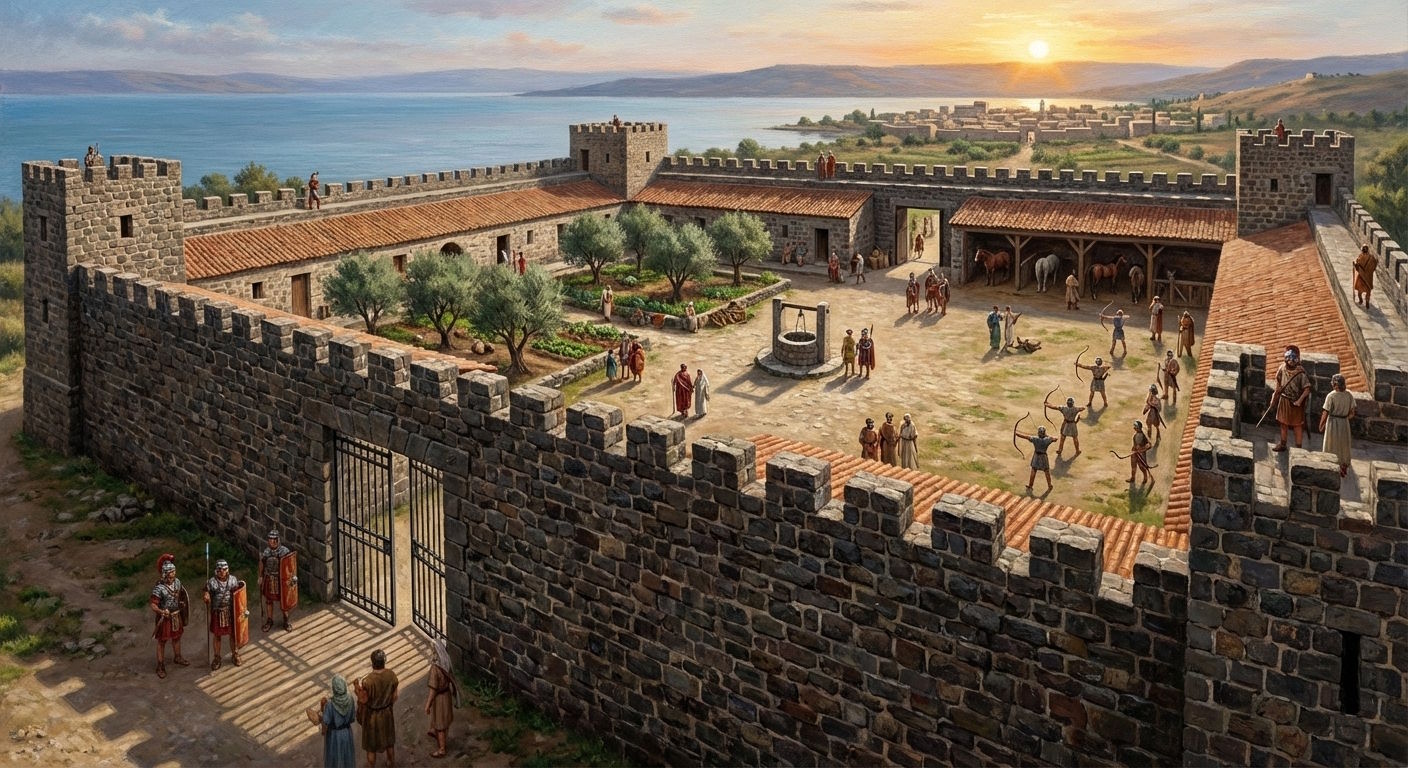
Unlike other important settlements, the Roman garrison of Capernaum was probably not located outside the city. That is, it did not form a “camp” in the style of traditional Roman military fortifications. Nor did the troops stay in the homes of civilians, following the custom known as militare hospitium, which Justinian’s code would later call metata. In the case of Capernaum, from the time of Pompey’s conquest, the invaders simply requisitioned some of the existing properties, renovating them and converting them into regular barracks. It is quite likely that it was located next to the road or Via Maris and that its dimensions were sufficient to house the cavalry cohort known as the Cohors Ituraeorum.
We can imagine the barracks as an enclosure protected by high walls, about five meters high, solidly built with the abundant black basalt stone of the region. The facade would have featured a large iron gate that remained open when there was no danger.
Barracks, as far as we know, were usually rough and austere, with an area designated for dormitories and several turrets at the corners of the square that formed the parade ground. We can estimate its dimensions to be about sixty meters on each side. There was almost certainly a well within the compound, a key element for maintaining a siege if necessary, and perhaps an area designated for vegetable gardens, so as not to depend on external sources for supplies. The stables on one side and the training area on the other likely completed all the necessary facilities.
In Jesus’ time, one of the officers in charge of this garrison was a prominent figure. His name and rank are given in The Urantia Book: Mangus, a centurion or captain of the Roman guard (LU 147:1.1-3), meaning he was one of the six centurions who led the cohort. The story is well known (Lk 7:1-10; Mt 8:5-13). Jesus highlighted this man’s extraordinary faith. The Master found no one among his people with faith as great as that demonstrated by this Roman.
¶ References
- Emil Schürer, History of the Jewish People in the Time of Jesus, Ediciones Cristiandad, 1985.
- J.J. Benítez, Caballo de Troya 5 (Trojan Horse 5), Editorial Planeta, 1996. In this novel, the author provides an imaginative description of the Capernaum garrison, which has also been used in this article. However, he mentions a Cohors Italica as stationed in Caesarea, whereas Schürer calls it Sebastenorum.