[ p. 182 ]
We have so far studied in a most general way the more important geologic events of the earlier half of the earth’s history. Now we begin to take up in more detail the remaining chronology, and first the historical geology of the Paleozoic era. The position of this chapter in the volume shows at once that the greater part of the earth’s known history is subsequent to the pre-Cambrian, and this far more exact knowledge is due not only to the better preserved rock record, but especially to the abundance of fossils. The strata of the later half of the earth’s history are also usually far less altered and deformed by internal forces. The older formations, on the other hand, even if they had not been so much metamorphosed, would still lack fossils in abundance, for the reason that during the hrmdreds’of milli ons of years which they represent the organisms were devoid of preservable parts.
Definition of Paleozoic. — Upon the vastly thick masses of ancient igneous, sedimentary, and metamorphic rocks of Archeozoic and Proterozoic times, rest in usually marked unconformity the abundantly fossiliferous strata of the Paleozoic era. In the past century, geologists in general held that these rocks contained the evidences of the first life that appeared on the earth. Accordingly, Sedgwick in 1838 named the lower part the Paleozoic series, the name meaning ancient life, as he then believed it to contain the first life. Since then, however, as previously shown, fossils have been found in the Proterozoic, and it is now held that low forms of life lived also in the Archeozoic. Nevertheless, the term Paleozoic is not only retained for the part defined by Sedgwick, but has been extended until it is now understood to embrace all of the time and rocks between the older Proterozoic era and the younger Mesozoic era. The Paleozoic is at present regarded as the third geologic era in the history of the earth, or the third volume of the “ book of geologic time.”
Paleozoic of North America. — North America is wonderfully rich in a long succession of Paleozoic formations that abound in fossils, and this is especially true for the eastern half of the United States and Canada. No other continent is so rich in this history.
[ p. 183 ]
In addition, the Paleozoic strata of Europe are as a rule much disturbed and metamorphosed, making them very difficult to interpret, while in North America, over vast areas west of the Appalachian Mountains, the highly fossiliferous strata lie almost as they were deposited, although of course much consolidated by time. When these strata weather away, they jield their entombed organisms freely, and innumerable kinds of fossils are to be had by those who will look for them throughout the great valley of the Mississippi River and in southern and medial Canada to beyond the Arctic Circle.
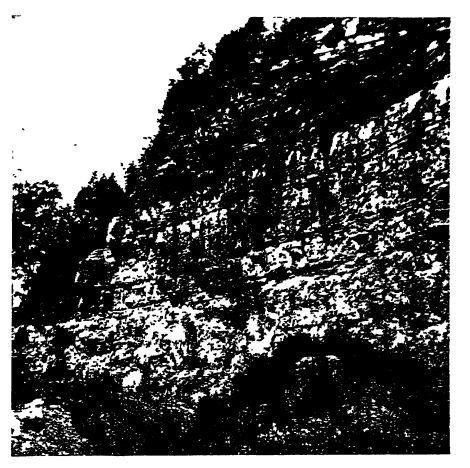
With the beginning of Paleozoic time, this abundance of fossils furnishes a ready and reliable means of correlating the formations not only from place to place but even between continents. Hence we have m most post-Proterozoic strata a far more detailed classification of the events, and also a greater knowledge of two parallel evolutions, that of the rocks and that of the organisms. As these two sets of phenomena are constantly interacting, they are checks [ p. 184 ] upon each other in the determination of the actual events which happened at any time at a given place. In other words, because of the abundance of fossils in the Paleozoic and subsequent times, we have a ready means of deciphering a much more detailed history of the earth and its life than is the case in the earlier eras.
Imperfection of the Paleozoic Record. — Nowhere is there a complete record of Paleozoic formations, and even when the knowledge that has been gleaned from a study of all the North American exposures is pieced together, the record is still incomplete, though the gaps are not thought, as a rule, to represent long intervals of time. The longest array of superposed strata is to be seen in the area east of the Mississippi River, and in the Appalachians from northern Pennsylvania south to northern Alabama. When the formations here are studied in detail, and widely separated places are compared with one another, it is found that certain formations of one section may be greatly thickened or thinned or even completely absent in another (see Fig., p. 183). Even the famous sequence in the state of New York, the “ Standard Section ” with which the Paleozoic strata of America are compared and correlated, is now known to be very much interrupted by breaks or intervals of erosion.