[ p. 185 ]
¶ Part I. Cambrian in General, and the Lower Cambrian
Origin of the Term Cambrian. — The Cambrian period of time or system of rocks takes its name from Cambria, the Roman name of northern Wales, where the deposits were first studied by Professor Sedgwick of Cambridge University in 1822. The term Cambrian, however, proposed in 1835, -was intended to apply to what’ is now called the Ordovician (Champlainian) period, the one following the Cambrian, and although Sedgwick often objected to the transposition, brought about in the main by his friend Sir Roderick Impey Murchison, this misapplied usage has unfortunately persisted.
In Bohemia there is no Lower Cambrian, but Middle Cambrian is well developed, and here, through the great industry of a Frenchman, Joachim Barrande, who spent the greater part of his life as an exile at Prague, the sequence and abundant life of this time were made known. The fossils came to be widely spoken of as the “ Primordial Life.” Finally, a still more complete fossiliferous sequence was determined in Sweden and later in Newfoundland and these areas became standards for international correlation. However, nowhere is there a longer or a more complete sequence of fossiliferous Cambrian formations than in the Cordilleran region of North America, and to-day, due almost wholly to Charles D. Walcott, these are our chief standards of correlation.
[ p. 186 ]
Significant Things about the Cambrian Period. — The Cambrian period is the first one in the Paleozoic era, and is generally separated from the older rocks by one of the most marked unconformities known, representing a very long erosion interval. It is also the first period in earth history with an abundance of life preserved as fossils. This life consists entirely of marine invertebrates, and includes representatives of all of the more fundamental types, thus implying a long antecedent evolution. There is no trace of land animals, or of land plants, although the latter may have been present.
Still another striking fact about the Cambrian period is that the Cordllleric and Appalachic sinking areas, or geos 3 Ticlines, are now fully formed seaways. Following the geosynelinal seas of Lower Cambrian time came marked spreading of these waters across the continent as epeiric seas, beginning in the late Middle Cambrian and attaining greatest flooding in early Upper Cambrian times.
Finally should be pointed out the striking topographic fact that when the Lower Cambrian seas entered the Appalachic trough from the south, their waves broke to the east against a mountain tract as grand as the present Alps of Europe. Like all mountains, however, their lofty beauty lasted but a short time geologically, and the close of the Lower Cambrian found them reduced to lowlands (see map, p. 193).
Cambrian Life. — Of Cambrian animals, it is estimated that about 1200 have been described from North America alone. From all coimtries together there are known not less than 1500 species, fully 90 per cent of which are trilobites and brachiopods, the trilobites making up about 60 per cent of the Cambrian faimas, and the brachiopods about 32 per cent. While this life is primitive in organization, its elements are so diversified as to indicate at once that it had a very long previous history. It is almost wholly a life with locomotive freedom. In the succeeding chapters we shall see that the marine invertebrates become more and more fixed to the ground, tending toward what John M. Clarke has recently termed “ dependent life,” which gives rise to no higher classes of animals .
Absence of all Land Life. — Not the slightest evidence exists showing the presence of land plants in Cambrian tune, and the same statement is applicable to the greater part of the succeeding Champlainian. When, however, we consider that only the lower tjrpes of land plants could then have existed and that these were soft and nearly devoid of woody material, the only preservable portion, there is nothing extraordinary in this extreme imperfection of the plant record. On the other hand, the thoroughly decomposed [ p. 187 ] nature of the soils of this time, as seen in the mudstones largely made up of kaolin, appears to indicate that the lowlands at least must have been clothed with vegetation.
There is also not a trace of land animals, either of fresh waters or of the dry lands, in the Cambrian. The first clearly ascertained evidence of such does not appear until Silurian time.
¶ The Lower Cambrian
The Lower Cambrian is restricted in eastern North America to the Appalachic geosyncline and its rocks will be referred to as the Taconian series. The strata of the Cordilleric geosjmcline in western North America are embraced under the term Waucobian series.
The Term Taconian. — It is one of the glories of American Geology that the oldest Paleozoic rocks were first pointed out by a member of the great New York State Survey, Professor Ebenezer Emmons. The unravelling of the Taconian began in 1837, and Emmons’ announcement of it as a system was made in 1841, and was followed by a different definition in 1842. But American geologists for more than half a century would not accept his system, because the Taconic Mountains of eastern New York, its type area, are in one of the most difficult regions possible for interpretation. Here the strata are not only closely folded and repeatedly over-thrusted, but have been much altered in the making of the mountains, so that their present condition is one of almost hopeless confusion. This difficult field condition was further enhanced by the various interpretations of the geologists of the time. It is only in recent years, through the growth of our science from facts garnered in all parts of the world, that a greater unanimity of opinion has come about, and some of the Taconian formations have been seen actually to have the age relations that Emmons attributed to them. He held that the Taconian rocks are older than the Potsdam sandstone, a formation now referred to the uppermost Cambrian, and that they are at the base of the Paleozoic series, conclusions that are true at least in part. It is on this residuum that the validity of the Taconian rests, and it must be recognized as at least a series term in good standing.
The Taconic controversy is well set forth by George P. Merrill in his interesting book, The First One Hundred Years in American Geology (Yale University Press, 1924).
Taconian Sediments. — In the Appalachic trough the Lower Cambrian thicknesses in places are great. In Vermont and northeastern New York there appear to be about 1500 feet, mainly of slate and quartzite, with an additional 1200 feet of marble and dolomite. This material was very largely derived from the west. In eastern Pennsylvania, western Alaryland, and Virginia there are from 1000 to 5000 feet of limestone at the top with 4700 feet of sandstone and shale below. Keith thinks that all these"sediments also came from the west, but farther south in the trough the deposits (Ocoee) came from the east.
Waucobian Formations. — In the Cordilleric sea the Lower Cambrian had by far the best development. Here Walcott has measured sections of strata ranging from 1500 to 5670 feet in thickness. The greater lower portion consists [ p. 188 ] usually of almost unfossiliferous sandstones and it is above in the shales and limestones that the fossils are common. All of this material came from the western land Cascadis.
Walcott tells us that in the Cordilleric trough the Cambrian sediments are often the Proterozoic residuals worked over by the advancing Paleozoic sea and deposited almost conformably on the underhung and geologically undisturbed Proterozoic formations. In such instances, where the waves and current action were weak, the passage between the strata of the Proterozoic and Paleozoic is almost imperceptible and often could not readily be distinguished if it were not for the abundant remains of animal life in the Cambrian. Nevertheless, there is a time break here of vast duration. It may, however, be said that as a rule the sandstones of the Proterozoic are dirty and rich in feldspars, and it is the greater or complete absence of the latter in the Cambrian sandstones that helps to distinguish them from the older ones.
The Early Cambrian Ocoee Mountains. — In northwestern Georgia, eastern Tennessee, and western North Carolina, the strata known as the Ocoee and Chilhowee series have long perplexed geologists as to their geologic age. They form a most interesting series of formations highly variable in character and thickness from place to place, and consist in the main of thin and very thick conglomerate zones wedging in and out of a vast pile of feldspathic sandstones that have but few mudstones and least of all limestones. The average thickness in ap. area of over 200 miles long by 30 miles wide ranges between 9000 and 13,000 feet. After much arduous labor in the field, Arthur Keith, on the basis of field relations and fossils found near the top of the series, was finally able to demonstrate their age as Lower Cambrian.
These coarse materials of the southern Appalachic trough, Joseph Barrell, in an impublished manuscript, states came from a highland area that then stood to the east, and one not at all unlike the present Alps. The mass of rock which was eroded to furnish what is now seen in the Ocoee and Chilhowee series he estimates was equivalent to a block 200 by 30 miles in extent, and 28,500 feet thick. The Ocoee mountains stood where the Piedmont plateau now is.
The local climate is thought to have been cool, with a moderate rainfall, but there is here no evidence of a glacial climate or even of local glaciers.
Into the valleys of this eastern highland the early Taconian sea flooded, drowning their western ends (see map, p. 193). Early in this sea-invasion the rivers were of the torrential type, and deposits coarse in character rapidly jfilled the drowned river valleys. More than two thirds of the unfossiliferous OcoeeChilhowee series is of fresh-water origin, and it is only toward the top of these formations in widely spread shales and cleanly washed sandstones that a few marine fossils of late Lower Cambrian age have been discovered.
Life of the Lower Cambrian. — The known life of the Lower Cambrian is wholly of the seas. This animal life, consisting entirely [ p. 190 ] of marine invertebrates, ranges from simple sponges to complex forms of Crustacea. This statement does not, however, imply that all of the known kinds of invertebrate anim als, fossil and recent, were already represented in the Lower Cambrian, only that the main stocks, the phyla of the scheme of classification, were here in well developed foims. More than one half of the common animals are trilobites (crab-like forms fully described in a later chapter), and 32 per cent are brachiopods (two-shelled animals without pearly shells, described in Chapter XVII). As the former are the characteristic and most common fossils of the Cambrian, we speak of them as the dominant animals of this time. See Figs., pp. 189, 201. The life of the Lower Cambrian seas is very much alike not only throughout America, but in Europe, Asia, and Australia as well. It is therefore said to be cosmopolitan in character.
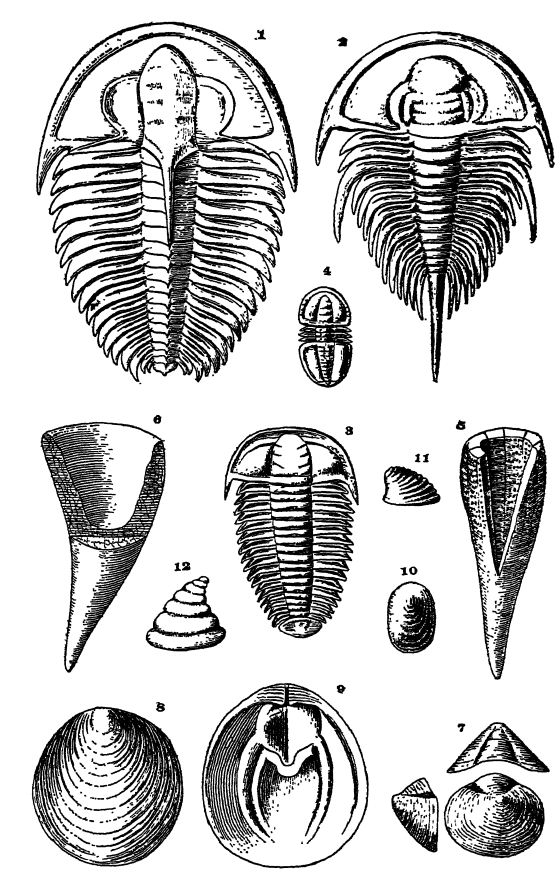
Fig. 1, Holmia hrOggeri, x 2, Olenellus ihompsoni, x I; 3, Atops trllineatus; 4, Eodiscus specioms; 5, ArchoBocyathus renssdoericus, X 3; 6, 4. profundus; 7, Paierina bellat x 4; 8, 9, Obolella crassa, x 3; 10 to 12, Stenoffieca rugosa. All after
The trilobites were, as has been said, the most characteristic animalR of the Lower Cambrian. Nearly all of the many brachiopods had shells made of phosphate of lime, while those of the later Cambrian and subsequent periods were of carbonate of lime. The limpet-like gastropods (shells like the snails, drills, and periwinkles) were rare and of the most primitive type; mth one exception, they were hood-shaped and not spirally coiled as is usually the case among these animals (Pl., p. 189, Figs. 10-12). The conical three-sided tubes known as Hyolithes were abundant (Pl., p. 201, Fig. 8). They are related to the gastropods. There were still other kinds of animals, but no mussel shells, and only the most diminutive and primitive cephalopods (Salterella and Volborthella).
One of the most interesting types of Lower Cambrian fossils is casts of jellyfishes (medusae), whose original composition is 95 per cent or more water. The illustration (Fig. 19, p. 155) of a living Aurelia shows what these Cambrian jellyfishes looked like. They are common as fossils in Vermont and Alabama.
In the oldest of the Lower Cambrian deposits in California and Nevada, fossils are scarce and all that have been found are two forms of trilobites. Near the top of the Lower Cambrian, however, fossils are abundant and consist of trilobites, snail-like forms, brachiopods, and the coral-like Archaeocyathidae. In Inyo County, California, occur limestone reefs made up of these coral-like animals, and their fossils are found in many parts of the world; Labrador, with reef limestones up to 50 feet thick; New Siberia, in 70° north latitude; Sardinia; Spain; Australia, with limestones fully 200 feet thick, over an extent of 400 miles — the greatest Paleozoic reefs known anywhere; and finally in Antarctica.
[ p. 191 ]
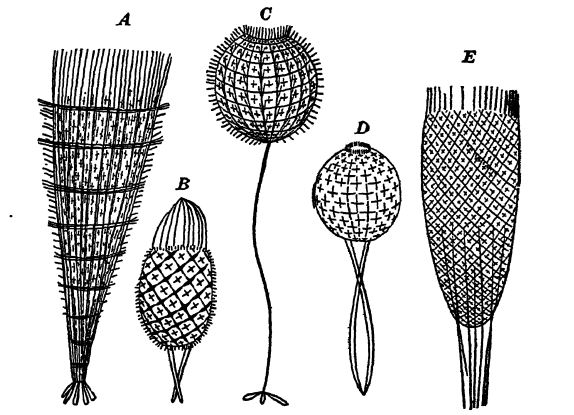
Archaeocyathids (from Greek words meaning primal and cupi. — These are the most ancient and the simplest coral-like animals known, and are almost restricted to the Lower Cambrian fsee Pl., p. 1S9, Fig. 5 - 6 1 . They are rare in the earlier part of the epoch. In general, they are single polyps, though some are thought to be compound animals. Single polyps sometimes attain a length of 11 inches, while the saucer-like forms may be as wide. Their form is most often that of two cups placed one within the other, and their skeleton consists of granular calcite, not of spicules. The very deep inner cups are without spines or septa and are pierced with perforations, and the .space between the two cups is more or less subdivided by radial partitions and horizontal bars or plates, which are also perforated, the pores being arranged in longitudinal series. In other forms the outer wall may be thick and porous, or have wormlike canals. The basal attachment of the corallum is also more or less thickened by vesicular partitions.
The arehaeocyathids have been compared with calcareous algae, such as living Acetabularia, but in general their skeletons appro.ximate more closely that of the Anthozoa, though in general shape, protean forms, and methods of attachment they are distinct from the usual ecelenterates and in certain characters they resemble the sponges. According to some writers, they appear to hold an intermediate position between the corals and the sponges, by others they are regarded as sponges, but in this book they are looked upon as more probably belonging to the ecelenterates.
Significance of Lower Cambrian Life. — As trilobites, which belong to the highest division of invertebrate animals and are therefore really complex organisms, were the dominant life of the Lower Cambrian, it is plain that life could not have originated in this time. Even though it is now established that a variety of animals must have been present in the Proterozoic, still the change in the life of the Lower Cambrian, as compared with that of the former era, is very remarkable. We have seen that in the Proterozoic the known organisms are essentially lime-secreting seaweeds and worm tubes made of chitin, yet in the Lower Cambrian there was an abundance of very varied and highly complex animals with skeletons of chitin and carbonate of lime. These facts mean, on the one hand, that there is a very great loss of record in the geologic column between the latest Proterozoic and the oldest Cambrian deposits, and on the other hand, that since the time of the Proterozoic, invertebrate a nimals had taken upon themselves an external skeleton, either of chitin or carbonate of lime.
Marine Life Zones of Lower Cambrian. — On the basis of characteristic trilobites, the Lower Cambrian is divided into five life zones. The oldest — (1) Nevadia zone — is restricted to the Cordilleric trough; the next three (2) EUiptocephala zone, (3) Callavia zone, (4) Olenellus zone — are common to this and the Appalachic trough; while the youngest one — (5) Protolenus zone — is restricted to the Atlantic province of Cape Breton.
[ p. 192 ]
Lower Cambrian Paleogeography. — The paleogeographic map of the probable seaways of this time is shown on p. 193. We know that the Pacific Ocean in earliest Lower Cambrian time first invaded the land in the Great Basin area and gradually spread northward, forming throughout the Cordilleric geosyncline a sea which finally united with the Arctic Ocean. Some time after the appearance of the western Cordilleric sea, a similar waterway appeared to the west of Acadis and Appalachis, finally extending as a narrow trough — the Appalachic geosyncline — from Alabama to southeastern Labrador. At its maximum the Lower Cambrian inundation did not submerge more than 18 per cent of North America.
The North American continent then, as now, was bordered by highlands, but these lands extended out into the oceans hundreds of miles farther than do the present shore-lines. On the west was the extensive land of Cascadis, and on the east were two land masses, the southern and greater one being Appalachis united with Antillis, which was more or less continuous with the northeastern one, known as Acadis. It was from these marginal highlands that came nearly all the sediments of the inland seas, the exception being in northern Appalachis, where the debris came from the west. The greater northern half of North America, the Canadian Shield, was also land, but it was a low land and furnished only a small part of the sediments of Cambrian time.
Lower Cambrian Climate. — From the world-wide distribution of the reef-making coral-like animals of this time described on a previous page, it is evident that the waters of at least the later half of the period were warm and equable over most of the earth, since these animals lived then not only in the equivalent temperate regions of the present but also in both polar areas. Then, too, the wide occurrence of limestone-depositing seas in the succeeding Cambrian, with an even greater abundance of varied life, is further evidence of mild climate over most of the world, not only for Lower but as well for all Cambrian times.
It should be pointed out once more that the so-called Lower Cambrian tillites of esistem Australia, and the feldspathic (Sparagmite) series of the “ Eo-Cambrian ” of central Norway are not clearly established as of the time of the Lower Cambrian. They are for the present better referred to the Proterozoic, and in Chapter XII are discussed at greater length. However, even if the evidence of these tillites is admitted to denote Lower Cambrian, there would still be time enough for the oceanic waters to have again become warm by the time of the appearance of reef limestones made by the Archaeocyathidae.
Lower Cambrian Emergence. — Toward the close of the Lower Cambrian, the Appalachic geosyncline was drained of all of its [ p. 193 ] [ p. 194 ] marine waters, and a long time ensued before another cycle of deposition took place in this trough. What took place at this time in the Cordilleric geosyncline is not clear. In the most continuous area of Cambrian deposition — Mt. Bosworth, British Columbia — Lower Cambrian fossils are present to the top of the Mount WTiyte formation, then for 500 feet there are no fossils, and above comes an unmistakable Middle Cambrian fauna (Albertella fauna). Walcott holds that there is continuous deposition here and expects transitional faunas to turn up in this 500-foot interval of arenaceous limestones, uniting the older ones with those of the Middle Cambrian.
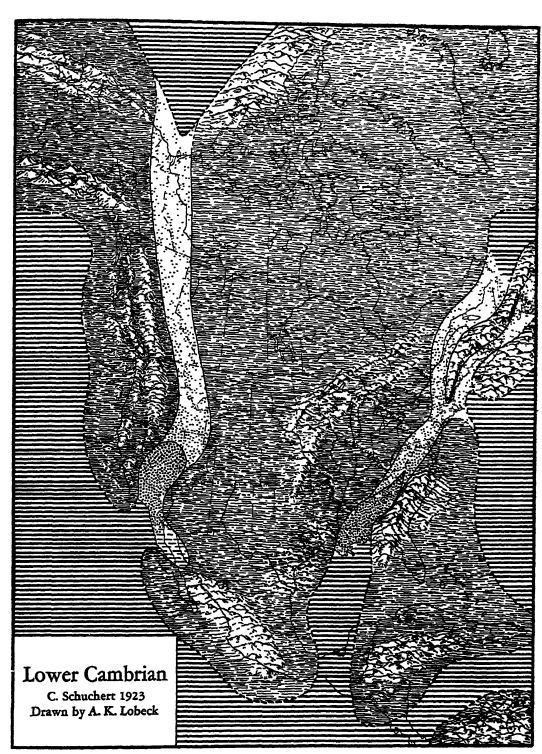
Epeiric seas dotted; oceans ruled; lands in wavy lines. See Plate 6 (p. 195) for Cambrian paleogeography.
The probable geography of Lower Cambrian time, without most of the drainage, which is wholly unknown. The seas are described on page 192, and the map shows the earliest and latest floods. The Ocoee mountains of Appalachis are described on page 18S, and the Killamey mountains of Ontario on page 171. The other mountain areas of this time are more or less hypothetic.
The land was devoid of all vegetation, and the climate mild and more or less arid.
As previously stated, at the close of Lower Cambrian time the Appalachic geosjmcline was drained of its marine waters, and the sea did not reenter it imtil Upper Cambrian time.
¶ Part II. The MronuB and Upper Cambrian
Physical Characteristics
During Middle and Upper Cambrian times most of North America appears to have been a lowland devoid of scenic beauty. Accordingly it was possible for the oceans to transgress the lands widely, as we shall see they did. If there were any highlands at all, they were in the bordering lands of Cascadis, Appalachis, and Acadis. In the center of the great interior lowlands stood a low upland consisting of the roots of the Killamey Mountains (see p. 193) that trended east and west across what is now the Lake Superior country.
The longest and most complete Cambrian sequences of strata with entombed fossils occur in the Cordilleran region of North America, and here it is believed there was continuous deposition throughout the Cambrian period. From the Middle into the Upper Cambrian all stratigraphers are agreed that the seas continued uninterruptedly, and a few even hold that there was in most places an unbroken recording of strata and fossils into the Champlainian (Ordovician). The latter view is, however, not yet established.
Close of the Middle Cambrian. — In all places where the Upper Cambrian strata repose on those of Middle Cambrian time it is seen that the life of the one series is as a rule sharply distinguished from that of the other; in other words, there are no known transition faunas of this time in eastern America preserving the stages of evolving forms, and this is thought to indicate a break in deposition and [ p. 195 ] [ p. 196 ] an absence of faunal record. Only in the Cordilleric trough occur transition famias; in the greater part of the Appalachic geosyncline the Upper Cambrian rests on the Lower Cambrian with all of the Middle Cambrian absent. This is evidence that in the latter region the elevation brought about by the Lower Cambrian emergence had not yet been overcome by erosion or subsidence. However, there are so far no data sho’R’ing that either Appalachis or Cascadis had been further elevated at the close of Middle Cambrian time.
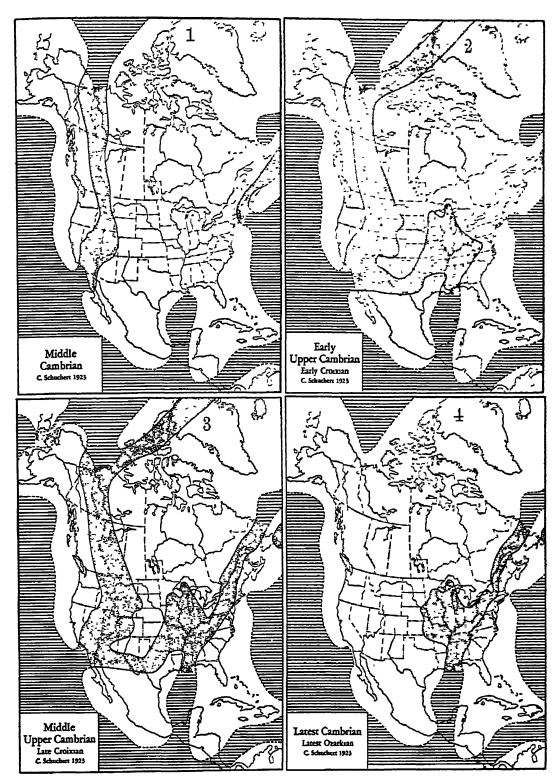
Epeiric seas dotted; oceans ruled. See Plate 5 (p. 193) for Lower Cambrian physiography.
Note that the Cordilleric, Franklinic, and Appalachic geosynclmes are m full development at this early time. The Acadic geogyncline had water in it only in Lower and Middle Cambrian time.
Inland Seas. — During the Lower Cambrian, the seas were restricted to the Cordilleric and Appalachic geossmclines, but in Middle Cambrian time the latter trough was drained of all marine waters. The Cordilleric geosyncline, however, continued its seaways throughout Middle and Upper Cambrian time, laying down from 5000 to 8000 feet of usually thin-bedded limestones, but very little shale and almost no sandstone.
Late in the Middle Cambrian the Cordllleric marine waters began for the first time to spread across the continent toward the east, and throughout most of Upper Cambrian time epeiric seas were of wide extent, especially in the area of the Mississippi basin. In the Arbuckle Mountains of Oklahoma there is no less than 3000 feet of limestones and dolomites. The Appalachic trough was also reoccupied by these waters of Pacific origin, depositing magnesian limestones with some shale. In Alabama the thickness is about 4000 feet, and this depth remains fairly constant all the way north to Chambersburg and Mercersburg, Pennsylvania. When the flood was at its widest, it covered more than 30 per cent of North America (Pl., p. 195, Fig. 2).
Croixian Seas. — The early Upper Cambrian is also known as the Croixian epoch (pronounced Croyan; from the St. Croix Eiver of Wisconsin), and in the upper Mississippi valley sandstones and not limestones are the dominant strata. Here these sandstones are wide-spread and in Wisconsin their thickness is about 720 feet. They are the residual materials or the loose rock and soil (regolith) of a granitic lowland, the Canadian Shield, that had for a very long period undergone erosion. These sands are usually well rounded with lusterless surfaces, and hence are thought to be the sands of ancient deserts or at least of dunes rewashed into the deposits of the Croixian series. In small amounts these sands reach as far as the Ozark region of southern Missouri, where the Upper Cambrian deposits are thin and consist mainly of limestones alternating with sandstones.
[ p. 197 ]
The Croixian seas were prevented from spreading north of the region of Lakes Superior and Huron the east-west trending Killarney Alountains that came into existence late in Proterozoic time (Collins 1922). They were not reduced to a peneplain until late in Champlainian (Ordovician) time, since the sediments of the Richmondian were the first to transgress them.
It may be well to state here the formations included by Ulrich in the Crobdan epoch of the upper Mississippi Valley: Mt. Simon, Eau Claire, Dresbach, Franconia-Mazomanie, St. Lawrence, and Jordan.
Some geologists think that the upper Keweenawan and Lake Superior sandstones are river deposits of Croisdan time, but as yet the proof is not at hand for this correlation.
Ozarkian Epoch. — The late Upper Cambrian constitutes the Ozarkian epoch. In 1911, Ulrich proposed this name (from the Ozark uplift in southern Missouri) for a series of formations that had heretofore been referred mainly to the Cambrian and in part to the Champlainian. Walcott accepted Ulrich’s conclusions in 1923, regarding the Ozarkian as the final series of the Cambrian, and it is so placed in this book.
The early Ozarkian sea invaded the central part of the continent* from the south, and at about the same time spread into the Appalachic geosyncline. The Cordilleric trough was also invaded. During the late Ozarkian the seas were greatest in the Mississippi Valley and the southern Appalachic trough. (See p 195.)
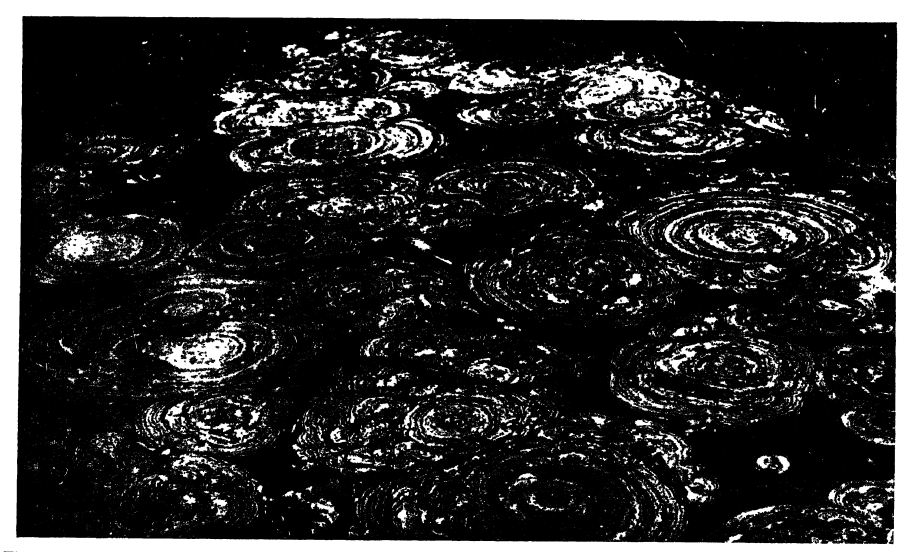
As a rule, Ozarkian fossils are scarce, or at least hard to get, because most of the formations are dolonutic, and yet Ulrich has about 200 species. Walcott (1923) lists 125 forms alone from the older Ozarkian and of these about 70 are trilobites, 25 brachiopods, 20 gastropods, 4 cephalopods, and 2 bivalves. The most prevalent organisms are lime-depositing seaweeds (Cryptozoon, see Fig., p. 198).
In Missouri, the Ozarkian series is mainly of the later half (Gasconade, Proctor, and Eminence, with a combined thickness of 525 feet), while the earlier portion is only partially present in the Potosi formation (300 feet). In Wisconsin, the thin Madison and Mendota are below, then comes a long break, and at the top is the Oneota. In eastern New York, the Little Falls, Hojii, Theresa, and Potsdam constitute the lower Ozarkian; their equivalents Keith has shown to be also present in northern Vermont. In central Pennsylvania, the lower Ozarkian has a thickness of 2250 feet. The longest and thickest development, 5550 feet, occurs in Alabama. In Nevada, the Goodwin formation is 1500 feet thick, while the St. Charles of Utah, and the Chushina and Mons of Alberta have similar depths. The Cordilleran formations are all of early Ozarkian time.
[ p. 198 ]
[ p. 199 ]
At the close of the Upper Cambrian, there appears to have been a very wide and probably a complete retreat of the epeiric seas from the interior parts of North America.
Establishment of the Lime-secreting Habit. — The epeiric seas of Middle and Upper Cambrian time, as we have seen, deposited a very great amount of rocks consisting of carbonate of limp ; this means not only that the waters were clean of muds but that their temperature was warm as well. Life was more prolific in the Upper Cambrian and there was also an abundance of invertebrate animala with lime carbonate skeletons. In other words, for the first time in the history of the earth there was an abundant molluscan fauna, and the greater abundance of carbonate of lime in the seas established the lime-secreting habit permanently in many classes of animals.
¶ Life of the Middle and, Upper Cambrian Epochs
The seas of Middle and Upper Cambrian time swarmed with a great variety of life, chiefly trilobites and brachiopods. In the Upper Cambrian the gastropods begin their ascendency, and the same is true of the cephalopods, though to a less striking degree. The bivalved molluscs and crustaceans, the lamellibranchs and ostracods make their appearance in the Ozarkian epoch.
[ p. 200 ]
Beginning with the Middle Cambrian, instead of the cosmopolitan faunas of the preceding epoch, there are now’ clearly two realms, the greater one of the Pacific, recently named Albertan by Grabau, and that of the North Atlantic, first developed by G. F. Matthew from the region about St. John, New Brunswick, and named Acadian by James D. Dana in 1874. During hliddle Cambrian time the Cordilleric sea had about the same limited geographic extent as that of the Lower Cambrian, while most of the Appalachic geos3mcline appears to have remained continuously above sea-level.
Albertan Faunas of the Cordilleric Sea. — The western or Cordfileric limestone-making seas were prolific in life. The faunas of the Albertan seas were distinctly of the Pacific realm, similar ones being known in China. Trilobites were dominant, TnakiTig at least half of the faunas, and there was a greater variety of these interesting animals than in the Lower Cambrian (Pl., p. 201, Figs. 1-4). Large-tailed forms were characteristic of the Pacific waters, and as the genus Bathyuriscus was the most prevalent form at this time, these waters are sometimes called the Bathymiscus realm. The brachiopods were also far more numerous tLq.r» in the Lower Cambrian, but still small, and almost all of them not only had phosphatic shells but were very similar to those of the preceding epoch.
The fauna of the Cordilleric trough was marked by the trilobites Olmoides, AlberllOa, Dorypyge, Nedllnvs, Ogygopsis, Asapllscm, and Bathyuriscus, and [ p. 202 ] by the brachiopods Lingtddla, Micromllra, Acromele, Nisusia, and BMngaella. HytAilhes was common and there was a somewhat greater variety of gastropods.
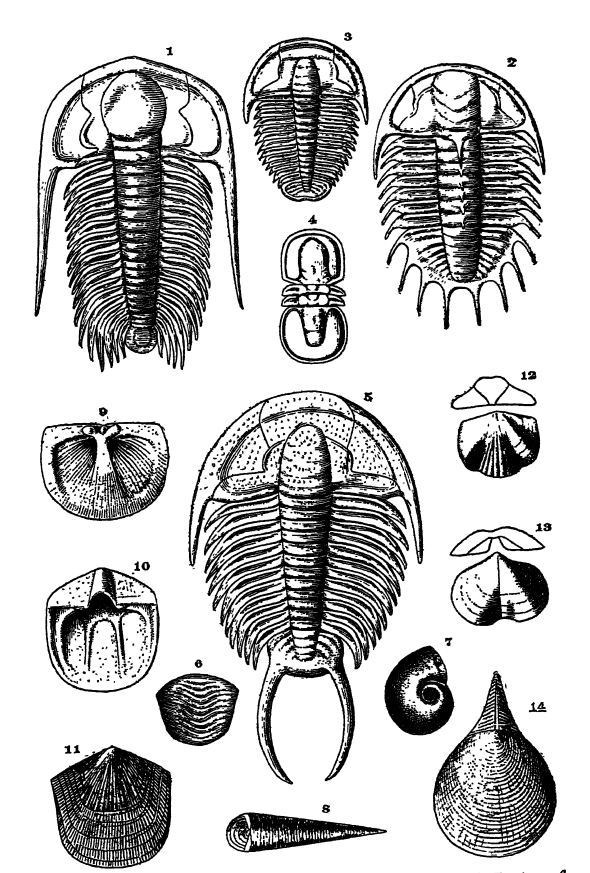
Fig. 1, Paradoxides harlani, x ¼ 2 Dorypyge curticei x ½; 3, Ptychoparia kingi x ¾ 4, Agnostus montis, x 3; 5 Crepicephalus texanus, x ½; 6, 7, Owenella antiquata, x 2; 8, Hyolithes primordialis; 9-11. Billingsella coloradoensis, x 2; 12, 13, Huenella texana, x 1 ½ Lingulepis acuminata, x 2. Mostly after Walcott. (201)
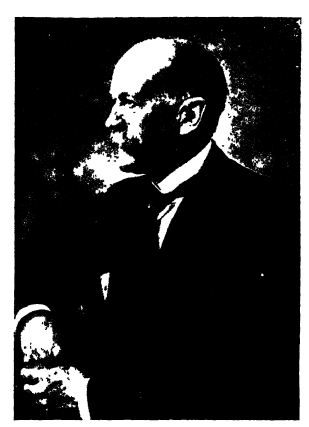
Burgess Shale Middle Cambrian Fauna. — In the Selkirk Moimt.a.ing of British Columbia, famed for scenic grandeur and for alpine glaciers, has been found the most interesting locality in the world for fossil invertebrates. The mountains here are made up largely of Cambrian strata, which attain a thickness of at least 13,000 feet. The Burgess fossil community lies in a bed of hardened Middle Cambrian shale some 7 feet thick, situated on the southwestern flank of Mt. Wapta, about 3000 feet above the town of Field, and 8000 feet above sea-level. This wonderful cemetery of ancient sea animals was discovered in 1910 by Walcott, who has since quarried out hundreds of tons of rock (100 x 15 x 7 feet) that have netted him thousands of specimens, described under 70 genera and 130 species. The striking feature of the fauna is that the usual Cambrian forms, especially brachiopods and molluscs, are rare, while the common fossils are of soft-bodied creatures such as worms, etc., or chitin-covered crustaceans other than trilobites, stocks seldom seen anywhere by the paleontologist. All in all, it is a revelation of how very imperfect our knowledge is of the faunas of the past; what we have are but the “skimmings of the pot of time.”
Nearly all of the Burgess forms were devoid of calcareous external skeletons, and where there was a hardened covering it consisted in the main of chitin. It is natural to ask, therefore, Why were these usually thin-shelled and often soft-bodied animals preserved in the Burgess shale, while elsewhere the mud bottoms of the same age failed to retain traces of the organisms of their time of deposition? The Burgess shale is a blue-black, bituminous, aluminous mud with quartz of finest grain and some iron pyrite; it was probably laid down either in a depression of the sea bottom, a mud hole, or in a more or less enclosed bay [ p. 203 ] where the cuirentless waters were stale and devoia of free oxwgen. On such foul bottoms, reeking with carbonic acid, and lacking in oxygen, no animals can live except sulphur bacteria. However, almost none of the Burgess shale organisms were types which lived on the bottom, but they were almost all floaters and swimmers, inhabitants of the surficial sunlit and oxygenated sea waters. We must therefore conclude that they represent the life of the surficial waters which dropped into the asphyxiating death-trap near the bottom. These foul bottoms had no scavengers to eat the moribund, nor were there here the usually prevalent decomposing bacteria to destroy the organisms that fell from above into the verj- soft muds. Hence the bodies were quickly covered by the fine muds and underwent a slow chemical alteration, leaving behind a residuum, often as “fools gold,” or pjTite, which preserves in greatest detail the forms of the organisms entombed.
The Burgess fauna includes a varied array of siliceous sponges fmonactinellids and hexactinellids). There is one jellyfish (sej-phomedusan) and a remarkable variety of annelids preserving the entire body form. The most interesting organisms, however, are the crustaceans, twenty-eight genera of branchiopods, phyllocarids, primitive and specialized trilobites, and other generalized subclasses suggestive of links between some of the crustacean and araehnidan phyla. Curiously, no ostracods are known here or elsewhere until latest Cambrian time, but the forms so called are in reality phyllopods. Often the soft parts and the limbs are preserved, and there is even much structure at hand that reveals something of the internal organs (see Fig. B, p. 211).
Acadian Faunas of the Atlantic Area. — In the Acadian region and in Newfoundland, there are other Middle Cambrian de* posits, here essentially muds and sands, with distinctly different fossils, though of the same general faunal development as those of western Europe, in other words, of the Atlantic realm. They are characterized by the trilobite genus Paradoxides (Pl., p. 201, Fig. 1).
The trilobites of the Upper Cambrian, now more varied than before, made up over 50 per cent of the faunas (Pl., p. 201, Fig. 5), while the brachiopods with phosphate of lime shells were at the height of their development, and those forms having valves of carbonate of lime (Pl., p. 201, Figs. 9-13) were rapidly increasing. Then there were also a number of coiled and spiral gastropods (Pl., p. 201, Figs. 6, 7), and a few cephalopods of the pearly nautilus type as well.
Characteristic Fossils of the Croixan. — The more characteristic trilobites of the Central Interior sea and of the Cordilleric trough were Dikellocepkalus, Saukia, Illaenurus, Conaspis, and Crepicephalus, The earliest limulid (horseshoe crab) is present in Aglaspis and a eurypterid in Strabops. Of brachiopods there were Linnarssonella, Lingulepis, Obolus, Syntrophia, and Billingsella; of gastropods, Owenella, Holopea, and Pleurotormria- forms. Bottom-living graptolites made their appearance here in Callograptus.
[ p. 204 ]
¶ Green Mountains Disturbance
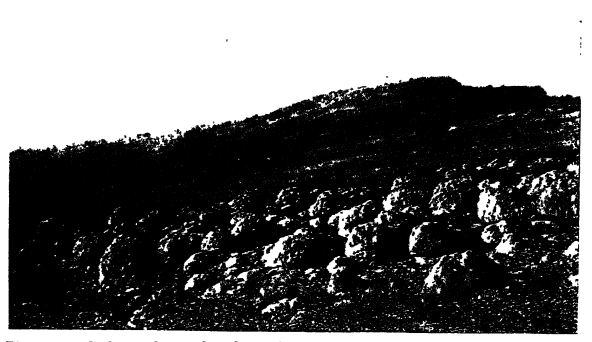
At the close of the Cambrian the New Brunswick geanticline (see p. 141) was reelevated and in Vermont and Quebec the Cambrian limestones were locally broken up to furnish the material for the thick and much localized limestone conglomerates (Beekmantown) at and near the base of the Champlainian. The fragments of these conglomerates are angular to subangular and rarely rounded; often the pieces are large, up to one or more tons in weight, while in Quebec and Vermont occur masses up to 150 feet in length. Some of these conglomerates have been interpreted as intraformational in character, but are now known to be true conglomerates and breccias, since they have both Lower and Upper Cambrian fossils. The conditions under which they were made are not yet clearly understood, but they appear to be rock slides of clijBf origin, the St. Lawrencic sea of early Champlainian time having undermined the cliffs, causing great masses of them to fall into the marine depths.
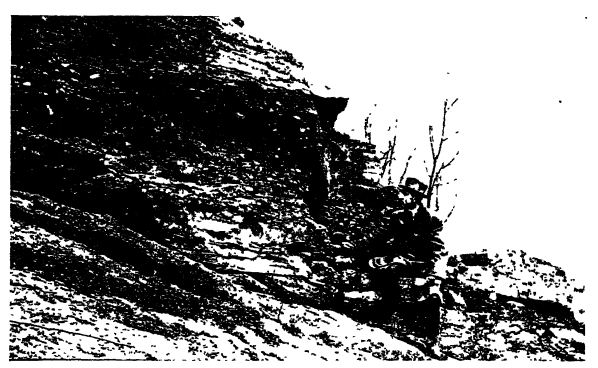
One of the striking facts in connection with this disturbance is the absence of early Champlainian formations in most of Nova Scotia, northern New Brunswick, and all of the New England States other than Vermont and western Massachusetts and Connecticut. These areas are the region of the New Brunswick geanticline, a highland that furnished the sediments and conglomerates for the [ p. 205 ] northern part of the Appalachic geosyincline of Champlainian time (Beekmantown). For easy reference, this time of land elevation at the very close of the Cambrian may be comprehended under the term Green Mountains Disturbance, since the Green Mountains are situated on the western border of the uplifted area.
There was also some elevation of the lands in western Europe previous to earliest Champlainian time. Holtedahl in 1920 writes of the rising of a vast northern land (northern Fennoscandis or the northern side of the Baltic Shield) at some time towards the close of the Cambrian and before the introduction of the Champlainian.
In the previous edition of this text-book it was stated that “ Apparently the closing epoch of the Upper Cambrian was a time of quiet emergence and withdrawal of the sea.” Further, that “ There was no mountain making at this tune in North America.” Since this was written, the unravelling of the very difficult geology of Vermont has made much progress and it now appears that there was some crustal movement in the area of the New Brunswick geanticline.
The facts on which these conclusions are based are as follows: The recent work of Arthur Keith west of the Green Moimtains of northern Vermont has shown that this region was either folded or vertically uplifted at the close of the Cambrian, that is, after Ozarkian time. Here the basal Champlainian conglomerates consist in the main of thin-bedded limestones and large blocks of a white marble. In some of the limestone bowlders occur Lower Cambrian fossils, but more commonly they are of early and late Upper Cambrian kinds. As the pieces are in the main angular and of all sizes, and clearly from Lower and Upper Cambrian formations, the evidence of the conglomerate appears to indicate that their sources were highlands shortly to the east, and that the transporting power may have been cliffs facing the sea.
In the area about Quebec, the Champlainian begins with thick unfossiliferous formations of coarse and conglomeratic quartz sandstones (Lauzon), followed by red shales (Sillery). Then come the Levis dark shales, with thin zones of limestones, having an abundance of Beekmantown fossils, and many zones of limestone conglomerates, the pieces of which have Cambrian fossils. These occurrences may be traced from Quebec along the south side of the St. Lawrence River northeastward for at least 200 miles, and at Bic the conglomerates are in grandest development.
¶ Collateral Reading
C. D. Walcott, The Faima of the Lower Cambrian or Olenellus Zone. U. S. Geological Survey, 10th Annual Report, 1890, pp. 509-763.
C. D. Walcott, Correlation Papers, Cambrian. U. S. Geological Survey, Bulletin 81, 1891.
C. D. Walcott, Paleozoic Intra-formational Conglomerates. Bulletin of the Geological Society of America, VoL 5, 1894, pp. 191-198.
C. D. Walcott, Mount Stephen Rocks and Fossils. Canadian Alpine Journal, Vol. 1, 1908, pp. 232-248.
C. D. Walcott, A Geologist’s Paradise. National Geographic Magazine, VoL 22, 1911, pp. 509-521.
[ p. 206 ]
C. D. Walcott, Cambrian Brachiopoda. U. S. Geological Survey, Monograph 51, 1912.
C. D. Walcott, The Monarch of the Canadian Rockies. National Geographic Magazine, VoL 24, 1913, pp. 626-639.
C. D. Walcott, The Cambrian and its Problems in the Cordilleran Region. Chapter IV in “Problems of American Geology.” New Haven (Yale University Press), 1915.
C. D. Walcott, Cambrian Geology and Paleontology Smithsonian Miscellaneous Collections, Vols. 53, 57, 64, 67, 1910-1922.
See also under Walcott in the various parts of the Bibliography of North American Geology published annually by the U. S. Geological Survey.
Arthur Keith, Cambrian Succession of Northwestern Vermont. American Journal of Science, 5th series, Vol. 5, 1923, pp. 97-139.
T. G. Taylor, The Archaeocyathinae from the Cambrian of South Australia. Memoirs of the Royal Society of South Australia, Vol. 2, Pt. 2, 1910, pp. 55-188.