[ p. 5 ]
All Nature is composed of matter and energy, and if there is anything else, science has not yet been able to demonstrate it. Matter is the stuff of the universe perceived by our five senses, and energy is the perceivable or latent (locked up) activity of matter. The sum total of either remains constant. Energy may, however, pass from one form to another, and the quantity present in any given form may and does vary.
Matter, whether of the earth or of the rest of the universe, is minutely granular, complex, divisible, resistant substance. There are three states in which it occurs, the solid, the liquid, and the gaseous.
Matter commonly exists in more or less complex substances -which can be broken up by chemical and physical means into at least eighty-six elements, including the unstable forms involved in radioactive disintegration (see page 264 of Pt. I).
Evolution of Matter. — All material nature is subject to the law of evolution or change, and in the main tends to evolve from simple to more complex conditions. The progressive change is from highly attenuated, atomically simple gases to more condensed and heating ones, and these in the course of a slow evolution change into more complex liquid and solid substances composed of one or more elements in combination.
Nature of Inorganic Matter. — Inorganic matter is lifeless material. In the crystalline form it begins in a nucleal molecule or particle; it enlarges by external addition or accretion alone, and there is hence no proper development, since the crystal is perfect, however minute; it ends in simply existing, and not in reproducing; and, being lifeless, it has no proper death or necessary dissolution. (Dana.) In other words, a crystal grows by the external addition of materials chemically the same, or of the same kind, as itself, arranged in layers, the body always retaining the same shape and constituticmand never exhibiting motion, assimilation of food, internal growth, or reproduction of its own kind.
[ p. 6 ]
Nature of Organic Matter. — The fundamental difference between orgajiic and inorganic matter, the quick and the dead, is that one is endowed with the quality of irritability, while the other is inert. In other words, the bodies composing the inorganic world are in the crystalline form, or in fragmented or altered condition; while the bodies of living matter have their substance organized into a cellular vital mechanism capable of response to external and internal agencies, and are therefore called organisms.
A living organism exhibits five inherent activities, — contractility, the power of movement, which is better developed in animals than in plants; irritability, the power of responding to stimulus in the wide sense, also more marked in animals; nutrition or utilization of food; respiration; and excretion, which is again greatest in anim als — besides the periodic activities of growth and reproduction. Organisms are therefore “ chemical machines ” that have the peculiarity of preserving and reproducing themselves.
Origin of Living Matter. — Only two chemical compounds, according to Henderson, are of prominent importance to organisms: first, water, and second, carbon dioxide. These are the common source of every one of the complicated substances which are produced by living beings. They never part company, and together with sunlight and the proper temperature, they make up the actual environment of organisms. Carbonic acid possesses the first great qualification of a food: its occurrence is universal and its mobility a maximum.
Water is the most familiar and the most important of all things. Although very mobile, it is a poor conductor of heat, and is the great stabilizer of temperature, since evaporation consumes heat and cools the surrounding atmosphere. The organism itself, Henderson says, is essentially an aqueous solution in which are spread out colloidal (glue-like) substances of vast complexity. The human body is, in fact, 71 per cent water. The body fluids of the lower forms of marine life correspond exactly with sea water in their composition, and there are strong indications that the fluids of the highest animals are really descended from sea water.
Most biologists hold that it was in the sunlighted water that life originated, and probably in the permanent oceanic basins, which may therefore be assumed to be the cradle of life. Here the conditions of life are simplest, the inorganic food materials are of nearly uniform distribution, and the energy of the sun is at its strongest and at the same time may be modified by depth of water. Marine [ p. 7 ] organisms actually float in a food medium and their environment is the most constant of all organic habitats.
For twenty centuries philosophers held that life was being constantly and spontaneously generated (spontaneous generation) out of inorganic matter, or that it arose out of dead animals, or developed as worms in the intestines of animals. All of the stated cases of spontaneous generation, however, have been proved to arise in invisible organic germs floating in the air and falling into water or other environment necessary to growth and development; the theory was definitely laid aside by Pasteur, who showed that sterilized cultures always became infected with life when exposed to air, and that properly filtered or sterilized air never caused infection. In the case of dead bodies giving rise to new and very different life, this is now seen to be due to insects depositing their eggs in the carcasses of animals, where they feed and develop into maggots and other larval forms. Intestinal worms arise in eggs swallowed by the host.
Cells of Organisms. — Life may be manifested in a single tiny cell or in a combination of cells (see Fig., p. 9). The simplest of plants and animals reveal their individual vital actions in a single cell. These are the unicellular organisms, known among plants as the Protophyta (means first plants), and in animals as the Protozoa (means first animals). The great majority of organisms, however, are composed of many cells and are therefore known as the multicellular organisms; here the plants are grouped under the term Metaphyta, and the animals under the term Metazoa.
The number of these cells in the higher organisms is enormous. Such a community consists of many millions of millions of such living imits far outnumbering the total population of human individuals on the earth, and this vast community of living cells which together constitute a living man or woman, are, in a state of health, so coordinated and regulated as to excel, in goodness of government and co-adaptation to one another’s wants, any social system which has ever regulated a body corporate in human history ” (Moore).
Most cells are too small to be distinguished except through lenses; many single-celled animals are just visible to our unaided eyes. The most important part of the cell is a structure known as the nucleus, a small, granular, and solid looking body, which is thought to be the main seat of vital energy, and of the reproductive and hereditary tendencies of the species. The softer body material of the cell is known as cytoplasm. Under the microscope the finer structure of the plasm has a frothy or net-like appearance. This framework is known as the linin of the cell (see Fig., p. 9).
Evolution of the Cell. — According to the late Professor E. A. Minchin, the earliest living beings were minute, possibly ultra-microscopic corpuscles, and of the nature of chromatin only. He calls these theoretic organisms biococci, [ p. 8 ] but as yet no living examples are known; they probably represent once independent and very primitive living organisms.
It is thought that the biococci gave rise to two new types of organisms: (1) one type that specialized in the vegetative mode of life, getting their subsistence out of the inorganic matter about them; and (2) another type that developed a predatory existence, feeding upon other organisms. The first type gave rise to forms like Micrococcus; these then evolved into the more complex bacteria and so upward into the higher assimilating plants. In the second type, the biococci evolved into the cytode stage, or corpuscles with chromatin grains ( = chromidia) scattered in a cytoplasmic-like material having a kind of streaming movement that enabled them to engulf other organisms. The next stage was that of the protocyte, in which the chromatin grains or biococci were organized into a nucleus; they gave rise to the Protozoa, and out of them arose the higher animals (see Fig., p. 47).
Structure of Organisms. — In all the organisms having bodies (bodies are made up of many cells), similar types of cells are aggregated together into structures, called tissues, designed for serving some common office of the body, and at times two or more tissues are blended together to form what is termed an organ for carrying out some special task. Such are the stomach, lungs, heart, etc. There is therefore a division of labor among the cells, and an interdependence of all parts upon a wide commerce of chemical exchange (see Fig. A, p. 9).
Essential Differences between Plants and Animals. — The functions, cellular structure, and development in plants and animals are essentially alike, and there is no absolute distinction between them. They differ only in the detail of their functions; the two kingdoms have developed along two independent trunk lines since early in the earth’s history.
Plant cells have the power of organizing inorganic matter into living plasm; animal cells subsist on organic materials alone. Further, animals have the power of purposive motion, while plants appear to be immobile. The food which most plants absorb is cruder or chemically simpler than that which animals are able to utilize, and plants do not actively pursue their food, but passively absorb it through their cell walls from their surroundings.
Cells of plants have firm, more or less thick walls, made of cellulose, which enclose the plasm with its granules of green coloring matter (chlorophyl). This stiffness of wall structure limits independence or apparent purposive movement. Plants, therefore, by means of the green coloring matter and the energy of sunlight, have the power of producing their own nutritive substances from the carbon dioxide of the air and the water, and from the salts contained in the ground. Hence they are able to exist independently, while animals are dependent [ p. 9 ] for their nourishment, and so for their existence, on plants. Plants are therefore the primary magazines of food.
Activity of Animals. — Most animals live an active life, in great part ruled by the three motives of love, hunger, and caution or fear in their widest sense ; they are busy finding food, avoiding enemies, wooing mates, making homes, and tending the young. These and other forms of activity depend upon internal changes within the body. Thus the movements of all but the very simplest animals are due to the activity of contractile parts known as muscles, which are controlled by nervous centers and by impulse-conducting fibers, and the energy involved in these movements, and in most other vital activities, results from the oxidation or combustion of the complex carbon compounds which form a substantial part of [ p. 10 ] the various orgaius. Free oxygen is constantly supplied by the water or air.
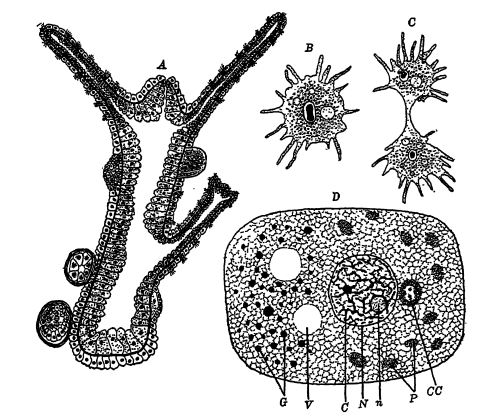
The work done means expenditure of energy, and is followed by exhaustion (muscular, nervous, etc.), so that the necessity for fresh supplies of energy is obvious. Recuperation is obtained through food, but before this can restore the exhausted parts to their normal state, or keep them from becoming, in any marked degree, exhausted, it must be rendered soluble, diffused throughout the body, and so chemically altered that it is readily incorporated into the animal’s substance. In other words, it has to be digested. A fresh supply of oxygen and a removal of waste are also obviously essential to continued activity. The sum of these chemical changes within the cells and the body of the organisms is known as metabolism (means change).
We may say, then, that there are two master activities in the animal body, those of muscular and those of nervous parts. To these the other internal activities are subsidiary conditions, turning food into blood and blood into tissues, and thus repairing the waste of matter and energy, keeping up the supply of oxygen, sifting out and removing waste products, and so on.
Growth and Reproduction. — Besides the more or less constantly recurrent activities or functions, there are the processes of growth and reproduction. When income exceeds expenditure in a young animal, growth goes on, and the inherited qualities of the organism are more and more perfectly developed. At the limit of growth, when the animal has reached maturity, it normally reproduces, that is to say, Eberates either parts of itself or special germ-cells which give rise to new individuals.
The Life Cycle. — Each living plant and animal has a fairly definite duration of Efe. UniceEular organisms are said to be immortal because they grow to a given size and then divide into two individuals that continue to Eve and reproduce. In the higher organisms, however, with sexual reproduction, a definite span of life is pecuEar to the species.
The most primitive organisms Eve their individual Eves in a few hours, and in a general way it may be said that length of Efe increases with complexity of organization. The great majority of plants and animals have a span of Efe of but a few years. Thirty years is above the average for the vertebrates, man rarely exceeds 70 years, elephants may Eve a century or more, and tortoises are known to have attained to 350 years. On the other hand, among plants the forest trees attain the greatest age; the California giant [ p. 11 ] trees, the sequoias, conunonly continue to live for a thousand years, and more than one tree, when felled, has showed upward of three thousand annual rings of growth.
The tiny microcosm or cell in which all life begins may pass through the life cycle before death overtakes it. Of the countless organisms born each day, but very few will complete the cycle, because the struggle for existence is especially hard on the young, and death may overtake any individual at any time. These statements, however, apply more especially to the lower types of organisms with their countless possibilities of reproduction, while in the higher life complexes the chances are better that the entities will pass through the allotted span of life.
The life cycle begins in a single cell, germ or spore, which, if of the lowest organization, divides and gives rise to a daughter cell, completing the cycle. In the more complex plants and animals, however, the cell is usually, though not always, fertilized by another cell, and then, if all goes well, this two-in-one germ (egg and sperm) evolves into the individual embryo that grows into yovih and maturity, and then gives rise in turn to eggs or sperms, thus completing the life cycle from “ egg to egg.” No more wonderful microcosm exists than the fertilized cell, for it contains within itself “ all the future characteristics, physical, mental, and moral, wherein the offspring resembles its parents, be they rotifers, or dinosaurs, or mice, or men!” (Lull).
Extinction of Species and Races. — Just as individuals may in old age develop senescent characters, so frequently do the races. Among these racial old age characters are the following: (1) more or less complete loss of juvenile expression and structures; (2) development of new features, as relative increase of size; (3) spinescence, or the tendency to overdevelopment of once useful or ornamental features, as spines, horns, or bodily armor; (4) physical degeneracy, as the loss of teeth or limbs, or a parasitic mode of life.
As human individuals and families die out, so do races. Extinction may be complete with the blotting out of the line, or the line may be transmuted into another family or species, and the evolution so begun may continue until wholly different looking organisms are developed. The structure of the tree is symbolic of this genesis, and as it has many branchlets on the fewer branches, and as any of these parts may give rise to other ramifications, or may die and fall away from the parent tree, so in the animal and plant trunks any of the branches may rebranch or die. In this way during the geologic ages a great many stocks have died out, [ p. 12 ] as for instance the trilobites (page 210), ammonites (page 530), dinosaurs (page 497), etc. Other stocks that are gone as such but have been transmuted into different and still living ones are the oldest known insects (Palaeodictyoptera), which have given rise to the cockroaches, grasshoppers, may-flies, etc.; the toothed birds of the Mesozoic (page 582), now living in the toothless birds; the four-toed horse of early Cenozoic time (page 630), which evolved into the extinct three-toed horses whose descendants are now living in the one-toed forms, etc. Finally, some stocks appear never to die out, as the “ immortal protozoans ”, best seen in the amoeba (page 9), in the marine brachiopod Lingula, that has lived ever since Champlainian time, or in the lung-fishes, that have lived since the Devonian.
When races are senile, or overspecialized, or are the giants of their stocks, they are apt to disappear with the great physiographic and climatic changes that periodically appear in the history of the earth. The very ground on which some of the stocks are living at these times rises slowly many thousands of feet into a colder and t hinn er air. It is not necessarily the temperature, however, that kills off the organisms, but these changes imbalance the organic world of the time, and the quantity and kinds of enemies and food change, due to the harshness of the climate. In this way a new kind of struggle is set up, to which not only the senile but also many other stocks can not adapt themselves. Such stocks are then doomed and they die out completely, while the adaptable ones are transmuted into new species and among these there is set up a new struggle for the mastery of the organic world. . It is the very active, alert, adaptable, and smaller forms that take the ascendency away from the rulers of the past.
¶ Classification of Organisms
Basis of Classification. — It is instinctive with humanity to group things of a kind together; for instance, animals that feed on plants we speak of as plant-feeders (herbivorous), those which seek flesh for food we know as flesh-feeders (carnivorous). However, a natural classification is not based on mere superficial resemblances, as is sometimes thought by people who are not naturalists, and who speak of all animals that inhabit the ocean as fishes, a fact which has led to the inclusion of the whales under this term, although they are truly warm-blooded mammals and nurse their young with milk like those living on the land. Systematic biologists, that is, students of organic relationship, are careful to select, as a [ p. 13 ] [ p. 14 ] basis for grouping, such characters as have a fundamental significance leading to the discovery of natural descent, organisms with the same structure and related genealogy being, classed together. This TnAa.Tis not only that the organisms so grouped must be structurally g-lilfft at maturity, but also that they must have a very gi’mi’lflr life development from the egg onward. The study of the stages of growth in the individual is the science of Ontogeny, which includes Embryology. This study is also applicable to the fossils and we can thus trace more or less imperfectly the history of living things back into their geologic ancestry, and the process may be continued into the most remote times. Therefore the botanist and the zoologist must cooperate with the paleontologist in the grouping of organisms into natural classifications. In addition, the paleontologist notes the appearance of the organisms in the stratified rocks, this time-sequence being called chronogenesis. Therefore the named divisions in any scheme of organic classification are finally based on organic structure, ontogeny, phytogeny, and chronogenesis.
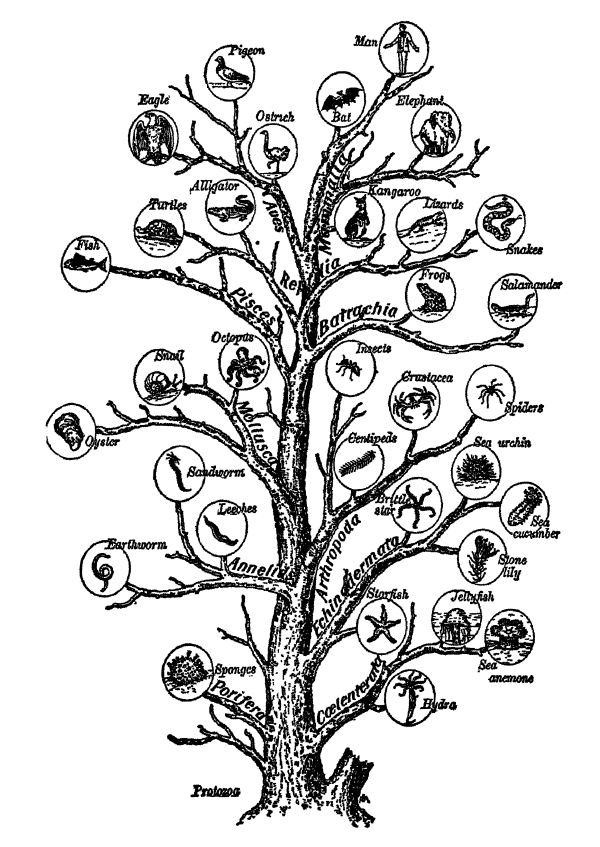
The study of living plants is the science of Botany, and that of fossil forms is Paleobotany (means botany of ancient plants). The study of living animals is the science of Zoology and that of fossil forms is Paleozoology. The study of all life, living and extinct, is called Biology, while that of all fossils is Paleobiology or Paleontology.
Grouping of Organisms. — All organisms are divided into the plant kingdom, or Plantae, and the animal kingdom, or Animalia. These are the largest divisions, and whlle all organisms are referred to one or the other of them, in reality a sharp boundary line between plants and animals first becomes possible when they exhibit a complicated structure. This is in accordance with the theory of evolution, which holds that the higher organisms have been evolved from the tower. In common practice there is, however, no difiSculty in distinguishing plants from animals.
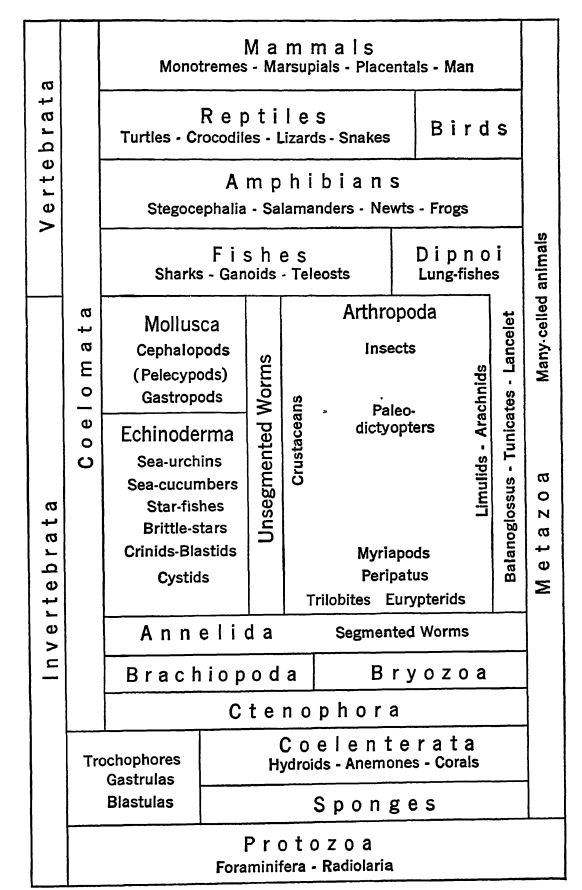
The kingdoms of plants and animals are each again divisible like the parts of a tree, the trunk representing the kingdom, and the branches the divisions of smaller and smaller import, down to the individual leaves. The individuals that are more or less alike in their trivial characters are grouped together as species, for example, the domestic cats, or the domestic dogs. The different kinds of these dogs and cats, for instance. Angora cats or bulldogs, are known as varieties. Then all the species that have characters in common are included in a genus (plural genera) : such are the various soecies [ p. 15 ] of cats (lion, tiger, puma, leopard, domestic cat), all of which belong to the genus Felis; or the dogs, wolves, and foxes, which are included in the genus Canis. The genera in turn are combined into families, these into orders, the orders into phyla, and the phyla into kingdoms. (See Fig., p. 13.)
Time Origin of the Greater Divisions. — Only about fourteen times in the history of life upon the earth have new animal phyla appeared. No new phylum has been evolved since the appearance of the fishes in the Champlainian, and no new classes since the mammals and the birds of the Triassic. It will eventually be shown that all of the phyla trace their origin back to an early period in the history of the earth. (See Fig., p. 47.)
For easier reference, the various divisions above defined may be grouped as in the following example:
Kingdom (Animalia);
Phylum (Vertebrata, or vertebrate animals);
Class (Mammalia, or mammals);
Order (Carnivora, or carnivorous animals);
Family (Felidae, the eats);
Genus (Felis, a member of the cat family);
Species(Felis tigris, the tiger);
Individual.
Names of Organisms. — It is the ambition of naturalists to describe and name all plants and animals, living and fossil, and according to the rules of nomenclature regulating this proceeding, each species is to have two names. The first one, the generic name, is taken from the Greek or Latin language; for instance, the genus Elephas, from the Greek elephas, elephant, and the genus Felis from the Latin felis, cat. A genus may contain but a single species or it may have several or even many, but in all cases where the species are grouped under the same generic name, it means that all have in common the structural characters on which the genus is founded. A species, like a genus, originates but once. The specific name is taken from the Latin language or is a Latinized form of a word from another tongue; for instance, the common house cat is called Felis domestica, the lion is Felis leo, the African elephant is known as Elephas africanus, and the Indian form as Elephas indicus. This double naming is called binomial nomenclature and was used by Linnaeus in the first edition of his Systema Natures in 1735, but the method was not fully established until the tenth edition of the work (1758), the starting point of zoological nomenclature.
[ p. 16 ]
In America it is the custom to write the generic name with an initial capital letter and the specific and varietal names, of whatever significance, with an initial small letter. Both names are written in italics.
Definition of Species. — Lamarck correctly held (1809) that species are not fixed entities, and further that there are no sharp divisions in the organic world corresponding to the classes, orders, and genera of our biologic classifications. “A species,” he wrote, “ is a collection of similar individuals which are perpetuated by generation in the same condition, as long as their environment has not changed sufficiently to bring about variation in their habits, their character, and their form.”
¶ Divisions of the Plant Kingdom
Since organic evolution is a fact, it follows that there can not be a sharp distinction between plants and animals. There is, however, a marked one between all of the easily seen kinds of plants and animals, and the separation becomes difficult only among the lowest microscopic unicellular forms of life. When life began on the earth, and for a long time afterward, all forms of life were the simplest of plants, and in the course of time there gradually evolved out of them the characters which are distinctive of animals, and of the higher plants as well.
Plants and animals have had a long geologic history, and Historical Geology shows that they begin in simple foims which in the course of tune become more and more complex. It was in the oceanic water that the plants had their origin, and very early in the history of the earth some of them must have become habituated to the dry lands. There is, however, no evidence of their presence during the first half of the earth’s history. Once organized for a dry land existence, with roots as absorbers of water which is exhaled as vapor through the leaves (transpiration), and with breathing pores to take m the air with its food (the carbon dioxide), the main evolution of plants has been on the lands. In this way the more complex plants prepared the lands to be the future homes of the higher land-living animals. The plants which made this transmigration appear to have had a very long struggle in getting away from the water and swamps, since no land plants are known until Champlainian time. (See Fig., p. 17.)
The nine great phyla of the Plant Kingdom are the following:
(1) The marine plants that made the original passage from the sea to the swamps and then to the drier and drier lands were the [ p. 17 ] algae or sea-weeds. They belong to the phylum Thallophyta or thallus plants, green shoots devoid of roots, stems, and leaves, and they reproduce by splitting (jfission) and by unicellular spores. Berry states that thallus plants differ as much among themselves as do all the rest of the plants together. Originally all algae were marine in habitat, but subsequently they spread into the fresh waters, and the unicellular forms over the dry lands, and even into the interior of all animals. In fact, they are everywhere, and are the cause of all organic decay, of many diseases to which plants and animals [ p. 18 ] are subject, and of the ferments in many of the human food and drink industries. The most primitive are the unicellular ones like the bacteria and molds, while the multicellular, larger, and more complex for ma are the green, brown, and red algse, the stoneworts, lichens, and mushrooms. Some of the marine algse are of gigantic sizes, but as fossils they have little significance, being too perishable for good preservation in the strata. Some of the limesecreting forms since ancient times have been makers of much limestone.
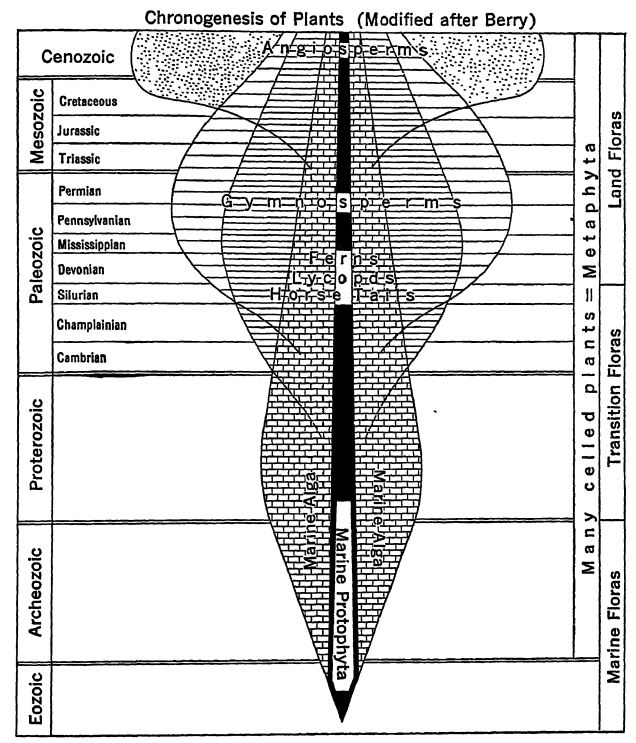
(2) Next higher in organization to the thallophytes are the Bryophyta or moss plants. These are almost unknown as fossils and none are older than the Age of Reptiles (Mesozoic). They have no true roots, and their transpiration tubes (vascula) are of the simplest construction.
(3) The fern plants are known to all and are included in the phylum Pteridophyta. They have been in the world since at least Devonian time, and in the Pennsylvanian there were tree-ferns 50 feet tall. These plants have stems, leaves, spores, and roots, and true woody or vascular structures.
(4) Next higher in organization are the rushes or horsetails of the phylum Arthrophyta. These are herbaceous and tree-like sporebearing plants, in which the stems are ribbed and articulate at the nodes where the whorls of leaves are situated. This phylum includes some of the oldest known land-living plants, and attained its maximum differentiation in the Paleozoic.
(5) The highest of spore-bearing plants, widely known as lycopods, are but illy represented in the living world by the club mosses or crowfoot and the ground pines. They are of the phylum Lepidophyta, dominant in the land floras of later Paleozoic times and, together with the arthrophytes, making up most of the coal accumulations of that part of the earth’s history (see Fig., p. 17).
(6) The most primitive seed plants are the seed-ferns of the phylum Pteridospermophyta. They look very much like ferns, and in fact have much the same anatomical features, but instead of spores have well developed seeds. The phylum includes “ a plexus of synthetic seed plants.” Arising out of the ferns and appearing in the Devonian, the whole stock vanished with the Permian.
The seed-ferns (6), cycads (7), and conifers (8) in the older classifications were embraced under the term Gymnosperms, and are so included in Fig., p. 17.
(7) The cycads or sago pahns of the warm climates of to-day are of the phylum Cycadophyta, but a host of very diverse forms lived [ p. 19 ] [ p. 20 ] all through the Mesozoic and particularly during the earlier half. They arose out of the seed-ferns.
(8) Pines, redwoods, sequoias, junipers, and cypresses are known to all. They are of the phylum Coniferophyta or cone-bearing trees, so called because so many of them have their seeds in cones. They are also known as Gymnosperms and evergreens. These seed-bearing and decidedly woody plants made up the greater part of the ancient forests. Their flowers were fructified by the wind blowiag pollen upon them, and never through the agency of insects. The cone trees arose long before iosects had appeared, in fact, they developed before Devonian times out of the “ plexus that gave rise to the seed ferns ” (Berry).
(9) The highest of all plants are the hardwood trees and our beautiful flowering plants (phylum Angiospermophyta), of which more than 100,000 living kinds have been described. They appear in the Jurassic (earliest in the southern hemisphere) and are thought to have arisen out of the preceding phylum. All have closed ovaries, a condition seen in no other plants. All other seed-bearing plants (phyla 6, 7, and 8) are said to have open or naked ovaries, and they are sometimes combined into, a single phylum, called Gymnospermae.
¶ Divisions of the Animal Kingdom
The animal kingdom is divided into two subkingdoms. Protozoa and Metazoa. In the former .the individual or unit animal consists of a single cell, that may lead a free life independent of its associates, or with them may combine into colonies. In the colonial form, however, each cell is a complete individual and there is as a rule no division of labor among the members of the colony. In the Metazoa, or higher animals, as they are usually called, the cells are grouped into tissues and organs, and there is always a division of labor among them. In other words, the Protozoa are usually very simple microscopic animals, almost unknown except to naturalists, while the Metazoa are multicellular animals, varying greatly in size and of different degrees of complexity. (See Fig., p. 13.)
The animal kingdom is divided into at least fourteen phyla, and nine of these have an abundance of fossil representatives. These latter are as follows:
(1) Protozoa, above defined as the single-celled animals. Includes Foraminifera and Radiolaria.
(2) Porifera or sponges.
(3) Coelenterata, or animals with a very simple, sac-like, digestive cavity, having but one opening, the mouth. The stony corals are [ p. 21 ] the best known representatives, the jelly-fish the most watery, and the flower-like anemones the most beautiful.
(4) Echinoderma, or spiny-skinned animals, such as starfishes, brittle-stars, sea-urchins, sea-cucumbers, and feather-stars or stonelilies. They were wonderfully varied and prolific in the Paleozoic.
(5) Bryozoa, minute, moss-like animals that at times are great limestone makers. Often the Bryozoa are combined with the Brachiopoda in the phylum Molluscoidea, but we prefer to regard both as distinct phyla.
(6) Brachiopoda or lamp-shells, animals with two valves, but wholly unrelated to the bivalved molluscs.
(7) Mollusca or shelled animals, like the clams and oysters, the gnailfi and drills, the pearly nautilus and ammonites, and the octopus.
(8) Arthropoda, or jointed-limbed invertebrates, having more diversity of form than all the other phyla together. Here belong the shrimps, lobsters, and crabs, the trilobites and horseshoe-crabs, and the endless variety of msects, spiders, and thousand-legs or centipedes.
(9) Vertebrata, the highest animals, having an internal bony skeleton, the diagnostic part of which is the vertebral column or back-bone. Here belong the fishes and eels, the toads, frogs, and newts or batrachians, the reptiles, the birds, and the mammals.
¶ Collateral Reading
E. W. Berry, Paleobotany: A Sketch of the Origin and Evolution of Floras. Annual Report of the Smithsonian Institution for 1918, 1920, pp. 289-407.
L. J. Hendebson, The Fitness of the Environment. New York (Macmillan), 1913.
R. S. Lull, Organic Evolution. New York (Macmillan), 1917.
B. Moore, The Origin and Nature of Life. New York (Henry Holt), 1913.
H.F. . Osborn, The Origin and Evolution of Life. New York (Scribner), 1917. L. L. Woodruff, Foundations of Biology. New York (Macmillan), 1922.
O. Abel, Grundzüge der Palaeobiologie der Wirheltiere. Stuttgart (Schweizerbart), 1911.
K. A. Von Zittel, F. Broili, and M. Schlosser, Grundzüge der Palfiontologie, Pt. II, Vertebrata. Munich (Oldenboiug), 1922.
K. A. Von Zittel and C. R. Eastman, Text-book of Paleontology. London (Macmillan), Vol. I, 2nd edition, 1913, Vol. II, 1902.