| II. Organisms, their Composition, Structure, and Classification | Title page | IV. Evolution, the Constant Change of Living Things |
[ p. 22 ]
Living plants and animals constitute the present organic world, while fossils are the remains of organisms that have lived in the geologic past. Fossil-bearing strata are the graveyards of the bmied past, of the lost races connecting the past with the present. “ The dust we tread upon was once alive ” (Byron). The New York State Geologists, when they entered upon their work in 1838, found fo ssils “ in the stone fences and farm foundations ; they lay loose along the streams and on the shores of the Finger Lakes; and they protruded from the rocks on the edges of the cliffs. So ubiquitous were they that the Seneca Indians used the fossil cup-corals for pipes, strung together the joints of crinoid stems into necklaces, and buried brachiopod shells along with axes and spear points in the graves of their braves ” (Clarke).
Fossils may occur in any sedimentary rock of the low land near the sea or far inland, or even in the highest mountain ranges. They indicate not only the kinds of animals which have lived, but a great deal about the nature of their home surroundings as well. For example: the remains of a marine animal, such as an oyster, found naturally entombed in strata anywhere on the present land indicate that where the relic now occurs the sea existed at the timft when the organism was living.
Ancient Views about Fossils. — The fact that fossils resembling in every way the shells of marine animals are foimd far inland has long perplexed mankind. Some of the Greeks in the third and fourth centuries before Christ explained them as ineffectual attempts at creation by a plastic force inherent in the earth. This poetic interpretation arose again and again in the subsequent centuries, and the “ controversy about fossils ” was particularly acute after the fifteenth century. These occurrences were then regarded by many as mere mineral concretions .and described as Imvs naiurm, freaks of nature, while others said that these “ figured ” or “ formed ” stones were made in the soil of the earth under the influence of the stars. Still others correctly held that fossils could only have belonged to once living plants and animals, [ p. 23 ] but attributed their presence in the rocks to the Deluge, believing that not more than 6000 years had elapsed since the time of the Creation and that the Flood had been universal, destroying all life and spreading its remains far and wide over the lands. “ They had no conception of the physical impossibility of accumulating all the fossiliferous formations of the earth’s crust within the space of one hundred and fifty days during which ‘ the waters prevailed upon the earth, and all the high hills that were under the whole heaven were covered,’ ” as Sir Archibald Geikie has said. Thus arose the “ diluvial theory ” and with it a bitter controversy that only ceased late in the nineteenth century.
In the Mediterranean countries, however, the younger geological formations “ underlie many of the plains and rise high along the flanks of the hills. In these deposits, shells and other remains of sea-creatures have been preserved in such vast numbers as could not fail to arrest attention even in the infancy of mankind. Since the organisms are obviously like those still living in the neighboring sea, the inference could readily be drawn that the sea had once covered the tracts of land where these remains had been left. This conclusion was reached by some of the earliest Greek philosophers [especially Xenophanes, 576-480 b.c.], and there can be little doubt that it led to those wide views of the vicissitudes of Nature which were adopted in later centuries by their successors.” (Geikie.) Thus arose the theory of “ cataclysms and re-creations,” one that was laid aside only in the past century for the theory of evolution, which teaches that life, once originated, has continued uninterrupted to the present.
Transition of Present Life into Fossil Forms. — The easy transition between the living marine molluscs (shell-fish) and their geologic ancestors is best -understood by the following examples. The Pleistocene formation is the youngest of geologic deposits and in it, at a given locality, all of the species may be of still living forms, while at another place where the deposits, are, older, as many as 25 per cent may be of extinct species. In the still older Pliocene, less than half of the forms are of living kinds, and in the next lower formation, the Miocene, only from 20 to 40 per cent are of recent species. Finally, in the oldest of Cenozoic formations, the Eocene, there are rarely more than 5 per cent of living shelled animals foimd. In other words, the present life shades gradually into that of the geologic past, this transition being most gentle among the marine invertebrates, while but few of the living species of land-inhabiting vertebrates are known in the geologic formations. This is because [ p. 24 ] evolution has gone on more slowly among the marine invertebrates and the land plants, and most rapidly among the land mammals.
¶ What Fossils Teach
Fossils are not freaks of nature, nor are they merely chance relics of things once alive, but they are the very important geologic records from which has been unraveled so much about the history of the earth. These records reveal (1) the course organic evolution has taken, along with the geographic distribution of plants and animals; (2) the sequence of geologic time or chronology; and (3) the nature of the environment of the fossils, whether they lived in marine or fresh waters or on the dry land, and something about the depth and temperature of the seas and the climates of the lands.
As the first-mentioned value is of most importance in pure Paleontology and general Biology, it need not be treated in detail in this book. The ehronogenetic value of fossils is, however, of great import in Historical Geology and needs, therefore, to be studied with some care. All life has constantly changed, not only as to specific form but as a rule in definite directions from the simpler to the more complex types of structures, although often also in the reverse manner. For these reasons, fossils are of the greatest value in determining the past history of the earth.
The time value of fossils was first discovered by William Smith and published between 1816 and 1820. He said that “ each stratum contained organized fossils peculiar to itself ”, but this law considers only the significance of fossils as “ medals of creation ”, and as “the classified signs by which geological formations may be recognized. This is the scope of the older paleontology. The higher or comparative paleontology, as set forth by Cuvier (1800-1832), Deshayes, Lyell, and Lonsdale, considers the relationship which fossils bear to each other, to those which preceded them, and to their successors. It deals with the history of organisms, and therefore is able to find in fossils themselves evidence of the order of sequence of the rocks containing them” (H. S. Williams).
Habitats. — Every species of the plant and animal kingdoms has a given home or environment, known as its habitat, which may be dry land, rivers and lakes, or seas and oceans. Moreover, temperature varies between the poles and equator, and therefore organisms are cold, temperate, or tropical in their adaptations. All of these differences in habitat are reflected in the fossils, which are therefore guides to the past climates and kinds of environments. [ p. 25 ] Of course, dry land organisms may be washed into water habitats, but when this occurs, they will show this accidental mixing, and the further fact that the land was not far away from the place of entombment.
Guide Fossils. — As all organic races, like individuals, have a span of life, and usually a short one geologically speaking, it follows that, since species and genera are constantly changing, they are more or less indices or guides to the time of their existence. Some fossils are better guides than others, and can be used accurately in correlating the strata of a given age from place to place or even from continent to continent.
Facies Fossils. — It has been pointed out that since all present and past life is adapted to a particular environment, it follows that the kinds habituated to marme or fresh waters, to lands, or to cold, temperate, or warm climates, will show even among the fossils their former habitats. In addition to this, marine organisms living on mud bottoms will usually be different from those habituated to sand or lime bottoms. The freely swimming or floating forms, however, may be found in all kinds of sedimentary deposits, since at death they fall on any kind of a substratum. These different habitats are said to impress their facies (sand, mud, or lime environment) on the organisms of a given time and place. It is true that some species can live on any kind of bottom, but as a rule each kind is addicted to, and spends its life on, a distinct type of marine bottom. Bivalves and horseshoe-crabs prefer mud or sa,nd, while crabs live on any kind of bottom, and at night will even come ashore in search of food.
Evolution and Superposition. — To ascertain the course evolution has taken, the fossils must also be studied in the order of their appearance in any given series of rocks, and this is done by noting their occurrence in the strata. Those in the lower rocks naturally must be older than those in the higher or superposed strata. The order of superposition is usually determined in regions where the earth’s crust has not been disturbed, for here bed upon bed of rock occurs as laid down by the waters (see Frontispiece) ; but where the strata are faulted or deformed into mountains the natural order of stratigraphic sequence is at times very difl&cult to ascertain. However, after one hundred years of endeavor a great deal of knowledge has been worked out as to the evolutionary sequence of organisms, and this knowledge, as determined in many countries, can now be relied upon to fix in turn the stratigraphic sequence.
[ p. 26 ]
¶ How Fossils are Preserved
Fossils always occur in sedimentary or stratified rocks that have been laid down in bodies of water, or on the lands through the action of the winds. Another type of sedimentary strata having the possibility of fossils consists of volcanic ashes, which at tunes of outburst are shot high into the atmosphere and then carried by th e winds for shorter or longer distances over the lands or seas, burying all living things. In this way the Roman summer resort, Pompeii, was buried by ashes from the volcano Vesuvius in the year 79 A.D. To-day in digging out the city some of the victims are found in the form of molds, so that when these hollow spaces in the fine ashes are jSUed with plaster of paris, good casts of the people and animals as they appeared in the flesh are obtained; such may be seen in the National Museum at Naples. The bones of human victims are also occasionally found under a thin flow of lava, as is the case at Pedregal de San Angel, near Mexico City. However, fossils are not often found under or in the basal sheet of lavas and it naay therefore be said that in general they do not occur in igneous rocks.
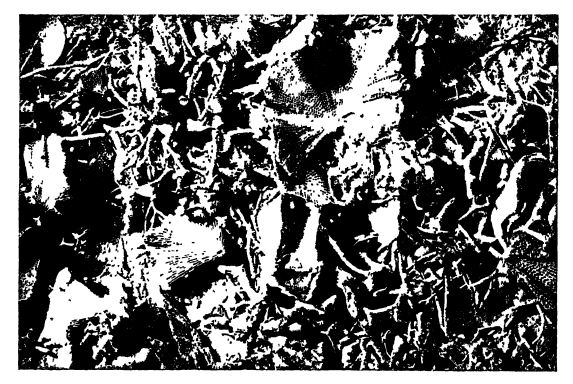
Any dead organism exposed to a temperature above the freezing point of water is, as a rule, at once attacked by the ubiquitous microscopic fungi and bacteria of the plant kingdom, and by the [ p. 27 ] small and large scavenging animals, and soon vanishes without leaving a trace of its former existence. In this process the oxygen of the atmosphere also assists, and the same is true for organisms under water, only in the latter case complete destruction is slower. The dissolving effects of circulating waters in most cases complete the destruction of even the harder skeletal parts. In other words, the individuals of entire floras and faunas are seen at the present time to vanish under the influence of other Imng things, and of the atmosphere and hydrosphere. It is probable that more than 99 per cent of all life has thus been removed. Every organic trace may be oxidized and dissolved into the elements from which it came — into the air, water, and the dust of the earth. Therefore, if an organism is to be preserved as a fossil it must be covered quickly by sediment, and even then only a mold of the exterior form may remain. Complete destruction is the rule among all organisms having soft bodies devoid of hard skeletal parts, and it is the exception among such to leave behind even a mold of their bodily form. Where there is a skeleton, either external, as shells, or internal, as the bones of vertebrates, it again depends upon the chemical nature of these structures, upon the character of the sediment, and finally upon the chemical content of the waters in the rocks whether these parts are to be preserved or only to give evidence of their existence in the condition of molds.
[ p. 28 ]
Deformed Fossils. — Most sediments undergo consolidation during their accumulation, due to superposed load, and especially to the water being squeezed out, permitting closer compacting of the granular material. Compacting is especially great for the mudstones, and the organisms included in them have undergone much crushing and more or less distortion. When strata are folded into moimtain ranges, they are further subjected to enormous pressures, and in consequence the rocks are either squeezed together or stretched. This condition is again especially true of the mudstones.
On the other hand, strata that have been replete with fossils may lose every recognizable trace of them by being subjected to the heat of large igneous intrusions, or more commonly by suffering great pressures during times of crustal deformation resulting in ranges of mountains, as described in Chapter XIII of Pt. I of this text-book. These are the metamorphosed rocks, and whether recognizable fossils are present in them or not depends upon the character of the sediments of which they are composed and the degree of alteration which they have undergone.
Nature of Preservable Parts in Organisms. — The skeletons of plants are very rarely made of silica, this condition being found only among the single-celled and microscopic diatoms. These are so small that in a cubic inch of tripoli there are 41,000,000,000. (See Fig., p. 69.) Among the animals, silica is also used sparingly, arid is almost wholly restricted to those forms living in the sea. The microscopic diatdms and radiolarians (see Fig., p. 70) use it freely, and among the sponges probably somewhat less than one half have a siliceous skeleton. In these sponges the silica of the skeleton is in the colloidal form (not crystalline but like opal) and is therefore easily destroyed during the process of organic decay; hence the glass-sponges (see Fig., p. 199) are rarely preserved as fossils and are common only in Mesozoic strata. Among the diatoms and radiolarians, however, the silica occurs in the insoluble form and is very rarely destroyed at the time of deposition or afterwards.
Calcium carbonate is used liberally by many types of invertebrates but in plants it is utilized freely only among the marine and fresh-water calcareous sea-weeds. Here the sulphate of lime of the waters is converted by the organisms into the carbonate of lime of their skeletal structures, bound together by an organic base. This secretion is known as conchin and crystallizes in two mineral forms, as aragonite (harder and heavier, crystallizing in the rhombic system, and easily soluble) and calcite (crystallizing in the hexagonal system). Sometimes a structure consists entirely of [ p. 29 ] aragonite or entirely of calcite, but usually both forms exist in the same individual, as for instance among the Mollusca, where the inner mother-of-pearl layers are of aragonite and the outer porcelanous layers are of calcite. In other cases the calcite predominates, as in the oysters. At times the granules or fibers of mineral matter in the shells are associations of aragonite and calcite. It is very important to know this, because structures in the form of calcite, or in which this mineral dominates, are very apt to be preserved as secreted by the organisms, whereas such parts, when secreted as aragonite, are very rapidly dissolved away during decomposition or are replaced by other minerals through the agency of the percolating waters in the strata. In the Paleozoic rocks it is almost the rule for the aragonite structures to be gone, this being especially true among the Mollusca, but in the Mesozoic and Cenozoic the motherof-pearl layers are much more commonly preserved. Just why this is so is not yet determined. The internal skeletons of vertebrates, the bones, are composed largely of phosphate of lime bound together by an organic compound (collagen).
Other much thinner, and usually somewhat flexible skeletal structures consist of a compound of the nitrogenous substances of the ammonia group and a carbohydrate, known as chitin. This material [ p. 30 ] has great resistance to chemical agents and is therefore hard to destroy. Among fossils it is often preserved in one form or another. Chitin makes the external skeleton of many kinds of invertebrates, for example, the arthropods (horseshoe-crabs, trilobites, insects), and to it are often added lime salts. A similar substance is spongin, which composes the fibers in bath sponges; this is rarely preserved among the fossil forms. Keratin contains sulphur in addition to nitrogen, and is but very rarely preserved among the fossils; it makes up the hairs, nails, and horns of mammals, the feathers of birds, and the scales of fishes.
Preservation of Soft Parts. — It has been stated above that the soft parts of animals are only exceptionally preserved. The most remarkable preservation of entire animals, however, is the case of those buried in the tundras (frozen ground, mainly ice) of northern Siberia, where great woolly elephants (Elephas primigenius) have been kept intact in natural cold storage. How long these carcasses have been entombed in the tundras it is difficult to say, certainly thousands of years, and yet the flesh when exposed on the melting of the ice is greedily devoured by the dogs of the Siberian peoples. The skeleton of one of these mammoths, found at the mouth of the Lena Eiver, and another from Beresovka, with the mounted skin and skeleton and all of the internal organs kept in alcohol, are shown in the Natural History Museum, Petrograd, Russia. A hairy rhinoceros (Rhinoceros tichorhinus) has been found in Siberia preserved in the same way, and similar but far less perfect preserval occurs in the frozen grounds of northwestern Alaska. Finally, large parts of the skin of a rhinoceros have been found well preserved in the petroleum seepages of Galicia.
Molds of the entire exterior of organisms are often found, even of such extraordinarily soft-bodied animals as the jelly-fishes or medusae, in which the organic substance is at least 95 per cent water. The most wonderful examples of such come from the Jurassic limestones of Solenhofen, Germany.
Color Preservation. It is exceedingly jrare to find among the fossils a trace of their former color. When they are preserved in light-colored shaly limestones, the former color pattern may be present in dark bands, such being known as far back as the Champlainian. The mother-of-pearl color, or nacre, is, however, often preserved and especially well in limy shales impregnated with petroleum, but this color is due to the play of light in the prismatic or aragonitic portions of the shells, and not to a pigment in the material.
¶ How Fossils Occur
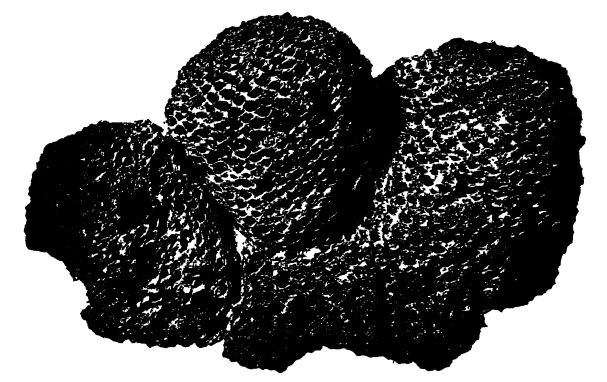
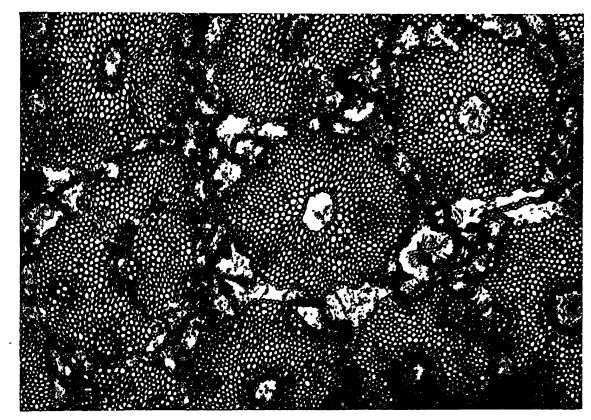
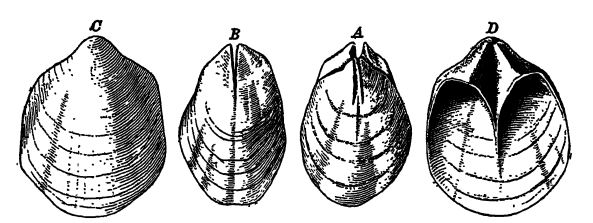
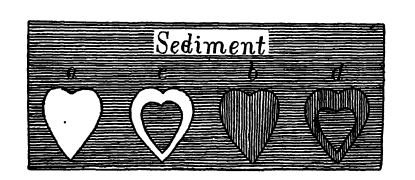
Fossils occur in any one of seven different natural conditions, three of which relate to the substance left- by the organisms, three to their form, and one to both. (1) The great majority of fossil specimens preserve more or less of the original hard or mineral substance of the individual plant or animal, and to this may have been added, in the organic interstices, during the process of mineralization, more or less of other mineral substance, forming permineralized fossils. (2) When the original mineral matter is exchanged [ p. 31 ] for another and usually a dissimilar mineral, with the substitute preserving the original microscopic structure of the organism, the process of substitution is called histometabasis (two Greek words that mean tissue exchange) (Fig., p. 29). In this condition the woody parts of plants are often preserved and for study purposes are as good as the similar parts of living plants. (3) Plants may be wholly carbonized (coal), with the original organic structure more or less completely destroyed during the process. Such fossils have little paleontologic importance, but are of great economic value and are often used as datum planes in Stratigraphy and Structural Geology. The form of organisms with the original substance absent may occur in the rocks as (4) molds, (5) imprints, and (6) natural casts (Fig., below). There is no marked difference between molds and imprints other than that the latter term is applied to impressions of thin substances, as leaves, etc. Natural casts are the counterparts of organisms made by filling the molds of fossils with an uncrystallized substitute; (7) when the replacing material is a crystallized mineral, as calcite, pyrite, and more commonly silica in the form of chalcedony, the replacement is called a pseudomorph (from two Greek words that mean false form) (Fig., p. 26, also study Fig., p. 32).
Fossil wood occurs in almost incredible quantity to the north and the south of the Colorado River. Here and elsewhere the siliceous logs lie prostrate in continental deposits of stream origin, or stand upright in volcanic ash. The petrifying agent during the process of histometabasis appears to have been the periodic alkaline waters of semiarid or arid climates, holding in solution silica that percolated through the unconsolidated sands or ash while accumulating. The silica takes the place of the woody tissue, molecule by molecule, and in most [ p. 32 ] cases preserves to a wonderful extent the microstructure of the plants (Figs., pp, 27, 29). Logs entombed in continental deposits of pluyial climates are dissolved away and occur as casts or coal. The woody tissue may also be replaced by ealcite, but here the replacement appears to have taken place under a permanent cover of water, and also shortly after entombment, as in the “ coal balls.” Most of these rare occurrences are found in fresh-water swamp de-* posits, and it is a question if such replacement ever takes place in marine strata.
Tracks of animals crawling around on the muddy floors beneath bodies of water, and especially in the sea, are very commonly preserved. Land animals also often leave their tracks in the geologic record, but these, when of vertebrates, in most cases occur in red clays or sands laid down in deserts or at least in arid regions. Reptile tracks are often seen in the Carboniferous (Mauch Chunk) and are especially abundant in the Triassic.
Geologic Change in Organisms. — In Cenozoic deposits it is the rule to find the marine shells almost unchanged by the addition of mineral matter, and in general it may be added that the older the organisms are geologically, the more mineralized they are apt to be. Probably 50 per cent of all fossils stOl remain in their original calcareous condition or are but slightly permineralized. This mineralization may have taken place through the waters percolating in the rocks at any time after the entombment of the fossils or during the time of weathering of the formations, but it is more apt to have occurred during the time of burial, when the ground waters of the sea-floor were charged with carbonic and other acids derived from organic decomposition. For these reasons, the fossil skeletons of organisms occur in all conditions from the unchanged to complete pseudomorphs in calcite, dolomite, silica, iron pyrite, or even lead, zinc, etc.
[ p. 33 ]
Again, the percolating land waters or the ground waters of the sea may have dissolving powers only, and remove all of the organic shells; in this case their former presence is indicated by cavities in the rocks, the molds of organisms, more commonly seen in dolomites and sandstones. These molds are often so wonderfully sharp that the finest artificial casts or squeezes can be made from them. On the other hand, it often occurs that molds, and especially those in dolomites, are covered with a lining of crystallized mineral matter, in which case the fossils are nearly always valueless. Even though molds are bulky to collect, nevertheless they should be gathered, and the casts on the inside of them, the filling of the interior cavities of the organisms, should be secured as well. Imprints are more commonly seen in the shales and are the impressions in mud of the exterior parts of plants and animals.
¶ Where Fossils Occur
Fossils are to be especially looked for in the evenly bedded strata of marine origin that are more or less calcareous or magnesian, and least of all in the red shales and sandstones. In nearly all of the red beds other than red limestones it is the exception to find fossil remains, because the plants and animals have been oxidized and dissipated during the process of subaerial sedimentation. It is therefore the green, blue, gray, black, and subsequently oxidized yellow beds that are apt to hold fossils. However, the red shales and sandstones may also have such fossils as the foot imprints or trails of animals, very rarely the bones of vertebrates, and still less often the imprints of plants or chalcedonized woods. In freshwater deposits fossils are usually very scarce, but subsequent to the Silurian such beds may have plant and vertebrate remains.
The accident of burial has much to do with the decided differences between the kinds of organic records, for an animal living in the shallow sea and especially in or on the sea-floor is in the most favorable place for entombment, while only those animals of the land can leave fossils which live in, or whose bodies are swept into, some area where sediment is accumulating; the most abundant land fossils being remains of those nuimfllg which dwell on delta plains or partly within the rivers.
Of all stratified rocks, shales make up 80 per cent, sandstones about 15 per cent, and limestones 5 per cent (see Pt. I, p. 281). It is in the limestones, “ the preserving salt of the geological world ” (Hugh Miller), that fossils are nearly always present in abundance, but this does not mean that for every foot of limestone, nine of the [ p. 34 ] shales and sandstones are barren of organisms. Carbonate of lime is widely disseminated throughout the strata, and in all the calcareous shales there are apt to be fine fossils that will weather out free; even the calcareous sandstones usually have organisms in some abundance. Further, the thick green and blue shale formations often have thin beds of impure limestone or sandstone and in these bands fossils should be looked for.
Conglomerates may abound in fossils, but here especial care must be exercised in keeping apart the specimens of each pebble, as these may be of very different ages. The fossils of the matrix also must not be mixed with those of the pebbles, for otherwise an impossible chronogenetic association will result. On the other hand, the breccias and intraformational conglomerates have the same species as the binding matrix, because all were formed at the same time.
How Fossils Are Collected. — In looking for fossils there should be no haste, as the work of collecting is always a slow process. It seems to be a common opinion that paleontologists scent ” the presence of fossils, a conclusion that is wholly erroneous, for they are often discovered only after patient hunting.
On any exposure of stratified rocks fossils may occur, and therefore the surface should be scanned for loose specimens. These free fossils are the most desirable, because they require the least labor in cleaning, and, further, they show all parts of the individual. All residual red clays should be searched, as these are often replete with fine free specimens, usually preserved in silica as pseudomorphs.
When loose fossils are found, these should be traced to the bed from which they come and the occurrence of others still in place noted. Naturally the best places to find fossils are in the hard protruding ledges of limestone, and all such should be broken here and there with the hammer. Sometimes a thin zone will be one mass of fossils, and when weathering has loosened them so that they will fall out freely when hit by the hammer, the easiest way to collect such is to take away a lump from 6 inches to a foot across. In this connection it should be added that weathered rock yields fossils far more easily than that not so affected.
Fossils of a siliceous nature and partially weathered out of limestone should be gathered in bulk, to be treated in the laboratory with dilute hydrochloric acid (Fig., p. 26). Material which will bear this treatment is readily tested in the field with a pocket knife; if the blade does not scratch the fossil, but leaves a black mark, it will be well to make the experiment. Of course where the fossils are in cherts or are more or less surrounded with amorphous silica, nothing can be done to free them.
The field geologist in collecting fossils for study by the paleontologist will do well to remember that the value of the work of the latter depends largely on the number of specimens he can study, and therefore as much material as circumstances permit should be [ p. 35 ] gathered. It is not so much a quantity of specimens, however, as it is of species that a paleontologist desires, because it is known that different forms have very different chronogenetic values.
¶ Collateral Reading
A. M. Davies, An Introduction to Palaeontology. London (Murby), 1920.
W. Deecke, Die Fossilisation. Berlin (Bomtraeger), 1923.
H. L. Hawkins, Invertebrate Palaeontology, an Introduction to the Study of Fossils. London (Methuen), 1920.
Charles Schuchert, Directions for Collecting and Preparing Fossils. U. S.
National Museum, Bulletin 39, Part K, 1895.
H. W. Shimer, An Introduction to the Study of Fossils. New York (Macmillan), 1914.
C. A. White, The Relation of Biology to Geological Investigation. Annual Report of the U. S. National Museum for 1892, 1894, pp. 245-368.
| II. Organisms, their Composition, Structure, and Classification | Title page | IV. Evolution, the Constant Change of Living Things |