| VII. The Geological Time Table, and the Age of the Earth | Title page | IX. The Earth before Geologic Time |
[ p. 107 ]
“Whence sprang this world, and whether framed By hand divine or no.”
Man, with all of his limitatiops, has throughout long ages been asking whence came the earth, his home, and the stm and stars in the canopy of the heavens above. It is, however, only within the past few centuries that this inquiry has been pursued along scientific lines, and the problem for more than a century has occupied the central place in astronomical thought. Nevertheless the solution is not yet finally at hand, and in the following pages different hypotheses will be presented. The one accepted in this text-book as the most reasonable is that of Chamberlin and Moulton, which postulates the evolution of the solar system out of the sun itself through the accident of close approach to another star early in their respective careers.
There is no study more awe-inspiring than astronomy. It takes us beyond the earth, moon, and sun to the bright stars, and beyond the stars to the countless spiral universes. The measurable distances between the stars are so vast as to be beyond all actual understanding, and beyond them space is thought to continue without limit. “ There are, perhaps, a. million other universes, as large as our own and each with a billion suns, within the ken of our great telescopes ” (Curtis). Space without limit , through which are moving countless systems of orbs in wondrous array; such is the majesty of the greater universe. And everywhere throughout this universe there is law and therefore order. It is the vastness of astronomy that makes all the more unanswerable the question. What does it all mean? Thinking man has long been pondering over the stars, the infiniteness of space, the indestructibility of matter, and in his helplessness he has sought refuge in religion and in imagined supernatural powers that order the laws of nature. Who can deny, who can afifinn?
¶ The Nebulae
When we look out into the nearer heavens we see the sun and l ytmA of its family of planets, composing the solar system. In the [ p. 108 ] space beyond occur the stars, and among and beyond them are foxmd different kinds of nebulae (“ little clouds” so called because in the telescopes their matter looks like small clouds). The nebulae, like the stars, are luminous masses, but are far less dense, and are strewn in space far less thickly than the stars. “ Where stars are scarce, nebulae abound, and where stars abound, nebulae are scarce." Of the brighter nebulae, two or three hundred have long been known to exist in and near the Milky Way, and about four hundred of all kinds are known in this region of the skies. These are the gaseous nebulae. The great majority of nebulae, however, known as the white, faint, or spiral nebulae, are absent from this part of the heavens.
Green Nebulae. — The gaseous nebulae are condensing with extreme slowness into hotter masses and eventually into nebulous stars, but in some, no condensing centers are seen at all. The green nebulae within the galaxy of stars are highly rarefied bodies of glowing gases, with surfaces enormously large in proportion to the heat content. Orion is one of these which may be seen with the unassisted eye. These green nebulae are in the simples elemental condition of matter, consisting essentially of nebulium, and their material is in a state of change. As they appear to have no direct bearing on the evolution of a system like our solar system, however, they need not be further considered.
“It is quite possible, and even probable,” says Campbell, “that gaseous masses have not in all cases passed directly to the stellar state. The materials in a gaseous nebula may be so highly attenuated, or be distributed so irregularly throughout a vast volume of space, that they will condense into solids, small meteoric particles, for example, before they combine to form stars. Such masses or clouds of non-shining or invisible matter are thought to exist in considerable profusion within the stellar system . . . That this material will eventually be drawn into the stars already existing in the neighborhood, or be condensed .into new centers and form other stars, we can scarcely doubt.”
Seemingly there should be no “ black holes ” or non-luminous spaces in the crowded portions of the stellar system. These holes in certain parts of the skies Campbell thinks are due to “invisible materials between us and the stars,” in other words, the stars are here hidden by material that occults the light they are sending toward us. Newcomb and Kelvin have smd that there is much more invisible matter in the stellar system than there is in the visible stars.
Spiral or White Nebulae. — We have seen that the green nebulae are associated with our system of stars, the galaxy, and that to this starry system belongs our sun with its family of planets and moons. But beyond the galaxy there are countless other nebulae, the white ones, having a spiral-like structure. These spiral nebulae we must consider in more detail, since they figure in certain theories of earth origin to be described in later pages.
[ p. 109 ]
It is now known that the great majority of the nebulse are of this spiral type. Perhaps a million spiral nebulae are within reach of the lenses of the large reflector telescopes. The cause of their white light is as yet unknown, though the suggestion has been made that it is the combined light of millions of suns (see Fig., below).
The dominant form of the white nebulse is, as has been said, the spiral. The largest is the great nebula of Andromeda, hundreds of thousands of times greater in diameter than the distance from the earth to the sun, yet visible to the unassisted eye only on the clearest of nights, due to its extreme tenuity and tremendous remoteness. Seen from the side, the spiral nebulae are thin and discshaped; their matter is also irregular in distribution within the discs. Their most significant feature is the presence of two dominant arms that arise from diametrically opposite sides of the nucleus, and curve concentrically away. There are often more than two arms in the outer part, and there is much irregularly dispersed matter. The spiral arrangement is evidence that they are in rapid rotation.
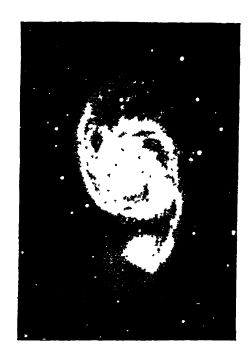
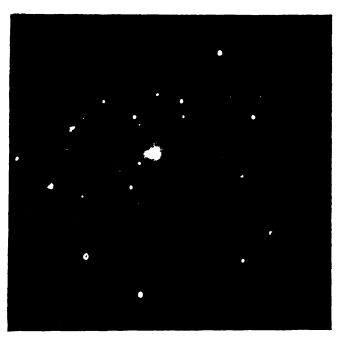
Campbell asks, “ Are the spiral nebulae in or attached to our system, or are they outside of our system, at tremendous distances from us? . . - The old hypothesis [of Herschel and Kant] that the unresolved nebulae are other great universes of stars very far distant from our own universe of stars is receiving favorable consideration.” Certain of the spiral nebulae “ contain enough material to make . . . possibly millions of stars comparable in mass with our own [ p. 110 ] sun.” Furthermore, their motions of approach and recession are very great, roughly from about twenty to thirty times faster than the motions of the average of stars in our stellar system. Campbell therefore favors the hypothesis that the spiral nebube are enormously distant bodies, independent stellar systems in different degrees of development, and independent of our stellar system. Humboldt long ago called them “ island universes.”
¶ Evolution of the Stars
What a wondrous sight are the skies on a clear dark night, especially in the rarefied air of a mountain top or in the dry climate of the desert! We see distinctly hundreds of quivering stars, large and small, variable in color, all set in the deep black of boundless space. The Milky Way on the outer bounds of the galaxy extends across the whole sky like an irregular filmy cloud of silvery white, and it, too, consists of innumerable stars. The largest of all the apparent stars are of course best seen in the early evening and morning — the Evening and Morning stars, as we call them, though they are not stars but planets of our solar system shining by reflected light derived from the sun.
All of the true stars are self-luminous bod’cs and most of them exceed the dimensions of the sun by as much as forty times, while Betelgeuze is about 250 times the diameter of the sun (865,000 miles). The sun is the nearest star, and yet it is on the average some 93,000,000 miles away. The nearest fixed star, on the other hand, is more than 200,000 times farther away than the sun; nevertheless most people can see at any given locality at least 250 stars, and good eyes can make out about 800. The bright star Arcturus, emitting light very much like the sun, is calculated to be 50,000 times larger in volume than the sun, and 200 light-years from it. Light travels at the rate of 186,000 miles per second, and a lightyear is equal to 63,000 times the distance between earth and sun. Stated in another way, a light-year has six million milli on miles.
The stars are all in motion, moving on the average about 16 miles per second. About 20 per cent appear to be motionless, but the rest are moving in two opposite directions, as if two swarms of bees were all intermixed and yet one of them passing through the other at apparently right angles.
Dark Stars. — There are also scattered throughout the heavens many “ dark stars ” that have run their course of evolution and are now externally cold and non-luminous. Their approximate number no one knows, but they probably outnumber the shining stars. Nor have we any knowledge of planets and satellites other than those [ p. 111 ] of our solar system, and it may be that some of these dark stars become comets of the sun’s family.
Shape and Size of the Stellar System. — Astronomers tell us that the stellar system or galaxy (= aggregate of stars under one gravitative control) has roughly the shape of a very flat pocket watch. Its dimensions are enormous, and the astronomers of the Mount Wilson Observatory in southern California place the greater diameter at about two million light-years. Looking toward the equator of the stellar system or the Milky Way, we are looking through the greatest depth of stars, while the far lesser depth is in the axial or polar regions of the galaxy.
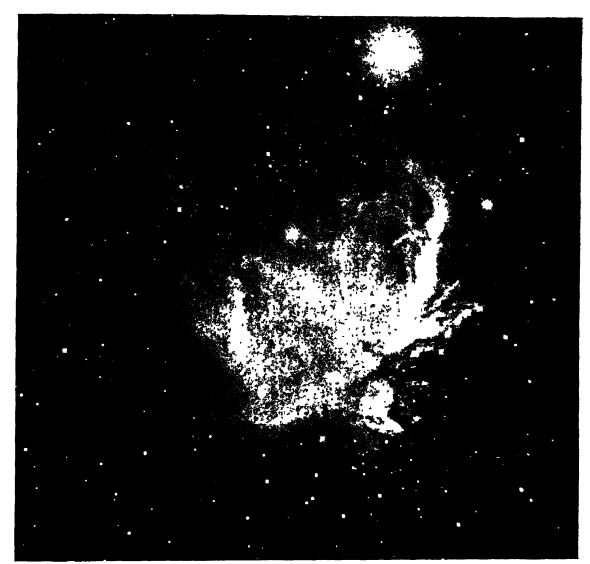
Origin of Stars. — Stars develop out of nebulous matter, the green nebulae in a gaseous state, and further evolution takes place through condensation and the loss of heat by radiation, resulting in smaller, more complex, and hotter stars.
[ p. 112 ]
The great nebula in Orion (Fig., p. 111) is held to be in the first period in the history of a star, for here the gas of nebulium is exceedingly tenuous and the stars condensing in it seem to indicate that the entire cloudlike nebulous mass is also in slow internal motion.
Giant Stars. — Astronomers have now ascertained the evolution of the stars far better than ever before, and they have been grouped into an ascending evolutionary series of heating giant stars, and a descending cooling series of dwarf stars. In other words, the giant stars are in the earlier stages of stellar evolution, are enormously larger than our sun, have a much lower temperature, and their gases are as diffuse as those in an electric vacuum tube. Jeans says that the volumes of the giant stars compared with those of the dwarf stars are of the ratio of about one million to one.
Betelgeuze, the red star in the constellation Orion, is one of the greatest of the known giant stars, with a diameter of about 215,000,000 miles (Hale). In volume it exceeds the sun at least a million times, although its mass is probably not more than ten times as great. The density of its gas can hardly exceed one-thousandth of our atmosphere. Three quarters of the naked-eye stars are in this stage, according to Hale, and Antares and Aldebaran are other examples. Slowly, with time, the giant stars contract through constant loss of heat by radiation, and yet their temperature rises, and as a result their color changes from red to bluish white. This process of shrinkage and rise of temperature goes on so long as the stars remain in the state of a perfect gas. The pinnacle of the ascending or heating evolution is reached in the intensely hot bluish-white stars of the helium class. The density of these stars is perhaps one tenth that of the sun, and the latter has a density of 1.4 greater than that of water.
Then follow the cooling stages, the descending part of the evolutionary cycle, for as soon as contraction has increased the density of the gas beyond a certain point, the temperature begins to fall. The bluish white light of the star becomes yellowish, and stellar evolution is now in the dwarfing part of the cycle. Our sun is a good representative of this stage. The density increases, surpassing that of water as in the case of the sun, and will go far beyond in later evolution. In the course of millions of years a reddish hue again appears, finally turning to deep red. The densest of known stars is the “ New Variable,” in position a little south of the Big Dipper. It is as solid as the surface rocks of the earth, with a specific gravity between 3.1 and 4.8. Curiously, it shines brightly, being of the eleventh magnitude. Accordingly we see that there are youthful giant red stars in which the gases are not much condensed, and dwarf red stars that are far advanced in their condensation. The latter are the oldest stars and are near extinction as light-givers. As the dwarf stars cool, the falling temperature permits the elements to unite into compounds of ever greater complexity. Finally, all light emission ceases and the star passes into its ultimate state, having a cold, dark exterior but with a more or less hot interior.
Helium Stars. — Through the study of the light (spectra) of stars it has been learned that the gaseous nebulae of the Orion type [ p. 113 ] develop into stafs that reveal dominantly helium. These are the bluish-white stars, the final stage in the ascending series of heating giant stars. The helium stars have the lowest known stellar velocities and the velocities oT stars increase from the helium stars through the hydrogen and solar stars to the red stars. The helium stars are young, their motions are slow, and they have not wandered far from the place of their birth in the Milky Way. The more mature dwarf stars have wandered far from the place of their origin.
Hydrogen or Sirian Stars. — Next in order of evolution in the dwarfing series appear to be stars like Sirius, in which the spectrum is marked by conspicuous hydrogen lines, associated with inconspicuous ones of iron, sodium, magnesium, etc. They do not have dense absorbing atmospheres, and due to this fact and to their extremely high temperature, they are revealed to us also as the white or bluish white stars. These stars, though relatively condensed, are nevertheless much less dense than the sun.
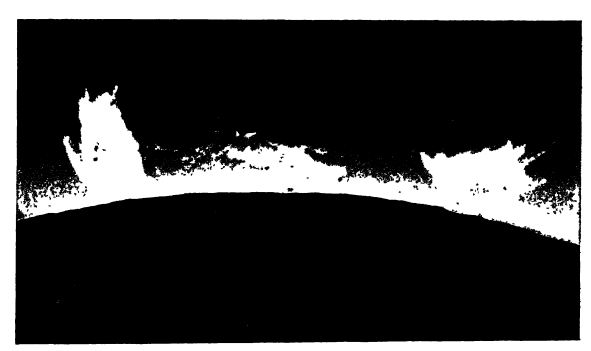
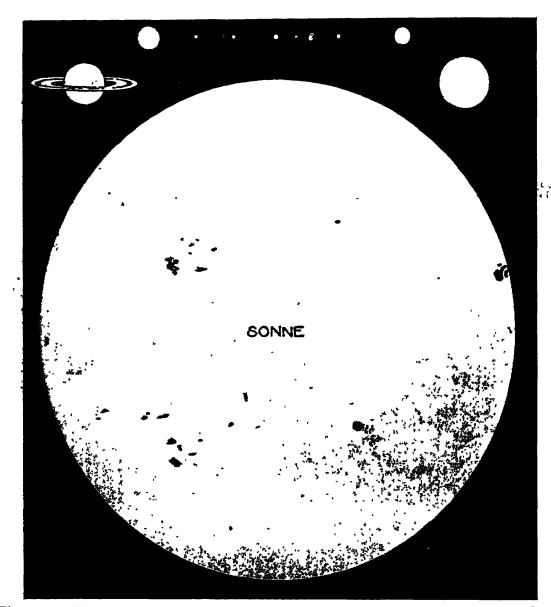
Solar or Metallic Stars. — Further condensation produces more and more of a thick absorbing atmosphere, and the consequent filtering of the stars’ light causes them to take on a yellowish or reddish tinge. Solar or yellowish stars are thought to have attained stellar maturity — are middle-aged stars — and like the sun have thick absorbing atmospheres; their interiors, however, are still gaseous, though under strong compression. The sun’s temperature is of the order of 6000“ absolute Centigrade, or nearly twice the [ p. 114 ] temperature of the arc light (see Fig., p. 113). The sun, like many other stars, is of the metallic type, somewhat hotter than the reddish yellow or Arcturian type, and the spectroscope reveals in it the presence of vapors of iron, sodium, magnesium, calcium, hydrogen, and many other elements known on the earth, but in general no compounds of elements occur (Abbot).
Hale describes the appearance of the sun at times of total eclipse as follows: Bed flames of hydrogen, sometimes reaching heights of five hundred thousand miles, may be seen rising from a continuous sea of flame, which completely encircles the sun (see Fig., p. 113). These are the prominences, and the continuous ms-sfi of flame from which they rise is the chromosphere. Extending far beyond these flames into space, sometimes to a distance of millions of miles, is the corona, which shines with a silvery luster somewhat inferior in brightness to that of the full moon.
Carbon or Antarian Stars. — The stars in their continued evolution beyond the solar stage eventually fade further and further toward invisibility. From the yellowish stars we pass to those of an orange or red color, the spectra of which reveal marked carbon lines. The latter is the last period of stellar visibility.
Dark Stars. — Finally the evolution continues into the dark or invisible stars, of which many are known to exist by the gravitative disturbance which they exert upon the neighboring stars. The last stage will be the formation of a hard outer shell, but no life will be evolved because there will be no light to supply the necessary environment for organisms. The original motion, however, will continue, and therein lies the possibility of a future cataclysmic approach to some other star.
Rapidity of Stellar Evolution. — “Speaking somewhat loosely, I think we may say that the processes of evolution from ah extended nebula to a condensed nebula and from the latter to a spherical star, are comparatively rapid, perhaps normally confined to a few tens of millions of years; but that the further we proceed in the development process, from the blue star to the yellow, and possibly but not certainly on to the red star, the slower is the progress made.”
“There are reasons for suspecting that the processes of evolution in our sun, and in other stars as well, may be enormously prolonged through the influence of energy within the atoms or molecules of matter composing them. The subatomic forces residing in the radioactive elements represent the most condensed form of energy of which we have any conception-. It is believed that the subatomic energy in a mass of radium is at least a million-fold greater than the energy represented in the combustion or other chemical transformation of any ordinary substance having the same mass. These radioactive forces are released with extreme slowness, in the form of heat or the equivalent; and if these substances exist moderately in the sun and stars, as they do in the earth, they may important factors in prolonging tiie lives of these bodies.” (Campbell.)
[ p. 115 ]
New Stars. — As we have seen, there must be in the galactic universe countless numbers of dead stars, any one of which may at some future time, through the accident of close approach to another star, be set ablaze for a time. The novae or new stars may be due to such stellar catastrophes.
In the early stage of galactic evolution, close approach, Jeans says, must have happened often, since the stars were then much more closely spaced than they are now, their relative velocities probably much smaller, and their densities very low.
The new stars are superb stellar catastrophes suddenly flashing out in the sky, and nearly always in the Milky Way, where previously no star was known to exist. Their known number is not large. They usually rise to maximum brilliancy in a few days, and some have increased in brightness ten thousandfold in two or three days. They become invisible in a few weeks or months.
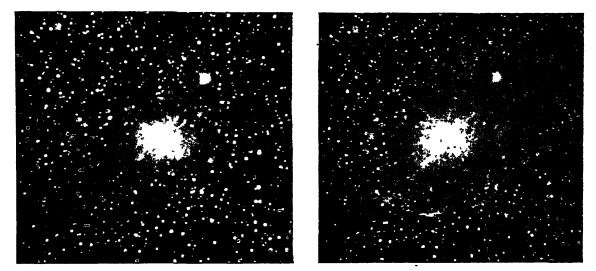
“ A nova,” Campbell says, “ is seemingly best explained on the theory that a dark or relatively dark star, traveling rapidly through space, has encountered resistance, such as a great nebula or cloud of particles would afford. While passing through the cloud the forward face of the star is bornbarded at high velocities by the resisting materials. The surface strata become heated, the luminosity of the star increases rapidly.” Reynolds (1923) holds that novse pass into planetary nebulae.
¶ Meteorites and Comets
We must here digress a Httle to study the meteoritea, since they fairly represent the nature of any kind of scattered interplanetary matter of the solid type that might once have been available for the formation of small planets and satellites,” as postulated in the Chamberlin theory of earth origin, soon to be described.
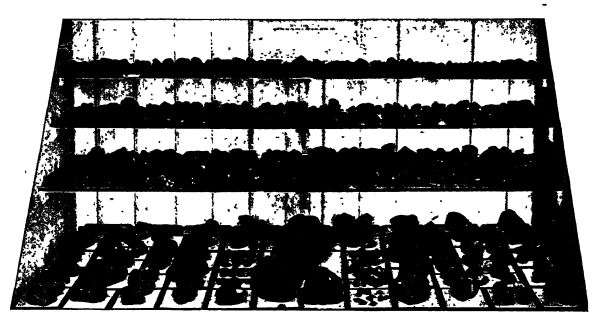
On almost any dark night may be seen brilliant white or green [ p. 116 ] streaks of light shootmg with high velocity and in clivers directions through the skies. These fiery lines, popularly called shooting stars,” and “ falling stones,” are caused by bodies of solid matter, those reaching the earth varying in size from 5 grams to at least 37.5 tons (Figs., pp. 116, 117). Although but few are seen by the eye, it is estimated that 20,000,000 strike the earth or its atmosphere each day, and yet only about 815 (260 American) falls are known to geologists. It is thought that about 100,000 tons of meteoritic dust are added annually to the earth. The meteorites are “ unquestionable fragments ” of other worlds moving swiftly through our atmosphere. The initial velocity of impact is so high, up to 45 miles per second, that the meteors are heated to the point of dissipation as a luminous gas by the friction generated in passing through the terrestrial atmosphere. Thus they become visible only at the moment of their dissolution, and this is dependent upon the accident of collision with the earth.
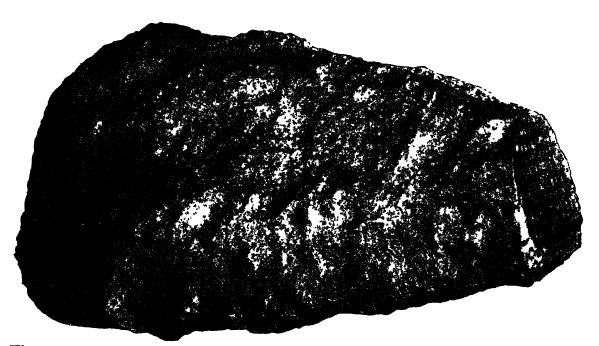
Meteorites appear to be disintegrated comets, attracted to the sun and earth from the outer confines of solar space. They bring to us samples of their bodily constitution and the proof that they are closely related in their chemical elements to our own sun and earth, though differing in the proportional amounts and sometimes radically in their combinations. More than forty elements are known in meteorites, the most- abundant being aluminium, calcium, carbon (as graphite and diamonds), iron, magnesium, nickel, oxygen, phosphorus, silicon, and sulphur.
[ p. 117 ]
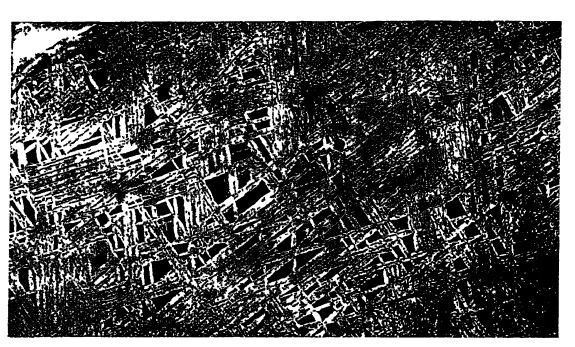
There is a considerable variety of meteorites and these are grouped by Merrill as follows: (1) stony meteorites (basaltic and chondritic) or aerolites, consisting essentially of silicate minerals with minor amounts of the metallic alloys and sulphides (Fig., below); (2) stony-iron meteorites or siderolites of metal and silicate minerals; and (3) large iron meteorites or siderites, essentially of an alloy of nickel, iron, and cobalt, with iron phosphides and sulphides (Figs., pp. 116, 118). “ It is evident that the meteorites were formed under conditions of a limited supply of oxygen and that they have since their formation been subjected to high temperatures and the reducing power of gases (Merrill).
Chamberhn regards meteorites as “but an incidental result of stellar and planetary action. Their genesis is wholly a secondary matter, and furnished no ground for regarding meteorites as the parent material of great nebulae or of stellar systems. . . . This scattered matter is presumed to be picked up bit by bit by all the larger bodies, as is being done daily by the earth.”
Comets and their Relation to Meteors. — Comets, compared to the earth or moon, are decidedly smaller bodies, and they are now members of the constellation of the sun. Originally they were dark interstellar bodies deflected from their paths by the mass attraction of the solar system. They spend most of their time in the outermost parts of the solar system and swing around the sun usually from west to east. Most of them are seen but once, but at least sixty are periodic, and revolve in short ellipses about the sun. Comets develop tails on approaching the sun, consisting of gases and the finest of dust that is blown away into space by the light pressure and is then seen by reflected light from the sun.
[ p. 118 ]
The heads of the periodic comets are more diffuse in appearance t.hg.Ti the others and it is believed that they consist principally of discrete small bodies held together by their own shght gravitation. With each return to the sun, the parts are more and more scattered and eventually the comet becomes invisible but appears to retain its cometary orbit as a swarm of meteors. Five such swarms are known; those of April and August, the Perseids; those of November, the Leonids; and Biela’s comet. “ Clearly,” says Campbell, “ the cometary materials had been gradually scattered by the disintegrating effect of the sun’s attraction, and the separate particles were compelled to move in orbits differing slightly from each other, and from the recognized orbits of the comets.”
¶ Theories of Solar Origin
Geologists and astronomers are now more and more giving up Laplace’s theory of the origin of the earth out of the sun, and accepting more or less of the Chamberlin-Moulton hypothesis. The latter explanation will, however, be better understood if we give the history of the rising Laplacian theory.
Nebular Hypothesis of Kant. — Astronomy and physics received a great impetus from Newton’s principle of universal gravitation, given to the world in 1687, a principle that led to a sound conception of the evolution of the solar system. This Newtonian principle was the basis of Immanuel Kant’s nebular hypothesis, [ p. 119 ] which that professor of mathematics and phsrsical geography at KQnigsberg presented in 1755 .
Kant, according to Iddings, conceived that the universe might have been developed out of chaos and that space was filled with fundamental material highly varied as to mass, density, and power of attracting other particles. He argued that since the planets and their satellites moved in strict conformity with one another and in definite relation to a central sun, with vacant spaces between them, there must have been a diffusion of their substance through space, and a subsequent segregation into planetary masses.
The attraction of the particles for one another would occasion motion in all directions throughout the swarm. The denser would in time become nuclei of condensation. Finally there would thus result zones or rings of discrete particles segregating into condensing nuclei, which upon further condensation become planets and satellites, the preponderating central nucleus becoming the highly heated sun.
[ p. 120 ]
“ Kant’s hypothesis,” Campbell says, ”had the great defect of trying to prove too much. It started from matter at rest, and came to grief in trying to give a motion of rotation to the entire mass through the operation of internal forces alone — an impossibility. Kant’s idea of nuclei or centers of gravitational attraction, scattered here and there throughout the chaotic mass, which grew into the planets and their satellites, is very valuable.”
Nebular or Hot-earth Theory of Laplace. — The celebrated theory of the French astronomer Laplace explaining the origia of the solar system dominated the world’s thought from the date of its publication in 1796 and its further modification in 1824. Laplace thought that our ancestral sun, long before it gave birth to its family of eight planets (four outer large ones and four inner [ p. 121 ] small ones), their twenty-six satellites, and the ring of more than nine hundred very small planetoids, was originally in a state of luminous vapor. It extended even beyond the orbit of the outermost planet Neptune. In other words, the vaporous sun then had a diameter of not less than 5,600,000,000 miles, and its gas must have been unbelievably thin, several hundred million times less dense than the air we breathe.
Laplace pictured our ancestral sun as a rotating nebula of gas that was slowly contracting through loss of heat by radiation, and leaving behind nine rings of gas liberated from the equatorial region of its mass, each one of which condensed either into a planet or a ring of planetoids. Important as was this birth of the planets, their total mass is not more than one half of one per cent that of the sun. However, according to Campbell, successive abandonment of nine gaseous rings of matter, each ring rotating as if it were a solid structure, is unthinkable.
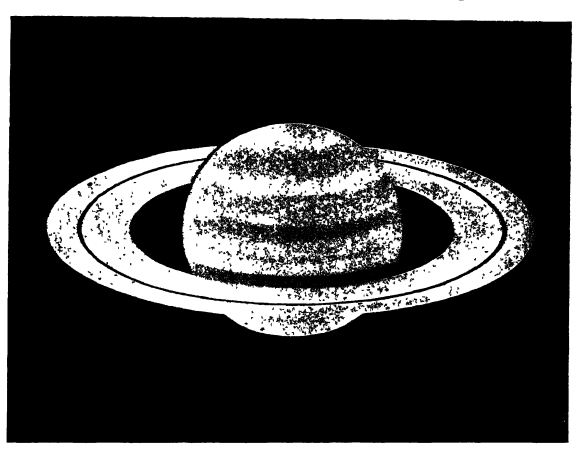
Laplace also held that the gaseous planets similarly left behind one or more equatorial rings that have since condensed into moons. In the case of Saturn (see Fig., p. 119), some of the rings remained as such, but it is now known that these are not gaseous but composed of fragmented solid material. However, as all the satellites should revolve in the same direction as their planet parents, i.e., from west to east, clockwise, it is fatal to Laplace’s theory that eight of them do not follow this rule; these are the four moons of Uranus, the one of Neptune, the ninth or outermost moon of Saturn, and the eighth and ninth moons of Jupiter.
Objections to this theory were brought forward at various times during the nineteenth century, and some of them have already been mentioned. Others are: (1) No nebulae closely resembling the supposed annulated one that gave rise to the solar system have yet been discovered. (2) The very extended solar mass in rotation would violate fatally the law of constancy of moment of momentum (the technical term for energy of the rotating body). (3) The Laplacian solar system should be regular in all of its parts, but the solar system as it exists is a “ combination of regularities and many surprising irregularities (Campbell). (4) Even if the rings had formed, Moulton has shown that it would have been impossible for this nebular material to draw together into a planet.
Jeans’s Theory of the Evolution of the Galaxy and Solar System. — According to Jeans, in the beginning all the stars within our galactic universe formed a single mass of excessively tenuous gas in slow rotation. This mass contracted owing to loss of energy by radiation, [ p. 122 ] and so increased its angular velocity until it assumed a lenticular shape. After this, further contraction was a sheer mathematical impossibility and the system had to expand. The mechanism of expansion was provided by matter being thrown off from the sharp edge of the lenticular figure; the lenticular center now formed the nucleus of a spiral nebula of the normal type, and the thrown-off matter formed the arms. (See Fig., p. 109.) The long filaments of matter which constituted the arms, being gravitationally unstable, first formed into chains of condensations about nuclei, and ultimately formed detached masses of gas. With continued shrinkage the temperature of these masses increased until they attained incandescence and shone as luminous stars. The majority of the stars broke away from their neighbors and so formed our present galactic universe, in which the flattened shape of the original nebula may still be traced in the concentration about the galactic plane, while the original motion along the nebular arms still persists in the form of “ star-streaming.”
The solar system of the galactic universe has, however, not been formed as the result of a rotational break-up, as have our galaxy and the spiral nebulae, but developed out of tidal disruption caused by the close approach of another star to the sun.
At intervals it must have happened that two stars passed relatively near to one another in their motion through the universe. We conjecture that our sun experienced an encounter of this kind, a larger star, one above the average, passing within a distance of about the sun’s diameter from its surface. The effect of this would be the ejection of a stream of gas from the sun toward the passing star. At this epoch the sun is supposed to have been dark and cold, its density being so low that its radius was perhaps comparable with the present radius of Neptune’s orbit. The ejected stream of matter condensed into detached nuclei which would ultimately form planets. The more liquid planets at the end of the chain would be those of smallest mass; the gaseous center of the ejected chain of matter would form the larger planets Jupiter and Saturn.
Planetesimal or Cold-earth Theory of Chamberlin and Moulton. — These authors postulate that the materials now composing the sun, planets, and satellites must have had a “ biparental origin.” Due to a close approach, “ a nebula was evoked from the sun to form its attendants.” In other words, the secondary solar nebula was little more than a streaming knotty pair of arms of nebulous matter shot from the sun and curved into spiral appendages about it by the joint pull of itself and a passing star.”
[ p. 123 ]
“ Chamberlin and Moulton’s hypothesis has the advantage of a parent mass in rotation, practically in a common plane, and with the materials distributed at distances from the nucleus as nearly in harmony with the known distribution of matter in the solar system as we care to have them. … In effect it retains all the advantageous qualities of Kant’s proposals. It seems to have the flejdbility required in meeting the irregularities that we see in our system” (Campbell).

The knots of the solar nebula play a leading part in the interpretation of the immediate genesis about them of the planets, planetoids, and satellites, since they served as collecting centers for the dispersed dust-like material, the planetesimals, the minute particles of the secondary solar nebula.
The student must be careful not to confound the solar nebula, which was spiral in form, with the vast spiral nebulae, the “ island universes,” since the latter condense into galaxies, while the solar nebula gave rise only to the constellation of the sun.
According to the planetesimal hypothesis, there were six stages in the growing earth before geologic time began.
These may be described briefly as follows:
(1) Nuclear Stage. — The earth started in a nebular knot, the diameter of which may have been between 2000 and 3000 miles. At first the discrete matter was held together by mutual gravity, and later the whole passed gradually into a solid mass.
(2) Initial Volcanic Stage . — Before the nucleus grew to any large part of the earth’s present mass, the self-compression which arose from its own gravity, when at a diameter of less than 3000 miles, is thought to have produced sufficient central heat to have reached the melting points of the common kinds of rock under low pressures. Accordingly there soon appeared volcanic activity at the surface of the growing earth. The internal heat may in part have been produced by the infall of planetesimals, and an unknown amount was probably inherited from the nebular [ p. 124 ] knot that constituted the original earth-nucleus. The chief source of internal heat is, however, assigned to the progressive interior condensation of the growing body as planetesimals were added to its surface. Another source of heat lay in the atomic and molecular rearrangement of the growing nucleus.
(3) Initial Atmospheric Stage. — In the nuclear stage the earth was too amall to hold to its surface the gases of an atmosphere, but when it had a mass at least one tenth of its present one, it probably held a limited atmosphere as does Mars. As it grew larger, it began to attract atmospheric molecules and developed the power of holding an atmosphere. The diameter of the earth may then have been about 4200 miles, and with the origin of volcanic action, more gases were added to the atmosphere.
(4) Initial Hydrospheric Stage. — When the earth had attained sufidcient size, water vapor was held in the atmosphere, and when, at length, the point of saturation was reached, it took the liquid form and initiated the hydrosphere. When the water accumulated upon this surface, it did so in innumerable small depressions or lakes. These bodies of water initiated the oceanic basins. Therefore the differentiation of the heavier oceanic regions from the lighter continental protuberances began almost as soon as the hydrosphere started to gather, or when the earth had attained the size of Mars.
(5) Initial Life Stage. — Suitable conditions for life did not exist until after some notable development of the atmosphere and the hydrosphere, but it is possible that certain forms of life originated long before the earth was full-grown.
(6) Last Stage of Planetesimal Accretion. — During all the previous stages the earth was slowly growing larger, and according to Chamberlin, it grew very, very slowly. Finally, the time came when practically all of the planetesimals of the original nebula under the influence of the attraction of the earth and the moon had been gathered. The earth probably then had a considerably greater equatorial diameter than now. This stage ended Cosmic tima in the history of the earth.
(7) Gradational Stage. — After the growth of the earth had ceased, the surface was no longer subject to continual burial, but was exposed ever afterward to the action of air and water, and heat and cold, wearing away the high places to fill the lower ones. The seventh stage, therefore, embraces all geologic time, and its dominant process was gradational.
If the earth was built of meteorites like those seen to fall on the earth, which have a mean specific gravity of 3.69, and it the meteorites were as small as dust. [ p. 125 ] rigid, and elastic, then the earth at the close of its growing period must have had a radius of 4530 miles, with the present specific gravity of 5.53. This is 570 miles greater than the present radius (3959 miles). Originally porosity was far greater because of the granular nature of the planetesimals. Accordingly the earth has shrunk about 570 miles since the beginning of its growth (Chamberlin).
Planetoidal or Hot-earth Theory of Barrell. — We have seen that according to Chamberlin the planetesimals were in the main of dust size, and that it took an immensely long time for the earth and moon to gather them. Barrell (1918), on the other hand, viewing the probable size of the planetesimals as equivalent to that of the planetoids, inclined to the idea of rapid infall of material upon the earth nucleus. Accordingly, but little time was consumed during the growth stages of the earth, and the infall of masses mainly large and up to hundreds of miles in diameter led to the formation of a hot earth.
According to Barrell, from one fourth to one half of the whole material shot out of the sun was in the knots, the remainder in planetoids and planetesimals. Four small knots represented the beginnings of the four small inner planets. Beyond them was the zone of the planetoids, and as here there was no dominating nucleus, they have therefore remained to this day largely in the planetoidal state. Outside of the latter were the four greater nuclei, the beginnings of the four major planets. These nuclei and planetoids gathered the planetesimals within the spheres of their attracting powers.
Chamberlin conceives the earth to have been built up as a solid body, not to have been fluid or viscous at any time later than the early nuclear stage. Such Kquid rock as was generated by compression or radioactivity during earth-growth is regarded as having been kneaded and squeezed to the surface, where it solidified approximately as fast as it was formed.
On the other hand, Barrell holds that the chemical character of the igneous rocks, the limited depth of density variations in the crust, the limited amount of the salt m the sea, the rotation periods of the moon and planets all point to a molten condition of the earth at the completion of its growth. If the earth began to have an ocean when about one half of its present diameter and one eighth of its present volume, then the oceans should be far more salty than they are, because seven eighths of their accreted materials underwent weathering and should have yielded their salts to the oceans.
The argument for an eventual molten earth, Barrell deduces as follows: The belt of asteroids, better called planetoids, appears [ p. 126 ] to have remained more nearly in its original state than have other parts of the solar system. The diameters of the known asteroids range from a mflyim nm of 485 miles in increasing numbers down to 15 or 20 miles, the limit of telescopic visibility, and countless others must be so small that they will remain imseen. All the asteroid masses together, according to recent calculations, are equivalent to less than one-hundredth of the mass of the earth. Therefore the invisible parts of this ring of asteroids are not iu dust-like or molecular form, but are in fragments of appreciable size, ranging up to some miles iu diameter. Furthermore, these masses, owiug to their amnll diameters and hence weak gravitative force, would possess almost no power to grow by accretion. They must retain almost the original stage of the nebula, or better, the meteoritic swarm. Their evidence therefore favors the view that the scattered matter which was added to the nucleus to form the earth was largely of such size that the individual planetoids would have penetrated beneath the surface of the liquid or solid earth. The energy of impact of the larger masses would result in local liquefaction. If in addition the infall of the planetoids was sufficiently rapid to bury the heat of previous infalls before it could be dissipated by conduction to the surface, a general heating and liquefaction of the earth would tend to take place, both from the increased compression of the deeper nucleus and the effects of impact at higher levels.
¶ Collateral Reading
C. G. Abbot, The Sun. New York (Appleton), 1911.
Svante Arrhenius, The Destinies of the Stars. New York (Putnam), 1918.
Joseph Barrell, The Origin of the Earth. Chapter I in “The Evolution of the Earth and its Inhabitants,” New Haven (Yale University Press), 1918.
W. W. Campbell, The Evolution of the Stars and the Formation of the Earth. Popular Science Monthly, September, 1915, pp. 209-235; Scientific Monthly, October, 1915, pp. 1-17; November, 1915, pp. 177-194; December, 1915, pp. 238-255.
W. W. Campbell, The Nebulae. Science, new series, Vol. 45, pp. 513-548, 1917.
T. C. Chamberlin, The Origin of the Earth. Chicago (University Press), 1916.
G. E. Hale, The New Heavens. New York (Scribner), 1922.
G. E. Hale, The Study of Stellar Evolution. Chicago (University Press), 1908.
J. H. Jeans, Problems of Cosmogony and Stellar Dynamics. Cambridge (University Press), 1916.
| VII. The Geological Time Table, and the Age of the Earth | Title page | IX. The Earth before Geologic Time |