| VI. Seas, the Essential Recorders of Earth History | Title page | VIII. The Evolution of the Stars and the Origin of the Solar System. |
[ p. 88 ]
Geology is one of the natural sciences, and among its various pursuits also seeks to unravel the history and age of the earth. “ Speak to the earth and it shall teach thee,” we read in the book of Job. “ Go and see,” is the first principle in Geology. The history of the earth has automatically recorded itself in the lithosphere, and it is this wonderful record that geologists seek to write down as Historical Geology.
With Lyell, we agree that “ strata have been always forming somewhere, and therefore at every moment of past time Nature has added a page to her archives; but, in reference to this subject, it should be remembered that we can never hope to compile a consecutive history by gathering together monuments which were originally detached and scattered over the globe.”
Rise of the Earth Sciences. — In ancient times, most of the philosophers of India, Eg 3 rpt, Greece, and Rome failed to study the order in the lithosphere, and indulged in the more attractive but fruitless discussion concerning the origin of the earth and the great catastrophes to which it was supposed to have been subjected. Certain Arabian writers of the tenth century, and in the sixteenth to eighteenth centuries the philosophers of Italy and later of France, Germany, and England, laid the true foundation of a science of Geology. A marked advance came when they fully realized that the fossils in the earth’s strata represented once living things, and that the earth is vastly older than some thousands of years. “ It is very difficult at first sight,” says Judd in The Students’ Lyell, “ to believe that the making of lofty mountains and deep valle 3 rs, the piling together of many thousands of feet of ma-terials, and the passing away of whole generations of living creatures, have not been brought about by great and convulsive throes of nature rather than by simple causes operating through vast periods of time.”
Geologic classification had its origin in the “ formations ” of two German geologists, Lehmann (1756) and Puchsel (1762). ThD older geologists had, in general, no clear ideas of the geographic [ p. 89 ] extent of geologic formations, but Abraham Gottlob Werner (17751817), professor of mining at Freiburg, Germany, had such a conception, and on the basis of some facts and much fancj” he taught with wonderful success that the formations were universal for the earth, a fallacy of which Geology to this day has not completely divested itself.
Geology was at first a science of minerals and rocks, and it was not until the significance of fossils as determinants of age was first worked out in England by Smith (1799-1801), and still more clearly by Cuvier and Brongniart in France (1808-1811), that stratigraphy and geologic chronology had their begioning. Cuvier, and more especially D’Orbigny, taught that each formation contained its own specially created flora and fauna, and that each creation was in turn destroyed by a general catastrophe. Geologists were largely swayed by these ideas imtil the appearance of Darwin’s famous book, The Origin of Species, — although Lyell (the great Uniformitarian) had long previously combated the theories of the catastrophists.
The principle of the uniform operation of Nature’s laws (= uniformitarianism) is the guiding one, not only of organic evolution, but of Geology as well. It was widely promulgated by Lyell, who got it from the first great geologist, James Hutton of Scotland (1795). The principle of uniformity and continuity in Nature implies the improbabihty of violent catastrophism in either the lifeless or living worlds; it teaches that we must seek in the operation of Nature’s present actions the explanation of her past acts. This is the law of uniformity.
The idea of catastrophism has now given way to the theory of local and general changes in the environment, changes that bring about small and great alterations in the plants and animals and in their local associations. We learn, therefore, that the primary basis for discerning the sequence of geologic events is the fossils entombed in the strata at the time of their formation. However, many rocks have no fossils, and in the earlier and longer portion of the earth’s history the life then existent was so rarely preserved that other methods have had to be devised to unravel their sequence and genetic relation to one another. These various principles will be described later in this chapter, beginning with the criteria (standards of judgment) of the fossils and then proceeding with those of oceanic spread, erosion, and diastrophism.
Basis of Chronology. — The fundamental principle imderlying all endeavor to make out the geologic past is evolution, the oscillating [ p. 90 ] but progressive changes wrought in the long ages, changes whose interpretation leads to the history of the earth — the science of Historical Geology.
The earth develops as a whole, but the record is far from bemg everywhere alike , even if it were so, it would not be wholly accessible for study, because sheet upon sheet of rock hides others below, and the atmospheric agencies have destroyed much through erosion. Likewise, the more complete stratigraphic record buried under the oceans is hopelessly inaccessible. Therefore the completed geologic record will eventually be put together from the evidence of all places which are at present land. Such history is largely brought about through the periodic adjustments of the lithosphere, which settles down upon a shrinking nucleus, and in so doing crushes the outer shell into great folds which tend to rise, especially toward the margiTiR of the continents. Broad movements of a vertical nature also take place at times, whereby the continents tend to warp up and restore the elevations destroyed by erosion. On the other hand, the oceanic areas also move up and down, and as they are the reservoirs of all sediments derived from land wear, it is but natural that the marine waters should periodically flood the lands.
¶ Time Terms in Geology
Geologic time is divided into eras, and these into periods that are composed of formations. It is therefore necessary to define these very far-reaching terms, since they will recur throughout the remainder of this book.
Eras. — An era is the longest division of time used in Geology; the eras are the volumes in the book of geologic time. They are comparable in human history to the Christian era, and like it, characterized by a striking change in events. The era terms are taken from the Greek language and are based on the state of organic evolution present. In the Paleozoic era, life is primitive (palaios, ancient, and zoe, life), and in the Cenozoic (cainos, recent) it is modern. We are living in the Psychozoic era, the era of reason.
A geologic era is composed of a group of periods. It is bounded by “ critical periods,” by the greatest of unconformities, and by the longest breaks in the geologic and organic records. At these times of emergence, the continents are largest and most protuberant above sear-level, and when the oceans again begin to spread over them, it is seen that the life has changed in the interval, the reconl of which is lost.
[ p. 91 ]
Near the close of the eras also occur the most extensive times of mountain making, and these elevations bring about marked changes in the environments that react strikingly on the life of the tune. These times of major diastrophism are the critical periods or revolulions in the history of the earth, and they divide, as it were, the book of geologic time into chapters.
The critical periods are marked by the following features:
(1) By wide-spread deformation of the earth’s crust, transmitted from place to place. This leads to the elevation of many and widely separated mountain ranges, followed by long intervals of erosion and mountain removal, and therefore by almost universal unconformities. Each revolution or critical period is named after one of the prominent mountain ranges formed at the time designated, for example, Laramide and Appalachian revolutions.
(2) By wide-spread changes in the physical geography. That is, there are at these times a highly diversified or young topography, decided alterations in the continental outlines, the making of new or the breaking down of old land connections (the land bridges which permit intercontinental organic migrations), and marked changes in the oceanic currents, all of which also lead to marked variations of temperature and often to actual glacial periods.
(3) By marked and wide-spread destruction of the previously dominant, prosperous, and highly specialized organic types.
(4) By the marked evolution of new dominant organic types out of the smallsized and less specialized stocks, and by the development of hordes of new species.
The last or Cascadian Revolution is so recent that the record of it is not lost, and a study of this enables us better to comprehend the changes wrought by the earlier revolutions. LeConte regards it as the type, as the best proof of the fact of critical periods, and as throwing abundant light on the true character of such periods, and especially on the causes of the enormous changes in orgam’c forms during such times.”
The eras are divisible into suberas (the “ major divisions ” of the table, page 101) on the basis of physical changes and the dominance of a group of organisms. For instance, in the early Paleozoic subera there are practically no land plants or backboned animals, in the middle division land floras appear and fishes are common, while in the youngest division appear the land-living vertebrates.
Periods or Systems. — The eras and suberas are composed of periods of time or systems of rocks and they are the chapters in the book of geologic time. The older geologists based these on unconformities or marked differences in the entombed fossils. As the work proceeded, however, and knowledge became more detailed, it grew increasingly difficult to formulate principles for the discrimination of natural periods and systems.
In one form or another, geologists have always delimited their geologic divisions according to movements of the earth’s crust, [ p. 92 ] but how to discriminate the smaller movements from those that have more or less of a world-wide application for the delimitation of periods or systems is only now becoming clearer. Dependence will always have to be placed primarily on the fossils, but some criterion besides that of the contained life is needed to differentiate between the systems of stratified rocks. Such a physical principle apparently exists in the periodic submergences of the continents, also known as the positive changes of sea-level, for when one of the floods attains its maximum of spread, the widest distribution of similar faunas and identical species would naturally be expected. Conversely, the maximum of continental emergence must mark the absence of marine faunas in most land areas, followed for a time by more or less dissimilar faunas in all the provinces. The plotting of these periodic submergences and emergences on paleogeographic maps, not merely for one continent but for most of the world, win make it possible to define the boundaries of the systems of rocks and will also help greatly to determine a more accurate time valuation of the formations and their life in the various continents. It is, therefore, the principles of diastrophism, paleogeography, and organic evolution that will eventually correctly define the periods or systems.
A period of time, according to H. S. Williams, is based on a sequence of rock formations whose stratigraphic order and lithologic composition are thoroughly well expressed in some definable geographic region, and whose fossils indicate a more or less continuous biologic sequence.” Hence their names are taken from the geographic area where they are first studied, e.g., Pennsylvanian, from the greatest coal state. The Cambrian, Silurian, and Devonian systems were first discriminated in England and Wales, and take their names from ancient peoples living in these countries, or from the district in which the rocks are best developed. Triassic has reference to the tripartite development of rocks of that age in Germany, and is an heirloom from the days of Geology when the science had not worked out the principle that formations and periods must be based upon type areas. Cretaceous is a still older inheritance from the days of mineral Geology, the name being based upon the chalk deposits of western Europe.
The Three-fold Nature of Periods. — A period usually begins with highlands that are inherited from the previous period. There is therefore also marked erosion, and the limited sea-ways have dissimilar faunas. During the middle part of the periods, the oceanic transgressions are greatest, the lands are lowest, and the faunas [ p. 93 ] throughout a continent are most ahke in composition and have the greatest number of species in common, that is, are “ cosmopolitan faunas.” Restriction again takes place during the closing part of the periods, though at these times there are many more hold-over species from the earlier, widely dispersed faunas; in other words, there is no marked introduction of new organic types during the recession of the seas. However, before the oceans again spread over the continents, a long time will have elapsed, many of the old famihar forms will have disappeared under the stress of restricted habitat, and new forms will have been developed, the prophets of a new period and indicative of the next trend in evolution.
Epochs and Series. — A period of time is very long, and a system of formations is usually of great thickness; in fact, these divisions embrace so many events that other and smaller groupings are required for their better comprehension. A period is therefore subdivided into epochs of time, and a system of formations is distributed into series of strata. In general, epochs and series are now rather arbitrary divisions established either on faunal grounds or on a long series of strata supposed to represent a sedimentary cycle, beginning in a conglomerate or sandstone and ending in calcareous deposits. While these criteria are more or less correct, they need to be checked by diastrophism and paleogeography. The epochs and series are further divided into ages (time) and stages (rocks), but these divisions have as yet no scientific precision.
Formations. — The epochs are again divided into formations. The word formation is in general practice used for the smallest units that can be plotted on a geologic map, and may embrace a single more or less thick succession of like sediments, such as the Trenton limestone, Rochester shale, or Medina sandstone, or a succession or alternation of sediments that are unlike (for example, shale, limestone, and sandstone), but have closely related faunas, such as the Hamilton formation. In short, any set of conformable strata that are without significant time breaks and are grouped’ together for any stratigraphic or faunal reason or a number of reasons may be termed a formation.
Disturbances. — As the eras end in revolutions, so the periods may terminate in crustal movements, and these times of diastrophism are known as disturbances, a term used by H. D. Rogers as long ago as 1856. It seems probable that the periods were all separated by disturbances, events occurring now in this and now in that continent.
[ p. 94 ]
¶ Evidence of Fossils
Fossils furnish the first step in the process of stratigrapLIc correlation. Their testimony is checked by the geographic distribution of the sediments that contain them, and by the relation of the latter to the formations beneath and above them (superposition). These principles are easy to state but very difficult to apply accurately to so great a land mass as North America, and even thoxigh approximately a century of work has been devoted to it, the ground is only about half covered by detailed studies.
Changing Environment. — In general, sedimentation is a dow process, and under relatively constant surroundings, it is held that but little if any recognizable change in the species is developed, but as the environment of the organisms is continually c han ging, even though only to a min or extent, these physical alterations cause the life assemblages at the very least to alter their combinations and to shift from place to place. They die out in one area, but gain a foothold elsewhere, and although this to-and-fro migration is slow when measured in years, yet in stratigraphy the life assemblages appear as if suddenly introduced. This fact has always excited the interest of the paleontologist, and he has explained the phenomenon according to the view of his generation. Once he thought it due to special creations of new types or recoinages of old, but since the time of Darwin it has been looked upon as due to slow evolutions of which glimpses only are obtained in the fragments of the geologic record; or it may be due to shiftings of faunas, or to geologically sudden migrations into the continental or interior seas from the permanent or outer oceanic reservoirs, the continuous realms of marine organic evolution. The fossil faunas from the oceans spread as fast as the sea transgressed the land, and, for practical purposes in stratigraphy, they may be accepted as having appeared simultaneously in widely separated places.
Different Values of Different Fossils. — The localized species (forms restricted to a locality) are of the greatest value in the stratigraphy of small areas, while the new forms which attain wide dispersal are on the other hand of most significance in correlating the tune stages in separated regions, for they are progressives, the time heralders, as distinguished from their variously conservative associates. Therefore in the chronologic correlation of the stratified rocks most dependence is put upon a few species, known as “ guide fosals,” together with the collateral evidence of associated forms.
[ p. 95 ]
Dissimilarity of Successive Faunas. — Locally successive marine faunas derived from the same oceanic realm usually exhibit a more or less ancestral or direct genetic relationship to one another. In some cases they are the returning, slightly altered descendants of an older fauna, in other words, “ recurrent faunas.” Therefore the possibility of a “break” in sedimentation between the strata containing such successive faunas is easlly overlooked and the time value of the recurrent faunas underestimated. Or, two locally superposed faunas may be totally dissimilar, not only in the species but even in the majority of the genera, and yet the tima break between them may be a comparatively short one, the reason for this unlikeness being that the two faunas are migrations from different oceanic realms and have therefore had a development from different ancestors.
¶ Physical Evidence
Evidence of Periodic Oceanic Spreading. — Another primary principle of value in marking the periods of geologic chronology is the recognition of the times when the surface of the earth and the oceanic level are in decided motion. The crustal oscillations of the earth are not due to heterogeneous and xinrelated movements, but are connected, in that areas of elevation and depression remain as such throughout the eras, or during more or less long stretches of geologic tune. It is now clear that North America has been more or less widely flooded by the oceans at least fifteen tunes since the Proterozoic era, and that the other continents have been similarly flooded many times. The movement of the ocean waters may be of small and narrow extent, due to warpings of the lithosphere, or may spread over areas of great magnitude. As the lands are known to warp up and down and to fold into mountain ranges, it is but natmal to conclude that the oceanic bottoms are affected in the same way. Not only do the lands move up and down, the sum of this motion being in the main upward (positive movements, called geocratic by Stefanini in 1917), but it is also now clear that the ocean bottoms are periodically more or less in motion, with the sum of their movements downward (negative movements, called thalassocratic by Stefanini). For these reasons, the oceanic level in relation to the continents is inconstant, and therefore the marine spreadings over the lands, with their concomitant sedimentation, are variable not only in time, but also in geographic extent. On the other hand, when the lands protrude more than usual above the strand-line, the oceans naturally overlap the continents least [ p. 96 ] widely and make at such times limited marine stratigraphic records, which are restricted to the margins and their embayments and to the persistent axes of depressions, the geosynclines of the continents (see Chapter X). As the oceans and seas are all connected one with another, and are also the receivers of most of the land wash or detritus, it follows that a displacement of the strand-line anywhere, through any cause, must be transmitted to all marine waters. It has been calculated that if the present protuberant land masses were transferred to the oceans, the general sea-level would be raised about 650 feet, and therefore the North American continent would be flooded to a depth of at least 200 feet. Then under the waters there is continuous sedimentation, and they abound in more or less of evolving life that is most advantageously situated for burial and preservation; hence the marine stratigraphic sequence is the least broken of the several kinds of historic records accessible to geologists.
As already stated, the amount of water in the oceans is fifteen times greater than the mass of land above sea-level. This is because the oceans have an average depth of 12,000 feet and cover about 70 per cent of the earth’s surface, while the average elevation of all the lands is only 2250 feet and they occupy but 30 per cent of the lithosphere.
It is now known that the oceans have spread periodically and more or less widely over the North American continent, the areal extent of which is about 8,300,000 square miles. These floods occurred hardly at all during the Cenozoic; four times widely during the Mesozoic; and, with the maximum spread, apparently twelve times during the Paleozoic. More broadly it may be stated that the floods begin and end with shelf seas marginal to the continent and occupying between 1 per cent and 5 per cent of the total areas of the continental platform, the conditions being thus not unlike the present conditions of overlap; while the greatest inundations are of the interior or epeiric seas that during the middle of the periods cover from 12 per cent to 47 per cent of the continent.
It is therefore apparent why the major portion of the earth’s chronology depends for its determination upon the marine sediments. These formations, except in so far as they are later eroded, record the extent of the transgressions, and, in their physical characters, something of the topographic form of the adjacent lands, with a hint as well of their climates; and through their fossils they establish the chronology from place to place.
There is a certain amount of rhythm in these periodic movements and this meter permits us to group the formations into systems or [ p. 97 ] periods. As has been shown, the periods usually begin with highlands inherited from the closing orogenic movements of the previous period. In contrast, the quieter but broader deformations within the period, of epeirogenic nature, as shown by the world-wide movements of the strand-lines (eustatic levels), are of long continuance. Each submergence with the following emergence is seemingly the natural basis for the delimiting of a period.
Evidence of Erosion. — Geologic chronology has been so far almost wholly, though necessarily, interpreted on the basis of stratified rock accumulations, that is, the marine and continental strata. There is, however, still another record that has so far been almost refused recognition in our time-tables. This is the time evaluation of topographic form at any given stage of development (the physiography of the present, the paleophysiography of the past). To be sure, it is mainly a condition of removal by erosion of previously made histories, but nevertheless the topographic form of the land still remains and has a time value. We all appreciate to a certain extent the significance of unconformities as records of emergence and erosion between periods of inundation, but can any one tell what time value is to be accorded to the complete removal to sea-level of mountain ranges like the present Alps of southern Europe? Many times have similar mountain chains been washed away and then again and again vertically reelevated, only to be worn away after each reelevation.
Evidence of Breaks. — The erosion intervals are the “ breaks,” the lost intervals,” or the disconformities and diastems (or diar stemata) in the succession of strata. In addition to the disconformities, there are unconformities due to movements in the shell of the earth when mountains are made (see Pt. I, p. 306, et seq.).
The breaks are known to be many, but they are far greater in number, and their time durations, although admittedly very variable, are far longer than is usually believed to be the case (see Fig., p. 98). The geologic column will probably never be completed on the basis of the recoverable physical and organic evidence, but it will grow into greater perfection for a long time, and this growth will come through the discovery of formation after formation along the lines of these breaks, and more particularly in the areas nearest the continental margins. The perfection of the colunm will also bring about a greater harmony in the very variable estimates as to the age of the earth, as given on the one hand by the geologists and on the other by the physicists.
[ p. 98 ]
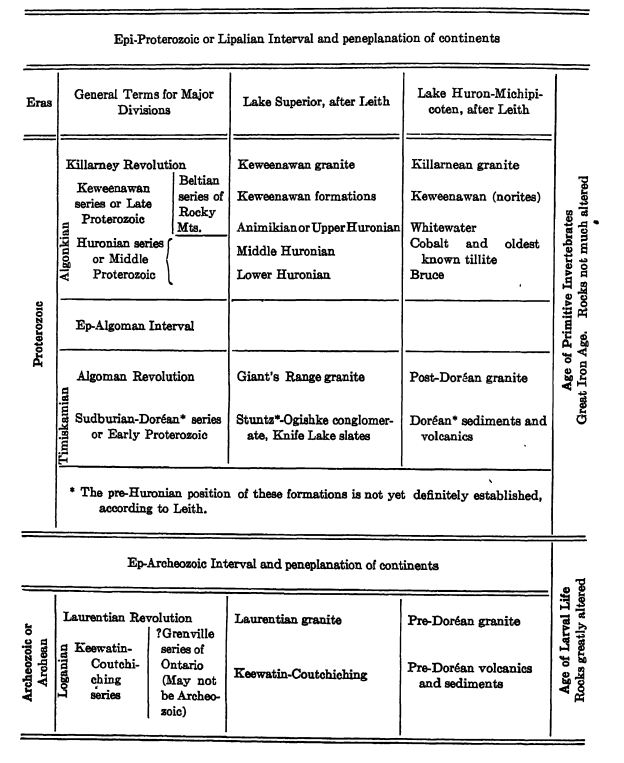
The major breaks in the geologic record are indicated in the time-table by intervals,” the marked erosion periods representative in the main of wide and high continents and of dominant erosion, not recorded by sediments within reach of observation; therefore, in geologic chronology these are “lost times” of long duration. It was not thought desirable to give a new and independent name to each one of these intervals, but rather to use in modified form an old and familiar one. Therefore the Greek word epi (upon or after) is here adopted as a prefix to the era terms, to indicate the subsequent time, that is, the intervals. These intervals will then be known as Epi-Mesozoic, Epi-Paleozoic, Epi-Proterozaic, Epi-Algoman and Epi-Archeozoic, This method of naming was first proposed by Lawson. The same combination can be used, when it becomes necessary, for the intervals between the periods, as Epi-Silurian, etc.
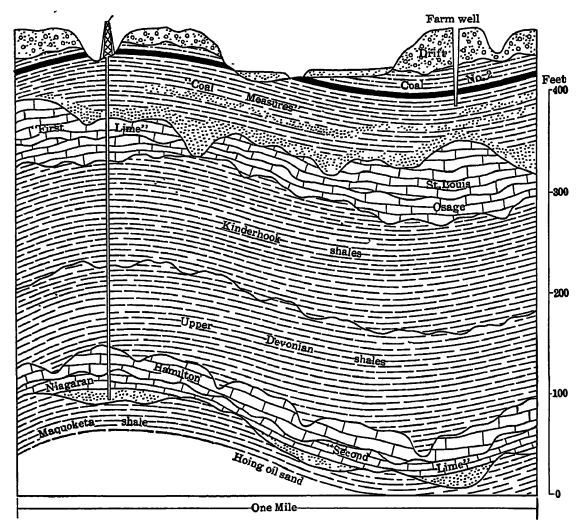
Diastrophism. — As shifting of the strand-line is the most important criterion in ascertaining diastrophic action (a term to include all movements of the outer parts of the earth, described at length in Chapter IX of Pt. I), it is well to state here briefly how these alterations are most readily determined. Organically they are recorded: (1) by abrupt changes in the superposed faunas, and (2) by the sudden appearance of newly evolved stocks; physically, (3) by more or less obvious breaks in the sedimentation, due to sea withdrawal, (4) by change in the character of the deposits, especially when this involves. abrupt transition [ p. 99 ] from organically formed strata (marl, chalk, limestone, dolomite) to mudstone and sandstone, or a change from continental to marine deposition, and (5) by marine overlaps upon rocks of earlier age, producing typical unconformities.
Correlation of formations in separated regions is made in part also on a physical basis. This is done by finding similarities in disconformities (time breaks in conformably superposed or parallel strata, see Pt. I, p. 31 L and Fig., p. 183), and changing petrologic characters. A physical correlation is in general, however, far less reliable, and must ever remain second in importance to correlation by fossils for the discernment of diastrophic action. Of course, the most easily determined crustal movements are those which are compressive in character and lead to mountain-folding. Upon erosion and subsequent sea invasion, these angular or structural unconformities are the most easily found and those about which there can be the least doubt. The broad and gentle flexures known as crustal warpings, on the contrary, as a rule bring about the disconformities.
¶ The Geologic Time-table
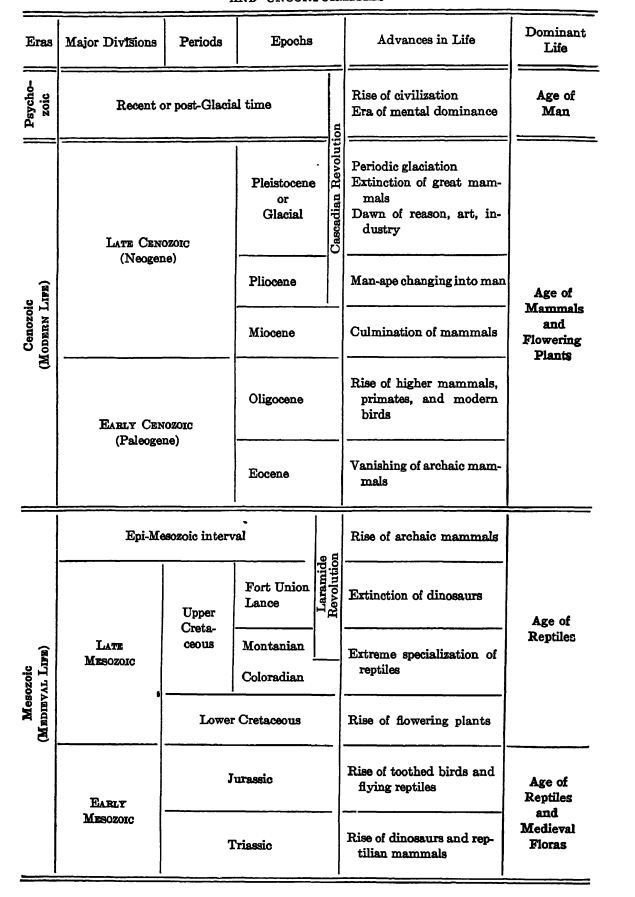
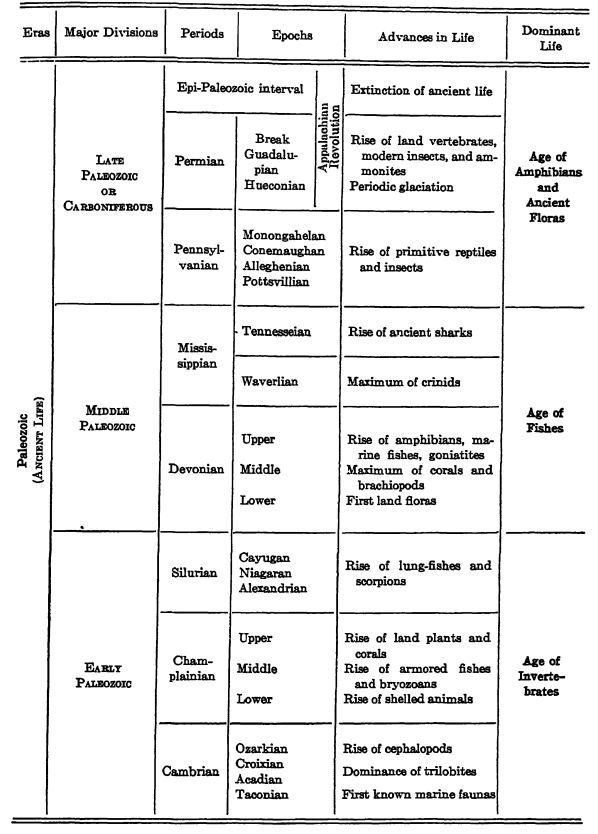
The time is not yet at hand for a complete evaluation of the minor diastrophic movements, the disturbances, because the recorded geologic succession in the different countries is by no means the same. Hence it can not be stated that the periods in the accompanying table are the only ones that will eventually be recognized. It may truthfully be said, however, that there is now a good deal of harmony among geologists in their use of the theory that the surface of the earth is periodically and rhythmically in motion, and that this diastrophic action is the basis of chronogenesis, developing not only cycles of sea invasion and land emergence, and cycles of erosion, but also cycles of organic evolution. This cyclic condition is due to the revolving of the earth on its axis and about the sun, and of the latter in the universe. Although the eras are clearly recognizable ever3rwhere, nevertheless, until the paleogeography of Europe is worked out in detail, we shall not be able to say that the various periods in current use are all established in nature.
The student is urged to commit to memory at least all of the names of the eras and periods and what is said of the life in the following tables. This knowledge is the A, B, C of Historical Geolog’y, arid without it further progress is almost impossible.
[ p. 100 ]
¶ Geologic Chronology for North America
Eras are distinguished by world-wide revolutions and marked organic change. Periods are separated by crustal disturbances and moderate changes in life.
I. CLASSIFICATION BASED ON ORGANIC EVOLUTION, SUPERPOSITION OF STRATA, AND UNCONFORMITIES
[ p. 101 ]
Geologic Chronology for North America (continued)
[ p. 102 ]
Geologic Chronology for North America (continued)
Archean or Pre-Cambrian of Older Authors Mainly for Lakes Superior and Huron, and Ontario Province
II. CLASSIFICATION BASED ON ROCK SEQUENCE AND CRUSTAL MOVEMENTS
[ p. 103 ]
Geologic Chronology for North America (continued)
III. Classification hypothetic. No known rock record
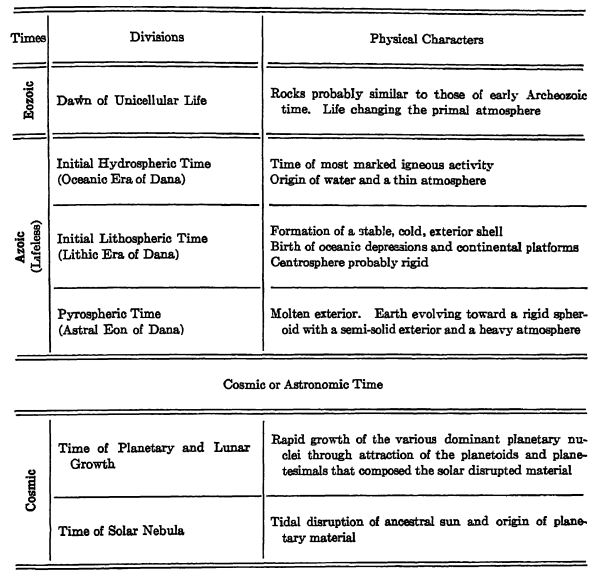
¶ The Age of the Earth
To measure the duration of geologic time became a definite scientific aspiration during the past century. Many of the cosmogonists and even some of the geologists of the nineteenth century held to the biblical interpretation that the earth was created 4004 years b.c. This was Bishop Ussher’s estimate in 1650, his interpretation of the “ In the beginning ” of Genesis, despite the fact that some of the ancient religions held that humanity had lived during many cycles, each of untold millenni ums . Hutton in his studies of Scotch geology (1795) found “ no vestige of a beg inni ng no prospect of an end.” In 1860, John Phillips placed the age of the earth at 38,000,000 to 96,000,000 years, and geologists twenty years ago quite generally accepted 100,000,000 years as the probable [ p. 104 ] age since the beginning of Archeozoic time. Then in 1903 came the epochal discovery of radium and the knowledge that some of the so called elements break up into others. Shortly thereafter the physicists told the geologists that they must multiply their figure at least ten times! Truly there is now an embarrassing richness of time.
The different methods by which the age of the earth has been calculated are all based on a common principle. The I’ates of certain changes at the present day are determined as accurately as possible, and in imagination, the respective processes are traced backward in time, until limiting conditions are arrived at. Thus Kelvin takes us back to a time when the earth was not yet a solid globe; [George] Darwin traces back the moon’s history until he finds it revolving close to the earth; Joly bids us imagine the oceans in their original freshness, free, or nearly so, from salt; Geikie finds an end at last to the long succession of stratified rocks and seeks to estimate the time they represent. Last of all, and most brimful of promise, there lies in the mechanism of radioactivity an elegant method for assigning a date to the period of crystallization of every igneous rock in which suitable minerals can be found (Holmes).
The two chief methods of Geology used in determining the age of the earth are (1) the rate of land denudation, or the rate of deposition of the sedimentary record, and (2) the rate of sodium chloride derivation from the land and its accumulation in the oceans.
The rates of denudation for nine large rivers are so discordant that they can not “ afford any information of quantitative value ” (Harker). In the Irawadi basin of India it foot in 400 years, and in the Hudson Bay region 1 foot in 47,000 years. For solvent denudation it is 1 foot in 30,000 years, and for mechanical removal 1 foot in 12,000 years. The known sedimentary record in its areas of thickest deposits now attains to something like 70 miles in depth. Such a mass of material means the wearing away to sea-level, one after another, of more than twenty ranges of mountains like the present European Alps or the American Rockies. On the other side of this picture of denudation are the long intermediate times of repose, when all the base-levelled lands furnished almost no sediments to the seas and oceans.
The physicist’s “ radioactive clock ” obtains figures of the order of 1,600,000,000 years since early in the Archeozoic, while the leading geologists would nowadays admit on the basis of their hourglass that the sedimentary and saline records indicate a time of the order of, say, 250,000,000 to 300,000,000 years. This acceptable estimate [ p. 105 ] does not, however, take into consideration the uncountable breaks, i.e., the smaller number of very long-enduring angular unconformities, the great number of disconfonnities, and the exceedingly numerous diastemata. T. M. Reade estimated on the basis of limestone as an index of geological time that the age of the earth is “ at least 600,000,000 years." Geology can therefore say that the earth since the beginning of the Archeozoic is probably at least 500,000,000 years old. On this basis the geologic time clock has been adjusted in the figure above.
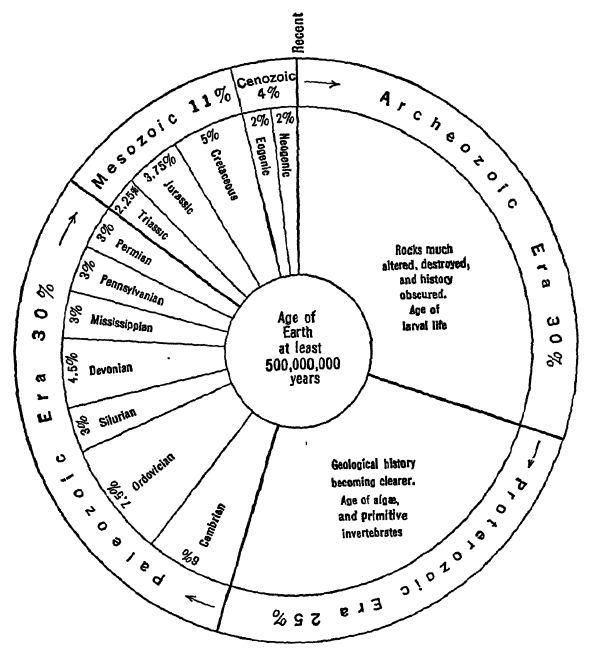
It appears probable that the “ radioactive clock ” has not always been running at the present rate of disintegration, a view stoutly backed by Joly, The latter in 1923 still holds to an age of about 130,000,000 years, basing his conclusion [ p. 106 ] on thorium disintegration and not on that of uranium. On the other hand, it is also probable that the reading of the hourglass of denudation by the geologists is not wholly dependable; in fact, it is admitted that geologic time is longer than the readings indicate. Of the two calculations, however, the radioactive basis is the more dependable.
Any one wishing to be visually impressed with the immensity of geologic time should stand on the brink of the Grand Canyon in Arizona and reflect on how long it has taken the Colorado River to cut this nearly mile-deep gorge, the most beautiful and impressive in the world. He should also think of how long it has taken the seas to lay down this depth of Paleozoic strata and the more than two miles of Proterozoic sediments beneath them. Having done all this, he should remind himself that after all he has seen but a small part of the whole geologic column.
Still standing on the brink of the Grand Canyon, on a clear night he should turn his eyes skyward and note the many stars. All are exceedingly far away. Shapley tells us that one of the star clusters is 220,000 light-years away, and light travels at the rate of 186,000 miles per second.
With these statements we leave the subject of the age of the earth and take comfort in the knowledge that during all this time the sun has been radiating energy into space at about the same rate as it does now. The life of the Archeozoic basked in the warmth of the sun with the same comfort that the lilies and roses, or sequoia and man, do now.
Truly it is all beyond human comprehension!
¶ Collateral Reading
A. Geikie, The Founders of Geology. London (Macmillan), 1905.
G. P. Merrill, The First One Hundred Years in American Geology. New Haven (Yale University Press), 1924.
K. Von Zittel, History of Geology and Palaeontology. London (Walter Scott), 1901.
J. Barrell, Rhythms and the Measurements of Geologic Time. Bulletin of the Geological Society of America, Vol. 28, 1917, pp. 745-904.
A. Harker, Geology in Relation to the Exact Sciences, with an Excursus oi Geological Time. Nature, Vol. 95, 1915, pp. 105-109.
A. Holmes, The Age of the Earth. London and New York (Harper), 1913 .
J. Joly, Radioactivity and Geology. London (Constable), 1909.
| VI. Seas, the Essential Recorders of Earth History | Title page | VIII. The Evolution of the Stars and the Origin of the Solar System. |