| PREFACE | Title page | II. The Greater Powers of Neolithic Man: the Benefits of Tools, Communication, and Social Organization |
PART I
INTRODUCTION: MAN IN EARLY GROUPS OR SOCIETIES
PURPOSES OF PART I
- To show how earlier groups or societies lived, so that we may better understand how much progress we have made.
- To show that ability to harness nature increases man’s power to hve well.
- To show that ability to communicate increases man’s power to live well.
- To show that ability to do teamwork increases man’s power to hve well.
- To show that ideals and aspirations are important in living together well.
CHAPTER HEADINGS OF PART I
Chapter I. Neanderthal Man’s Feeble Powers: the Mere Beginnings of Tools and Communications.
Chapter II. The Greater Powers of Neolithic Man: the Benefits of Tools, Communication, and Social Organization.
You have reached a very interesting point in your learning and thinldng.
Behind you is a period during which the school has given you tools with which to work. You have learned to read, to write, to measure and calculate. Ahead of you is a long period — the rest of your life — during which more and more of your thought and effort will go into other cluinnels. In particular, you will become absorbed, in school and out of school, in the great adventure of living in organized society.
Living together in society is such a complex matter that most persons get very puzzled and confused in thinking of it. This book gives a simple outline of what it is all about. It shows that man has done (and is still doing) four big things;
- He has multiplied his powers by harnessing na ture. Wo shall learn of that in Part II.
- He has multiplied his powers by communication. We shall learn of that in Part III.
- He has multiplied his powers by cooperating with others. We shall learn of that in Part IV.
- He has directed Iris powers in certain ways be cause he has ideals and aspirations. We shall learn of that in Part V.
Part I is still to be accounted for. In Part I, pages 5 to 69, we shall see how two early groups of men . lived. We can compare their living with ours, and thus understand ours better.
It will be worth while to read the Table of Contents ff the book before starting on Part I.
[ p. 5 ]
THE STORY OF HUMAN PROGRESS
CHAPTER I
NEANDERTHAL MAN’S FEEBLE POWERS; THE MERE BEGINNINGS OF TOOLS AND COMMUNICATION
Questions to Keep in Mind while Reading This Chapter
- In what ways was the “living” of early man different from ours?
- Why did he live so much less comfortably than we do to-day?
This book tells of our living together in society. — This is a book about ourselves. A book about ourselves should not try to tell everything about us. If it did, it would be such a huge volume that we could not possibly read it in one school year. Books about ourselves, such as histories, life-stories, and physiologies, therefore, usually discuss only certain kinds of facts about us, and so does the book you are now reading.
This book will talk of ourselves as persons who are living together in what we call SOCIETY. By reading it we shall find out what it means to live together in society, and we shah, learn some of the things we need to know in order to live in society happily and well. All of us vsish to know how to live happily and well in our family, in our village or town, in our state, in our nation, and in this vast world of oursThis is only a longer way of saying that we wish to know how to live happily and well in society.
We are so used to living together with others that at first you may think there is little to talk about. You may feel about it much as you feel about breathing. You breathe [ p. 6 ] easily and without thought ; you always have breathed, so why fuss about it? But if someone should hold your nose and mouth so you could not breathe, or if someone should put poisonous gas into the air you breathe, you would rjuicldy conclude that there are some things to look out for in breathing happily and well. And the same thing is true of living together. We must leaim what to look out for so that we may live together happily and well. We want no poisonous living together.
Many present-day ways of living together are quite new. — Then, too, the way we live to-day is really quite new and unusual, odd as that may sound. Most of the things with which we are familiar, such as schools, churches, cities, medicines, steamboats, railroads, books, and telephones, are not very old when compared with man’s total stay on this earth.
As just one example of the newness of our present, ways of living together, let us make a chart showing how recently man has secured such good means of communiciation as printing, the railroad, the steamship, or the wireless. It will be worth while to keep this chart along with others that we shall make as we work through the book.
Take, now, a large sheet of note paper and, turning it sidewise, write along what is now the top, this heading:
¶ The Length of Time Man Has Been a Good Communicator
Underneath this heading draw a seven-inch line, marked off into inches. Let the total line represent the length of time man has been able to write, calling it 7000 years. Now, it would be a terrible task to write with pen and ink all the bokks we use to-day. We do not do it that way. We print them. We “run them off” by the thousands from printing [ p. 7 ] presses. Man has had printing presses for, say; 500 years. Represent that on your seven-inch line. Modern books and modern methods of telling our thoughts to one another are really quite recent, are they not?
And let us look at three other means of communication, the railroad, the steamship, and the wireless. We have had railroads and steamships for, say, one hundred years, and wireless for, say, twenty-five years. Can you show these periods of time on your seven-inch line?
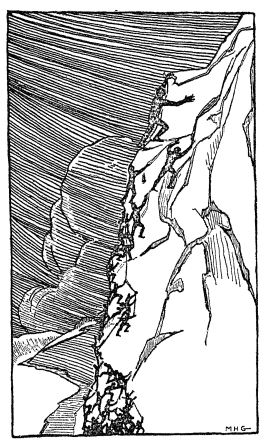
Do you see how true it is that many things which you have “taken for granted,” without thinking much about them, are really quite new and unusual when measured against the long, hard climb man has had in reaching his present ways of living?
We start with a snapshot of Neanderthal man. — If we wish to understand our present ways of living together we shall need to know something of the long, hard climb man has had. Knowledge of this climb will show us what progress man has made and how he made it. It will show us how we came to live the way we do. It will help us to get some idea of what our future living together will be like.
Now, we shall not need to study the whole history of [ p. 8 ] man’s climb. It wijl be enough if we take a snapshot of how very early man lived and then take another snapshot of how man lived after he had made thousands of years of progress. The first snapshot will give a picture of how a kind of man called Neanderthal man lived in Europe thousands and thousands of years ago. The second snapshot will give a picture of the way a type of man called neolithic man lived after thousands of years of progress had been made. It must be remembered that these two snapshots are taken of ways of living which are thousands of years apart.
How we have learned about Neanderthal man. — How do we know anything about Neanderthal man? Of course, there is no person alive to-day who ever saw him. We cannot, therefore, learn of him through an account by an observer, or witness. Furthermore, we cannot read about him in any books that he himself wrote, for, as we shall see, he could not read or write and so could not have left that kind of record for us to study. We cannot learn of him even by means of any stories which have come down by parents’ telling them to children, generation after generation, for Neanderthal man could not even talk enough to start these stories!
No, we have learned about him in an even more fascinating way. Such things as some of his own bones, some bones of animals he lived with, and some of his crude stone tools and weapons have been found lying together in places where, through these long thousands of years, they have been preserved because they were accidentally covered with soil or because they were in some cave. These fragments have been studied very carefully, and some of them have been compared with similar things that exist to-day among living savage peoples. The scholars who have done this studying have pieced together an account of how Neanderthal man may have lived.
[ p. 9 ]
The Neanderthal world differed from ours. — Geologists give us the first big surprise when they point out that Neanderthal man lived in a world rather different from our own. Perhaps, up to this time, you have thought that this world has always had the same land and water areas and the same plants and animals that it now has. Nothing of the sort. A continual change has taken place in such matters, and change is still going on. So true is this that people living two hundred thousand years from now may look back at the way we live and think our land areas and our animals as cmious as we think those of Neanderthal man to have been.
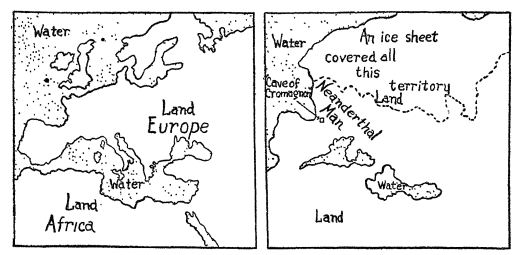
In the Europe of Neanderthal man, England, Iceland, Norway, and Sweden were not separated from the continent. The Mediterranean was then two inland lakes.
Land and water areas. — First of all, let us look at the map of Europe at the time of Neanderthal man. This time covered thousands of years. At the time of early Neanderthal man, Europe had a temperate climate. Then there began what geologists call the Fourth glacial age. There had been three others. Great glaciers, or masses of ice and snow, [ p. 10 ] pushed down from4he north so that later Neanderthal man lived in a Europe whose whole northern section was under a thick covering of snow and ice. Although he lived in the part of Europe that was not thus covered, the climate -was, of course, cold and harsh.
The sea was much shallower than it is now. England and Ireland were still parts of the mainland. What are now the Irish Sea, the North Sea, and the English Channel were then valleys through which great rivers flowed, before the covering of ice crept down. What is now the Mediterranean Sea was then merely two inland lakes, and a person could have walked, dry-shod, from Africa to Europe over what are now the Strait of Gibraltar and the sea to the south of Italy. All this is a different Europe from the one we know.
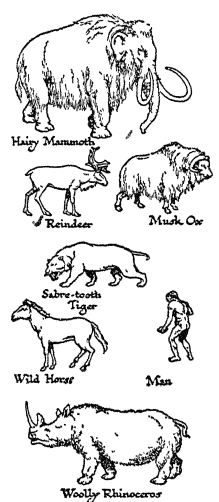
Animal life. — As for animals, there were in the earlier temperate period animals suited to a temperate climate, some of which are no longer on the earth. There were the huge mammoth, the straight-tusked elephant, the hippopotamus, the broad-nosed rhinoceros, bison, aurochs, red deer, giant deer, badgers, beavers, and a few sabre-toothed tigers. But as the glaciers crept down and the climate became harsh and cold, some of these disappeared and there came in gradually such lovers of coolerweather as the reindeer, the hairy mammoth, the woolly [ p. 11 ] rhinoceros, the musk ox, the cave lion, the cave bear, the cave leopard, the cave hyena, the arctic fox, the arctic ptarmigan, the arctic hare, and the steppe horse. Their very names show the change that was taking place. Some developed “woolly” coats, others took to caves for shelter, others are described by the word “arctic.”
Plant life. — Of course, corresponding with these changes in animal life, there came changes in plants. Plants more suited to frigid temperatures took the place of those adapted to temperate climes. One must not be too greatly puzzled by these changes. It took thousands of years for Mother Nature to work them out.
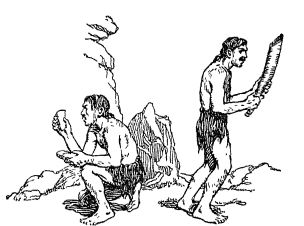
An account of how Neanderthal man lived.[1] — What sort of life was Neanderthal man living during these great changes?
If we imagine that we could suddenly chance upon one of the “squatting-places” of Neanderthal man, we should find that these people differ in aspect from most men, women, and children of the present day. They are somewhat shorter in stature, broader in the back, and less upright. They are much more hairy than human creatures of the present time. All are naked, or only slightly protected with ill-dried skins.
The heads are long and fiat. The foreheads recede, the large, bushy, red eyebrows meet over the nose, the brows are [ p. 12 ] heavy and deeply overshadow the eyes beneath. The noses are large and flat, with big nostrils. The teeth project slightly, and the chins slightly recede. The ears are slightly pointed and generally without lobes at the base.
They exchange ideas by sounds and signs: by chattering, jabbering, shouting, howling, yelling, sometimes by hilarious shouting (not true laughter), barking or screaming, or by making semimusical sounds. They also express their thoughts by movements of the eyes, eyelids, and mouth, by grimacing, and by gestures made with body, arms, and legs. The men and women have gestures and sounds sufficient for their wants. At a signal of danger they point and imitate the roar of the lion, the growl of the bear, or the bellowing of the elk. They have few of what we call "words.”
Some, especially the young people and children, are full of life and frolic; others are in ill-health, burnt with fever, or wheezing and coughing with colds. Some are clean, others very dirty.
The young people romp and play, take hands and dance in rings. They engage in sham fights. They climb trees and swing from branch to branch, and paddle about and play in the streams. They play games of throwing stones and sticks.
The primeval men and women work as well as play. They look after fuel to keep up the fires. They gather together [ p. 13 ] fallen branches, twigs, ferns, and other dry vegetable materials. They hack and break off branches. They are not able to tie up bundles.
These early people make stone implements. They look for suitable blocks of flint, push such flints out of the chalk, stiff clay, or earth with sticks and bring them to the squattingplace. There, by the fireside, the more skilled and lighthanded ones make crude, pointed stone weapons and edged choppers and knives.
This primeval savage has for food hazelnuts, beechnuts, chestnuts, and acorns. He has crab apples, wild pears, wild cherries, wild gooseberries, blackberries, dewberries, hops and haws, watercress, fungi, the larger and softer leafbuds, as well as other delicacies of the vegetable kingdom. He has birds’ eggs, young birds, the honey of wild bees, snails, and frogs. By the seaside he has fish, mullusca, and seaweed. He has some of the larger birds and small mammals, which he gets by throwing stones and sticks. He has the snake, tne slowworm, the crawfish, grubs, insects, the large larvae of beetles, and various caterpillars.
In addition to the smaller animal life he sometimes finds the remains of oxen, horses, and deer naturally dead or newly killed and only partially consumed by the lions, bears, hyenas and wolves. The heads are hacked and torn off, the skulls split open with ponderous stone axes, and the soft and tasty brains eaten on the spot. The old people, being toothless or nearly so, are glad of a meal of this kind; they are not able to chew tough meat. The old men and women pull out the larger bones, smash off the knobby ends, push out the marrow with a stick, and eat it as one would now swallow an oyster.
Primeval man is commonly described as a hunter of the great hairy mammoth, the bear, and the lion, but it is very [ p. 14 ] improbable that he ever hunted animals much larger than the hare, the rabbit, and the rat. Man was probably the hunted rather than the hunter. Outside the squarting-place he would see, hear, and dread the larger animals. As a rule, these animals, unless driven by hunger, would not sceriously molest him. In times of danger man would flee to the trees.
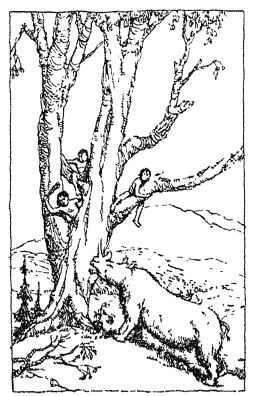
It would be useless to run to the water, as most of the animals could swim.
This account shows how far man has climbed. — Let us think back over this accoupt of Neanderthal man and get from it, and from other evidence, certain general ideas concerning his life. These generalizations wail help us to make some comparisons with the way in which we live to-day.
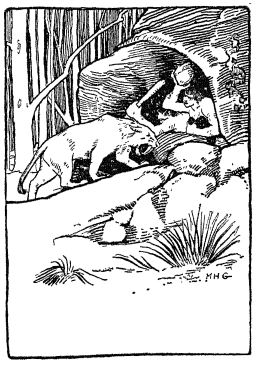
1. Food, clothing, and shelter. — Let us begin by not icing how ineffective he was in getting his shelter, food, and clothing. As far as we can judge, in the preglacial period he had little more shelter than most wild animals have in their forest lairs. Quite likely he knew enough to break off branches and make rude dens in caves or by the sides of cliffs, but there is no reason to suppose that he could build a shelter nearly as good as the house the beaver makes. And without the protection of good shelter how he must have trembled at the threatening sounds of the huge animal life surging and crashing about him! Even when the glaciers, creeping down from the north, brought on a semiarctic [ p. 15 ] climate, cold and damp, he could not build houses. He sought shelter under overhanging cHffs and chatteringly disputed with animals the possession of such natural shelter as caves afforded.
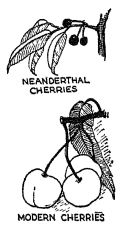
His plight with respect to food was no better. He grew no fruits or vegetables. He did not raise crops of any kind. Such a thing did not occur to man for thousands of years after this time. He ate such plant products as he found growing wild, and these were wretched specimens when compared with our cultivated fruits and vegetables of to-day. He had no domestic animals — not even the dog — so that he raised no food by having herds.
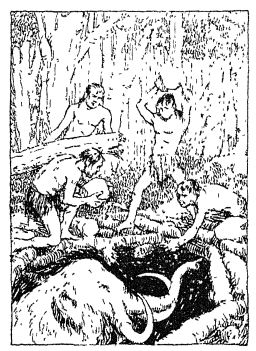
He was a hunter but he was an ineffective one, for his weapons were puny and feeble against all fair-sized game and against all swift game. Very hkely he had clubs and sharp sticks. He certainly had hand hatchets of flint, but it is not likely that he had learned to make spears and axes by attaching his flints to handles. Bows and arrows he had not. It is not even likely that he had the fishhook; almost certainly he had no nets. It is possible that he knew how to dig trenches — at what cost of painful handscratching of dirt! — to snare mammoths, and if this is really true, one can imagine these yelling forerunners of ours standing on the edge of the ditch and working for hours even to kill the giant they had trapped.
[ p. 16 ]
In the mam, you see, Neanderthal man had to depend for his food upon very uncertain means. He was almost certainly hungry for more of the time than he was well fed. And such food as it was! If it was cooked at all, it must have been roasted in the ashes, for he had no pots or other cooking vessels. And its eating was certainly not attended by any use of such tools as knives and forks, and not blessed with anything that we should recognize as table manners.
As for clothing, anything better than rough, unsewn skins of animals, poorly cured by being dried in the sun, never occurred to him. Any such thing as cloth came thousands of years later. Even skins could not have been very plentiful in view of the wretched character of the hunting tools.
You would not wish to have such meager and uncertain food, clothing, and shelter.
2. Communication. — His mental tools, as represented by words and speech, were as poor as his physical tools, as represented by stone hand-hatchets and clubs. Have you ever realized how important words are to you in trying to think? They are the tools of thought. You are proving this fact when thoughts rise to your mind as you read the words of this book. Early Neanderthal man had few words, and his lack of them limited his power to think, just as his lack of bows, arrows, and guns limited his power to kill game. Such thoughts as he had were passed on to others by gestures, grimaces, [ p. 17 ] and by some few words. Of course sucli people could not make many plans together. This poor ability to plan lessened their teamwork and handicapped them in getting food, clothing, and shelter, and indeed, in all their living together.
Just compare their ability to communicate with one another, to plan together, to talk things over, to teach one another, with what we have to-day. We have not only speech, but writing. We have books, newspapers, telephones, schools, churches, movies, and a host of other “thought quiekeners” and “plan transmitters.” We can really “work together” fairly effectively.
You would not wish to be without our modern speech and means of communication.
3. Health. — In such matters as health, recreation, government, and religion. Neanderthal man was as pinched as he was in getting the necessities of life, food, clothing, and shelter. We should have to guess so much about his recreation and religion and government, that we shall not study such matters until we take a snapshot (in Chapter II) of a much more advanced savage life that has actually been seen by modern writers. But we know what must have been the state of affairs as regards the health of Neanderthal man. It must have been wretched. No doctors, no hospitals, no knowledge of what caused sickness or what to do about it — and this in the midst of a situation full of dangers to life and limb and full of causes of sickness. Cold, damp, arctic cave life, with poor food and clothing, does not make healthful smroundings, and it must have been anything but a safe task to hunt the animals of that time with the weapons at man’s disposal.
You would not wish to have your health so poorly safeguarded as was that of Neanderthal man.
[ p. 18 ]
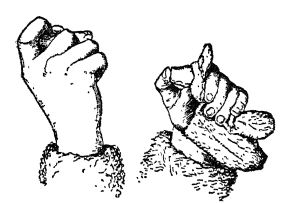
Striking Fire
In the hand at the right there is one piece of pyrite just under the thumb. Under this pyrite is held some dry tinder upon which the sparks are to fall.
4. The beginnings of the harnessing of nature. — And now we come to the most important generalization of all. He lived as safely and well as he did largely because he had at least begun to use tools — to harness nature and to make it do his bidding. We shall find, as we go on in this book, that man’s climb can be told — it is only one way of telling it — as a story of man’s increasing power to harness Dame Nature, and we are now seeing the beginning of this liarnessing.
He did have fire, and that fact saved him when the glaciers came. How man originally got fire we cannot be sure. Perhaps he got it from volcanoes. Perhaps he got it from some burning forest tree that had been kindled by lightning. Perhaps he got it from nature in some other way. Whether Neanderthal man knew how to “make fire” is uncertain, but some writers believe that he was able to do so by striking iron pyrites — a kind of iron ore — together and letting the resulting sparks fall in a handful of dry grass. So much we know; the dead embers of his fires have been found in his caves along with his crude tools and with the bones of the animals he ate. And fire meant life for him and a chance for the race to improve. It was a first step in harnessing nature.
He did have clubs and sticks and crude stone tools, even if he did not join them togel3ier and make arrows and axes with handles. What he had was at least a beginning, and in a very real sense his tools are the forefathers of the wonderful tools and machines which to-day help us so much.
[ p. 19 ]
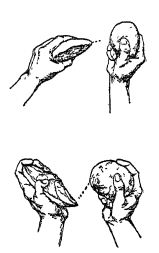
MAKING HAND TOOLS
The upper picture shows the first step in making a thin blade. The lower picture shows the beginning of the shaping of the other side.
His stone tools were made of flints, which will often break in such a way as to leave a sharp cutting edge. Very likely man’s first stone “tools” were just conveniently shaped stones that he found and that he did not make at all. But Neanderthal man had reached the point of making these stone tools, and that was no slight advance, as you will soon come to beheve if you try to make some of them yourself. They are by no means easy to make. They require a great deal of time, work and skill.
The stone tools of Neanderthal man may seem very crude and ineffective to us, but we must remember that these tools did enable him to kill some animals, to crush bones for the marrow, to skin animals and to scrape the skins, to hack clubs and sticks into shape, and to do more than could be done with the bare hand. This was progress — great progress.
But you would not wish to depend upon such crude tools.
¶ Problems
- Neanderthal man had no pottery, baskets, or similar utensils. Make a list of the things you have in your home that he could not possibly have had, in view of the absence of these things. Tell some things that you and your family can do that he could not possibly have done.
- He had no metals. Look around your schoolroom and see what would be left if we had no metals to-day. Name some things outside the schoolroom which we should not have if there were no metals. In what ways would the absence of metals make a great difference in our getting food, clothing, and shelter?
- He knew nothing of germs as possible causes of disease. What things do we do differently from the way he did them, because of our knowledge of such matters. [ p. 20 ]
- The squatting-places or rude homo-placos of prinutivo man were probably always near water. Why was this necessary? IIow do you get a drink when you want one? How do you account for the difference between the way you do it and the way Neanderthal man did it ? Is it a story of harnessing nature?
- What uses did Neanderthal man make of fire? What uses do we make of it to-day?
- “We should not wish to be dependent for our progress to-day upon the crude tools of Neanderthal man.” What have we that is better?
- “We should not wish to have our health so poorly safeguarded as was that of Neanderthal man.” What have we that is better?
- One vTiter has said, “The kind of living Neanderthal man had depended mainly upon the whims of Nature. The kind of living man has to-day depends much more upon himself.” Is this true? If it is true, what explains the difference?
- Answer the questions at the beginning of this chapter.
¶ Interesting Reading
Marshall: Readings in the Story of Human Progress, Chapter I.
- The Earth in Space and Time (a glimpse of the wonders of the universe and the part played by our earth).
- The Newness of Civilization (the short period of time man has lived in his present ways).
- Unlocking the Secrets of the Past (how we have learned about early man).
- The Art of Cromagnon Man (a glimpse of early cave drawings).
Problems to think over are given in these reading selections.
| PREFACE | Title page | II. The Greater Powers of Neolithic Man: the Benefits of Tools, Communication, and Social Organization |
¶ Notes
This account is adapted from Worthington G. Smith, Man, The Primeval Savage (Edward Stanford, Ltd.), pp. 48-59. It gives a scientist’s picture of what primeval man may have been and how he may have lived. ↩︎