| I. Neanderthal Man’s Feeble Powers: the Mere Beginnings of Tools and Communication | Title page | III. Fire and the Metals as Phases of Man’s Harnessing of Nature |
[ p. 21 ]
CHAPTER II
THE GREATER POWERS OF NEOLITHIC MAN: THE BENEFITS OF TOOLS, COMMUNICATION, AND SOCIAL ORGANIZATION
A. Introduction: the Iroquois an Example of Neolithic Culture.
B. The Iroquois as Tool Makers and Harnessers of Nature.
C. The Iroquois as Communicators.
D. The Iroquois as Teamworkers and Planning Organizers.
Questions to Keep in Mind while Heading This Chapter
- Just what did the Iroquois do by way of harnessing nature and how much did it help them?
- Just how did the fact that they were communicators help the Iroquois?
- What were the main social groups of the Iroquois?
- What is social control, and what forms of it did the Iroquois have?
¶ A. Introduction : the Iroquois an Example of Neolithic Culture.
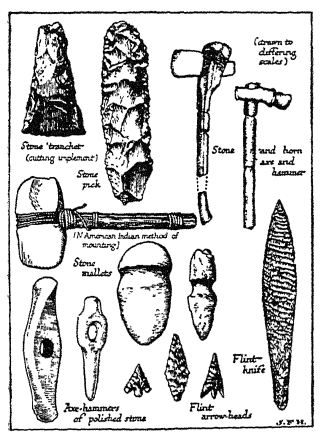
Neolithic Implements
Neolithic means “new stone.” The people who made such implements ground them or polished them so that their edges were better than the edges of the implements made by Neanderthal man or by reindeer man, who are sometimes called “old stone” men. “New stone” man is just a way of saying “more advanced” man.
The account of Neanderthal man was a snapshot of man who lived but little better than do the animals. He had but the beginnings of speech. He had made but the merest start in harnessing nature and in making her supply his wants. He hved meagerly and wretchedly.
For thousands of years this kind of man dragged on his miserable existence in Europe and then he seems to have been wiped out completely. Our best guess is that he was wiped out by a more able type of man who, in some other [ p. 22 ] part of the world, had slowly developed better tools and greater powers. This more able man seems to have drifted into Europe from the south. He followed, in his hunting, the animals who moved northward as the great glacievs melted and drew back toward the pole.
These newcomers have come to be called “Cromagnon Men” or “Reindeer Men.” They had much better, tools and weapons thandid Neanderthal man. They quite surely had much more in the way of speech than had Neanderthal man.
After still other thousands of years, these reindeer men also disappeared as a result of the slow coming in of still another branch of the human race, called the Mediterranean branch. This later branch found a Europe much like the Europe of to-day. Its land and water areas were about the same. So also were its plants and animals.
This people had climbed still a few steps higher than had the reindeer men. Their stone axes and other tools were ground or polished; those of the reindeer men bad been madeof roughly chipped stone without any polishing. They had, [ p. 23 ] too, many more tools, weapons, and implements than had their predecessors. In particular, there is no question that they made much use of the bow and arrow. Then, too, they had made at least the beginning of taming animals and of keeping herds for use as food. They knew how to make pottery and various kinds of cooking utensils. They could weave coarse fibres and rushes. They had made a beginning in planting seeds and in raising food supplies. In brief, they were much abler harnessers of nature than reindeer man.
The Iroquois discussed as an illustration of neolithic culture. — It so happens that this neolithic way of living, this neolithic culture, was the stage which some of oiu own American Indians had reached when the whites from Europe found them. Because of this we shall take our snapshot of neolithic culture not from the neolithic peoples who lived in Europe thousands of years ago but from our own Iroquois Indians as they lived a little more than two hundred years ago.
It would be hard to find a more interesting subject for one of our snapshots than the Iroquois. One tradition says that their early home was in the far Northwest, around Puget Sound, and that they were there a fish-eating and hunting people. Tradition further says that some time in the dim past they migrated to the Mississippi Valley and there, through centuries of slow progress, they found out how to harness nature by raising foodstuffs — that is to say, they learned agriculture. From the Mississippi Valley they drifted northeast and finally came to the region where the white men found them. This was in the general location of our present state of New York. Here the five tribes, the Senecas, the Oneidas, the Cayugas, the Onondagas, and the Mohawks, had formed a great confederacy known as the “League of the Iroquois.”
[ p. 24 ]
¶ B. The Iroquois as Tool-makers and Harnessers of Nature
(In shelter making, hunting, fishing, agriculture, and domestic arts.)
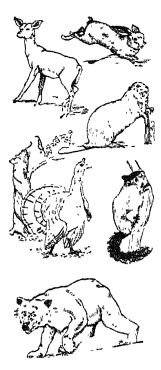
The Iroquois lived in a good physical environment. — The region in which they lived, as you know from your study of geography was well fitted to serve the three main pursuits of the Iroquois, fishing, hunting, and agriculture. The region abounded with lakes and streams, which fairly teemed with fish. Then, too, it was a hilly region whose forests of maple, pine, ash, spruce, elm, oak, and other noble trees sheltered moose, deer, beaver, bears, rabbits, squirrels, pigeons, ducks, geese, turkeys, and dozens of other representatives of wild animal and bird life.
The wild plant life was equally abundant and provided, in the way of food, such things as acorns, hickory nuts, chestnuts, walnuts, cranberries, strawberries, raspberries, grapes, paw-paws, whortleberries. May apples, crab apples, and many edible roots. The forest yielded, too, the raw materials of such crude “manufacturing” as the Iroquois engaged in. The various trees gave the materials for canoes, snowshoes, bark barrels, bark baskets, lacrosse sticks, and many other implements. The inner fibres of the elm and moose wood, together with the wild hemp, gave material for coarse cord with which to supplement vines, animal tendons, and strips of skin as binders arid lashings. Reeds from which mats could be made were abundant, and the skins of animals could be fashioned into clothing. The fertile valleys and hillsides gave good locations for raising the corn, [ p. 25 ] beans, squashes, and melons that were their main agricultural products.
As one thinks back over the many ways in which nature helped these people, one begins to understand what is meant by saying that the physical environment is very important in determining whether men can live together well.
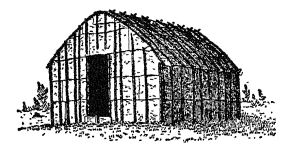
Iroquois Bark House
This shows the method of construction of the Iroquois bark house. Most of the houses were much longer. Several “ families ” lived in one “long house ”
The Iroquois harnessed nature in providing shelter. — When we read about Neanderthal man, we saw that it was also important, if man was to live well, that he should have tools, that he should be a harnesser of nature. Let us look at the various implements or tools which the Iroquois had and, first of all, let us look at their shelter.
The long house. — The Iroquois called themselves Ho-de-no-sau-nee or “People of the long house,” and the name was well chosen. When the Iroquois built a house, they set upright in the ground two long rows of hickory saplings, set opposite each other in pairs, so they could be bent over and made into a long series of arches. The builders then lashed split poles lengthwise on these uprights, much as we to-day put laths on the uprights of a frame house. Then they lashed great slabs of bark on this framework of the wall and roof, leaving an open space about a foot wide at the crown of the roof so that the smoke of their fires could get out. Outside this covering of bark were lashed still other upright poles so that thb whole was really quite strong and rigid. They used lashings because they had no metals and therefore no iron nails.
Such partitions as they wished to make inside the houses [ p. 26 ] were built of the shme material, or were made of animal skins. These partitions did not reach clear across the long house. An open passageway about six feet wide ran its whole length, and in this passage-way the fires were kept. For each fire there were two (sometimes four) families, the fire being between them. This gave each family an alcove that was six or more feet deep and nine or more feet long.
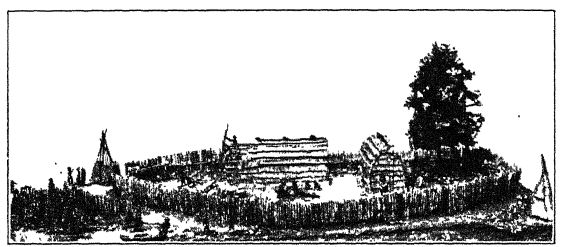
Iroquois Village
It does not look much like one of our villages. There were no schools, churches, waterworks, paved streets, electric lights, street cars, stores, — just a few dwellings.
In some long houses a seat or couch, made of poles and perhaps two feet high, ran along the wall. This served for what we would call chairs and beds. Higher up on the walls there might be another wide shelf, serving as a place to put utensils and households goods. At the very ends of the long house there might be vestibules, which could be used either as storage places, or as places for the young men to sleep, or for both purposes. There were no windows, and there were only two doors, one at each end of the long house. Some doors seem to have been made of bark and to have had a crude sort of wooden hinge. Others were just curtains of skins. Over the door was a crude representation of an animal or bird [ p. 27 ] from which the particular group living in that long house took its name. There were eight such groups (the scientific name is gens, with the plural gentes) in the Iroquois tribes. They were represented by the wolf, the bear, the beaver, the turtle, the deer, the snipe, the heron, and the hawk.
A village. — The long houses occasionally stood alone, but much more frequently several of them were grouped together to form a village. The whole village was sometimes protected by a sort of stockade or palisade made of logs. Such a village stronghold was likely to be located on a side of a steep hill near a stream of water. The hill and the stream gave the families some protection against a sudden raid by an enemy and at the same time gave them the needed ready access to water. Once a village was made, it was likely to remain in the same place as many as ten or fifteen years, since it was usually not worth while to move unless the surrounding soil had become poor, or the game and fish scarce.
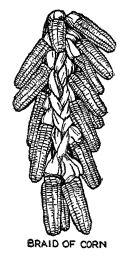
This description of Iroquois shelter may sound like an account of one of our pleasant vacation shelters. In the summer some of us get a good deal of enjoyment by going away from our noisy, complex city life and hving simply, with few tools and few household utensils, in the woods. But when we do this, we five with a great deal more comfort than did the Iroquois. To begin with, they must have been a bit crowded in their homes. Here they kept their bark barrels of dried corn, nuts, and dried berries, and here they hung their strings of dried squashes and their braids of corn ears, the husks being used for the braiding. Here they kept the skins, pottery, bows, arrows, war clubs, clothing, and playthings of the whole group.
[ p. 28 ]
Quite aside from the crowding there were other unpleasant features. With all their good qualities the Indians were not a very cleanly lot, and the long house rather quickly became greasy, dirty, and smoke-smirehed. In the wintertime, indeed, the smoke was so bad that apparently it was not comfortable to stand erect. Their couches did keep them off the damp ground, but they were not the only users of these couches; fleas and bedbugs were plentiful. This place, filled occasionally with the stench of fish being dried in the smoke of the fires, was not as pleasant a place to live in as your summer cottage. But with all that, neolithic man (as illustrated by the Iroquois) had far better shelter than Neander thal man.
Appropriative, adaptive, and creative stages illustrated in shelter making. [1] — This is a good place to begin to understand what is meant by certain words or terms that show stages or steps in man’s harnessing of nature. The words we shall need to understand are these: the appropriative period, the adaptive period, and the creative period.
The approprialive stage. — Let us now illustrate these terms by using them in connection with man’s shelter. As far as his shelter was concerned. Neanderthal man was in the appropriative period. The word “appropriate” means “take.” Man merely took what nature supplied him in the way of shelter and did nothing to improve it. This means that he sought shelter under bushes and in caves.
The adaptive stage. — When Neanderthal man began to make a few improvements (as very likely he did), he was beginning the adaptive period. You can see that the word means that man takes things furnished by nature and adapts them, or modifies them, or works them over into better shape for his use. When Neanderthal man piled a heap of stones [ p. 29 ] at the mouth of his cave to keep wild animals out, he was adapting, he was modifying nature. He had begun the adaptive period. Our Iroquois friends were distinctly in the adaptive period. They took bark and skins and poles and fashioned them into dwelling-places.
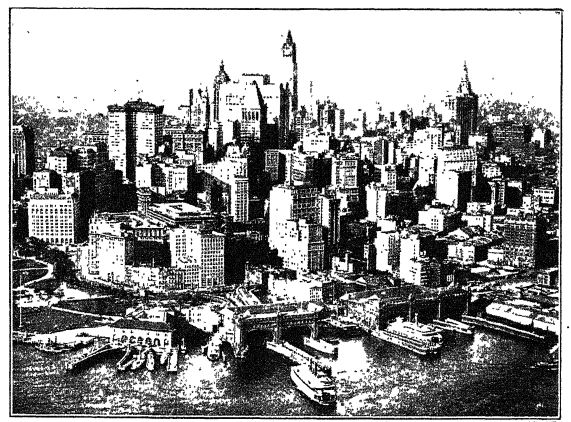
Modern Creative Shelter Making
Compare this with the home of Neanderthal man (page 15) and with the home of the Iroquois (page 26).
The creative stage. — We shall not now stop to see all the steps by which men gradually passed into the creative period, in which man is no longer content merely to appropriate, or even to adapt. He makes or creates new fibres and substances — fibres and substances not found in nature — and from these fashions all sorts of things. In our housebuilding to-day we are partly adaptive, but we are largely [ p. 30 ] creative. We adapt with stones and lumber but we have created new substances in liricks, mortar, plaster, glass, and steel. Our modern houses and modern skyscrapers are, as a result, as far superior to the long houses of the Iroquois as these long houses were superior to the damp, dirty, smelly caves of Neanderthal man.
We shall find as we go on with our study that what is true of our shelter is true of everything else. These words, appropriative, adaptive, and creative, will come to mean much to us as we watch man in his long process of harnessing the forces of nature to do his bidding.
The Iroquois harnessed nature when fishing and hunting. — Neanderthal man had poor results from his fishing and hunting because he had almost no tools with which to do this work. The Iroquois had such tools and as a result their food supply was much more abundant and much more regular.
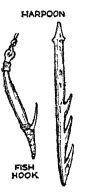
Fishing devices. — As for fish, it is quite probable that Neanderthal man had to be content with clams and dead fish found floating around, — with only an occasional lucky capture of a live fish. The Iroquois knew how to make harpoons with jagged edges, which held the fish that had been speared. These harpoons enabled them to make good catches because fish were quite abundant. They may have had a sort of a fishhook also, but if so, it was not a very good one.
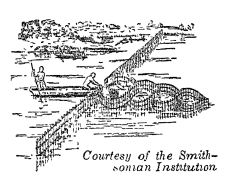
The fish are being dipped out with a net.
They got their largest catches by what we should to-day call seine fishing and by the building of weirs. They knew how to make cords and ropes from the inner fibre of the elm, from the tendons and long hairs of animals, and from the vines of the forest. With these they made dip nets and seines and thus caught fish by the dozen. Then, too, they used branches and vdnes to make closely woven weirs or fences for [ p. 31 ] catching fish. One way of doing this was to put such a fence across a river and then, beginning far up or down stream, a line of men with branches would wade the stream in the direction of this fence, frightening the fish before them. When they reached a point near their first fence, they built a second fence across the river and then caught the fish that were between the two fences with spears and seines. Another way was to make in the river a V-shaped fence that ended in a sort of open box at the angle of the V. They would frighten the fish down the V into the box, and people stationed there would spear them or dip them out. Sometimes such weirs were made of stone. All these adaptive means would have sounded wonderful to Neanderthal man.
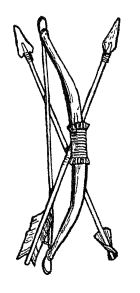
Hunting devices. — Their hunting was as effective as their fishing. Here also they used the spear, but they used the bow and arrow much more. The Iroquois bow was almost as long as a man. It was made of very stiff wood and was strung with a cord made of animal tendons. They would take the long tendons from the hind leg of a deer, soak them in water, and separate them into many strands, and would then roll the strands into a remarkably strong cord. The arrow shaft was a long straight stick carefully dried and prepared. At one end they bound a flint arrow head, using for the purpose green rawhide or wet tendons. These shrank as they dried and fastened the flint head on very firmly. on the other end of the shaft they bound fronds stripped from [ p. 32 ] feathers. They bound these fronds on the shaft with a twist. This made the arrow revolve in its flight and as a result it flew straighter. These weapons were really very effective.
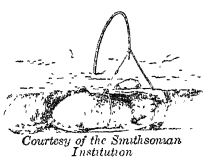
Marmot Trap
When the marmot gnawed through the thong, the bent sapling sprang up, and the noose tightened around the marmot’s body
Then, too, they knew how to make traps and snares. They would stretch nets from tree to tree in the woods and capture hundreds of pigeons in a single night. They had individual snares of the sort shown in the picture. They made snares for deer by bending over a young tree and fixing a noose on the ground. There was a sort of trigger so adjusted that, when the deer passed, the noose would tighten around his hind legs, the tree would spring back, and the deer would be suspended. They made for kilhng deer long V fences quite like the scheme they used in fishing.
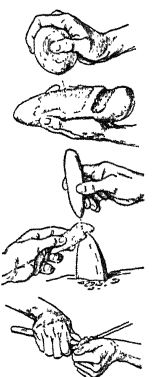
Making Axes And Arrowheads
Their tools were helpful. — Of course, they could not have made all these devices if they had not had tools to work with. Their knives of crude stone, bone, or wood (they had no metals), and their axes, which were hafted or supplied with handles — as had not been the case with Neanderthal weapons — stood them in good stead. Probably these stone axes were not used very often for actually cutting wood. They would be rather brittle for such work. Probably these stone tools were used in woodcutting mainly as a means of hacking or scratching out the charred parts after the bulk of the work had been done [ p. 33 ] by fire. By keeping the charred parts out of the way, they could of course make the fire work much more rapidly.
They were begiiming to domesticate animals. — The Iroquois had not made much progress in the way of taming or domesticating animals. They did not have the horse. This animal is not native to America, but was brought in by the white man. They did have the dog in great numbers, and he was probably used in the chase.
The Iroquois harnessed nature when they tilled the soil. — Agriculture is, of course, a harnessing of nature. We make nature do our bidding and give us fruits of the soil. We prepare the soil, drop in the seed, keep the place free from the weeds, supply moisture if necessary, and nature does the rest. The crop is a result of our harnessing nature’s powers and making her serve us.
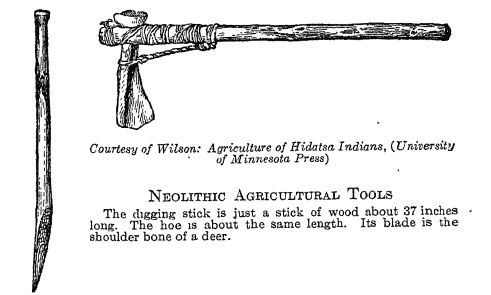
Neolithic Agricultural Tools
The digging stick is just a stick of wood about 37 inches long. The hoe is about the same length. Its blade is the shoulder bone of a deer.
The Iroquois had learned to do this even if they did not do it as well as we do it to-day. They cleared the land of trees, brush, and weeds by thb use of fire and their stone axes. After the land had been cleared, they used a wooden digging stick with which they gouged or dug up the soil and prepared it for the seed. This preparation of the soil was a long, [ p. 34 ] hard job, since they had not invented the plow and had no horses to draw it, even if they had known of it. Once the seed had been planted, they cultivated the land and kept it free from weeds by the use of their bare fingers or by the use of crude hoes made of wood, or of tortoise shells, or of the shoulder blade of a deer fastened to a wooden handle. Crude as these tools were, agriculture is so much more effective than hunting or fishing that it furnished the main part of the food supphes of the Iroquois. They raised corn and beans and melons and squashes, and referred to corn, beans, and squashes as the “three sisters,” “our supporters.” Supporters they were indeed. Some villages had several hundred acres of corn.
Primitive agriculture, you may say. Yes, but it was as much better than Neanderthal man’s appropriative use of wild berries and roots as our modern tractor plowing (see page 87) and tractor harvesting are better than the way in which the Iroquois raised foodstuffs.
They used tools within the household. — Man is just as truly a user of tools, just as truly a harnesser of nature with in the household, as he is in his outdoor life.
Neanderthal man took his food and ate it almost as nature furnished it. At the very most he was able to cook his meat a little by putting it in hot ashes or by supporting it on sticks before the fire. He did not know how to boil food. Thousands of years had to go by before man learned that, for he had first to learn how to make cooking utensils in which he could do the boiling. Neanderthal man was mainly appropriative in his household acts. The Iroquois, however, had developed to the adaptive stage. Of course, they appropriated many things, such as nuts and berries, directly from nature, but they adapted most of their food and clothing. They were able to do this because they had tools for that purpose.
[ p. 35 ]
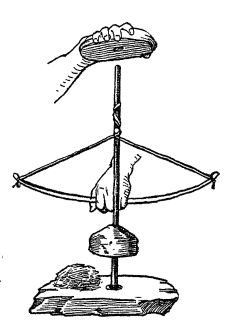
The string would be twisted around the Spindle aud the bow pressed down. The spindle would then spin and wind up the string in the opposite direction. The bow would again be pressed doen and the spindle would whirl back. This was kept up and the friction of the whirling spindle upon the dry board below presently caused flame to burst forth.
The fire-making tool. — To begin with, the Iroquois had advanced far beyond Neanderthal man in ability to make a fire, which is perhaps the most important single device (fire may quite properly be called a device) that man has everused. They knew how to use the bow drill, and since that drill is so fully explained in the accompanying picture, we need merely to remind ourselves what a wonderful thing it was that the Iroquois, no matter where they might be, could find a piece of dry wood and build a fire. It meant much, not only in the way of shelter but also in the way of proper food.
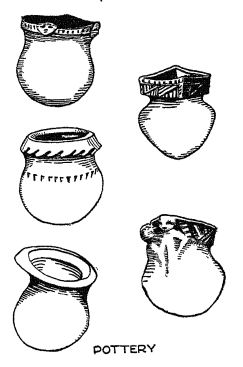
Devices for preparing and storing food. — For preparing their food they had both stone and wood mortars in which to crush their corn and they even knew how to take the harsh hulls from the corn by boiling the kernels and then bruising the hulls off. Alter they had crushed the corn in mortars, they sifted this meal in sieves made of wood fibres or of animal tendons and got it into still better shape for cooking. They had earthenware cooking utensils made of clay (or clay mixed with ground shells or flint) and then baked in a fire. With these they could bake, roast, or boil any of their foods.
The Iroquois had taken another step which sounds verysimple to us to-day but which was far, far ahead of the ways of Neanderthal man. The Iroquois had learned a few “first lessons” in preserving and storing food supplies. This meant [ p. 36 ] that when food was plentiful, they could prepare it, put it aside, and keep it until a time when food was less plentiful. They were thus saved many of the hunger pangs which had been such common experiences of Neanderthal man. He had never thought of laying up supplies for a time of need ; so he gorged or stuffed himself when food was plentiful and went hungry, or even starved, when it was scarce.
In the berry season the Iroquois dried strawberries, mulberries, huckleberries, and raspberries. In the green-corn season they boiled the corn, scraped it from the cob, and dried it in the sun, or they roasted or parched the corn and shelled off the kernels. At the height of the fishing or hunting season they took their surplus catch and either dried it in the sun or smoked it over their fires, or both. When corn and squashes and nuts were ripe, they harvested these foods and stored them.
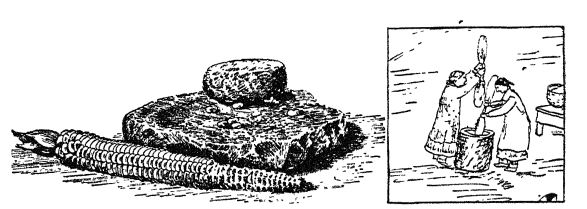
Corn-grinding Tools
When the stone mortar was used, the small stone was used as a pounder or roller. The wooden mortar was probably made by burning a hole in a log.
And they had tools for storage. Tubs, barrels, and trays, made of bark (most frequently of elm bark) and fastened together with vines or animal tendons, were for them the bins and bags of the modern housewife. Then, too, they had learned to make pits or caches, sometimes lined with furs or [ p. 37 ] bark, in which they kept almost all the items of food listed above. Sometimes these caches were in the long houste under or near the fireplace. Sometimes they were outside the long house. Neanderthal man would have been greatly amazed and delighted by such tools and devices, simple and primitive as they seem to us to-day.
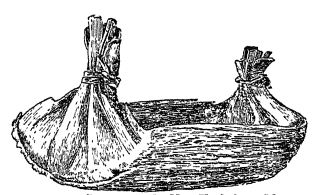
Bark Tub
Now, all this meant that the Iroquois had a range of diet that was utterly unknown to Neanderthal man. They had many corn preparations (someone has said more than twenty), beans, squashes, meat, fish, maple syrup, maple sugar, nuts, berries, fruits, and even a sort of tea made by boihng the sassafras root in maple sap. One of their favorite dishes was sagamite, which was parched corn ground up and boiled (making what we sometimes call mush), seasoned with fish, meat, fruit, maple syrup, or bear fat.
Corn, beans, and squashes might all be boiled together as succotash and even combined with meat in a sort of goulash. All told, it was not a bad living. What we need to remember is that they had a fairly good living because they had learned to harness nature by using tools and by raising crops and by preserving and storing some of their foods.
[ p. 38 ]
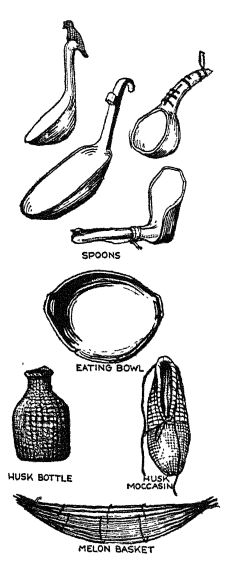
Eating utensils. — They had made a beginning, too, of tools to eat with. They knew how to make spoons or ladles of wood, bone, or horn. Crude plates were made of wood. However, we must not picture these savages seated around a mahogany talde with napkins and finger bowls eating meals served in courses. Everybody took his supply at mealtime from the common kettle of the group, which ordinarily meant the commnon kettle of the whole long house. The men ate first, then the women and children, and both groups ate with scant ceremony.
Clothing-making and its tools. — Upon the whole, the Iroquois did not fare as well in their clothing as they did in their food. What we call textiles were practically unknown to them. It is true that they did make a few mats and rugs from corn husks and reeds, and they did know how to make a little crude“cloth” from the inner fibres of the elm and from the fibres of the hemp plant, but the Iroquois squaw was not really a weaver. She had reached only that stage in man’s long climb upward which enabled her to adapt the skins of animals into clothing.
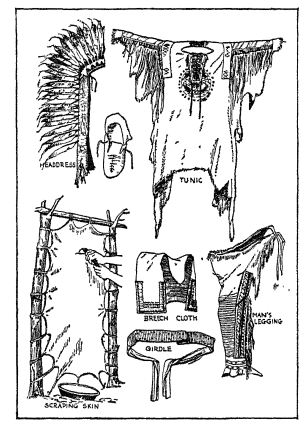
In this she was really quite skillful. She took the “fresh” or “green” skin, stretched it, and pegged it to the ground. With a flint scraper she scraped off any loose flesh, and sometimes she removed the hair in this same way. Then she [ p. 39 ] soaked the skin in a mixture of water and deer brains or liver or fat, and kneaded it carefully with her hands. Some skins were cured still further by exposing them to smoke. The result was a very passable “buckskin” from which, and from imdressed skins, could be made the five characteristic pieces of clothing of the ordinary Indian — the breech cloth, the tunic, leggings, moccasins, and the robe or blanket. These garments were “cut out” with flint knives and were then sewed together with strings or thread made from animal tendons. Bone or wood needles and awls were used for the purpose. Sometimes the garments were rather prettily decorated by the use of porcupine quills, stained or otherwise, and by the use of shell beads and dyes of various colors. They were sometimes embroidered, too, with hair dyed in a variety of colors.
Each group was self-sufficing. — We need to keep in mind one very important matter concerning the household arts of the Iroquois. It is this: each little local group made all its own utensils; prepared, preserved, and stored all of its own foods; made all its own clothing; and was in general what we call self-sufficing. This means that one group did not depend upon others to get the means of gratifying its wants. Each little group met the situation itself.
[ p. 40 ]
You know how different the situation is to-day. Take your own home, for example. The wall paper, the furniture, the rugs, the cooking utensils, the stoves (to mention only a few things) were all made outside the family: in most cases they were made in huge factories and shipped to your town and sold to your parents by merchants. Even your food and clothing are made or prepared largely by others. You need only to recall your various breakfast foods, some of which are not even cooked in your home; your bread, which your mothers may or may not bake, but which is in any event made from flour or meal ground in a mill hundreds or perhaps thousands of miles from your home. Baking powder, flavoring extracts, pepper, cloves (all of which were, of course, absolutely unknown to the Iroquois) are bought from the grocer, who bought them from another, who bought them from another, who bought them from another, and so on back to the growers or makers.
The household arts with which we are familiar are just the finishing touches to a lot of work which is now done outside the household by farmers, manufacturers, wholesalers, and retailers. Our households are not self-sufficing. Each household depends upon many other persons to prepare or partly prepare food, clothing, and our various conveniences and luxuries of the home. We say that we are interdependent.
¶ C. The Iroquois as Communicators
(Speech, the forerunners of writing, transportation, trade, and the beginnings of money.)
We have already seen that as far as communication was concerned, Neanderthal man was in a bad way. He could make faces, he could shrug his shoulders, he could shake his fist; but he could talk only a little. His words were so few that he must have had a difficult time in his communicating.
[ p. 41 ]
The Iroquois were great commimicators. — Of course neolithic man had no such modern communicating devices as newspapers, telephones, telegraph, wireless, the post office, schools, or churches, but they were, nevertheless, fairly good communicators.
Speech. — We can see how much speech meant to the Iroquois by the way they used it in their councils. Every important happening resulted in a council being called. It might be a council concerning whether to go on the war path against some other tribe; it might be a council to elect a chief to take the place of one who had died; it might be for some other important purpose. Whatever the purpose, at every council there was much speechmaking. The Iroquois, indeed, were known far and wide as great orators.
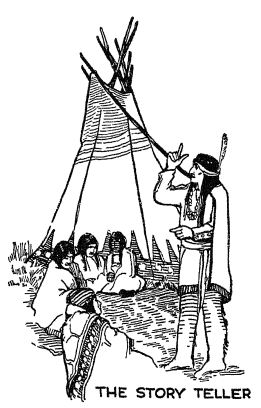
Another sign of the importance of speech is found in the work of the story-teller. In every group there was quite certain to be some one who had come to be known as a good story-teller, and this story-teller always had an interested audience. He recited to them all sorts of things : the Indian account of the way in which the world was made; stories of Indian gods or spirits; stories of the wise actions of chiefs either living or dead; stories of witches; stories of great events in the history of the tribe; stories of fact; and stories of fancy. All were eagerly heard. It was one of the most important ways by which the young [ p. 42 ] people learned thS wisdom of the tribe. Indeed, the stoiytelhng was such a temptation that by tribal custom the story-teller was forbidden to tell liis stories in the summer season (we say there was a taboo upon it) when there was much work to be done. He must confine his story-telling to the winter, when work was not so pressing. It would be hard to find a clearer proof of man’s love of talk than this.
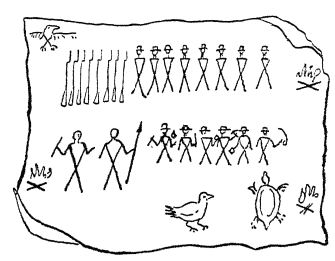
This picturp says that two Indian guides, eight soldiers and six officers and geologists camped here and had a prairie chicken and a turtle for supper. They had three campfires.
But the Iroquois was not able to write. He had no alphabet and no writing as we understand that word. We cannot tell the story of the development of the alphabet at this time; that will come in Chapter VII. But we can at this time see what the Iroquois Indians were doing that might have led to writing if the white people had not discovered them for a few thousand years. Such things have led to writing among other peoples, as we shall see.
Picture writing. — To begin with, there was their so-called picture writing. This means simply that they would draw crude pictures which told some story. A group on the warpath, for example, might draw on a tree pictures telling how many there were of them, in what direction they had gone, and even what they had done to the enemy. In a village there might be a war post with accounts of the wars on this post in picture writing. One sign would mean a war, another sign would stand for a scalp taken, still another sign for a [ p. 43 ] prisoner taken alive, and so on. This war post would become for those who knew what the signs meant a written record of happenings. Of course, one had to know what the signs meant, but so do you with these signs you are now reading. Our letters and words are, after all, merely signs that we have learned to understand.
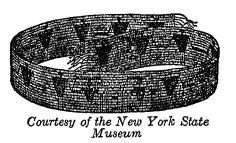
THE WASHINGTON WAMPUN BELT
The belt commemorated the peace treaty between the Iroquois the tribe, as for example when they and the united states during the presidency of Washington.
Wampum writing. — They had a sort of wampum writing too. Now, this was really not writing at all. It was much like your tying a string around your finger when you want to remember something important. Every time you look at the string it brings back to your mind that which you wish to remember. The Indians used wampum strings or wampum belts in just that way. The wampum bead was a piece of shell that had been perforated and made into a bead. When an important thing happened in the history of the tribe, as for example when they made a treaty with some other tribe or later with the white man, they wove a lot of these wampum shells together in such a way that the persons who saw it done would understand that the string or belt stood for a story.
Of course, what the belt meant would be forgotten unless people kept reminding themselves of the story. Accordingly, at some of their councils, the chief whose duty it was to keep the wampum records would rise in the council meeting with his belts and strings and would recite to the council the laws and treaties and happenings woven into these belts. In this way such records were passed down from generation to generation.
They had transportation devices. — Trails. — If Neanderthal man had any roads or trails, it was very likely more or [ p. 44 ] less by accident, and they were probably made with little more intelligence than cow paths are made by cows on one of our farms to-day. The Iroquois had no roads as we use that word to-day, but they, did have trails that were laid out with great care and skill; with such care and skill, indeed, that some of our roads and railroads follow old Indian trails. These trails were their highways from one village to another and from one tribe to another. They were, too, their highways out into fishing territory, hunting territory, or the territories of their enemies. Since theyy had neither horses nor cattle, these trails were of course merely footpaths, but they were used so much that even to-day in certain places they can be seen as Httle troughs that were beaten out by the feet of generations of savages as they went about their daily affairs.
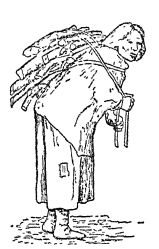
Land-transport devices. — Since they had no r beasts of burden and, of course, no wheeled vehicles, their carrying of things overland was upon the human back. For this purpose they had developed the burden strap shown in the pictme above. If this seems very simple and crude, remember that Neanderthal man probably could not even tie up a bundle of sticks to carry into his cave.
A Snow Shoe
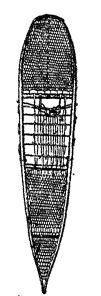
For winter use they had their snowshoes, on which a good traveler might make as much as fifty miles a day, and they had learned to make sleds having curved runners lashed together. The sled was, of course, always pulled by either a man or a woman (generally a woman) and not by a tamed draught animal.
[ p. 45 ]
The canoe. — But their easiest transportation was on the water with the famous Indian bark canoe. The canoes that the Iroquois themselves made were generally made of elm bark, and they were not entirely satisfactory, since elm bark warps too readily. Much better canoes were made in the north where birch bark was available, and sometimes the Iroquois bought birch-bark canoes from these northern tribes. These canoes, whether of elm or of birch, carried considerable loads, and were themselves so light that they could be carried overland from one river to another, or from one lake to another, if no water channel existed.
The beginnings of trade and of money as a language of trade. — Buying and selling are really one form of communicating with other people, a form in which money is the language that is used. The Iroquois had made a beginning of this kind of communication. It was only a beginning. They had very little trade either among themselves or with other people. What little they had took mainly the form of “present giving.” They managed it in this way. One person, or perhaps a group, would go with his goods to some other individual or group and, in a very formal and ceremonious way, he would make presents. It was quite understood, however, that when a present was made, the person who received it was to give a present in return. If the presents pleasedboth parties, both were content and a trade had taken place. You may have heard of “Indian giving,” and it probably means to you that after a present has been made it is taken back again. This sometimes happened in the kind of trade we have been talking about. If a trader was not satisfied with the presents he received, be would return them and take back the things that he had given, -unless a more acceptable present were offered him. This is trading, but it is very slow and awkward trading.
[ p. 46 ]
The Iroquois had the beginnings of the use of money as a language of trade. They did not have money in the form of coins or paper notes as we have it to-day. They used for this purpose these same wampum beads that we have been talking about. As time went on, they came to trade their furs, their canoes, their coin, etc., for these wampum beads. Thus it came to pass that a person who owned much wampum was a wealthy person, which meant merely that since he had much of it, he could buy many other things with it. After all, that is what money means to us to-day. It is a tool we use in trading. We talk of the various goods we trade not only in terms of yards or pounds, but also in terms of money. It is a language of trade.
¶ D. The Iroquois as Teamwoekers and Planning Organizers
(Social organization as seen in family, clan, and village life; in tribal and league government; in division of labor; in religion .and other means of social control; in property rights; in play and recreation.)
Thus far we have talked of tools, of harnessing the forces of nature, of speech, and of money as the language of trade. We come now to some new terms. We wish to talk of groups, or communities, or societies. Let us see what such terms i mean. A group is any number of people, whether large or small, who think and talk and act about the same things in much the same way; that is to say, they have common interests. This is also a definition of a community or a society, though we sometimes use the word community to mean a fairly large group, such as a village or a city; and we sometimes use the word society when we speak of a very large group, such as the United States. The word group is the easiest one to use. A family is a group, the school is another group, as is also a trade union, a city, a state, or a class in a [ p. 47 ] school. The Iroquois had such groups as the family, the long house group, the village, the tribe, the confederation, the war group, the hunting group, and the gens.
The Iroquois family group was not just like ours. — Let us begin with what we call the family. To us that means father, mother, and children living together in a separate house or apartment, but it did not mean this to the Iroquois.
Marriage. — The Iroquois young man and young woman did not arrange for marriage in the same way that the people we know arrange it. Ordinarily the young people of to-day become acquainted, and they themselves decide, usually with the consent of their parents, to marry and set up a home of their own. Among the Iroquois, however, the young people had little or nothing to say about the matter and neither had their fathers. The two mothers arranged everything. It is true that the yoxmg people had usually become acquaintedat the dances, festivals, and other happenings of the villagehfe. It sometimes happened, however, that they hardly knew each other and knew nothing of any plans until after the marriage had been announced by the mothers!
As for the marriage ceremony itself, you would not recognize it as such. One writer describes the ceremony thus:
The maiden was taken by her mother and a few female friends to the home of the intended husband. She carried in her hand a few cakes of corn bread, which she presented to her mother-in-law as a token of her usefulness and skill in the domestic arts. The mother of the young warrior then gave to the mother of the bride a present of venison or other fruit of the chase as a token of his ability to provide for his household. This exchange of presents bound the new pair together in the marriage relation.[2]
Family life. — After marriage the Iroquois young people did not set up a new home as is usual among us. “ Household” meant not a family, as it means to us, but the long house [ p. 48 ] where there lived all the members of a particular gens wliieh, as we have seen, was represented by some animal or bird. The bride stayed with her gens: the groom continued to live with his gens. True, there might now be anothei-compartment added to the long house for the bride. Indeed, this was fairly certain to be done after there were children, but even then the father usually continued to live in the household of his own gens. The children were known as belonging to the gens of the mother. For example, if a man of the bear gens married a woman of the snipe gens, each continued to live in the long house formerly occupied. The children, both boys and girls, belonged to the snipe gens.
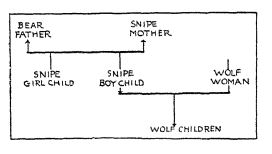
As a consequence, many things in the Iroquois familywere very different from the family with which we are familiar. The father paid little attention to the children, especially in their earlier years. They belonged mainly to the mother. If, for example, the father was a chief of the bear gens, his son could never become chief in his place because his son belonged to the snipe gens. So, also, such small property (we shall hear more of property and property rights later) as the father may haveowned did not go to his children upon his death, but was divided up among his near relatives in his own bear gens. The property of the snipe mother, on the other hand, went to the children, since they were “snipes.” You can readily, see that the family was not as close and unified as is our family to-day. It was Just a part of the large household or long house of the mother’s gens.
It is clear that our kind of family group is by no means the only possible kind. In this, as in all other matters, we ought [ p. 49 ] to be cautious about ever assuming that our way is the only way things can be done.
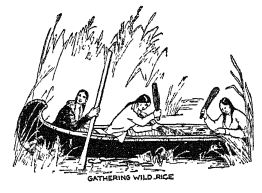
The Iroquois had the beginnings of specialization. — It is interesting to see how tasks had come to be divided up between men and women. The man was in the main the warrior, the hunter, the fisherman, and the trader, but he did help with other work. He made, or helped to make, weapons and agricultural tools, helped clear the site of the village, helped in the heavy work of building houses and palisades, and helped in clearing ground for agriculture. The women did the bulk of the agricultural work. They sowed, they tilled the land, they harvested and preserved their agricultural crops, as well as the nuts, fruits of the forest, and roots. They helped make the household tools, made the clothing, prepared the food, and carried most of the loads on the journeys they made with their husbands. This dividing of the work between the sexes is one form of what we call “division of labor ” or “specialization.” We shall hear a great deal of other forms as we go on in this book. Of course, we have “divided our labor” or “specialized” much more than tile Iroquois had done.
Longfellow, in his Song of Hiawatha, has described the Indian division of labor in never-to-be-forgotten verse. One can almost see the old warriors sitting by and watching the women work. Among the Iroquois there was likely to be feasting at the husking bee Longfellow describes, and you may be certain the old rascals would not be far away from the kettle of corn and beans. But it was not at all the customary thing for them to aid in the harvesting.
[ p. 50 ]
There was peace among the nations;
Unmolested roved the hunters,
Built the birch canoe for sailing,
Caught the fish in lake and river,
Shot the deer and trapped the beaver;
Unmolested worked the women,
Made their sugar from the maple,
Gathered wild rice in the meadows,
Dressed the skins of deer and beaver.
Twas the women who in springtime
Planted the broad fields and fruitful,
Buried in the earth Mondamin; [the corn]
Twas the women who in autumn
Stripped the yellow husks of harvest,
Stripped the garments from Mondamin,
Even as Hiawatha taught them.
Then Nokomis, the old woman,
Spake, and said to Minnehaha:
’Tis the Moon when leaves are falling
All the wild rice has been gathered,
And the maize is ripe and ready;
Let us gatlier in the harvest,
Let us wrestle with Mondamin,
Strip him of his plumes and tassels,
Of his garments green and yellow!
And the merry Laughing Water
Went rejoicing from the wigwam,
With Nokomis, old and wrinkled,
And they called the women round them,
Called the young men and the maidens,
To the harvest of the cornfields,
To the husking of the maize-ear.
On the border of the forest,
Underneath the fragranirpine trees,
Sat the old men and the warriors
Smoking in the pleasant shadow.
In uninterrupted silence
Looked they at the gamesome labor
[ p. 51 ]
Of the young men and the women;
Listened to their noisy talking,
To their laughter and their singing,
Heard them chattering like the magpies,
Heard them laughing like the blue jays,
Heard them singing like the robins.
And whene’er some lucky maiden
Found a red ear in the husking,
Found a maize-ear red as blood is,
“Nushka!” cried they all together,
“Nushka! you shall have a sweetheart,
You shall have a handsome husband!”
“Ugh!” the old men all responded
From their seats beneath the pine trees.
The next larger group was the village. — The family and the household were thus the smallest groups among the Iroquois. They were what we call primary, or face-to-face, groups, which means that all the members met one another face-to-face. The next larger group was also a face-to-face group. It was the village. The picture on page 26 shows that several long houses were to be found in a village; sometimes, indeed, a village was made up of several scores of them. It was quite unusual, however, for the villages to be very large; probably a village of four hundred Indians would be regarded as quite good sized. As you can see from our account of the family life, there were likely to be in each village several gentes, and each gens had its own long house, or more than one long house if the numbers in the gens made it wise to build more houses.
This village group was mainly self-sufficing. As we have seen, it did carry on somS little trade or present giving with other groups, but in the main each village produced its own stuffs and ate its own stuffs. Indeed, each gens was largely self-sufficing. Usually the men of a given gens went hunting [ p. 52 ] or fishing together, and the women of a given gens carried on their agiiculture and other duties together.
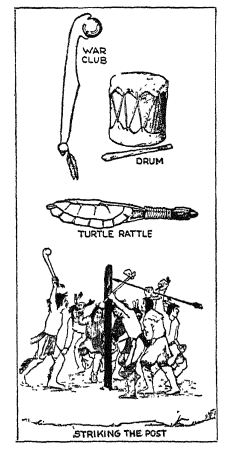
Cooperation in peace tasks. — We need to notice that the Iroquois had learned that it pays to have teamwork; it pays to cooperate. There were, of course, cases where a single warrior hunted and fished by himself, and perhaps there were a few cases where a woman tilled a separate plot of land. But, as a usual thing, they hunted or fished or worked in groups. Indeed, the wcnnen workers usually had one of the older women of the gens acting as supervisor when they worked in the fields. It was what we should call a very democratic cooperation. They chose their own leaders, whether for the tasks of war or for the tasks of peace, and they worked together with those leaders wholeheartedly.
Cooperation in war. — What happened when some members of the village decided to go on the warpath shows how democratic the Iroquois were. A council would be, called (no Iroquois would do anything important without a council), and men would gather either in a long house built separately for such councils, or around a council fire out in the center of the village. Although the village had a person who was a sort of war chief, anyone could lead a war party, and anyone could join it. The way to organize a war party was to hold the war dance. A leader of a small group would start the dance in a close circle. As the dance went on to the [ p. 53 ] beating of drums and the shaking of rattles, war songs and speeches encouraged others to rise and join the dance. Those joining the dance indicated by that act that they intended to join the war party. We should not think of organizing an army by just these methods!
The dance itself was an interesting ceremony. It represented the actual fighting. One man would pretend to be attacking and another to be defending himself. Here would be one in the act of drawing an invisible bow, another pretending to strike with the war club. Others would be listening, watching, or strugghng with the enemy. They would act out the stealthy approach to the enemy camp, the shouting, striking, and scuffling of actual combat. The next morning the party would be off in full paint and feathers with their long bows, sheaves of arrows, and war clubs.
Above the village was the tribe. — The next larger group above the village was the tribe, which was made up of several villages, the number depending upon the size of the tribe and the size of the villages. As we saw, there were five of these tribes, the Mohawks, the Oneidas, the Senecas, the Onondagas, and the Cayugas. The tribe as a whole had little to say about the ordinary affairs of life. All these ordinary affairs of hfe, even including the punishment of criminals, were handled by the village or by the gens. The whole tribe held a council only on very important occasions, such as when a great war was to be declared or a great treaty of peace made or a new sachem (a great chief) elected to take the place of one who had died.
Above the tribes was the League. — These five tribes were united, as we have seen, in a great league, or confederacy, called the League of the Iroquois. One tradition has it that the five tribes were having a rather sad time of it w’arring among themselves and that a great Onondaga law giver, [ p. 54 ] Daganoweda, called them together and arranged for this league. Probably it did not happen just that way. Probably the league was formed very gradually as a result of experiments running over hundreds of years.
The league was “governed" by sachems and councils. — There were in the league fifty sachemships which were distributed among the five tribes. These fifty sachems, or great chiefs, and the great annual council that they led were really the league government. In the autumn a council of the league was held at Onondaga, and here great matters were talked over. War was declared, peace was made, ambassadors were sent to other peoples, other peoples who had been conquered were told how they would be governed, etc. In these great councils the fifty sachems were, of course, the most important men, but smaller chiefs were also heard, and even the ordinary warriors and the women could make their wishes known through persons chosen to represent them. After the great council was over, each tribe went back to its own territories, its sachems going with it, and the central government ceased to be until the next annual council, or until some special council was called.
An account of a special council. — As an example of a special council, let us study one called for the “raising up” of a new sachem to take the place of one who had died. This was called the mourning council. Suppose that an Onondaga sachem had died. The Onondaga tribe would arrange to elect his successor and would send a runner with a belt into which a message had been woven to the next tribe. This message was that an Onondaga sachem had died and that a mourning council was to be held and his successor “raised up.” This next tribe would send -word on to its neighbors. Finally the whole Iroquois League would hear of the council, and thousands of people, young and old, men, women, [ p. 55 ] and children, would set out on the trails to the place of meeting.
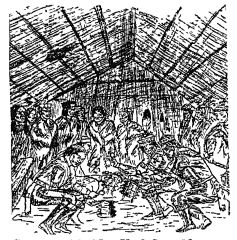
Eagle Dance
They are imitating the hopping of a bird. An Iroquois drew this picture.
When the time for holding the council arrived, each tribe marched to the council, led by its sachems and war chiefs. The sachems and chiefs stepped forward and walked around the council fire, singing songs of mourning. At the end of the singing, the peace pipe was passed around. Then the sachems made speeches, one after another, and the belts of wampum, which had been sent out to announce the council, were returned to the senders. The various bands then marched up to the council fire singing their mourning songs. The mourning for the dead sachem was long and solemn. His brave and good deeds were recited.
Then came the raising up of the new sachem. This was a ceremony of many songs, speeches, and replies. After the new sachem had been raised up, the Onondaga sachem who was the keeper of the wampum recited the ancient laws and customs of the great League of the Iroquois. He read these laws, as we have seen, from belts of wampum into which the records had been woven. These wampuxn belts were carried from one group of sachems to another to be read and explained, and the new sachem in particular was told their meaning. It was necessary for him to learn all about the laws and customs so that he would be a wise councilor. Finally, the new sachem was presented to the people.
With the raising up of the new sachem the mourning for the old sachem was over and the feasting and celebration [ p. 56 ] began. Several days were passed in games, feasts, and dancing. Then, one by one, the tribes broke camp and set out toward their various villages.
Do you know how all this compares with the inauguration of, say, the governor of one of our states?
There was social control among the Iroquois. — As we have seen, a group or society is made up of persons who think and talk and act about the same things in much the same way. In every such group or society it always happens that what is done is very much controlled by the group. We call this group control, or social control.
Control by “government” of the league or tribe. — There are many forms or kinds of social control. There is, for example, control by the government. It is clear that the League of the Iroquois had a sort of government and that this government controlled in the more important league matters, such as declaring peace or war. It is also clear that each tribe had a government. Tribal councils had control of important tribal matters.
Control through gens and village councils. — For the ordinary man, however, the group control that was most felt was that of his gens and village. As an illustration of how this worked out, let us see what happened when anyone needed punishment.
If one Iroquois killed another, the gens to which the murderer belonged must send a present of much white wampum to the gens of the victim. If this was not sent, the victim’s gens wmuld appoint an avenger who was to take the life of the murderer. This planning was, of course, all worked out through the usual councils.
If anyone became a traitor to the group or was supposed to practice witchcraft, he became an enemy of all, and a council decided his fate. He might be executed or he might be declared [ p. 57 ] no longer to be a member of the group. Such a declaration was almost equal to an execution, for then every member of the group was free to kill this enemy, this person who did not belong to the group. The Iroquois, as well as most other early societies, considered any person who did not belong to the group an enemy.
Control by custom and group opinion. — The punishment for lesser wrongdoing, however, was usually worked out through group opinion. The Iroquois, as is true of most savage peoples, did not change their ways of doing things very much as time went on. They kept on doing what had always been the customary thing. Their traditions and customs were well known by all members of the group, and anyone who disregarded them did wrong in the eyes of the group. His punishment came by feeling the scorn and anger of other members of the group. It is a little hard for us to understand this way of doing things, for we are not so much bound by custom and tradition. We feel more free to experiment and to do things a little differently from the way they have ordinarily been done. But even we are much bound by custom, and we know something about being punished by group or public opinion. You can name several things you would not do because you would not wish to bring down upon yourself the dislike of your friends. This feeling was very strong among the Iroquois and took care of many things that we to-day take care of by means of law and the policeman, or by other means.
Religion was an important form of their social control. — The ordinary person was controlled in part by custom, tradition, and group opinion, as we have just seen. He was also controlled by religion. Let us see what that means.
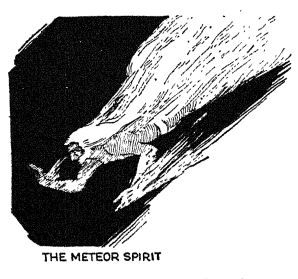
“Explaining” the world. — It is hard for us to understand the religion of a savage because it is hard for us to think of [ p. 58 ] things in the way he thought of them. Let us think of his religion as his effort to understand the world about him. Let us remember that many things we understand quite well were very puzzling to him — were “magic” indeed. For example, you and I know enough about lightning to know that it is caused by the same electricity that is in our electric light wires. Not so the savage. Some “spirit” must be behind the lightning! You and I know that germs cause diphtheria. Not so the savage. An outbreak of diphtheria must have been caused by angry spirits! The sun’s regular rising must, to his way of thinking, be governed by a spirit. A meteor (shooting star) must surely be a spirit with, streaming, flaming hair! And so it went. The savage n-flnd was full of fears and superstitions about the world in which he lived. But let us remember that his notions about the world, strange as they seem to us, were his “explanations” of that world.
Dreams helped cause belief in many spirits. — Apparently many of his explanations grew out of the fact that he often dreamed as he slept. In these dreams he seemed to see persons who were at the time far away. Some were, indeed, dead. He saw also animals, trees, etc. He, himself, in his dreams “went away from his body” to other places. He thought he must have gone away from his body, for his body was in one place and he saw anether place in his dreams! Then, too, a fellow tribesman would occasionally fall in a fit (which seemed to the Indian a sleep from which he could not be awakened), and upon recovery he would sometimes tell of [ p. 59 ] strange “experiences” while he “was away from his body.” We can readily see how he arrived at his crude notions of his “soul,” as we should say it. He could easily believe that animals, birds, fish, trees, rocks, and all the other things he saw in his dreams also had souls.
You see, his religion was not Hke ours. Before the white man came, the Iroquois had not learned to think of there being only one great spirit. They thought there were multitudes of spirits. They had a vague notion that everything . could think and act just as men could, and that it was wise to be friend’s with the spirits of everything. There was the spirit of the sky, of the sun, of the rain, of the winds, of frost, of hail, of stones, of trees, and of animals, to mention only a few. Some spirits were good spirits, and they were to be praised and thanked. Other spirits were evil spirits, and they should be soothed and kept from getting angry! It is not surprising that when a youth “came of age,” he went to some quiet place to fast, hoping that he would see in his dreams some animal that would from that time be a sort of guiding spirit to him. That animal would be thought of as his “good medicine.”
The Heno myth typical of their myths. — All sorts of tales (we would call them myths) were told by them about the spirits. Heno, the Thunderer, was one of the most kindly of spirits. He brought the rain, helped the crops grow, hated and killed serpents and “false faces,” or bad spirits. He carried on his back a great basket of boulders, and he threw them at evil spirits in the sky. If he missed, these boulders fell to earth as balls of fire. This, of course, was the lightning.
Heno now lives “in the west” in the skies. He used to live under the falls at Niagara, but his home was destroyed in this curious way. When he was still living under the falls, so one myth goes, there wms a village up the river whose [ p. 60 ] people were dying of pestilence. Heno told them that the trouble was that there was a great serpent in the ground that wanted to eat their dead bodies. This serpent accordingly poisoned the river so that there would be more bodies buried. Heno advised the villagers to move up Buffalo Creek.
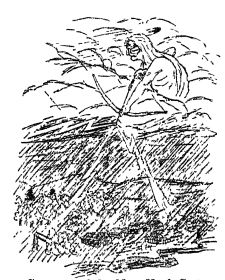
Heno, the Thunder Spirit
This picture was drawn by an Iroquois. The artist evidently thinks of Heno’s arrows, rather than boulders, as the, source of lightning.
This they did. The serpent missed its usual meals, and, putting its head above the water, it discovered what had happened and went up the creek after them. Heno gave it a mortal wound with a great thunderbolt. The serpent turned to rush down the river and escape, and in its turning it bulged the shores of the creek out into bends which still remain. But it could not escape. Heno followed it with his thunderbolts.
The great carcass of the serpent floated down the river and lodged at the falls with its huge bulk reaching upstream in the form of a halfcircle. This danamed the water. Finally, so much water gathered above the serpent that it crumbled the rocks under the body and formed the great horseshoe falls of Niagara. Of course, this destroyed Heno’s home under the old falls.
Stories like this were told of all sorts of spirits. They furnished, indeed, a large part of the subjects for the village story-tellers; Of course, these stories were believed by the children who listened to them, and became a part of the religion of the people.
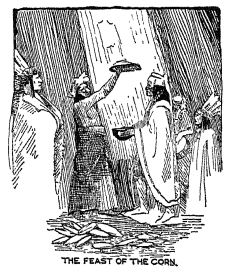
Dances, festivals, and games were partly religious acts. — While they had no churches, they had a very definite system [ p. 61 ] of worship of their spirits. This worship occurred partly in their score or more of dances, upon which they thought the spirits looked with great favor, and partly in their festivals or thanksgivings, of which they had six. The maple festival, designed to return thanks to the maple tree for its sap, was really a spring festival. Then came the planting festival. Later there was a strawberry festival — really a thanksgiving for early fruits; and then came, in order, the green-corn festival, the harvest festival, and the new-year festival.
The green-corn festival. — The green-corn festival came when the green corn was ripe enough to be used, and it lasted for four days, each day ending in a great feast of succotash made of corn, beans, and squashes. On the first day came the thanksgiving address, the feather dance, and three or four other dances. On the second day came the thanksgiving dance, which was much like the feather dance except that many speeches of thanksgiving were made in the intervals of the dance. These speeches were very short, running like this: “We return thanks to the maple which yields its sweet waters for the good of man.” Similar speeches returned thanks to the bushes and trees, mother earth, herbs, rivers and streams, the three sisters, the moon, the stars, the sun, and especially to grandfather Heno.
On the third day came the thanksgiving concert made up of many short thanksgmng speeches, each speech closing with a song made up by the singer, with all the people joining > in a sort of chorus. This thanksgiving concert was concluded by several dances.
[ p. 62 ]
The fourth day brought the festival to an end with a game of chanee, their famous peach-stone game. Two players sat opposite each other. In a bowl between them were six peach stones which had been burned black on one side. The bowl was shaken and the player lost or won according to the number of black sides which were up at the end of the shaking. The two players were likely to find themselves in the midst of a yelhng, shouting, sweating group, and betting ran high. The game might last a half day or even longer.
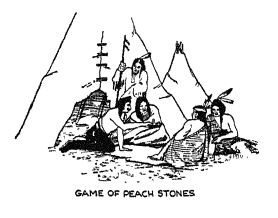
No priests or preachers. — There was no special set of persons who acted as priests or preachers. Certain of the warriors or chiefs were “keepers of the faith,” who made arrangements for religious festivals and dances, but they did this as only a small part of their work in the tribe.
There were also the “medicine men,” who were supposed to have special influence over spirits and who were particularly likely to be called upon when, for example, rain was needed or an enemy was to be defeated. They were also called upon when anyone was sick, since it was believed that any serious sickness meant that the spirits were displeased. It was a curious sort of doctoring as we think of such matters. They did make a few simple medicines from herbs, and this was real doctoring, even if it was frequently very poor doctoring. A good part of the doctoring was, however, as you can see, connected with their religion. It was the business of a medicine man to coax or scare the evil spirits from the body of the sufferer, and he was likely to do this with much shouting and drum beating and pummelling of the patient.
[ p. 63 ]
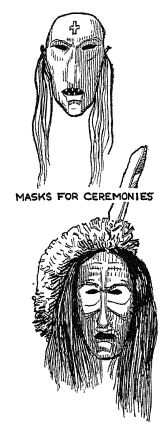
Religious beliefs influence actions. — In this account of the religion of the Iroquois, we have been interested not so much in seeing what they believed, as in understanding that their beliefs would make them act in certain ways; that religion is one form or means of social control. We can understand, without any further explanation, that they would wish to act in a way that was pleasing to souls and spirits and that their religion was an important part of their living together. For that matter, religion is always an important part of the living together of any people.
How the Iroquois owned things. — There were certain things that every Iroquois warrior could call his own, such as his pipe, his weapons, and his clothing. So also there were certain things that each woman owned, for example, her tools, her clothing, and her ornaments. Most other things, however, did not belong to separate persons. Most things belonged to the gens, the tribe, or the league.
The league, as such, did not own much of anything except its wampum records and such wampum as might be in a sort of league treasury. Much the same thing was true of the tribe. It might have a sort of treasury of wampum, and it could say who could settle in its territory, who could hunt and fish there, and who could pass through. Most things, however, were owned by the gens. It owned the long house. It owned or at least controlled the land it cultivated, the lakes or rivers in which it fished, and the common kettles and other utensils of the group that lived in the long house.
[ p. 64 ]
This did not leave much to be owned by individuals. True, some warriors were luckier than others at games of chance and won property in this way. True, a hunter usually owned the skin of the animal he killed, even if the carcass was turned over to his gens. True, the old medicine man was mjt above selling his “control of spirits ” for wampum. But after all, food and shelter were available for everyone in the long house, and the agricultural land and the hunting and fishing grounds were open to all. They had, in other words, only the beginning of what we call private property, which means that private persons own most things. Among the Iroquois most things were owned or controlled by the group — by the gens. You will find as we go along in our study that we have come to make more use of private property, but we shall have to postpone the reasons for this to a later study.
The recreation of the Iroquois. — Life was by no means all drudgery with the Iroquois. They used games and sports in their religious ceremonies, and they also used them as we use them to-day — as a means of recreation and as a means of preparing the young to live well in the group. Did you ever stop to think that our games help teach us how to use our heads and hands, and help us to learn teamwork?
Their favorite amusement was the Indian game, lacrosse, which has since been adopted by many other peoples. Lacrosse is a French word meaning “the hooked stick.” The name comes from the fact that they used in the game a sort of racket, or stick with lacings, as shown on the opposite page. The point of the game is to carry or throw a ball by means of this stick between two upright posts, or goals, each team defending its own goal. Sometimes the game wns played between matched teams as we might have a game of football or baseball to-day, but it was also a game in which whole villages, men, women, and children, could take part. [ p. 65 ] We are told, indeed, of one lacrosse game in which there were two thousand players.
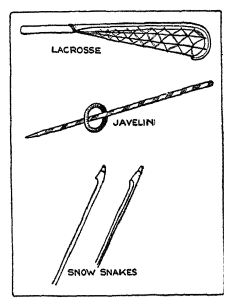
Although lacrosse was their favorite game, it was by no means the only one. They had a javelin game in which they tried to throw the javelin through a ring as it rolled along the ground. They also had another javelin game which was lost or won according to the distance the thrower succeeded in making the javelin go. The deer-button game was very much like the peach-stone game that has already been described. There was also a snow-snake game that consisted in sliding a stick called the snow snake over a course of snow. There were, of course, archery contests, running contests, and many other forms of athletic sport.
Summary and conclusion. — This has been a rather long story of our Iroquois friends and it is, therefore, worth while to think back over the whole story and get its main points in mind.
1. The harnesser of nature. — The first point standing out is the fact that the Iroquois lived much better than did Neanderthal man. In large part this was because they knew better how to use tools, because they were better harnessers of nature. This fact came out in our discussion of their weapons, of their shelter, of their household implements, and of their agriculture. The Neanderthal people were appropriators; the Iroquois were appropriators and adapters; we are to-day appropriators and adapters and creators, and our greater ability to harness nature means greater ability to live together well.
[ p. 60 ]
2. The communicator. — The Iroquois was a better communicator than was Neanderthal man. He became as a result a better planner. True, he had only the beginnings of communicating with other people as far as trading with them was concerned, but he had made this beginning. We saw that his trading gave him birch canoes which were better than the elm canoes he could make liimself. From the whole story of the Iroquois as communicators we get the idea that we ourselves can live together better by communicating with others, both in speech and in writing and in exchange of goods. We begin to see money as a language of trade.
3. The social organizer. — The Iroquois were teamworkers; they cooperated; they made plans and worked together in carrying out those plans. They pulled together in the gens, in the village, in the tribe, and in the league. They pulled together in hunting, in tilling the soil, in war, and in play.
They accomplished more by cooperating than they could have accomplished if each had worked or fought alone. This gives us a hint that we ourselves shall live together well to the extent to which we are cooperators and planning organizers.
The Iroquois had group or social control. They hud government and law, but their social control was worked out mainly through custom, religion, and group opinion.
4. The idealist and aspirer. — In their religion we catch a ghmpse of “man the aspirer,” for in their religion they were seeking the explanation of things. And, of course, they had their notions of right and wrong; of good and bad ways of living together. In other words, they had ideals.
And now let us remember thaf we have been studying the Iroquois as an example of how man lived when he had progressed to the neolithic stage. The powers of neolithic man were greater than those of Neanderthal man. They [ p. 67 ] were greater because neolithic man was a better harnesser of nature, a better communicator, a better cooperator or social organizer, and a man of higher ideals and aspirations. These are the four great forces or factors in living together well.
¶ Problems
- The Iroquois had no metals. What did they do for nails? For cooking utensils? For cutting tools? For hammering tools? For drilling tools?
- In the account of how the Iroquois lived, we had almost a complete list of their tools and devices, and it did not take up much space. Would it take much space to list all our devices to-day? Are they all listed in a mail-order catalog? How does it happen that we have so many?
- How do we store our foods to-day? Does the housewife store any? Does the grocer? Does the wholesaler? Does the grower? What are grain elevators? What are cold-storage plants? Have we ways of preserving foods that were unknown to the Iroquois?
- Some Indian tribes had no pottery. They boiled meat thus : they dug a hole, lined it with the skin of some large animal, put in water and raw meat and then threw in red-hot stones from a near-by fire. This is hot-stone boiling.” Is this a tool? If it is, give reasons why it is not as good a tool as pottery.
- The Iroquois squaw sewed skins with a bone needle and mth thread made of animal tendons. What do we use to-day? Not much of our clothing is sewed by hand. How is it sewed? Is it all sewed in the home?
- Make as long a list as you can of the devices we use in communicating with one another to-day. Do the same in the case of transportation devices.
- In what big ways did the Iroquois harness nature better than did Neanderthal man? Do we harness nature better than did the Iroquois?
- Notice the range of diet of the Iroquois (p. 37). Compare it with our diet by looking on the shelves of a grocery and of a meat store and by glancing through your mother’s cookbook. Can you work out any reasons why the range of our diet is so much greater? Does range of diet affect health?
- Notice the kinds and qualities of clothing of the Iroquois (p. 39). Compare this situation with our situation by looking over the shelves of a clothing store and of a dry-goods store and by glancing through the catalog of some big mail-order house. Can you work out any reasons why [ p. 68 ] we have so many more forms of clothing, made of so many more kinds of material?
- At your dinner to-day make a list of the things you have that Iroquois did not have. Include both utensils and kinds of food. If some of your food is the same in kind as that of the Iroquois, how much of the preparation which the Iroquois squaw have this food is now carried mi in your home?
- Are you quite sure you understand what is meant by the appropriative, adaptive, and creative periods of man’s progress? If you have any doubt of it, read again pages 28 and 29, for you will need to use these terms.
- When we were studying Neanderthal man, we said that no stories of how he lived had been handed down through the generations to us. Concerning the Iroquois, however, we tell what tradition says about the way they lived around Puget Sound and in the hlississippi Valley. How does it happen that traditions have not come down from Neanderthal man and that they have come down from the early Iroquois?
- Think back over the way the Iroquois traded. Is trading done to-day in the same way? Is more trading done to-day?
- In what ways was the long house like a modern apartment house? In what ways was it different?
- In what ways was the Iroquois family like ours? In what ways was it diffex’ent?
- Think back over how the Iroquois tried to cure a sick person. Compare the medicines used with the number on the shelves of a modern drug store. How long do our doctors study before they try to cure people? Do you begin to see what we mean when we say that we use science to-day?
- Make a list of the ways in which an Iroquois youth could learn about their laws, customs, and religion. What ways have you to-day?
- Have we anything in our government that is at all like the League of the Iroquois? Anything that is at all like their great autumnal council?
- Someone has said that one of the greatest services of science is that it has freed man from many foolish fears and has made him feel safe. Can you illustrate this by comparing’iis with the Iroquois, who had no science?
- Answer the questions at the beginning of the chapter.
- Read the purposes of Part I on page 3. Show that these purposes have been accomplished.
[ p. 69 ]
¶ Interesting Reading
Marshall: Readings in the Story of Human Progress, Chapter 11.
- The Swiss Lake Dwellers (groups that came to live far better than Neanderthal man).
- Woman’s Share in Primitive Culture (early division of labor).
- Some Great Advances of Neolithic Times (the domestication of animals and the use of agriculture).
- The Oeh-da, the Good Spirit and the Bad Spirit (an Iroquois myth of the creation) .
Longfellow: The Song of Hiawatha, The illustrated edition published by Houghton Mifflin Co.
See also in Marshall: Readings in the Story of Human Progress.
Chapter III. 1. How Early Man Tamed Fire (illustrations of early fire making).
Chapter VII. 1. Gesture Language (two complete stories told entirely by gestures.)
Chapter VIII. 1. How Nature Affects Primitive Transportation (an example of the importance of nature in our living together) .
Chapter XIV, 1. Some Early Forms of Social Control (myths, magic, fetishism, totemism, and taboo).
Problems to think over are given in these reading selections.
| I. Neanderthal Man’s Feeble Powers: the Mere Beginnings of Tools and Communication | Title page | III. Fire and the Metals as Phases of Man’s Harnessing of Nature |