| X. The Changing Aspect of North America, or the Geosynclines, Borderlands, and Geanticlines | Title page | XII. The Proterozoic Era, or Age of Iron Making |
[ p. 143 ]
¶ History of Classifications
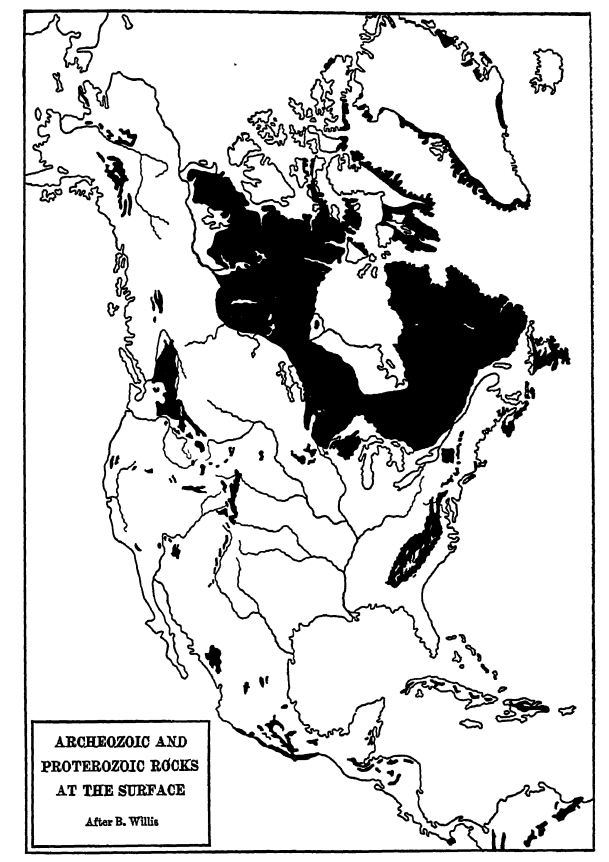
The greater part of Canada, or, rather, the Canadian Shield, of over 2,000,000 square miles in extent, exposes the oldest portion of the North American continent (see Fig., p. 139). Here lies the very complex record of event upon event, made during the earliest eras of geologic time.
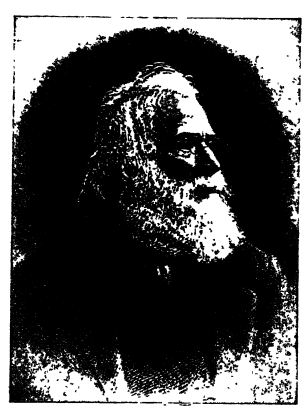
Work of Sir William Logan. — The beginning of the unraveling of this history fell to William Edmond Logan (1798-1875), the first director of the Geological Survey of Canada. He did his pioneer work well, and, as he inaugurated the study of pre-Cambrian formations, he has been called the Father of PreCambrian Geology.
Geikie says of Sir William Logan: “ At the very beginning of his connection with the Geological Survey of Canada in 1843, Logan confirmed the observation [of previous geologists] that the oldest fossfliferous formations of North America lie unconformably on a vast series of gneisses and other crystalline rocks, to which he continued at first to apply the old term Primary.” After years of labor on the part of himself and his associates, he proposed for these most ancient mineral masses the general appellation of Laurentian, from their development among the Laurentide mountains. … In the course of his progress, he came upon a series of hard slates and conglomerates, containing pebbles and boulders of [ p. 144 ] the gneiss, and evidently of more recent origin. . . . These rocks, being extensively displayed along the northern shores of Lake Huron, he named Huronian. He afterwards described a second series of copper-bearing rocks Isdng unconformably on the Huronian rocks of Lake Superior. He thus recognized the existence of at least three vast systems older than the oldest fossiliferous formations. … He will ever stand forward as one of the pioneers of geology, who in the face of incredible difficulties, first opened the way toward a comprehension of the oldest rocks of the crust of the earth.”
Method of Correlation. — In deciphering the pre-Cambrian chronology the geologist has no fossils to depend upon, and the criteria used in the working out of the geologic sequence are of a physical nature, as follows: (1) similarity of rock character, (2) structural nature of the rocks, (3) superposition of the formations, (4) crustal movements, and (5) cycles of erosion. The study of the various pre-Cambrian formations makes it clear that their two most significant and distinctive features are: (1) the wide-spread crustal revolutions, characterized by vast upwellings of molten rocks; and (2) the profound depth to which erosion has planed, revealing over great areas deeper levels of the crust which, while deeply buried, were subjected to regional metamorphism — levels whose original place was miles beneath the present surface.
Length of Pre-Cambrian Time. — It is generally admitted by geologists that the time back of the Cambrian, the first period with an abundance of fossils, was extremely long. There were during this time at least two and possibly three marked revolutions, and how many smaller breaks there are in the geologic record no one has the faintest knowledge. In consequence, we have allotted, on the baas of the radioactive clock (see Fig., p. 105), more than one half of geologic time to the Archeozoic and Proterozoic eras.
Terminology. — In regard to the use of the terms Archeozoic and Proterozoic for the Age of Larval Life and the Age of Primitive Invertebrates, respectively, the following should be stated. As the subsequent eras are marked by an abundance of life preserved as fossils, it is highly desirable to bring out this fact in the names through the ending zoic, which means life. Previous to the eras with an abundance of fossils, the older ones have almost none in recognizable forms, and at best they are always exceedingly rare. Therefore a classification of the formations of the Proterozoic and Archeozoic on the basis of fossils can not be developed, though it is certain that life existed throughout both of these eras. The usage of zoic in the names of these eras is, however, justifiable, and harmonizes [ p. 145 ] them with those used for the later eras, even though the classification of the Archeozoic and Proterozoic formations is by geologic structure and not by fossils. Since the formations of the Archeozoic are seemingly devoid of fossils and in addition very greatly altered, some geologists prefer to call it Archean (means very old or may be taken to mean beginning), a term once applied to all pre-Cambrian formations. In this book, however, Archeozoic is preferred because it means oldest or primal life, a significance in harmony with our present conception.
Divisions of Archeozoic Time. — In Chapter VII, the geologic events of pre-Cambrian time are given in tabular form and in relation to the younger formations; below, only the more important events of the Archeozoic are listed, arranged from younger to older.
Table of Archeozoic Events
Ep- Archeozoic Interval and peneplanation
Diastrophic record < Laurentian Revolution, mountain making, and intrusion of Lauientian granites
Aqueous and volcanic record < Grenville series (may prove to be Proterozoic (Huronian)) Keewatin-Coutchiching volcanics and sediments
Unrecoverable beginning of earth history
¶ Archeozoic Time
In Chapter IX were described the events that are thought to have taken place during pre-Archeozoic time, and now we will proceed to a presentation of the oldest formations known to geologists.
Basement Complex. — The student of Archeozoic rocks is confronted with vast difficulties, since none of the formations of the basement complex are in their original condition. They are called basement rocks because they are the oldest known, and a complex because of their highly altered present natures. The water-laid sediments and the lavas and granites have been greatly altered through tremendous pressures of moimtain-making forces, and bent and gnarled by intruded igneous masses. Hence their original condition has through heat, pressure, and consequent rock-flowage been caused to undergo chemical change, and its mineral matter has recrystallized into other kinds, resulting in new rocks that are in a crystalline, gneissic, or schistose condition. At many localities nothing remains as it was, all appears to be in hopeless confusion, and therefore the order of superposition of the formations, and the time value to be placed upon their contacts, are exceedingly [ p. 146 ] to establish. Greatest value is now placed on the degree to which younger eruptives welling up from below have cut the older formations, since the age of an eruptive rock is reckoned from the time when it cooled in the intruded masses. Next in value is the areal extent of the angular unconformities resulting from mountain making and from the later long-continued erosion intervals.
The Archeozoic, as a whole, is homogeneous in its heterogeneity, that is, it is alike m its extraordinary complexity.
First Sedimentary Rocks. — In the earliest but as yet undiscovered geologic history, the surface of the earth is thought to have had igneous rocks only, and these essentially granites. With the appearance of rains came the first sediments, the erosion products of granites and lavas, besides volcanic dust and solution materials like limestones dissolved out of the granites and lavas. The sediments must therefore have been sandstones and mudstones, and the limestones may at first have been precipitated chemically; later on, organisms took part in their deposition.
Absence of Oiiginal Earth’s Crust. — Geologists have as yet no evidence as to what took place in earliest Archeozoic time, nor have they seen the original foundation upon which the Coutchiching, Keewatin, and Grenville series rest. The evidence, therefore, is positive that the former foundation of the Canadian Shield, that is, the rocks older than those now resting upon the Laurentian granites, has been displaced or re-fused by the great upwellings of these, the most ancient of known granite rocks.
Archeozoic Formations. — The Keewatin and the Coutchiching are the oldest known formations of North America. The Coutchiching formation is the oldest series of sedimentaries known and occurs typically in the Rainy Lake country of Canada north of Minnesota. Its thickness at the very least is 4600 feet, and it originally consisted mainly of carbonaceous shales, now metamorphosed into mica-schists, and dolomite, both probably of marine origin. The Keewatin, best known in the Lake of the Woods area of extreme western Ontario, consists of subaqueous dark lava flows (usually basalts, now greenstones or schists), with some ash beds and black carbonaceous and sandy mudstones, now changed to schists. Farther east, as at Hunter’s Island and the Mattawin River, there is much iron (usually hematite) in banded jaspers, and the iron is mined in the Vermilion Range of Minnesota. The Keewatin, like the succeeding Grenville, has a wide distribution, but the outcrops are generally small and much localized. It represents one of the greatest outpourings of basalt.
[ p. 147 ]
[ p. 148 ]
In the Province of Ontario north of Lake Ontario and east of Lake Huron, occurs a vast succession of essentially calcareous strata, the thick Grenville series. These formations are in this book retained in the Archeozoic in conformity with the prevalent opinion, though Leith and Collins think they may be of Proterozoic (Huronian) time. We were first made acquainted with this series by Logan, who gave the rocks their name from Grenville township. They are now known to cover most of Labrador, Quebec, Ontario, the Thousand Islands, the Adirondacks, and southern Baffin Land. Adams and Barlow have estimated the thickness in Ontario as over 94,000 feet (nearly 18 miles), of which about 50,000 feet is limestone. The limestone phase is, however, practically limited to southern Ontario, the Adirondacks, and Quebec. (See Fig., p. 147).
The most striking parts of the Grenville series are crystalliae limestone, sometimes a coarse white marble but more often colored. It abounds in graphite, mica, hornblende, and serpentine. As it weathers easily, it is commonly found in valleys or along lakes. Associated with the limestone is gneiss, and in lesser amounts quartzites; these originally were mudstones and sandstones. Beneath the Grenville occur old lava flows suggesting those of the Keewatin.
Grenville rocks usually extend over the ground as long bands between areas of gneissic granites, since they commonly form steeply dipping synclinal troughs caught between the bathyliths of the Laurentian gneiss. These banded structures are due to the strata having been domed by the rising bathyliths of the Laurentian mountains, which are now so deeply eroded across as to expose only their roots, the deeper parts of the Grenville s 3 Ticlines, between which are the granite domes. (Coleman and Parks.)
Serpentine is common in the Grenville marbles, and here are found the fossil-like structures known as Eozoon, described on a later page. The Grenville is the thickest known series of Archeozoic strata and appears to be the deposits of a transgressing shallow warmwater sea. It is probably in part a chemical and in part a bacterial deposition. Toward Hudson Bay the limestones vanish and give way to what were originally muds and sands and are now quartzites, gneiss, and schists (Cooke 1919).
Because of the shallowness of the Grenville seas, and because their muds and sands came from the Hudson Bay region, Cooke points out that a great part of the Canadian Shield was already present in Gremille time as a positive or continental element. This [ p. 149 ] shows how far back in geologic time the rocks of this shield originated, and that the nucleus of North America probably came into existence during the formation of the earth’s original crust.
In the Grand Canyon of the Colorado (see Frontispiece) the Archeozoic rocks are known as the Vishnu series. Here the Granite Gorge of the river exposes these rocks for 40 miles. They consist of gneiss (50 per cent), mica-schists (30 per cent, the metamorphosed sediments), basic intrusives (10 per cent), and pinlr siliceous intrusives. It may be that here occurs an ancient gneiss basement on which the schists were deposited (Noble 1916).
Graphite. — The attention of geologists has long been attracted to the great quantity of graphite in the Archeozoic strata, chiefly in the quartzite-schists. Sir William Dawson long ago said there was more graphite dissenoinated in the Grenville series than there is carbonaceous matter in the entire Carboniferous (coal-bearing) systems. Bastin states that in the Adirondacks the graphite varies from 3 to 10 per cent by weight of the rock. Near Hague, on Lake George, New York, occur alternating layers of graphitic schists from 3 to 13 feet thick, and the appearance is that of a fossil coal-bed. This graphite is believed to have been derived in the main from carbonaceous or bituminous shales, of organic origin, and probably the residuum of primitive marine plants.
Quebec Geosyncline. — From Labrador to Lake Superior, through a distance of more than 1400 miles, there extended along the southern side of the Canadian Shield in Archeozoic time the great Quebec geosyndine (so named because a greater part lay in the Province of Quebec), apparently deeper in the northeast than in the southwest. In general, the strike of the formations laid down in this trough is between N. 75° E. and S. 70° E. Along the southern side of the trough east of Lake Huron occurs the very thick Grenville series of limestones, which becomes more and more metamorphosed, folded, crumpled, and elevated to the north. Toward the close of the Archeozoic, a long northeasterly-southwesterly trending mass of granite, having the general direction of the present north shore of the St. Lawrence River, and followed on the north, not by limestones, but by sandstones and conglomerates (Cooke), broke through the sediments of the trough, resulting in the formation of the Laurentian mountains. Then early in the Proterozoic there was developed out of the area of the former trough the later (“sequent”) Ontario trough to be described in the next chapter. (See Fig., p. 159.)
[ p. 150 ]
¶ Archeozoic Mountain Making and Laurentian Peneplain
Laurentian Granite. — The chief rock formation of the Canadian Shield is the widely distributed Laurentian gneiss and granite. It is the consolidation of numberless bathyliths that have welled up as molten magma into the older sediments known as the Keewatin series in the Lake Superior country, and eastward in Ontario as the Grenville series. So prevalent are these granites that they cover more than 90 per cent of the Lake Superior country, and for a long time were regarded as the original cooled surface, or crust, of the earth, upon which the above-mentioned formations rest. Since 1887, however, it has become clear that these granites are not older than the formations they seem to underlie, but that they are really yoxmger, for they have upwelled from unknown depths of the earth, have broken up the older rocks, and shattered and invaded the formations above them. Geologists, therefore, do not as yet know upon what foundation these older invaded formations lie, and it has been said that they rest upon nothing.” Although, from the standpoint of their origin, they do rest upon nothing known, in actual superposition they rest or float upon the Laurentian granites. However, it should not be forgotten by the student that these basement granites are intrusives and therefore younger in age than the Keewatin and Grenville series, which rest upon them.
The Laurentian rocks are mainly “granite, granodiorite, or syenite, with smaller amounts of gabbro or diorite; but usually these materials have a schistose or banded structure and are termed gneiss. The rocks are mostly coarse-grained and often contain porphyritic feldspar crystals, and, in many cases, they have been sheared into ‘ porphyritic granitoid gneiss,’ a very common phase of the Laurentian.
“Laurentian batholiths are often oval, but sometimes irregular in shape where several upwellings have combined, and have a schistose structure parallel to the curving edge, changing inwards to the ordinary structure of granite. They may be of all sizes, from a few miles to fifty miles in longest diameter, as on Rainy lake; and their general arrangement runs roughly north-east (50°80° east of north), indicating the direction of the great mountain chains of which they formed the cores ” (Coleman and Parks).
Ep-Archeozoic Interval. — After an exceedingly long era of seemingly tranquil events and the accumulation of vast depths of marine and some continental deposits, Archeozoic time in the southern area of the Canadian Shield passed into the throes of the Laurentian mountains, as described in treating of the Laurentian granites. Then followed a long time of erosion, the Ep-Archeozoic Interval, reducing the highlands to a peneplain (see p. 145). This [ p. 151 ] erosion interval is the most significant break in all North American geology, and the Canadian Shield the most remarkable of all known peneplains.
“ The hills are shadows, and they flow
From form to form and nothing stands;
They melt like mists, the solid lands,
Like clouds they shape themselves and go.”
Tennyson.
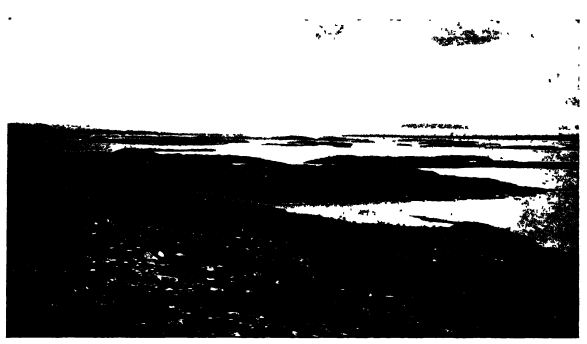
Present Character of the Canadian Shield. — The greater part of the present surface of the Canadian Shield (see map, p. 139) is an undulating plain replete with an intricate series of connected lakes and rivers (Fig., below) ; near the center of it lies a depressed area containing Hudson Bay, an epeiric sea with an average depth of 420 feet. From this central basin there is an upward slope in all directions toward the Height of Land. The general level of the plain above the sea is about 1500 feet, and the local differences of level are usually under 150 feet, though rarely they may be as much as 500 feet above the general plain.
The peneplain of the shield as a whole rises slowly to the east, and in central Ungava is about 2400 feet above the sea. Along the eastern margin of Labrador are rugged mountains that in the north attain 6000 feet, and certain peaks even reach 7500 feet. In fact, it may be said that a mountainous tract extends for 2000 miles from Belle Isle north to Cape Sabine in Ellesmere Land. This rough topography, and also that along the southern margin east of [ p. 152 ] the city of Quebec, is youthful in form, and the deformation of the shield here is thought to have arisen in early Pleistocene time, the movements continuing to recent times.
Suess would limit the shield to Canada, as above defined, but Adams and other geologists include in it Greenland and the Adirondacks of New York. The latter region now reaches a height on a few mountain peaks of about 5000 feet above the sea, the average elevation being about 2000 feet, an altitude which is also the result of Cenozoic upheaval of a regional character.
¶ Evidence of Life in the Archeozoic
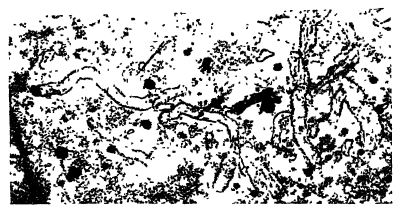
The direct evidence that life existed in Archeozoic time is exceedingly scanty, and yet it indicates positively that at least microscopic blue-green algae related to modern Inactis or Microcoleus were living in the era (Gruner 1923, see figure above).
Long ago Sir William Dawson described from the Grenville limestones Eozoon canadense, which means “ dawn animal of Canada.” For a time many accepted these globular masses, sometimes several feet in diameter, as of organic origip, and they have figured in many text-books as such since 1864, though no one successfully showed to what class of animals they belonged. They look very much like Fig. 54, p. 176. They certainly are not protozoan animals as assumed by Dawson. These masses consist of irregularly alternating thin calcite bands and dark green layers, usually of serpentine, and result from metamorphism of the lime deposits. They are now regarded as probably of organic origin and are thought to be calcareous depositions, made involuntarily by marine plants (algae), i.e., through the chemical reactions of living material (metabolism).
[ p. 153 ]
The usual absence of fossils in the Archeozoic does not disprove the theoiy that life began in soft-bodied microcosms, rather is it indirect evidence confirming the theory. Primordial life, to judge on the basis of the gi-ow1:h stages of things alive now, was too perishable and minute to be preserved as fossils. Lane has therefore called Archeozoic time the Collozoic Age, meaning that then the organisms were jelly-hke.
The indirect evidence is even more in favor of the view that life aboimded in the Archeozoic. This is shown by the nature of the hydrosphere and more especially by the presence of oxj-gen in the atmosphere and its reaction on the sediments. Another indirect proof is seen in the wide-spread and vast amount of graphite in these oldest sediments. This graphite is largely if not wholly the metamorphosed carbon once in organic bodies, and is therefore clear evidence for the presence of life and free oxygen in the atmosphere. These matters are discussed on later pages of this chapter.
The Life-giving Primordial Atmosphere and Hydrosphere. — In the previous paragraphs was given the direct and indirect evidence of life in the Archeozoic, and now we will take up a study of the nature of the primordial atmosphere and hydrosphere and see how they evolved into the present ones. The following is in the main after Barrell.
The heavy acidic atmosphere discussed in an earlier chapter attacked the cooling crust of the earth chemically when it became sufficiently cold, and then oceanic basins became laden with solutions, not only of carbonates, but as well of chlorides of sodium, magnesium, calcium, and iron, because of the large amount of chlorine present. While the chloride solutions continued to accumulate, the carbonates of calcium and magnesium were being chemically deposited as hmestones and dolomites. Where sodium silicate was emanating from the earth’s interior, its reaction with the chloride of iron resulted in exchanging the iron for the sodium, forming sodium chloride and iron silicate. The latter, precipitating along with the carbonates of calcium and magnesium, Van Hise and Leith (1911) believe gave rise to the cherty iron carbonate formations so common in the pre-Cambrian.
Since oxygen, which is one of the essential constituents of the present atmosphere and the energizipg element of animal life, was absent from the primal atmosphere, we must now examine into its source, and as well into the time when the amount of this very important gas became large. Its only known source is in the carbon dioxide of the hydrosphere and atmosphere when freed through the agency of the life processes of assimilating green plants, which take in the CO 2 , keep the C, and exhale the O. However, the freed oxy-gen would not remain in the atmosphere unless the carbon of the plants became buried and excluded from the oxidizing influences of the hydrosphere and atmosphere. Therefore the dead decomposing plants must be buried imder muds or their own mass. That this process went on already early in the Archeozoic is attested by the great amoimt of graphite in the Grenville limestones. The amount of carbon thus locked up as graphite or disseminated in the dark sediments is [ p. 154 ] a measure of the free oxygen that has been added to the air and waters throughout geologic time. Therefore the oldest carbonaceous deposits or the graphite that has resulted from their metamorphoses give clear evidence of the earliest presence of life and of free oxygen.
[ p. 155 ]
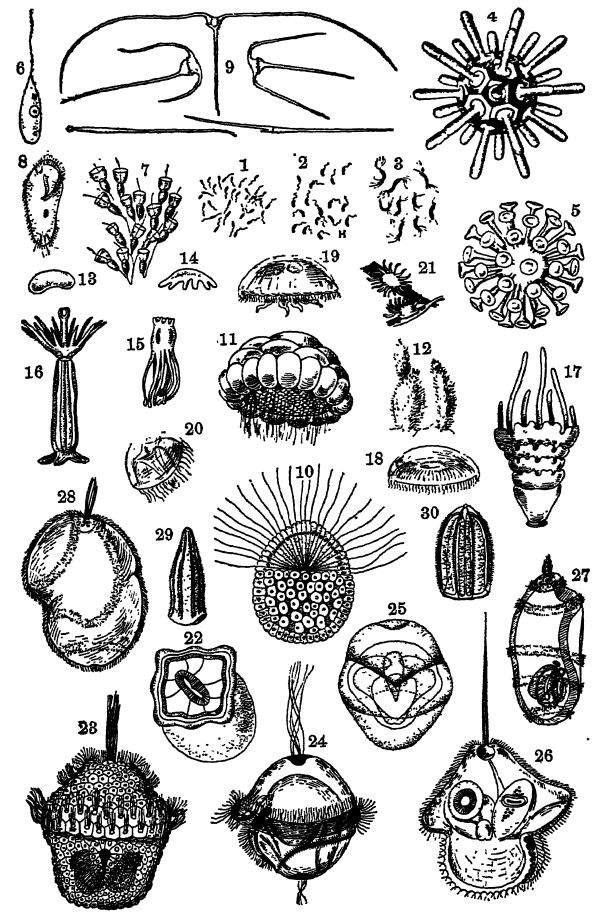
Figs. 1-3. — Three forms of bacteria (1, Pseudomonas; 2, MicrospiTa; 3, Spirillum),
4r-5. — Lime-secreting algae or rhabdospheres.
6-9. — Protozoa (6, Flagellata (Peranema); 7, colony of Choanoflagellata (Codosigna); 8, Ciliata (Stylonychia) ; 9, Dinoflagellata or peridineans).
10-12. — Stages of growth in primitive sponges (10, amphiblastula of Grantia; 11, gastrula of Sycandra; 12, the full-grown sponge Sycandra, x 1/2).
13-16. — Stages of growth in a tubularian hydroid (13, planula-like larva; 14, larva with tentacles; 15, crawling actinula; 16, mature anchored individual).
17. — The fixed strobilla larva that develops into the medusa Aurelia (Fig. 19). Figs. 18 and 20 are other medusse or swimming bells (AEquorea and Tima),
21. — Two small actinians (Anemonia) growing on seaweed.
22. — Free larva of an actinian before fixation (Urticina).
23-28. — Trochophora and trochophore-like larvae (23, trochophore of the gastropod Patella; 24, same of the annelid worm Polygordius; 25, larva of the brachiopod Terdyratulina; 26, pilidium larva of a nemertine worm; 27, dipleurula larva of the crinid Antedon; 28, tomaria larva of the ancestral chordate Bdllmoglossus) ,
29-30. — Ctenophora or paddling bells, to illustrate the probable appearance of the Protoccelomata* (29, Beroe; 30, Idyia).
Most of the figures have been copied from E. W. MacBride's Text-book of Embryology.
Plate 2
Adults and larvae of living things suggestive of the probable life of the Archeozoic seas. Nearly all of this hypothetic life was microscopic in size, short-lived, and pelagic in habit, that is, it floated and drifted, or swam but poorly, near the surface of the marine waters. The kinds illustrated in Figs. 12, 1&-21, and 29-30 may have attained diameters easily seen by the imassisted eye. Figs. 1-9, 12, 16, l8-21, 29
[ p. 156 ]
The first clear evidence of an atmosphere rich in free oxygen is proved by the Archeozoic hematite of the Vermilion district, and especially by the red color of Proterozoic strata. In the absence of free oxygen, the iron of sediments must be deposited as a ferrous salt which can give them only gray or green colors, but in the presence of free oxygen the iron may be oxidized to a ferric state, when the deposits take on yellow, red, or brown colors. The oldest Archeozoic sediments are dark or gray in color, but the continental deposits of Proterozoic time are often oxidized into red colors. From this evidence is gathered the conclusion that in Archeozoic time the weathering of the enormous areas of basic rocks used up the free oxygen about as fast as it was being liberated by the assimilating plants. It is clear, therefore, that the weathering of all geologic time has abstracted from the atmosphere many times more free oxygen than it now contains.
It further appears from what has been said that primordial life must have been more or less like the anaerobic bacteria, which can live without free oxygen, and probably can tolerate carbon monoxide.
In the later Proterozoic (Beltian), we see an abundance of red fresh-water sediments, proving that then the atmosphere was rich in free oxygen. Furthermore, the Animikian formations of the Proterozoic are very rich in carbonaceous deposits, and in the Beltian formations there are animal remains as complicated in structure as the tube-inhabiting annelids.
For a time the primal oceanic waters were almost fresh, and, as Lane believes, probably tending toward being acid. Under such conditions no organism could directly secrete hard parts until the concentration of salts reached and passed the optimum for some cell activity, when the extra lime would be secreted as a pathologic reaction. The geologic evidence tends to show that throughout the Archeozoic organisms did not directly use calcium or silica. The earliest external skeletons of both plants and animals were nitrogenous, and later some became siliceous and more calcareous.
Probable Life of Archeozoic Time (see Pl., p. 155). — Since it is now known that algse and bacteria existed late in the Archeozoic, we may conclude from the presence of much graphite and the further evidence of the nature of the sediments themselves, that there was then an abundance of life. It is in order, therefore, to speculate as to the probable forms and stage of evolution attained by the organisms of the Archeozoic. Furthermore, since late in the succeeding era there is the added evidence of annelid tubes, we are all the more justified in holding that considerable organic progress had been made in this early era.
In our theorizing about the kinds of this life, we may take as a safe guide the embryology of the living world, all of which, plants and aniTnalg alike, starts in a single or in a fructified cell, and each living individual recapitulates the development of the race. Therefore it is believed that for a long time the oceanic waters must have been peopled by a great variety of exceedingly minute floating plants, whose whole organization was in a spherical cell, and which were of a green or red color. They were living on the carbon dioxide and nitrogen of the water, their home. Their abundance soon led to congregation and to parasitism, to communal cell life and to feeding upon one another, and so gave rise to the [ p. 157 ] animal kingdom. Survival wa.s facilitated first by attaining to greater cell size, and then through congregating into colonial life, and finally by division of labor among the cells themselves. Thus was develojDed a “bodly” a greater and better organic workshop and a resistant mass wherein was also stored a greater amount of food, all of which finally led to longevity. By easy stages the singlecelled plants (Protophyta) and animals (Protozoa); passed into the more and more complex ones, the many-celled Metaphj’ta and Metazoa.
The development of living metazoan animals is variably rapid from the fertilized cell into a small community of cells becoming a tiny, hollow, spherical embryo known as the blastula (means a little germ, bud or embryo). Such aggregates, developing no higher, are alive to-day (e.g., Volvox, a colonial protozoan; these are, however, larger colonies, made up of thousands of cells). The simplest blastulae show no cell differentiation, and the water-inhabiting invertebrates at this stage of development are usually uniformly ciliated and move freely through the water with a rotary movement about a definite axis, one end of which always points in the direction of movement.
Blastulae floating about developed into the next stage, known as the gasinda (Greek diminutive for stomach), in which the embryo introduces an open cavity for digestion of food. This gastrulation is the result of an inpushing or invagination of the cells of the vegetative or feeding pole of the blastula. The emhryo is now a celluliferous two-layered sac, composed of an outer skin, and an inner cavity forming the primitive gut, while its single opening to the exterior is the gastrula’s mouth. The animal is now all skin, stomach and mouth (see Pl., p. 155, Fig. 11). In the higher Metazoa the outer layer of cells gives rise to the integument, nervous system, and sense organs of the adult, while from the inner one come the digestive tract and certain of the glands, such as the liver.
All metazoan animals pass through the blastula stage, and the next or gastrula stage as well. This was long ago pointed out by Haeckel and is the basis of his gastraea theory of animal development. Then the progressive series of gastrulae develop body cavities, and because of these primitive pouches are called protocoelomates (means primitive animals with body cavities. See Pl., p. 155, Figs. 29-30). Out of them have come all the higher animals. Most of this life is larval in the living world of the present, and is transitional to higher forms, but in the Archeozoic little of it had progressed beyond the stages of evolution mentioned, and accordingly much of this micro-life floated in the sun-lighted waters of the oceans. Some forms, however, had descended to the sea bottom and glided over or became attached to it. Seaweeds then flourished and probably tiny sponges with nitrogenous skeletons; planulse, primitive hydroids, and actinians should also have been present; and shimming among the floating life there should have been small jelly-fishes and ctenophores. It was all a soft-bodied life and probably none of the animals attained an inch in diameter.
¶ Collateral Reading
F. D. Adams, Problems of the Canadian Shield: the Archeozoic. In “Problems of American Geology.” New Haven (Yale University Press), 1915.
A. P. Coleman and W. A. Paeks, Elementary Geology. London and Toronto (Dent), 1922.
| X. The Changing Aspect of North America, or the Geosynclines, Borderlands, and Geanticlines | Title page | XII. The Proterozoic Era, or Age of Iron Making |