[ p. 214 ]
(See Pls. 7, 11, 21, 26)
All brachiopods have two shells, and the living forms are gregarioui sexed animals that have their homes in the seas and oceans. Mon than 215 living kinds are known, extending from the strand-line down into the great oceanic abyss of more than 3 miles in depth Their greatest abxmdance, however, is in the shallow water dowr to 1000 feet, where fully 80 per cent of the living forms occur, whil€ 70 per cent live above 600 feet of depth.
At first these shelled animals were regarded as belonging to the bivalved molluscs to be described later, but Cuvier (1792 and 1802) was the first to see that this reference was wrong, although he still regarded them as of the phylum Mollusca. It was the Frenchmar Dumeril who in 1806 gave them the name Brachiopoda, which means arm-footed, because he thought these animals crawled around od their arms. Molluscs do crawl, but no brachiopod ever does, and therefore the name Brachiopoda continues a wrong physiological interpretation. What are called arms are really breathing organs, and it was these that Dumeril mistook for the foot upon which the animals moved about (see Figs., pp. 216, 217). The individual brachiopods stay throughout life fixed to one place, the new-born young alone beiug free, and remaining unattached for some days or, rarely, two or three weeks.
Brachiopods are sometimes called lamp shells because many of the kinds living after Paleozoic time resembled a miniature Roman lamp. Most of the older brachiopod shells do not, however, in the least resemble these lamps.
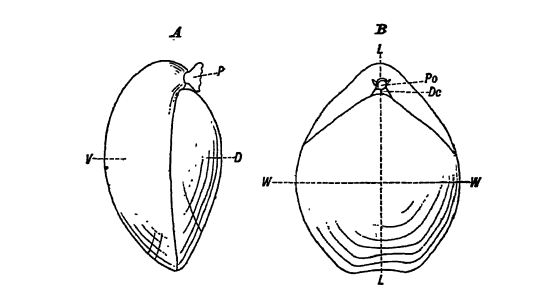
External Structure. — Brachiopods have two valves (shells) which are situated on the ventral (belly) and dorsal (back) sides of the animals, and are hence known as the dorsal and the ventral valves (Fig., p. 215). In bivalved molluscs, on the contrary, the shells are on the right and left sides of the animal, and are therefore called the right and the left valves. Issuing from the ventral valve in the brachiopods there is a short, or in some types a very long, worm-like body known as the peduncle or pedicle (Fig. A., [ p. 215 ] below). This is a fleshy stem, which in the great majority of cases anchors the animal to some foreign object on the sea bottom. It is only exceptionally that brachiopods in later life are without a peduncle and then the ventral valve is more or less cemented to some hard object, or otherwise held in place.
The shells of brachiopods are either phosphatic (phosphate of lime) or wholly calcareous (carbonate of lime). WTien phosphatic, they are usually thin and do not have ventral teeth and dorsal dental sockets or hinge-lines for the hinging or articulation of the valves (Figs. A, p. 216; B and C, p. 217) but are held together by muscles only; such forms are said to be inarticulate. All of the calcareousshelled brachiopods are more or less well hinged and therefore articulate. The shell substance is said to be impunctate when there are no minute perforations passing through, and punctate when there are closely set canals in the valves. These cannot be seen with the naked eye, but with a pocket lens the canals in any punctate brachiopod are readily made out.
Internal Characters. — The shells are secreted by the mande, which consists of two thin membranes that are not united marginally and have the form of the inside of the valves. They completely cover the soft parts of the animal, like skins, and their inner surfaces are respiratory.
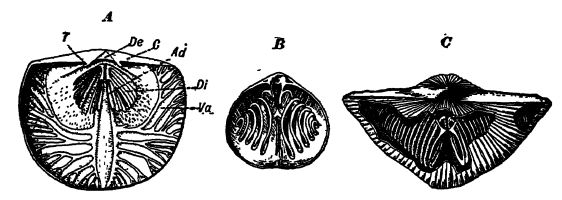
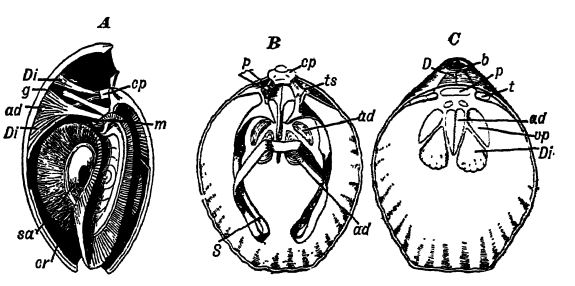
On the inside of the two valves are usually seen muscular impressions, or Tnarking a on the places where the muscles were attached These scars are different in the dorsal and ventral shells, and more [ p. 216 ] or less variable throughout this class of animals. Only the mos important and largest of them need, however, be mentioned. I: the ventral valve in the middle line are two small elongate scar called the adductor impressions (Figs. A and C, p. 217). These rep resent the places of attachment for the adductor muscles, o those which by contraction close the shell. The other ends of th adductors are seen in the four prominent sears of the dorsal valv (Fig. B, p. 217). On each side of the adductor impressions in th ventral valve are two large diductor scars (Figs. A, p. 216; C, p. 217) which open the shell and which pass backward to the posterio region of the dorsal valve and are there attached to a protuberanc known as the cardinal process (Figs. A and B, p. 217).
Gills. — Within the anterior mantle cavity there are two more o less looped or spirally rolled, fleshy, fringed arms.” These ar the gills or breathing organs of the animals and the food gatherer as well. Through movements of the cirri and their cilia (the fring of the gills) they attract currents of water into the shell, where th microscopic food, chiefly plants (algse), is extracted from it and fe< to the mouth. Respiration takes place through the filaments of th gills, and through the inner surfaces of the mantle, which absorb th free oxygen taken in with the water.
In many brachiopods the gills are unsupported by internal cal careous skeletons, but in the majority there are such support and they are of much value in the classification of these lowly animals (see Figs., pp. 216, 217). The most primitive supports consis of two short, sickle-shaped hooks known as crura. When thes are more or less long and united in the middle, they are calleops [ p. 217 ] (Fig. B, below), shells of this type being common after the Paleozoic; but when they bend outward into spiral coils, they are referred to as spirals, a type seen chiefly in the Paleozoic (Figs. B and C, p. 216).
Geologic Occurrence. — Brachiopods are particularly charaeeristic of Paleozoic time, and in North America about 2500 kinds tre already known, while the knoum fossil forms of all countries md ages probably exceed 7000 in number. They appeared in some variety in the Lower Cambrian but it was in the Champlainian that they began their great specific and generic deplojTiient and the class had its evolutional culmination in the Devonian, where 30 per cent of the American Paleozoic species occur. Then followed more or less of a decline throughout the Carboniferous and a marked vanishing of stocks during the Permian.
In the late Triassic a new evolution set in which attained its climax in the succeeding Jurassic. Here the shells known as rhynchonellids and terebratulids are most common and are the characteristic forms of the Mesozoic. Throughout this era the American continents are poor in brachiopods, probably fewer than 100 species being recorded, while in Europe the seas swarmed with them.
[ p. 218 ]
Brachiopods are of special importance as index fossils in Stratigraphy throughout the Paleozoic and Mesozoic. In the Cenozoic they have little importance, since they were then no longer a conspicuous clan, and probably at no time in this era were there more species than are living to-day. In North America less than 20 Cenozoic forms have been recovered.
Brachiopods are among the longest-lived animal stocks known, the genera Lingula and Crania having persisted through all the physical changes since the Cambrian.
It was said above that brachiopods appeared in some variety in the oldest Cambrian. Before the close of the Lower Cambrian three of the four orders into which the class is divided were in existence. This means that brachiopods originates in the Proterozoic.
¶ Collateral Reading
James Hall and John M. Clarke, Introduction to the Study of the Paleozoic Brachiopoda. Paleontology of New York, Vol. 8, 1892-1895.