| XVII. Brachiopoda or Lamp Shells | Title page | XIX. Champlainian Time and the Reign of Invertebrate Animals. |
[ p. 220 ]
(See Pls. 9, 12, 22, 44)
Mollusca are often spoken of as shelled fl.niTn fl.ls, though many of them are completely devoid of any external hard shell. Originally all of them had shells but throughout the geological ages many stocks abandoned the stiff outer armor so that they could the more easily move about. The Mollusca are a greatly diversified array of bilaterally symmetrical animals, and it is estimated that fully 45,000 kinds are now living. Such are the clams, oysters, snails, and the pearly nautilus. Their greatest diversification and abundance is in the seas and oceans. They are less varied and common in the fresh waters, while the air-breathing kinds of snails alone live on the dry land wherever there is vegetation.
The term Mollusca means soft, the bodies being very soft and devoid of an internal skeleton. They inhabit shells to protect themselves against their enemies. The bodies are not segmented as are those of the worms, and as a rule the animals are very sluggish. Though they are devoid of limbs for crawling or swimming, most of them do, however, move about, accomplishing this by means of the so-called foot, a creeping sole situated imdemeath the belly. Usually the body is covered by a mantle, a thin membrane that secretes the shell when such is present. Within the mantle cavity lie the gills, organs of varied construction setting up currents of water, out of which is extracted not only the oxygen for respiration but often flisn the food for life sustenance. In the land snails there are no gills and here the mantle cavity has been adapted into a kind of lung for aerial respiration, since they breathe the air. In all of the molluscs, except the bivalves, the mouth is furnished with a fiexible chitinous ribbon known as the radvla, a sort of tongue, usually provided with numerous minute, sharp, hard teeth and moved by sp>ecial muscles for the breaking up of the food. The sexes are separate, or united, the individuals in the latter case being hermaphrodites.
Nature of Shell. — The shells usually consist of three layers: an outer, very thin, brown, horny layer always absent in the fossils; [ p. 219 ] a thick, middle, limy layer referred to as the porcelanous layer, the one most often preserved in the rocks; and an inner, generally thick, mother-of-pearl layer that is often destroyed in the fossils, especially among the Paleozoic molluscs, since it consists of an easily dissolvable form of carbonate of lime known as aragonite.
Classification of Mollusca. — The most primitive class of Mollusca are the Lamellibranchia, bivalves like the clams and oysters. They are primitive, however, only because they are degenerates, having in the course of their evolution lost their heads and eyes, due to their being completely encased between two heavy shells, which have made of them more or less sedentary animals. Originating in marine waters, they have spread into the fresh ones, but none have succeeded in living on the dry land.
The primal stock that gave rise to the Mollusca has not yet been found in the Proterozoic, but in the Cambrian the Gastropoda or snails are the common molluscs. From this and from the embryology of living forms it is evident that this clan in its construction is nearest to the primal molluscan stock. Throughout the geological ages the gastropods in their evolution are an ascending group of organisms and at present are more diversified than ever. They include the snails and drills.
Out of the gastropods came the highest and therefore the most complex and intelligent of molluscs, the Cephalopoda, such as the pearly nautilus, ammonites, squids, and devilfishes. The two first mentioned groups have shells and these are always abundantly chambered, while the squids and devilfishes have no shells at all, though there may be present something of an internal skeleton.
Significance of Molluscan Evolution. — The vast kingdom of the Mollusca started well, with bodily independence, fully equipped with locomotive powers, and with excellent iimervation, but all excepting the cephalopods sold their birthright for ease and content. Even the cephalopods, with the marked degree of independence seen in the squids and devilfish, did not give rise to any stock higher than themselves. The gastropods, and especially the lamellibranchs, became dependent upon the movement of the water, and waited for the waves to bring them food. Secure in their protection and adaptation, these types of life have come crowding down the ages in inexpressible variety, but out of them can come nothing better. They had their chance at the very beginning of their ascendency, but the chance was missed, and for untold millions of years they have failed to improve. (J. M. Clarke, 1917. Also see his Organic Dependence and Disease, 1921.)
[ p. 221 ]
¶ Lamellibranchia or Bivalves
The najue Lamellibranchia comes from lamella, meaning leaf, and branchia, meaning gills, and was chosen because in these molluscs the gills are leaf-like. The class is also widely known as Pelecypoda, meaning hatchet-foot, because the foot often suggests the shape of a hatchet (Figs. A, below, and A, p. 222). The group includes all the headless and therefore degenerate Mollusca. The body is usually compressed from side to side and always covered with two shells or valves, one on the right, the other on the left side (Figs. A and B, below). They are therefore often called bivalves, and are popularly knotvn as mussels, clams, oysters, cockles, and scallops. Their habitat is mostly marine, in the shallow waters near the shores, where their food, the microscopic algae, is most abundant. Nearly all fresh waters, however, have some mussels, but none have succeeded in living out of the water on the land, as do the snails. The food is strained out of the water by the gills (actually the labial palps), which are also the breathing organs. The lamellibranchs are very sluggish animals, many remaining buried in the pa-Tifl and muds of the sea (Fig. A, p. 222). The scallops only can swim a little by clapping their valves and forcing water alternately from one side and then the other.
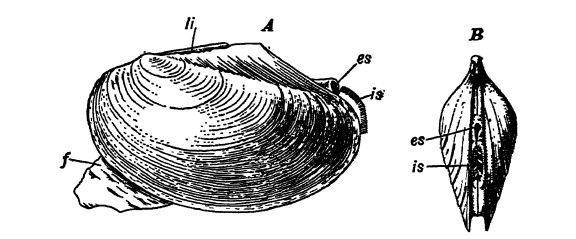
Shell Characters. — The two shells are joined on the dorsal side of the body by a hinge, a more or less thickened area provided with teeth and sockets, allowing the valves to move upon one another (Figs. B and C, p. 222) . Either on the outside or within the thickened shell majgg of the hinge area there is an elastic ligament attached to both valves that acts like a spring and keeps the shells open when the animals are in repose (Fig. A, above). On the inside of the valves [ p. 222 ] are muscle sears, usually one at each end of the shell, these being due to the anterior and posterior adductor muscles, though in many forms, as in the oysters, there is only one of these scars situated near the center of the valve (Figs. B and C, below). These muscles close the shell, and when it is shut the elastic ligament is under strain ready to open the valves again as soon as the adductors let go their pull. The wedge-shaped foot of the lamellibranchs is large in the creeping forms but more or less reduced in size through disuse, according to whether the animals live in holes, like the soft clam, or have one shell firmly cemented to some hard object on the sea bottom, as in the oysters.
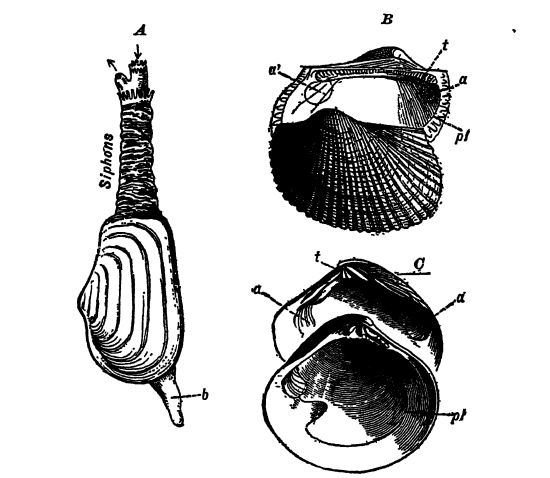
Contrasted with brachiopods, which also have two shells, it is seen that in that group the valves are on the dorsal and ventral sides of the animals, while in lamellibranchs they are on the right and left sides. The brachiopods have a complicated muscle System to open and close the shells, while lamellibranchs have such only [ p. 223 ] for closing them; they are opened by the elastic ligament. In brachiopods there is a peduncle that holds the animals to the ground, while bivalves are nearly always free to move about.
Siphons. In most lamellibranchs the mantle elongates beyond the shell into two tubes or siphons through which the water of respiration enters and leaves the mantle cavity (Figs. A, p. 221, and A, p. 222). When the siphons are large, it is an adaptation for living buried in the sand or mud, and all lamellibranchs with such siphons have the shells marked on the inside by a decidedly bent line, the pallial sinus, seen in connection with the posterior adductor muscle.
Geologic Range. — Lamellibranchs were not well established until the Champlainian, after which time they became more and more abundant and are very prolific in all the shallow waters of the present oceans. While the shells of these bivalves are often abundant in the Paleozoic rocks, they are usually not well preserved until the Pennsylvanian, a condition seemingly connected with a rather thin porcelanous layer and a comparatively thick mother-of-pearl one, the latter being easily destroyed. They are only occasionally of value as stratigraphic markers in the Paleozoic, but, beginning with the Mesozoic, they are abundantly preserved and often serve as index fossils.
¶ Gastropoda or Snails
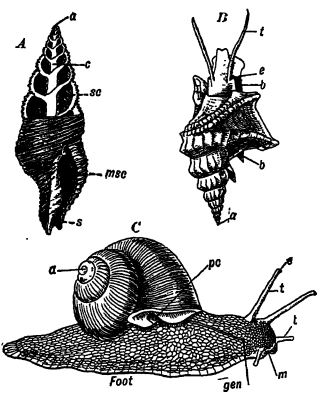
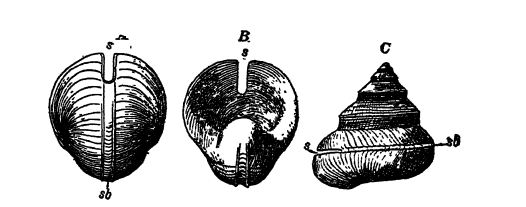
General Characters. — The name Gastropoda means stomachfooted, and has reference to the fact that the animals creep about by contractions of the sole of the foot, which lies on the ventral side (Figs. B and C, p. 224). This class of molluscs, which are as a rule sluggish, though less so than the lamellibranchs, are exceedingly [ p. 224 ] varied and embrace not only such shelled forms as the limpets, drills, periwinkles, whelks, conchs, and snails, but also the naked sea slugs and the slugs of the land. They are most abundant and varied in the shallow seas, where they crawl over the bottom, are far less varied in fresh water, and on the land are represented by the vegetarian, air-breathing or puhnonate snails (so-called because the mantle cavity acts as a lung in respiration, see Fig. C, opposite), which are found in nearly all places where plants grow, and are very varied the world over. The mantle cavity in the aquatic forms usually has but a single gill, the one on the right side, that on the left side having been lost because pf the spiral form of the body. In habit they are, as a rule, herbivorous, less often carnivorous and scavengers. The mouth is provided with a radula or tongue-like process. The carnivorous forms known as drills bore holes into their ghelled victims, such as the clams, with the radula and the aid of a weak secretion of sulphuric acid. The head of most gastropods is usually distinctly marked off from the rest of body, and has a pair of eyes and one or two pairs of sensory organs or tentacles (Figs. B and C, above).
Spiral Shell. — The usual form of the shell or protective covering is a spirally twisted, right-handed (dextral) cone with the apex directed upward (Fig. C, above); it is secreted by the mantle situated on the dorsal side of the animal. Because of this single shell, the gastropods are also spoken of as univalve molluscs. In many forms, however, there is a chitinous or calcareous operculun, [ p. 225 ] a plate attached to the side of the foot, which closes the shell opening when the animal has retreated into its shell or is retracted. Even though gastropods may thus have two shells, these together do not represent the t’wo valves of bivalves. It is only the spiral cone that corresponds to the valves, because the operculum is a secondary structure not present in all univalves, is secreted by the foot, and has nothing to do with the dorsal mantle or true shell secretion.
Geologic Range. — Primitive forms of Gastropoda were present in the Lower Cambrian, where practically all of them were more or less conical, not twisted, but resembling little hoods. The twisted type of cone appears more and more abundantly in the Upper Cambrian and since the Champlainian has been common as fossils. At present there are litdng more than 20,000 species, a larger representation than at any time during the geologic past. In the Palezoic they are, as a rule, defective fossils and it is only since the Mesozoic that their abundance in well preserved specimens is of value in Historical Geology. The air-breathing gastropods appear rarely in the Pennsylvanian and seem not to have been common until late in the Jurassic, where are also seen the first fresh-water snails. There are about 500 species of fossil pulmonate snails known and about 6000 kinds of land snails.
¶ Cephalopoda
Cephalopoda (means head-footed) are the most highly organized Mollusca and include such animals as the nautilus, ammonites, octopus, cuttlefish, and squid. All are exclusively marine. The two former types of cephalopoda have chambered shells in which the nnimfllg five, while the latter stocks are devoid of these. For present purposes the nautllids only will be described, because they are decidedly characteristic of the Paleozoic, and the remainder will be considered when Mesozoic animals are studied.
The living pearly nautilus (see Fig., p. 226) derives its name from the fact that its beautiful, bilaterally symmetrical shells are often used as ornaments and for pearl buttons, after the thin, outer, porcelanous, striped layer has been removed from the thicker, inner, mother-of-pearl one. The word nautilus is a poetic form of the Greek word for sailor, and like their distant relatives, the argonauts, it was believed that these animals could expand certain of their arms into the wind and so sail the seas. This idea, however, is wrong, for the four living species of the genus Nautilus now inhabiting Oceanica from the Malay region to the Philippine and Fiji islands have never been seen at the [ p. 226 ] surface except in a dying condition, though their empty sealed shells drift to Japan, Africa, and New South Wales. The nautilids are gregarious animals of the deeper and warmer sea between 300 and 600 feet, at a temperature of 68° F., but they have been taken in 1000 feet of water. In habit they are fierce and decidedly carnivorous and will take the meat that baits the fish-pots at depths down to 420 feet. The sexes are always distinct.
Cephalopoda are also known as chambered shells, because the cone, of whatever form it may be, is regularly chambered by thin, pearly, transverse partitions called septa. These septa are concave toward the opening of the shell, and are perforated by a circular hole. Through these perforations there passes a fleshy tube known as the siphon (Fig., above, si), originating on the roimded posterior side of the animal and continuing through all the chambers to the final minute one at the apex of the cone, where it is fastened to the innAr side of the wall. In many fossil forms the siphon has secreted a calcareous tube, known as the siphuncle, which at timAs is very t.LiAV In life the chambers are filled with a gas to make them more or less buoyant, and thus to render the weight of the stony house but little [ p. 227 ] of an encumbrance. The nautilids crawl over the bottom of the sea, or hold to it by then- retractile tentacles, and can swim rapidly backward in a jerky manner by forcing out water from the mantle cavity through the hyponome or ambulatory funnel. To the sides of the cone the septa are firmly united, but in the fossils it commonly happens that the outer shell is lost, in which case the edges of the partitions show plainly as so many lines in the rock-filled cone. The nature of these lines is of much importance in classifjung shellbearing cephalopods, and they are termed suture lines. Usually these suture lines are straight, but there are forms in which they are decidedly bent in undulations. These, when convex toward the apex of the cone or backwardly directed, are termed lobes, and when curved toward the larger end or aperture of the shell, are called saddles.
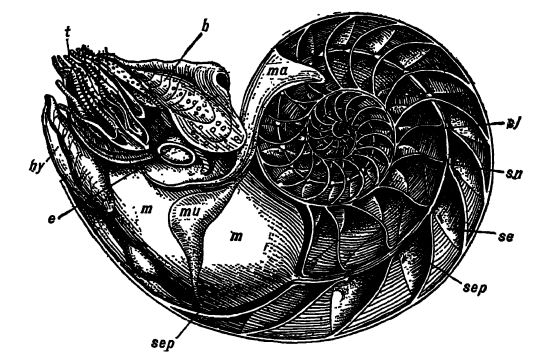
Below the visceral sac is situated the large mantle cavity with its gill-plumes, where water is freely taken in and passed out through the funnel. When the animal wishes to swim, however, the two flaps of the mantle are appressed, forming the funnel, and by a rapid contraction of the mantle or gill chamber the inhaled water is shot out with great force. The animal then darts backward or sidewise according to the direction in which the stream is ejected- They are expert and rapid swimmers. The eyes on either side of the head are large, of primitive structure, and supported on short stalks called peduncles. The mouth is surrounded by the tentacles and is provided with two powerful, protrusible, homy, parrot-like bills, the upper one of which among fossil forms was often tipped with a carbonate of lime beak.
Geologic Occurrence. — Nautilids are the oldest and most primitive division of the Cephalopoda. They appeared with the Cambrian, were fairly abundant in the latest Cambrian, and increased in numbers in the Champlainian. The most primitive were straight, tapering cones that were circular or oval in outline, and the many famihes of them are called Orthoceracones (from the genus Orthoceras, meaning straight horn, Pl., p. 236, Fig. 19). These orthocerids were common throughout the Paleozoic and particularly so in the Champlainian and Silurian, when individuals are known that originally had a shell as long as 15 feet (Endoceras). With the Devonian these primitive straight-shelled forms began to wane slowly, but some were still present in the Triassic.
Straight and coiled nautilids persisted into the Mesozoic and were most abundant in the earlier half, after which time they gradually became less numerous. In the present oceans occur only the four relic forms, which give us our sole knowledge of the soft parts of the many thousands of kinds that swarmed the ancient seas.
[ p. 228 ]
Kinds of Nautilid Cones. — All the higher types of nautilids had their origin in the straight-shelled Orthoceracones. The first of the descendants had their shells slightly bent and are therefore called Cyrtoceracones (from Cyrtoceras, meaning bent horri, Pl., p. 236, Fig. 21); later ones were coiled in a loose spiral wound in a plane and are known as Gyroceracones (from Gyroceras, meaning round hcrm); still others are tightly wound, with the whorls embracing one another more or less closely, as in NauiiluS, and these are termed Nautilicones, On the sides of such one sees more or less of the inner whorls of the shells, and the area of these whorls is spoken of as the umbilicus. It is small in Nautilus and wide or open in the Champlainian forms (Pl., p. 236, Figs. 23, 24). The bending of the tubes is due to a more rapid secretion of lime along the ventral side of the cone, and the greater the unequal grovrth the more rapidly the cone rolls up.
Classification. — Cephalopods are divided into two subclasses, the Tetrabranchiata and Dibranchiata, on the basis of the number of plume-like gills used to oxygenate the circulatory blood. In the former subclass there are four gills (tetra, four), and the latter division has but two. The Tetrabranchiata, all of which have external shells, appeared in the Cambrian, and have now almost vanished from the earth, while the Dibranchiata, which are in almost all cases naked but may have internal vestiges of the ancestral outer shell, arose in the Triassic and are abundantly represented among living cephalopods by the squids, argonauts, and octopus.
Habits of Fossil Nautilids. — In his studies of Paleozoic nautilids, Ruedemann states that from the nature of the preserved color bands it appears that among the forms with straight shells held horizontally, some crawled sluggishly forward over the bottom of the sea, or when in trouble darted backward quickly through the aid of the pumping siphon. Among the more active swimmers, the smaller and bent shells were held obliquely upward, and the coiled ones vertically. In the living nautilus the shell of the female has a somewhat different shape and larger size than that of the male, and this sex differentiation can be distinguished in some of the Paleozoic forms. The larger are regarded as the females and the smaller as males.
¶ Collateral Reading
A. M. Dates, An Introduction to Palaeontology. London (Murby and Co.), 1920.
Zittel-Eastman, Text-book of Paleontology, Vol. 1, 2d. ed. New York (Macmillan), 1913.
James Hall, Lamellibranchiata. Paleontology of New York, Vol. 5, Pt. 1, 1884-1885.
C. 0. Dunbar, Phases of Cephalopod Adaptation. In “ Organic Adaptation,” to be published by the Yale University Press.
R. Ruedemann, Cephalopoda of the Beekmantown and Chazy Formations of the Champlain Basin. New York State Museum, Bulletin 90, 1906.
R. Ruedemann, Observations on the Mode of Life of Primitive Cephalopods. Bulletin of the Geological Society of America, Vol. 32, 1921, pp. 315-320.
| XVII. Brachiopoda or Lamp Shells | Title page | XIX. Champlainian Time and the Reign of Invertebrate Animals. . |