| XIX. Champlainian Time and the Reign of Invertebrate Animals. . | Title page | XXI. Silurian Time and the First Air-breathing Animals |
[ p. 247 ]
In this chapter we are to study two of the greatest sources of natural wealth, mineral oils or petroleuna (rock oil), and natural gas. Their annual value is now next to that of coal and iron, so that their exploitation has led to vast personal fortunes, greater than that of Croesus; and through their benefactions some of the owners of this great wealth are stimulating the world to nobler and healthier living. The “ master mind ” of the petroleum industry is John D. Rockefeller of New York.
Manifestations of natural gases and oils issuing out of the ground in the form of “ burning springs,” iridescent films on the surface of streams, or lakes of asphalt, are nothing new, for such phenomena of nature have been recorded in human history these thousands of years. “ The vale of Siddim was full of slime pits,” we read in Genesis XIV: 10. “Slime had they for mortar” (Gen. XI: 3) in the building of the tower of Babel. Herodotus also tells that the bricks and tiles of the temples of Babylon, “ the brick city,” and Nineveh, “ the stone city,” were held together by pitch or asphalt, and the latter city paved its streets with asphalt more t.ha.n 4000 years ago.
Rise of Petroleum Mining. — The earliest mention of American petroleum occurs in Sir Walter Raleigh’s account of the Trinidad pitch lake in 1595, and the oil industry undoubtedly had begun in America long before 1632, when the Jesuit missionary Joseph de la Roche d’Allion noted the oil springs of southern Allegany County, New York, and said that the oil was highly prized by the Indians for medicinal piuposes. However, nothing of a decided commercial value came of this until 1859, due to the lack of knowledge that petroleum often occurs in great quantities in the rocks, and of where and how to drill deeply into the earth to obtain it. The latter information was gained first through the early settlers in the Ohio valley searching for salt. Natural brines issued from the ground along the Little Kanawha River in West Virginia, and here in 1806 new drilling methods were devised to get at these deep-seated waters. [ p. 248 ] The first well, after much hard labor, was sunk to a depth of 80 feet by the lifting and dropping of a heavy chisel. Then the drillers found to their dismay that the brine was spoiled by an abundance of petrolemn, to them a nasty and useless material By 1820, drilling methods had been perfected so that 1000 feet of depth could be reached, but many of the salt wells were still rendered useless ” because of the oil, which dirtied the Kanawha to such an extent that it became known as Old Greasy.”
The accumulated knowledge of deep-well drilling and of the fact that rock oil occurs in commercial quantities deep within the earth’s crust was made use of by Col. E. L. Drake and the Seneca Oil Company in 1859, in drilling to completion, near Titusville, Pennsylvania, the first well for the getting of rock oil. At 69 feet below the surface they obtained a flow of petroleum pumping at first 40 barrels per day and later 15 barrels. This oil sold at from $25 to $30 per barrel, but since then the price has been even lower than 75 cents per barrel. Here was the beginning of a new industry, one that the development of the gasoline motor was to swell to huge proportions.
Depth of Oil Wells. — Oil and gas wells have been driven down to 7600 feet, a maximum attained in West Virginia and in Europe; few, however, are deeper than 4000 feet, the great majority ranging between 500 and 3000 feet. Probably more than a million wells have been driven or bored in North America and during each of the past six years about 26,000 wells have been drilled. The piped holes are usually from 6 to 12 inches in diameter, though at Baku in the soft rocks the wells range up to 26 inches.
Successes and Failures. — A well that does not yield oil or gas in paying quantities is said to be a “ dry hole,” and it is estimated that of all those drilled at present about 20 per cent fall into this class. Drilling with the object of finding new productive territory is of a very speculative nature. In the old days of oil prospecting, one great producer was struck in about every 150 wells dug, but now, due to the accumulation of geologic knowledge, about one good well is obtained to every three sent down.
Duration of Wells. — All oil and gas wells, after a time — usually a short one — cease to flow and finally even the pumps can raise no oil. To-day there are in the United States upward of 200,000 produciug wells. The average duration of wells is from four years in Texas to seven in Pennsylvania. Single wells, however, have been productive from 25 to 57 years. In the Appalachian region the average of production in wells in 1907 was about two barrels per day, and in California more than forty barrels. Good wells are those that yield several thousand barrels daily, and at Baku in the Caspian region great gushers yield from 50,000 to 170,000 [ p. 249 ] [ p. 250 ] barrels, but at this rate only for a month or so, though one well gushed for seventeen months. The greatest of all the gushers was Cerro Azul No. 4, near Tampico, Mexico, which in 1916 yielded daily 260,000 barrels.
After a well has produced for some time, the internal pressure lets down and finally pumps are brought into use. Even so, all the oil that is concentrated into pools can not be recovered; at present, it is thought, not more than from 50 to 75 per cent.
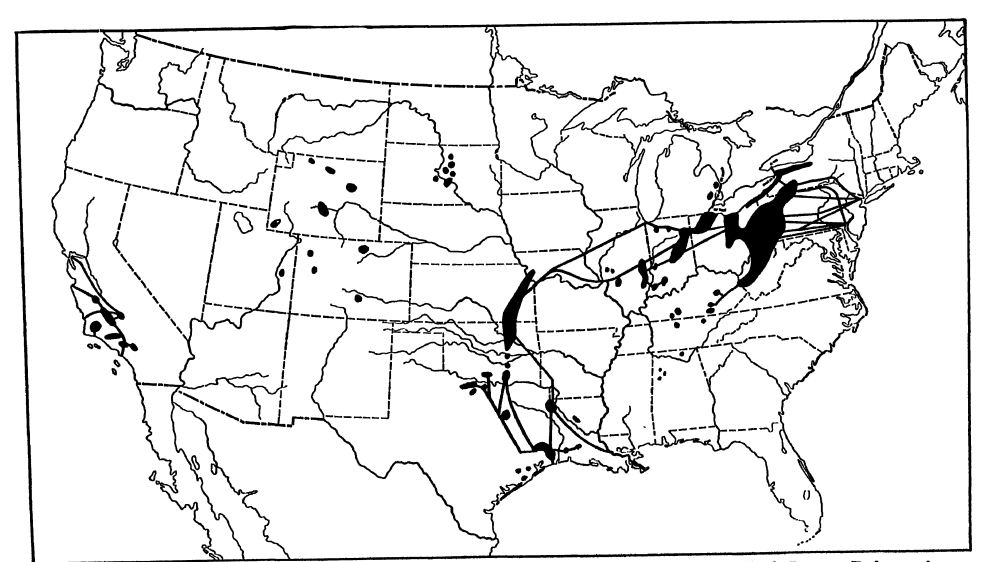
The World’s Great Oil Fields. — Since the days of ancient Greece, petroleum has been obtained from the western shore of the Caspian Sea (Baku) and south into Persia, and this region is still one of the richest in 3aeld.- In the United States, the industry spread from western Pennsylvania, after 1859, first south through the Allegheny Mountains, then throughout the Ohio and Mississippi valleys, with the greatest activity to-day in the “ Mid-Continent Oil Field ” (Kansas, Oklahoma, Texas) and California. With the increasing demand for petroleum, the search for productive strata has been carried into every continent, from the arctic areas of northwest Canada to the tropical East Indies, and from Japan to the Argentine. The most productive fields to-day, outside of our own coimtry, lie in Mexico, Russia, Persia, and Venezuela, with those of Peru and the Dutch East Indies in rapid development.
Growth of the Oil Industry in the United States. — In 1859, the year when the present oil industry began, the United States produced 2000 barrels of crude petroleum; in 1870 the yield was 5,000,000 barrels, and in 1918 it had risen to the astonishing amount of 356,000,000 barrels, valued at $704,000,000, a natural national asset for that year as great as the combined values of gold, silver, copper, and zinc, and exceeded only by coal and iron. Moreover, the yield is still rising, and in 1920 equalled 450,000,000 barrels. The value of natural gas in 1918 was about $154,000,000, or nearly twice as great as that of lead. The pipe lines through which the crude oil and gas are transported total about 45,000 miles. Petrolemn now comes from eighteen states, the leading ones being, in the order named, Oklahoma, California, Kansas, Texas, West Virginia, Illinois, Pennsylvania (once the greatest producer), Louisiana, Ohio, Wyoming, Kentucky, etc. The United States yielded between 1859 and 1918 about 60 per cent of the world’s entire production of petroleum. Russia comes next with about 30 per cent.
Areal Extent of Oil Fields. — The present proved area of the oil fields of the United States amounts to about 4,100 square miles. The known new territory is estimated at 1000 square miles more. [ p. 251 ] and the future supply still in the ground at about 9,000,000,000 barrels (about 45 per cent prospective) all of which it is thought will be consumed during the next twenty years. The imdeiground reserves in all countries are estimated by David White at 43,000,000,000 barrels, and this supply may last the world three hundred yeare. It is probable, however, that there is far more oil in the ground than is now believed.
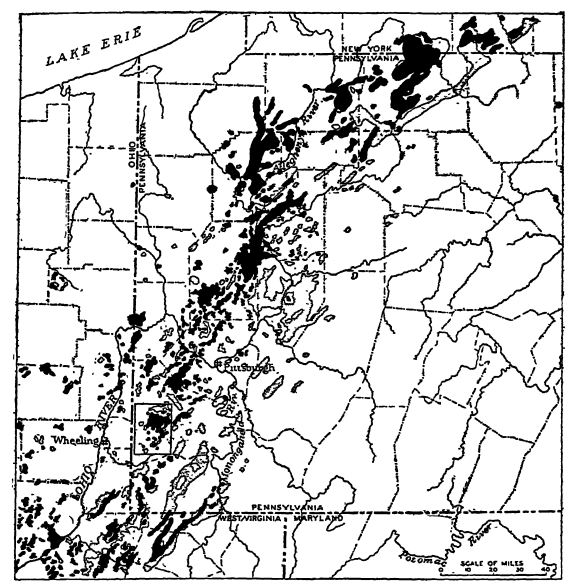
The Pennsylvania Oil Field as an Exemplar. — In the Upper Devonian of western Pennsylvania, West Virginia, Ohio, and New York, vast quantities of petroleum and natural gas have been obtained by drilling. This was the first exploited field in America. During the next forty-five years some 90,000 wells were driven at a cost of about $360,000,000, the yield in that interval being more than 750,000,000 barrels. The field is still productive, more than [ p. 252 ] twenty distinct horizons 3 delding petroleum. The map, p. 251, shows the areal extent of the underground pools. The oil and gas are stored in coarse, open-textured sandstones and conglomerates, and because of this the term oil-sand has come to be applied by drillers to all horizons yielding these volatile hydrocarbons. The number of underground oil-sand layers in a locality varies between one and three, and the productive wells are from 100 to 4000 feet beneath the surface. The oil and gas pools lie parallel to the principal geologic folds of the region.
¶ Nature, Origin, and Distribution of the Natural Hydrocarbons
Natural hydrocarbons — natural gas, petroleum, asphalt, etc. — are mixtures of compounds of carbon and hydrogen. These mixtures are well-nigh universal in marine sedimentary rocks, but accumulations of petroleum in commercial quantities are rare. The hydrocarbons are likewise present in marine rocks which are not too much metamorphosed, but while free gases and oils are stored ia sediments of fresh-water origin, no valuable deposits in such have so far been found. The greatest amoimt of the hydrocarbons occurs in a disseminated solid condition in the shales, especially in the fossiliferous black shales, where oil forms as much as 21 per cent of the rock mass. Even when only 3 per cent of the rock is petroleum it can be extracted by heating the shales and driving off the crude oil, and was so produced many -years ago at a cost of 14 cents a gallon. Impure limestones, especially when dark in color, are full of oil, a fact at once noticeable on fracturing them with a hammer, when the odor of petroleum becomes apparent. Chicago is built upon a Silurian dolomite, and long ago T. Sterry Hunt estimated that each square mile of this rock one foot thick has more than 220,000 barrels of petroleum, and since the formation is 35 feet thick, each square mile has upwards of 7,500,000 barrels. Four square miles of this formation has more oil than all of the oil wells of Pennsylvania yielded between 1860 and 1870, or 28,000,000 barrels. These facts are recited to bring out the wide spread of petroleum in the marine strata, and yet the limestones have the smallest amounts. However, if the material is to be commercially valuable, it must be concentrated by natural agencies into limited underground areas and such invisible reservoirs must be discovered by the driller. For the distribution of the oil and gas fields in the United States see Fig., p. 249.
Petroleum. — The word petroleum means rock oil, and these mineral oils have long been known as Sicilian oil, as naphtha among [ p. 253 ] the Persians, and as nephtar among the Jews. They are used for power, for lighting, and for lubrication; about three hundred products are in fact made out of them.
Petroleum is a liquid bitumen, one of the hydrocarbons — a complex mixture of many compoimds, principally of carbon (79-88 per cent) and hydrogen (9.6-14.8 per cent). There are two chief types of petroleums, one with a paraflBn base and the other with an asphaltic one. The paraffin oils are lighter and more valuable, because they contain more gasoline and lubricating oils. Next to coal, petroleum is the most important of all the carbon compounds of the earth’s crust.
Natural Gas. — This is an ideal industrial and domestic fuel, and is also used in the making of carbon black, pencils, and the carbons for electric arc lamps. Nearly all oil fields have gas, but there are gas fields that do not have petroleum in commercial quantities. In general, gas pools are far less wide in distribution than is petroleum. The pressure in a gas well is sometimes very high, as much as 2000 pounds to the square inch, though it is commonly much less. In Wyoming there are wells yielding more than 100,000,000 cubic feet of gas per day.
Other Hydrocarbons. — Gas and petroleum are the volatile natural hydrocarbons, and these gases and liquids, through more or less complete evaporation while underground, grade both chemically and physically into viscous and solid hydrocarbons. Natural wax or paraffin, known as ozokerite, is thus the solid residue of high-grade oil. Asphalt is another remainder of petroleum. Gilsonite, grahamite, and albertite are valuable black, b rilli a n t, and solid hydrocarbons much used in the making of varnishes and enamels; they occur in veins up to 17 feet thick (albertite). Just as plants are preserved in all grades from peat to anthracite and graphite, so the decomposition products of plants and flTn’mflls grade from gases and petroleum to solid hydrocarbons.
Original Source of Hydrocarbons. — It appears that the hydrocarbons are almost wholly of organic origin, since they are essentially the carbon and hydrogen residues of plants and animals. The proof of this statement follows on subsequent pages.
The bodies of living things, as is well known, are composed in the main of carbon, hydrogen, oxygen, and nitrogen. The plants extract out of the atmosphere the carbon for their bodies, while out of the ground they get the hydrogen and nitrogen, and much of these elements is finally stored away in the rocks as the hydrocarbon. How vast this migration of carbon has been throughout the geologic ages from the atmosphere into the living bodies of plants and animals, and hence to their dead remainders in the rocks, is [ p. 254 ] seen in the great amounts of carbonaceous materials in the sedimentary and essentially marine rocks, estimated to be thirty thousand ti’tnftg greater than the amount in the present atmosphere. Now let us see how the fatty materials of plants and animals come to be in the rocks.
During the life of plants and animals their daily chemical work results in some offal, and at death their whole bodies are subject to further change through bacterial decomposition. If this takes place directly under the atmosphere, decay is rapid and the decomposition products all return as gases and dust to the air and the ground whence they came. All rock formations which are accumulated directly beneath the atmosphere, such as the pure continental deposits, are therefore originally devoid of commercial quantities of petroleum, though subsequently such may migrate into them from adjacent marine strata.
All deposits, either of the fresh waters or of the seas, which are periodically subjected to atmospheric weathering during their time of accumulation, are lacking in oil in paying amounts. Hence the conclusion that all red or reddish, yellowish, or white, rain-pitted or sun-cracked deposits, either continental, fresh-water, or semi-marine in origin, are lacking in petrolexun in large quantities.
Under water, and especially in marine water, bacterial decomposition of organisms is very slow, and as the fatty materials are freed, they tend to rise as tiny globules of oil. If the water is free of muds and is moved by currents, thus aerating it, the oil will be oxidized and escape into the air and be lost so far as the sedimentary rocks are concerned. If the waters be stagnant and muddy, however, then the tiny globules of oil will attach themselves to the clay particles and so sink to the bottom. Thus firmly locked together they win go forward toward the ma king of a dark bituminous shale. The life of the seas is therefore the ultimate source of the petroleum. The rising globules of oil have no affinity for the grains of quartz nor much for the precipitating tiny flakes of carbonate of lime. While probably only 10 to 15 per cent of all shales are black shales, yet these are of great importance, since they are the mother rocks of petroleum. The nitrogenous portions resulting from organic decay, however, rise through the water into the air and this is the reason why nearly all of them are absent in the petroleum. This affinity of oil for clay is, therefore, a constant force holding it in the shales or in the clay particles m sandstones and limestones. To liberate this oil again another force is needed, and we shall see later on that it seemingly is the pressure of capillarity that sets the oil free.
[ p. 255 ]
Proof that Petroleum is of Organic Origin. — That probably almost all petroleum and in fact almost all hydrocarbons are essentially derived from marine plants and animals, microscopic and large, is proved by the fact that they have the same optical properties as animal oils, that is, rotate the plane of polarized light. Charles F. Mabery says that the evidence for organic origin is even better shown in that most of the rock oils have up to 20 per cent of nitrogen derivatives, which could only have had their source in organic materials.
Dalton says that the optical activity of petroleum is due to cholesterol and phjrtosterol, and that the physical and chemical properties of these alcohols are both recognized in the oils. Not onlj’ do they establish beyond question the organic origin of petroleum, but also, since the alcohols in question occur in the fatty parts of animals and vegetables, they confirm Engler’s hypothesis that these parts play the principal r61e in the formation of mineral oils.
¶ Occurrence of Oil and Gas in Nature
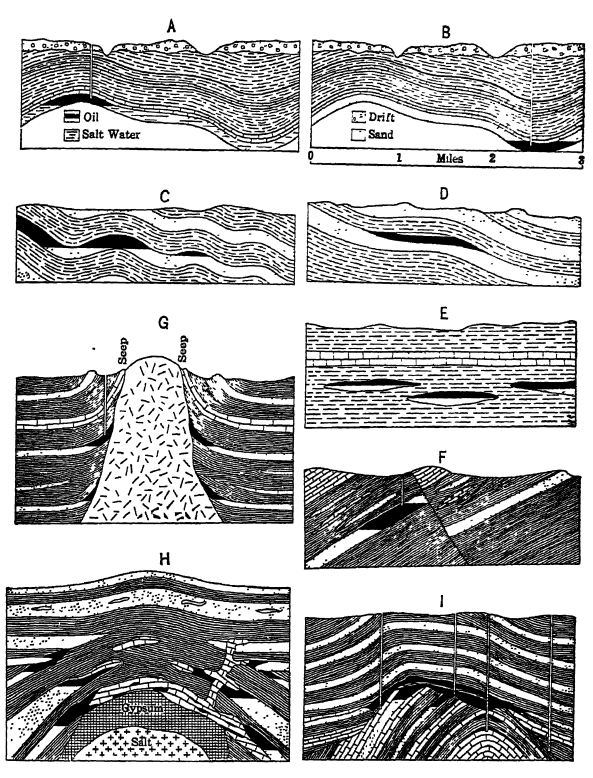
Requisites for Oil and Gas Pools. — We will now describe more or less briefly the six primary requisites for oil accumulations. These are: (1) Dark bituminous rocks, the original source of the hydrocarbons, which are the chemical end-results of organic decay in marine waters. (2) Underground water, under either hydrostatic or gaseous pressure, as the dislodger of the hydrocarbons from the carbonaceous rocks, more commonly the black shales, and as the carrier of the oil, the water being in the main rain water that has filtered deeply and more or less widely into the rocks from the rain-soaked soils. (3) An internal rock pressure, either gaseous or hydraulic, that will force water with its load of hydrocarbons into the rising geologic structures. (4) Some sort of an ascending geologic structure, like those illustrated in the diagrams on p. 259. In these structures the grain or bedding of the rocks is ascending, which leads the water that is under pressure to carry the oil to locally higher levels, where the hydrocarbons find lodgment in coarsegrained rocks. (5) A porous granular formation like a sandstone, conglomerate, crystalline or cavernous dolomite or limestone, rarely a volcanic rock. These coarse-grained rocks make the “ reservoirs ” for oil and gas, and the local accumulations are the “ oil sand,” “ oil pools,” and “ gas pools ” of the petroleum geologists. Fractured or jointed rocks also lead to oil storage. (6) An impervious rock cover to prevent the volatile hydrocarbons from escaping into the air. These coverings are in most cases very fine-grained mudstones like shales or marls, or there may be a sealing agent in the rock cover, such as the interstitial cement of water-laid rocks. More often, however, it is the thickened or solidified hydrocarbons themselves that seal the reservoirs.
[ p. 256 ]
When the rocks are devoid of water, in which case they are said to be “ dry,” the gas separates from the heavier oil and rises to hi gher levels of the rock beneath the shale cover, while the oil gravitates down the dipping slopes of the strata to lower levels and segregates in the more porous areas, where oil “ pools ” are formed (see Fig., p. 259). The oil or gas may accumulate in pay layers of rock as thin as 2 feet, or in rare cases (California) the productive stratum may be 200 feet thick. The pools in dry strata are more irregular in distribution than those in wet formations. When a large quantity has concentrated there seems to be a tendency for the pools to seal themselves at the top, and, if more and more oil and gas are added from below, the “ rock pressure ” rises above the hydraulic pressure or “ head ” produced by the water of circulation. Lower “ rock pressures ” are the rule, from 350 to 500 pounds to the square inch, but they are known up to 2000 pounds to the square inch (in newly tapped gas wells) . Hydrocarbons may also be driven to higher levels by the heat of subterranean bbdies of intrusive igneous rock, or by chemical alterations within the strata, but such fields are the exception.
The storage of oil in “ pools ” takes place in the original pores of the strata, or in induced spaces developed through solution by circulating waters. The original porosity results from the unfilled interstitial spaces between the grams or pebbles of which the rock is composed, or where a filler or cement has been subsequently dissolved out. Induced porosity results from water percolating through limestones along erosional unconformities, between bedding planes in thin-bedded formations, through the solution holes of dolomites, through the spaces between dolomite and calcite crystals developed during diagenetic changes, or in joints and tension cracks, and along fault and dike faces.
Extent of Migration. — There is little evidence indicating exactly the extent to which oil and gas have migrated through the strata. Geologists in general hold that it has not been far, that the hydrocarbons probably have not been moved more than hundreds of feet and rarely noiles in extent. Some field men, however, say that there is evidence that oil has been moved 2 or 3 miles up the flanks of rising geologic structures, and in Wyomiug even as far as 15 miles. The migration probably takes place quickly in geologic time, and apparently immediately after deformation of the strata. The oil then remains localized for coimtless ages or until another warping or folding time occurs. During the geologic past, however, all parts of the continent have been repeatedly moved.
Geologic Structure of Oil and Gas Areas. — Oil and gas are more conanonly found in the flattened tops of depressed geologic arches [ p. 257 ] and local domes and down the slopes of anticlines where the dip of the strata is arrested so as to form shelves or terraces (the “ terrace structure ” of oil experts); they occur also in sandstone lenses, in the upturned strata of faulted formations, along dikes of igneous rocks penetrating sediments, and on the peneplained surfaces of arches covered by younger formations.
The anticlinal theory was first suggested by T. S. Hunt (1863) and E. B. Andrews (1865), and put into good working order by 1. C. White (1885). This theory as originally stated by White is as follows: All of the great gas wells of Pennsylvania and West Virginia are situated either directly on or near the crown of an anticlinal axis, while wells bored in the sjnclines on either side fui> nigh little or no gas, but in many cases large quantities of salt water. The gas wells are confined to a narrow belt, only one fourth to one mile wide, along the crests of the anticlinal folds. They are therefore connected unmistakably with the disturbance in the rocks caused by the upheaval into arches. It does not follow, however, that all arches have gas or oil, since pools of these materials axe dependent on the presence of thick porous sandstones or extensively fissured fine-grained rock, to act as reservoirs; and these storage rocks must nnderKe the surface at a depth of at least several hundred feet. In Paleozoic fonnations the arches must be of the depressed type and outside of mountain tracts, smee in the areas of the ancient mountains the gases and the oil have long smce escaped from the folded strata into the air and their residues dried up. In the moimtains of late Mesozoic and Cenozoic time, however, much oil and gas remain. Finally, the areas of commercial pools must have fonnations close at hand of bituminous shale, since it is from these depoats in the main that the hydrocarbons have migrated.
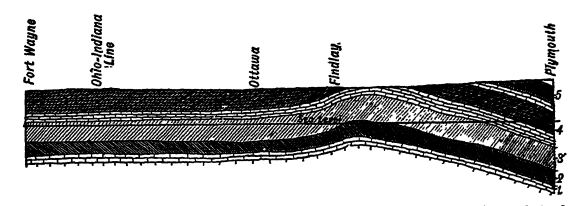
Water, the Migrating Agent. — Moving water is the essential agent of migration. This migration takes place either (1) through the migratory action of water driven by hydraullc pressure; (2) through the capillary powers of water and oil in coarse- and fine [ p. 258 ] grained rocks; or (3) through the specific gravity of oil and water, whereby these come to be locally segregated. In dry rocks gas will rise into the higher places, while oil will sink into the lower ones or into synclines, because of the difference in their specific gravities. All strata during their deposition are full of water, and thro ugh their subsequent consolidation and compression more or less of the water is squeezed out and upward. In its movement, it carries some oil with it, and this becomes lodged in the greater pore space of the porous rocks. Under the conditions of compression, cementation, and iacreasing heat, these factors probably combine to cause further upward movement of the oil and water. The general effect of this migration is to increase the percentage of oil in the sandstones at the expense of the shale, and to drive out from the strata a greater ratio of water than oil, which further increases the percentage of oil to water in the sandstones, yet probably leaves a large amount of oil in the shales (Munn).
“ The fundamental idea of the hydraulic theory is that moving water under either hydraulic or capillary pressure has been the direct agent of accumulation of oil and gas pools. To this idea may be added another of equal value — the pools of oil and gas are held in place by water under hydraulic and capillary pressure which effectively seals up all the pores of the surrounding rock and prevents the dissipation of pressure by diffusion ” (Munn).
Oil Shales. — There is a great deal of anxiety at present because of the fact that the oil territories are being rapidly exhausted. It is said that during the past sixty years the United States has used up 40 per cent of its available petroleum reserves. This may or may not be so. Such rapid exhaustion of the petroleum leads most geologists to the belief that when all is used up, and it will be with present denaands about twenty years hence, there -will be no gasoline, illuminating, or lubricating oils. There need be no immediate fear of this, however, because when the present oil fields are used up, the nations can still have as much petroleum as they care for, but of course at enhanced prices, since there is an inexhaustible amount of petroleum available in the black bituminous shales, the pyroshales (burning shales), and the cannel coals or torbanites. The United States and Canada are especially rich in such resources. The Paleozoic formations of the Mississippi valley, the Cretaceous of western Canada, and especially the wide-spread Eocene (Green Biver) shales of Utah, Wyoming, Colorado, and Nevada, aboimd in these petroliferous rocks. Out of them can be produced petroleum, heating and illu min ating gas, and ammonium sulphate as a fertilizer. It is said that the black shales about Louisville, Kentucky, [ p. 259 ] [ p. 260 ] have in them something like 7,000,000 barrels of oil to each square mile of shale. The problem at present is how most economically to get the oil out of the shales.
¶ Collateral Reading
L. V. Dalton, On the Origin of Petroleum. Economic Geology, VoL 4, 1909, pp. 603-631.
H. V. Dodd, Some Preliminary Experiments on Migration of Oil up Low Angle Dips. Ibid., Vol. 17, 1922, pp. 274-291.
W. H. Emmons, Geology of Petroleum. New York (McGraw-Hill), 1921. Dorsey Hager, Practical Oil Geology. New York (McGraw-Hill), 1919.
R. H. Johnson and L. G. Huntley, Principles of Oil and Gas Production, New York (Wiley), 1916.
M. J. Munn, The Anticlinal and Hydraulic Theories of Oil and Gas Accumulation. Economic Geology, Vol. 4, 1909, pp. 509-529.
J. S. Newberry, The First Oil Well. Harper’s Magazine, October, 1880.
J. L. Rich, Moving Underground Water as a Primary Cause of the Migration and Accumulation of Oil and Gas. Economic Geology, Vol. 16, 1921, pp. 347-371.
G. O. Smith, Where the World Gets its Oil. National Geographic Magazine, Vol. 37, 1920, pp. 181-202. Also see World Atlas of Commercial Geology. U. S. Geological Survey, 1921.
R. Theessen, Origin and Composition of Certain Oil Shales. Economic Geology, Vol. 16, 1921, pp. 289-300.
A. B. Thompson, Oil Field Development and Petroleum Mining. London (Lockwood), 1916.
I. C. White, Important Epochs in the History of Petroleum and Natural Gas.
Bulletin of the Geological Society of America, Vol. 32, 1921, pp. 171-186. Victor Ziegler, Popular Oil Geology. New York (Wiley), 1920.
| XIX. Champlainian Time and the Reign of Invertebrate Animals. . | Title page | XXI. Silurian Time and the First Air-breathing Animals |