| XXI. Silurian Time and the First Air-breathing Animals | Title page | XXIII. The Rise of Fishes and the Prophecy of Vertebrate Dominance |
[ p. 282 ]
General Description. — In the present shallow seas and oceans, and more especially in the warm-water ones, there is a great variety of radially symmetrical animals, with or without external skeletons of homy or calcareous materials. These flower-like animals are the corals and anemones, technically known as the Caelenterata, the name implying that they are sac-like, having but one internal cavity which serves both as a body cavity (coeloma, characteristic of all higher animals) and as a digestive sac (enteron). This simple body structure, comparable to a double-walled sac, has the mouth end frayed out into tentacles, while the other end is attached to foreign objects on the sea bottom.
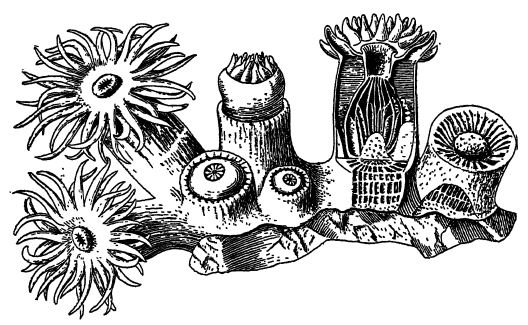
The coelenterates are, as a rule, very simple animals in which appear the beginnings of definite organs. In their variety they seem nearly [ p. 283 ] to exhaust the possibilities of radial symmetry, and many are very flower-like. They have therefore also been called zoophytes (plantanimals), and their budded colonies afford interesting illustrations of cooperation and division of labor.
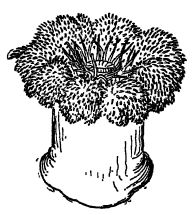
Some, like the anemones, do not secrete a skeleton, but a great many other kinds do, and all such are commonly spoken of as stony corals, but all coral-like calcareous skeletons are by no means the work of true corals.
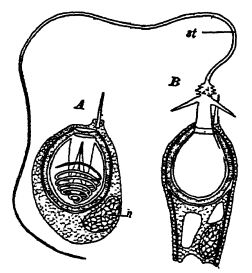
The coelenterates sting to death the larger animals on which they feed. This stinging is done by a multitude of very minute threads, each one of which is shot out of a cell buried in the skin and enters any soft body that comes into contact with the animals (Fig., opposite).
Into the mouth is passed the food, which is digested in a more or less simply constructed cavity of the sac, and through the same opening is ejected any indigestible remainder. They feed, as a rule, on the smaller animals, but when the individuals, or polyps, as they are called, are minute, their food consists of microscopic animals or plants.
¶ Anthozoa
There are many types of coelenterates, but in this chapter we are concerned only with the more complicated ones, the rockmaking Anthozoa (means flower-animal). These are the stony corals and many of them are reef and rock makers. The animals that build the stony reefs are usually very small (under one fourth of an inch), though some kinds attain* a diameter of an inch or more. The colonial skeletons may be of any size up to 15 feet across and in height.
The internal cavity has hanging down in it a rudimentary, tubular, digestive gullet, opening upward into an elongated mouth and below into the true digestive cavity or codenteron (see Fig., p. 282). The [ p. 284 ] wall of the latter has a number of longitudinal folds or ingrowths of the body wall projecting more or less deeply into the cavity. When one of these polyps is cut transversely the folds or partitions are seen as radii, for which reason they are also known as ray animals (Fig., p. 282). When a hard supporting skeleton or stony part, known as the corallum, is present, as is most often the case, it is usually made of calciiun carbonate (see Pt. I, p. 182), is nearly always secreted by the outer layer of the soft body, and has its exact form. Therefore the skeletons of corals have a radiate or partitioned structure, and it is only this lime skeleton which is preserved in the fossils (see Fig., below). The polyps either live singly and are then cylindrical or conical in shape (the cup corals), or more commonly form colonies by the budding of closely adjoining individuals.
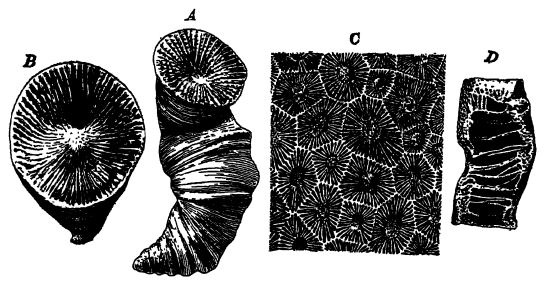
The Coral Skeleton. — Cup corals, which are the calcareous bases of single polyps, are of very frequent occurrence in Paleozoic rocks. They multiply by sexual reproduction and not by budding, as is the case in colonial forms. Cup corals are usually conical and more or less curved, with variably deep cups divided into many shallow compartments by radially arranged partitions called septa (see Fig., above). These septa originate in the outer wall and are of variable length, the several lengths being disposed in a regular manner; only a part of them, the primary septa as a rule, meet in the center, where they often form a simple or twisted column, the columella. The colonial corals have about the same general [ p. 285 ] structure as the single polyps, but when closely crowded the corallites take on a prismatic form (see Fig., p. 284). They may also bo circular in outline and then the spaces between the individuals are filled with a loose structure.
The types of coral structure most often seen fossil are the following:
Tabulata or tabulate corals (tabula means table and has reference to the many transverse partitions found in the tubes). — These primitive but specialized Paleozoic corals always grow in colonial form and never as single indhiduals, hence among the Tabulata there are no cup corals. As a rule, the individual poh-ps are small or even minute transversely, but longitudinally they build more or less long tubes that are abundantly partitioned by tabulse and perforated by pores as the animals grow upward (see Fig., above). The polyps may be loose in growth when the individual corallites are roimd or oval in outline, but more often the tubes are tightly appressed to one another and the corallites uniformly prismatic. There are no radial septa and when such appear to be present they are seen to be a series of short spines arranged in longitudinal rows (incipient septa, as it were), or the spines may be irregularly disposed. The Tabulata are therefore Paleozoic corals without true septa, and are thereby readily distinguished from their associates, the Tetracoralla. The walls of the corallites are thin and perforated by large pores, the mural or wall pores (see Fig. B, above), which represent failures at budding for the reason that almost no space is present for the vast majority of the possible buds to grow into individuals.
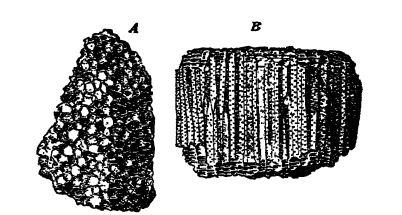
The tabulate corals appeared in the Middle Champlainian and had their greatest development in the Silurian and Devonian. The [ p. 286 ] chain coral (Halysites, Pl., p. 270, Fig. 1) was characteristic of the Silurian and Champlainian, while the honeycomb corals (Favosites, Fig., p. 285) were great reef makers in the Silurian and Devonian, where some of the colonies had a diameter of 4 feet. The organpipelike coral (Syringopora, Pl., p. 320, Fig. 8) was common throughout the Silurian and most of later Paleozoic time.
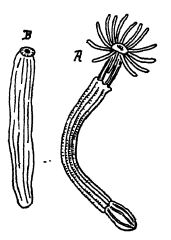
Tetracoralla or tetracorals (corals with the septa arranged in four quadrants or bimdles). — Throughout the Paleozoic from Middle Champlainian time, and more especially beginning with the Silurian, the tetracorals are common fossils (see Figs., p. 284, and 4-7, p. 320) . They occur as single corallites, the cup corals, or in compound colonies. Cup corals were very common in the Middle Paleozoic and were more numerous, in greater variety, and of larger size (up to 2 feet long) than those of subsequent times. Compound tetracorals were also abundant, and, with the cup corals, were of wide distribution, being especially common as reef makers in the Silmian and Devonian. They were rare in the Pennsylvanian and passed out of existence with the Permian.
In the cup tetracorals the bundling of the septa is usually readily seen, and with their smooth or somewhat wrinkled exterior covering (epitheca) extending from the base to the edge of the cup, they are easily distinguished from other kinds. The compound tetracorals are usually not so easily separated from the Hexacoralla (six-rayed corals), because the tetramerism or division into four parts is much or wholly obscured, but, as a rule, it is seen that the polyps are larger while the radial septa are more numerous or at least thinner, straighter, and simpler. Some of these compound tetracorals attain the size of modern colonies and have been seen as large as 12 feet across.
The most primitive zoantharian in the seas of the present is Edwardsia, and the living Hexacoralla are known to pass through an Edwardsia-like stage in their ontogeny. Edwardsia is a soft-bodied animal, i. e., devoid of a skeleton, and lives in the colder waters. In the Middle Cambrian near Field, British Columbia, Walcott has found a fossil very like Edwardsia, and also without a calcareous skeleton. This he has nWed Mackenzia costalis, regarding it, however, as a holothurian. Raymond suggests that Mackenzia may be closely [ p. 287 ] related to Edwardsia, and that similar forms may have given rise in the Champlainian to the lime-secreting Tetracoralla, and later in the Triassic to the stony corals, or Hexacoralla. ( See Fig., p. 256.)
Hexacoralla or hexacorals were the common kinds after Paleozoic time and are the main reef builders of the present oceans. The name has reference to the fact that the young polyps start with six primarj’ septa and all subsequent cycles of partitions are regularly introduced between the pretious ones. There is, therefore, a regular radial arrangement of the septa and they are never bundled into quadrants as in the Tetracoralla, and the single polyps are also not so decidedly cup- or funnel-shaped. In the compound forms the animals are apt to be small, often very small, as in the staghorn corals, while the corallites are not, as a rule, so distinctly walled from one another as are the older corals. The walls often also appear to be thick, and in many forms the individuals are compressed and seem to merge irregularly into one another, suggesting the convolutions of a mammal brain, hence the name brain-corals, which is sometimes applied to them. See Pt. I, p. 183.
Habitats of Living Corals. — Hexacorals live in all oceans from sea-level down to 11,000 feet, but are particularh’ common in clear tropical waters and in depths of less than 240 feet. In the deeper, darker, and colder waters the single polyps predominate, while on the reefs where the sunlight is strong the compound corals are most prolific. There are five times as many kinds of hexacorals in waters not over 150 feet deep as there are between this depth and 240 feet, the maximum depth to which any reef species extends. Between 600 and 2400 feet there is another coral zone, usually of sTnall single polyps or of delicate, branching, compound forms. Beyond the latter depth corals are few in number and variety and those that do exist are small and extremely fragile. Off the eastern coast of North America between Cape Hatteras and Newfoundland there are living fourteen species of corals, several of which go below 6000 feet (Verrill). Hemispheric corals are known to attain 15 feet in diameter, while staghorn colonies are reported growing to heights of 15 feet.
In regard to the temperature, strictly reef-building corals flourish only between 68° and 78° F., but will continue to live even at 85° F. The deeper coral zone has a far lower temperatmre, one between 40° and 50° F., and the deep-sea species may live in water as cold as 32° F. In other words, corals may live at any depth of sea water, but reef-maMng corals live only in warm and shallow waters.
[ p. 288 ]
Probably there are more coral reefs to-day than at most times in the history of the earth, even if they are now all restricted to the warmer oceans. It is estimated that about one twentieth of the shelf seas (500,000 square miles) are at present covered with coral reefs. This excess seems to be due to the recent rising of the oceanic level in consequence of the increased water resulting from the melting of the polar ice caps. Through the elevating of the oceanic level the lower areas of the reef corals become more favorable and enlarged habitats. In regard to the nature of coral reefs and their places of growth, see pages 182-190 of Pt. I. For fossil coral reefs, see the Silurian and Devonian chapters.
¶ Collateral Reading
J. D. Dana, Corals and Coral Islands. 1872.
W. Saville-Kent, The Great Barrier Reef of Australia. 1893.
T. W. Vaughan, Some Shoal-water Corals from Murray Island (Australia), Coeos-Keeling Islands, and Fanning Island. Papers from the Department of Marine Biology, Carnegie Institution of Washington, Vol. 9, 1918, pp. 51-210. (See for fine photographs of living corals and for list of other papers on corals by the same author.)
Paleozoic Corals:
W. J. Davis, Kentucky Fossil Corals. Kentucky Geological Survey, 1876. James Hall, Devonian Fossils, Corals. New York Geological Survey, 1876. Also in Paleontology of New York, Vol. 6, 1887.
P. E. Raymond, The History of Corals and the Limeless Oceans. American Journal of Science, 5th series, VoL 2, 1921, pp. 343-347.
Cabl Romingeb, Fossil Corals. Michigan Geological Survey, Vol 3, 1876.
| XXI. Silurian Time and the First Air-breathing Animals | Title page | XXIII. The Rise of Fishes and the Prophecy of Vertebrate Dominance |