| XXIII. The Rise of Fishes and the Prophecy of Vertebrate Dominance | Title page | XXV. The Mississippian Period and the Climax of Crinids and Ancient Sharks |
[ p. 306 ]
History of the Term Devonian. — Previous to 1833 the geologic column was not determined beneath the “ Carboniferous ” the time of the world’s greatest coal making. In westem Europe, however, it was soon noted that above the coal-bearing strata there lay a great mass of red sandstones and marls, and that beneath the Carboniferous in Scotland occurred a similar series. Because geologists had not yet recognized the importance of designating tjTje areas of strata by the name of the locality in which they occur, these two dmsions came to be known simply as the New Red sandstone (upper series) and the Old Red sandstone (lower series), with the Carboniferous between them. The Old Red sandstone to this day has failed to jdeld undoubted marine fossils, and since the geologic column is essentially based on a marine faunal sequence, this lower series did not bear in itself the evidence for correlating it with marine beds. However, not far away from the Old Red area of Scotland, in Devonshire, southwestern England, there had been collected a number of fossil corals; these were placed in the hands of Lonsdale, and he, in 1837, expressed the opinion that they were intermediate in character between those of the Silurian and the Carboniferous, and, further, that the limestones of Devonshire were of the age of the Old Red sandstone.
This important information was imparted in the same year to both Murchison and Sedgwick, geologists to whom we owe, as has been said in earlier chapters, the first determination of the actual sequence of the Paleozoic strata beneath the Carboniferous. In 1839 these two workers concluded that certain of the marine strata of Devonshire were in all probability the equivalent of the Old Red, and that they occupied a stratigraphic position between the Silurian and the Carboniferous, so, fearing that the New York state geologists would soon propose a period name for equivalent formations, they hastened their work, and in the same year defined the period term Devonian. In the type area in southwestern England to this day the base of these rocks is not to be seen, and [ p. 307 ] a worse region for the erection of a period term could hardly have been selected. The Devonian here was seen eventually to consist of an immense series, 10,000 to 12,000 feet thick, of graywacke, slate, and limestone, with intercalated eruptives aud beds of tuffs. All these are decidedly folded and very much faulted, so that the stratigraphic sequence could only be made out on the basis of the equivalent strata of the continent of Europe. Tliis iniierent difficulty was soon recognized by Sedgwick and Murchison, and they crossed the channel and began work in the Rhine valley of Germany, where there is one of the best known developments of Devonian faunas. Their results on this area were published in 1842, but although nearly all the strata studied by them are now recognized as Devonian, at that time they referred most of the rocks to the Cambrian and Silurian. In practice, all Devonian correlations are still made with the Rhine area, although the period name is based on the sequence in Devonshire. If our English cousins had waited until 1842, this period would now be called Erian, and the state of New York would be the type area, than which there could have been no better, even in Germany.
Significant Things about the Devonian Period. — There is no more significant or picturesque period in the hlstoiy of the earth than the Devonian. This is the time when the former nakedness of the lands becomes clothed with a deeper verdure and the first forests appear, providing the needed homes and food for the invasion of the continents by the ever-hungry descendants of the denizens of the sea. The conquest is first attained by the invertebrates — the scorpions, shellfish, worms, and thousand-legs.
The invasion of the land is fairly under way in the Devonian, chiefly in the rivers and lakes, but due to the wide-spread arid climates a fierce struggle is instituted among the inhabitants of the then temporary waters, resulting in the dominance" of the better equipped air-breathing fishes, an issue prophetic of vertebrate ascendency, hereafter never to be questioned in its onward sweep to its culmination in man.
A striking feature of the southern Devonian epeiric seas is their shrinkage along with the closure of the entrance of the Gulf of Mexico during late Middle and all of Upper Devonian times, This withdrawal can not, however, mean a high uplift of southern Appalachis, since in these southern (now cul-de-sac) seas the deposits are thin and nearly always of black muds almost devoid of life; besides, the seas reenter here in the following period.
[ p. 308 ]
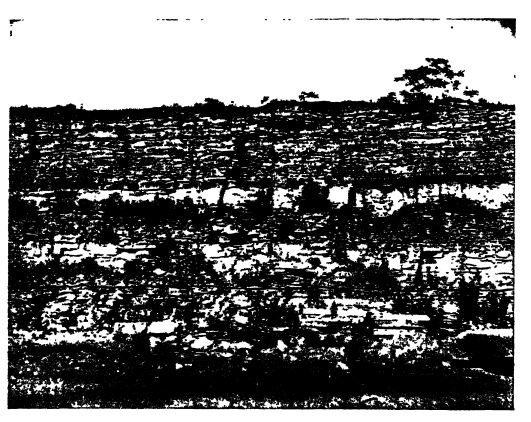
The strata making up the Devonian system in North America have a very wide distribution, especially those of the Middle Devonian, the Lower Devonian rocks being largely restricted to the Appalachic and Cordilleric geosynclines (see Pl., p. 313). Because of this distribution, the Devonian strata of the interior of the continent are, by their faunal content, readily distinguished in the field from the Silurian, but their separation from the Carboniferous above in the Mississippi valley is not so easy. In this interior region the strata are all conformable upon one another, and the disconformities separating the systems can, as a rule, be determined only by the aid of the faimas (see Fig., above). In the Ohio and Mississippi valleys also the Devonian often terminates in a black shale series and the Mississippian system as often begins with a very similar formation (see Fig., p. 183). Almost nowhere are there angular unconformities between them.
The Devonian system in New York is the best known and is therefore the standard for reference in correlation in North America. It is divided as follows:
TABLE OF NEW YORK DEVONIAN FORMATIONS
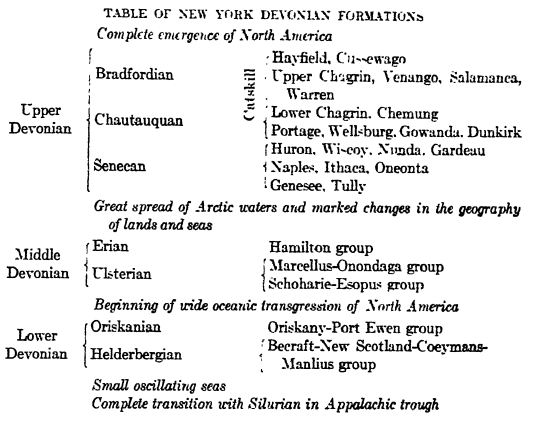
¶ American Devonian
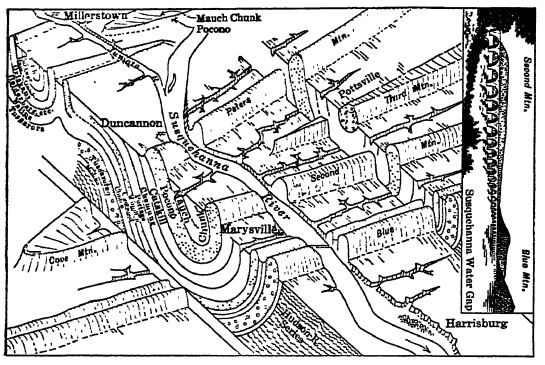
Appalachian Area. — The longest sequence and the thickest series of Devonian deposits occur in the northern Appalachian area, where most of the materials are shales and fine-grained sandstones. The Catskills on the west side of the Hudson River are the most imposing single Devonian pile in the United States. The greatest thickness is in Pennsylvania, where the Susquehanna River has cut through the Appalachian Mountains (Fig., p. 310); here the Pennsylvania Geological Survey has determined a maximum depth of nearly 13,000 feet of Devonian shales and sandstones, becoming increasingly coarser, redder, less marine, and more rapid in accumulation with the progress of time, that is, toward the top.
To make more evident what is represented in Pennsylvania, some of the details of the section should be given. In this great series there are from 260 to 425 (Helderbergiaii 50-100, Oriskanian 210-325) feet of Lower Devonian limestone and arenaceous sandstone. The Middle Devonian starts with the widely spread Onondaga hitiestone, which has a depth of 0 to 250 feet. Then begins the great detrital series of muds and sands, as follows: Hamilton, 1400 to 2500 feet; Portage, 1100 to 1400 feet; Chemung, 2200 to 4600 feet; and Catskill, 2500 to 3700 feet. In other woros, the Lower Devonian has 260 to 425 feet, the Middle Devonian 1400 to 2750 feet, and the Upper Devonian 5800 to 9700 feet, with most of it red shales and coarse sandstones and conglomerates. The thicknesses in Marydand are: Lower Devonian, 340 to 767 feet; Middle Devonian, 600 to 1650 feet; Upper Devonian, 4600 to 8550 feet.
[ p. 310 ]
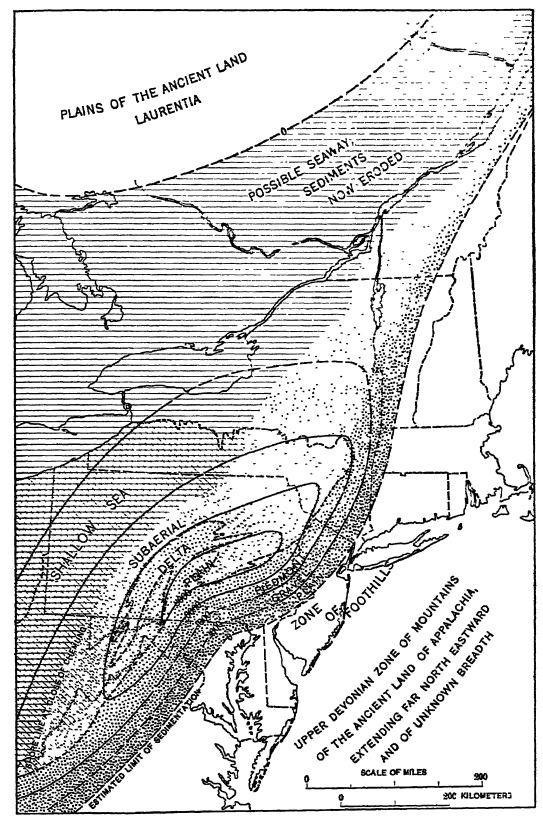
Appalachian Delta. — Along with the greater rapidity of accumulation the marine faunas become increasingly scarcer upward in the section, and the sediments change in character to red beds, most of which are of fresh-water origin, marked by ripples, suncracks, and rain imprints, and have land plants and fresh-water fishes. Pennsvlvania was the central area of a great delta formed at the mouth of the large rivers that flowed out of the highlands to the east and northeast, in which latter region there was mountain making and volcanic activity throughout much of the time of the delta accumulation. From this central and rapidly subsiding delta, the deposits thin rapidly to the north west, and south (see map, p. 311 ).
Devonian Sediments of the Interior. — In the region of the Cincinnati uplift and throughout the Mississippi valley the essentially calcareous deposits, mainly Middle Devonian time, are very thin when compared with those of the Appalachian region. At Louisville, Kentucky, there is about 60 feet of Middle Devonian [ p. 311 ] [ p. 312 ] limestone, and 100 feet of Upper Devonian shales, and from here northward, lboth to the cast and west, the sections thicken and introduce more shale, so that in western Ontario there is a depth of about 600 feet, much of which is shale. To the northwest, about Alpena, Michigan, the Middle and Upper Devonian sediments are still thicker, and there are here the greatest accumulations in the medial portion of North America.
In the southern Missisippi valley ani in Oklahoma the Devonian sections are thin, and mo-t of the deposits are of Lower and early MiddIe Devonian time. Probably no single section exceeds 250 feet.
Devonian Sediments of the Western and Arctic Regions. — In the Cordilleric sea the Devonian sediments were essentially limestones, and while the sections within the United States are usually less than 300 feet thick, yet in the Eureka district of Nevada there are from 4000 to 6000 feet of Devonian limestones and calcareous shales. The latter strata seem to represent an unbroken series from the beginning ahnost to the close of the Devonian period. In Manitoba there are about 400 feet of dolomites, limestones, and shales, and in the Mackenzie valley nearly 900 feet, of which about one half is limestone. From here northward the sections seem to thicken. In southeastern Alaska there are at least 600 feet of limestone. There is another area of sedimentary accumulation in the EUesmere-Parry Island area, where Per Schei has published a Siluro-Devonian section with a thickness of 8000 feet, most of which consists of coarse Devonian detritals.
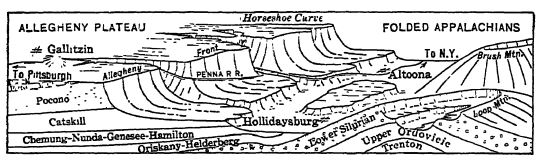
Devonian Localities. — The Devonian strata may be seen to good advantage in the Catskill Mountains of eastern Xew York, and for 25 miles west of Buffalo along the shore of Lake Erie in the western end of the same state (see Fig., p. 308). About Cumberland, Maryland, almost the entire Xew York sequence is repeated. Cleveland, Ohio, stands on Upper Devonian, and Sandusky and Columbus, also in that state, on Middle Devonian deposits. Louisville, Kentucky, is famous for its Middle Devonian coral reef. Milwaukee, Wisconsin, and Davenport, Iowa, are good places for fossils of this period. In NIichigan, at the summer resort Petoskey, and more especially at Alpena, and in western Ontario about Thedford may be found especially fine Middle Devonian organisms.
[ p. 313 ]
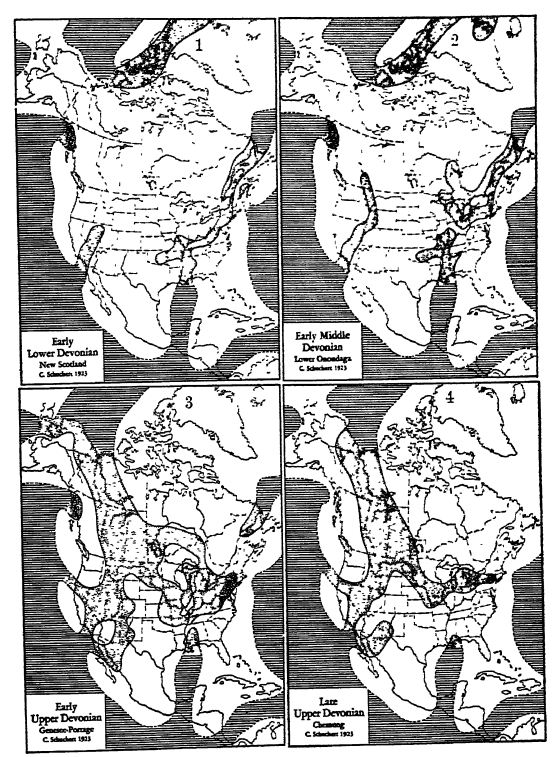
Epeiric seas dotted; oceans ruled. See Plate 19 (p. 317) for late Middle Devonian physiography.
In Devonian time there was but one slowly developmg flood, coming from the Artic Ocean with Euro-Asiatic faunas and attaining maximum spread as depicted in Plate 19 and Map 3 of this plate, with slow recession in Map 4. Note in Map 3 the vast Appalachian delta and the much smaller one of Gaspé,, Quebec, also the final absence of seas in the southeastern states.
[ p. 314 ]
Another fine Devonian section occurs at Gaspe on the end of the peninsula bordering the St. Lawrence River on the south, where the basal 2000 feet of limestone, of Lower Devonian time, are followed by 7000 feet of Middle and Upper Devonian sandstones. These are the deposits of another large delta. Elsewhere in the Maritime Provinces of Canada and in the New England States, the Devonian is poorly represented, and when present usually consists of continental deposits.
Submergences of the Continent. — At the beginning of Devonian time almost all of North America had emerged, and at no time during the Lower Devonian was more than 10 per cent of the continent covered with marine waters (see Pl., p. 313). These Devonian seas were long and narrow in the Appalachic, St. Lawrencic, and Cordilleric geosynclines, and the waters of the Appalachic trough appear to have been oscillatory and unstable in areal extent.
Late in Oriskanian time the submergence became markedly positive, and attained its maximmn flood in the late Middle Devonian (Hamilton), when at least 38 per cent of North America was covered by the sea (see Pl., p. 317). The waters were warm, for they brought from the Gulf of Mexico and the North Atlantic many coral species which built extensive reefs seen in many places in the limestone deposits. Later there was also an Arctic invasion through the Cordilleric sea, and it likewise brought an abundance of corals, this being particularly true for Alaska and the Mackenzie valley.
Probable Cause of Submergences. — The great Middle Devonian flood was also common to Europe, Asia, South America, and Australia, the strata in New South Wales alone having’a thickness of 10,000 feet. It was one of the greatest of continental inundations, exceeded later only bj’ the great flood of Cretaceous time. Such a flooding of the lands could not have been wholly due to the unloading of the eroded land materials into the oceans, for it was of too great an areal extent. Previously, however, when discussing the Caledonian Disturbance of Silurian time, it was stated that Laurentis and Baltis were welded into one continent by that movement, and it is probable that the shallow pre-Devonian sea Ijdng between Britain, Norway, and Greenland was also destroyed at that time. It is true that this elevation began toward the cl(se of the Silurian, but that it continued into Devonian time is attested by the marked and long-enduring volcanic activity in Acadis and western Europe. Not only this, but the extremely thick deposits of the Old Red, to be described later, were accumulated [ p. 315 ] in mountain valleys during and immediately after this upheaval, and are further evidence to the same end. Therefore, the displacing of the Norwegian sea by an extensive land area, combined with the unloading of the mountains into the oceans, appears to have caused the general water level to rise everywhere and thus to have brought about the marked inundation of the continents in Devonian time.

Emergence of the Continent. — During the Upper Devonian the seas were gradually withdrawn, first in the southern Mississippi valley and finally throughout the interior of the continent and the Cordilleran area. If there was any water left on the land, geologists have as yet failed to discern its transition strata between the Devonian and the Mississippian. Thus nature delimited another geologic period in the history of the earth, and at the close of the Devonian nearly all of North America was again emergent.
The Great Northern Transverse Continent Eris. — We have seen that the Caledonian Distmbance resulted in the making of mountains that extended throughout northwestern Europe, It was then that Laurentis (Canadian Shield Greenland) was welded upon Baltis (Sweden-Finland), forming the most western part of the great northern transverse land mass that extended unbroken far into Asia. Therefore, at the very beginning of Devonian time there came into existence an almost circumpolar land, whose only submerged portion lay in the North Pacific, and which was formed by the union of Laurentis, Baltis, and Angaris (see Fig., p. 431). The great Canadian geologist, Sir William Dawson, of McGill University, labored long to make known the plant life of the Devonian, and since he termed it the Brian flora after the Brian rocks in which it is entombed, taking the name from Lake Erie and the Erie division of the New York state geologists, Suess in 1909 gave the continent the name of Eria (here [ p. 316 ] changed to Eris), It is the ancestral continent of the modern Holarctic region of the zoologists.
Acadian Disturbance. — The Acadian land, throughout the New England States and the Maritime Provinces of Canada, began to be moved, that is, elevated and folded, in Middle Devonian time, and the sea was finally completely in retreat throughout the entire area, destroying forever the seaways that formerly connected the Central Interior sea with the St. Lawrencic trough. This mountainmaking movement, first described by Dawson, was in 1895 named by H. S. Williams the Acadian Revolution; the movement continued to the end of Devonian time, since even the Upper Devonian strata of continental character are folded. Throughout the Devonian, and especially in the Upper Devonian, volcanic activity occurred here on a large scale, many of the lavas and intruded granites being preserved in the ilaritime Provinces. The volcanic cones are now eroded away, and what is left are the deeper seated volcanic necks, seen to-day in Mt. Royal, back of McGill University, Montreal, and in the Monteregian hills farther east. Far greater intruded masses are to be seen, however, in many places throughout New Brunswick and southern Quebec, and there are great granitic bathyliths at St. George and in the Little Megantic Mountains. Possibly also the crystalline rocks of the White Mountains of New Hampshire, and certain others in Vermont and Maine are of Devonian origin. With this folding, the rivers of Acadis were rejuvenated, marked erosion set in, and the resulting detrital materials (muds and sands) were carried into eastern Pennsylvania and New York and piled up in places to thicknesses of 13,000 feet. In Acadis and Gaspe the deposits of later Devonian .time are of the continental or Old Red sandstone character and contain land plants and fresh-water fishes.
According to Dawson, throughout Nova Scotia, New Brunswick, and southern Quebec, the Carboniferous formations rest with marked unconformity upon the older rocks. This being so, the Acadian Disturbance is seen to be of very great import.
Disturbances in Other Continents. — In Lower Old Red times the northern half of the British Isles was the theater of igneous action on a large scale. To this time belong not only the very considerable accumulations of volcanic rocks in the midland belt of Scotland, in the Cheviots, and in County TyTone, but as well a large part at least of the “ newer granites,” etc., of Scotland, along with other granites of the English lake district, and an important suite of minor intrusions (Harker 1909).
[ p. 317 ]
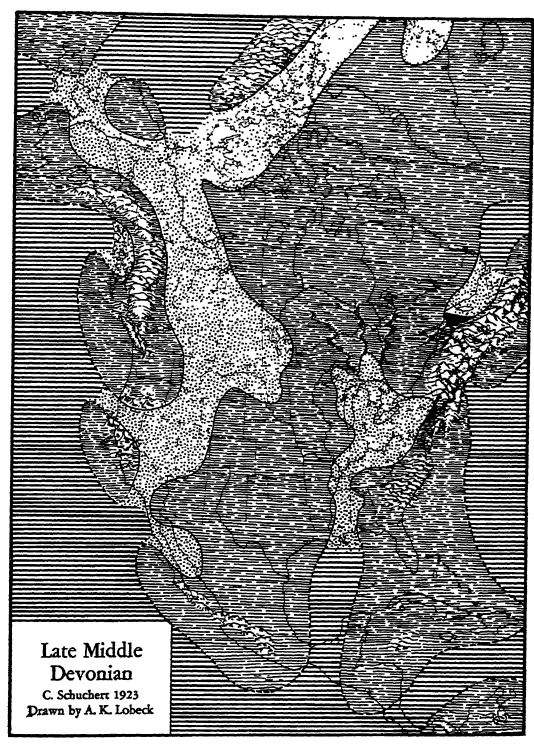
Epeiric seas dotted; oceans ruled; lands in wavy lines. See Plate 18 (p. 313) for Devonian paleogeography.
The probable geography of late Middle Devonian time, when the Acadian mountains were rising (see p. 316), from which came the main mass of sediments in the great Appalachian delta (black area) described on pages 309-312, and that of Gaspé (p. 314). The other highland areas are hypothetic, and even though the drainage is unknown, some rivers have been sketched in. Note the volcanoes in California.
The lands were clothed with vegetation and in the lowlands there were forests, with trees up to 35 feet in height (pp. 327-330).
[ p. 318 ]
In the Christiania fiord of southern Norway there is also an area of about 4000 square miles that is intruded with igneous rocks of this time.
Throughout eastern Australia in late Devonian time there occurred the most marked mountain-making period of that continent, when the Kanimbla Mountains were elevated, trending north and south, and were intruded by granitic bathyliths (Suessmilch).
¶ Marine Life of the Devonian

Provinces. — The Devonian marine life of the world is divisible into two great faunal realms: (1) the boreal, and (2) the austral. The latter is well developed in the Andean region of South America, the Falkland Islands, and South Africa. The boreal faunas are far more extensive and better imderstood, and those of North America may be arranged in three provinces. (1) In the Appalachian and Acadian areas the northern Atlantic waters dominated during the Lower Devonian and the life was in harmony with that of northern Europe (England and Rhineland); while throughout the balance of this period the faunal assemblages were those of the Central Interior sea. (2) The Central Interior sea to the west of the Cincinnati uplift, on the other hand, was dominated by life that was characteristic of this area and of Brazil, and it is sometimes referred to as the American faimal province. There was, however, a great difference between the two hemispheres, for in South America corals were practically absent. (3) The Cordilleric sea formed still another faunal province with most of its life derived from the northern Pacific or Euro-Asiatic province, and this biota was also wide-spread in the Arctic Ocean. This third province was wholly independent of the Central Interior sea until near the close of Middle Devonian time, when the two seas had communication across Iowa and Michigan. In the Upper Devonian the faunas again took on a cosmopolitan character, the Euro-Asiatic aspect dominated [ p. 319 ] most of the seas of this time, and its representatives are hence found in all three provinces.
Marine Invertebrates. — The seas after Lower Devonian time swarmed with corals, brachiopods, and shellfish, and in general the life was not very unlike that of the Silurian (see Pls., pp. 320-322). The corals were wide-spread, and are known from Louisville, Kentucky, north into Alaska. The Louisville reef is the one best known; it has a great abundance of species, with cup-corals over 24 inches long and more than 3 inches wide, and compound colonies as much as 8 feet across (see Pl., p. 320, Figs. 4-8). There were also many bryozoans. Of the echinoderm type of animals, the blastids were now common and may have originated in America (see Pl., p. 320, Figs. 1-3). Starfishes were also at times abundant. Trilobites were still common, but greatly reduced in variety, there being about twenty genera and over one hundred species (see Fig., above, and Pl., p. 322, Figs. 7-12). The Devonian deposits are often full of brachiopods, of which there were no fewer than seven hundred different kinds in North America [ p. 320 ] [ p. 321 ] [ p. 322 ] [ p. 323 ] (see Pl., p. 321), this being the time of their maximiim development and differentiation. The most characteristic were the spirebearing forms.
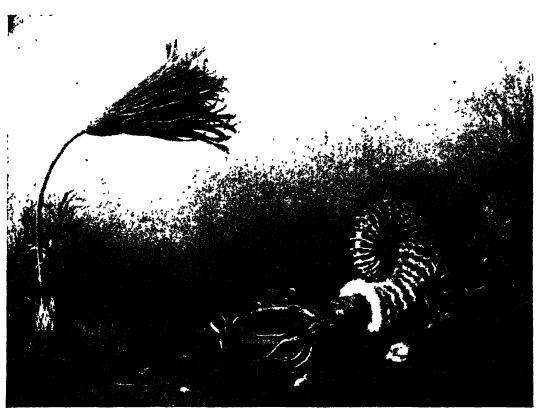
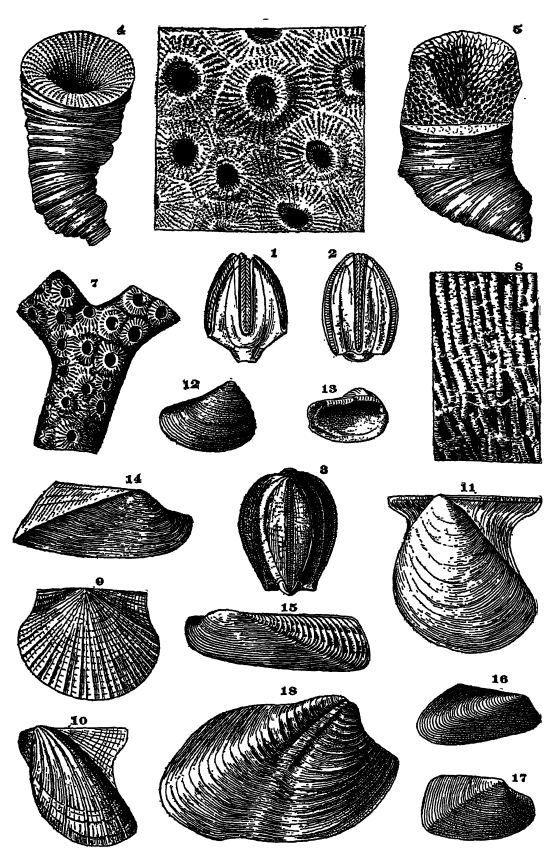
Fig. 1, Pentremitidea filosa, x 2; 2, Granatocrinus leda; 3, Elaeacrinus verneuili; 4, Heliophyllum halli; 5, Cystiphyllum vesiculosum; 6, Phillipsastraea gigas; 7, Thamnoptychia limbata; 8, Syringopora perelegans; 9, Aviculopccten ornatus, x ⅔ 10, Pterinea flabellum, x ½, Actinodesma erectum, x ⅔, 13, Nucula randalli; 14, Goniophora carinata, x ⅔; 15, Orthonota undulata, x ⅔; 16, Modiomorpha concentrica, x ½; 17, Cypricardella bellistriata; 18, Grammysia bisulcaia.
From Paleontology of New York, and Geological Survey of Canada.
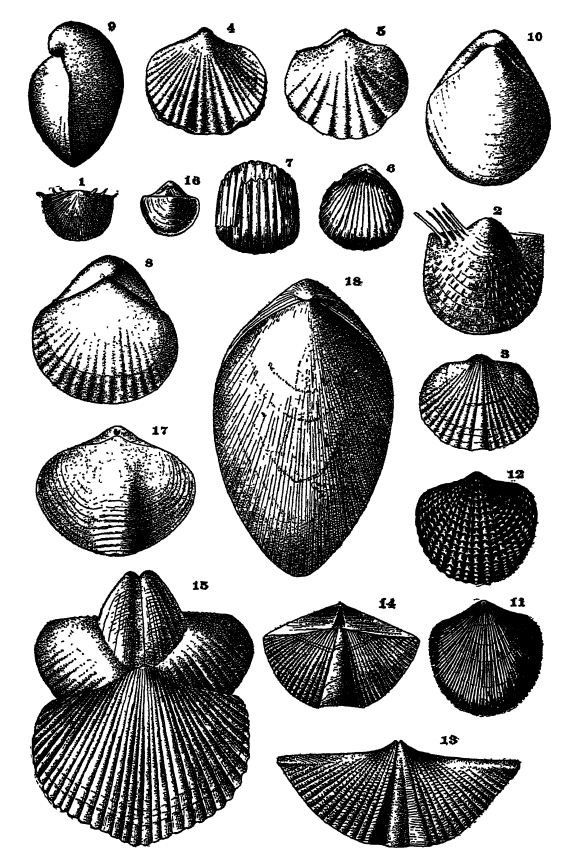
Fig. 1, Chonetes setigenis; 2, Productella hirsuta (Upper Devonian) ; 3, Tropidoleptus carinatvLs; 4, 5, Eatonia medidlis; 6 , 7, CamarotcBchia ventricosa; 8 , 9, Gypidula coeymansensis; 10, Meristella Usvis; 11, Atrypa reticularis; 12, A. spinosa; 13, Spirifer pennatus (mucronaius); 14, Spirifer medidlis; 15, interior cast and exterior of ventral valve of Spirifer arenosus; 16, Ambocodia umbonata, x 2; 17, AtAyris spiriferoides; 18, RenssellBtia ovoides. From Paleontology of New York.
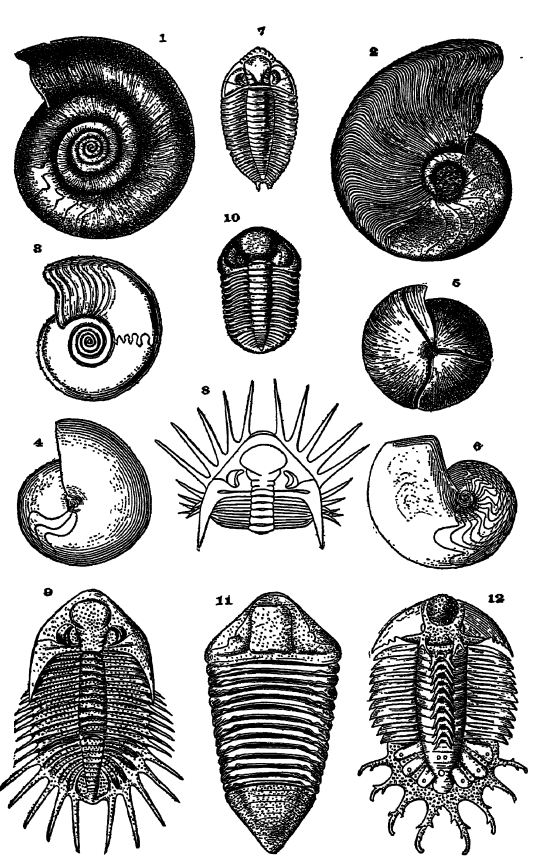
Fig. 1, Oxyclymenia undulata (Europe); 2, Aphyllites vanuxemi, x ⅓; 3, Prolecanites lumdicosta (Europe), x 4, Tomoceras simplex (Europe); 5, Brancoceraa sulcatum (Europe); 6, Manticoceras oxy, xi; 7, Odontocephalus selenurus, x i; 8, 9, rolled-up Cryphceus punctatus, and same extended (Europe) ; 10, Phacops bufo; 11, Dipleura dehayi, x 4; 12, Terataspis grandis, x A.
Figs. 1-6, 9, 11 from Gurich’s Leitfossilien; Fig. 8 after Richter; Figs. 6, 7, 10, 12 from Paleontology of New York. (322)
Comparing the American marine Devonian faunas with those of Europe, there is seen to be considerable dissimilarity, one especially marked difference being the development in the Old World of the goniatites (see Pl., p. 322, Figs. 1-6). There these animals appear in six genera at the very base of the Bohemian Devonian and are usually prolific throughout the later part of the period. They continued to be plentiful in the Mediterranean waters during subsequent Paleozoic time, but in America are usually rare fossils. Goniatites are cousins of the nautilids and gave rise in later Paleozoic time to the ammonids, the most characteristic marine animals of Mesozoic time. Goniatites are described in Chapter XXXVII.
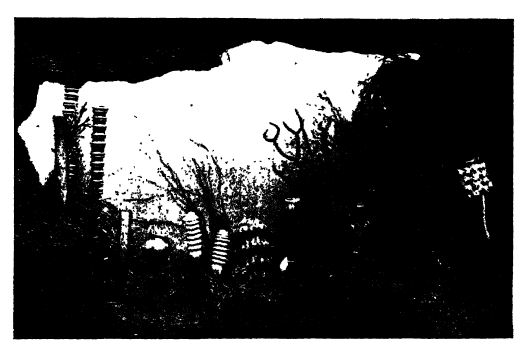
Upper Devonian Sponge Colonies. — From southern central New York, J. M, Clarke has interestingly described at least five sponge colonies entombed in the Chemung sandstones. They are all of the glass type of sponges (hexactinellid Dictyospongidae), and represent 90 species and 16 genera. More fossil glass sponges occur here, in fact, “ than in all the rest of the world together.” These sponges lived in waters thought to have been cold enough at times to have floating ice, and at depths of probably less than 300 feet, but in the present oceans the hundred kinds of glass sponges are inhabitants of waters ranging in depth from 570 to 17,000 feet.
[ p. 324 ]
Marine Fishes. — With the rise of the marine fishes one notes the decline of the trilobites and the nautilids, and it is probable that the fishes fed largely upon both of these types of animals. Beginning with Middle Devonian times, the teeth and spines of marine sharks are often met with. From Columbus, Ohio, northward to Lake Erie, there occurs locally a bed, sometimes 6 or more feet thick, made up of the broken bones of these and other fishes. They were in the main shell-feeders and ranged in length up to 6 feet. As they were in greatest development in the Mississippian, they are further described in the chapter on that period. In the Devonian the sharks made up about one third of all the kinds of fishes then e.xisting.
The most striking fishes of the Devonian seas were the highly armored Arthrodira, and it is thought that about 40 per cent of all Devonian fishes were of this subclass. They are described in the previous chapter.
¶ Devonian Fresh-Water Deposits and the Prophecy of Vertebrate Dominance
Fossiliferous Continental Formations. — The oldest fresh-water or continental deposits of Paleozoic time having an abundance of fossils are those of the Devonian, and especially of the Old Red sandstones of Scotland. From the Devonian period onward, the geologic record often bears testimony to the continental origin of certain deposits and their entombed life, and while such are preserved and accessible more and more as one goes upward in the geologic scale, still the record of the land-living and air-breathing plants and animals is far more imperfect than the record of marine life. This is due to the fact that the organisms of the land are rarely entombed in the sands and muds of the land waters, but are either eaten by their living contemporaries, or oxidized and blown away by the atmosphere. The life of the fresh waters is more apt to be preserved, along with such land-dwelling organisms as may be accidentally drowned or blown into them (leaves), or washed by the floods into the areas of standing waters where burial may take place. Even though burial occurs on land, however, the circulation of ground waters is far more marked in loose continental deposits than in the more completely cemented marine strata, and in this way nearly all the remains have been leached away.
Old Red of Scotland : Typical Continental Deposits. — The Old Red deposits of Britain are a tremendously thick series of coarse detritals [ p. 325 ] and volcanic effnsives, seemingly accumulated in vallej’s between high mountains that were upheaved during the Caledonian Disturbance. Jukes-Browne states that there were probably five parallel ranges. The maximum thickness of these deposits may be as great as 37,000 feet, but in no single area is there more than 20,000 feet. Nowhere is there a transition, as has so often been stated, from the Silurian into the Old Red, for the contact is an unconformable one, and the break at the top with the Carboniferous is equally distinct. As long ago as 1856 Godwin-Austen regarded these deposits as of fresh-water origin, a conclusion now agreed to by nearly all geologists. They are probably wholly continental, and were accumulated in several independent and subsiding valleys, imder a climate more or less arid. The record is a very long one and covers most of the Devonian, though sedimentation was interrupted for a considerable time during the Middle Devonian.
Old Red in America. — In America there are no fresh-water deposits of Devonian time that were accumulated in inland mountainous areas, like those of Scotland. They are, rather, delta deposits formed by large rivers flowing into the sea, apparently under a semiarid climate (see Fig., p. 311) . Two of the non-marine animals are shown in Figs., pp. 326, 331. Clarke regards certain of the Upper Devonian deposits of New York (Oneonta and Catskill) and the sandstones of Gaspé in lower Quebec as of great coastal lagoons receiving terrigenous sediment rapidly and in vast quantity from a rapidly rising highland. In places there are thin, interbedded, marine zones that represent the overwash of the outside water in times of stress, bringing in the marine organisms as we find them — sea shells from the littoral. It is in these regions that are found the Am erican Old Red fishes, most of which appear to have come from the rivers and not from the sea. The deposits of Scaiunenac, Quebec, which are evenly bedded, gray to greenish, sandy shales, appear to be wholly of fresh-water delta origin, the only fossils being land plants and fresh-water fishes, in harmony with those of the Upper Devonian of Scotland. There occur eleven species of fishes (selachians three, ostracoderms three, dipnoans one, ganoids three). No marine fossil of any kind has ever been seen about Scaumenac.
Proof that the Old Red of Scotland is of Continental Origin. — These deposits are often very decidedly cross-bedded, and the materials are usually poorly assorted. The conglomerates are frequently of great thickness, with erratic bowlders as large as 8 feet in diameter. Ripple-marking is frequent, and the suncracking is deep, indicating that there was long exposure to dry [ p. 326 ] air, since the edges of the prisms are often curled. There are also present rain-drop impressions. All of these are characteristic of continental deposits. While the rocks are not red throughout the Old Red series, this is nevertheless the dominant color; it is usually due to the quartz grains being coated and held together by a crust of earthy ferric oxide very much as in the Triassic sandstones of the Connecticut valley, which are deposits of undoubted land origin under a semiarid climate. Further, Goodchild points out that some of ithe red sandstones of Scotland are often full of desert sand grains, and are highly faJse-bedded in places, like an old desert sand-dune.
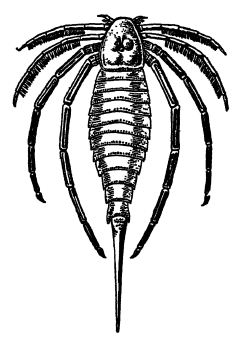
In the Old Red there are no thick, evenly bedded limestones, and the amount of carbonate of lime present at certain horizons is not greater than that found in undoubted continental deposits. The Old Red abounds, in land plants and most of the fishes are of unmistakable fresh-water types, ranging in length. up to 30 inches. Of true marine animals there are none, though the small sharks and the small to gigantic eurypterids may have migrated from such waters. With none of these, however, are associated marine shells, and on the other hand it is well known that a few kinds of sharks are living to-day in fresh waters. If sharks adapt themselves to fresh waters now, why may they not have done so in the past? Therefore, the only evidence against the view that the Old Red is of continental origin is that of* the eurypterids.
Eurypterids (Pl., p. 276) are locally abundant in the lowest beds, one even attaining a length of 6 feet. These are known to the Scotch quarrymen as “ Seraphims.” Previous to the Old Red, all eurypterids occur in unmistakably marine or at least estuarine associations, but toward the close of the Silurian, both in Europe and America, they are nearly always restricted to brackish-water assemblages. After Silurian time none of these animals are found in normal marine associations, and the last occur in the Pennsylvanian, where they again appear either in brackish-water faunas or in association with land plants and with a complete absence of marine animals. It is therefore held, and justifiably so, that the later eurypterids traveled far up the estuaries and even into the freshwater rivers either in search of food or more probably to spawn.
[ p. 327 ]
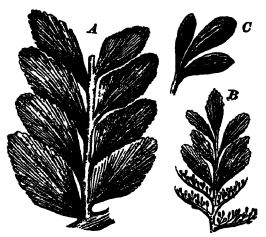
Mixed Marine and Fresh-water Faunas. — Wherever the Old Red fishes are found associated with marine faunas, it is seen that such mixtures have taken place near the shore lines of the Devonian epeiric and shelf seas. Therefore these occurrences may be cases of moribund fresh-water animals floated to the sea by the rivers, or they may be of species that have interchangeable marine and fresh-water habitats, as have many modern fishes, such as the sahnon. Kayser, and more especially Walther, hold that the Old Red areas were lagoons of the sea in which the character of the water recurrently changed; for long intervals the sea was present in the lagoons, followed by equally long periods when it was out of them, or the rivers dried out before attaining the sea and then over the areas of the deltas were deposited irregularly variable sheets of desert deposits derived from the highlands. On the other hand, Barrell holds that the Old Red deposits are wholly of river origin, with local lakes and swamps: flood-plain deposits under seasonal rainfall of a semiarid climate.
We are reminded by the Old Red of the Ten region of southern India, where the wide coastal plain is covered by wandering dunes of carmine red sands nearly two hundred feet high, between which are beautiful dark blue lakes whose shores are decorated with palms. Here are forming thick red sandstones with typical dune-bedding, beside thin-banded red clays at the bottoms of the lakes. Not far away are being deposited marine limestones and sandstones decidedly rich in beautiful pearl shells and snails, which gradually pass into coral reefs with their teeming life. Just as these sands of Teri are coated with a thin layer of iron oxide, so were those of the Old Red, and we cannot escape the conviction that both were caused by identical semiarid climatic conditions. (Walther.)
Plants and the Climate. — In the Devonian there is much evidence of land plants, but it is not until the Middle Devonian that we can speak of floras, for in the Lower Devonian these fossils are still very scarce. In the Upper Devonian there was a considerably diversified flora, forming the oldest or first forest, in which florished fernlike plants, fem-like seed trees (Eospeimatoptens) rushes, tall ground pines (lycopods), and primitive evergreens with woody trunks nearly [ p. 328 ] 2 feet in diameter. Drifted logs of these trees are often found in the marine deposits of Upper Devonian time. At Gilboa in the Schoharie valley, New York, have been found about thirty great stumps and spreading roots of tall trees still standing in their native soil. They attained a height of 30 to 40 feet and are thought to have been seed-ferns. As the dominant plants of this cosmopolitan flora were fern-like forms, it has been called, after one of them, the Archaeopteris flora, and the time, the Age of Archaeopteris (see Fig., p. 327). As the flora in its broader aspect was not very unlike that of Pennsylvanian time, the detailed description of it is deferred to Chapter XXVIII. The Devonian forests, however, were devoid of all insects. One of the most remarkable facts in connection with this flora was its wide distribution and uniform character throughout eastern North America and into the Arctic region, Spitzbergen, and northwestern Europe, indicating equable [ p. 329 ] climates and the complete union of North America and Europe across Greenland, Spitzbergen, Norway, and Great Britain. None of the trees show annual rings of growth attesting to seasonal changes due to a varying climate or to prolonged drought and it is therefore held that the general climate of this time was uniformly warm though semiarid, the known forests being localized in wet places along the valleys and in the swamp areas. That the climate was warm is further shown in the wide distribution of the reef corals of the seas, which extended even into Arctic regions, but that the air was more or less semiarid is proved by the prevalence of the oxidized and red continental deposits of Eris. Locally, however, there must have been winters, for J. M. Clarke has demonstrated the presence of shore ice during Upper Devonian times in central New York and at Scaumenac, Quebec. Kirk also describes Upper Devonian ice-facetted rocks in southeastern Alaska (1918). The “striated” pebbles reported in the deformed Table Mountain series of South Africa, however, turn out to be squeezed and shckensided stones (Daly 1923).
Thin coal beds of very local distribution are occasionally observed in the Old Red continental deposits, but these, as a rule, are of no commercial value; to the scientist, however, they indicate that swampy areas abounding in plants occurred where the coals are found. On Bear Island, to the north of Norway, are found beds of good bituminous coal sometimes 3.5 feet in depth.
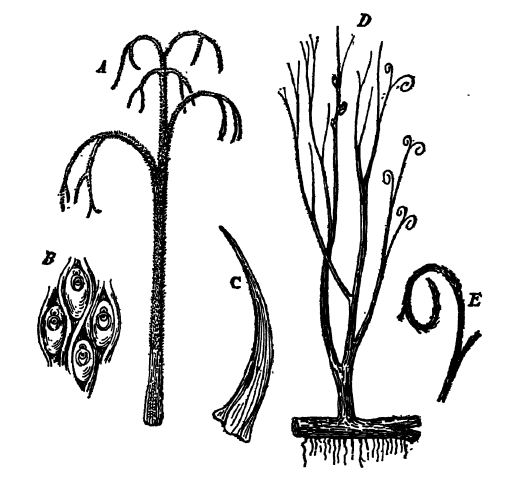
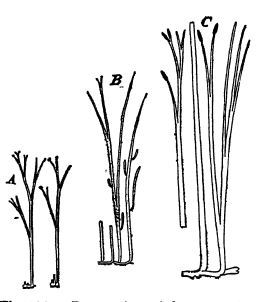
Rise of Land Plants. — In Chapter II something was said about the origin of land plants out of the marine seaweeds. We will now follow the subject further. A. H. Church (1919) holds that the chief structural characters of the land flora were first outlined in the sea. In their very difficult migration from the sea to the dry lands, the algse needed to provide themselves with absorptive instead of merely anchoring roots, and with a water-conducting system. In fact, the oldest well-known land plants (Rhynia and Hornea) are nothing more than branching duct-bearing stems, not over 8 inches tall, covered with scattered breathing pores (stomata), and specialized tips or sporangial areas for the development of spores. Such were recently discovered in the Old Red of Scotland, with all the microstructure preserved. Rhynia and Hornea are without roots, leaves, or aSrial appendages, and therefore are but little more advanced structurally than the seaweeds of the present. Psilophyton of Dawson is very- closely related, and all are said to be of the Psilophyton flora. These plants were fitted, however, for terrestrial life. They may be regarded as Thallophytes, intermediate toward the fem-like plants (Pteridophyta). (See Figs., pp. 328, 330.)
The land plants of the Lower Devonian and of earlier periods are much more primitive than those of the first land floras of the Middle and Upper Devonian, and in their structures show that the fem-like plants (Pteridophyta), mosslike plants (Bryophyta), and seaweeds are of one line of descent. It appears that before the Middle Devonian there were no ferns at alL In the later Devonian, [ p. 330 ] along with the fern-like plants, there were also ancient conifer-like trees, and Scott hints that the seed-bearing plants may not have arisen in the ferns as is generally believed, but rather that both stocks go back to more ancient times, and to plants like Rhynia and Homea.
Devonian Fresh-water Fishes. — The fresh waters of Devonian time must have abounded in life, an inference justified by the fact that over one hundred species of fishes alone, in more than forty genera, are known in the continental deposits of this time. In the Orkneys at Stromness the Old Red sandstones are at certain horizons replete with fishes. In fact, they are so common that Hugh Miller calls this area “ a land of fish”. As fishes are fully discussed and illustrated in the previous chapter, we need here only present a general summary of the Devonian kinds (see Pls., pp. 291 and 295). These were primitive in that they did not have well developed internal skeletons, and in that the latter were more cartilaginous than bony. The median fins were often continuous, or a series of fins, extending along the dorsal and ventral surfaces and meeting around the end of the tail. The vertebral column often extended to the end of the tail, with the continuous fin all around it, the diphycercal type of tail. The heterocercal tail was the other common type.
The oldest forms were small fresh-water spinous sharks known as acanthodians, which vanished from the rivers before the close of the Devonian. In the Lower Devonian appeared various kinds of ganoids, fishes related to the living sturgeons and gar-pike; in present waters they are not at all common, but in the Devonian they made up almost one quarter of all the fishes of this period. There were also many lung-fishes or dipnoans.
Among the Devonian fresh-water fishes, and probably arousing more speculation than any others, are the winged ” fishes known [ p. 331 ] as Ostracodermi (means shell- or bony-skirmed), described at length in the previous chapter.
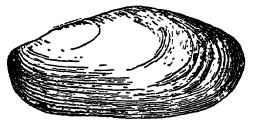
Food of Devonian Fresh-water Fishes. — In the fresh-water deposits of Devonian time there is not as yet known a single definitely determined water-living plant, nor invertebrates of any kind other than bivalves (see Fig., opposite) and myriapods. The ultimate basis of fish food, however, must have been water plants and algse. There was probably also an abimdanee of earthworms present, though their bodies were too soft for preservation as fossils. The sluggish bottom-living Devonian fishes were, then, dependent upon water plants, and upon these fishes subsisted the more active carnivorous forms. That food was still scarce in the streams and lakes of Devonian time is attested by the average small size of these ancient fishes, few of which exceeded 9 inches in length. In the marine waters where food was plentiful, the average length of fishes was far greater, and one at least of the Arthrodira attained 20 feet. It was probably because of the abundance of food in the seas and oceans that we see so many different stocks of land fishes returning and adapting themselves to these more favorable habitats.
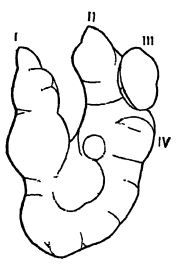
Amphibia. — Of vertebrates higher than the fishes, the only evidence rests upon one foot imprint (Thinopus antiquus) nearly 4 inches long, which was found near the top of the Upper Devonian of western Pennsylvania (Fig., left, above). This indicates the presence of a salamander-like animal (stegocephalian) with a probable length of nearly 3 feet. The track is from a marine sandstone of the littoral or beach area over which the animal walked, probably in search of dead marine life. This stratum is associated with others that are ripple-marked and sun-cracked, and bear rain imprints.
[ p. 332 ]
¶ Collateral Reading
J. Barrell, The Upper Devonian Delta of the Appalachian Geosyncline. American Journal of Science, 4th series, Vol. 36, 1913, pp. 429-172, Vol. 37, 1914, pp. 87-109, 225-253.
W. B. Clark, Maryland Geological Survey, Devonian volumes, 1913.
John M. Clarke, Strand and Undertow Markings of Upper Devonian Time as Indications of the Prevailing Climate. New York State Museum, Bull. 196, 1917, pp. 199-238.
John M. Clarke, Early Devonic of New York and Eastern North America.
New York State Museum, Memoir 9, 1908-1909.
John M. Clarke, Naples Fauna in Western New York. New York State Museum, Memoir 6, 1903.
John M. Clarke, (Pestorations of Devonian Life), New York State Museum, Report of the Director for 1917, 1919, opposite p. 24.
Hugh Miller, Old Red Sandstone, 1851.
| XXIII. The Rise of Fishes and the Prophecy of Vertebrate Dominance | Title page | XXV. The Mississippian Period and the Climax of Crinids and Ancient Sharks |