| XXIV. Devonian Time and the Dominance of the Fishes | Title page | XXVI. Spiny-skinned Sea Animals (Phylum Echinoderma) |
[ p. 333 ]
History of the Term Carboniferous. — The Upper Paleozoic rocks were once regarded as comprising but a single period of time, and because coal (carbon) is common in them, they were called the Carboniferous System. In western Europe, where Geology had its inception, the coal-bearing strata are of wide occurrence, and as long ago as 1808 Omalius d’Halloy wrote “ bituminous terraine ” for the coal deposits of Belgium. In England the miners have long used the term Coal Measures, and it was John Phillips of that country who in 1839 proposed the name Carboniferous System. The term was then applied to all the strata above the Old Red sandstone or Devonian and beneath the New Red sandstone or Triassic. At present the Europeans recognize two systems, the Carboniferous and Permian, while in America three are now accepted.
The present American classification of the Carboniferous strata may be contrasted with that of Eimope as follows:
| Europe | America |
|---|---|
| Permian period | Permian period |
| Break not general | |
| Upper Carboniferous or ures | Coal Meas Pennsylvanian period or Coal Measures |
| Break general | |
| Lower Carboniferous (Culm) or Dinantian Upper or Viséan Lower or Toumaician |
Mississippian period or Subcarboniferous Upper or Tennesseian Lower or Waverlian |
The Productus Seas. — The seas of the three Carboniferous periods the world over were characterized by an abundance and great variety of brachiopods of the genus Productus (see Pl., p. 365, Figs. 5-11), and have hence been called the Productus seas. These shells are always common, and as they are of large size, they are the most conspicuous and easily secured fossils of the Carboniferous marine [ p. 334 ] formations. Further, as the genus died out during Permian time, they are the best guide fossils to the Carboniferous strata. It is true that this stock arose in the Middle Devonian, but even though the forms of the ancestral genus Productella were not rare in the Upper Devonian, they were then neither large nor common enough to dominate the marine faunas as they did in the Carboniferous throughout the world.
¶ Mississippian Peeiod
Significant Things about the Mississippian Period. — Eastern North America at this time was occupied by the old land, greater Appalachis, and as it had been re-elevated at the close of the Devonian, it was natural that the shallow seaways to the west of it as far as the Cincinnati arch should be depositing much mud and sandstone and but little limestone. In the Mississippi valley the small seaways had clearer water, and here the dominant rocks are limestones and oolites. Along the Pacific coast was the old land Cascadis and to the east of it lay a wide shallow sea. At times this, the Madison limestone-making sea, connected with the Tnarinpi waters of the Mississippi valley.
Toward the close of the period, mountains arose in the southern Appalachian area, in Arkansas and Oklahoma, in Nova Scotia and New Brunswick, and m central Europe.
The marine life of the Mississippian is noted for its many kinds of Pentremites, the first abundance of echinids, the peculiar screwlike bryozoans known as Archimedes, the many productids, and especially* for the vast quantity of crinids and crinidal limestones and the many shell-feeding sharks. Of the land floras little is known in North America, and of the amphibians only some foot impressions. There are as yet no commercially valuable coals known in America, other than at Cape Lisbume, Alaska.
The geologic record of Mississippian time in North America is markedly different from that of the Pennsylvanian, for the former is one chiefly of the sea, while in the latter in the eastern half of the continent there is an alternation of the sediments of Tnarinft floodings with accumulations of coal beds in vast more or less fresh-water swamps. In other words, the Mississippian is a recurrence of Devonian conditions, while the Pennsylvanian formations alternate between those of the sea and land.
The Term Mississippian. — At first this system of rocks was known in North America as the Lower Carboniferous or Subcarboniferous (Owen 1852). A part of these strata in Ohio was also known as [ p. 335 ] the Waverly sandstone series (Mather 1838), but not until 1869 was a geographic name proposed to embrace all of the Lower Carboniferous strata. This was the Mississippi Group of Alexander Winchell, who applied the term to the Lower “ Carboniferous Limestones of the United States which are so largely developed in the valley of the Mississippi River.” In 1891, Professor H. S. Williams revived this term as the Mississippian series, defining it as “that series of rocks, prevailingly calcareous, which occupies the interval between the. Devonian system and the Coal Measures.” This name is now in general use as a period term.
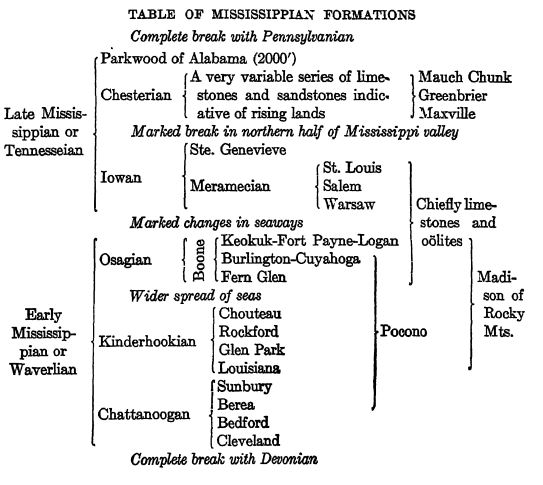
TABLE OF MISSISSIPPIAN FORMATIONS
¶ Early Mississippian Time (Waverlian)
Waverlian Seas. — The Devonian period closed with marked retreat of the seas in North America and it appears that all parts of the continent were emergent. How long this complete emergence lasted is not known. The submergence of Waverlian time began first in the Gulf States and along the western side of the Cincinnati uplift. At this early stage of the inundation the seas were small in extent but in Middle Kinderhookian time the waterways were greatly [ p. 336 ] expanded. The most striking change of this time, however, was the reappearance of the Cordilleric sea, depositing far and wide throughout the Rocky Mountains a great mass of limestones, known as the Madison limestone, that in places attains to a thickness of 1600 feet. It is exceedingly massive and where uplifted the streams have cut in many places deep and picturesque canyons through it. This Cordilleric sea is known in Alberta (Lower Banff shale and limestone with a thickness of 2300 feet), on the Liard River m the Mackenzie region, and probably extended into the Arctic Ocean. That it connected at times with the Central Interior sea either across Colorado or New Mexico into Kansas and Oklahoma, is proved by identical species in both; in fact, more than one third of the Cordilleran forms also occur m the Central Interior sea. The Cordilleric sea, then, remained throughout Waverlian time and seemingly vanished completely at the close of this epoch, to reappear greatly altered in its geography in the later Tennesseian. During the maxunum submergence of Waverlian tune about 26 per cent of North America was imder the sea.
The northern Appalachic basin existed throughout Waverlian time east and north of the Cincinnati uplift in the states of Ohio, Michigan, and Pennsylvania, and it is from this area (Waverly, Ohio) that the epoch name is derived. The life of this basin also had its own impress, but as there were many species common to it and the Central Interior sea it is plain that they were connected.
It was a sallow basin with coarse deposits throughout: sandstones and shales, with some conglomerates and but little calcareous material. Eastward, these deposits pass into the Pocono series of fresh-water and brackish-water origin (400-1400 feet), of Pennsylvania, Maryland, and Virginia. Here also occur the oldest American coal beds, thin accumulations of little commercial value but prophetic of the thicker beds occurring in later formations. However, coal was forming early in Waverlian time in other and widely separated places, as in arctic Alaska (Capes Lisbume and Thompson), southern Siberia, and Scotland; and later thin coal beds were accumulating in western Europe in some of the Culm deposits. At Cape Lisburne the coals are non-coking and semi-bituminous, in beds up to 4 feet thick of clean coal, which is now mined.
In the Central Interior sea the invasion began with black mud deposits almost, devoid of fossils (Chattanoogan) and for a long time the sediments were of this character, with local sand accumulations. During Kinderhookian time the waters west of the Cincinnati uplift clarified and then for a long time remained clear, depositing over great areas the later Kinderhookian and Burlington crinidal limestones. The entire thickness of Waverlian deposits at Burlington, [ p. 337 ] [ p. 338 ] Iowa, is about 300 feet, but the series thickens considerably to the south.
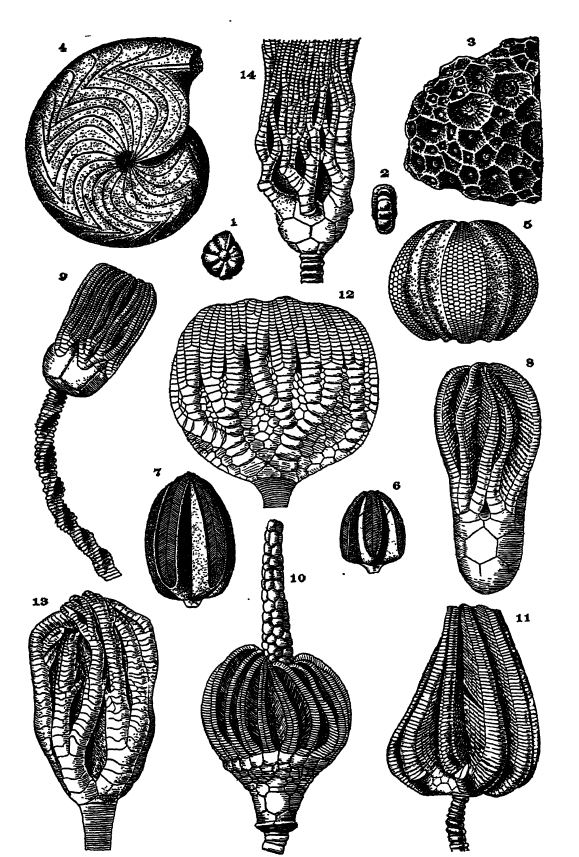
Figs. 1, 2, Endothyra bailey, x 9; 3, Axinura canadensis, X i; 4, Brancoceras iosion, x i; b, Melonechinusmulliyorus, x i; Q, Pentremites conoideus; 7, P. ellmgaius; 8, Agassizocrimis dactyliformis, x i; 9, PlatycHnus symmetrieas; 10, Batocrinus pyriformis, x f; 11, Agaricocrmus imllatus; 12, Forbesiocrinus wortheni, x 13, Onychocrinus ramulosusy x 14, CyadMcrinus mullibrachiaius. In the main after
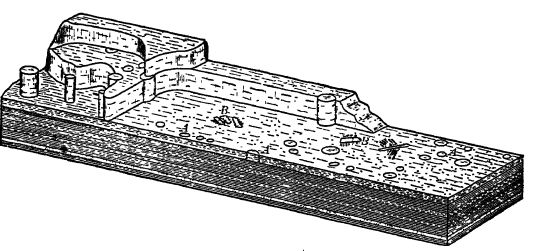
In the Acadian area of New Brunswick and Nova Scotia there was another basin of deposition, but wholly of continental strata. Here were laid down the dark-colored Horton and Albert formations of arkoses, conglomerates, feldspathic and muddy sandstones, and micaceous siliceous shales, attaining a thickness varying between 2800 and 3400 feet. In the Horton, W. A. Bell has counted no fewer than fifty-six dirt beds which represent preserved swamp soils of this time. They are replete with the fossilized roots of Waverlian plants, and in some of them are still seen the erect stumps of small trees (Lepidodendron corrugatum). On a surface 150 by 15 feet were counted ninety-six vertical trunks embedded in a dark greenish sandy mudstone. A part of this layer is illustrated in the figure above. Some of the beds of the Albert series abound in a few species of fresh-water ganoid fishes.
Farther north in southern Quebec there is another thick series, but here of red beds, long known as the Bonaventure formation, a series of sometimes very coarse conglomerates, sandstones, and sandy shales. They are of fresh-water origin. The conglomerates are of the older formations and the pebbles are in the main of the fossiliferous Devonian, Silurian, and Champlainian. The brick-red color of the Bonaventure strata is not in keeping with the color of Waverlian deposits, and it may be that they are actually of late Tennesseian time.
Diastrophism at the Close of Waverlian Time. — The Waverlian submergence was at its height late in the Burlington and the seas began to retreat in Keokuk time, persisting longest in the Cordilleran region. The Central Interior sea again became muddy in the north. [ p. 339 ] where shales and sandy shales dominate, and even the limestones farther south are less pure than those of earlier time. Toward the close of the Keokuk the withdrawal of the seas was widespread though not complete in the Central Interior region. Local mountain making took place in Nova Scotia and New Brunswick toward the close of the Waverlian, since the Tennesseian deposits (Cheverie and Windsor series) are here not strictly in conformity with the continental deposits of the Waverlian (Horton). The greatest geographic change, however, took place in the western part of North America, since it appears that the Cordiheric geosyncline became dry land and remained so until late in the Tennesseian, when the seas returned but changed greatly in geographic distribution. It is this emergence that leads to the separation of the Mississippian into two divisions as shown in the table on page 335.
¶ Late Mississippian Time (Tennesseian)
Lands and Seas. — The seas of Tennesseian time early in the Meramecian (see table, p. 335) began a renewed spread in the Central Interior area and attained their maximum spread early in the Chesterian. At no time, however, were these epeiric seas so extensive as those of the Waverlian. It appears that never was more than 12 per cent of the medial portion of North America submerged, while the average for the epoch may have been about 8 per cent. Nowhere are there more than 1100 to 1800 feet of sediments, most of which in the center of the area are hmestones and oolites. On the flanks, and especially along southern AppaJachis, there are sandy or calcareous marine shales that attain a thickness of several thousand feet, but the deposits in the northeastern part of this trough are, in the main, of continental origin, being soft, red, sandy shales devoid of marine fossils (Mauch Chunk, at Pottsville, Pennsylvania, 3000 feet thick, thinning to 600 feet in western Pennsylvania and 40 feet in West Virginia).
The area of the Tennesseian limestones of western Kentucky, which includes the celebrated Mammoth Cave, has been called “ the land of ten thousand sink holes More than 9000 of these solution holes have already been mapped, and it is estimated that when the United States Geological Survey completes its work, something like 60,000 of them will have been located. They are of all sizes, the largest one covering 3100 acres. (W. R. Jillson.)
In the Acadian area there was another sea of this time, consisting of narrow connected troughs between mountain ranges made during the Acadian Disturbance. These seaways deposited conglomerates, [ p. 340 ] saads, much mud, thin zones of dolomites, and great quantities of gypsum. At the top the series commonly has ejctensive sheets of igneous rocks. These Acadian deposits are known as the Cheverie and Windsor series and at times are rich in fossils. The fauna is a distinct one and has no close relationship to those of other seas, though Bell has shown it to be somewhat related to English faunas. The thickness of the rocks is estimated at about 2000 feet, and the formations occur in New Brunswick, Nova Scotia, and southwestern Newfoundland.
In the Cordilleran area a great geographic change appears to have taken place at the close of the Waverlian, since the eastern shore of the heretofore very wide Cordillerie geossmcline was apparently shifted to western Colorado, Wyoming, Montana, and Alberta, thus narrowing considerably the area of this trough. Seemingly, this warping movement took place at the close of the Madison deposition and before the introduction here of the late Tennesseian formations that have Pacific faunas. South of Colorado the Cordilleric trough still remained very wide, the narrowing not taking place until the close of the Pennsylvanian.
The marine life of the western or Pacific waters dining the Tennesseian was markedly different from that of the Central Interior sea. These western life assemblages contrast sharply with those of the Mississippi valley in the almost complete absence of Peniremites, crinids, and Archimedes so common in the east. Goniatites, Leiorhynchus, Posidonia (Caneyella) and other elements of the associated black shale deposits (facies) spread into Missouri and Arkansas. It is in these western seas that we meet also with the Produdus giganteus fauna characterizing the Vis4an of Europe, but m the Cordilleric seas it is associated with Asiatic forms.
¶ Life of Mississippian Time
Marine life. — In Middle Waverlian times the life was most diversified, and the sea was filled with an abundance of crinids in great variety, a richness of development never again attained by this class of radiate animals (Pl., p. 337, Pip. 8-14). They were at first delicate forms, becoming larger, thicker plated, coarser, and more ornate with the progress of time. About the city of Burlington alone nearly four hundred species have been found and through the quarrying of the limestones these fine fossils became readily accessible, thus stimulating several collectors living in the city to turn to natural history and geology as a vocation. In the Tennesseian the crinids were far less diversified. Other kinds of fossils were also abundant in [ p. 341 ] the Waverlian seas, as, for instance, brachiopods (Prodndus, Spirifer), bryozoans, and cup corals, but none attained the profusion of the crinids. That reef-building corals were not present in this warm and clear sea is strange, since reefs were made at this time in Europe. Among cephalopods, the nautilids were no longer so prevalent as they w’ere in earlier times. Their descendants, the goniatites, (Pl., p. 337, Fig. 4) were now rising into ascendency, and were more common than in the Devonian, but this statement applies rather to the European seas than to the Central Interior sea. Trilobites were almost gone. The carnivorous or aggressive life of the Waverlian sea was therefore dominated bj’ the shell-feeding sharks. It is interesting to note here that the life of the Waverlian sea was much like that of western Emope, seen to best advantage in the equivalent strata of Belgium (Toumaician), indicating that these waters were in connection with each other.
The marine life of the Tennesseian of the Central Interior sea differs in many ways from that of the Waverlian, but as it is largely a direct outgrowth of the latter it naturally cannot vary greatly. One of the noticeable features of this life is a dwarf fauna of more than seventy species which reappears at least four times but is alwa 3 rs connected with the same physical environment, shallow-water oolite deposits. This life assemblage of dwarf forms is known as the Salem fauna because it is best developed in the Salem formation of Indiana. In the Tennesseian, two groups of echinoderms were well developed. These were the blastids (Pentremites, Pl., p. 337, Figs. 6, 7) described elsewhere (p. 349), which are the guide fossils to the marine deposits of this time, and in places are so common that geologists have called the beds the Pentremital limestone; and, associated with them, though far less common, the equally characteristic seaurchins known as Melonechinus (the melon-like urchin, see Pl., p. 337, Pig. 5; and Fig. C, p. 347). Bryozoa with a thick, screw-like axis (Archimedes) were also characteristic of this epoch and certain horizons filled with them have been called the Archimedes limestone. There were small cup corals, and one type of compound coral (Axinura, see Pl., p. 337, Pig. 3).
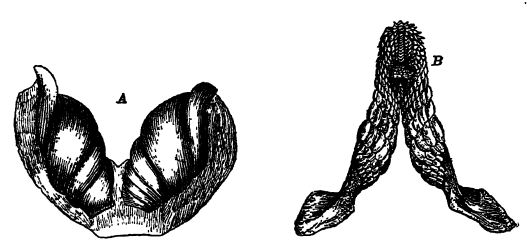
Shell-feeding Sharks of Mississippian Seas. — Large sharks of the shell-feeding type were becoming more and more plentiful during Waverlian time, for their flat, crushing teeth and large fin spines are often abundant, and especially so toward the close of the epoch (Keokuk). See Mg., p. 342.
Very small “ spinose sharks ” (aeanthodians, see Pl., p. 295, Kg. 1), rarely more 6 inches long, appear in the late Silurian, and the first of the shell [ p. 342 ] feeding sharks (Pl., p. 295, Fig. 3) are known in the following period. In the American Devonian there are 39 species, in the Mississippian 288, in the Pennsylvanian 55, and in the Permian 10. Therefore there was apparen% a very rapid evolution of the sharks in the Waverlian, when they were the dominant ma rinp fishes, with a quick decline during the Tennesseian, the history being the same in Europe. These sharks were all of primitive types, that is, the acanthodians were least in number, and by far the commonest were those with pavement-hke teeth, known as cestracionts, and the cochliodonts (Fig., below). The acanthodians vanished with the Paleozoic, while the other forms were very sparingly represented after Permian time.
Land Life. — Of Waverlian land life little is known other than plants, and most of these are preserved in the Pocono deposits of the Appalachic trough. The plants are so like those of the Pennsylvanian that a description of them is deferred to Chapter XXVII.
Of fresh-water fishes, other than those of the Albert formation, little is known in the Waverlian deposits, but those of Europe indicate a marked decline of the stocks seen in Devonian time.
Toward the close of Teimesseian time, throughout the continental deposits of Pennsylvania known as the Mauch Chunk are seen the tracks of many kinds of amphibians, nearly all of which are still imdescribed. Lea in 1849 collected a most interesting slab, a little over 5 feet long, with six successive foot impressions made by an amphibian (Palceosauropus) with a IS-inch stride. This slab is ripple-marked and has rain imprints, indicating a mud flat of land origin, over which the animal walked when the deposit was yet soft and wet. Another amphibian track has been found in Giles County, Virginia (Dromopiis).
[ p. 343 ]
¶ Climate of Mississippian Time
The marine life of Mississippian time appears to indicate warm and equable waters throughout North America, though the seas were never warm enough to produce great numbera of corals or coral reefs, nor were the cephalopods ever present in great variety.
On the land the organic evidence of Waverlian time is very scant but since the continental and brackish-water deposits are of darker colors and the coal beds thin and local (Pocono), warm and moist conditions seem to be indicated. During Tennesseian time the evidence of the sediments brings out the further fact that the nuld climate of the land became more and more semiarid and locally even arid. This condition was especially true for the area to the north and northwest of the Acadian and Appalachian mountains, as evidenced by the thick and widely spread red deposits (Mauch Chunk) of Pennsylvania and West Virgmia, the red beds of Michi g an with salt, the thick red Windsor formation of Nova Scotia with its deposits of gypsum, and the thick red fresh-water conglomerates of Gaspé (Bonaventure). Toward the close of the Tennesseian the climate became cooler, and in the mountains of Nova Scotia there appear to have been even winters.
¶ Mountain Making of Mississippian Time
We have already directed attention to the renewal of crustal warping toward the end of the Waverlian, and now at the close of the Tennesseian the evidence is clear that folding took place in several parts of North America and on a great scale.
Ouachita-Cahaba Disturbance. — In the southern Appalachie geosyncline of central Alabama (the Cahaba coal field). Butts reports at least 10,000 feet of coarse deposits, conglomerates and sandstones, that in the main are of continental and brackish-water origin, and all of which are referred to a Pennsylvanian age “ older than the Pottsville.” A similar series (Stanley-Jackfork), having a maximum thickness of over 12,000 feet, was laid down along the south side of the Arkansas valley, extending into southeastern Oklahoma, that is, in the area of the Ouachita (pronounced watch-itah) Mountains. These great thicknesses of detritals of earliest Pennsylvanian time show that in southwestern Appalachis and in northeastern Uanoris mountains of no mean altitudes had been m existence. The Wichita Mountains of western Oklahoma were also folded at this time. These orogenic movements, resulting in a greatly changed geography of the Central Interior seas, and a [ p. 344 ] consequent long emergent time, separate the Tennesseian from the Pennsylvanian.
The Ouachita-Cahaba disturbance finally completely blotted out the Mississippi embajunent that had been in existence since Lower Cambrian time, and warped markedlj’ the Central Interior region, so that the pattern of the middle and late Pennsylvanian seas is very different from that of earlier times (see Pl., p. 355).
Windsor Disturbance. — In Nova Scotia and New Brunswick, the Cheverie and Windsor series of about 2000 feet in thickness and all of the older formations were toward the close of the Tennesseian folded into a high series of mountains. Bell (1921) holds that this was the most marked of four crustal movements occurring during the Carboniferous in the Maritime Provinces (see p. 369). All of the Pennsylvanian strata lie unconformably upon the older formations, and the Coal Meastires, wholly of continental origin, attain very great thicknesses (14,000-18,000 feet). Clearly such great piles of intermontane deposits indicate previously made mountains of considerable altitude. The New Brunswick geanticline, extending into the New England States, was also reelevated.
Varisdan Mountains of Central Europe. — In many parts of western Europe, and especially in Germany, all of the formations beneath the Coal Measures are folded and over them unconformably the Upper Carboniferous. The time of this folding was after the Culm and before the introduction of the productive coal measures. A high chain of mountains then extended through middle Germany and for this reason is sometimes spoken of as the German Middle Mountains. These mountains occur in the area of the ancient peoples known as the Variscians, and they appear to be the European equivalents of the Canadian mountains of late Windsor time.
¶ Collateral Reading
J. Origin and Significance of the Mauch Chunk Shale. Bulletin of the Geological Society of America, VoL 18, 1907, pp. 449-476.
Charles Butts, The Southern Part of the Cahaba Coal Field, Alabama. United States Geological Survey, Bulletin No. 431, 1911.
Charles Butts and E. O. Ulrich, Mississippian Formations of Western Kentucky. Kentucky Geological Survey, 1917.
S. Weller, The Geology of the Goleonda Quadrangle. Kentucky Geological Survey, Series 6, Vol. 4, 1921.
H. S. Williams, Correlation Papers — Devonian and Carboniferous. United States Geological Survey, Bulletin No. 80, 1891.
H. S. Williams, What is the Carboniferous System? Bulletin of the Geological Society of America, Vol. 2, 1891, pp. 16-20.
| XXIV. Devonian Time and the Dominance of the Fishes | Title page | XXVI. Spiny-skinned Sea Animals (Phylum Echinoderma) |