| XXV. The Mississippian Period and the Climax of Crinids and Ancient Sharks | Title page | XXVII. The Pennsylvanian Period, the Time of Greatest Coal Making |
[ p. 345 ]
As the American seas of Mississippian time, and especially during the Waverlian epoch, swarmed with a great variety of crinids, blastids, and echinids, it is desirable that these classes of flnimalg be described here.
General Description. — In the seas and oceans there is a great variety of radiate animals called echinoderms, which means spiny skin, a name given because their outer surface is usually more or less studded with parts composed of carbonate of lime in the form of spines and plates. These hard pieces may consist of small particles loosely dispersed in the skin, or occur in the form of spines that make a loose or open mesh, or entirely encase the soft parts in a firm skeleton, a mosaic of closely adjoining plates that are either plain or studded on their outer surface with more or less long spines. In large species (pentacrinites) of the Mesozoic there may be even more than three million stony pieces.
The parts of the body are usually arranged on the plan of five divisions, five radii and the same number of spaces between them — the interradii — being characteristic of the echinoderms. These parts are best seen in the starfishes; while they are present in nearly all Echinoderma they are at times much obscured.
The Echinoderma are divided into two great groups on the basis of their leading a free or sedentary life. The free forms having fossil representation are the starfishes (mcluding the brittle stars) and the echinids. The sedentary or attached, stalked kinds are the crinids and blastids, among which nearly all the fossil forms are characterized by having a more or less long, jointed stalk by which they are, as a rule, fixed to the ground. In the free forms (Eleutherozoa), the mouth is on the under or ventral side, and it is on this side that they crawl about in search of food. The stalked forms (Pelmatozoa), however, are turned over and have the mouth and the ventral surface upward, while from the center of the back or dorsal side originates the stalk, which is usually fastened to the sea bottom. All of the forms that are attached or sessile feed on microscopic food taken out of the circulating sea water. Most of the Echinoderma have the power to reproduce parts bitten off by predatory animals, [ p. 346 ] and a starfish may be tom into several pieces and each piece, under favorable conditions, will regrow the lost parts, because an arm retaining a part of the disk has all the essential organs of an entire starfish. The starfishes have little significance in Historical Geology and need not be described here.
Echinids or Echinoidea. — These are the sea-urchins, sanddollars, and heart-urchins, and, as a rule, are extremely spiny, many of the spines being movable on ball-and-socket joints. In general form, the echinids are dome-shaped, the wall of the dome being made up in living forms of twenty columns of closely adjoining plates arranged in pairs (see Figs. B and C, below). Five pairs of these are the ambulacral columns which are perforated by tubefeet, and alternate with five other pairs which are not perforated, the interambulacral columns. The mouth is on the lower or flatter side and is often provided with a powerful jaw of very complicated stmcture, first described by Aristotle and compared by him to a Greek lantern, and hence now referred to as “ Aristotle’s lantern.”
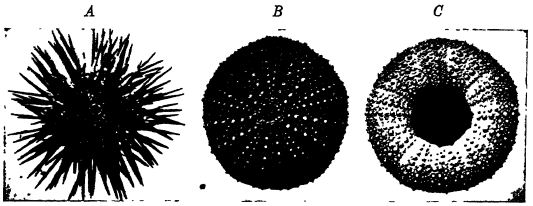
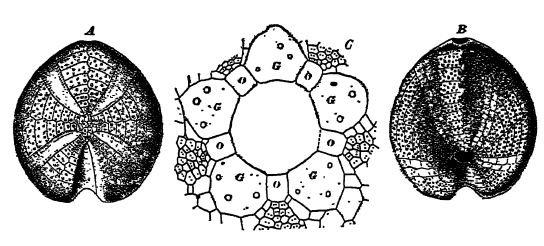
At the top of the dome or corona is the anal opening, around wj;iich are arranged ten plates in one or two circles. The five large plates of the inner ring are called the genitals because each is pierced by an opening, the terminus of the genital organs. The five smaller plates of the outer ring, situated at the termini of the five pairs of ambulacral columns, are known as the oculars because in them are located the so-called eyes (see Fig. B, above, but here the plates are arranged in a single ring. Also see Fig. C, p. 347),
The echinids just described are called regular echinids because they are the normally constructed forms, but in the seas of to-day [ p. 347 ] there are many others whose structure is less normal and which are known as irregular echinids. Their irregularity consists in that the anal aperture is not at the top of the dome but on the posterior ventral surface (see Figs., below). Further, they are not circular in outline but are somewhat elongate, often lobate and heart-shaped, and hence are called heart-urchins. The sanddollars are also of the irregular type. The spines in these forms are very short and slender and usually there is no lantern-like jaw.
The echinids described above are practically unknown in the Paleozoic rocks, but, appearing in the earliest Mesozoic, become more and more varied and are of much importance in Historical Geology. This is particularly true for Europe, where the Mesozoic strata are at times crowded with them, but in America they are always rare except in the Lower Cretaceous beds of Alabama, Texas, and Mexico. About 2500 fossil forms are known, and some 500 living kinds.
Paleozoic Echinids. — The Paleozoic echinids differ from those described above in having as many as seventy-five columns of plates in the corona (Pl., p. 337, Fig. 5). Here the ambulacral areas have from two to twelve rows and the interambulacrals from three to eleven. Further, the plates usually overlap like the shingles on a roof. These forms appeared in the late Silurian but were not common until the Mississippian, when the melon echinids (Melonechinus) were characteristic.
[ p. 348 ]
Crinids or Crinoidea (means lily form). — The crinids are popularly known as sea-lilies or stone-lilies, names that give very erroneous suggestions as to their nature, since they are animals and not plants. A better name is feather-stars. They are Echinoderma wrliich are usually gregarious in habit and nearly all of the fossil forms are fixed to the sea bottom by a more or less long stalk; after the Paleozoic there are, however, also many free forms that craw’l or swim around. In the present seas, A. H. Clark says there are living upward of 575 species in 142 genera, and of these 500 are unstalked. About one half of the living forms occur in shallow seas. From these facts it appears that crinids are not on the verge of extinction, as is sometimes held, since they are in places exceedingly common. They feed on microscopic plants and animals.
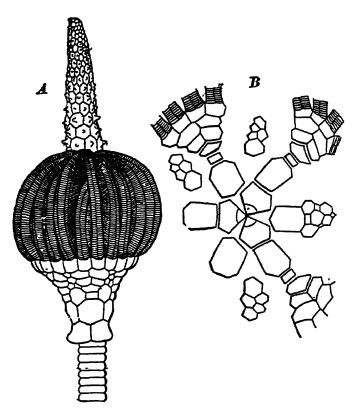
Crinids consist of three main parts: (1) the calyx or body proper, (2) the arms, and (3) the stalk. The calyx and arms together are referred to as the crown (see Fig., above, also Pl., p. 239, Fig. 5, and Pl., p. 270, Fig. 4). The calyx may be large or small and is made up of a variable number of closely adjoining plates, which are arranged in a very definite manner in the different forms, and the ciinids are classified according to their arrangement — a scheme too complicated to describe here. From the upper part of the calyx arise the arms or radii, hardly ever less than five in number, and these may fork once or many times according to a regular or irregular plan, but most often in multiples of five. The arms are made up of single or double columns of plates and may have a regular series of small arnolets arising from their inner edges and known [ p. 349 ] as pinnulae, suggesting the barbs on a feather (hence the name feather-stars). The ambulacra are situated along the inner sides of the arms and pinnulae, where the microscopic food is captured and conveyed to the mouth at the top of or within the calyx. The anal aperture is also on the upper or ventral surface of the calyx but is always more or less eccentrically situated and often drawn out into a long anal tube (Fig. A, p. 348). The stalk consists of many superimposed, disc-like, perforated pieces called columnals. It is usually short, from 6 to 18 inches in length, but in one Jurassic form attains 50 feet.
Ancient, Crinids. — In the Paleozoic, crinids at times were very common, especially the forms known as the box crinids (Camerata, now extinct). In these, the calyx was large and box-like, with thick plates that usually held together tightly (see Pl., p. 337, Figs. 10, 11). Their remains are sometimes so common as to make thick crinid limestones, this being especially true in the Mississippian formations.
Crinids appeared early in the Champlainian but are not common fossils until the Silurian, when they are plentiful, and remain so until near the close of the Paleozoic era. The crinids of the Mesozoic are less abundant and in American deposits are indeed very rare. They are very different from those of earlier times and more like those inhabiting deep water to-day. In Europe, crinids are conunon in the Triassic and Jurassic.
Blastids or Blastoidea (means germ or bud) are small, stalked, extinct Echinoderma that arose in early Champlainian time. In a broad way, these fossils resemble nuts and because of this the people in the southern states, where they are common, often call them “ fossil hickory nuts ” (Pentremites). We may say they are far simpler than the crinids, and differ markedly in having no arms, only delicate armlets called brachioles. These are situated at the sides of the five large and conspicuous ambulacral areas seen on the sides of the calyxes, areas which are practically never seen in crinids. In blastids the calyx is usually made up of thirteen plates (see Pl., p. 320, Figs. 1-3; Pl., p. 337, Figs. 6, 7).
Blastids appeared in the Champlainian, and, while often seen in Devonian strata, were not common in America until Mississippian time, when the seas abounded in them. They are guide fossils of this time, but died out early in the Pennsylvanian.
[ p. 350 ]
¶ Collateral Reading
F. A. Bather, A Treatise on Zoology, Part III, The Echinoderma. London (Black), 1900.
W. B. Clark and M. W. Tkitchell, The Mesozoic and Cenozoic Echinodermata of the United States. U. S. Geological Survey, Monograph 54, 1915.
F. Springer, The Crinoidea Flexibilia. Smithsonian Institution, Publication Xo. 2501, 1920.
C. Wachsmttth and F. Speingbe, The Crinoidea Camerata of North America. Memoirs of the Museum of Comparative Zodlogy, Harvard College, Vols. 20, 21, 1897.
| XXV. The Mississippian Period and the Climax of Crinids and Ancient Sharks | Title page | XXVII. The Pennsylvanian Period, the Time of Greatest Coal Making |