[ p. 351 ]
History. — The term Pennsylvanian embraces the Coal Measures of the older geologists. The succession of strata included under it was first determined in Pennsylania by Henry D. Rogers for the United States Government in 1838. Then and for a long time afterward they were referred to as the Coal Measures, or the Upper Carboniferous. Finally, in 1891, H. S. Williams applied to them the term Pennsylvanian Series as a period name, and this geographic name has come into general use for the older coal-bearing rocks of North America. The period takes its name from the Keystone State, whose coal measures in 1918 yielded almost half ($800,000,000) of the country’s coal output.
Significant Things about the Pennsylvanian Period. — The outstanding facts about the Pennsylvanian are its variable geography, resulting in great coal-making swamps, and its abundance of land plants. Not only were the marine and the fresh waters fully inhabited, but the lands were peopled with breathers of the air in plenty, from plants, snails, and insects to amphibians and reptiles. It was still a very ancient organic world, but the prophecy of medieval times was upon it and its unfolding was to begin in the next or Permian period.
The climate of Pennsylvanian time was warm and genial the world over, and the lands bordering the epeiric seas were moist, with an abundant and well distributed rainfall. The seas, due to the marked instability of the earth’s surface during this period, oscillated back and forth over the low lands more actively than before. As a consequence there developed great fresh-water swamp areas replete with a varied flora, which grew quickly and reproduced itself in the main through spores. The plants were buried in the swamps where they had lived, and they accumulated in such vast quantities as to make the greatest of the world’s coal reserves.
Pennsylvanian time was especially one of crustal unrest. Previously during the Paleozoic the times of mountain making occurred [ p. 362 ] at or toward the close of the periods, but during the Pennsylvanian the mountains were raised repeatedly after long pauses of stability. This greater crustal unrest is also the prophecy of a coming marked climatic change along with larger and higher lands. The previous wann and moist climate finally gives way to trying ones of aridity and wide glaciation. The old organic habitats are undone, and with their passing comes a revolution in the organic world that drives it into a higher evolution of better adapted land plants and animals. Henceforward the struggle for the mastery of the lands lies with the more alert Peixoian reptiles, and some of them, overrunning the dry land, evolve either into the ponderous dinosaurs or the small birds and mammals of Mesozoic time.
[ p. 353 ]
[ p. 354 ]
¶ Events in North America
Submergences. — The geologic history of the interior or basinlike part of North America during Pennsylvanian time was one devoid of crustal folding, although local warpings were common, resulting in periodic shallow-water submergences. In the New England States and the Maritime Provinces of Canada, however, the geanticlines were raised vertically, and here mountains were made at different times. The crust was also folded in the southern states of the Central Interior region (chiefly Arkansas, Oklahoma, and Texas), and finally, toward the close of the Pennsylvanian, all of these areas, besides the Appalachians and the southeastern part of the Rocky Mountains, were in the throes of moimtain making. These movements will be described later and they are mentioned here only to emphasize the fact that the greater medial portions of North America, and chiefly the United States, were a region of crustal warpings only. Into the down-warped areas the waters of the Pacific entered.
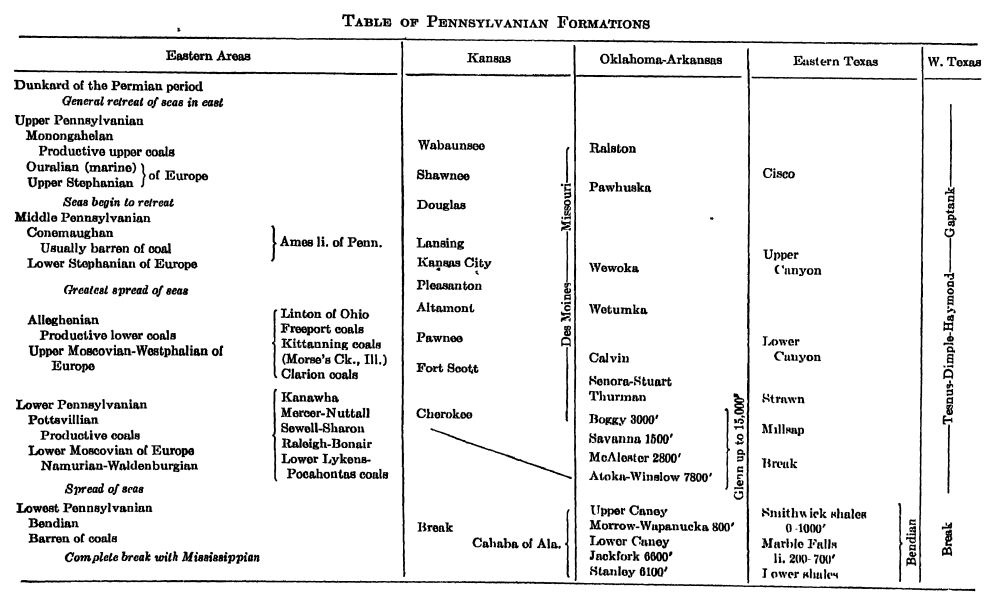
The seas submerged great parts of the continent, coming from the south and west over Texas and Oklahoma and overlapping the land northward into Nebraska and chiefly eastward into Pennsylvania. For a long time the seaways were small and restricted to Texas, Oklahoma, and Arkansas, and long before the submergence became general, three fresh-water deltas were forming, one centering about Pottsville, Pennsylvania, another about the Kanawha River, West Virginia, and the third in the area of the Cahaba Valley of Alabama. Finally these areas also came under the influence of the spreading seas at or before the close of Pottsvillian time. The submergence was most extensive in late middle Pennsylvanian or ConemaughCanyon time, when about 30 per cent of North America was again under the sea. It should be said, however, that during the last half of Pennsylvanian time, the sea-level was agaia decidedly oscillatory, due to local warpings of the land, for the Coal Measures are largely a series of interbeddings of shallow marine and brackishwater fiiner sediments with coarser ones of fresh waters. A final regression of the seas began late in this period, and they lingered longest west of the Mississippi and south of the Missouri rivers, retreating more and more to the southwest in very latest Pennsylvanian time, a retreat that was continued, also in an oscillating manner, throughout the Permian.
Great Coal Deposits. — The most striking feature of the Pennsylvanian or Coal Measures in North America and Europe is the fact [ p. 355 ] [ p. 356 ] that they contain the greatest known accumulations of coal. This has long been recognized and it led the older geologists to name the period the Coal Measures. It is true that much coal was laid down subsequently, and especially during the Permian, Jurassic, Cretaceous, and Cenozoic, but at no other time was so much valuable fuel deposited as during the Pennsylvanian. The great coal fields of China, according to the latest work of the Japanese and Chinese geologists, are probably all of Permian age. Because the nature of coal and its mode of formation are of such great importance to humanity, a special chapter will be devoted to them, and another one wdll describe the coal flora; in this chapter we shall present only a general statement of the main events and life characteristics of Coal Measures time.
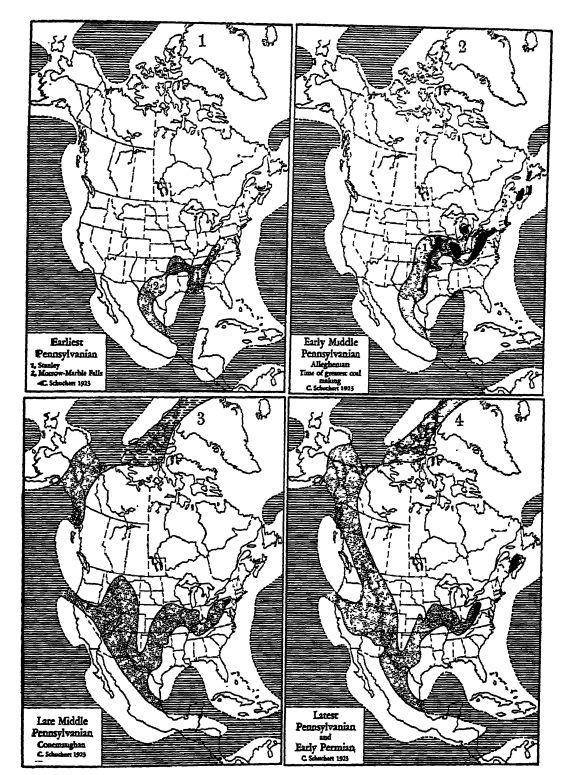
Epeiric seas dotted; oceans ruled. Fresh-water deposits cross-ruled; coal-making swamp areas in solid black. Note that the latter are in areas of the seas (1 = paralic coals), and in fresh-water basins of deposits (2 = limnetic coals).
Note the vanishing of the Appalachic geossmcline, and the spreading of the southern Cordilleric trough across Mexico. The former change is prophetic of the rising of the Appalachian Mountains, illustrated in Plate 32 (p. 425).
¶ Character and Significance of Deposits
In the Maritime Provinces of eastern Canada the Pennsylvanian is well developed and usually of very great thickness. The celebrated Joggins section of Nova Scotia is 13,000 feet in depth and consists entirely of continental deposits. The Cape Breton series is 10,000 feet thick and the Pictou field has a similar thickness. The Riversdale and Harrington beds (with marine zones) and the plant-bearing strata (“ fern ledges ” of fresh-water origin) near St. John, New Brunswick, are also of Pennsylvanian age. It is very rare for marine fossils to be reported from this region, and the few that have been foimd indicate early Pennsylvanian time. On Prince Edward Island the Permo-Carboniferous has an exposed thickness of over 6000 feet and consists of soft reddish shales and sandstones.
In the Appalachic basin east of the Cincinnati uplift, and in the greater Central Interior sea to the west of this axis and extending into Nebraska, Kansas, Oklahoma, and central Texas, the formations have alternations of marine deposits with coal accumulations (see Pl., p- 355). It was in these areas, therefore, that the sea-level was most oscillatory, and here the workable coals occur. In the Central Interior basin the coals are associated with more normal marine faunas and are interbedded with calcareous shales and limestones, this generalization applying in the main to the western side of the Cincinnati axis, and less to the eastern side. In the Appalachic basin the mass of strata is not onl y thicker but also coarser, consisting, in general, of sandy shales and sandstones with the marine and calcareous zones inconspicuous or, locally, even absent, the marine zones vanishing eastward. Here also the coal accumulations are [ p. 357 ] thicker, as the swamps were of greater areal extent and less often under the influence of the sea.
The essentially muddy and sandy deposits of PennsylvanianPermian time in eastern Kansas have a united thickness of about 4600 feet, thinning into Nebraska and Iowa but thickening greatly southward. To the south, the Cherokee dark shales change completely, passing more and more into a tremendouslj’ thick series of sandstones and sandy shales. To the south and southeast, there then lay a high land of large dimensions known as Llanoris, of which the Sabine uplift of Louisiana is a part. This is the land from which the sediments came, for Ozarkis and the rising Arbuckles and Wichitas were too small to have furnished the great thicknesses of the Pennsylvanian deposits of the south central area. West of Little Rock, Arkansas, into southeast Oklahoma occurs the thickest series of Pennsylvanian strata known anywhere in the world, with a depth of between 20,000 and 25,000 feet.
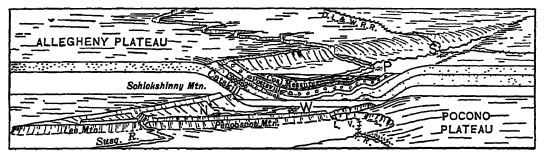
Fully 15,000 feet of these are as old as, or older than, the Cherokee shales, and below them lie other similar strata (Jackfork and Stanley) that attain a like thickness. We may add here that there are in the basal portion of the Stanley series from three to five tuff beds, each of which is from 6 to 85 feet thick, showing that active volcanoes were in existence nearby. The general thickness along the south side of the Arkansas valley H. D. Miser tells us is between 20,000 and 25,000 feet, of which fully 90 per cent is coarse clastic material. As one proceeds to the north and west and away from Llanoris, the lower half of this mighty pile, the debris of wom-down mountains, thins very rapidly and changes into dark muds and even into limestones of no great thickness (Caney shales up to 1500 feet, Morrow-Wapanucka limestones and shales up to 800 feet, and the equivalent of these in Texas, the Bendian series of limestones and shales, 4001900 feet).
There is as yet no harmony among stratigraphers as to the age of the series called in this book Bendian. The reason for this lack of decision is the general absence of fossils, and when such are present the animal remains are usually of black shales and therefore of long-ranging forms. They are therefore not diagnostic for detailed correlations, and even though the plant remains are by far the more significant, they are scant in quantity and appear to lack the proof of geologic [ p. 358 ] age that would be theirs if the American Mississippian had had a long and abundant sequence of floras. Hence we are dependent as yet in the main upon the field relations, but unfortunately the area is highly disturbed by folding and faulting; further dependence is had in the principle that a great series of elastics are indicative of new mountains that have arisen toward or at the close of a period.
After the above was written, Charles W. Honess showed the writer a series of fossils collected by him from the top of the Jackfork formation. These are clearly of Morrow-Wapanucka aflSnity. It is therefore held that the Jackfork series is the equivalent of the upper Caney shales and that all of these formations agree in age with the Bendian series of Texas. All are older than the usual type of Pennsylvanian formations.
In general, the series is an alternation of shale and sandstone, for the calcareous deposits of Kansas thin southward while the sandstones of Oklahoma vanish northward. Furthermore, the fossiliferous marine condition of these beds in Kansas gradually vanishes more and more toward Oklahoma, and the greater part of the higher series changes into the widely known red beds of that state, Texas, and the southern Great Plains coimtry (see Pl., p. 355, Fig. 4). With the appearance of the red deposits not only do the marine fossils disappear, but tremendously thick beds of table salt and gypsum occur. In western Texas, 2000 feet beneath the surface, there is also much potash. On going south in Texas, the amount of gypsum becomes less, the red beds yield very interesting amphibian and reptilian remains, and the time is toward the close of the Pennsylvanian or is Permian. It is apparent, then, from the above paragraphs, that the seas retreated at first in the east and north, and we shall see that the continuing Permian waters vanish more and more to the southwest. Study maps on pages 355 and 425.
Since petroleum is of organic origin, and chiefly from plants, it is but natural that the Coal Measures should also abound in oil. In the mountain areas this volatile substance has long ago been dissipated through the folding and fracturing of the Pennsylvanian strata. In the Ohio and Mississippi valleys, petroleum is also not abundant, possibly because these same strata are at the surface, permitting the gases and oil to escape into the air. But in the “ Mid-Continent Oil Fields ” of Kansas, Oklahoma, and north central Texas there are tremendous riches of these hydrocarbons. In Kansas, the pools occur mainly in the deep-lying Mississippian, and in Oklahoma and Texas at various levels in the Pennsylvanian. For other detail, see Chapter XX.
In the Cordilleran region, the record is very different from that of the eastern portion of the continent. In the area of the Rocky [ p. 359 ] Mountains and the Great Plains, wherever Pennsylvanian formations are known, they are as a rule of normal marine waters, and consist chiefly of limestones and calcareous shales, with local sandstones. Rarely is there an alternation of this condition with that of coal making, such as is found in the central and eastern parts of the. country. Coal beds are known, however, in many places in eastern New Mexico and Utah, and in western Colorado, but the coals are thin and have but little commercial value. They occur at the base of ihis Pennsylvanian, and represent the introductory swamp conditions before the area was wholly submerged by the invading seas. In general it can be said, therefore, that the Pennsylvanian of the Cordilleran region is made up in the main of limestones and calcareous shales, with but little sandstones, contrasting in this very markedly with the Pennsylvanian of eastern North America.
Along the entire Pacific area from northern California into arctic Alaska, the limestones and calcareous shales of the Pennsylvanian and the early Permian are interbedded with much extrusive igneous material. The thickness in California is not less than 4600 feet, with a maximum of 10,000 feet, while in the Copper River region of Alaska it is nearly 7000 feet. The calcareous deposits often abound in fossils unrelated to those foimd elsewhere in North America; they are of the Pacific, and seemingly of the northern Euro-asiatic, realm, while the life record of the eastern Cordilleric seas is of more southern Pacific, and seemingly also of Caribbean, waters and closest in relationship to those of South America; in the main it is best regarded as constituting the North American province.
¶ Life of the Pennsylvanian Period
Cosmopolitan Land Floras. — We have seen in earlier chapters that plant combinations or floras are not known earlier than the Middle Devonian. Although their description is deferred to a later chapter, it may be stated here that with the Pennsylvanian, land plants began to be common in America, and that the swamp floras were then luxuriant, large, and varied. Furthermore, these floras, and the land animals as well, were not only very much alike in the different lands of the northern hemisphere, but there was a marked similarity even between the floras of the two hemispheres during the greater part of Pennsylvanian time (see Fig., p. 360). In other words, the floras, and to a lesser extent the faunas, were cosmopolitan, and their similarity was undoubtedly due to equable climates and easy migration across the extensive east-west continent [ p. 360 ] [ p. 361 ] Eris. Their distribution was further facilitated by the fact that most of the plants had spores, or microscopic reproductive germs, which could be widely blown about by air currents (see Pl., p. 377, Figs. 4-6).
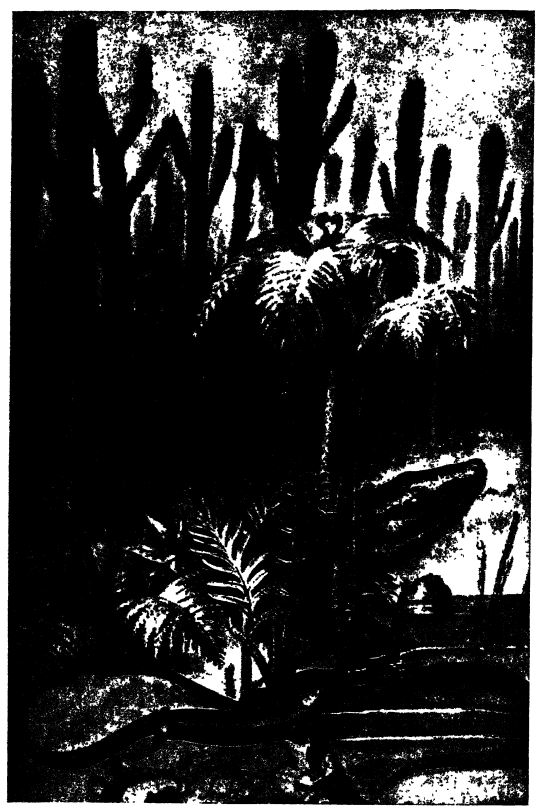
The late Mississippian flora, according to David White, was impoverished, restricted, and stunted, and yet out of this unpromising assemblage came the Pennsylvanian succession. Early in the Pennsylvanian (early Middle Pottsvillian) the flora had expanded and differentiated largely, with a further rapid expansion a little later (through the Pottsvillian into early Alleghenian time). Still later (Conemaughan) most of the gigantic lepidodendrons vanished, along with a great reduction of the spore-bearing plants. Toward the close of Pennsylvanian time (Monongahelan), the seed plants began to differentiate rapidly and to displace the spore-bearing forms. It was then that the first distinctly cycadaceous plants appeared.
Insects. — According to Handlirsch, the Viennese authority on fossil insects, there is no evidence of these animals older than the Lower Pennsylvanian. However, there is good ground for believing that they may have arisen in the Devonian (see Pl., p. 363).
The Pennsylvanian was the time of giant insects, the largest ever known. The maximum size was reached by those of the dragon-fly type, one of which, found in the Coal Measures of Belgium, measured 29 inches across the wings. Out of four hundred forms known from the Lower and Middle Pennsylvanian, all but one had a wing length of over 0.38 inch, while more than twenty had a length of 4 inches, six attained to nearly 8 inches, and three to 12 inches or more, the average being 2 inches. In the earliest Permian there were also large forms, but soon afterwards began a decline in size which continued throughout the Permian and Triassic and culminated in early Jurassic time. At no period since the Pennsylvanian have insects grown so large, and their rapid decrease in size after the Pennsylvanian can only be connected with the drier and colder climates of Permian and Triassic times.
The Permsylvanian well deserves its title of the Age of Cochroaches, since more than eight hundred kinds are known from rocks of this period (Pl., p. 363, Figs. 3, 4). They were mainly carnivorous, and as a rule large, several attaining a length of 3 to 4 inches. While no species were common to America and Europe, their resemblances are marked, indicating an easy land passage from one continent to the other.
[ p. 362 ]
There are now known about 1300 species of insects from the Pennsylvanian and Lower Permian strata. They are still scarce in the Lower Pennsylvanian, but in the middle and upper thirds of the system are common. The oldest forms, known as Palseodictyoptera (170 kinds), were especially prevalent in the Pennsylvanian, and all died out during the Permian (see Pl., p. 363, Figs. 1, 2). They were, as a rule, large in size and of primitive structure, and led an amphibious life, their youngest or larval stage being spent in the water. In general, they were not carnivorous animals, but as they had powerful chewing mouths it is thought that they fed on plants and on sluggish or dead animal matter. They had four straight wings, all alike, which projected sideways like those of the modern dragon-flies and could not be folded back over the abdomen as in most modern insects. The thorax had three large segments, followed by a long and slender abdomen in which the segments were alike, ending in two long cerci or appendages connected with the breathing organs, as in the living may-flies. Their eyes were compound and their antennae simple.
These primal insects gave rise to several transitional stocks, which in turn changed into the modern insects, such as the dragon-flies (Odonata), cockroaches (Blattoidea), and grasshoppers (Orthoptera).
Scorpions and Spiders. — In the Pennsylvanian are found scorpions, which, ancient as they are, much resemble those of modern times. Associated with them we see many forms of rather stout spider-like animals, having a cllstinct cephalothorax (head-trunk), and usually a large abdomen, the latter with four to nine segments; in none of them, however, are known anal spinnerets, or organs for the making of webs (see Pl., p. 363, Fig. 5). Those with smaller abdomens, and therefore nearer the true spiders, also occur in the Pennsylvanian rocks, but are very rare fossils.
Thousand-legs or Myriapoda appear in the Lower Devonian (Old Red of Scotland) and are plentiful in association with the Pennsylvanian floras of America. The average species was about 2 inches in length, but at Mazon Creek, Illinois, there lived one that had a length of about 12 inches and was 0.75 inch thick. All had double pairs of legs. The head was large, and had great lateral compound eyes, in some of which there were a thousand lenses. In habit some at least were amphibious, and others appear to have been completely adapted to the land.
Land Snails. — There is no evidence of air-breathing or land snails until Middle Pennsylvanian time. The greatest number of individuals have been taken by Dawson from the hollows of fossil tree stumps (Sigillaria) at South Joggins, Nova Scotia. All of the species are small.
Fresh-water Clams. — In many of the coal areas, in dark, very fine-grained shales, both in North America and more especially in western Europe, are found great quantities of small and large bivalves (Carbonicola, Anthracomya, and Naiadites) which suggest living river and lake shells (Unio, Anodonta, Dreissensia). It is therefore certain that the rivers at least since Pennsylvanian time have been stocked with an abundance of living food for fishes.
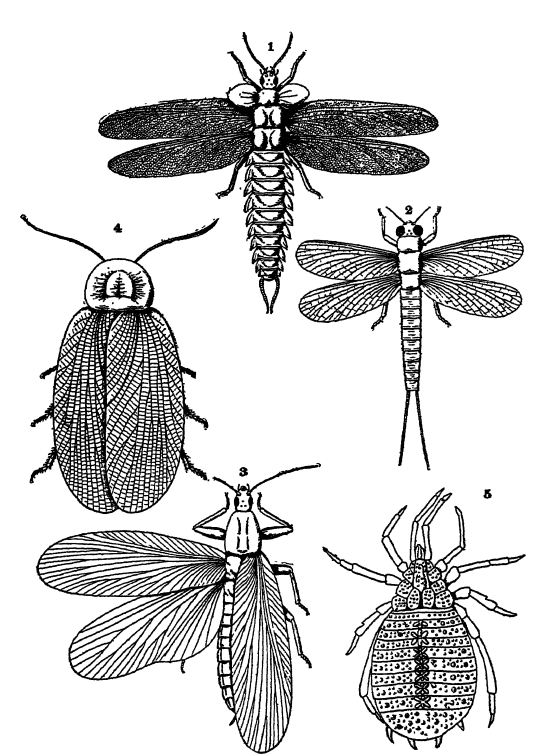
Fig. 1, Stenodidva lobata, 2, Eubleptus danielsi, x 1 ⅓; 3, Eucænus ovalis; 4, Aphthoroblattina johnsoni, x ½; 5, Eophrynue prestwichii, x 1 ½. Figs. 1—4 after Handlirsch.
Land-living Vertebrates. — In the Pennsylvanian deposits there is much evidence of the presence of many kinds of Amphibia (forty [ p. 363 ] [ p. 364 ] six genera) and their bones become increasingly more abundant in the strata of later times, as described in Chapter XXX. The Amphibia are most common in the Pennsylvanian, and their origin goes back to at least the Middle Devonian. The remams of Reptilia, on the other hand, which dominated the land of Permian time, appear first in the Upper Pennsylvanian (see Figs., pp. 407 and 413).
At Linton, Ohio, occurs the Freeport coal of the Alleghenian series, and beneath this humic coal is found a thin local deposit of cannel coal. This is the first material laid down in an open fresh-water pool in an extensive swamp in which the coal flora grew and accumulated. In the cannel coal has been found an abundance of ganoid fishes and over fifty species of flesh-eating amphibians (Stegocephalia). They range from 6 inches up to 10 feet in length, and nearly all of them are known only from this place — a limited glim pse of what must have been a highly varied and prolific amphibian fauna. Curiously, almost no other animal life is preserved. (See Fig., p. 360.)
The very varied amphibian fauna of the coal swamps, summarized by Moodie, contains representatives of no fewer than seven orders, nineteen families, forty-six genera, and eighty-eight species. They are therefore seen to be a highly varied group of land animals, ranging in size from less than 2 inches in length to as large as an adult Florida alligator. Most of them, however, were small creatures related to the living salamanders, but being more primitive, are known as branchiosaurs and microsaurs. They were rather sluggish animals, living about or in the water, as is indicated by the known larval stage of branchiosaurs. They were more or less protected against their enemies by an external body armor, and because of this are also known as stegocephalians (from the Greek word meaning cover and head) to distinguish them from the salamanders. They had their best days in the Pennsylvanian, and their further evolution will be discussed in the chapter on the Penman period.
Life of the Seas. — The invertebrate marine life of Pennsylvanian time was not only prolific but also very varied. It was, moreover, a cosmopolitan one, the Coal Measures faunas being everywhere very similar. In Kansas are known nearly 400 kinds of invertebrates; of shelled forms alone there are 234, divided as follows: brachiopods 46, bivalves 111, gastropods 51, and cephalopods 26. The commonest shelled animals were the spiny brachiopods (Productris), Nearly all of this cosmopolitan life was, however, blotted out before the close of the Paleozoic. (See Pl., p. 365.)
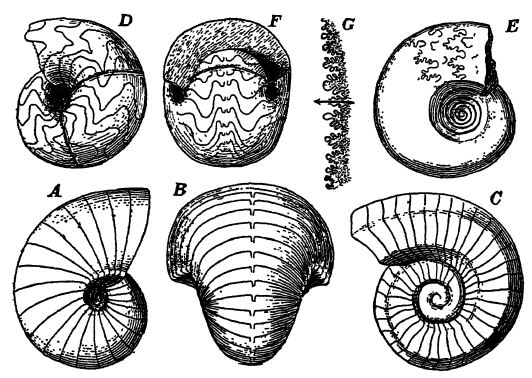
Brachiopods are the common fossils of Pennsylvanian time in this country but their places were being taken more and more by the bivalves. The same faunal change also went on in northern Europe, [ p. 366 ] but in the Mediterranean region (called Tethys) extending from Sicily into India, the waters still swarmed with brachiopods into Permian time. While the brachiopods were vanishing, the shelled cephalopods in the goniatid and ammonid stocks were rapidly changing into a variety of forms characteristic of Permian times (see Fig., below).
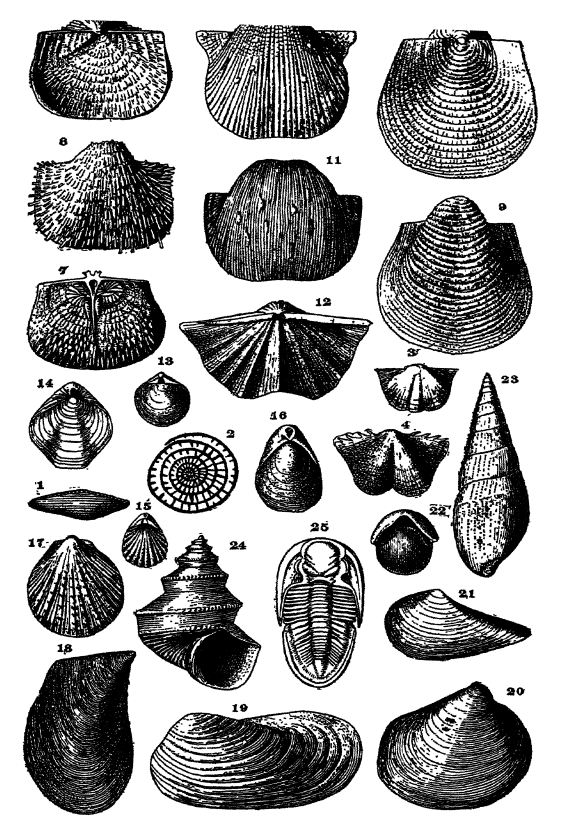
Fig. 1, Triticites secalicus x 2; 2, same cut through center, x 8; 3, Chonetes mesolobus; 4, C, verneulianus, x 2; 5-7, dorsal and ventral valves, and dorsal interior of Productus nebraskaensis; 8, 9, P. punctuatus x 10, P. semireticulatus; 11, P. com, x I; 12, Spirifer cameratus, x I; 13, AnibwxBlia planooonttexa, x 2; 14, Composita subtilita, x 15, Mustedia mormoni; 16, Dielasma bovidens; 17, Pseudomonotis hawni, x I; 18, Myalina subquadraia, x 19, Allorisma suhqmdrToium, x 20, Schizodm harii; 21, Leda. heSistriata, x 3; 22, Euphemus carbonimus 11 . Soleniscus fusiformis; 24. Worthenia tabulata; 25, Phillipsia
Fusulinids. — Among the minute and lowly organized animals little has as yet been said about the Protozoa, whose individual organization is contained in a single cell, and which represent the first form of animal life. These Protozoa are tiny, naked or shelled globules of streaming protoplasm, with a central, more solid sphere known as the nucleus, which is the actual seat of vital energy or life. They sometimes live singly, but more commonly are combined into colonies. They are known as fossils since the Middle Cambrian, but were not rock makers until later Mississippian time. The forms with calcareous shehs are known as the Fcraminifera, a name referring to the numerous perforations in the shell. Of these, in the Pennsylvanian and early Permian the fusulinids (meaning spindle-form; the colonies look like grains of wheat) abounded on the bottoms of the seas and were often limestone makers (Pl., p. 365, Figs. 1, 2). They are known almost everywhere in the northern hemisphere where Pennsylvanian deposits occur. Even in far northern Spitzbergen above 76° north latitude their fossils are still abundant. Similar colonial foraminifers live to-day only on the bottoms of warm-water seas and on coral reefs.
[ p. 367 ]
¶ The Mountains of Pennsylvanian Time
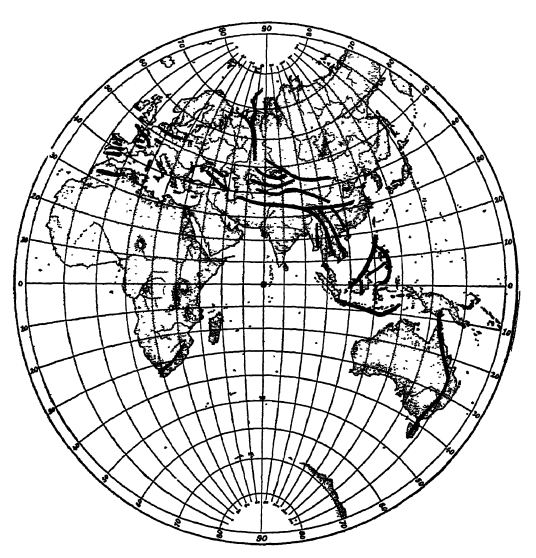
Paleozoic Alps of Europe. — The late ilississippian and Pennsylvanian periods were times of marked crustal movement, resulting in far-reaching changes in the distribution of land and sea. In central and western Europe, the movements began shortly after the close of Culm time, were renewed in the Upper Carboniferous, and again in the Permian. In the heart of Europe there arose a mighty chain of folded mountains, the Paleozoic Alps of Europe, whose stumps of massive rocks may be seen in Germany, France, Belgium, England, and Ireland to-day (see map, p. 352; their general distribution is shown in Fig., p. 387, of Pt. I). The western ranges extending from Ireland across Wales and southern England (the Mendip system) to the central plateau of France, Suess has named the Armorican Mountains; the eastern ranges extending from southern France across the Vosges and the Black Forest to the Thuringian Forest, the Harz, the Fichtelgebirge, Bohemia, and the Sudeten, and possibly even farther east, he calls the Variscian Alps. Mountains also arose in the Pyrenees, the Spanish Meseta, Corsica, Sardinia, and the Alps. The folding of the Urals likewise began in later Carboniferous time and attained its climax in the Permian. Even in Armenia, central and eastern Asia (Altai, Tianschan, etc.), and South Africa, Australia, and the Andes can be followed the traces of the moxmtain-making movements of this time (see Fig, p. 368).
D. N. Wadia states that in late Pennsylvanian time there was in the Himalayan region “ a great revolution in the physical geography of India," and that this orogeny blotted out for a time the Tethyan sea.
Intrusives. — Hand in hand with these dislocations arose enormous masses of eruptive rocks, especially granite in stocks and bathyliths, accompanied by porphyries of various kinds. The granitic rocks of the Harz, the Thmingian Forest, the Erzgebirge of Saxony, the Vosges and other regions are of Carboniferous age. Outside of Germany the intrusions of granite (mainly laccolithic) and other eruptive rocks played a large r61e in the Carboniferous; for instance, in Brittany, Cornwall, Scotland, and southern Norway.
The Rising Mountains of North America. — Just as high moxmtains arose in western Europe shortly after the close of the Lower Carboniferous (Culm or Dinantian), so similar ones came into being in America at the end of the Mississippian. In the chapter on the latter period was described the rising of moxmtains in Alabama, Arkansas, and Oklahoma, and others in eastern Canada. We will now trace the renewed risings of those areas in Pennsylvanian time.
[ p. 368 ]
The ancient land Llanoris of Louisiana and Texas was in movement. we are told by McCoy, early in the Pennsylvanian (close of Bendian series) and again later in this period (Cherokee time). Toward the close of IMiddle Pennsylvanian time (Canyon) came into being the Arbuckle Mountains of Oklahoma, and at the close of the period the Wichitas farther west in the same state. These movements are equivalent to the Hercynian ones of Europe.
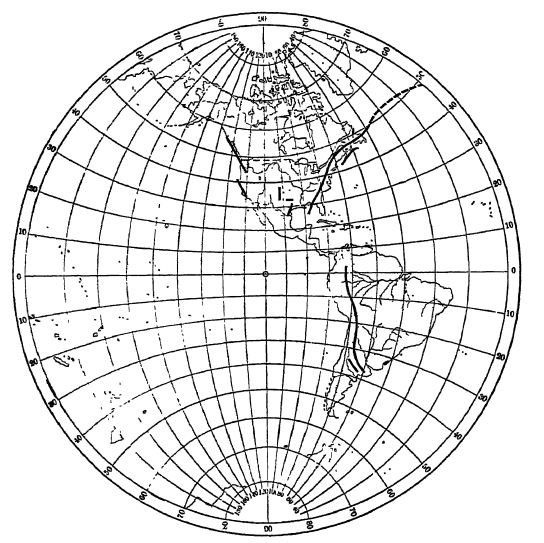
The coarse and. thick deposits of the late Pennsylvanian and Perm ian in New Mexico, Colorado, and Wyoming , known as the red beds, have recently been interpreted by Lee as the debris brought down from a newly arisen area to the east of them. These mountains, the ancestral southern Rockies, were also the source for most of the red beds of central Texas and Oklahoma, a region that in Pennsylvanian time, however, was getting its sediments from the southeast [ p. 369 ] or Llanoris. This orogeny completely changed the geography of the area of the southern Rocky Mountains, and different seaways with different faunas lay on either side of these mountains.
Along the Pacific border the Pennsylvanian marine formations are interbedded with much extrusive igneous material, testif;ying to an abundance of volcanoes from northern California north into Alaska, and these seemingly show that mountains were also forming here.
The region of New Brunswick and Nova Scotia of the Acadian area is a fine one to illustrate in intermontane marine and continental deposits a successive series of elevations. Here may be studied two movements that made for intermontane seaways, and four that are recorded in fresh-water valley deposits. The first movement, toward the close of the Devonian, let in the sea only partially (HortonAlbert series) ; then came the second orogeny, bringing in the Windsor sea of late Mississippian time. This period was closed by a third time of mountain making, which blotted out in Acadis nearly all the seaways. In Pennsylvanian time the fourth movement came early in the Westphalian, and the fifth after this epoch. The sixth is of Permian time.
Bell, in his studes of the Acadian region, tells us that in early Mississippian time there was laid down about 3400 feet of coarse fresh-water deposits (HortonAlbert) . Then came the first of four movements of Carboniferous time. Limited seaways entered in between the mountains and laid down about 2000 feet of late Mississippian formations (Windsor). In latest Mississippian time there was a second period of mountain making, which appears to have been the strongest of the four. The succeeding continental deposits, of Pennsylvanian age, in their overlapping and transgressive character, all show more or less of an angular unconformity beneath them. The first of these are the conglomerates of southern New Brunswick, followed by the Lower Westphalian coal series of New Glasgow, the Fern Ledges of St. John, and in part the Millstone Grit of the Sydney area and Prince Edward Island, together having a thickness of more than 5000 feet. Next came the third erogenic movement, of Middle Westphalian time, resulting in the conglomerates of the Joggins, Parrsboro, and New Glasgow areas, and the late Westphalian coal series of the Joggins basin, with a total thickness of more than 6800 feet. Finally came the last of the four Carboniferous deformations, of post-W estphalian time. It was followed by the deposition of the youngest conglomerates of the Joggins area and the Lower Stephanian coal series of Sydney, whose thickness is not less than 2100 feet (6000 feet in Prince Edward Island). Finally, in Permian time, there was another deformation, since none of the Carboniferous strata remain in their original attitude of deposition.
¶ Climate
Previously it has been stated that the late Mississippian flora was an impoverished, restricted, and stunted one, while that of Lower Pennsylvanian time was much expanded and differentiated, [ p. 370 ] leading White to conclude that an “unmistakable climatic amelioration” had taken place.
In this connection it will not be amiss to point out that Taff in 1910 reported the finding in the Caney shales of southeastern Oklahoma (near Talihina) of grooved and striated limestones, and erratics in sizes up to 50 feet across. The markings on these stones Woodworth ascribes to internal rock movements accompanying the faulting of the beds. He agrees with Taff, however, that the distribution of the bowlders, aside from the nature of their striated surfaces, demands transportation by ice. Further, that at the time of the Caney the climate was cold enough to permit “ floating ice in continental bodies of water and also in the sea in middle latitudes ” (1912). To these opinions may be added another by Ulrich, who also concluded that these erratics of the Caney owe their transportation to “ heavy shore ice” (1920). This was in earliest Pennsylvanian time when there were high mountains in Llanoris.
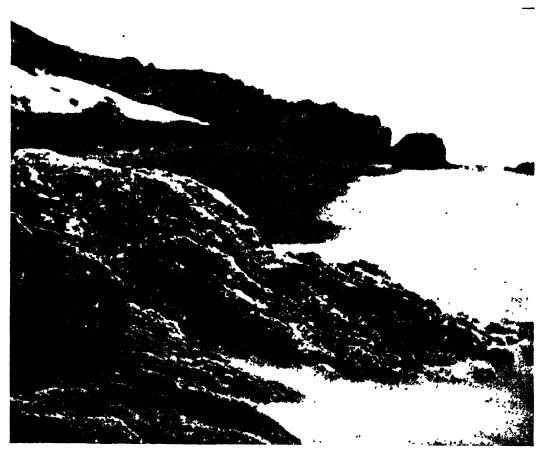
From this cooler climate of earliest Pennsylvanian time, those of later epochs became rapidly warmer, equable, and humid. Great swamps at sea-level in many lands of the northern hemisphere were storing vast quantities of coal — carbon taken from the atmosphere [ p. 371 ] and water — and even greater amounts of carbon dioxide were being laid away in the limestones of the seas and oceans. Proof of a mild climate is found in the luxuriant coal floras, which are devoid of all evidence of a non-growing season, that is, the logs have no growth or annual rings until near the close of the Pennsylvanian; in the profusion and great size of the insects; in the wide distribution of the fusulinids; and in the occurrence of coral reefs in Spitzbergen (Fig., p. 370). With the rise of the European Alps the floras underwent changes, and these changes were more marked in that continent than in America, for the floras and insects of earliest Permian time in the United States still indicate a climate devoid of winters, though the air was drier, the red beds and gypsum deposits pointing rather to a semi-arid chmate.
The semi-aridity of early Permian time begins to appear in late Middle Pennsylvanian time (Conemaughan), when the spore-bearing plants were greatly reduced in numbers, and there appear for the first time the pinkish colored strata which indicate “ short dry seasons ” and a climate still free of frost. The same climate was continued in the Upper Pennsylvanian, and the seed-plants began to expand rapidly, along with the first introduction of cycadaceous forms. Then shortly after earliest Permian time a marked reduction of climate took place, leading to the development in the southern hemisphere of the cool-climate flora to be described in the chapter on that period.
¶ Iron-ores and Fire-days of the Coal Measures
Iron-ores. — In places where coal beds abound one rarely sees red or yellow rocks. The color is generally gray to light greenish, or even whitish, for the sandstones, while the shales, though they may be greenish to black above the coal beds, are usually more or less white clays beneath them. This lack of strong red and yellow colors, which are produced in rocks by ferric oxide (hematite and limonite), is due to the fact that in the presence of organic matter, either in the coals as they were deposited or in the solutions passing downward from them, the ferric iron is reduced to ferrous and then unites with carbon dioxide to form ferrous carbonate. The latter is not a coloring agent and by this change, the chemical aspect of which has been previously discussed, Pt. I, page 172, the strata are decolorized except as they may be gray to black from included carbonaceous material. As shown on pages 172 and 181 of Pt. I, the ferrous carbonate thus formed, being, like carbonate of lime, soluble in water containing carbon dioxide, may be removed in solution, [ p. 372 ] leached out and concentrated elsewhere. By passing into shallow bodies of standing water the carbon dioxide might escape, the iron be re-oxidized by the aid of the iron bacteria and precipitate as hydrated ferric oxide (limonite), forming the so-called hog iron-ore. But in the presence of abundant organic matter, such as the swamps and marshes of Carboniferous time possessed, this re-oxidation was prevented and the iron concentrated and deposited as the ferrous carbonate. Sometimes the iron-ore was mixed with more or less clay from muddy water and this variety is known as day iron-stone; in other cases it was more or less mingled with black peaty matter, in those swamps where there was prolific vegetation, and this forms the valuable black-band ore, which occurs in Ohio and Pennsylvania.
These iron-ores are found in beds of any thickness up to 50 feet, but are usually under 4 feet, and like the coal beds may be repeated many times in a section. They are also often underlain by fire-clays, or the iron-stone concretions occur in the clays.
Fire-clays. — Fire-clays, when impure, are more or less sandy, but are usually aluminous. The aluminous type is the true fire-clay, and is so named because it is capable of resisting heat to a high degree and is much used for making fire bricks to line the insides of blast furnaces. The purest white clays are used for the making of pottery and tiles. The purity of these white clays is due to the presence of carbonic acid in the depositing waters, which takes away the iron and also the particles of feldspar which it decomposes. When some of the feldspar still remains, furnishing soda, potash or lime to act as fluxes, the clays are fusible and are not good fire-clays.
¶ Collateral Reading
J. W. Beede, Carboniferous Invertebrates. University Geological Survey of Kansas, Vol. 6, 1900, pp. 1-187,
J. W. Beede, A. F. Rogers, and E. H. Sellards. Coal Measures Faunal and Floral Studies. Ibii, VoL 9, 1908, pp. 315-480.
H. Hinds, F. C. Greene, and G. H. Girty, The Stratigraphy of the Pennsylvanian Series in Missouri. Missouri Bureau of Geology and Mines, 2d series, VoL 13, 1915.
K. F. Mather, The Fauna of the Morrow Group of Arkansas and Oklahoma.
Bulletin of the Scientific Laboratories of Denison University, Vol. 18, 1915, pp. 59-284.
L. F. Noble, A Section of the Paleozoic Formations of the Grand Canyon at the Bass Trail. U. S. Geological Survey, Professional Paper 131-B, 1922.
F. B. Plummer and R. C. Moore, Staatigraphy of the Pennsylvanian Formations of North-Central Texas. University of Texas, Bulletin 2132, 1921.
D. White, Deposition of the Appalachian Pottsville. Bulletin of the Geological Society at America, Vol. 15, 1904, pp. 267-282.