| XXVIII. The Rise of the Land Floras | Title page | XXX. The Rise of Land Vertebrates and the Dawn of Reptiles |
[ p. 389 ]
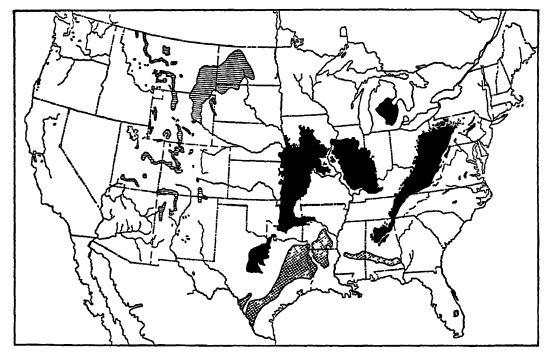
Carboniferous Time. — The most conspicuous feature of the rocks of Carboniferous time is the many beds of valuable coal which they contain. In North America nearly all the coal of this time was laid down during the Pennsylvanian period in the eastern United States and the Acadian provinces. In other words, the Pennsylvanian coals of North America occur east of the 100th meridian, while most of the younger coals lie to the west of it (see Fig., p. 402).
The more valuable coals of Europe and China were also deposited during the Carboniferous, though in Europe the accumulating began earlier and lasted longer. By far the greatest amount of good coal in the world was laid down during the time of the Coal Measures; it has been estimated that seven tenths of it was formed in these, the closing periods of the Paleozoic era.
¶ Nature and Varieties of Coal
Nature of Coal. — Coal is a compact mass of plants more or less altered through decay, the end result of which is mainly carbon. The plants accumulate in swamps as peat, and how peat is formed is explained on pages 175-179 of the first part of this book; now we must consider how the plant material comes to be changed into coal.
Ordinary coal is a compact, stratified mass of plants which have in part suffered decay to varying degrees of completeness. Coal, however, is often also mixed with more or less of local and foreign impurities, usually muds. The plants of a coal may all have been of one kind, but usually are of several or many kinds; when subjected in thin slices to the microscoi>e, however, the recognizable parts are seen to be most often the chemically tough coverings of spores. Some coals appear to be structureless, a sort of solidified jelly breaking readily into cubical blocks, while others are indistinctly fibrous. Along the bedding planes may often be seen fragmentary plants. When heated, bituminous coals soften or even fuse; but it is a mistake to think there is bitumen present, [ p. 390 ] since these coals consist largely of carbon, with some oxygen and hydrogen. They are therefore better spoken of as humic coals, since all coals consist of vegetable matter. When the plant materials decompose in the presence of water, and more or less excluded from the chemical changes of air, there is liberated some carbon dioxide gas; in other words, there is a continuous loss of some carbon and of more oxygen. The process of change is one of carbonization through biochemical decomposition (mainly bacterial) of the greater part of the plants while still in the bog. This decomposition, if continued for a long time, finally changes the vegetable matter into hmiiic coal through the loss of carburetted hydrogen or illuminating gas. During the geological ages occur the succeeding djmamo-chemical changes through the further loss of hydrocarbons, due in the main to pressure exerted by the superincumbent strata (load), or that produced by their folding during the time of mountainmaking. The gases then escape either through the pores or the cracks (joints and cleavage) in the strata, but the success of this escape is again dependent upon the presence of overlying shale beds and their internal construction (grain). In general, the shale beds are impervious to the gases and the circulating ground waters, but when sandy or cleaved through deformation, the chances of escape are greatly enhanced, resulting in anthracite coals that are 95 per cenf fixed carbon.
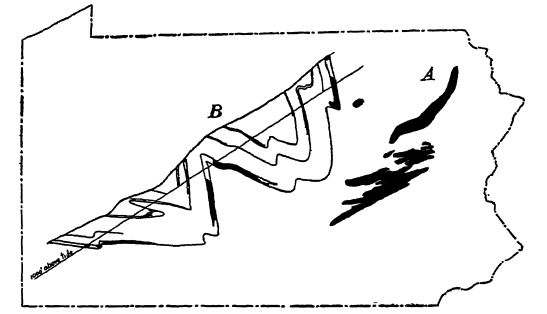
Carbonization of Coals during the Geological Ages. — Anthracite differs from humic coal in having more fixed carbon and less of the volatile hydrocarbons. It is well known that volatile matter is constantly escaping from coal, and that the gases thus released may become ignited, causing explosions in the mines. If the volatile matters had been constantly escaping during geologic time, due to the dynamo-chemical changes, we should expect all of the oldest coals to be anthracitic, which, however, is far from being true. On the other hand, anthracite is almost invariably found in strata that are more or less folded, as in the anthracite field of eastern Pennsylvania (see Fig., 391), and when the strata are much deformed the coals are graphitic, as in Rhode Island. Other anthracite fields also in the areas of mountains are those of northwestern Colorado, southwestern Utah, the Cascade Mountains of Washington, and the Cerrillos field of New Mexico. Because of these occurrences it has long been assumed that the mountain-making forces have in some way brought about the change.
Coal beds are nearly always covered by a shale zone, and in coal fields there are always many coal beds and many more zones of [ p. 391 ] shale than coal. These shale beds prevent the volatile matter of coals from escaping. In the Ohio-Pennsylvania-West Virginia area there are, however, ten horizons of valuable oil in the sandstones, showing that the volatile matter does to a certain extent migrate.
In mountain-making processes it is well known that shales and limestones stretch far more than sandstones and dolomites, and that they do not pull apart so readily, forming rents. However, when the deformation is marked, all of the rocks are much cleaved, as is well shown in the roofing slates of mountainous regions. It is in these areas that the anthracite coals are found (see Fig., below). What more natural inference than that the anthracitic and graphitic coals have lost their volatile hydrocarbons, not so much through the pressure engendered during the time of moimtain making as by the cleavage and shattering of the strata, thus permitting the oil and gas, in the course of time, to escape?
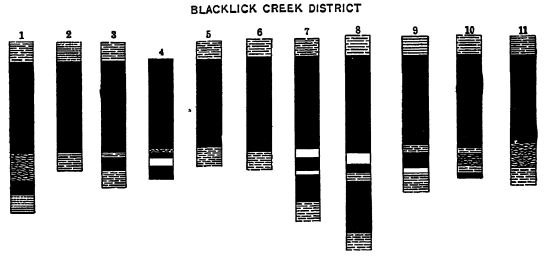
Proofs of the Derivation of Coal from Plants. — We shall see that coals, as a rule, lie upon clays filled with roots, and even upon the floors of the former forests. In the roofing shales of coals are to be seen well-preserved fern fronds and the woody stems of many kinds of plants. Many of these stems are covered with a film of coal like that of the coal beds. In the coal itself it is common to see thin zones of impure coal, the worthless hony coal of miners (see Fig., p. 392 ) ; this is more or less mixed with clay, the result of coal formation where the marshes were invaded by water currents bringing in [ p. 392 ] mud, and such zones always show plant remains and often very good ones. In fact, in almost any coal, even the anthracites, when allowed to weather, we may see plant fibers.
Good specimens of Lepidodendron, Sigillaria, and Calamites may be had along some of the bedding planes of the coal. They occur also in the textureless cannei coal (described on p. 393), as in Breckenridge County, Kentucky, where the coal is marked through its whole mass by stems and leaves of Stigmaria and Lepidodendron, rendered distinct bj” infiltration of sulphid of iron. Even when nothing of an organic nature is discernible to the imassisted eye, the plant composition of the coals can be made out if suitably prepared thin sections are studied under the microscope. Finally, even the ashes will show vegetable cells.
LeConte has truly said that “ a perfect gradation may be traced from wood or peat, on the one hand, through brown coal, lignite, bituminous coal, to the most structureless anthracite and graphite, on the other, showing that these are all different terms of the same series. In chemical composition, too, the same unbroken series may be traced. Lastly, the best and most structureless peat, by hydrauhc pressure, may be made into a substance having many of the qualities and uses of coal.”
Animal Material in Coals. — Fishes, amphibia, and certain kinds of invertebrate animals are at times found in some abundance in certain coals (Linton, Ohio, Fig., p. 360), and there can be no doubt that their decomposed remains have yielded considerable carbonaceous material to the peaty or more volatile varieties.
[ p. 393 ]
Varieties of Coal. — The varieties of coal depend upon the purity, the degree of carbonization, and the proportion of fixed and volatile matter. As has been seen, coal consists both of plant or combustible and inorganic or incombustible matter. The relative proportion of the latter varies considerably; good coals have from 1 to 5 per cent ash, while the so called bony coal has from 30 to 40 per cent and is thrown away at the mines. When the ash content is very low, it is wholly the mineral matter taken up by the plants from the ground along with the water; but when there is more than 6 to 10 per cent, it is probably all muds of the bog waters deposited with the plants.
Anthracite is the most carbonized, hardest, and most ideal coal for domestic purposes, since it has the greatest amount of fixed carbon, 90 to 95 per cent. It is a brilliant variety, with conchoidal fracture and high specific gravitj", but of low heating power. It has lost nearly all of its volatile materials, and such coals are always found in areas of regionally disturbed and more or less metamorphosed strata. When the coal consists wholly of fixed carbon, it is called graphite. This is not usually considered a variety of coal, because it is not readily combustible, but it is evidently the last term of the coal series.
Semi-anthracite is also a hard coal, which has from 80 to 85 per cent of fixed carbon and from 15 to 20 per cent of volatile matter. It is less metamorphosed through regional deformation than anthracite. These coals look much like the former, but are more iridescent in color, burn freely, and do not cake and clog. Their heating quality is high. They are also often known as steam coals.
Humic coals (from humus or vegetable mold) are perhaps the commonest kind, and may be regarded as typical coal. They break rectangularly and hence are often called block coals. They are usually known as soft or bituminous coals, but the latter term is misleading, since coals are not formed of bitumen but of humic materials. In these coals the volatile matter is from 30 to 50 per cent, and hence they fuse and cake when burning; they are therefore used in the making of coke- When the volatile matter approaches or exceeds 50 per cent, the coal is said to be “ fat ” and is much used in the making of illuminating gas and coke. Cannel coal (a corruption from “ candle coal,” so called because it bums readily with a candle-like flame) is one of the fattiest of coals, and generally rich in hydrogen. It is a dense, dry, structureless, lustreless, black type, breaking with a conchoidal fracture. When the supply of petroleum and natural gas gives out, these coals will be much used in the making of substitutes for them. The cannel coals owe their fatty nature to the kmd of plant material of which they are composed, mainly spores that have been converted into jelly-like masses by the bacteria of the bogs.
Lignites are the brown coals that have a woody or clay-like appearance, and when green have water up to 40 per cent. Their heating value is low. Upon drying in the air, lignites dack readily and break up into flat pieces parallel with the bedding. They are in the main of Mesozoic or Genozoic age.
Sulphur in Coal. — Sulphur increases the liability of coal to spontaneous combustion, and more than 1.5 per cent spoils the coal for the manufacture of gas or blast furnace coke.
[ p. 394 ]
The amount of sulphur in coals of Pennsylvanian age is very variable, from a trace to nearly 9 per cent. The average amount in ten anthracite coals from eastern Pennsylvania is 0.6 per cent (0.4-1.0); in seventy-seven humic coals from the western part of the same state it is 1.4 per cent (0.4-5.8); in twenty-four soft coals from Ohio it is 2.2 per cent (0.4-6.3); and in the IndianaIllinois coals, nineteen samples averaged a little over 2.0 per cent (0.3-4). The anthracite coals of Pennsylvania and the humic ones of the Joggins field appear to be wholly of fresh-water origin, and they have the smallest amount of sulphur. All the other coals are interbedded with strata having more or less of marine faunas, and as these coals are of marshes that were often somewhat under the sea-water, where the sulphur-making bacteria were most abundant, the sulphur content is accordingly far greater. Hydrogen sulphide is found in great abundance in peat beds to which sea-water has access, according to C. A. Davis, and is seldom found in peat formed under fresh water.
Rate of Coal Accumulation. — In the North Temperate region the present peats accumulate in swamps at the rate of about one foot in 10 years. This one foot of plant material, however, after it is covered with 15 to 20 feet more of accumulation, is decomposed, mainly by fungal and bacterial agencies, to about one inch of peat. It appears, therefore, that the present rate of accumulation when measured at a depth of about 18 feet is about one foot of peat per century. On the other hand, it has been noted that plant stems in coal are now from one seventeenth to one twenty-fourth of their original thickness, and this gives some idea how much material is lost in passing from green plants to coal. During Pennsylvanian times, when plants grew luxuriantly, David White thinks the accumulation may have been at the rate of 2 feet per century. Ashley has estimated that if compressed peat accumulates at the rate of one foot per century and the same thickness of coal in three centuries, then it has taken 2100 years to form 7 feet of good coal like that of the Pittsburgh bed. This estimate is probably extreme, because this coal accumulated under a subtropical climate with luxuriant growth. Even so, the biochemical changes are followed by the dynamo-chemical ones resulting from pressure of the superimposed load and from crustal movements, which still further consolidate, devolatilize, and dehydrate the fuel.
As a rule, black coals take much longer to accumulate than do brown coals. This is because in the black coals that result from the more mature kinds of peats, the swamp waters underwent a far better oxygenation, which brought about, through the more decided biochemical changes, a greater destruction of the plant material than in the brown coals where the waters were more stagnant and aseptic.
[ p. 395 ]
Thiessen states that coal is chiefly a plant residue, con.=isting in the main of the most resistant parts* such as the cuticles, spore and pollen coverings, bark, cork, and waxy coverings. These are composed in the main of resins, resin waxes, waxes, and the higher fats, along with more or less of cellulose.
¶ How Coal Occurs in Nature
As a rule, coal beds occur between coarse sediments, that is, are interbedded with sandstones and shales, and there is in the sections a more or less complete absence of marine strata and animals.
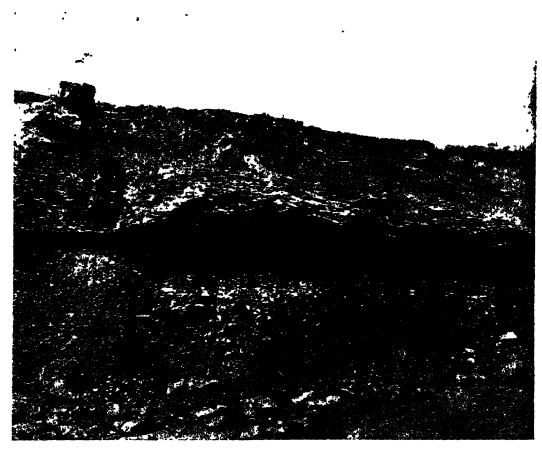
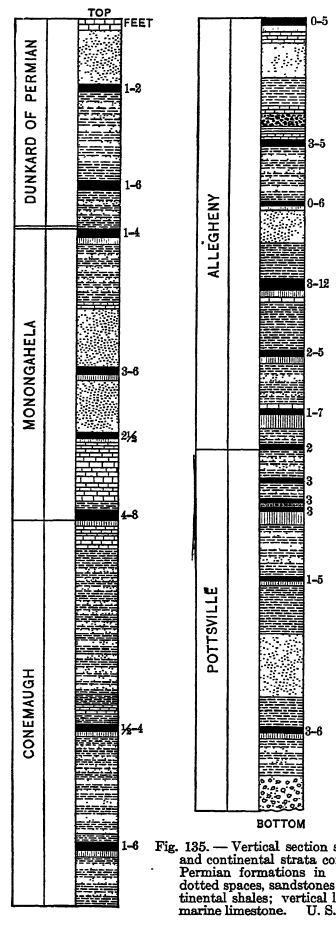
Limestones may be completely absent, and when they are interbedded with the coaly shales are thin and devoid of undoubted marine organisms. Coal beds are known to lie directly on marine limestones (crinidal in Ohio and Pennsylvania), but still there are no marine fossils even in the very basal layers of such coals. In other words, there is no transition from a pure marine faima directly into a coal bed. Impure limestones are, however, not uncommonly seen to overlie the coal directly (Ames limestone on 2 feet of pure coal in Allegheny, Pennsylvania, Fig, above), but the contacts are sharp and there is no transition from the coal. The roofing shales of the coals [ p. 396 ] generally abound in fine fern fronds, but occasionally there are very impure coaly covers that contain phosphatic-shelled brachiopods, or even sparse dwarfed marine faunas (Seville, Illinois). In all such cases these are the basal beds of the invading sea, whose water may or may not have churned up the soft peaty material and then redeposited it as a bituminous mud, along with the enclosed shells.
In the great majority of cases coals are underlain by an underclay that is usually unstratified and filled with the roots and rootlets of plants;, in other cases the roots are completely absent though such clays usually have a vertical fracture with some short and slender upright pipes still preserved, which are the casts of once existing roots. These underclays sometimes have the rooted trunks of the former forest still in situ, as in the Parkfield colliery, England (see Fig., opposite). Underclays therefore are either old soils or the clayey bottoms of the marshes. These soils may be sandy, but are more often true aluminous cla 3 rs and are then called fireclays. They are described in the chapter on Pennsylvanian time.
Favorable Conditions of Coal Formation. — The most notable physical features of Pennsylvanian time were the many and vast swamps, the great majority of which lay near sear level. This sea-level was, however, inconstant, and although its fluctuations may not have been greater than 50 feet, yet because of the vast extent of the tidal and delta flats, these latter were widely flooded by the rising of the sea. This oscillation of the sea-level was due to the marked crustal unrest of Pennsylvanian time ; with every rising of sea-level, the rivers were dammed back, and the waters over the flats became more or less marine, depositing muds and muddy limestones that often abound in remains of sea life (see Pl., p. 365). During the upwarps of the land, causing the intervals of ebb, the streams were rejuvenated, scouring away some of the deposits on the previous sea floor and spreading over the low lands the thick sandstones and sandy shales, which very rarely have marine organisms (see Figs., pp. 392 and 398). At these times, and also when the sea basins had [ p. 397 ] been filled with sediment, large salt- and fresh-water marshes and shallow lakes formed, around whose borders became established the marsh fioras (see Fig., below), which in tune p>ossessed the entire flats and lake areas and filled the basins with jjeat or jelly-like masses of carbonaceous material. These alternations between the land and the sea were repeated many times.
The conclusion is therefore attained that coal beds, as a rule, are formed naturally in the place of their occurrence, in fresh-water marshes. The coals are chiefly due to growth in situ in river deltas and valleys, as are those of the Joggins, or rarely they may be of drifted material in lakes, like those of Commentry. These are the limnetic coals (from the Greek word meaning living in a freshwater marsh). Coals were also formed in situ near sea-level on the borders of the epeiric seas or on continental shelves by plants that grew behind marine barriers in marshes whose waters were at first brackish but eventually became fresh. These are the paralic coals (meaning growing by the sea), often of wide areal extent; they embrace essentially those of Pennsylvanian time. The great purity of many coals is further evidence of their having formed where foimd, for if made of drifted plants, the water currents bringing the latter must of necessity have also carried muds or even sands, which would have been deposited with the organic matter.
Number of Coal Beds in a Coal Held. — In Pennsylvania there are twenty-nine coal beds with a maximum total thickness of 106 feet. In Indiana, there are twenty-five, having an aggregate thickness of 90 feet, and in Illinois there are seventeen. The Coal Measures of South Wales, Bristol, and Somersetshire have eighty-five different coal beds. In the Saarbrucken region of Germany there are as many as one hxmdred and twenty, not including those less than one foot thick.
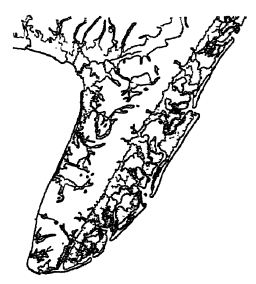
Pittsburg Coal Bed. — The greatest coal swamp of Pennsylvanian time was that which made the Pittsburgh coal bed, extending interruptedly for 225 miles in a northeast-southwest direction and 100 miles from east to west. This swamp was twenty-two times greater than the present Dismal Swamp of Virginia-North Carolina; it must not be assumed, however, that all parts of the area were a continuous coal swamp, as there were undoubtedly many intermediate dry places. I. C. White states that the Pittsburgh coal is known to be workable over 6000 square miles of western Pennsylvania, eastern Ohio, and West Virginia, an area six times larger than the Dismal Swamp. The latter, before it began to be drained, covered an area 40 by 25 miles, and is now a great coal field in the making, covered with a layer of peat as much as 15 feet thick in places (see Figs., pp. 177, 178, 181 of Pt. I).
[ p. 398 ]
Thickness of Coal Beds. — Coal beds vary in thickness from a mere film up to more than 80 feet. A workable bed must be at least 2 feet thick, and it is very seldom that they are thicker than 8 to 10 feet. The mammoth anthracite bed of Pennsylvania has a thickness of about 45 feet. The Pittsburgh bed of soft coal varies up to 16 feet, with an average of 6 to 10 feet. In the Commentry basin of central France, there is a [ p. 399 ] single coal bed of Lower Permian age that is locally over 80 feet thick.
Variability in Sedimentation. — In the coal fields there is a marked variability in the sedimentation, sandstones and shales varying the most and being very inconstant in geographic distribution. The more persistent horizons are the thicker coal beds, the calcareous marine shales, and especially the marine limestones. In Pennsylvania there are at least one hundred and fifteen of these alter nations in 2600 feet of strata, in Indiana one hundred and twentyone in 1300 feet.
The Joggins Section. — The Coal Measures previously described were deposits more or less under the influence of the sea. We will now turn to the celebrated Joggins section in Nova Scotia, which is of a different origin, and nearly every foot of which can be studied at the head of the Bay of Fundy.
The name Joggins seems to have had its origin in the “ jog-in and jog-out” of the shore. The total thickness of the section here is nearly 13,000 feet, and it appears to be all of Pennsylvanian [ p. 400 ] age. Throughout this mass of coarse material, very largely tinged with red, no one has j’et found an assemblage of genuine marine fossils, or even a single brachiopod or other undoubted sea animal. The fossils are in the main land plants, but these are abundant only in the roofs of the coals, while tbe drifted and prostrate logs are nearly all restricted to the gray and green sandstones, where they occur as casts. Logan’s “ Division 4,” with a thickness of 2539 feet, is the main fossiliferous horizon with coal formation, and often abounds in fresh-water bivalves, air-breathing snails, bivalve crustaceans, tiny worm tubes, and bones and tracks of Amphibia; even rain-drop impressions are preserved. The coal swamps were, as a rule, of short duration and the more persistent ones were often invaded by muddy water which deposited above the underlying pure coals the many black shaly zones.
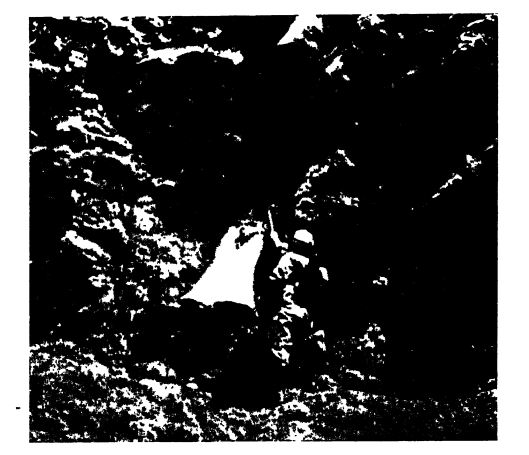
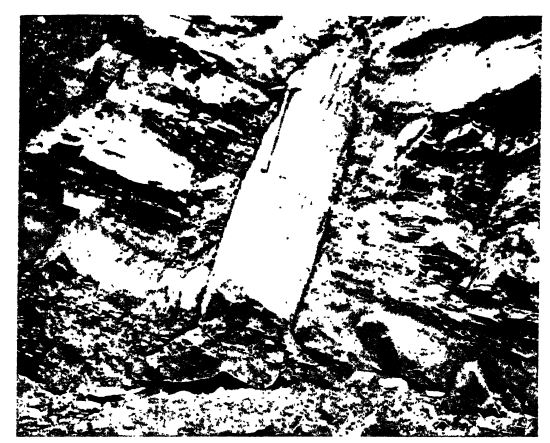
A further study of the detail of this section shows clearly that it was only the prostrate logs that were rafted away from their place of growth and whose remains are now seen as casts in the sandstones. The coals themselves, of whatever thickness, were made in fresh-water [ p. 401 ] marshes in the places where they now occur, since most of them are underlain by the swamp soils still filled with fossilized roots. Not only this, but there are preserved many additional soils whose exposed vegetation was swept away by the waters that brought the invading and covering muds and sands. Still further proof of the origin of the coals in situ, that is, where they now occur, is found in the logs of Sigillaria and Calamites still standing erect in the places of their growth (Figs., pp. 399 and 400). There are many of these logs in superposed tiers, Logan reporting seventy-one such exposed in Division 4 alone (see also p. 396). These standing logs have been admired by all geologists since Richard Brown discovered them in 1829, and the drawings of them by Logan, Lyell, and Dawson have been repeated in most text-books on Geology". They are of all lengths up to 25 feet, and some of them reach 4 feet in diameter. From their evidence we may agree with Lyell that what he saw in 1842 at the Joggins proved the growth-in-situ origin of these coal beds. Similar erect fossil trees are also known in England and France.
Pennsylvanian Coal Fields of America. — The coal fields of Pennsylvanian time in America occupy an area estimated at over 252,000 square miles, a total considerably greater than that on any other continent in the world (see map, p. 402). China has the next largest area, in amount somewhat less than that in the United States, Russia has 27,000 square miles; New South Wales, Australia, 16,500; Great Britain, 9000; Germany, 3600; and France, 1800.
There are six coal fields of Pennsylvanian age in North America. These are as follows (see Map 2, p. 355) :
1. Acadian Field. — The Pennsylvanian coal formations of eastern Canada, estimated at about 18, (XK) square miles, are in Nova Scotia, New Brunswick, Cape Breton, and to a very limited extent in western Newfoundland. The coals are all limnetic.
2. Rhode Island Field. — This is the smallest coal basin, covering 500 square miles in Rhode Island and Massachusetts. The coals are of limnetic origin and are now highly anthracitic and graphitic.
3. Appalachian Field. — In eastern Pennsylvania there is an isolated field of limnetic anthracite coals covering an area of but 500 square miles; it is, however, by far the most productive anthracite field in America.
This field also has the most productive area of paralic humic coals in America, covering approximately 70,800 square miles in nine states, extending from the northern border of Pennsylvania and eastern Ohio southwestward 850 miles to central Alabama, and from Appalachis westward to the Cincinnati uplift.
4. Michigan Field. — The paralic humic coal field of southern Michigan covers an area of about 11,000 square miles. All prospecting is done with the drill, because the region is deeply covered by glacial material.
[ p. 402 ]
5. Eastern Interior Field. — This is an isolated coal basin in Indiana, Illinois, and western KentucW, covering about 58,000 square miles. The coals are soft humic and are interbedded with marine zones.
6. Western Interior Field. — This is the largest coal area, though not the greatest from the standpoint of production. It covers about 94,000 square miles, lying to the west of the Ozark uplift and extending from northern Iowa and Nebraska southwestward 880 miles to central Texas. It has an eastern extension south of Ozarkis from central Oklahoma into Arkansas. The coals are soft humic and of parahc origin.
Wastage of Coal in Mining. — The amount of impure coal in nearly every coal bed in the United States varies from 10 to 50 per cent, averaging 25 per cent. At present all of this is thrown away, though much of it could be used for the making of gas for gas engines. Due to faulty mining, bad engineering, the falling of roofs, squeezes,” creeps,” and “ crushes,” approximately another 30 to 40 per cent of the coal present in the mines is never taken out and is thus lost. In other words, about 40 to 70 per cent of the coal present is wasted or unused and never to be regained after the mines are abandoned. If the wasteful methods of the past are to continue,” says I. C. White, if the flames of 35,000 coke ovens are to continue to make the sky lurid within sight of [ p. 403 ] the city of Pittsburgh, consuming with frightful speed one third of the power and half of the values locked up in these priceless supplies of coking coal, the present centurj’ will see the termination of the American industrial supremacy in the iron and steel business of the world.”
Coal Production. — In 1912 the soft coal mined in the United States amounted to 450,000,000 short tons, valued at $518,000,000. The anthracite output of Pennsjdvania for the same year was 75.000. 000 tons, valued at $177,000,000. In 1913 three-quarters of a million men were employed in the mining of coal. From 1814 to the end of 1900 the United States had produced 4,470,000,000 short tons of coal, and by the end of 1914 the total had risen to 10.358.000. 000 short tons. The total amoimt of coal in the United States within 3000 feet of the surface is estimated by M. R. Campbell as about 3,540,000 million tons. In Nova Scotia there are at least 7.000. 000.000 tons of coal capable of being worked. The total quantity of coal available in the world is estimated by Gibson at about 11,801,000 million tons. Of anthracite in millions of tons there is about 500,000; of humic 3,903,000; and of sub-humic and brown coal, 7,398,000. In these estimates no allowance has been made, however, for coal not minable or for loss in mining.
In 1815, the year of the Battle of Waterloo, the world’s entire output of coal was less than 15 million tons; a century later it was more than 1,300 million tons — an increase nearly a hundredfold. In 1913 the United States produced the greater amount of the world’s coal output, 39 per cent, and used of it 37 per cent; Great Britain came next, with 22 per cent, of which she consumed 15 per cent ; while Germany was third, having mined 21 per cent and consumed 19 per cent. For a manufacturing people, coal is at the basis of national prosperity. J. W. Gregory states that Great Britain has mined only about 6 per cent of its available coal, and that the supply will last at the present rate of consumption about 600 years. That of the United States and Germany will last these countries at the present a.TiTnia.1 3deld for 1500 years.
Mineral Wealth of the United States. — The annual production of minerals throughout the world, according to C. K. Leith, is nearly 1.700.000. 000 tons, and more than 90 per cent of this vast wealth dug out of the earth consists of coal and iron. Of all the minerals annually produced, about two thirds are used in the countries producing them, the remainder being exported as international exchange. How rich the United States is in mineral wealth is at once shown by the statement that this country produces one third of the [ p. 404 ] world’s minerals (in 1913 the value was about $2,500,000,000); Germany less than 15 per cent; Great Britain 11 per cent; no other country more than 5 per cent. America is dependent upon other lands for its nitrates, potash, manganese, chromite, magnesite, tin, nickel, platinum, mica, graphite, asbestos, chalk, cobalt, etc., but nevertheless we are more nearly self-sustaining in regard to minerals as a whole than any other country.
The exportable coal of the world is controlled by North America, which in 1913 supplied about 40 per cent of the world’s output, by England, and by Germany (Europe 54 per cent). In copper (65 per cent) and petroleum (roughly, 70 per cent) the United States dominates the world, and it is in addition a very important factor in the world’s supply of sulphur (50 per cent), phosphate, silver, iron (38 per cent), and cement. We have of minerals an annufll surplus for export amounting to about one billion dollars, and need to import annually about $175,000,000 worth. It is these natural wealths that lead to world power in this age of industrialization.
For a good, account of the world’s mineral resources, see the World Atlas of Cormmercial Geology, published by the United States Geological Survey in 1921.
¶ Collateral Reading
M. R. Campbell, The Coal Fields of the United States. U. S. Geological Survey, Professional Paper 100-A, 1917.
A. H. Gibson, Natural Sources of Energy. Cambridge (University Press), 1913.
E. C. Jepfket, The Mode of Origin of Coal Journal of Geology, VoL 23, 1915, pp. 21S— 230.
K C. Jepfret, The Structure and Origin of Coking Coals. Science, new series, Vol 58, 1923, pp. 285-286.
Mabie C. Stopes and R. V. Wheeler, Constitution of Coal. Department of Scientific and Industrial Research, London, 1918.
H. G. Turner and H. R. Randall, A Preliminary Report on the Microscopy of Anthracite Coal. Journal of Geologj’, Vol. 31, 1923, pp. 306-313.
D. Whitb and R. Thiessen, The Origin of Coal. U. S. Bureau of Mines, Bulletin 38, 1913.
The Coal Resources of the World. Twelfth International Geological Congress, Canada, 1913.
World Atlas of Commercial Geology. U. S. Geological Survey, 1921. Coal, pp. 9-16.
| XXVIII. The Rise of the Land Floras | Title page | XXX. The Rise of Land Vertebrates and the Dawn of Reptiles |