| XXX. The Rise of Land Vertebrates and the Dawn of Reptiles | Title page | XXXII. Climates of the Geologic Past, and the “ Critical Times ” |
[ p. 420 ]
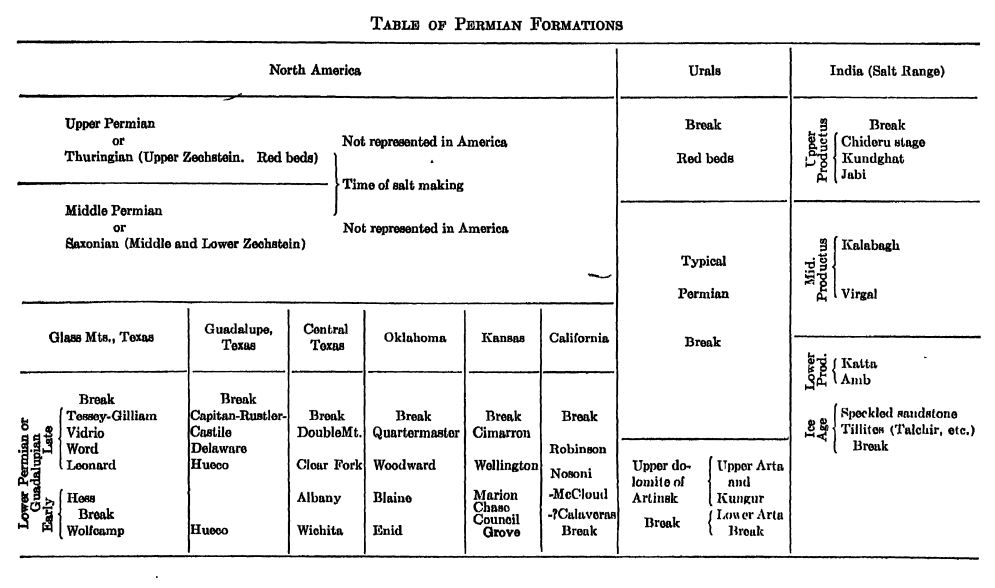
History of the Term Permian. — When Murchison through his great classic Siluria had become widely known as the great leader in Stratigraphy, he was asked by the czar to study the geologic sequence of western Russia and chiefly of the Ural Mountains. In this work he was associated with Keyserling of Russia and De Yemeuil of France. Their studies led to the discernment of a distinct series of highly fossiliferous marine and brackish-water formations that lay above the Coal Measures and beneath the Triassic. These were found well exposed along the western flank of the Urals in the Province of Perm, and using this geographic term Murchison proposed in 1841 to include them under his new term Permian system, which has now come into universal use.
The actual significance of the Permian of the Urals was, however, not clear until long afterward, and as late as 1903 we read in Sir Archibald Geikie’s text-book that “ no satisfactory scheme of subdivision of the Permian system has yet been devised capable of general application.” We are, in fact, only now approaching this desired end. In Miu-chison’s time, the strata of Artinsk (southern Urals), lying below the typical Permian, were thought to be of Coal Measures age, and it was only toward the close of the nineteenth century that they were successfully referred to the Permian. A clearer understanding of the significance of the Permian of the type area gradually came through the determination of the longest sequence anywhere of these formations, that in the Salt Range of India. These strata were gradually correlated on the basis of fossil content with those of the Urals and more especially with those of the northern Mediterranean, which have a variety of widely dispersed ammonites, the best of fossils for correlation. During the past decade these shells have also been collected in Texas and elsewhere in the United States, and due especially to the studies of G. H. Girty and Emil Bose, the American equivalents of the Permian now appear to be satisfactorily correlated with the formations of India and Russia.
Following m the main the work of Bose, the Permian of North America may be classified as shown on page 421.
[ p. 420 ]
Most Significant Things about the Permian. — The Penman is the closing period of the Paleozoic era, and with the close of the Lower Permian all of North America was dry land. There is in our continent no record of Middle and Upper Permian times other than of erosion, but as to the importance of this erosion little is to be gleaned from the unconformities between the Permian and subsequent formations.
Almost all of the Lower Permian formations occur in the Central Interior and southern Cordilleran regions of the United States. The marine waters that laid down these deposits came from the Pacific across northern Mexico; they were normally marine toward the south and west, but their northern and eastern extensions spread vast sheets of red beds that have thick deposits of gypsum and salt. It was an epeiric sea surrounded by desert conditions, and the brackish-water phase, the red beds, entombed in places a wonderful series of reptiles and amphibians.
The marked mountain making of the Pennsylvanian was continued into the Pe rmian, and culminated with the making of the Appalachians, the Ouachitas, and the Ancestral Rocky Mountains. With the recession of the epeiric seas, there came in during the last third of Lower Permian time a glacial climate that was of greatest import in the southern hemisphere, and seemingly one as cold as, or colder than, that of the Pleistocene. The stress climate of the Permian, and chiefly of the southern hemisphere, warmed later to more equable ones, but over most of the earth the widely emergent continents still produced more or less of dry and desert conditions. In North Eiurope the last of the Permian seas laid down very thick red deposits, along with tremendous amounts of salts and gypsum, all of which testify to the arid conditions so prevalent during the closing period of the Paleozoic.
The glacial climate and the subsequent long-continued arid conditions wrought a mighty change in the life, both of the lands and oceans. We have seen that for a long time before the Permian the climates had been mild the world over, and that “ no animal could endure the least cold.” Accordingly the Permian was an age of hardship and struggle for all life, and brought death to many of the specialized stocks. With the glacial climate, there came into existence a hardier flora in the southern hemisphere known as the Gangamopteris flora, which in later Permian time had in Asia spread to the Arctic Ocean. This flora provided a different, and probably a better food for the insects and reptiles of the land, and accordingly we see a marked evolution among them. In the seas there was a [ p. 421 ] [ p. 422 ] great dying out of many kinds of brachiopods (chiefly productids and orthids), tetracoraJs, ancient echinids, and fusulinids, and the scattering trilobites also vanished. Their places were taken by the anunonids, lobsters, and modern echinids and molluscs. Just as the river fishes of Silurian time had peopled the seas, so now the land reptiles (Mesosaurus) began to take to this habitat, and this early adaptation is a prophecy of the many kinds of marine reptiles that were to flourish in Mesozoic time.
¶ American Seas
Central Interior Region. — By far the best known sequence of American Permian formations is that of Texas, where they appear to continue the Pennsylvanian strata without a marked break. In the central and northern part of the state they are of the red beds phase, and as such are continued north across central Oklahoma and Kansas into eastern Nebraska. In the north these deposits are not thick and are of brackish-water origin, thickening more and more into Oklahoma and Texas, where toward the west the sandstones, sandy muds, and clays are dominantly red in color and abound in vast quantities of gypsum. In fact, Oklahoma is known as the Gypsum State. There is also in places considerable limestone and dolomite. In Texas the thickness is variable up to 5400 feet and the clastic materials appear to be derived from the rising Ancestral Rocky Mountains in Colorado and New Mexico. They are vast tidal flat and river deposits of an arid climate, spread eastward into the epeiric seas that came over the continent from the south and west. In north-central Texas the Permian is in places replete with a wonderful array of land reptiles. (See Map 4, p. 355.)
The red color and the presence of gypsum and salt are the striking phenomena of the latest Pennsylvanian and early Permian deposits of the southwestern United States. With the retreat of the Pennsylvanian seas and until their return in Europe in the Middle Permian, the brackish- and fresh-water formations are as stated, and these conditions are interpreted as due to dry climates, evaporating the water, precipitating the salts, and oxidizing the sediments.
Southern Cordilleric Seas. — The north-central Texas Permian strata are continued westward beneath later formations, and when they reappear at the surface in the Glass and Guadalupian mountains in the southwestern part of the state, they are a very thick sraies of limestones (4800-6800 feet) and sandstones (2000 feet), probably averaging about 7000 feet in thickness. At the top there are again [ p. 423 ] red beds with gypsum, about 500 feet thick, but this phase of the deposits thickens toward the north to constitute the widely spread red beds of the Great Plains countiy". This brackish- and freshwater phase also continues across central New Mexico north into Wyoming, while the marine character is more dominant over Arizona north into Nevada and Idaho. In the Grand Canyon of the Colorado may be seen a fine exposure of Permian strata and as well a great valley cut down through the entire Paleozoic to the old floor over which these seas wandered for so long a time (see Frontispiece).
In northwestern California the Permian is also known, but nowhere else along the Pacific border. (See Map 4, p. 355.)
Dunkard Series. — In southeastern Ohio, southwestern Pennsylvania, and adjacent parts of West Virginia, the Pennsylvanian formations are continued without interruption into the Dunkard series of earliest Permian time. These are also known as the Upper Barren series, because the Dunkard has but little of commercially valuable coals. They are the last Paleozoic deposits of eastern North America. Of them there still remain, over an area of 8000 square nules, sandy shales with persistent sandstones, and thin limestones, variable in thickness from 600 feet of dominantly red beds in Ohio to about 1200 feet of greenish and red beds in West Virginia. That the southwestern sea did enter this area, at least for a limited tune, is attested by the presence of marine brachiopods (Lingula) and shark spines. The Dunkard abounds in land plants, and in the Cassville beds 107 species of these are known, along with many wings of cockroaches.
Vanishing of the Paleozoic Epeiric Seas. — We have seen that during later Pennsylvanian time a very shallow sea, coming in from the south and west, spread in an oscillating way across the United States as far as central Pennsylvania. These waters began to ebb toward the close of this period, though brackish waters were to some extent still present in earliest Permian time in southeastern Ohio, as attested by the sharks of the Dunkard formation, A very little fresh-water Permian is also known near Danville, Illinois, filling an ancient river valley. Otherwise no rock-making records of this period are known throughout the eastern half of North America, and we shall see that this widely emergent condition continues here to the present time.
With the making of the mighty Appalachian Mountains and the permanent withdrawal of all seaways, the many domal and axial uplifts of the Great Interior were again upwarped. It was upon this rejuvenated topography that the present drainage system came [ p. 424 ] to be developed, wearing away the later Paleozoic formations from the higher places and so exposing here the older ones, and levelling all into a vast peneplain. This levelled land during Mesozoic and Cenozoic times lay nearer sea-level by a few hundred feet than it does now, and the renewed scouring of the present rivers is due to wide and gentle uplifts that occurred late in Pleistocene time. We shall see in subsequent chapters that the making of later geologic records in the main is restricted to the greater western half of North America and to a very limited area along the Atlantic and a somewhat wider one along the Gulf of Mexico border of the United States.
Vast Salt-making Areas of the Permian. — In previous pages attention was directed to thi red beds of vast extent in the southern and western interior regions of this country. Such widely spread red formations indicate the presence of arid or desert climate, and we have now to consider the evidence which clinches the argument for general Permian aridity.
In central Kansas at Hutchinson and Lyons, salt has been mined for some years, and Darton has recently informed us that the salt deposits here have a thickness of between 200 and 400 feet in an area of at Feast 7000 square miles. It is interesting to note that our knowledge of these salt beds has been largely revealed in the search for petroleum. The time of the making of these salt beds was early Permian (upper Marion). The evidence as presented by Darton indicates that the known extent of the salt in this area covers at least 100,000 square miles, with an average thickness of 200 feet, making the gross quantity about 30,000 billion tons. The prediction is made that much potash for fertilizers will also be obtained here. It is the largest salt area of the world, exceeding even that of Germany in younger Pennian time.
Over the greater part of North Germany occur the Middle and Upper Pennian limestones and dolomites known as the Zechstein, and twice the sea which deposited these was converted into vast salt-making basins. Each salt series, in its best development, begins with gypsum (anhydrite), passing into thick deposits of sodium chloride and finally into magnesium and potash salts. It is the region of most complete sequences of salt precipitations, and has made Germany not only the richest nation in table salt but more so in potash fertilizers. Kayser in his well known Lehrbwh der geologisehen FormccHonshunde says that the salts between Wesel and Ruhrort have a thickness of 420 feet, at Hohensalza of 585 feet, Eaiseroda 740 feet, Stassfurt 3000 feet, Aschersleben 1600 feet, and Sperenberg over 3900 feet (here sodium chloride only). Below the Zechstein are copper-bearing black shales or a series of red continental deposits (Rotliegende), and the Pennian here, as in Russia, is terminated by other red beds.
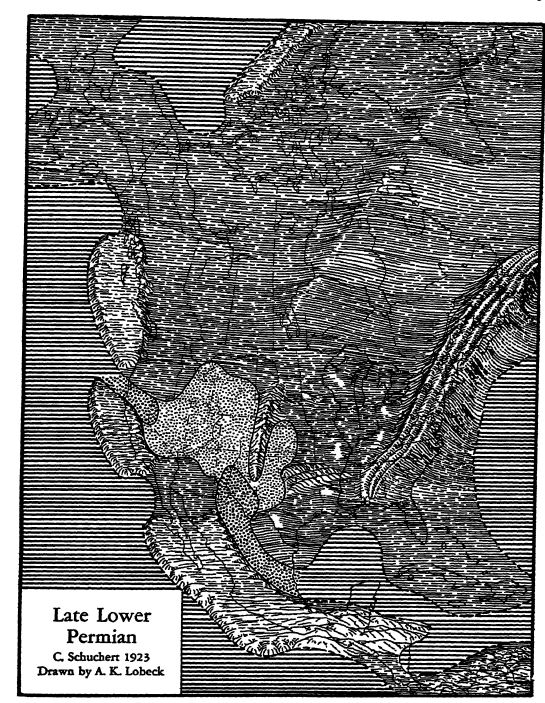
Epeiric seas dotted; oceans ruled; lands in wavy lines. See Plate 24 (p. 355) for Pennsylvanian paleogeography.
The time of the seas shown on this map (the earlier invasions are in darker diading) is late Lower Permian, but the rising of the mountains came later. Eastern North America, in the Appalachian area, stood higher then than at any subsequent time. Note also the Ancestral Rocky Mountains of Colorado, and the several domal areas in the central United States (see pp. 367-369, 426). The medial ridge through the Canadian Shield is drawn too prominently, and the broken-lined area in CalifomiaSonora means that epeiric seas may also have extended here.
The climate was warm arid, and the seas of the Great Plains area left much salt and gypsum in their withdrawal (pp. 423-424). The Permian ice age came just after the time of this map and probably before the Appalachian Mountains had been completed (pp. 428-430).
[ p. 426 ]
¶ The Greed, Mountain Making of Permian Time
Appalachian Revolution. — Earlier in this chapter it was stated that, with the exception of the southwestern states, the seas began to vanish toward the close of the Pennsylvanian, and that in late Lower Permian time the continent had again nearly all emerged from the sea. Then for a long time there is no record other than that of continental erosion. During the Paleozoic era previous to the Pennsylvanian, the continent had been four timna in the throes of mountain making. None of these deformations, however, had the significance of a revolution (see p. 91). Each one of these crustal movements, in turn, folded some area of greater Appalachis and finally also Llanoris of Louisiana and Texas. Then came in the same regions the several orogenies of Pennsylvanian time, previously described, with the added crustal unrest of the Ancestral Rocky Mountains. There probably were other regions of movement along the Pacific border, in California and in the Washington-Vancouver area (see Figs., pp. 352 and 368). Volcanoes were then active from California to Alaska.
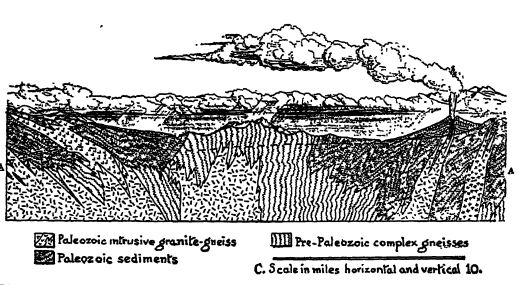
Early in Penman times all of these areas again appear to have been in motion, especially the whole of the Appalachian and Llanorian regions. With these uplifts the epeiric seas of early Permian time all vanished from the continent. The northeastern half of the Appalachian Mountains was then most decidedly in motion, the heretofore open folds being closed and finally overturned and overthrust to the northwest on a scale greater than anywhere else [ p. 427 ] in North America at this time. This has made the geology of the New England States and of the Maritime Provinces of Canada the most difficult of any to understand (see Figs., pp. 425, 426). The extent of deformation was also greater than at any other time, since the Appalachians extend from beyond Newfoundland to southern Alabama — a distance of over 2000 miles — while other mountains continue for 1200 miles southwestward across Texas, Chihuahua, and Sonora. At the same time, all of the domes and axes of the eastern United States were accentuated. Finally, North America was completely emergent and greater than it is now.
The Appalachian Revolution, beginning in Pennsylvanian and culminating in Permian time, was one of the most critical periods for the organic world in the earth’s history and may have been the greatest of them all with respect to changing environments. A glacial climate even came over the world m late Lower Permian time (see Figs., pp. 428 and 431).
How high the Appalachians stood in Permian time is hard to ascertain, but on the basis of the folds measured in Pennsylvania, it has been suggested that they may have been 5 miles high. However, as mountains rise slowly and their highest peaks are rapidly worn down during, the time of their rising, it is probable that the Appalachians at no time had the grandeur of the present Himalayas. There may nevertheless have been peaks that stood from 2 to 3 miles high in Middle Permian time. (See Fig., p. 426.)
Permian Mountains of Eurasia. — The crustal instability of Europe during Pennsylvanian (see p. 351) and Permian times appears to have been as marked as that of North America. The Hercynian Alps of central Europe were reelevated during earlier Permian time and toward the close of the period the Urals of Russia were rising. From northern India east to China, moimtains had also arisen in late Pennsylvanian times.
Wadia in his valuable Geology of India states that to the north of peninsular India, following the Middle Carboniferous, there was a time of great earth movement, profoundly altering the face of Asia. These movements brought m a vast extension of the Tethyian mediterranean, originating a new geosjmcline that extended over the whole of North India, Tibet and far into China. “ The southern shores of this great sea . . . coincided with what is now the central chain of snow-peaks of the Himalayas, beyond which it never transgressed;” but, to the east and west of the Himalayan chain, great bays were extended to the south of this line into Upper Burma and Baluchistan, and toward the Salt Range. In consequence there is almost everywhere in India a great break in the geologic record, represented by an unconformity at the base of the Permian system.
[ p. 428 ]
From these deformations we learn that the closing period of the Paleozoic was a time the world over of crustal movements. The many red areas of America, Europe, and Africa attest widespread arid climates, and the tillites of many continents indicate that the temperature of late Lower Permian time was low.
¶ Glacial Climate near the Close of Lower Permian Time
For nearly fifty years geologists have been describing unmistakable glacial deposits of Permian age in the continents of the southern hemisphere, but it is only during the present century that their results have been widely accepted. It is now known that glacial deposits — bowlder clays called tillites — are of wide distribution.
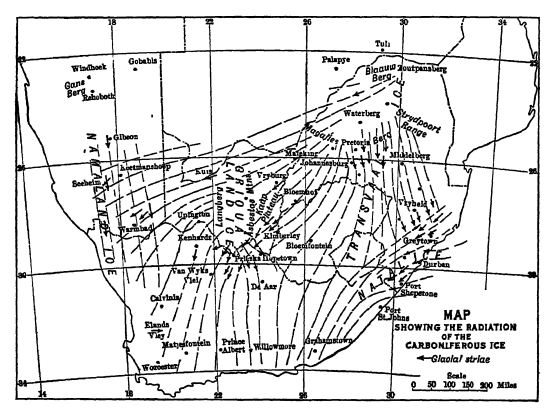
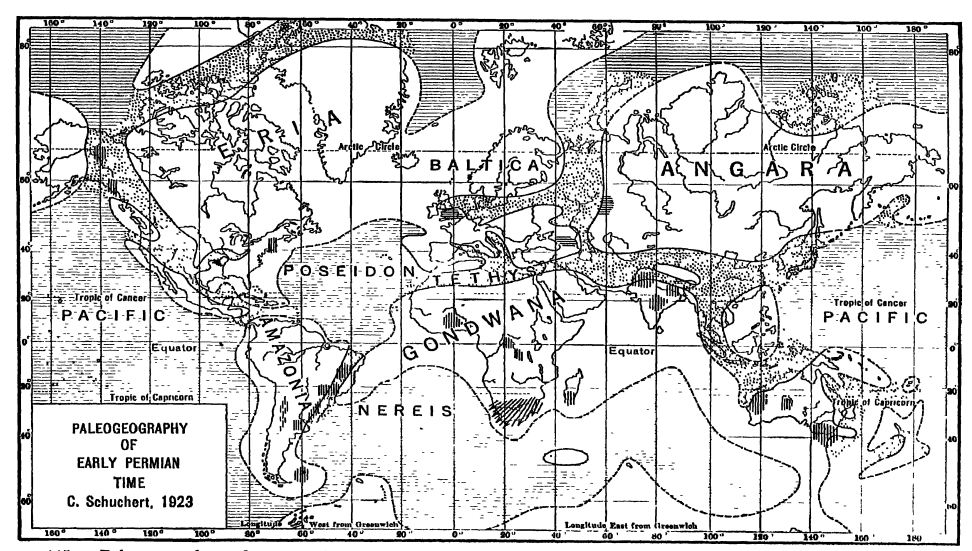
South Africa has the best known Permian tillites, and here Du Toit in 1921 has brought together the evidence. All of Airica and Madagascar south of 22° and 23° respectively was covered by ice sheets that at their maximum were between 4000 and 5000 feet thick. Of snow-accumulating centers there were two major and two minor ones, which, coalescing, moved toward the southwest and south out into the oceans. The high land was in the north and [ p. 429 ] especially northeast, rising here to about 4000 feet above sea-level. The Transvaal ice sheet was the most extensive, moving at least 700 miles to the southwest. The tillites of the Dwyka series are in the northeast less than 100 feet thick, but in the south attain to 1500 feet, and in southern Karoo to 2000 feet (see Fig., p. 428).
Eight or nine horizons of glacial rock debris derived from floating icebergs occur in South Australia above the Coal Measures, some of them 200 feet thick, interbedded in 2000 feet of marine strata, and in India the very thick glacial deposits (Talchir) preceded the Permian submergence. The old polished, striated, and grooved ground over which the glaciers moved is known in India, Africa, and Australia. In North America, tillites seemingly of Permian age are known about Boston, Massachusetts, and striated stones have been reported on Prince Edward Island; Caimes (1914) and Kirk (1919) also report tillites in different places in Alaska, and the latter thinks that some may be associated with the Weber quartzite of Utah and elsewhere. In England and Germany they occur at the base of the Permian. For the complete distribution of these glacial deposits, see Fig., p. 431.
The Permian glacial formations occur mainly on either side of the equator from about 20° to 35° north and south latitudes, but evidence of this kind is scattering above 35° in north temperate lands. On the other hand, the climate of that time was arid in the United States and in northern Europe, as is proved not only by the red beds, but even more by the great accumulations of g3q>sum and salt.
The evidence is now unmistakable that early in Permian times, and seemingly toward the close of the Lower Permian, most of the lands of the southern hemisphere were under the influence of a glacial climate as severe as the polar one of recent times, and that, like the latter, the Permian one also had warmer interglacial periods, for coal beds occur associated with the glacial deposits in Australia, South Africa, and Brazil.
Cause of Permian Glaciation. — What brought about this great change in the climate of Permian time, and why it was, apparently, mainly restricted to the southern hemisphere are as yet unsolved problems. Most geologists look for the explanation in the great derangements of the air and oceanic currents brought about by the marked crustal unrest during Pennsylvanian and Permian times, shown in the mighty mountain chains risen in the several continents at this time (Figs., pp. 352 and 368).’ Another factor that may have had much to do with the bringing on of this glacial climate was en [ p. 430 ] larged Antarctis, whicli seemingly then united with Australian on the one side and on the other with South America. Naturally, such upheavals and land connections must have also altered the oceanic currents.
¶ Gondwana and Tethys
Gondwana, the Great Southern Transverse Continent. — Something about this continent has been stated in Chapter V, and now fiuther proof of its existence must be given. Such evidence relates mainly to wide-spread deposits of Permian age having the Gangamopteris flora (Fig., p. 432). This flora occurs throughout the southern hemisphere, and paleobotanists hold that it could have been so widely distributed only across a continuous land (see Fig., p. 431). Belief in the e.xistence of Gondwana is wide-spread among European geologists, but some American workers do not yet believe in it, mainly because they hold strongly to the theory of the permanence of the oceanic basins and continents. Without this continent, on the other hand, paleontologists cannot explain the known distribution of Permian land life, and, further, its presence is equally necessary for the interpretation of the peculiar distribution of marine faunas beginning certainly with the Devonian and ending in the Jurassic.
Tethys, the Greater Mediterranean. — To the north of Gondwana lay the great medial ocean which Suess has named Tethys, after the consort of Oceanus (see Fig., p. 431) . The present Mediterranean is a remnant of this once grand middle ocean which widely overlapped northern Africa, southern Europe, and Asia, and long extended unbroken from France and Spain into the eastern Indian and Pacific oceans, from time to time connectmg with the Arctic Ocean by way of the Ural geosyncllne. How often it was in open connection with the Atlantic is not yet clear, but that it had such conununication is seen in the similarity of certain southern European and Gulf States faunas (Helderbergian, Einderhookian, and Comanchian) .
¶ Life of the Permian
Marine Life. — In southwestern Texas the thick deposits of early Permian time abound in a varied marine life, part of which also spread wddely over Arizona and Nevada. The faunas are no longer cosmopolitan like those of the Pennsylvanian. In many ways, they are the Pennsylvanian life changed into other local species, and this is especially true of the Protozoa (fusulinids), braehiopods, gastropods, and bivalves. The productids are still common, while [ p. 431 ] [ p. 432 ] the trilobites are almost gone. The heralders of a later time are the actively swimming and widely dispersed goniatids and ammonids, which are now rapidly evolving into new genera and hence are the fossils by which the marine formations may be correlated from country to country. In subsequent chapters we shall see how these “Ammon’s horns ” abound in the Mesozoic seas.
Final Permian Marine Faunas. — The last stand of the Paleozoic marine life was in extensive Tethys, the greater mediterranean, whose rock and organic records are found in the eastern Alps and the lands to the east as far as the Himalayas. In these warm waters of late Permian times the descendants of the Upper Carboniferous corals, brachiopods, and molluscs still swarmed in varied profusion well into late Permian time. When the record of the marine Triassic begins, however, it shows that a great change has taken place, for now all the Paleozoic fusulmids, corals, blastids, productids, and trilobites are gone, and there is a new assemblage of more modern molluscs, echinids, and hexacorals, the essential denizens of the medieval marine world. The change began in the vanishing seas of the late Permian, and when the oceanic waters returned to the continent, especially in Tethys, there was a world of new and small forms that soon deployed into the diversified Triassic faunas.
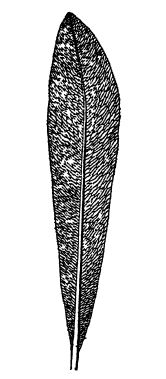
Cool Climate Cosmopolitan Flora of the Southern Hemisphere. — In the southern hemisphere, due in all probability to the cool climate brought about by the glacial period of late Lower Permian time, the more characteristic elements of the older cosmopolitan flora were in part wiped out and some of the elements which remained were evolved into new forms that soon took possession of the ancient land Gondwana (see p, 431), and finally of the entire southern hemisphere, including Antarctis- This plant assemblage is known as the Glossopteris or Gangamopteris flora, because of the prominence in it of these two plants (see Fig., above). The flora was less striking, both in size and variety, than its predecessors, and less luxuriant, but was hardier and had thicker and less ornate leaves. It appeared at about the same time in Africa, Australia, Tasmania, southern India, and South America
[ p. 433 ]
The paleobotanist Berry tells us that Glossopteris and Gangamopteris were simple fem-like fronds, shaped like those of the common hart’s-tongue (Scolopendrium), and were borne on creeping stems or rhizomes (Vertebraria). It appears that Glossopteris is seedbearing (the seeds are called Nummulospermum and Samaropsis) and is a Cycadophyte.
In this Glossopteris dora were relatives of the catamites of the Pennsylvanian, other Cycadophytes, many ferns, conifers (Voltzid), and probable relatives of the northern cordaites. With the amelioration of the climate in Middle Permian time, various members of the northern and older flora succeeded in reestablishing themselves, among them Lepidodendron and Sigittaria, these were the Lepidophytes. The tree-fern Psaronius also re-appears. The ringed woods of earlier colder climates are significantly absent in later Permian floras.
The Glossopteris flora began to spread as early as, or even earlier than. Middle Permian time into the northern hemisphere, for it is known in northern Russia to the west of the Urals, and to the east of them in the Altai Mountains and elsewhere in Siberia. Pinally, parts of it survived into Mesozoic time.
Permian Insects. — Near Elmo, Kansas, E. H. Sellards some years ago discovered in early Permian deposits insect remains that he, and later C. 0. Dunbar, have collected by the thousands. These are greatly changed from those of the Pennsjdvanian, since the mayflies, large dragon-flies, and many small forms transitional to the higher orders are now the leading stocks. Some Palseodictyoptera are still present, but cockroaches are rare. Another insect locality, but of late Permian time, has been found in Australia, and here occurs the oldest known beetle (Coleoptera). The Permian insects of Kansas are now being studied by R. J. Tillyard of New Zealand.
During the Lower Permian a great change took place among the insects, for they became not only smaller but more like modern forms. This modernization grew more and more marked in later Permian time, as is attested by the Australian forms. Judging from the insects of Triassic times, we see that those of the later Permian must have introduced complete “ metamorphosis ” (a transformation, as maggot to fly or caterpillar to butterfly) in their growth from the egg to the adult, and also resting stages because of winters or seasons of drought and absence of food, as is done by modern forms. This fimdamental change is attributed to the general aridity so prevalent throughout the Permian and Triassic, rather than to cold winters.
[ p. 434 ]
Some of the early Permian insects are still very large, indicating that the climate remained warm, and this conclusion is supported by the abundance and variety of reptiles of about the same time entombed in northern Texas. This was, however, before the glacial climate appeared.
Land Reptiles of the Permian. — In most places where red beds begin to appear in the strata of later Pennsylvanian time, and especially in the earlier Permian, reptilian bones are apt to occur. Nowhere, however, are complete skeletons found except in eastern New Mexico, central Oklahoma, and more especially in northern Texas. More than forty genera are now known and several museums, particularly that of the University of Chicago, show these reptiles in all of their skeletal perfection.
In the Wichita region of Texas, Williston has discovered two graveyards replete with entire skeletons, some of which are 4 feet long, resting in a natural position and piled upon one another to a depth of 2 feet. The creatures had probably died quietly in a stagnant pool of water that dried out annually, causing successive generations of the reptiles to be heaped one upon the other in layers. Even today in the same region there are small perennial rivers in wide valleys, and here and there in the permanent pools live fishes, such as catfish and carp, along with frogs and mud-puppies. The modern occurrences suggest the probable conditions xmder which the late Paleozoic amphibians and reptiles existed.
The evolution of the air-breathing vertebrate life of the Pennsylvanian and Permian, Williston says, is the most important phase of the whole progress of evolution, for at the close of the Permian we find forms foreshadowing the chief groups of the higher vertebrates of modern times. The predominant types of the Pennsylvanian were the armored Amphibia, known as the stegocephalians. More is said of these in Chapters XXVII and XXX. It is among the microsaurs that we find a distinct advance toward a higher existence away from the water, and in the direction of the reptiles. Some lost the dermal armor completely and became fleet of movement, best seen in the stmcture of the limbs, which mimic so closely in form and structure those of the modern quick-running lizards as to be practically indistinguishable. We may be assured that some of them before the close of the Pennsylvanian were inhabitants of high and dry lands where fleetness of movement, rather than obscurity in coloration and habitat, preserved them from their enemies, and that they were crawling reptiles in everything save in some technically significant details of their palates. Specialization of the microsaurs [ p. 435 ] had reached the extraordinary extent of snake-like, limbless forms by Middle Pennsylvanian time.
In addition to these two types of amphibia we have two others: the temnospondyloTis type, in which the vertebrae are divided into separate elements, and from which the mammals eventually arose; and the stereospondylous type, which terminated in the gigantic labyrinthodonts of the Upper Triassic. (Williston.)
Of Permian vertebrates, by far the richest and most varied fauna known is that of America, especially of Texas and Oklahoma. It was an independent and isolated development that had no intercommunication with the reptiles of other continents until well into Triassic time. The faunistic evolution here produced striking results, but does not seem to have been the direct line into the higher and more modern vertebrate stocks. Seemingly this ascending evolution took place in Africa.
At least three very distinct phyla of reptiles and as many of amphibia are known. Among the reptiles occur the pelycosaurs (Naosaurus, Dimetrodon), derivatives of a prior type which had branched off before the close of the Pennsylvanian; the true cotylosaurs (Diadectes), with, in some cases, singular developments of dermal carapace, or armor, strongly suggestive of the turtles and unknown elsewhere; and a third type (Labidosaurus, Pariotichus) of small crawling reptiles with large head, short tail, and short limbs, whose nearest, but remote, relatives are found among the pareiasaurs of South Africa. (Williston.)
¶ Salt Deposition
Occurrence. — Rock salt and gypsum may have accumulated in the sedimentary strata at any time and place when the necessary physical conditions, discussed on pages 84 to 89 of Pt. I, were present. In America extensive salt-depositing basins came into existence toward the close of the Silurian (Salina formation) in New York, Ohio, and Ontario (Pl., p. 273, Map 4). The salt brines of western West Virginia, on the other hand, rise from rocks of Upper Devonian age and those of southeastern West Virginia are of early Mississippian time, while in southern Louisiana occurs rock salt of Cenozoic age. The most interesting and by far the thickest beds, however, occur in Germany near Berlin (Sperenberg, 3000 feet of marine salt), and at Stassfurt in southern Saxony, where there is an average thickness of 3000 feet of salts. These deposits are of Middle and Upper Permian time. At Stassfurt occur more than thirty saline minerals, and it is estimated that the salts here were accumulated in less than 10,000 years, a calculation based on the many a nnu al layers which are clearly demarcated. (Also see p. 424.)
[ p. 436 ]
Theory of Salt Formation. — Beds of rock salt, in a section, may be separated from one another by clay, limestone, or dolomite or there may be a single bed of very variable thickness and made up of many kinds of salts.
Ocean water contains, on the average, about 3.5 per cent of solid matter in solution, most of which is sodium chloride or rock salt (78 per cent of the sea salts), and it contains also calcium sulphate or gypsum (about 3.5 per cent) (see Pt.I, p. 91). The two compounds are commonly associated with each other, but not invariably, for g37psum is sometimes derived from other sources, and rock salt may be dissolved and washed away from a given locality, leaving the gypsum. Still, concentration of the oceanic salt water is the principal source of these deposits. In general, the following is the order of deposition: (1) precipitates of lime carbonate and some hydrous iron oxide; (2) most of the gypsum, which precipitates when 37 per cent of the sea water is evaporated; (3) mixtures of gypsum and common salt; (4) pure sodium chloride, when 93 per cent of the original water is gone; (5) in exceptional conditions, mixtures of sodium chloride with salts containing magnesium, potash, bromine, and iodiae. This order, however, is subject to seasonal alterations, variations in temperature, and other conditions, so that alternations of gypsum, salt, and clay are exceedingly common in saline deposits.
It is probable that all of the more extensive accumulations of sodium chloride and calcium sulphate are connected with marine sedimentation, under dry, warm, or cool to even cold climates, m very shallow seas or bays more or less shut off from the oceans by land by or barriers and previously described as detached salt lakes (p. 86 of Pt. I). The essential conditions are (1) a dry climate constantly taking away by evaporation some of the water in (2) nearly land-locked seas, and (3) the supplying of the loss at frequent intervals (high tides) from the oceans. These waters must, therefore, be practically free of circulation, at least with no greater flow than that produced by the tides at the heads of bays.
Absence of Fossils in Salt Beds. — In basins supersaturated with salts one naturally would not expect much life, and when the saturation is marked (15 to 22 per cent) they are practically “ dead seas.” Even where the saturation is but a little above that of the ocean, animal life becomes scarcer and the molluscs make thicker and rougher shells. The Salina and Permian seas in the places of salt accmnulation left no fossil record.
The importance of sodium chloride to humanity is at once seen [ p. 437 ] in the statement that the amount of this salt sold annually in the United States is about 130 pounds per person, while of sugar the per capita consumption is 108 pounds. In 1918, the United States produced of sodium chloride 7,239,000 short tons, and the amoimt used in the arts and on the table was 7,142,250 tons, worth about $26,670,000.
¶ Collateral Reading
E. W. Berry, Paleobotany: A Sketch of the Origin and Evolution of Floras. Annual Report of the Smithsonian Institution for 1918, 1920, pp. 289-407.
E. Bose, The Permo-Carboniferous Ammonoids of the Glass Mountains, West Texas, and their Stratigraphical Significance. University of Texas, Bulletin 1762, 1917.
E. C. Case, The Permo-Carboniferous Red Beds of North America and their Vertebrate Fauna. Carnegie Institution of Washington, Publication No. 207, 1915.
E. C. Case, The Environment of Life in the Late Paleozoic in North America; a Paleogeographic Study. Ibid., Publication No. 283, 1919.
A. L. Du Torr, The Carboniferous Glaciation of South Africa. Transactions of the Geological Society of South Africa, Vol. 24, 1921, pp. 188-227.
G. H. Girty, The Guadalupian Fauna. U. S. Geological Survey, Professional Paper 58, 1908.
A. W. Grabau, Geology of the Non-metallic Mineral Deposits other than Silicates. Vol. 1, Principles of Salt Deposition. New York (McGraw-Hill), 1920.
C. R. Stauffer and C. R. Schroyer, The Dunkard Series of Ohio. Ohio Geological Survey, 4th series, Bulletin 22, 1920.
D. N. Wadia, Geology of India. London (Macmillan), 1919. For a good ac count of the Permian of India, see pp. 135-148 and 362-367.
S. W. Williston, American Permian Vertebrates. Chicago (University of Chicago Press), 1911.
| XXX. The Rise of Land Vertebrates and the Dawn of Reptiles | Title page | XXXII. Climates of the Geologic Past, and the “ Critical Times ” |