| XXXI. Permian Time and its Glacial Climate | Title page | XXXIII. The Beginning of Mesozoic Time: the Triassic Period |
[ p. 438 ]
¶ Part I. Climates, Pebsent and Past
Geologists have long been deeply interested in the climates of the past, not only because of their stimulating or depressing effect on the organic world, but also on account of their different effects on the materials that go into the making of the sedimentary rocks. Climate is not merely a matter of temperature, and of quantity or intensity of sunshine, but equally one of atmospheric composition. In it moisture and carbon dioxide play great r61es. Plants are dependent upon both, and animals feed upon plants. Organisms live, as a rule, wholly in the light of the sun on the dry lands and in the shallow waters and only rarely in utter darkness. When, therefore, Nature changes any of these regions, locally or widely, the organic world is forced to adapt itself or perish in the attempt. Ceaselessly the cycles unfold themselves, and all Nature is interlocked.
The Atmosphere: a Thermal Blanket. — LeConte h&s well said that the atmosphere is a kind of blanket put about the earth to keep it warm. So far as life is concerned, this is one of the most important functions it has, though its importance is great in other directions also. The reason for this is that the air is transparent to those rapid vibrations received from the sun which we know as light. On reaching the ground, however, a considerable portion of the light is transformed into much slower vibrations, which we perceive as heat. Now if there were no atmosphere, these heat vibrations would pass off into space and be lost; the result would be that the burning heat of the unmodified sunlight would be turned into almost the intense cold of outer space at night. This is prevented by the atmosphere, which retams the heat and thus moderates and equahzes the temperature on the surface of the earth. Of the various gases which compose the atmosphere (see p. 9 of Pt. I), the oxygen and nitrogen are transparent to both the quick light vibrations and the slower heat ones; they could not therefore alone modify temperature in any great degree. The carbonic acid gas and especially the water vapor in the air, on the other hand, while transparent to light, are [ p. 439 ] more nearly opaque to heat vibrations, and it is due to them that the heat is retained. The larger proportion there is of them in the air, therefore, the more equable will be the temperature. This explains why deserts, with their dry atmosphere, suffer such changes of temperature between day and night, while the moist atmosphere of oceanic islands gives them such even climates.
Water vapor in the last analysis is derived entirely from the oceans through the energy of the sunlight. It rises into the atmosphere and the winds blow it over the lands, upon which it falls as dew, rain, snow, and hail. In the United States the ammal rainfall varies between 5 and 100 inches.
It must not be understood that all sunlight is thus turned into heat, as a portion is absorbed in passing into the atmosphere and another part is reflected back as light and not transformed; it is the remaining portion that is thus effective.
Elements of Modem Climates. — Climate in relation to life is the most important factor in the organic environment. This is readily seen in that climate may be dry and hot, or very cold, and in such places life is scant; or it may be wet, hot or cool, equable or variable, and under such conditions productive of much life. The word cllmate has to do with the average of a complex that makes up the atmospheric conditions of a region, while weather is based on the variations of temperature, pressure, wind, clouds, and rain from day to day. The study of present climates is called climatology, and that of the past paleoclimatohgy.
If the earth had a smooth surface devoid of an atmosphere, the distribution of the heat received from the sun would be purely a question of latitude, and there would be a regular gradation of solar climates from the hottest at the equator to the coldest at the poles, due to the incliaation of the sun’s rays to the earth’s surface being most direct at the equator and with the greatest slant at the poles. All of this is, however, profoundly modified in the presence of (1) a variable atmosphere, (2) a high or low relief of the earth’s surface, (3) winds, and (4) oceanic circulation. Nevertheless it remains true that latitude is the most important single factor controlling climate with respect to temperature. On the other hand, the effect of altitude upon temperature is analogous to that of latitude, and is seen in the prevalence of cool climates at high levels near the equator as contrasted with the mild ones of many places near sea-level in the temperpte zones.
A climate is said to be marine when the winds blow directly from the oceans over adjacent lands, making them more or less mild and [ p. 440 ] equable, as in the seaboard countries of western Europe, and continental when the winds are not from the oceans, as in the interior of North America and Asia.
The wetness or dryness of a climate is determined especially by the prevailing movement of moisture-bearing winds and the relief of the land, while a second and important control is the location of a region with respect to storm tracks. The rainiest regions of the world are found on the windward slopes of mountain ranges not far from the ocean, where the moist winds, forced by the mountains to ascend rapidly, cool because of this rising and expansion, and shed their moisture (= orographic rainfall). To the leeward of such moimtains, arid conditions generally prevail. Along tracks of cyclonic stonns the climates have copious rainfall (cyclonic rainfall), as in the eastern United States.
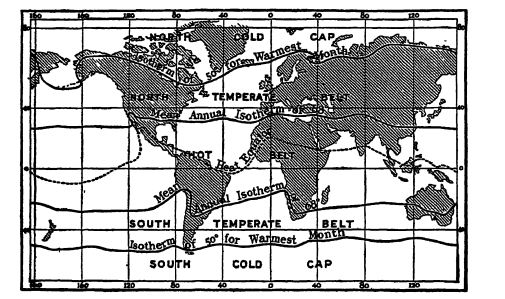
In a general way, the earth’s surface is divided into five climatic zones, the equatorial torrid belt, the two temperate zones, and the two polar zones. These zones, however, are not strictly defined by latitude but by lines of equal temperature, or isotherms, as illustrated in the above figure.
¶ Criteria for Determining Geologic Climates
Tills and Tillites. — The tills are the morainic deposits and bowlder clays of glaciers, and the work done by these streams of ice is described in Chapter V of the first part of this text-book. The geologic deposits made by ice and ice water during the Great Ice Age (Pleistocene) [ p. 441 ] are called tills, while the older and consolidated ones are known as tillites. These formations, when of coarse fragments (morainic), consist of unassorted and heterogeneous rock materials, and the pieces are of all sizes from flakes of mud to blocks sometimes tens of feet in length- This heterogeneity is due to the lack of sorting power in moving ice. On the other hand, the water-laid sandy clays (pellodites) are usually seasonally banded with lighter (s umm er) and darker (winter) materials, the particles being angular, with granular feldspar, calcite, and other easily dissolvable minerals present. These are the varved clays, each pair of bands making a varve.
In the tillites we have the best of evidence to prove, at least locally, the existence of cold climates like those of the high Alps or those of polar lands. Many of the known tillites are of local occurrence, but some are indicative of world-wide glacial climates.
The existence of intermediate warmer times during the ice ages may be ascertained from the nature of the deposits, but more surely from the entombed animals, since they are of temperate climates; added evidence lies in the presence of carbonaceous strata or even coal beds and an abundant flora.
Wind-blown Sands. — In water-laid sandstones the quartz particles are nearly always angular and well assorted, but in dune and desert sands the grains are more or less well rounded, smooth and frosted, minutely pitted through impact, and usually well assorted as to size. Therefore well rounded sands with frosted surfaces are apt to be indicative of desert climates. They may accumulate as continental eolian deposits, or be blown into river or marine strata. When, in addition, eolian sandstones are strikingly cross-bedded, with the bedding planes more or less long and concave, the evidence is decidedly in favor of desert dime accumulation (see Fig., p. 470). A sandstone with some rounded grains, or even one largely made up of such, may nevertheless be of fresh-water or marine deposition, the material/ then being derived from older eolian sandstones. It is now well known that sand may pass through several cycles of deposition, and as an example may be cited the eolian but marinelaid St. Peter sandstone of Middle Champlainian time, which came largely if not entirely from the Cambrian sandstones of windblown origin deposited in the Croixian seas. For a complete discussion of the nature and environmental significance of sandstones, see Sherzer, 1910.
Feldspar. — Ever since the Silurian, in wet and warm climates there has been an abundance of vegetation, resulting in large amounts of humic acids that dissolve out of the weathering rocks most of [ p. 442 ] their soluble minerals. On the other hand, in dry and cold climates there is little or no vegetation, and besides, nearly all of the rocks are fragmented through marked fluctuations in the temperature. Therefore in the continental deposits, or even in the marine strata adjacent to cold or dry lands, the formations have more or less of fragmented feldspar and calcite or rarely limestone and dolomite. Therefore formations more or less rich in these detritals are indicative of cold or dry climates.
Sediments as Climatic Indicators. — Johannes Walther in the third part of his Einleitung — Lithogenesis der Gegenwart, 1894 — was the first to emphasize the fact that the sedimentary formations of the ancient seas, and more especially the continental deposits, have within themselves a climatic record. His book entitled Das Gesetz der Wusteribildung, 1912, is a classic on the nature of deserts and their deposits. He points out that the deserts of central Asia are red in color, that carmine-red dunes are wandering across Arabia, while yellows are of wide distribution in Trans-Caspia and in Africa. The dust of the Sahara falls in Italy as the blood rain.” In temperate moist regions, the soils are chiefly gray, yellow, or brown in color, while in tropical ones they are red and the laterites are brownred. In America Harrell wrote much on the same subject between 1907 and 1919, and Blackwelder is another student of sediments and climates.
It is now evident that the color, character, and chemical nature of the geologic formations are largely connected with climate. Thus, a sedimentaiy layer which is deposited under water and in contact with much decaying organic matter, will necessarily be kept in a reduced or imoxygenated condition, whereas if it comes to rest on an exposed dry surface where aerated waters circulate down through it, the materials are likely to become thoroughly oxidized. Alternations in color from red deposits to gray and white sandstones and conglomerates, with coal beds such as occur in the American Carboniferous succession, appear to indicate wide swings of climatic change from warmth and semiaridity to cooled, humid, and probably even cold climates. Accumulations of salts and bedded gypsums in red formations are indicators of dry climates. Loess and steppe deposits, the residuals of cleavable, soluble, or decomposable minerals, plus finer abrasion products, are dust accumulations blown out of deserts or cold dry regions into grass-covered areas where these clays are retained by the moisture and vegetation. Widespread and thick formations of limestones, dolomites, and oolites are laid down in shallow warm-water seas [ p. 443 ] and hence indicate equable and mlld climates on the adjacent lands. Widely spread coal beds are the accumulations of swamps that probably are more often of warm moist climates than of cold ones. Finally, all mud-stones that are tension- or “ sun-cracked ” are evidence of seasonal exposing and the drying out of the contained water by the atmosphere. This phenomenon is particularly conunon in the oxidized red formations that were laid down imder more or less arid climates. In such, rain-pitting is also common.
Through an understanding of the present operations of the laws of nature, we learn how to discern their effects throughout the geologic ages, and to see that the rocks, like the living oiganisms, have within themselves the records of their climatic environments.
Fossils as Life Thermometers. — Paleontologists have long been aware that variations in the climates of the past are indicated by the fossils, and Neumayr in 1883 brought the evidence together in his study of climatic zones. Since the distribution of living plants and animals is so largely controlled by temperature, it is but natural that fossils of the ancient organic worlds should also indicate temperature ranges and something of their environments as well. Some of this evidence has more recently been briefly restated by Schuehert and Matthew.
Fossil plants have long been used to decipher climates of the past and great dependence is placed upon them by the paleontologists. When fossil tree-ferns, cycads, pahns, magnolias, and breadfruit trees are foimd in continental deposits in high latitudes, the conclusion that the land had a warm climate when they lived there is sound. In the same way, when the ancient marine deposits of arctic countries have an abundance of fossil corals, or better, coral reefs, shelled cephalopods, and reptiles, the concluaon follows that these seas also were warm.
Whole groups of invertebrate animals are conditioned by warm waters and such are now used extensively to work out the climates of the past. The colonial large-shelled foraminifers (Fusulinidse, Nummulinidae) ; an abundance of stony corals and especially the reef-builders; reef-making bivalves (rudistids, oysters); a highly varied bivalve and gastropod fauna, and especially with large or highly ornate forms; and an abundance of shelled cephalopods ( nautilids and ammonids) are all indicators of warm waters.
In continental deposits the presence of amphibians, reptilians, many kinds of mammals, and especially large ones and primates, are also indicative of warm land climates.
[ p. 444 ]
¶ Climates of Geologic Time
Rise of Paleoclimatology. — In the first half of the nineteenth century, nearly all geologists believed that the origin of the earth took place according to the theory of Laplace. This postulates the origin of the earth out of the sun as a hot gaseous star that in the course of cosmic time gradually cooled, passing through a fluid stage into a more solid one with a rock crust; then during the long geologic ages, as the crust became thicker, the climate cooled down from a very hot one to the present zonal arrangement from tropical warmth to polar ice-caps. The idea that the earth had very recently passed through a much colder climate than the present one came into general acceptance only during the last half of the nineteenth century.
The evidence in many lands is overwhelming that the earth is only now emeiging out of the glacial climate of Pleistocene time. The recognition of this fact began in the Alps, that wonderland of mountains and of extraordinary expanses of creeping ice. It was an Alpine chamois-hunter, Perraudin, who in 1815 directed the attention of the engineer De Charpentier to what is now so widely accepted, namely, that the large bowlders perched on the sides of the Alpine valleys were carried there and left by the present glaciers when they were thicker and greater in area. For a long time this conclusion was thought extravagant, but eventually Perraudin persuaded another engineer, Venetz, of its correctness. The latter told the Swiss naturalists at their meeting at St. Bernard in 1821 that his observations led him to believe that the whole Valais had been formerly covered by an immense glacier and that this glacier extended even outside of the canton, covering all the Canton de Vaud, as far as the Jura Mountains, carrying the bowlders and loose materials which are now scattered as “ erratics ” all over the large Swiss valley. Further, that the accumulation of heterogeneous rocks into moraines was the work of retreating glaciers, and that the time of their origin “ is lost in the night of time.” It was these conclusions republished in 1835 by De Charpentier that led Louis Agassiz in 1836 to take up a study of the glaciers of the Alps and in the following year to become the greatest advocate of the Ice Age. Agassiz’s Etudes sur les Glaciers, 1840, and De Charpentier’s Essai sur les Glaciers, 1841, are the classics that have revolutionized all thought about the climates of the past.
Succession of Geologic Climates. — Many older tillites are known, in fact, every year new ones are being discerned. Geologists [ p. 445 ] [ p. 446 ] now know of at least seven times of decided temperatme changes: early and late Proterozoic, late Silurian, early Permian, late Triassic, late Cretaceous, and Pleistocene; and of these, four (those italicized) were greatly reduced or glacial climates.
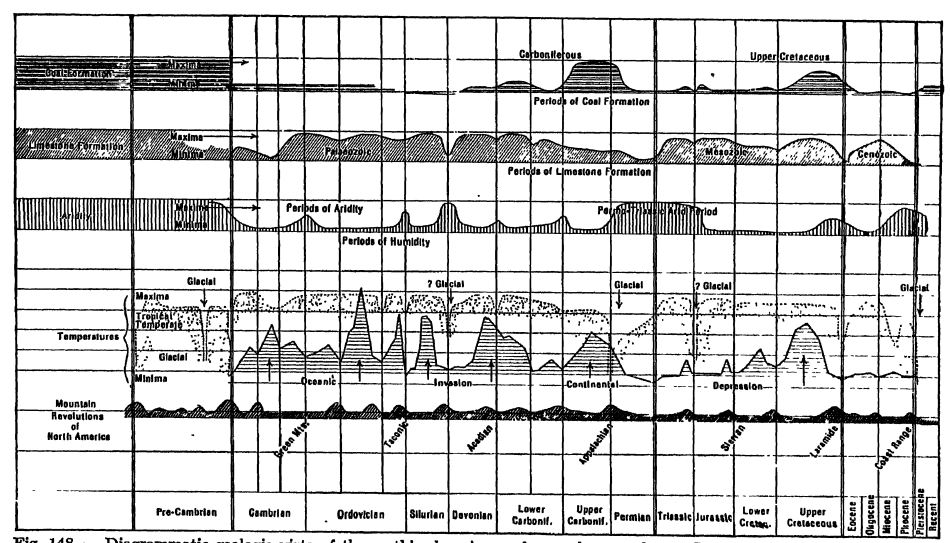
The marine “ life thermometer ” indicates vast stretches of timA of mild to warm and more or less equable temperatures, with but slight zonal differences between the equator and the poles. The great bulk of marine fossils are those of the shallow seas — areas that best simulate the climatic conditions of the lands — and the evolutionary changes recorded in these “ medals of creation ” are slight throughout vast lengths of time. These long periods of slightly varying climates are, however, punctuated by short but decisive intervals of cooled waters and consequent greater mortality, followed by quickened evolution and the rise of new stocks.
On the land the story of the climatic changes, as interpreted in the main from the entombed plants, is more variable and decided, but at times the equability of the temperature simulates that of the marine areas. In other words, the lands also had long-enduring life assemblages that indicate mild to warm and but slightly variable climates.
Periodic Marine Floodings. — Into the problem of land climates enter factors that are absent in the marine ones, and these have great influence upon the temperature and moisture of the continents. Most important of these is the periodic warm-water inundation of the continents by the oceans, causing climates that are milder and moister. With the vanishing of the floods, somewhat cooler and certainly drier conditions are produced. The effect of these periodic floods must not be underestimated, for the North American continent, as has been said, was variably submerged at least seventeen times, and over areas variable between 150,000 and 4,000,000 square miles.
Periodic Times of Mountain Making. — When to these factors is added the effect upon the climate caused by the periodic rising of mountain chams, many of which must have been snow-covered, or by the presence of explosive volcanoes clouding the earth’s atmosphere and obscuring the sun by a thin blanket of ashes that helps to cool the atmosphere, it is at once apparent that although the climates were mild as a rule, they must have been slightly variable.
Conclusions. — In general, we may say that the temperature fluctuations seem to have been slight throughout vast stretches of time, but geologically the climates varied between mild to warm pluvial, and mild to cool arid or even to glacial ones. The arid [ p. 447 ] factor has also been of the greatest import to the organic world of the lands, blotting out whole doras and faunas and establishing impassible barriers to the migration of life. Further, during emergent periods the lands were apt to be connected by land bridges, and these barriers changed the oceanic currents and likewise the local climate (study Fig., p. 445).
¶ Part II. Cycles op Life and Critical Times
We have seen that great areas of our own continent have been repeatedly inundated by marine waters, with the effect of extending the shallow-water areas of the oceans and thus giving rise both to expanding marine life — expanding not only numerically in individuals but also in species — and to restrictive evolution of the land life.
When the lands are low and more or less covered by seas, the areas so affected have climates of the insular type. Forests are then more prevalent and open meadows are restricted. With the removal of the seas, the lands become drier, and the forests diminish. If, in addition, great areas are elevated into mountains, the climate becomes cooled, with the alpine parts icy and cold; and if the mountains deflect the air current or take out their moisture, then on the leeward side of the highlands semiarid to desert regions result. A warm climate followed by a cold one is productive of many new species, most, of the specialized ones dying out and others changing into new forms. With the lack of moisture, and the appearance of deserts, whole floras and faunas are almost wiped out, and those elements that remain are highly specialized through adaptation. Such changes bring on in the areas so affected critical times for the land life.
Many times during the geologic ages the lands were reduced to but little above sea-level, and at these times there were worldwide mild climates. Such can be demonstrated most easily for Pennsylvanian, Jurassic, Cretaceous, and Oligocene times. Contrast, toen, tins condition with that of the present topography, with its marked zonal climatic belts, high mountains with cool to cold climates, polar ice caps and hot equatorial climates, and one fifth of the lanri area so lacking in moisture as to be deserts. All of the present deep oceanic water has been icy cold since the glacial times of the Pleistocene, when all North America was covered by a thick ice-sheet down to the Ohio River, and Europe south to Poland. Then the extreme cold was at its greatest, walrus living as far south as Georgia and musk-oxen ranging from New Jersey southwest [ p. 448 ] through Kentucky into Oklahoma and Nebraska. Such great climatic changes appear rapidly in geologic time, and on .the lands blot out many kinds of plants and animals.
Africa to-day, due to its equatorial situation and to a long emergent history, is peopled by peculiarly localized faunas, among which the most notable elements are the many kinds of mammals, not very unlike those of Pliocene time. Now think what destruction would befall this asylum, with its hundreds and even thousands of peculiar forms, if the greater part of the continent were to be covered by the oceans, or a very cold climate were to prevail. The last remainder of the Pliocene organic world would be gone. However, as no continent £*evef wholly inundated by the marine transgressions, only parts of the floras and faunas would be killed off, while others would be modified to suit the changed conditions. If small asylums of diy land remained — and surely there would be such — when the waters retreated the floras and faunas of these asylums would expand with their enlarging habitats and their changing environment, and evolve into new life assemblages expressive of their time, but showing unmistakable linkage with those of the Pliocene. Physical changes of this character have many times taken place and have had a most telling effect on the land life ever since the Silurian, On the other hand, the extension of the marine shallow-water areas has given rise rather to the wide dispersal of these faunas than to marked expansive evolution. It is when the restriction occurs that many of the species are blotted out, because of the more and more congested conditions and the general disturbance of the web or balance of nature.
A survey of the organisms of the past reveals the vanishing of whole faunas from extensive countries, which were then repeopled by other forms from elsewhere. Countless groups, once flourishing, are no more; many others have had their day, and are now on the decline; many are now prospering, or even on the increase, and seem to have a future before them.
These facts of the geologic record long ago attracted the attention of naturalists and a century before our day the great Cuvier of France brought into almost universal acceptance the fallacious catadysmal theory. According to this theory the .succession of changed life assemblages was explained as due to wholesale destructions brought about by sudden geologic alterations that changed wide areas of sea into land or vice versa, followed by successive recreations of plants and animals. Long before Cuvier, however, another Frenchman had thought of life as continuous and evolving [ p. 449 ] with change. This was the naturalist Buffon, and with him came the theory of continuity of conditions and life. This theory of continuity (unifonnitarianism) was put into geologic form by James Hutton of Edinburgh and then developed into general acceptance by the geologist and text-book writer, Charles Lyell. With Lap marck of France and Charles Darwin of England came the revolution of thought from cataclysms and special creations to continuous development and organic evolution.
Small Heralders and their Giant Descendants. — It is one of the most striking generalizations of- Paleontology that the upwelling of future organic rulers begins in unobtrusive small forms. In all stocks of plants and animals such potential rulers are always present. In fact, each individual, however large, begins in a microcosm, and life itself began in the smallest and simplest globules of primitive protoplasm. The shelled cephalopoda begin in the Lower Cambrian with a length rarely exceeding 10 millimeters, and along various lines and at different times develop into giants many feet across. In the Silurian, the fishes are all diminutive, and even though great giants are present in the Devonian (Arthrodira), the biggest ones in many families come with the Mesozoic and Cenozoic. The Amphibia are rarely 3 feet long in the early Pennsylvanian, but giants two to four times as large come in the Permian and more especially the Triassic; the reptiles repeat the development of the Amphibia but swing rapidly through the Permian to become in the Mesozoic time the rulers of the land, the oceans, and the air. The titan dinosaurs of the Jurassic and Cretaceous are the most ponderous land animals that ever lived, ranging up to 40 tons in weight, and at least one of the “ dragons ” of the late Cretaceous attains a wing expanse of 25 feet. Finally, all through the Mesozoic the nrtfl.TnTnaJg are small and are not much in evidence, but with the vanishing of the dinosaurs comes their rapid ascendancy into the giant rulers of Cenozoic time.
These overspecialized giant forms vanish during or shortly after the times of either marked climatic or environmental changes. It is not bulk alone that brings about their extermination, but this in combination with a changing environment — the disappearing of their habitats and the vanishing or alteration of their food, to which they can not adapt themselves. It often happens that the smaller animals also die out at these times, but always there are some stocks left to find an unoccupied kingdom before them; and into it they spread, adapting themselves to the new conditions, and becoming in turn the lords of their time.
[ p. 450 ]
E. D. Cope denominated this pulsing or cyclic development of life as the survival of the unspecialized. He expressed it as an evolutionary law, namely, that the highly developed or specialized types of one geologic period are not the parents of the types of succeeding periods, but that the descent is derived from the less specialized of the preceding ages.
Osborn concludes that extinction of species begins with the dimmution in numbers of any form, which may arise from a chief or original cause, followed by other causes that are cumulative in effect. “ From weakening its hold upon life at one point, an animal is endangered at many other points.”
Parasitism. — It has been said that more than one half of the animal forms known are parasites and that all organisrds, even the parasites themselves, are infested with them. The human species is known to harbor more than fifty kinds. Parasitism is one of the best examples of the mterlocking dependence of organisms. The hosts may become inmume to their parasites, but when long immunized forms come into contact through migration with those that have not hitherto been infested by these parasites, the newly attacked species may become sick to death and be totally destroyed. Therefore the times of wide-spread intermigration of plants and animals across newly made land bridges are the ones when the parasitic diseases are most destructive in blotting out parts of floras and faunas. Parasites, even in the immunized hosts, must be a great factor in evolution. (Eccles.)
Interorganic Changes. — In the previous paragraphs some of the more striking physical causes that lead to changes m the organic world have been mentioned. Now we are to see, but briefly, some of the reactions among the organisms themselves, and the train of interlocking consequences that leads to specific destruction or change into new adaptive forms. Most organisms are dependent upon one another; for instance, most flowers would not fructify without the searching of insects for pollen or nectar, and mammals are interlocked with external and internal parasites. And so organic interdependence goes on from the higher to the lower organisms. Change one link in the chain of interdependence, and a cycle of reactions is bound to follow until the balance of nature is again established.
Critical Times in the Organic World. — The rocky shell of the earth is nearly always in slow movement, warping slightly up and down in compensation for internal changes, and periodically parts of it are pushed high into mountains. In other words, there are in the [ p. 451 ] history of the earth long times of slight adjustment, physical and organic, punctuated by shorter ones of marked deformations. It is these times of mountain making that condition ancient geographic history, crustal unrest with consequent marked changes of climate, and organic evolution.
The periods begin with small seaways, following the time of continental elevation and sea withdrawal at the end of the prcNuous period. The middle time of a period is a longer one of more or less crustal stability and more or less extensive flooding of the continents by the oceans. Here again we see a constant change in the geography and climates of the dry land and marine realms. Each one of these active and decisive movements occurs as a rule toward the close of a period, but toward the end of the eras (late Proterozoic, Permian, Cretaceous, Pliocene) many more regions of the earth’s crust are rising into mountains. Then result the greater alterations in geography and in life, when the marine waters are more or less completely withdrawn from the continents, the lands are highest, and the climates are decidedly zonal, with cool to cold regions. Critical times in varying degrees are upon the disorganized organic world.
The term “ critical periods ” was proposed by Joseph LeConte in 1877, and in 1895 these were defined as the times of very general re-adjustments of the crust of the earth and therefore of widespread changes in physical geography. At these times the physical changes are so great and so general as to affect profoundly and widely the climates of the earth, and in this way give rise to marked changes in the organic world. These critical times or revolutions are, however, not catastrophic, since the slowly evolving crustal movements endure through millions of years (study diagram, p. 445).
Summary. — We have seen how the climates of the geologic past have fluctuated from long times of slightly altering mild conditions that are locally variable between moist and dry, to the shorter punctuating ones of cool to cold conditions. This variability of climate appears to be largely governed by the changes of the earth’s surface, not alone through the change of lowlands into highlands with the resulting cooled climates, but also because of the periodic wanderings of the oceans as shallow seas over the continents. The greater the marine areas, the wider in extent are the resulting equable moist climates; and the smaller the floodings, the more contrasting are the climates of the lands. A look back through the geological ages appears to reveal the earth’s surface and its climates as in ceaseless flux, but after all, since geologic time is exceedingly long, the mean condition of any given time lasts for ages.
[ p. 452 ]
When the physical envii’onments of the organisms do not change excessively, then the floras and faunas quickly adapt themselves to them. Such changes do not bring out marked alterations in the floras and faunas. When, however, the changes are decided and especially when the climate becomes cold and the topography is rugged, then the life is subject to vast changes because critical conditions are upon it. It is then that are noted the greatest changes in the life assemblages, the vanishing of the most specialized and the giants, and the appearance of new creations, as it were, out of the small and less specialized — an emphasizing of the law of the survival of the unspecialized.
Through the periodic moving of the earth’s surface, and the consequent succession of climatic cycles, we see the struggle for survival among the plants and animals resulting in the retention of the most fit through adaptation to the changing environments. And in the perspective of the past we see the ups and downs of life, its pulsing throughout the geologic ages. In it all there is, however, a progression to greater individual complexity in an increasingly intricate organic complex that attains to higher and higher mentality.
¶ Collateral Reading
Ernst Antevs, The Recession of the last Ice-sheet in New England. American Geographical Society, Research Series, No. 11, 1922.
Joseph Barrell, Relations between Climate and Terrestrial Deposits. Journal of Geology, Vol. 16, 1908, pp. 159-190, 255-295, 363-384.
Joseph Barrell, Influence of Silurian-Devonian Climates on the Rise of AirBreathing Vertebrates. Bulletin of the Geological Society of America, Vol. 27, 1916, pp. 387-436.
Joseph B.arrell, Probable Relations of Climatic Change to the Origin of the Tertiary Ape-man. Scientific Monthly, January, 1917, pp. 16-26.
R. G. Eccles, The Scope of Disease. Medical Record for March 8, 1913.
W. J. Humphreys, Physics of the Air. Philadelphia (Lippincott), 1920. Ellsworth Huntington and S. S. Visher, Climatic Changes, their Nature and Causes. New Haven (Yale University Press), 1922.
W. D. Matthew, Climate and Evolution. Annals of the New York Academy of Sciences, Vol. 24, 1915, pp. 171-318.
M. Neumayr, Ueber klimatische Zonen wahrend der Jura und Kreidezeit. Denkschriften der kaiserliche Akademie der Wissenschaften, Vienna, Vol. 47, 1883, pp. 277-310.
W. H. Sherzer, Criteria for the Recognition of the Various Types of Sand Grains. Bulletin of the Geological Society of America, Vol. 21, 1910, pp. 625-662.
J. Walther, Das Gesetz der Wtistenbildung. Leipzig (Quelle and Meyer), 1912. A fourth edition will appear in 1923.
R. DeC. Ward, Climate Considered especially in Relation to Man- New York (Putnam), 1908.
| XXXI. Permian Time and its Glacial Climate | Title page | XXXIII. The Beginning of Mesozoic Time: the Triassic Period |