| XXXII. Climates of the Geologic Past, and the “ Critical Times ” | Title page | XXXIV. Dinosaurs, the Mighty Rulers of Mesozoic Lands |
[ p. 453 ]
¶ Mesozoic Era
To the founders of Geology the Mesozoic rocks were known as the “ Secondary ” formations, situated above their Primary (Paleozoic and older eras) and beneath their Tertiary (Cenozoic) divisions. To them the Mesozoic was the middle or medieval time of the earth’s history, and they therefore selected a name meaning medieval life to express that idea. It is now well known that the Mesozoic formations are far from holding the middle time of geologic history, but the life known to geologists is medieval in character and it is in this sense that the term is used.
Divisions of Mesozoic Time. — The Mesozoic era, though of very long duration, was only one half as long as the Paleozoic, or even less, but it was twice as long as the Cenozoic. In Europe, this era is divided into three periods — the Chalk or Cretaceous, the Oolite or Jurassic, and the New Red sandstone or Triassic; but in America the Mesozoic is sometimes divided into four periods, by separating the great chalk formations into a lower and an upper series, known respectively as Comanchian and Cretaceous. These periods, on the basis of organic change, and because of the decided movement that gave rise to the Sierra Nevada Mountains, can be grouped naturally in America into two sub-eras, the Early Mesozoic (Triassic and Jurassic) and Late Mesozoic (Cretaceous).
Characteristic Life of Mesozoic Time. — Gideon Mantell as long ago as 1831 called the Mesozoic the Age of Reptiles, because those animfllR then dominated the world. The Mesozoic Reptilia were very’ diversified in form and adaptation — small to gigantic, sluggish to agile — but their mentality was always of a low order. Scott tells us: “ They filled all the roles now taken by birds and mammals; they covered the land with gigantic herbivorous and carnivorous forms, they swarmed in the sea, and, as literal dragons, they dominated the air.”
Out of the reptiles early in the Triassic arose the small and insignificant reptilian and egg-laying mammals, and from another [ p. 464 ] stock came the reptilian birds, mth an abundance of teeth; both stocks at the close of the Mesozoic era began to modernize, one into the suckling mammals and the other into the toothless birds. Among the Paleozoic amphibians, the stegocephalians vanished with the Triassic, and their only living remote descendants are the salamanders and the greatly modified frogs of late Jurassic (Morrison) origin.
The dominant Paleozoic animals, the trilobites, sea-scorpions (emypterids), blastids, tetracorals, and graptolites, were gone, while the crinids, echinids, and brachiopods were greatly modified and the kindg were not only characteristic of the era, but more like those of the present. The bivalves and gastropods were undergoing great change in the Early Mesozoic, and the culmination of their evolution was attained in Cenozoic time. Oysters have been abundant since the Jurassic. The ammonids of the Permian gave rise to a wonderful evolution in the Triassic but were almost exterminated at the close of this period; another rapid evolution took place in the Jurassic, with the Lower Cretaceous they began to show decline, and at the close of the Cretaceous they had disappeared. Among the marine invertebrates none were more significant of Mesozoic time than the ammonids.
The floras had also undergone great changes, since all of the more significant spore-bearing plants of the Paleozoic were practically gone and the ancient ferns were changing into the modern stocks. The older seed-bearing plants had given rise to more modern conifers, maidenhair trees (gingkos), and cycads in greatest variety. Giant rushes, modernizing ferns, and tree-ferns also were present. As the cycads dominated the floras of Early Mesozoic time it is called the Age of Cycads (see Figs., pp. 27 and 386). The forests of early Mesozoic time must have displayed a variety of foliage never equalled before or since, and it is probable that the various shades of green were enlivened by fructification cones of dull red or purple colors as is the case to-day among the cycads and conifers. If sweet odors due to nectar secretions were then present, it was in all probability to a limited extent. With the Lower Cretaceous, the modern flowering plants and insects (beetles, flies, butterflies, bees, wasps) took their rise, and we may say, in fact, that much of the modern floral and insect world has been established since early in the Cretaceous.
¶ Triassic Period in Europe
The Term Triassic. — In Germany at the opening of the last century, the three-fold stratigraphic nature of the Triassic was already well known, Germany and the Alps being the regions from [ p. 455 ] which most of our knowledge of Triassic time has come. In the north, the Triassic begins with the variegated sandstone member (Bunter, 650-2000 feet) of fresh-water origin, which is overlain by a more or less thick shell limestone (Muschelkalk, 800-1100), made by an epeiric sea that spread northward into Germany from the mediterranean Tethys. This sea again vanished and local coal swamps appeared; then followed variegated continental deposits that are mostly of a red color, along trith beds of gjTpsum and more rarely of salt (Keuper, 800-2000). This is the Germanic phase and to it Alberti in 1834 gave the name Triassic because of its threefold development. In England there is no Muschelkalk and all of the Triassic is of continental origin; originally these deposits were known as the New Red sandstone. In France, the Triassic is often called the Saliferous period, because it has here important beds of rock salt.
In the Alps, and especially in the Tyrolian region, where the deposits are of marine origin, with a wonderful array of fossils, the Germanic classification cannot be applied. Here the Triassic is divided into six series, and as they are of normal marine sediments, this development is spoken of as the Alpine or normal phase. The latter has become the standard of correlation for the marine strata of this period, while the Germanic phase interprets the land conditions and the diastrophic movements.
Gümbel holds that the area in which was formed the Germaziic phase of the Triassic was separated from that of the Alpine or normal marine development by a low mountain tract — the Yindelian moimtains — that existed throughout the entire Mesozoic from Italy and Sardinia along the Bohemian-Bavarian boimdary to the central plateau of France.
¶ Triassic op North America
Significant Things about the Triassic. — Probably the most striking fact about North America in the Triassic, and in the Jurassic as well, was its emergent condition. The only flooding by the oceans was along the Pacific border and in Mexico. This condition is sometimes spoken of as geocratic, that is, with the land areas predominating. Because of this emergent condition, desert climates prevailed, and the geologic record therefore consists largely of coarse red fresh-water deposits, with scattering fossil plants and bones of reptiles. Along the Pacific coast, however, there are widespread marine formations that abound in molluscan fossils, among which the ammonites are most significant. Corals and reef lime [ p. 456 ] stones are also wide-spread. In these marine deposits, which are usually very thick, there are vast amounts of volcanic ash and lavas, attesting to an abundance of volcanoes from California far into Alaska. Lavas also flowed widely in the fault-troughs of eastern North America from Nova Scotia to Virginia. The Palisades along the west shore of the Hudson River and East and West Rocks at New Haven, Coimecticut, are also lava-like rocks, but of a tjrpe which congealed deep below the surface and have since been exposed through the erosion of their covering strata.
The Appalachian Revolution (see p. 426) not only raised the eastern border of North America into a movmtainous tract, but continued the continent to an unknown distance, at least some hundreds of miles, into the Atlantic Ocean as well. Therefore the greater eastern half of the continent remained above the sea for a very long time, certainly to the end of the Jurassic. A further reason why the sea did not spread over this region lies in the fact that another period of elevation set in at the close of the Triassic — the Palisade Disturbance. Hence the geologic record is one of erosion, the making of land forms, and the accumulation of continental deposits in thick series. Along the Pacific border, however, there is a long marine sequence that is correlated best with the Asiatic records, and the waters also spread their sediments over great areas of the western Cordilleras, but all later deposits are fresh-water red muds and sandstones. The Triassic of North America is therefore displayed under three different regional sedimentary and faunal phases: (1) Pacific coast normal marine, (2) western Cordilleran fresh-water, and (3) Atlantic border intermontane continental deposits.
Subdivisions op the Triassic
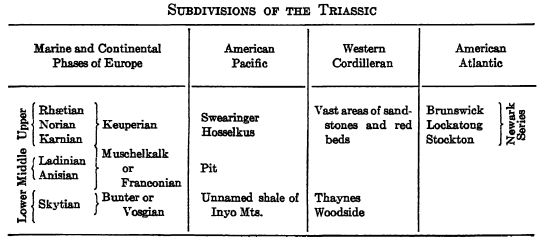
The physical conditions and the absence of the sea in eastern North America in Triassic time were also repeated in South America, most of Africa, and northern Europe and Asia. In other words, the revolution at the close of the Paleozoic [ p. 457 ] was decidedly positive and extended over the greater part of the earth, leaving most of the continents standing well above -ca-Ievel, while the main areas of oceanic overflow were the bordering lands of the Pacific and Tethys. Therefore the Triassic the world over was a geocratic time, when the continents were largest. During Middle Triassic time only did Tethys flow widely northward over Europe and lay down the well known epeiric limestones called the Muschelkalk. In nearly all the lands mentioned the climate was semiarid to arid.
¶ Newark Series
The Appalachian Mountains, consisting of many ranges that were completed in Permian time, where even then undergoing reduction, and all of the products of erosion were being swept into the oceans. Seemingly the same conditions continued into the Triassic, for no one has yet found among the few fossils of this period in eastern America any that are indicative of the earliest epoch. The fishes, Eastman says, indicate early Upper Triassic, while the plants Stur and Knowlton regard as of the same time. In any event, the Triassic deposits of Nova Scotia (see Pt. I, Fig., p. 99) lie upon the nearly peneplained and truncated edges of Paleozoic formations ranging from the Champlainian to the Pennsylvanian. In Pennsylvania and New Jersey the Triassic lies on the planed edges of the Lower Paleozoic. From this evidence we see, further, that the folded structures of Permian time had suffered profoundly from erosion even by the beginning of Newark deposition.
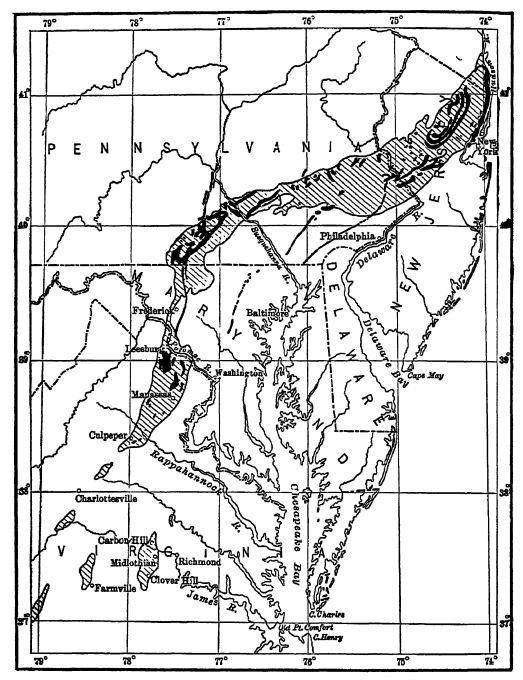
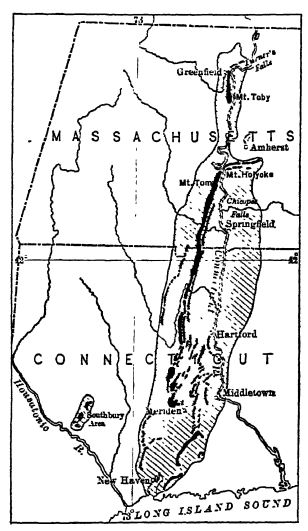
Newark Fault-troughs. — The term Newark, taken from Newark, New Jersey, was proposed by Redfield for the red sandstones found upon the Piedmont Plateau (Fig., p. 458). Beginning vrith about Middle Triassic time, the several regions of Newark sedimentation — Nova Scotia, Connecticut, and New Jersey to North Carolina — began to fault along one side, and certain narrow but long areas began to subside as troughs, while the adjacent spaces stood firm as unmoved blocks (horsts), or actually rose. In this way the median arch and the lateral horsts were reelevated from time to time into more or less high lands, and their eroded material was moved by the rivers into the subsiding valleys. Such major fault lines occur along the eastern side of the Connecticut valley (here the displacement is about 2 miles) and others are known in the western parts of the Triassic areas of jVIaryland, New Jersey, Pennsylvania, and Nova Scotia. In this way the constantly rejuvenated highlands were subjected to quick erosion, and into the sinking valleys on the sides of the horsts the aggrading rivers brought down vast amounts of sediment, the present Triassic formations. Because of their subsidence the loading troughs also came to lie below the plane [ p. 458 ] of erosion and so were preserved throughout subsequent time. In the Connecticut valley there are from 10,000 to 13,000 feet of continental deposits (Fig., p. 459), in New Jersey and in southeastern Pennsylvania the maximum thickness is said to be over 20,000 feet. Here the eastwardly flowing rivers may have headed as far west as the present Allegheny plateau. In Pennsylvania, the trough of sedimentation seemingly subsided 3 miles during the Triassic [ p. 459 ] period. Southward these deposits thin rapidly, and to the west of Richmond, Virginia, they are about 2500 feet thick, and in North Carolina 3000 feet (Fig., p. 458).
The character of the formations and the geological structure of the Newark troughs are analogous to those which exist at the present time in the Great Valley of Calif orma and the Sierra Nevadas. There, uplift on the east and downsinking on the west during the later Cenozoic have given rise to profoimd erosion of the uplifted side, the Sierra Nevadas, and transfer of sediment onto the sinking floor. A fault zone separates the Great Valley, the dowmsunken side of the block, from the Coast Range. The latter also contributes sediment to the valley, but the greater part comes from the crystalline rocks of the Sierras on the east. (Bairell.)
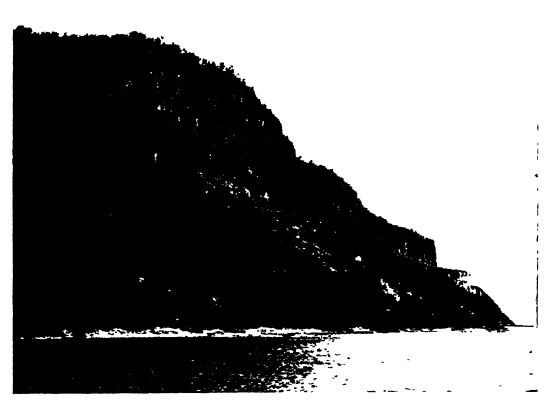
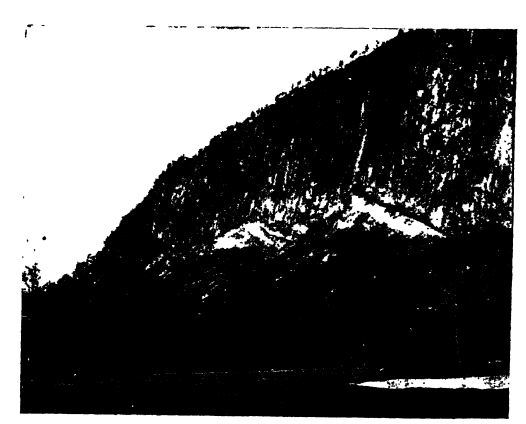
Igneous Material. — In all of the areas from Nova Scotia to North Carolina are found igneous rocks that in the lower strata occur as intruded sheets and dikes of trap (diabase), and higher up are extruded sheets of basaltic lavas in thicknesses up to 900 feet (Figs., p. 458, and opposite). These are seen to best advantage along the Hudson River of New Jersey, where they make the well known Palisades, whose vertical walls of columnar rock exhibit the edge of a great intruded sheet of diabase (Fig., p. 460). Although the remains of small volcanoes have been found in Connecticut there seem to have been no great ones at this time, and the molten material welled up repeatedly toward the close of Newark time through fissures situated in the deepest parts of the subsiding areas and near the great faults, and the lavas were either intruded into the sediments or for the most part flowed widely throughout the valleys of sedimentation and [ p. 460 ] away from the horsts and rising blocks. Undoubtedly the great subsidences of the sinking valleys fractured the earth’s crust deeply enough to let the molten magmas rise into the higher strata and even to flow out as lava on the surface of the Triassic basins.
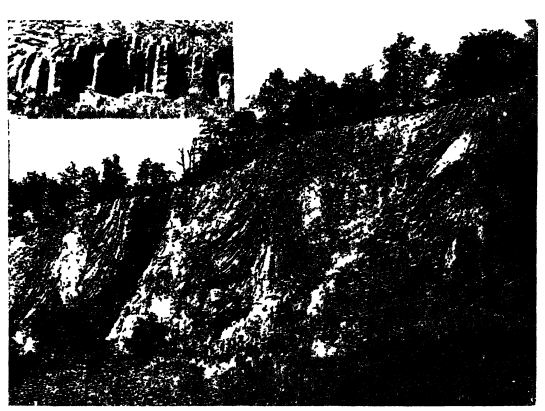
[ p. 461 ]
Character of Sediments. — From northern Virginia to Xova Scotia the Newark sandstones and mudstones are prevailingly red in color and consist almost throughout of conglomerates, sandstones, and shales. All of the material is poorly washed or assorted, and in most places is a heterogeneous mass of detritals, with the greater part of the conglomerates, fanglomerates (Longwell 1923), and coarser sandstones situated near the fault scarps whence they came. The great bulk of the material is from igneous and metamorphic formations, showing that the higher lands lay to the east in the Piedmont Plateau (the rolling land east of the Blue Ridge, see p. 311) of eastern Appalachis, which is made up of Archeozoic and Proterozoic igneous rocks.
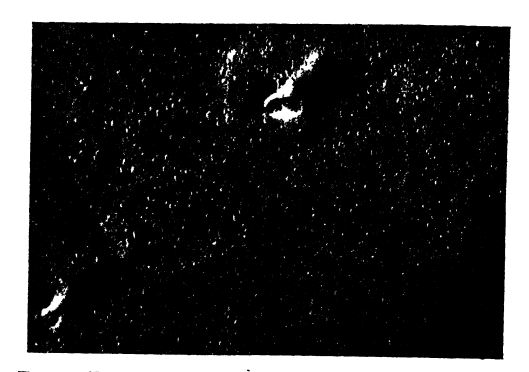
Nowhere have the Newark strata yielded a single marine fossil, all of the recovered organisms being those of the land (plants and vertebrates) and of fresh waters (fishes, bivalves). Actual remains of plants and animals are always rare in red deposits, due to the complete oxidation of the sediments during deposition, and the common organic evidence therefore consists of footprints or autographs made by quadrupedal and bipedal terrestrial reptiles (chiefly dinosaurs) (see Figs., pp. 474 and 480). The plants and fishes occur in dark to black shales which are evidently the mud deposits of lakes replete with water plants. The other sediments are much cross-bedded, abundantly sun-cracked, rain-pitted (Fig. 153, p. 462), and rippled, with the feldspars undecomposed; they are the erosion material of a high land of crystalline rocks, deposited in a semiarid climate with hot summers and possibly cold winters. (Barrell.)
Connecticut Valley. — In the Connecticut valley the Triassic is readily divisible into three series because of a great medial zone of lava flows. The upper series embraces the many quarries about Longmeadow, Massachusetts, and Portland, Hartford, and Middletown, Connecticut, and consists of coarse sandstones, conglomerates, and shales, about 3500 feet in thickness, with an abundance of reptilian tracks chiefly dinosaurian. Very rarely, however, is a skeleton or even a bone of a reptile found, though Hitchcock and Lull have described ninetyeight different kinds of vertebrate tracks. The middle series has at the tqp the posterior lava (trap) sheet, 100 feet thick, beneath which are the posterior shales with land plants and ganoid fishes, attaining a thickness of 1200 feet; then come the main lava flows, 400 to 500 feet thick, followed by the anterior shales from 300 to 1000 feet thick, with plants, fishes, and tracks of dinosaurs; at the base is the anterior lava sheet, 200 to 250 feet thick. The lower series [ p. 462 ] [ p. 463 ] consists of coarse granitic sandstones, frequent conglomerates, some shales, and intrusive traps such as those of East and West Rocks at Xew Haven, with a united thickness of 5000 to 6500 feet. Fos-ils are very scarce in this lower series.
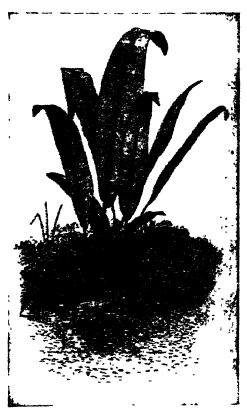
Coal Beds. — In the Upper Triassic areas of Virginia and North Carolina there is much fine-grained, black, bituminous slate, with decidedly local bituminous coals, and rarely a zone of black-band iron-ore. The coal beds vary in thickness from a few feet to 13 and even 26 feet. Plants are common here, and of these eight are conifers, twenty-three cycads, six rushes, and thirty-five ferns. Among the latter occurs the broad-leaved giant fem (Macrotoesniopteris, Fig., opposite). Very rarely are seen amphibia, reptiles, and reptilian mammals (Dromatheriwn and Microconodon, Fig., p. 475). These dark deposits with coal swamps, in which Lyell also reports many rushes that still stand vertically, show that the climate of the area of sedimentation was not always and everywhere semiarid, but that locally there were humid climates, with swamps having an abundance of cycads, ferns, and rushes.
Upper Triassic coals are also known in Mexico, Argentina, Australia, India, Asia, and southern and northern Europe.
Palisade Disturbance. — At the close of the deposition of the Newark series, crustal deformation again set in, apparently on a considerable scale, from Nova Scotia to South Carolina, and this makes a natural boundary between the Triassic and Jurassic. Everywhere this new area of deformation lay east of the Appalachian foldings, whose trends the Palisade block mountains nevertheless closely followed. The former mountains had been folded and overthrust, due to shortening of the earth’s crust, but now the surface was tom apart, resulting in numberless fractures and faults (tensional) of varying magnitude, and moving the strata in each basin into a series of monoclinal blocks, that is, all tilted in the same direction. As a [ p. 464 ] result there were formed chains of block mountains, the Palisade mountains of Dana, probably comparable in height to the Sierra Nevadas of to-day.
The Palisade mountain system comprised eight to ten independent ranges. They occurred at intervals over a region 1000 miles long, extending from Nova Scotia southwestward to the northern limit of South Carolina. The ranges were from 10 to about 350 miles in length and their general course was closely parallel to that of the Appalachian Mountains. The Connecticut River range was 120 miles long, and the Palisade range, extending from southern New York, on the Hudson, into Virginia, was 350 miles long.
The dip of the beds is, with rare exceptions, monoclinal, and mostly between 5° and 25° in angle. In the Connecticut valley, it is eastward, in the Palisade belt, westward. In two North Carolina belts, the eastern has eastward dip, and the western, westward. (Dana.)
“ These opposite slopes suggest the sides of a wide mountain arch raised between the Connecticut and the Hudson River, whose axis was continued southward through the region of the New Jersey coastal plain and offshore waters. But the raising of the arch was accompanied or foDowed by the fracture and settling which show on its sides. Wherever the Triassic sediments have been preserved in the Appalachians they show this phenomenon of tilting and faulting, indicating a general crustal movement. Each block lifted up would form a ridge or mountain, each block let down would form a trough or basin. . . . The lack of any known sediments deposited in basins from the erosion of the fault blocks suggests that general uplift prevailed over the whole Appalachian province and that the differential movement between the blocks was one of different degrees of uplift; that there was nowhere real downsinking. The greatest erosion was on the two sides of the basins facing each other. . . . Yet, in spite of this great crust movement, which could not have been earlier than the beginning of the Jurassic, a peneplain had been developed by the end of that period. This is shown by the fact that the Potomac deposits of the late Jurassic or early Comanche are laid down on a gently hilly surface which was eroded across the Triassic and all the older rocks.” (Barrell.)
¶ Marine Triassic of Western North America
Triassic of the Califomic Sea. — Beginning in the late Paleozoic, and more especially with the middle and upper part of the Triassic, there developed out of the western portion of the Cordilleric geosyncline a northwest and south-southeast trending geosyncline, the Pacific geosyncline, that opened out into the Pacific across northern California and southern Oregon, and again in southeastern Alaska. The southern portion of this trough was the Californic sea and it persisted all through the Mesozoic, but was widest and of most significance during the Triassic and Jurassic. In Cretaceous time it was longest and narrowest, extending from Alaska to the south end of Baja California. To the west of the trough lay two forelands, nearly all of which have since gone into the depths of the [ p. 465 ] Pacific, leaving the Coast Range of California as their only remnant. (See Pl., p. 465.)
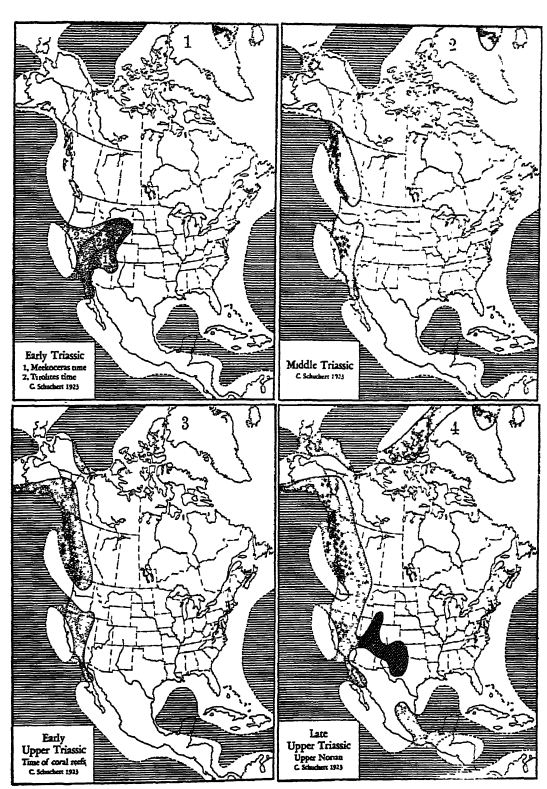
Epeiric seas dotted; oceans ruled. Desert and semiarid deposits either cross-ruled or solid black (along Atlantic piedmont). Volcanic regions indicated by crosses.
Note the absence of the Appalachic geossmcline, and that the marine areas are in the Cordilleric and Mexican regions.
[ p. 466 ]
Our knowledge of the West Coast Triassic is best for the states of California, Nevada, Idaho, and Oregon, and is due mainly to the work of Professor J. Perrin Smith of Stanford University. He states that the sequence of Triassic formations and faunas of the Calif ornic sea is unusually complete, and compares favorably with that of most other regions of marine sedimentation. The deposits are usually calcareous and fairly thick (about 4000 feet). The normal marine waters in early Triassic time (Kanab, Moenkopi, Wiser, Thaynes, etc.) spread across California, Nevada, and Oregon into Idaho and Utah, and possibly even into central Wyoming. Before Middle Triassic time this sea withdrew more and more to the westward, due to the rising of the Ancestral Rocky Mountains geanticline, so that the area of the Rocky Mountains and most of the Great Basin region has only fresh-water formations, usually of red colors, and in the main of Upper Triassic age.
The Lower Triassic is about 800 feet thick, the Middle division has about 1000 feet, and the Upper is the thickest, with about 2000 feet. The Middle Triassic faunas are as yet the only ones fully made known, but an estimate based on them indicates that the whole Triassic of this region will yield more than five hundred species, and of these over 70 per cent are ammonids (about ninety genera). All of this, moreover, was true IVIesozoic life, for at best there were but few Paleozoic genera then present. The corals (Hexacoralla) made reefs in the Upper Triassic that are known to extend from California into Alaska (60° north latitude), indicating that the waters were warm; this is the coral assemblage of the eastern Mediterranean.
Triassic of the British Columbic Sea. — In the Middle Triassic there appeared a wide and long trough throughout British Columbia, which in Upper Triassic time extended far to the north into Alaska and south into Washington and Montana. This was the British Columbic sea of the Pacific geosyncline, and it persisted into late Cretaceous time. (See Pl., p. 465.)
Along the Pacific border of British Columbia, from Vancouver north to the Queen Charlotte Islands, the Upper Triassic alone is present and it increases to very great thicknesses (Nicola formation), attaining, according to Dawson, to 13,000 feet. The significant feature, however, is not so much the thickness as the fact that more than nine tenths of the rocks are of volcanic origin. The material is that of submarine eruptions — effusive diabases and trachytes, agglomerates, breccias, and tuffs. With these are interbedded zones of marine sediments, argillites and quartzites, that are thin or even [ p. number ] absent to the east, while on Vancouver one such horizon reaches a thickness of 2500 feet.
These western interbedded marine and volcanic deposits undoubtedly extended eastward to the Rocky Mountains, where Upper Triassic strata and faunas occur all the way from Alaska south into Washington. In the coastal mountains of British Columbia they have been eroded away from the granitic bathyliths that rose beneath them toward the close of Jurassic time and that lifted them high into mountains.
Upper Triassic of Alaska. — The Triassic of the British Columbic sea had its widest distribution in Alaska, the marine waters transgressing also from the Arctic Ocean. The first deposits were the Chitistone massive limestones, ranging in thickness up to 2000 feet. Then followed the Xizina limestones in thin strata and with thicknesses up to 1200 feet. These are sediments of warm waters. Finally came black shales with much chert (McCarthy formation) and of cooler waters, having a thickness up to 2500 feet. This geology was fully described by G. C. Martin in 1916.
C. Burckhardt states (1921) that there was orogeny at the close of the Triassic in northern IVIexico (Zacatecas).
Emergence of the West Coast. — During the closing epoch of Triassic time (Rhaetic), all of western North America became dry land, and it remained above sea-level during the greater part of the early Jurassic (Lower and Middle Lias). Evidence which has come to light since the previous edition of this book seems to show that no mountains were made at this time, as was formerly held (Chitistone disturbance), the submergent waters having been removed apparently by the deepening of the oceanic areas. The time of mountain making here probably came rather toward the close of the Jurassic (Martin).
Volcanoes of the West Coast. — During early Triassic time, throughout western Alaska from the Alaska Range eastward and southward through eastern British Columbia, volcanoes were very active, and there were poured out over the land vast quantities of basaltic lavas, which in places attain depths of between 3000 and 5000 feet.
Along the western border of British Columbia and on Queen Charlotte and Vancouver islands, volcanoes that arose out of the sea were also very active during Upper Triassic time, and in places the lavas and ashes are as much as 10,000 feet thick. In Alaska there was likewise some volcanic activity at this time, but the extruded materials are not of much magnitude.
¶ Triassic Red Beds of the Cordilleran Region
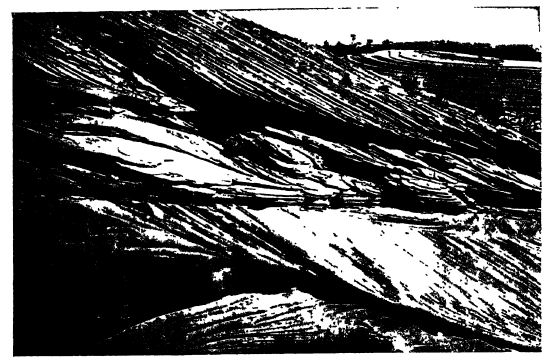
Throughout the Rocky Mountains region south of the Canadian border, but more especially from Wyoming south into western Texas, and in northern New Mexico and Arizona, occurs a series [ p. 468 ] of red or variegated sandy shales and cross-bedded sandstones (Fig., p. 470), with zones of gypsum sometimes 40 feet thick, that lie over the eroded surfaces of the older formations, and commonly on similar red beds of Permian or Pennsylvanian age. Over a large part of the area the basal conglomerate (Shinarump) is the preserved floor of a desert. Because of the scarcity of fossils in these red beds, the two series are not yet clearly distinguished in all places. In general, however, it may be said that in the eastern and central portions of the Rocky Mountains area these Triassic formations are thinnest, averaging from 200 to 400 feet thick, and increasing in depth westward to 1000 feet and more. They are all of continental origin.
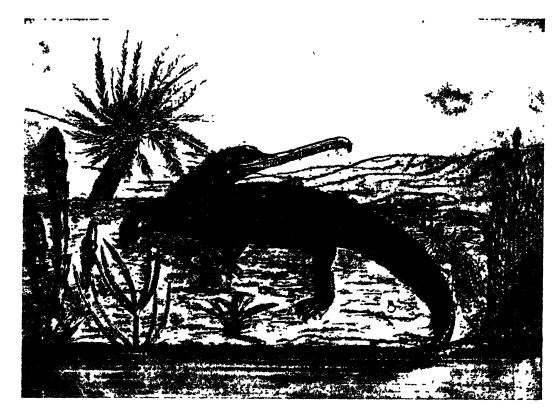
The fossils of these Upper Triassic red beds are scanty indeed, and none are of marine origin. Here and there fresh-water bivalves occur ( Unio) and in many places in the upper portion are thin zones with broken bones, known as bone conglomerates. These bones are in part remains of amphibia (Stegocephalia), but mainly of reptiles of the ancient crocodile type (Mystriosuchus, Fig., above) and of dinosaurs. Characteristic plant remains are almost absent, [ p. 469 ] but nearly everywhere occurs drifted wood that is now agatized; in the Petrified Forest of Arizona, near Flagstaff, this is exceedingly common, and great logs may be seen 120 feet long and with diameters of 8 feet, although the common thickness is from 2 to 4 feet (Fig., p. 471).
¶ Appearance of American Deserts
In the desert there is a war of elements — heat, wind, and cloudburst — and among the living a struggle for existence that for ferocity is unparalleled elsewhere in nature. The winds from outside of the desert, for obvious enough reasons, follow the channels through the mountains. During the day the intense heat expands the dry air until it rises, buoyed up by the heavier cooler air of surrounding regions. The hotter the day, the stronger the inward rush of the wind. At night the desert is usually still.
“ The shifting sands! Slowly they move, wave upon wave, drift upon drift; but by day and by night they gather, gather, gather. They overwhelm, they bury, they destroy, and then a spirit of restlessness seizes them and they move off elsewhere, swirl upon swirl, line upon line, in serpentine windings that enfold some new growth or fin in some new valley in the waste.” (J. C. Van Dyke.)
The sands are ever at work sand-blasting the rocks and wearing them into fantastic form, and in addition the great heat of the day and the marked coolness of the nights causes the rock to peel and split. The latter process, called deflation, is as effective in the desert for the weathering away of the highlands and protruding rocks as are water and frost in pluvial climates.
Another marked featme of deserts is that no rivers originate in, or flow out of them, though rivers originating elsewhere do flow through them, as in the case of the Colorado and the Nile.
The driest region of North America to-day lies in northern Mexico, Arizona, Nevada, and Utah. Here the average annual rain-fall does not exceed 10 inches, and in the Mohave desert of Arizona and California it is less than 2 inches. This drjmess is mainly due to the fact that the area mentioned is within the “ horse latitudes,” regions which have calm weather and light variable winds during a large part of the year. In addition, the windward-facing Pacific Coast is bordered by the Coast Ranges, which take out the moisture of the atmosphere as it rises and becomes expanded and cooled going over their summits.
The present deserts of the United States cover a triangular area of 50 000 square miles, with its base on the Mexican border and its [ p. 470 ] apex in north-central Oregon. On the west stand the mountain walls of Baja California, the Sierra Nevadas, and the Cascade Range. Eastward the desert extends to the Pecos River of New Mexico and western Texas.
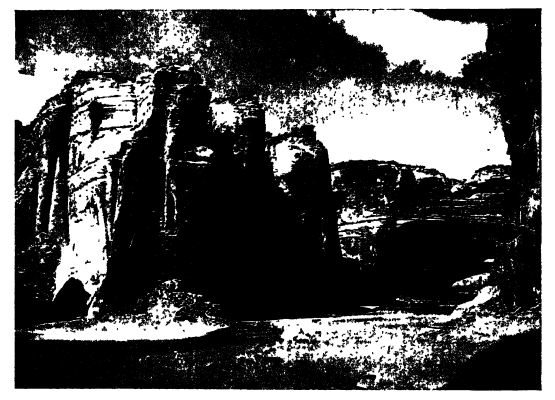
[ p. 471 ]
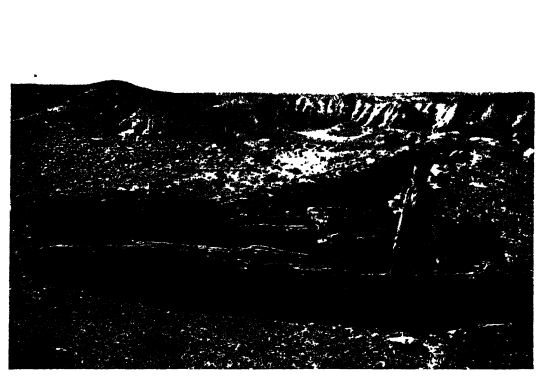
Succession of Deserts in Southwestern North America. — Over the Great Plains of the western United States, and more especially in the Great Basin countrj’, between the Rocky Mountains and the Sierra Nevadas, occur many continental deposits of sandstones, and more rarely of conglomerates, that are red, pink, or light gray in color. The materials of these deposits are mostly those of water transportation, though at times they are clearly of wind-blown origin, as is attested by the round grains of sand with frosted surfaces and the dune stratification of the sandstones. In the Lower Triassic the red sandstones are muddy, with interbedded red shales and curious concretions, while deposits of gypsum are not rare. In all of these strata fossils are usually scarce and when present are mainly of land plants or land animals. At places chalcedonized logs are occasionally plentiful. The greatest amount of the Upper Triassic deposits occurs in Arizona, Nevada, Utah, southwestern Colorado, and western New Mexico (Shinarump, Chinle, Dolores, Sandstone Spring, Dockum), and the thickness of the formations is often considerable. [ p. 472 ] Here we have spread before us the records of dry climates, varying from semiarid to decided desert conditions. Some of these desert sandstones are illustrated on page 470.
Red estuarine deposits begin to appear with the late Pennsylvanian, and are of widest occurrence during the earlier Permian and Triassic, an epeiiic sea of wide extent being present here during early Triassic times (Kanab, Moenkopi, De Chelly, Wiser, ThaynesWoodside, Spearfish). The material came in part from the west, from the highlands of Caseadis, and in part from the east out of the Ancestral Rocky Mountains of eastern Colorado and New Mexico. These deposits indicate semiarid rather than arid cllmates. Then came the truly desert conditions of the later Triassic. In early Jurassic times followed vast deposits of sandstone (La Plata, McEhno) that spread across northern Arizona, eastern Nevada, and western New Mexico into Utah. These materials came either from the west or from the south in northwestern Mexico. Beginning with the Upper Jurassic, however, the deposits are more or less those of inland seas and moist climates, red colors and gypsum being generally absent. From the present atmospheric and topographic conditions, we may conclude that in all probability the succession of southwestern American deserts from late Pennsylvanian into early Jurassic times was due to atmospheric and topographic causes that were very similar to the conditions obtaining at present in the same region.
¶ Life of the Triassic
In the previous pages some mention has been made of the Triassic life of the various American regions, but in this place it is proposed to point out the essentials of the Triassic floras and faunas.
Land Plants. — The Triassic floras are small, as not more than 400 forms are known in all the world, and of these 150 occur in America, with the best representation in Vir gini a… Practically all the known plants are of Upper Triassic time. Of the Paleozoic genera, nearly all had disappeared. The Triassic flora consisted essentially of rushes, many of them large; ferns, including tree-ferns; and cycads and conifers in many genera whose representatives now live in tropical and subtropical regions (see Figs., pp. 463 and 468). The evergreen trees were dominant in the forests and were as tall as the conifer woods of to-day (Fig., p. 471). In the swamps the rushes made dense brakes like the canes at present, and in general we may say that the vegetation of the Triassic, though far less varied than that of to-day, was rich and beautiful in leaf forms. The distribution of the floras was almost world-wide. While it was not a [ p. 473 ] luxuriant vegetation, the plants were not dwarfed, as might be expected from the general prevalence of warm semiarid to desert climates. The trees of Arizona show slight annual growth-rings that are probably due to seasonal drought, while those of Spitsbergen have decided ones (perhaps due rather to long seasons of darkness), and it is held by botanists that the climate was warm and mild throughout the greater part, of the world.
Insects. — Our knowledge of Triassic insects is almost a blank, for fewer than fifty species are known, and of these about two thirds are beetles, a group of animals that probabl5’ arose in the Permian. It may be that the social ants were also present at this time.
Fresh-water Faunas. — In the Triassic the fresh-water deposits contain bivalve shells, and in a broad way we may say that these were not very unlike those of the rivers and lakes of to-day. Of course, the species, and in most cases even the genera, were not the same, but nevertheless the pearl shells (Unios) were abundant. Fresh-water snails, although they arose in the Pennsylvanian, were still rare. The lung-fishes were greatly reduced in number, and the dominant forms were the ganoids.
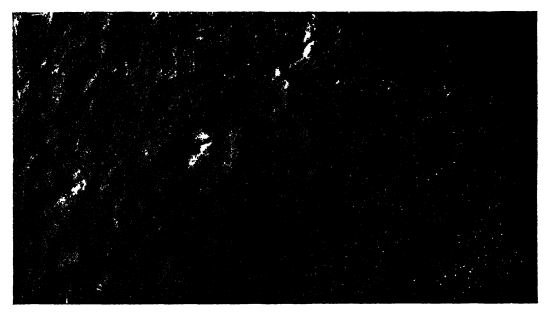
Land Animals. — The vertebrates of the land were now very varied and of great interest, exhibiting much structural and adaptive progression over their late Paleozoic ancestors. Among the amphibia the stegocephalians attained their culmination in number, [ p. 474 ] variety, and size. Progression was, however, especially marked among the Reptilia as a class, and specifically among the active dinosaurs (see Pl., p. 480), whose footprints are known in eastern North America in great variety (Figs., p. 473 and below), though good skeletons are exceedingly rare. In Europe, on the other hand, their remains are more common, and, so far as known, the animafe were of the same kinds as those of America. From this and other evidence it appears that the great northern continent Eris (Fig., p. 431) was still intact and was the land across which the plants and animals of Triassic time readily migrated to and fro. Crocodile-like reptiles of the sprawling type (Mystriosudvus, Fig., p. 468) and other active forms (AEosaurus, Pl., p. 480, Fig. 9) were common. Genuine turtles occur in the Triassic rocks, showing that the group originated in the Permian. No lizards, snakes, or birds are as yet known in rocks of this era.
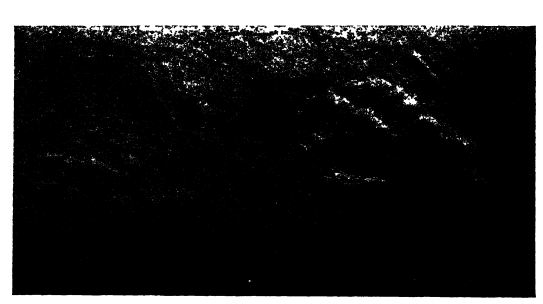
The dinosaurs, however, to be described in the next chapter, were the lords of- the land, and they were present in great variety and in great size; in fact, some, known by their footprints only, must have been larger than elephants (Fig., above). In the Upper Triassic they had become adapted to all the land habitats, and the best known American form is the carnivore Anchisaunts (Pl., p. 480, Fig. 6).
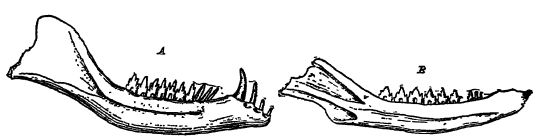
Archaic or Reptilian Mammals. — Of greatest interest is the rare occurrence in the Triassic of Virginia (two lower jaws, Fig., p. 475) and Europe (isolated teeth) of diminutive reptilian mammals . [ p. 475 ] Mammals are the most highly organized animals, but these, their earliest known representatives, were very small and veiy’ primitive, giving little promise of being the future conquerors of the world (Scott). They probably had their rise in the mammal-like reptiles known as the Theriodonta (Fig., p. 417, the name meaning beasttooth, and having reference to the resemblance between their teeth and those of carnivorous mammals), which were common in Africa and Europe dming the Triassic. The first stock of mammals to arise were the Multituberculata (Fig., p. 516), so named because the teeth have coned or tuberculated surfaces; these were reptilian, probably egg-laying mammals. Of this stock there are left but a few small specialized and degenerate forms such as the duek-billed mole (Omithorhynchiis) and the spiny ant-eater (Echidna), which are now living in Australia.
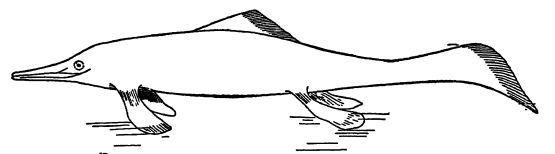
Marine Vertebrates. — In previous chapters we have seen how the fresh-water vertebrates were forced to adapt themselves to the land, and how this habitat was attained only after a very long struggle. Now that the reptiles were firmly established on the land, however, we see them going back again to the water, not only intennittently to the rivers and lakes, but permanently into the seas and oceans, where there was a more certain food supply in abundance than is usually the case on the land. Dolphin-like [ p. 476 ] reptiles, the ichthyosaurs, were abundant in the later Triassic (Cymbospondylus, see Fig. 163, p. 475, and other genera of California), and a stock of long-necked, turtle-like reptiles, the plesiosaurs (Nothosaurus of Germany) also had its start at this time. Both groups became characteristic of the Jurassic and will be decribed in Chapter XK-XV (see Figs., pp. 517 and 519). Here again we see the wonderful extent to which organisms can adapt themselves, for limbs have been changed from walking legs to swimming paddles, and the egg-laying method of rearing the young has been altered to that in which the young are born alive (viviparous development).
Marine Invertebrates. — The seas swarmed with ammonids in great variety, there being by actual count not fewer than 2600 named species and about 250 genera in all the world’s Triassic formations (Pl., p. 477, Figs. 4-16) . They were not only the most beautiful and characteristic animflls of the Mesozoic seas, but also the highest expression of invertebrate evolution in agility and in predaceous and scavenging ability. Some of the species spread widely throughout the world. This upwellmg of the ammonids continued into the earlier half of Upper Triassic time (Kamian and Norian) where Diener says there were no fewer than 146 genera. Then in the Rhaetic the stock began to die out quickly, since but 6 genera (11 species) were present here. Finally but a single genus (Phylloceras) passed into the Jurassic and there quickly evolved into the fullness of lias forms.
This rapid dying out of the ammonids is thought to be connected with the rise of the marine reptiles, an idea given the writer by his colleague, Carl 0. Dunbar. The marine reptiles appear in the Permian, but are not common until Upper Triassic times. Since most of these reptiles are fine swimmers, and of far larger size than the ammonids, it is natural to think that some of them may have fed upon the thin-shelled ammonids, because it is known that in Jurassic times the fish-lizards ate squids. Hence in the rise of the marine reptiles we appear to have the cause for the nearly complete extermination of the ammonids in the late Triassic. However, the seas begin to cool in Rhsetic time, and with this change in the habitats the reptiles become restricted to warmer waters, giving the ammonids a new lease of life in the cooler waters. The latter therefore undergo a new and rapid evolution in the early Jurassic, but with the warming seas of later time new stocks of marine reptiles appear, attaining their best devdopment in the Middle Cretaceous (see Fig., p. 559). Again the ammonids die away and finally the more prevalent forms are the bottom-living kinds often referred to as degenerates, but in reality highly specialized stocks (see Fig., p. 576).
The squids originated in the Triassic (Pl., p. 477, Fig. 3) and were common in the Jurassic.
[ p. 477 ]
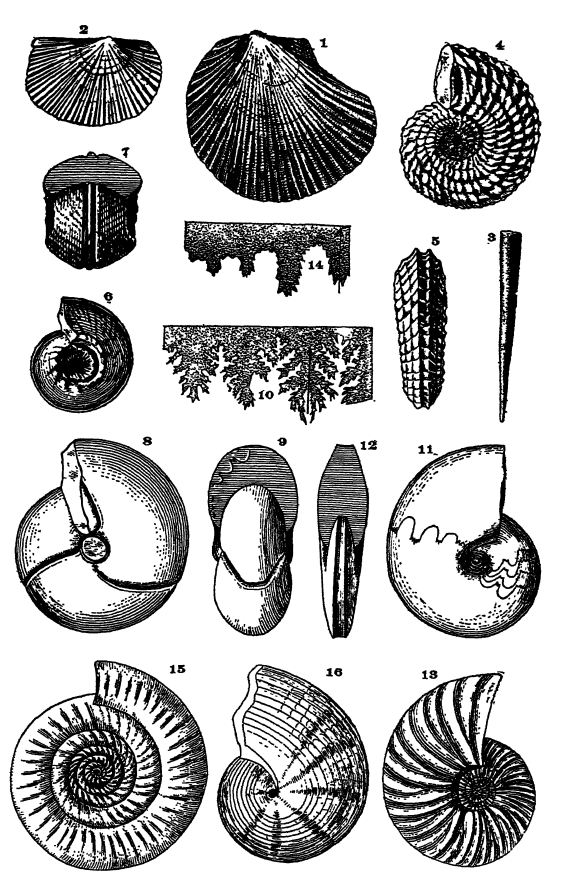
Fig. 1, Pseudomonotis subcircuZaris, x §; 2, Daonella dubia, x J; 3, Atractites burckhardti, x i; 4 and 5, Anoldtes meekt, x i; 6 and 7, Tropites suhbuJlatuS, x 8-10, Joannites neoadanus, x I; 11 and 12, Meekoceras gracilitatis, X f ; 13 and 14, Gymnotocems russelli, X f; 15, Tropiffostrites rolhpLetzi; 16, Sageceras gabbi, x i. After J. P. Smith, from the U. S. Geological Survey. (477)
[ p. 478 ]
Among the other shelled animals, the bivalves (Pl., p. 477, Figs. 1, 2) and siphonate gastropods were in the ascendancy. The brachiopods, though still common in Tethys, were very rare in the American Pacific faunas and have remained so up to the present time.
In the Upper Triassic appeared the modern reef-building corals (Hexacoralla), which built limestones in Tethys up to 4000 feet thick, while reefs are known elsewhere with many identical species, as in the Himalayas, and in the eastern Pacific from California into Alaska. The modern echinids and lobsters also originated at this time, but were not conspicuous until later. Tethys and the Pacific were the main centers of marine invertebrate evolution.
A survey of the life of the Triassic, contrasted with that of the Permian, shows that no greater change is recorded in all geologic time. This was the result of the marked physical changes undergone by the earth during the Appalachian Revolution, making the close of the Paleozoic one of the most critical periods in the history of the organic world.
¶ Collateral Reading
J. Barrell, Central Connecticut in the Geologic Past. Connecticut Geological and Natural History Survey, Bulletin 23, 1915.
W. M. Davis, The Triassic Formation of Connecticut. TJ. S. Geological Survey, 18th Annual Report, Pt. 2, 1898, pp. 9-192.
C. Dienee, a Critical Phase in the History of Ammonites. American Journal of Science, 5tli series, Vol. 4, 1922, pp. 120-126.
R. S. Lull, Triassic Life of the Connecticut Valley. Connecticut Geological and Natural Historj’ Survey, Bulletin 24, 1915.
G. P. Mekrill, The Fossil Forests of Arizona. Washington, 1912. See also American Museum Journal, Vol. 13, 1913, pp. 311-316.
I. C. Russell, Correlation Papers; The Newark System. U. S. Geological Survey, Bulletin 85, 1892.
| XXXII. Climates of the Geologic Past, and the “ Critical Times ” | Title page | XXXIV. Dinosaurs, the Mighty Rulers of Mesozoic Lands |