| XXXIII. The Beginning of Mesozoic Time: the Triassic Period | Title page | XXXV. The Jurassic Period and the Many Kinds of Reptiles |
[ p. 479 ]
In the chapter on the Triassic something was said about the dinosaurs and their footprints on the sands of time. Now they will be described in detail. Bird-like tracks on the red sandstones of Upper Triassic age have long been known in the quarries of the Connecticut valley. Some of these tracks are but an inch long, and others about 2 feet. Many of them are so like those made by three-toed birds that it is no wonder that the geologists of the first half of the past century regarded them as made by birds. Now, however, they are known to have been made by dinosaurs that ran on their hind legs as do the birds. Some of the imprints are fourand five-toed, but most are three-toed. Similar tracks are now known in Pennsylvania, Virginia, and North Carolina, and in many other lands in rocks of different Mesozoic ages.
The Mesozoic or medieval era was truly the Age of Reptiles, for the lands were then imder the control of the “ terrible reptiles,” named dinosaurs by Sir Richard Owen. What reptiles are and how they are related to the amphibians and the more primitive backboned animals is discussed in Chapter XXX, and this knowledge should make the following account more easily understood.
That the Mesozoic is the time of reptiles becomes all the more clear when we learn from Osborn that eighteen reptilian orders were evolved in this era. Of these, only five groups are now living, the turtles, lizards, snakes, crocodiles, and tuateras.
The medieval floras were also strange in their many rushes, ferns, cycads, and conifers. This plant world was peopled in the main by the dinosaurs, the most extraordinary animals the world has ever seen, as diversified in form and size as are the living mammals. Among them were huge beasts of prey with bird-like feet and eagle-like claws, running on their hind legs after the fashion of ostriches; associated with these were other bipedal dinosaurs, but of sluggish habits and with duck-billed muzzles, feeding on the vegetation of the swamps and water places; hugest of all were the sauropods, vegetarians walking on all fours, with more or less pillar-like legs, long [ p. 480 ] [ p. 481 ] snake-like necks, long tails, and a brain weighing less than a pound to govern a body with a weight of about 40 tons, and a length of 60 to 80 feet!
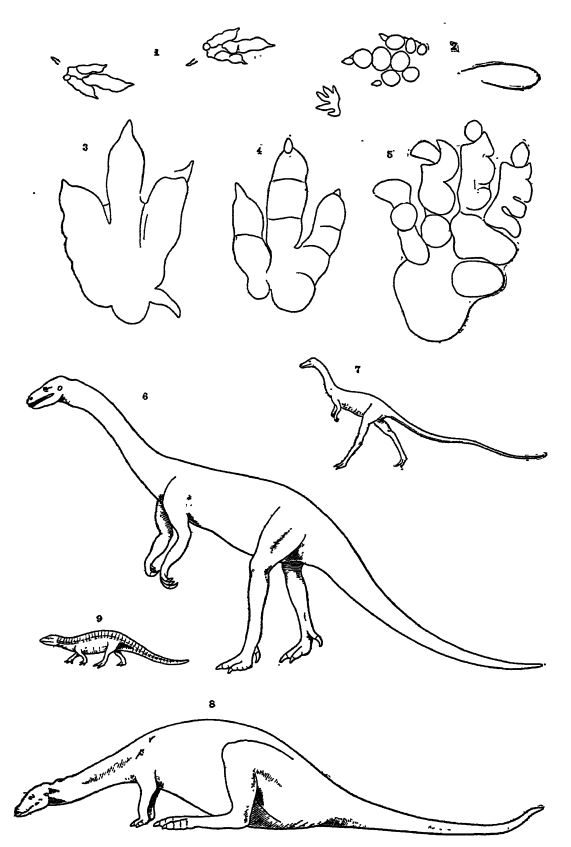
Fig. 1, Anchisauripus (Brontozoum) sillimani; 2, Sauropus barrattii (Anomospus major); 3, Gigandipus caudatus; 4, Eubrontes (Brontozoum) giganteus; 5, Otozoum moodii. All x 1/12.
Fig. 6, Anchisaurus colurus; 7, Podokesaurus holyokensis. x
Fig. 8, restoration of Sauropus barraMii; 9, restoration of the agtosaur Stegomus. x -h. All after Lull. (480)
Most curious of all, however, were the annored typ)es, covered with plates and spines; these were also plant-feeders and quadrupvedal in gait. Finally, toward the close of the medieval era there api>eared a very diversified horde of large rhino-like forms known as the ceratopsians. It is these many kinds of strange medieval brutes that we are to study in this chapter.
¶ Part I. Kinds of Dinosaurs
The dinosaurs are grouped as follows:
Order Dinosauria
- Division Saurischia. With lizard-like hip bones. Essentially carnivores
- Suborder Coelurosauria, or small bipedal carnivores
- Suborder Theropoda, or large bipedal carnivores
- Suborder Sauropoda, or giant quadrupedal herbivores
- Division Omithischia. With bird-like hip bones. All herbivores
- Suborder Orthopoda or Predentata
- Superfamily Omithopoda, or bipedal herbivores
- Superfamily Stegosamia, or armored quadrupedal herbivores
- Superfamily Ceratopsia, or homed quadrupedal herbivores
- Suborder Orthopoda or Predentata
The dinosaurs are divided into two main groups, based on the nature of the ischium, one of the hip or pelvis bones. The first group, the Saurischia, so called because the ischium is like that in lizards, includes the Coelurosauria, Theropoda, and Sauropoda, of which this chapter will discuss only the last two. The second group, called Omithischia because of the bird-like character of the ischium, includes the Ornithopoda, Stegosauria, and Ceratopsia. The significance of these two types of ischia is discussed later in the chapter in connection with the ancestry of the dinosaurs.
¶ The Carnivorous Theropoda
The primitive light-bodied, long-necked, and long-tailed type of dinosaur, of carnivorous diet, occurs for the first time in the Upper Triassic sandstones of the Connecticut valley. This animal is known as Anchisaurus (“ near-lizard ”). Out of this type developed the later flesh-eating forms, all of which were also bipedal in locomotion, with their greatest variety in Jurassic time. Their fore limbs were often absurdly small in proportion to those behind and were used for catching, holding, and tearing the prey. The hind limbs were long and powerful, the larger bones hollow as in other active beasts of [ p. 482 ] prey, and the feet were bird-like. The claws were long, curved, and sharp like those of eagles, hence the name Theropoda, which means beast-footed. The teeth were sharp, slightly curved, and dagger-like, often with serrate cutting edges to add to their terribleness. No fiercer biting head was ever evolved than that of the king-tyrant saurian. Tyrannosaurus rex, of the latest Cretaceous of Montana and Wyoming, — in respect to speed, ferocity, and bodily size the most “ destructive life engine ever evolved.” In size the Theropoda ranged from several feet long, measured along the back, to 47 feet in Tyrannosaurus, with a height in the latter of 18 to 20 feet, and a weight exceeding that of the elephant. The skin in the Theropoda was probably naked, at least it was not defensively armored, though in some cases there may have been scales as in snakes.
In the late Jurassic (Morrison) of Wyoming there lived a small form known as Ornitholestes (“bird-robber”), measuring about 6 feet long down the back, and a very agile carnivore it was. Long in hind limbs, bipedal in locomotion, running and walking but never hopping as do birds, its body and head were balanced by the long tail stretched out behind. (See Pl., p. 483, Fig. 6.)
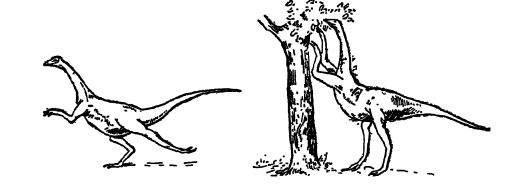
Out of the carnivorous dinosaurs just described, there was evolved, in adaptation to a changed diet and a different mode of getting food, a lighter and more decidedly bird-like type that finally in the Upper Cretaceous developed into Struthiomimus (“ ostrich-like ”). This was a slender, very long-legged animal, having three-toed bird-like feet, a very long thin neck, small skull, and jaws entirely without teeth, but with a homy beak like that of an ostrich. The fore limbs were comparatively long, with drawn-out slender fingers terminating in rounded straight claws. What these animals fed on is not known, unless it were’ fruits and very small reptiles and insects (see Fig., above.)
[ p. 483 ]
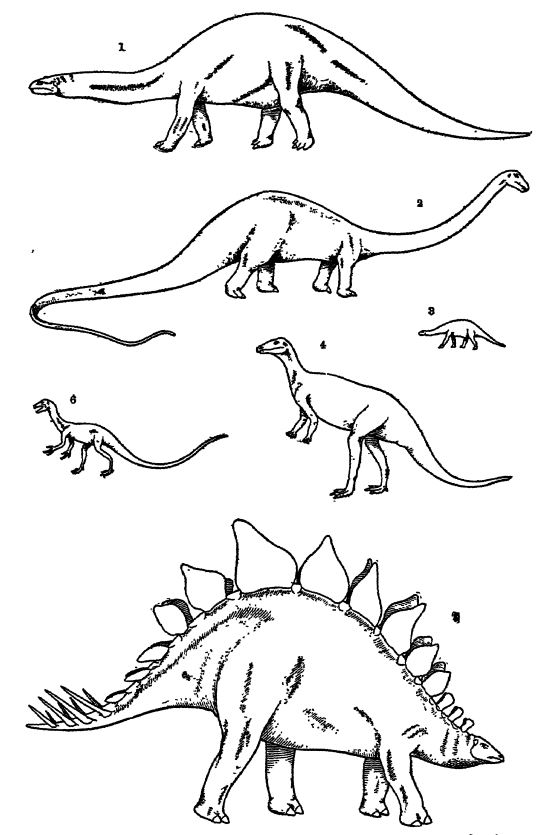
Fig. I, Brontosaurus excelsus, 2, Diplodocus carnegiei; 3, Pleurocoelus nanus. x 1/120. Fig. 4, Camptosaurus;, 5, Stegosaurus ungulatus; 6. bird-catching Ornitholestes hermanni x 1/16. All after Lull.
[ p. 484 ]
¶ The Giant Sawropoda
Professor Lull has shown that among the Upper Triassic footprints of the Connecticut valley there are tracks of carnivore-like dinosaurs that were ponderous and heavy of foot. These are thought to have given rise to the herbivorous sauropods (“ reptile-footed ”) of Jurassic and later medieval times, the mightiest of all land animals, and necessarily quadrupedal in locomotion.
It is Osborn’s belief that as there is never any need of haste in the capture of plant food, the sauropods underwent a reversed evolution of the hmbs, from the swift-moving primitive bipedal carnivorous type into a secondary slow-moving quadrupedal ambulatory type.
The sauropods attained a world-wide distribution, being best known in the late Jurassic of North America and East Africa, and in late Cretaceous beds in the United States and western Argentina. The greatest of these was Gigantosaurus of East Africa, the largest land animal known, with a length of some 80 feet, 36 feet of which was neck, and a live weight of something like 40 tons. In this form alone the fore limbs were longer than the rear ones. The American Brontosaurus (“ thunder saurian ”) was about 65 feet in length, but heavier in construction, weighing about 37 tons. It was ponderous of body, but with long tapering neck and tail “ as though an elephant were deprived of its normal terminals and provided with those of an enormous snake ” (Lull). The brontosaurs are thought to have lived for the most part in swamps of river valleys (Rocky Mountains) and in fresh-water marshes along the sea-shore (Africa), detaching the swamp plants with the claws and swallowing them without mastication.
Professor Lull says of Brontosaurus: “ Its skeleton is a marvel of mechanical design; the bones of the vertebral column are of the lightest possible construction consistent with strength, the bony material being laid down only where stresses arise and reduced to a minimum at other points. The assembled skeleton reminds one forcibly of a cantilever bridge borne on two massive piers — the limbs — between which the trunk represents the shorter channel span, and the long neck and tail the spans leading to the shores. Over the hips is a ridged anchorage formed by the coalescence of several vertebrae, for not only was this the point of origin of the tendons and sinews supporting the 30 feet of tail, but on occasion the whole forward portion of the body, fore limbs, and neck could be raised clear of the groimd after the manner of a bascule bridge. In the refinement of its architecture the vertebral column is essentially Gothic, [ p. 485 ] [ p. 486 ] with arch, pillar, and buttress, and the freedom of design characteristic of the great fabrics of medieval time.”
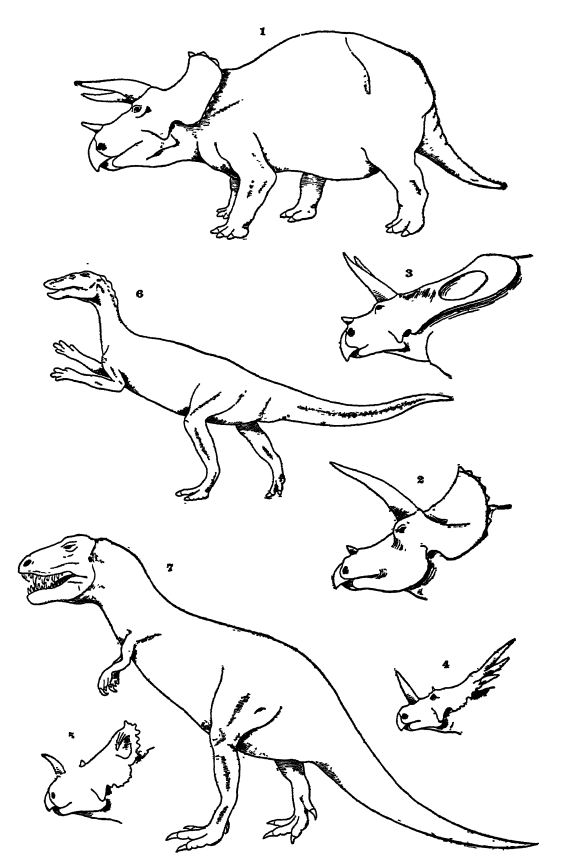
Fig. 1, Triceraiops prorsus; 2, head of T. elatus, the culminating form of one line of Ceratopsia; 3, head of another culminating species, Torosaurus gladius; 4, ol er, much horned ceratopsian, Styracosawrus aJbertensis; 5, another older form. Monodonius flexis; 6, bipedal predentate, Trackodon (Claosaurus) annectens; 7, the king tyrant carnivore. Tyrannosaurus rex. All after Lull. About x 1/60.
Diplodocus (so named from the vertebrae, which are doublebeamed) was lighter in build though long and slender, with 10 of its 80 feet of length taken up by a whip-lash-like tail of unknown use (see Pl., p. 483, Pig. 2). The ponderous size must have given it a certain immunity from attack, while its chosen haunts kept it out of competition with fiercer kin.
¶ The Bipedal Herbivorous Ornithopoda
Returning once more to the Upper Triassic tracks of the Connecticut valley, we see still other bird-like imprints, but of large size, made by bipedal dinosaurs. These were the Omithopoda (“ bird-footed ”) or Predentata, which had no front teeth. The muzzles, however, terminated in a homy sheath, making a beak as in ducks or turtles. These forms lived for the most part in water, where they cropped the plants with the sharp edges of their toothless beaks. In the back part of the jaws were wonderful magazines of wide teeth, long in sequence, and superimposed several deep, with which the predentates ground the food plants before swallowing them. While these teeth were being completely worn away through grinding at the top, new ones were growing beneath in the jaws to take their place.
The hind legs of the bipedal herbivorous dinosaurs were large and powerful, and on land were the essential means of locomotion. Their hands were webbed, and used for paddling, and the long tail was flattened and served to scull about in the water as do the alligators. The duck-bill mouth is further evidence that they dwelt much in water.
Skeletons of bipedal herbivorous dinosaurs are first represented in the American Upper Jurassic by Camptosaurus (“ flexible lizard ”) of Wyoming. In the Cretaceous the stock deployed into a variety of forms, which took more and more, though not wholly, to the swamps along rivers and lakes.
The more primitive of the bipedal herbivorous dinosaurs were those with the duck-like bill. These were the more common kinds during the Cretaceous and included the iguanodons of the Lower Cretaceous of Belgium (see Fig., p. 551) and the trachodons (“ roughtoothed”) of the North American Upper Cretaceous (Pl., p. 485, Pig. 6) .
The skin of the duck-billed dinosaurs is known m seven specimens. In the so called “ dinosaur mummy ” of the American Museum of Natural History, nearly the entire skin is preserved. This animal [ p. 487 ] must have lain exposed to the hot sun in a diy climate and so became desiccated and mummified before it was covered over by windblown sand. The skin is thin as in pythons and in the different species its bony tubercles are variable in size, form, and pattern, and probably as well in color. Scales were present.
Yet other kinds of beaked and bipedal herbivorous dinosaurs developed out of the duck-billed ones. Among these were the narrow-headed Kritosaurus of the Upper Cretaceous of Alberta and the completely aquatic Ccrythosaurus from the same locality, in which the skull bore a high crest as in cassowarys, while the muzzle was small and short.
¶ The Armored Stegosauria
In Jurassic time there developed out of the duck-billed forms a most bizarre stock of heavy-limbed quadrupedal animals, browsing on leaves and twigs. These were the plated and armored types, first discovered by Professor Marsh. Their habitat appears to have been completely away from the water on the dry land, where they were subject to the attacks of their carnivorous colleagues, hence the necessity of a protective armor. They retmned to the ancestral locomotion on all fours, and specialized in the production of an elaborate series of bony outgrowths of the skin.
In Stegosaurus (“ covered saurian ”) the almost impregnable armor consisted of a double row of variously large bony plates ranging down the back from the head to near the end of the la.»jbin g tail, there to be replaced by two or more pairs of long sharp spines, making the tail a “ huge battle mace.” All of these bony outgrowths were provided with homy sheaths. Over the hip area the plates were more than 2 feet high, 30 inches long, and 4 inches thick at the base. The tail spines attained to a length of about 2 feet. In the skin were other bony nodules. Doubtless when the stegosaurs were attacked, they drew their head and limbs under the body as do the armadlllos and porcupines, and relied for protection against their enemies upon their dorsal armature, aided by rapid lateral motions of the great tail with its series of spines. They died out during the Cretaceous, and appear to have been restricted to North America.
Stegosaurus was decidedly “ slab-sided ” or compressed in body. The head was absurdly small, with a turtle-like beak, while the hind teeth were like those of duck-bill dinosaurs. The relatively small size of the brain is further noted on page 494. (See Fig., p. 488.)
The climax of defensive armoring among the land-living dinosaurs was attained in late Cretaceous times among the sluggish ankylosaurs (“coossified saurian”) of Alberta and Montana. Their bodies [ p. 488 ] were exceptionally broad, but not compressed as in the group last discussed, and supported on short stout legs. The tail was heavy. Though the armor in these forms was less grotesque than that in the stegosaurs, it was more effective; the entire body from the nose to the tip of the tail was covered by small bony plates, more or less grown together and lying flat in the skin. The tail ended in a blunt [ p. 489 ] club of thick plates. In these fomis the annoring was in close imitation of that in the armadillos or in the extinct glyptodonts, both of which, however, are mammals. On the neck and tail the armor was in overlapping rings to allow for movement, and the animals when squatting on the ground were proof even against the attacks of Tyrannosaurus. Lull has well said that as “ animated citadels ” these animals must have been practicalh” unassailable.
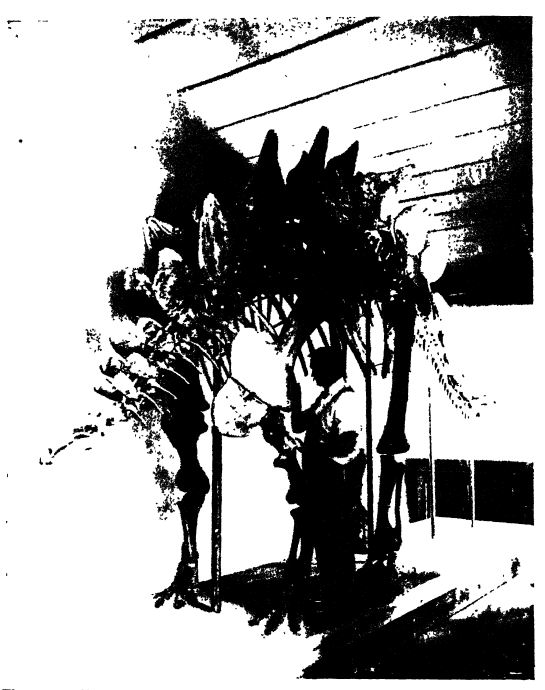
In the ankylosaurs the heads W’Cre very small, triangular in shape, and also covered with bony plates. The teeth of the jaws were feebly developed, but the decidedly horny beaks compensated in securing and cutting the food. The ankylosaurs had a longer history than the stegosaurs, since they appeared in the Lower Jurassic of England (Scelidosaurus), continued into the Low-er Cretaceous (Polacanthus), and were last seen in the Upper Cretaceous of Alberta and Montana (Ankylosaurus and Siegopelta).
¶ The Horned Ceratopsia
Probably the most interesting of all dinosaurs are the homed types, “strictly American products,” first discovered in Wyoming and Colorado by Hatcher. They are interesting because of their varied evolution, chiefly with respect to the head, which was used aggressively and defensively. These homed forms are characterized, in fact, by the hugeness of the heads, in contrast to the comparatively small ones in other dinosaurs. The first form discovered was called Ceratops (“ horned face ”), and this has given the name to the group. They looked somewhat like rhinoceroses. The body was usually very large, barrel-shaped, with four short but stout legs. The tail was massive, but relatively short. The heads were wide and long, being drawn out back over the neck into a prominent protective frill, usually 4 to 6 feet long but reaching 8 feet in Torosaurus. In some there was a short and in others a long horn over the nose, and over the eyes there were other horns, which again may be long or short. In Triceratops there were three prominent horns. Some of the horns had a length of 3 or even 4 feet, and all the cores of bone were sheathed in horn. In addition, there were still other smaller horns along the edge of the frill, or the latter was drawn out into long horns. The muzzles were also covered with horn as in turtles, and the jaws were replete with cutting teeth. The brain did not exceed 2 pounds in weight- (See Pl., P- 485, Figs. 1-5.)
According to Professor Lull, “ In the forms in which the nasal horn was dominant, the crest was imperfect, the animal doubtless charging as a rhinoceros might and impaling its enemy with a sweeping [ p. 490 ] upward thrust of its head; while those whose frontal horns were larger were animals of greater bulk and in them the crest reached its highest efficiency, so that a head-on charge of two rival males was comparable to a joust between panophed knights, the mighty impact of the lance-like horns being deflected by the shield-like flange. That the ceratopsians did fight, and that most desperately, is shown in the grievous ’ old dints of deepe woundes ’ that remain on many a skull, fractured and healed jaws and horns, pierced crania and crests. As these were only the relatively few wounds which penetrated the bone, what battle-scarred old veterans they must have been after their century or more of life!”
The terrestrial and quadrupedal ceratopsians originated, it is thought, out of small hornless forms, one of which was recently discovered in Mongolia (Protoceratops of possibly Lower Cretaceous age). Of this form the skull only is known and it is about 7 inches long. Evidently the ceratopsian stock originated in Asia, but all the homed forms appear ready-made in the Upper Cretaceous (Judith River) of the Great Plains of North America and were among the last of the dinosaurs to die out. Some of them were larger than elephants, weighing in the flesh up to 10 tons. The smallest known skeleton of a fully matured ceratopsian is a little over 5 feet long and but 30 inches tall (Brachyceratops).
¶ Part II. Dinosaurs in General
Geographic Occurrence. — Dinosaur remains occur in all continents, but chiefly in North America, Africa, China, and Argentina. The most wonderful known record is that of the American Great Plains. Carnivorous dinosaurs are the most widely spread, in fact, are world-wide in distribution. The same appears to be almost as tme of the ponderous sauropods, though they are best known in North America, Africa, and Argentina. The beaked dinosaurs are wholly unknown in South America and Australia.
History of Discovery. — With the building of the Union Pacific Railway and the opening up of the Great West ” came discoveries of fossil bone cemeteries, each more remarkable than the previous one, first in Nebraska and the Dakotas and later in Wyoming and Colorado. To the east of Medicine Bow, Wyoming, the railway passed one of these cemeteries at Como Bluff and here as early as 1872 the station master, Mr. Carlin, collected great bones that he showed to Professor Marsh of Yale, who was then more interested in the living animals of that region. Finally, during the winter and spring of 1877, William Reed, a hunter for the railway, collected more of [ p. 491 ] these bones, due to Carlin’s finds, and again they were brought to the attention of Marsh. In the meantime O. Lucas, a school teacher at Garden Park, Colorado, had also found huge bones of about the same age and these he sent to Professor E. D. Cope, of Philadelphia, Marsh’s competitor, while Professor Lakes of the School of Mines at Golden had seen gigantic bones near Morrison, drawings of which he sent to Marsh. The latter then sent into the field S. W. Wilhston and J. B. Hatcher, with the result that the “ fossil wonders of the West ” began to pour into New Haven. Since then hundreds of tons of rock with dinosaur bones, in carload lots, have been shipped east, for resurrection and study. Not only was Professor Alarsh the first to describe an American dinosaur, but the first dinosaur skeleton to be moimted in this country (Trachodon annectens) was placed on exhibition by his successor, Professor Beecher, and now occupies a prominent place in the Yale Museum.
Collecting Dinosaurs. — In the semiarid states of the Great Plains, and especially in their bad lands,” bones may be seen here and there sticking out of the rocks, and in places the groimd is literally covered with their fragments. These are the “ leads ” to skulls and skeletons, just as drifted ores in their trailings lead to the discovery of veins and future mines. As a rule, the remains of fossil vertebrates are much scattered, there usually being present but one or a few of the larger limb bones or vertebrae, more rarely a skull, and least of all, more or less of a skeleton. The best bones are the buried ones, since those exposed through weathering are very much fractured and worn.
A find leads to the use of pick and shovel, and the unearthing of a cemetery begins with horse and scraper or even with djTiamite to quarry away the hard capping stone. Bone quarries have been operated each summer through a succession of years and the wonderful relics of the past are garnered through much intelligent labor. In the old days, a find was recklessly picked into and the loose bones shoveled into a bag with the hope that the paleontologist or preparator could piece together the parts, the illustrations of the older books show with what results. The present fine art of vertebrate exhumation began with Professor Marsh, who took his ideas from the surgeon’s methods of bandaging broken limbs set in plaster. Now the field worker carefully uncovers the bones in their soft rock and then hardens them with mucilage or shellac. Finally, they are bandaged in plaster of pans, first on the exposed side, and then turned over and completely encased, and shipped in crates or boxes to the museum. Here begins the actual work of resurrection, a long laborious task with chisel and mallet, again hardening the bones with shellac, cementing together the fragmented parts, and finally restoring in plaster those which are lost. The assembling of the bones into an articulate skeleton is the work of the paleontologist, after a study of the remains combined with those of the nearest relatives in the living [ p. 492 ] [ p. 493 ] [ p. 494 ] world, and the skeletons set up in museums testify’ not only to the care of the collector but as well to the skill, ingenuity, and morphologic knowledge of the present-day preparators and paleontologists.
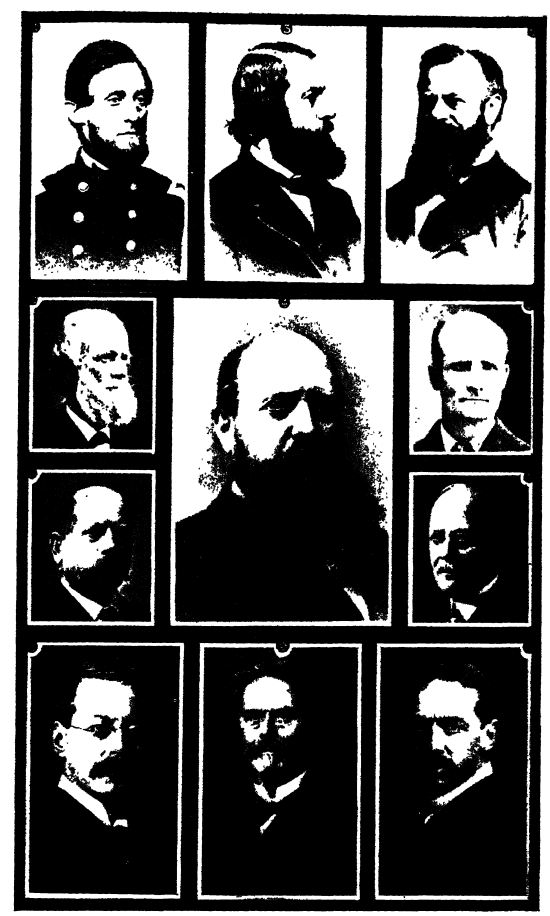
1. Ferdinand V. Hayden (1S29-1887), Director of the U. S. Geological and Geo graphical Sun-ey of the Territories, 1S69-1879, the first to indicate the bone localities of the West.
2. John W. Powell (1834-1902), Director of the TJ. S. Geological Survey, 1881-1894, who greatly fostered the collection and description of fossil vertebrates.
3. Joseph Leidy (1S23-1S91) , Professor of Anatomy in the University of Pennsylvania and Vertebrate Paleontologist of the Hayden federal surveys. The first systematic -worker in American vertebrate paleontology.
4. Othniel C. Marsh (1831-1899), Professor of Paleontology at Yale University, and Vertebrate Paleontologist of the Powell Survey. The first to bring from the field entire skeletons and to articulate them in their former perfection. To him are due the great collections at the U. S. National Museum and at Yale.
5. Benjamin F. Mudge (1817-1879), Professor of Natural History, Kansas Agri cultural College. The first to unearth for Marsh the Cretaceous birds -with teeth.
6. John B. Hatcher (1861-1904), whose great ability as a collector in the Great Plains and in Patagonia enriched the museums at Washington, Pittsburgh, Princeton, and Yale, and who also published much on fossil vertebrates.
7. Samuel W. Williston (1852-1918), associate of Professor Marsh, and later Pro fessor of Geology and Anatomy at the University of Kansas, and Professor of Paleontology at the University of Chicago. Leading authority on extinct Keptilia.
8. Adam Hermann (1847- ), who developed the art of preparing fossil bones and mounting restored skeletons, first at Yale and then at the American Museum of Natural Histoiy.
9. Edward D. Cope (1840-1897), of Philadelphia. Versatile and brilliant paleon tologist whose monumental volumes are in the quarto series of the Hayden Survey.
10. William B. Scott (1858— ), Professor of Geology and Paleontology, Princeton University- Authority on the extinct Mammalia of North America and Patagonia.
11. Heniy' F, Osborn (1857- ). President of the American Museum of Natural History New York, and nestor of the third generation of American vertebrate paleontologists.
Food of Dinosaurs. — The flesh-eating or carnivorous dinosaurs probably fed on any animals they could get, but more especially, it is thought, on their plant-feeding allies. The food of the latter was the medieval floras, rushes, ferns, cycads, conifers, and gingkos, whose nutritive values were not so high as those of the modern or flowering plants that came in strongly with the Upper Cretaceous. It may be that the latest dinosaurs were feeding on these higher plants, but it appears more probable that the primitive mammals took to them earlier and more completely, and in this way gained the ascendancy over the dinosaurs.
An elephant weighing 5 tons eats 100 pounds of hay and 25 pounds of grain for his day’s ration; but as such food is in a comparatively concentrated form, it would require at least twice this weight of green fodder for an animal of the same size. The largest brontosaur probably weighed 37 tons, and it is estimated that its daily food must have been something like 700 pounds of plants.
But here we must curb our imagination a little and consider another point: the cold-blooded, sluggish reptiles, as we know them to-day, do not waste their energies in rapid movements, or in keeping the temperature of their bodies above that of the air, and so by no means require the amount of food needed by more active, warm-blooded animals. Hence these great dinosaurs may, after all, not have been gifted with such ravenous appetites as we fancy. (Lucas.)
Dinosaur Eggs. — A point still unsettled is whether the dinosaurs were oviparous or viviparous, or both — did they lay eggs, or were the young born alive? Until 1923, the only evidence on this matter rested with the Upper Jurassic skeleton of Compsognathus, which, according to Marsh, contains an embryo within the abdomen. This form seemingly was viviparous. If, however, we are to be guided by analogy, it might be supposed that, like crocodiles and alligators, most of the dinosaurs laid eggs and left them to be hatched by the heat of the sun. This supposition has recently been confirmed by the American Museum Expedition’s discovery of many dinosaur eggs in Mongolia.
Small Brain in Dinosaurs. — Even though dinosaurs attained in the flesh the enormous bulk mentioned, none had a brain exceeding 2 pounds in weight, and in the armored forms (Stegosaurus), which were heavier than any elephant, the brain weighed about 2½ ounces, as against twenty times that weight in the elephant. Professor Lull states that in comparing the relative intelligence of the two, “one has to bear in mind the great preponderance of [ p. 495 ] the cerebrum, the seat of the intellect, over the other part of the elephantine brain, whereas in Stegosaurus it constituted scarcely more than a third of the entire brain weight- On the other hand, the nerve canal in the sacrum, that portion of the vertebral column which lies between the hips, is of startling dimensions and shows that this part of the spinal cord from which the nerves went out to the great muscles of the hind limbs and tail was not less than twenty times the mass of the brain. Mentally, Stegosaurus was superlatively stupid, depending for defense upon the automatic control of the great muscles after the feeble glimmer of thought had given the initial impulse.” The excessively small size of brain in dinosaurs, Osborn states, illustrates strikingly that in animals mechanical evolution is quite independent of the evolution of their intelligence; in fact, intelligence compensates for the absence of mechanical perfection.
In Trachodon the brain is smaller than a man’s fist and weighs less than a pound. Brontosaurus had a brain but little larger, while the large-headed Triceratops, with over 10 tons of flesh, possessed a brain weighing not over 2 pounds. Man has an average of about 2 pounds of brain to 100 pounds of total weight, while the dinosaurs did not have one-fourth of this amount of brain to the ton. Or with other comparisons, the brain of the average dinosaur was in proportion to bulk of body a tenth the size of that of a crocodile.
How much of what we term intelligence could such a creature possess? Probably just enough to have eaten when it was hungry anyhing more being superfluous, However, intelligence is one thing, life another, and the spinal cord, with its supply of nerve-substance, doubtless looked after the mere mechanical functions of life, and while even the spinal cord is in many cases quite small, the sacral portion is twenty times the bulk of the puny brain. (Lucas.)
Pineal Eye. — In a number of dinosaiu: skulls there is shown a round opening passing through the bone into the brain cavity. It is sometimes an inch in diameter. In this opening lay, when the animals were alive, a third eye that is known as the pineal eye. A similar eye, rudimentary’- and degenerating as an organ of sight, is present in some living lizards, connected with the brain and covered by a transparent scale. Vestiges of this eye are also present in the brain of all vertebrates, including man, where it is called the “ pineal body,” and is about the size of a hazel nut. (See also page 411.)
Dinosaur Ancestors. — The progenitors of the dinosaurs were among the Permian reptiles, and their descendants deployed into all the possible habitats of Mesozoic time. The line started either during the Permian, or certainly not later than the earliest Triassic, in hzard-like reptiles with comparatively long limbs, long tails, five toes on each foot tipped with sharp claws, and a mouth having a series of sharp pointed teeth.
The ancestral dinosaur was undoubtedly a quadrupedal form, distantly related to the crocodiles, and of similar habitat. With the [ p. 496 ] increasing aridity of Permian and Triassic times, however, speed became of great advantage in the search for food and drink, and this may have led to the adoption of the more rapid bipedal gait.
The dinosaurs probably had two independent origins in lizard-like reptiles, for the hip or pelvic bones are of two distinct types. In one they are crocodile-like and all those that have this type of pelvis are referred to the Saurischia, the term having reference to the saurian or lizard-like ischium, one of the bones of the pelvis. The other stock, with the bird-like hip bones, are spoken of as Ornithischia (bird-like ischium). Skeletal identities like these show that the dinosaurs are related to both the crocodiles and the birds. Both of these dinosaur stocks are present as early as the Middle Triassic, and their characteristic pelvic bones are illustrated above.
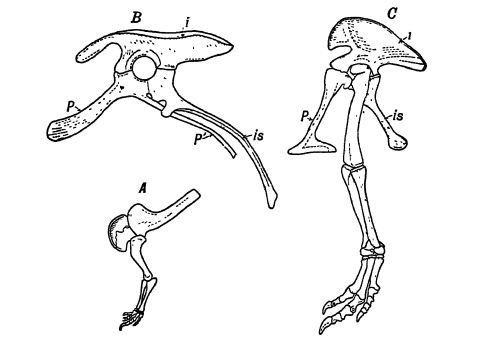
The earlier Saurischia were carnivorous in diet, though their descendants, the sauropods, became vegetarian. On the other hand, those with bird-like hip bones were all vegetarians. The latter are also known as the Predentata, because of a special bone developed in the front part of the jaws that is devoid of teeth.
Relation of Dinosaurs to Birds. — Besides the relationship shown in the pelvic bones as described above, the skeletons of dinosaurs [ p. 497 ] show many other similarities of structure to those of crocodiles and more especially birds. The one most often noted is that carnivorous or primitive dinosaurs have three toes as in most birds. By far the more important linkage with the birds, however, lies in the natui*e of the ankle joint. In manmials and Ihdng reptiles, the ankle joint is between the small bones of the ankle and the two larger ones of the lower leg. Birds and dinosaurs, on the other hand, have some of the ankle bones united with the leg bones, so that the joint comes in the middle of the ankle itself.
Dinosaur Extinction. — The dinosaurs were already well differentiated in the Upper Triassic and attained their fullness of development in the late Jurassic and on into the Cretaceous. Even toward the close of the Mesozoic most of the kinds were still present, but before the culmination of the Laramide Revolution they were all gone. The last of them are in the Lance formation, and their quickened going in North America appears to have been connected with the withdrawal of the Cretaceous inland seas during Fort Union time. Seemingly their death knell came with the obliteration of their homes in the swamps that bordered the inland seas, and the marked reduction of the climate that resulted from the rising Laramide mountains. No reptile with the dimensions and habits of dinosaurs could withstand winters, even if they were no colder than those at present in the Dismal Swamp of Virginia.
An animal stock so highly specialized as were the Cretaceous dinosaurs must have been vitally vreakened and greatly reduced in numbers through the vanishing of its habitats. The cooled climates tried them sorely. Thus weakened, they were all the more easily assailed by the competing archaic mammals that began a quickened ascendancy during Lance and Fort Union times. It has been suggested that the more active, intelligent, and warm-blooded mammals fed, among other things, on dinosaur eggs and on the young dinosaurs that never had parental care.
The dinosaurian career. Lull states, “ was not a brief one, for the duration of their recorded evolution was thrice that of the subsequent mammalian age. They do not represent a futile attempt on the part of nature to people the world with creatures of insignificant moment, but are comparable in majestic rise, slow culmination, and dramatic fall to the greatest nations of antiquity.”
With the rise of the modern floras and their more concentrated food value, and with the passing of the dinosaurs, there came the possibility of a speedy evolution of the archaic m amm als. These, however, because of radical defects of brain and feet and teeth, [ p. 498 ] had but a brief allotted span, and were in their turn displaced by the immigrating hordes of modernized mammals which were to be the rulers of the earth until forced to own the dominion of man.
¶ Collateral Reading
Barnum Brown, Fossfl Hunting by Boat in Alberta. American Museum Journal, Vol. 11, 1911, pp. 273-282.
F. A. Lucas, Animals of the Past. Sixth edition. American Museum of Natural History. Handbook Series, No. 4, 1922.
R. S. Lull, Organic Evolution, Chapters 30 and 31. New York (Macmillan), 1917.
W. D. Matthew, Dinosaurs. American Museum of Natural History, Handbook Series, No. 6, 1915.
W. D. Matthew, Canadian Dinosaurs. Natural History, VoL 20, 1920, pp. 537-544.
| XXXIII. The Beginning of Mesozoic Time: the Triassic Period | Title page | XXXV. The Jurassic Period and the Many Kinds of Reptiles |