| XXXIV. Dinosaurs, the Mighty Rulers of Mesozoic Lands | Title page | XXXVI. The Dragons of Medieval Time |
[ p. 499 ]
In Europe, over the Triassic Kes the widely distributed and usually but little disturbed Jurassic, a great series of strata attaining to thicknesses of over 3250 feet. The high lands that were made during the close of the Paleozoic had now vanished, and extensive epeiric seas, with a life that was astonishingly rich and varied, gradually spread over Europe.
Probably as many kinds of fossils are known from Jurassic rocks alone as from all the other Mesozoic strata combined, and because of this prevalence of organic remains, these formations have been the training grounds for many European stratigraphers and paleontologists.
In general it may be said that the Jurassic was a time of crustal stability until the closing stage, when mountains were made along the Pacific border of North America and elsewhere.
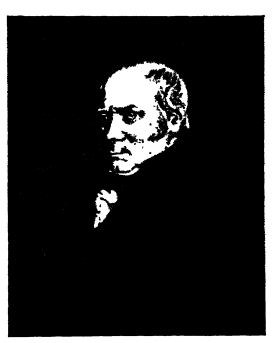
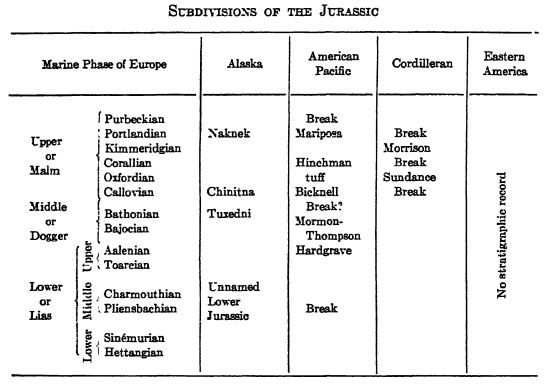
The Term Jurassic. — In England, these deposits furnished fossils to William Smith, the Father of Stratigraphic Geology (Fig., above), who was the first to discern in them a value as aids in determining the age of the containing strata. In fact, it is from the Jurassic deposits of England, Germany, and France that the principles upon which Stratigraphic Geology depends have been worked out. At the beginning of the past centurj”. Smith called this system the Oolite series, because so many of its formations abound in o5lite structures, so-called from their resemblance to the roe of a fish (see Pt. I, p. 293). The earliest division he named Lias, the middle [ p. 500 ] Dogger, and the upper Malm; these are quarrymen’s names for local kinds of rock and all of them are still in use, especially in England.
It is interesting to digress here a little, and to note that in the latter country the Jurassic passes through five cycles of sedimentary deposition, that is, the rocks pass five times through the cycle from arenaceous to argillaceous to calcareous strata (Geikie). At one time it was widely held that periods should be based on sedimentary cycles, but the fallacy of this conclusion is seen in that the Jurassic period has within itself five such cycles.
However, as none of the terms used by Smith were based on a definite exposure of rocks, the French geologist, Alexandre Brongniart, in 1829 proposed the name Jurassic for the system, establishing it on the equivalent formations exposed in the Jura Mountains, which lie between France and Switzerland.
Divisions of the European Jurassic. — In Germany, Von Buch, one of the great pioneers of Geology, in 1839 divided the Jurassic on the basis of rock character into Black (louder), Brown (middle), and White (upper) Jurassic, while in France Alcide d’Orbigny split it up into ten divisions. Later on Quenstedt took up a detailed study of the equivalent strata in southern Germany, in the Swabian Alps, and in 1858 dmded the system into eighteen biologic zones. He was not only a good teacher, but an enthusiastic and genial man, and thus was able to enlist in his work the local collectors of fossils and even the farmers; to this day it is said that the peasants point out his divisions on their farms. Oppel, his student and successor, finally divided the Jurassic into thirty-three zones, many of which are knowm to have a very wide distribution. More than forty divisions are now recognized, and Buckman predicts that from eighty-five to one hundred biologic divisions (hemerse) will eventually be defined. These facts are recited for the dual purpose of showing (1) to what degree of refinement stratigraphy may be developed when an abundance of fossils is present, and (2) that the Jurassic system has so far maintained itself as the best system for exhibiting the principles of zonal correlation.
From the studies of the abundant Jurassic marine faunas came also the first clear ideas of climatic zones in Geology and of world paleogeographic maps, through the work of Professor Neumayr of Vienna. As the result of a long study of the ammonids and their geographic distribution, he came to the conclusion in 1883 that the earth in Jurassic time had clearly marked equatorial, temperate, and cool polar climates, agreeing in the main with the present occurrences of the same zones. The consensus of opinion to-day [ p. 501 ] is that these are representative rather of faunal realms than of temperature belts. On the other hand, it is admitted that there were in the Jurassic clearly marked temperature zones.
North America, however, stands in strong contrast to the European Jurassic development, for the record is one of erosion and peneplanation over three fourths of the eastern part of this continent. It was only along the Pacific border that the ocean invaded the land and for a limited time extended east as far as Wyoming and Colorado. Probably fewer than 600 kinds of Jurassic fossils have been described from North America, while Europe has made known nearly 15,000 forms.
Outstanding Features of the Jurassic. — North America during Jurassic time remained highly emergent, continuing the geocratic conditions of the Triassic. Seas were present, for the most part, only in Mexico and along the Pacific border from California north into Alaska. For a limited time, however, there was an inland sea, a very large water-way across what is now the Rocky Mountains and the Great Plains country. This was the Logan sea, extending from the Arctic south into Colorado, New Mexico, and Utah. The longest enduring seas with the most prolific faunas were, however, those of Mexico and Alaska.
In Europe, Jurassic time is probably the most completely recorded of all the systems. Sea animals were not only prolific but in wonderful variety as well, the molluscs, corals, and sponges plajing the greatest rôles. For the stratigrapher, the many ammonites are most significant, since their evolution led into endless variety, furnishing the criteria for detailed time divisions. In the vertebrate life of this time, marine monsters like the fish-lizards and the snakenecked reptiles dominated the seas, while the lands were ruled by dinosaurs, the most gigantic land animals that ever lived, and the air was peopled by fierce dragons and toothed birds. It was truly a most wonderful time of reptilian dominancy, but even then many kinds of archaic mammals were awaiting their chance to rise into organic supremacy.
Toward the close of the Jurassic, all along the Pacific border of North America mountains were rising and of these the Sierra Nevadas of to-day reveal in their geologic structure their past grandeur. At the same time from deep uithin the earth there rose into the surficial strata mighty masses of molten rocks in the form of bathyliths, that to-day are seen as the granodiorites in the highlands from Lower California into Alaska.
[ p. 502 ]
¶ Jurassic Events in Eastern North America
Absence of Jurassic Deposits. — Until about 1910 it was held by many geologists that certain rather local deposits, of continental origin, occurring on the Piedmont Plateau and extending from New Jersey into Virginia, were of Jurassic age. This, the Potomac series, is now held, on the basis of its entombed plants and dinosaurs, to be of Lower Cretaceous time.
Jurassic Erosion Cycle. — In a previous chapter we saw that the Triassic period in eastern North America closed with the Palisade Disturbance, a movement that resulted in the making of block mountains probably as high as the present Sierra Nevadas. Accordingly, Jurassic time opened here with active erosion, and whatever continental deposits were formed at the time were swept into the oceanic basins. Therefore Jurassic time throughout the greater part of North America was one of erosion and without record of the sea, and the Morrison formation is the only one of fresh-water origin. All of the sediments were delivered into the Atlantic far beyond the present eastern and southern margins of the continent. This erosion cycle brought about the final transformation from the old topographic expression of high Appalachian and lower Palisade mountains to a nearly base-leveled land, and it was this peneplanation that prepared the way for the next overlap of the Atlantic Ocean, in Cretaceous time.
[ p. 503 ]
Potomac Disturbance. — Upwarping became pronounced toward the close of the Jurassic in Appalachis, but the uplift was restricted to the northern and western belt where the present highest elevations are still found, extending from the White Mountains southwestward into Georgia. To the east of the upwarped area, on the contrary, a downwarping took place, carrjdng this part of Appalachis into the depths of the Atlantic Ocean. These movements correspond to a warping or tilting about a horizontal hinge-line or axis which in a general way extended along a line drawn through the seaboard cities of Boston, New York, Philadelphia, Baltimore, Washington, and Richmond. To the west of this line, uplift increased with distance, and subsidence with distance to the east of it.
The undulatmg peneplain upon which the Potomac formations repose has a present slope of 112 feet per mile. The subsequent marine plain cut by the Upper Cretaceous seas has a present grade of 33 feet per mile. Therefore these two successive planes are inclined to each other at an angle of 79 feet per mile, and indicate a raising, without folding, of the vrestem Piedmont and Appalachian areas at least several hundred feet. (Barrell 1915.)
¶ Jurassic of the Cordilleran-Mexican Regions
Northern Pacific Border Area. — In the chapter on the Triassic it was shown that the period closed with emergence all along the entire Pacific border of North America. In consequence the sea was removed everjnvhere from the continent, at least from those parts of it now accessible to the geologists. This break in sedimentation lasted during the final epoch of Triassic time (Rhsetic) and the early Jurassic (Lower and Middle Lias).
The Pacific Ocean again began to invade North America early in Jurassic time, sparingly in the Aleutian Peninsula, the Cook Inlet country of Alaska, and across Vancouver Island. These areas are of the British Columbic geosyncline. The widest extension at this time occurred in the Californio sea of Oregon, California, and Nevada. Of Middle Jurassic events little is as yet well known, other than that the Lower Jurassic of Alaska (1000 to 4000 feet) continues imbroken into the Middle (1500 to 2000 feet), and Upper Jurassic (5000 feet). The marine Jurassic in Alaska is the longest sequence along the Pacific border of North America, and its more than 10,000 feet of thickness consist essentially of coarse deposits, such as tuffs, conglomerates, sandstones, and shales, with lava (andesitic) flows near the top of the system. The Jurassic series in Alaska along the Pacific border is fossiliferous throughout, though by no means to the extent that is true of Europe. (See Pl., p. 505.)
Arctic Alaska. — A very thick series of continental deposits of early Upper Jurassic age has been discovered by Collier in the Cape Lisbume region of Alaska (Pl., p. 505, Map 3). The strata, which have been given the name of [ p. 504 ] the Corw-in serie?, consist in the main of coarse deposits, shales with sandstones and some conglomerates, attaining to at least 15,000 feet in thickness, in which there are from forty to fifty low-grade non-coking coal beds, varying in depth from a few inches to 30 feet. Ten beds are each over 4 feet thick, and the total thickness of all the coal seen Ls 137 feet. The coal is of better grade than lignite. Below these coals are other workable Paleozoic non-coking coals that are of Lower Carboniferous age.
Coal beds of Middle Jurassic age are known in Mexico, California, Alaska, Greenland, Spitzbergen, Europe, Siberia, India, China, Australia, South Africa, Franz Joseph Land, and Antarctica.
Californic Sea (Walcott 1894). — The Jurassic marine deposits are widely spread over the states of California, Oregon, and Nevada (Pl., p. 505). Apparently much of Jurassic time is represented, but the detail of the formations is well known only locally, even though the much-sought-after placer gold of California originally was derived from rocks of this period, the IMariposa and Auriferous slates (Gold Belt series. See p. 510). These Upper Jurassic formations of northern California and the adjacent part of Oregon are essentially sandstones and shales, with very little of limestone and more of tufiFaceous conglomerates (500 feet). In places the thickness is 2000 feet, rising to over 6000 feet elsewhere in California, and if the Lower Knoxville strata of 10,000 feet thickness, with their Jurassic flora, belong here, the maximum thickness will rise considerably above the last mentioned figure. In the Humboldt Range of Nevada there are from 1500 to 2000 feet of basal Jurassic (Liassic) limestone, followed above by 4000 feet of slates. Evidently the Upper Jurassic material was derived from a high land, and in places these formations are seen to rest unconfonnably on the Triassic.
The faunas are always small ones and corals are locally common. During early and middle Jurassic time, the faimal migrations were from the warmer waters of the south, but in the Upper Jurassic (Mariposa, Lower Knoxville) the life was clearly of northern Pacific origin and a part of the boreal or cooler water faunas.
The Franciscan series of the Coast Ranges is probably of Jurassic age, but as to this geologists differ.
Logan Sea. — Toward the close of the Middle Jurassic, the northern Pacific, with a cool-water fauna, began to spread widely over Alaska, throughout the British Columbic geos 3 'nclme, and into the states of Montana, Idaho Wyoming, Colorado, and Utah, [ p. 505 ] in the Rocky Mountain geosyncline (Pl., p. 505, Map 3). In the Great Plains region the deposits of Logan sea (named after W. N. Logan, who first described its extent) have an average thickness vaiynng between 200 and 400 feet, but increasing to the west to upward of 1000 feet, and in southwestern Wyoming to 3500 feet. The nature of the deposits changes from place to place, and they consist of sandy clays, shaly marls, impure limestones, and sandstones. The cross-bedded sandstones, the changeable sediments, and the universal presence of oysters indicate that the sea was a shallow one, and further, that it flowed over a warped land eroded to a low relief.
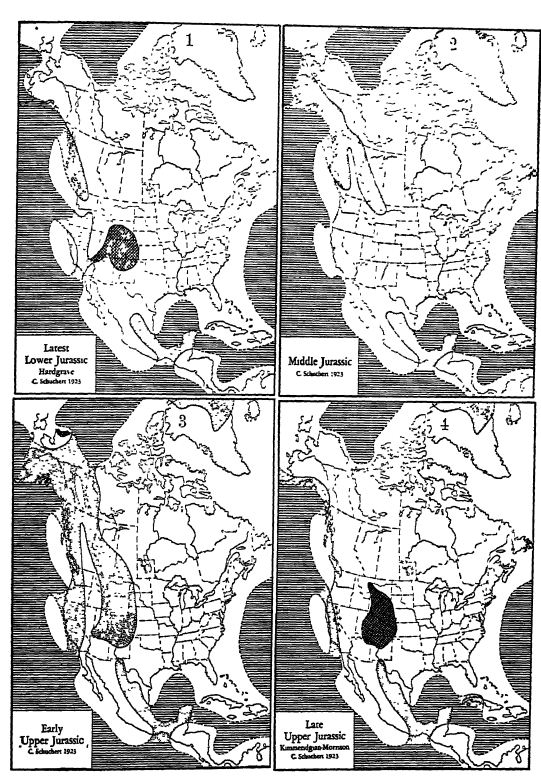
Epeiric seas dotted; oceans ruled. Fresh-water deposits cross-ruled. Volcanic regions indicated by crosses. See Plate 40 (p. 511) for latest Jurassic physiography.
Note that the entire sedimentary record is in the western part of the continent, Central America, and Cuba. In Map 3 is shown the spread of Logan sea, with gypsum and red beds in darker shading. The highly interesting dinosaurs of the Morrison strata are found in the cross-ruled area of Map 4.
[ p. 506 ]
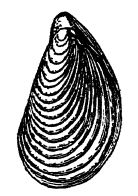
The fauna is a small, monotonous one, probably not exceeding seventy-five species, and is almost altogether made up of Mollusca, including a few ammonids and squids. The assemblage indicates that the waters did not belong to the open sea, but were those of a large bay and of boreal origin. Among vertebrates, the common forms were the dolphin-like reptiles called ichthyosaurs (p. 517), while the plesiosaurs (p. 518) were rare. The submergence was of short duration and vanished early in the Upper Jurassic before the Alaskan waters began to abound in the boreal bivalves known as Aucella (Fig., p. 504).
Jurassic Deserts. — In the chapter onTriassic time, the succession of Mesozoic deserts was described, hence all that need be said here is that the red Permian and Triassic deposits of the Great Basin area are followed by thick formations (2000 feet or more) of decidedly cross-bedded sandstones of white and pink color. These are the White Cliff sandstones of the Grand Canyon region, and farther north in Utah and Colorado the Vermilion Cliff and La Plata sandstones. All appear to be older than the Morrison, and are indicative of desert conditions.
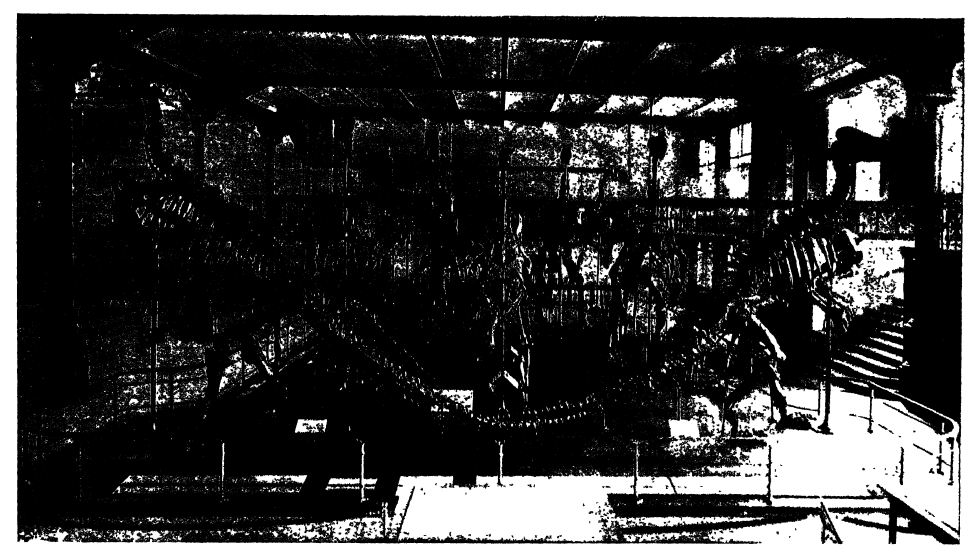
Morrison Continental Deposits. — Throughout the Great Plains country, from Montana south into New Mexico and overlying the marine Jurassic of the Logan sea, occur variegated green and red marls and shales with irregularly distributed beds of sandstone. They were first studied at Morrison near Denver, Colorado, and at Como Bluff near Medicine Bow, Wyoming. Over large areas the beds at first sight appear to be uniform in character, but seen in detail they vary considerably. The average thickness is about 200 feet, but locally it rises to over 400 feet. Because of the variability in the sediments from place to place, and especially because the strata yield in the main large dinosaurs (see Pl., p. 483, and Fig., p. 507), along with some archaic mammals (Fig., p. 516), fresh-water bivalves, snail shells, and land plants, it is apparent that they are of freshwater origin.
[ p. 507 ]
[ p. 508 ]
Osborn has tabulated the entire Morrison life and it has 151 species. The common forms are dinosaurs (69 kinds: sauropod 31, carnivorous 13, armored 11, and iguanodont 14), archaic mammals (25), one each of bird, pterodactyl, turtle, and rhynchocephalian, crocodiles (3j, fish (3), invertebrates (24) and plants (23).
Hatcher held that the llorrison deposits were laid down over a comparatively low and level plain which was occupied by small lakes connected by an interlacing system of river channels. That there were swamps in which the great dinosaurs lived and that they were occasionally entombed therein is attested by the occurrence of more or less complete skeletons preserved in the rocks. Further, there are many fresh-water clams (unionids) and snails. The topography and climatic conditions of that time may be compared to those of the region about the lower reaches of the Amazon to-day.
Ever since 1877, when dinosaurs were recognized as such for the first time in America, the age of the Morrison has been under discussion. The difficulties in correlation are great because (1) the entombed animals, while abundant, are an isolated occurrence of land forms; and (2) the local stratigraphic position is not clearly defined in the geologic sequence. The strata lie disconformably upon the earliest Upper Jurassic deposits of the Logan sea, and in the same way usually below the Cretaceous (Dakota formation). In recent years, however, Lee and Stanton have shown that the Morrison in Oklahoma and southeastern Colorado actually lies directly beneath the Upper Comanchian (Washita). This, then, according to the field relations limits its age either to Upper Jurassic or to any Comanchian time older than the upper division or Washita.
Within the past two decades giant dinosaurs have also been discovered in what was formerly German East Africa, and as the containing strata have marine beds of late Jurassic time associated with them, it is becoming clearer that the Morrison dinosaurs are in all probability also of late Jurassic age.
While the Morrison is rich in vertebrate remains, there is little that is distinctively American. The fauna is in harmony with that of Europe, and we may agree with Williston’s statement that during Morrison times there was freedom of migration between the eastern and western continents, so free that nothing distinctive of either region was developed through isolation.
Mexican Geosyncline. — Through all of Paleozoic time the greater portion of IMexico was land, and formed a part of the ancient continent Columbis (Fig., p. 139). Late in the Triassic the Gulf of Mexico spread for the first time over northern Mexico. In the late Middle Jurassic, the greater part of southern and eastern Mexico and southern Texas was flooded by the Gulf and the Pacific, and we shall see further periodic floodings of this land throughout later Mesozoic time (seePls.,pp.505,539,557). These seas are of the Mexican geosyndine, which endured throughout Mesozoic time and eventually became a part of the greater Gulf of Mexico. The [ p. 509 ] Jurassic sediments in the main are limestones, with but little of calcareous shales. The thickness of the formations ranges between 1000 and 2000 feet, and they abound in ammonids.
This Mexican subsidence is correlated by Burckhardt vdth the late Upper Jurassic. The faunas are unlike those of California and have decided European connections, since of the eighty-five ammonids described, eight are identical vsith those of central Europe and northern Russia, while eleven other forms are closely related. This shows that the western end of Tethys was open into the northern Atlantic and that the faunas migrated along the shores of Gondwana into Mexico. According to Buckman, there appears to be no marine Portlandian in Mexico.
Volcanic Activity. — In a previous chapter it was stated that volcanoes were active along the Pacific border of North America during Middle and early Upper Triassic time. Similar actmty began again locally early in the Jurassic and continued throughout the period, becoming even more wide-spread toward its close than at any time during the Triassic (see Pl., p. 505). The eruptions were in part submarine, and in part issued from vents situated along the shore line but following in the main the distribution of the Triassic volcanoes. In these lavas, basic greenstones, that is, altered basalts, now predominate. (Lindgren.)
Nevadian Disturbance. — Toward the close of the Jurassic the Pacific System (Sierra Nevadas, the Coast Range of California, and the Humboldt Range of Nevada; also the Cascade and Klamath mountains farther north) was elevated. With the rise of these mountains to the east and west there came into existence between them the Great Valley of California, a narrow but long geosymcline that has persisted into the present. These mountains did not then have more than half their present height. The making of the Nevadian Mountains at this time was pointed out by Whitneys in 1864 and further described by Dana. H. S. Williams (1895) and Blackwelder (1914) have called this the Nevadian movement, while Smith terms it the Cordilleran Revolution, but the deformation of the crust did not have the extent of a world-wide revolution. Although the mountains mentioned are the regions of most active deformation, it seems probable that movements more or less marked took place from Mexico into northwestern Alaska. This conclusion is drawn not only from the wide distribution of late Jurassic bathyliths, but also from the fact that at no subsequent time did the Pacific Ocean again spread over the United States so widely as it had previously done.
With the rise of the Sierra Nevadas, there also began the formation of a new trough to the east of the folded area, the Rocky Mountain geosyndine, of which much will be said in discussing the events [ p. 510 ] of the Cretaceous. During Lower Cretaceous time, however, this was not decidedly a sinking field.
While the Pacific border of North America was being folded, the earth-shell was also invaded by deep-seated igneous rocks (granodiorite) on a large scale. At the surface there were immense outpourings of lava, which are conspicuous in the present Sierra Nevadas. Magma-ci in great volume were intruded, forming the great chain of bathyliths now exposed by erosion along the Pacific border from Lower California to the Alaskan Peninsula (see Pl., p. 539). In comparison with this intrusion, all post-Proterozoic igneous phenomena fade into insignificance. The bathylith of the Sierra Nevada is 400 miles long and has a maximum width of 80 miles, while on the International Boundary there are twelve bathyKths that have a combined width of 350 miles. Farther north appears the Coast Range bathyllth, probably the greatest single intrusive mass known, which extends unbroken for 1100 miles into the southern Yukon country, with a width of from 30 to 120 miles. It is thought that while tllese intrusions began in Middle Jurassic time, the main injections took place at the close of the period, extending into Lower Cretaceous time, and that less significant upwellings went on even to the dose of the Mesozoic era. (lindgren, and LeRoy.)
The gold-bearing veins of quartz in the rocks of the Sierra Nevadas have formed as a consequence of the upturning. The wrenching of the strata opened the leaves of the slates and also made great intersecting fissures. The opened spaces and fissures became filled with silica (quartz) deposited by the heated solutions coming from the bathyliths below, which also brought with them the ores now found in the veins. Some of these auriferous quartz veins have a width of 10 to 40 feet Their erosion has furnished the gold found in the placers (see Pt. I, p. 431).
In the Coast Ranges of Canada the metamorphosed strata to the west of# the bathyliths have silver ores and to the east of them copper ores.
Prophecy of Gondwana Break-up. — In previous chapters there was pointed out the presence since at least early Paleozoic time of Gondwana Land, a vast equatorial continent extending from Brazil across the Atlantic and Africa, and across the Indian Ocean to India. The first hint of the breaking up of this land to form the medial Atlantic and the Indian oceans came with the Jurassic, and is seen in the tremendous eruptions of volcanic rocks present in South Africa and eastern South America. The upwelling of these heavier rocks into lighter ones shows that the same condition occurred, only in greater degree, in the areas of Gondwana that have gone down into the Atlantic and Indian oceans. This breaking up of Gondwana was completed in Cretaceous time.
[ p. 511 ]
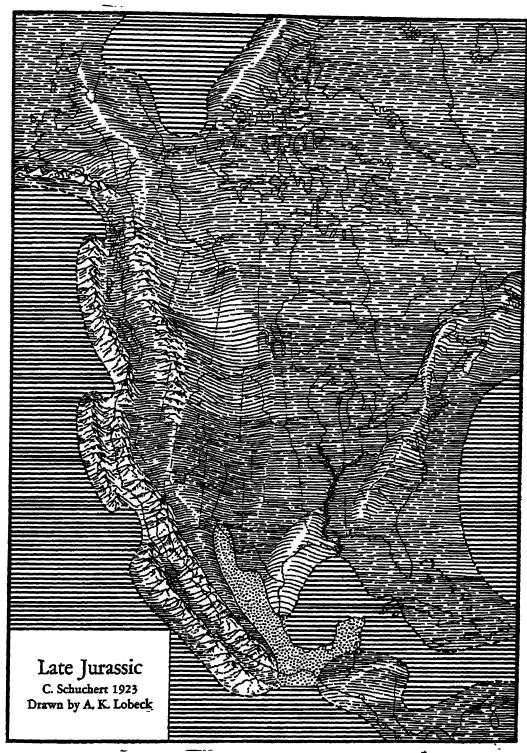
The probable geography of late Jurassic time, when the Sierra Nevadas and other mountains of the Pacific System were rising (see pp. 509-510) . The Central Cordilleran ridge to the east of these mountains was rising, but is here drawn too high, while the Coloradic geosyncline is shown as too deep (pp. 546-547) . Note that the Appalachiana are greatly reduced (compare with the map on p. 425), and that the Mississippi drainage may have begun this early.
[ p. 512 ]
Over eastern South America between the Amazon, Parana, and La Plata rivers, C. L. Baker (1923) has shown that there are plateau lava flows averaging about 1000 feet in thickness, and still covering at least 300,000 square miles of land. These lavas rest upon Permian and Triassic strata, and are overlain by fresh-water sandstones thought to be of Cretaceous age. Therefore these eruptions appeared at the surface seemingly at some time during the Jurassic. Their total volume is not less than 50,000 cubic miles, a mass of the order of a great mountain range. They range from andesites and olivine-free augite-porphyrites to typical limburgites rich in olivine.
In South Africa between 26° and 33° south latitude, A. L. Du Toit has shown that the Karoo dolerites rose into the Permian and Triassic fresh-water strata at some time after the Rhaetic and probably during the earlier Jurassic. The area invaded still equals 220,000 square miles and originally was not less than 330.000 square miles. These eruptives exist in numberless intrusive sheets and dikes that cut the Karoo formations so that now they look “like a mass of reinforced concrete.” The total volume of the Karoo dolerites is estimated at 50.000 to 100,000 cubic miles.
¶ Climate of Jurassic Time
We have seen that in Triassic time volcanoes and lava flows occurred in many places, and these are indicators of crustal instabihty. These movements do not seem to have been of suflflcient magnitude to bring on a marked reduction in the climate of the world toward the close of the Triassic, and yet a cooled climate is indicated among the animals, as will be shovm presently.
Students of ammonids say that the closing time of the Triassic (Rhaetic) was a particularly critical one for this group. Of the more than 2600 known species of Triassic ammonids, not one continued to live into the Jurassic, and the later fullness was developed out of a single genus of Triassic time. This extinction and marked evolution along a single line seemingly point to marked environmental alterations, factors that were explained in the chapter on Triassic time.
In the Lias there are known 415 species of insects, which remind one much of modern forms. Nearly all were dwarf species, smaller than similar insects living to-day in the same latitude and far smaller than those of the earlier Paleozoic or Upper Jurassic. Handlirsph is positive that this uniform dwarfing of the Lower Jurassic insects was due to a reduction of the temperature, and that the climate was then cool and like that of present North Europe. The climate, he states, was certainly cooler than that qf the Middle Triassic or of the Upi>er Jurassic. In confirmation of this, it may be noted that Hugh Miller in his Old Red Sandstone says that the fossil woods of the Cromarty Lias have the growth-rings as distinctly marked as in the pines or larches of the present forests.
[ p. 513 ]
With this dwarfing of the insects, and the vanishing of the late Triassic ammonids, there is also to be noted a marked quantitative reduction and geographic restriction among the reef corals of Liassic time. Not only this, but the wide distributior* of reef corals in Upper Triassic times vanishes with the later cool waters of this period. We are therefore seemingly warranted in concluding that the cooling of the climate in latest Triassic and early Jurassic time was not local in character, but was rather of a wide-spread nature.
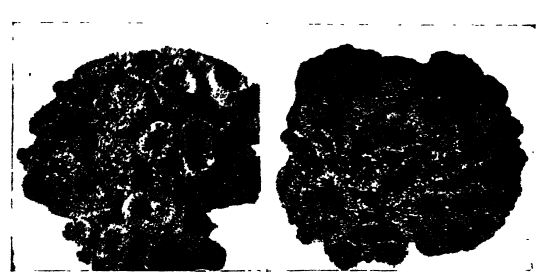
The very extensive distribution of Jurassic ammonids shows that there were at that time clearly marked temperature zones, that is, a very wide medial warm-water area, embracing the present equatorial and temperate zones, with cooler but not cold water in the polar areas. That the oceanic waters of Middle and Upper Jurassic times were warm throughout the greater part of the world is seen not only in the very great abundance of marine life, but also in the far northern distribution of many ammonids, corals (Fig., above), and marine reptiles. Jurassic rocks often abound in reefs made by sponges, corals, and bryozoans. Jurassic corals occur 2000 miles north of the present occurrence of similar forms. The plant distribution of Middle Jurassic time shows clearly that the floras were cosmopolitan and of a moist, warm, and probably subtropical climate. Not even in arctic lands do the fossil woods of this time show seasonal growth-rings. The insects of the early Upper Jurassic were again large and abundant, thus confirming the climatic evidence deduced from the plants. In other words, the temperature [ p. 514 ] of the early Upper Jurassic was considerably higher than it had been earlier in the period.
Evidence of Land Animals. — In the temperate and tropical belts, the world in Upper Jurassic time had the greatest of all land animals, the sauropod dinosaurs, reptiles attaining in the United States of America and in equatorial East Africa a length of about 80 feet (see Pl., p. 483, and Fig., p. 507). These animals could only have lived in a warm climate in marshes covered with succulent plants along the margins of the continents and in the estuaries of the greater rivers.
Latest Jurassic. — David White stated in 1913 that the latest Jurassic woods of England and of the United States have well developed annual rings of growth. This indicates the return of decided seasonal variations, a conclusion which is further borne out by the marked changes that take place in the floras of this time. Many of the older types, including the giant Equisetales, are blotted out, along with a marked differentiation among the Gymnosperms. Most important of all, however, is the appearance in late Jurassic time of the angiospermous flora, though its first forms are not known until early Lower Cretaceous time in New Zealand and later in the northern hemisphere. This conclusion is further supported, White says, by the rapidly developed and increased leaf expansion so characteristic of the dicotyledon, and the varied protection of the ovule with its powers of rapid maturation or of long-delayed germination. These are necessary results brought about by the long winters, followed by rapid vegetative growth and fructification within a short growing season, so as to tide over long periods of uncertainty and insure more favorable conditions for germination.
¶ Life of the Jurassic
Land Floras. — The Middle Jurassic floras were truly cosmopolitan, and Knowlton tells us that of the North American species, excluding the cycad trunks (Fig., p. 27), about half are also found in Japan, Manchuria, Siberia, Arctic Alaska, Spitzbergen, Scandinavia, or England. What is even more remarkable, the Jurassic plants collected by the Shackleton Expedition in Louis Philippe Land, to the south of Cape Horn, in 63° south latitude, are practically the same as those of Yorkshire, England.
The flora of the Jurassic, while in the main a continuation of that of the late Triassic (see Figs., pp. 468, 507), was in every way very different from the modern ones. It consisted of rushes or Equisetales, modern herbaceous and tree ferns, cycads, gingkos, and modern conifers, the descendants of which are now foimd mainly in southern lands, and also shows the incoming of a number of more modern types in these groups. The cycads were of course abundant and diversified, so much so, in fact, that the Triassic [ p. 515 ] and more especially the Jurassic are often called the Age of Cycads, In some places, as in the state of Oaxaca, Mexico, the fossil cycads make up 72 per cent of the flora.
Medieval Insects. — While many of the stocks of modern insects are thought to have had their rise in the Triassic, this conclusion is attained only from a study of the Jurassic forms, of which about one thousand species are knoTO, against fewer than fifty in the older period. In the Jurassic the insects began to feed on parts of the plants, but probably few as yet visited the inconspicuous flowers of that time to feed upon the pollen, and fewer still for their small amounts of honey. True butterflies and flies (Diptera) were rare in the Lias, but caddis-flies, scorpion-flies, dragon-flies, and beetles were abundant. Other kinds of insects known from this time are the cicadas, grasshoppers, locusts, cockroaches, and termites.
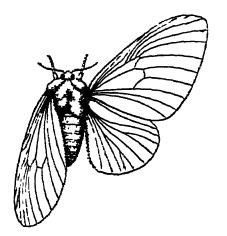
Wheeler states that the social ants were certainly present in the early Jurassic and that they arose out of primitive wasps of the kind that now live in deserts or hot sandy places.
He thinks it was the stress-climate of early Jurassic or late Triassic time that brought about their origin.
“The ants are the dominant social insects.” Humanity may learn much from them, since “human and insect societies are so similar that it is difficult to detect fundamental biological differences between them.” The family is the primitive basis in all societal living, and its bonds are physiological and instinctive. Each society lives in cooperative affiliation.
Social life among insects has arisen de novo in twenty-four different stocks, six times among beetles and fifteen times among bees, wasps, and ants. Among the white ants (termites) and ants there is even some culture, since they cultivate fungi and domesticate other insects for food, enslave members of their own or other colonies, and bequeath the farms and stocks along with their homes and hunting grounds to their succeeding generations. (W. IM. Wheeler 1922 .)
Land Reptiles. — In general it may be said that the reptiles attained a higher and more diversified development than in the Triassic. True lizards appeared with the Jurassic, and the turtles were then abundant and world-wide in distribution. One of the most remarkable groups of Jurassic carnivorous reptiles was that [ p. 616 ] of the flying dragons, which aje described in more detail in the next chapter (see Fig., p. 523).
The dinosaurs probably attained their zenith of differentiation in the late Jurassic and then continued in fullness of development into the Lower Cretaceous. The most characteristic and largest of all were the Sauropoda (Brontosawnis and Diplodoeus), and other striking large forms occurred among the carnivores (Pl., p. 485) and armored types described at length in Chapter XXXIV.
First Frogs. — It is interesting to note here that the oldest American frogs occur in the Morrison strata of Wyoming (Marsh). They were very small animals and apparently not of much significance in the animal world of their time.
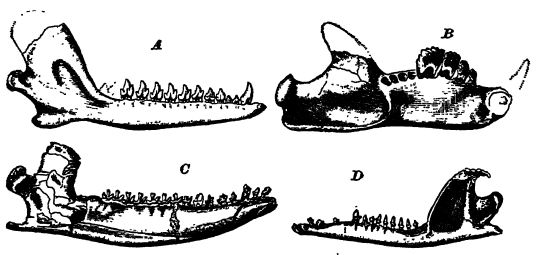
Archaic Mammals. — The rise of the reptilian mammals was noted in the Triassic chapter, and their fragmentary bones, especially teeth and lower jaws, are met with in the various deposits of the Mesozoic. They were obscure little beasts, and none “ could look a dinosaur in the face.” In England they occur at the close of the Jurassic and in the Lower Cretaceous, and in America in the Morrison (Fig., above). Little is as yet known of these animals other than that the American and European species were very much alike, and that they belonged to the most primitive mamma, the Multituberculata. It is probable that the Mesozoic ma.mma.lg were, in the main, egg layers.
Birds. — The oldest known fossil bird is Archasopteryz of the Upper Jurassic of Germany (Fig., p. 584). Two fine skeletons are known, representing a creature that in life was about the size of a modern crow. The evolution of birds is described in Chapter XL.
[ p. 617 ]
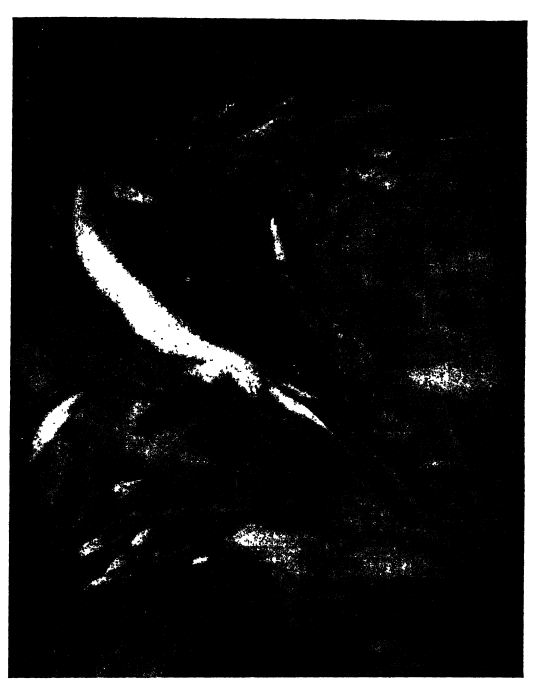
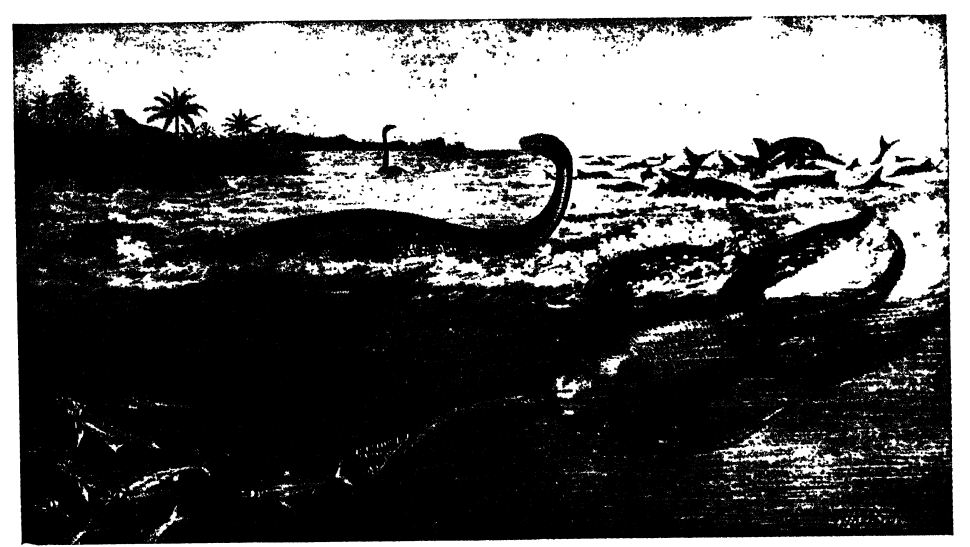
Reptiles of the Seas. The Ichihyosauria (Greek for fish-lizard’) were a highly characteristic group, for though they appeared in the Triassic and continued into the Cretaceous, the Jurassic, and especially [ p. 517 ] the Lower Jurassic, was the time of their principal expansion (Fig., above). Certain localities in the Lias of England and Germany have furnished an extraordinaiy number of skeletons, some of the specimens preserving the embryos and impressions of the [ p. 518 ] outlines of the body and limbs and showing recognizably the nature of the skin. In their stomachs were found the booklets of cuttlefishes, indicating that they fed on squids, and they probably also fed on fishes. The ichthyosaurs were entirely marine in their habits; their limbs were converted into sw imm ing paddles, and there was a dorsal fin and a large tail-fin, the latter being the principal organ of propulsion. The muzzle was drawn out into an elongated slender snout, armed with numerous sharp teeth, which were set in a continuous groove, instead of in separate sockets. The neck was very short and the skin smooth. In length, these reptiles sometimes exceeded 25 feet, and in appearance they must have been very like the modern porpoises and dolphins. The resemblance, however, is wholly superficial, since porpoises and dolphins are warm-blooded mammals.
Another group of carnivorous marine reptiles was that of the Plesiosauria (Greek for near4izard)y which appeared in the Triassic and culminated in the Jurassic, and which formed a curious contrast to the ichthyosaurs (Fig., p. 519). In the typical genus, Plesiosaurus, the head was relatively very small, and the jaws were provided with large, sharp teeth, set in distinct sockets. The neck was exceedingly long, slender, and serpent-like, and was marked off distinctly from the small, box-like body. The swimming paddles were much larger than in the ichthyosaurs and probably had more to do with locomotion. The Jurassic species of Plesiosaurus did not much exceed a length of 20 feet. In 1920 there was discovered in fresh-water deposits of Lower Cretaceous age (Wealden of England) a plesiosaurian 6 feet long. In this we see a Jurassic holdover and an instance of a form of marine ancestry becoming adapted to fresh-water environment.
Crocodiles swarmed in the seas and rivers of Jurassic time. In appearance these reptiles resembled the modern gavial of Truiia. and had a simil ar elongate and slider snout. The fore legs were much smaller than the hind, and the [ p. 519 ] [ p. 520 ] animals were probably less exclusively aquatic in their habits than the presentday crocodiles and alligators.
Fishes. — Nearly all of the Paleozoic fishes were absent in the Jurassic, excepting the ganoids and lung-fishes. The former vrere now at their highest development, not only in the fresh waters, but in the seas as well. Some of these Jurassic forms were evidently the forerunners of modern sturgeons.
The sharks of the seas had attained their modern development, and in the Jurassic the flat fishes known as rays made their appearance. The bony fishes were still rare.
Marine Invertebrates. — The seas of Jurassic time were replete with invertebrate life. This statement, however, is based on the development of Jurassic rocks in Europe and Asia, where about twenty-five forms are known for each one in America (15,000 : 600). As is pointed out elsewhere in this chapter, this dearth of marine life in America is due mainly to the absence of marine strata and to the fact that when such are present the deposits are not those of normal marine conditions.
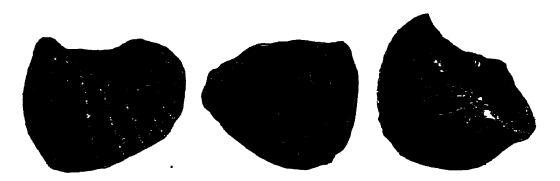
In the Jurassic rocks, sponges are locally very common and well preserved, and in places make up thick reef limestones. Other reefs are made of modern corals (Hexacoralla) and these are of very wide distribution in the Middle and early Upper Jurassic (see Fig., p. 513). Crinids are at times common and in the Lower Jurassic are found the largest forms that ever lived, the pentacrinids, which grew to 50 feet in height, with a crown a yard in length and width. Since Jurassic times the crinids have played no important r61e in the seas. Sea-urchins of modern types are also common and here appear the so-called irregular urchins (Fig., p. 347) that later on gave rise to heart-urchins and sand-dollars.
[ p. 521 ]
Brachiopods are still plentiful, but not in great variety, except in the rhjTichonellid and terebratulid families. Almost all of the Paleozoic forms vanish with the Jurassic. On the other hand, the rocks of Jurassic time abound in molluscs, which are prophetic of the rise of modern forms. The seas were full of small and large bivalves, some of which were not only very ornate but characteristic of this time (Trigonia, Fig., p. 518, and plicate oj-sters. Fig., p. 520). Especially interesting are the many forms living in the mud. Gastropods are also common and the siphonate forms are the most valuable for historical purposes (see Pl., p. 575, Figs. 10-12).
[ p. 522 ]
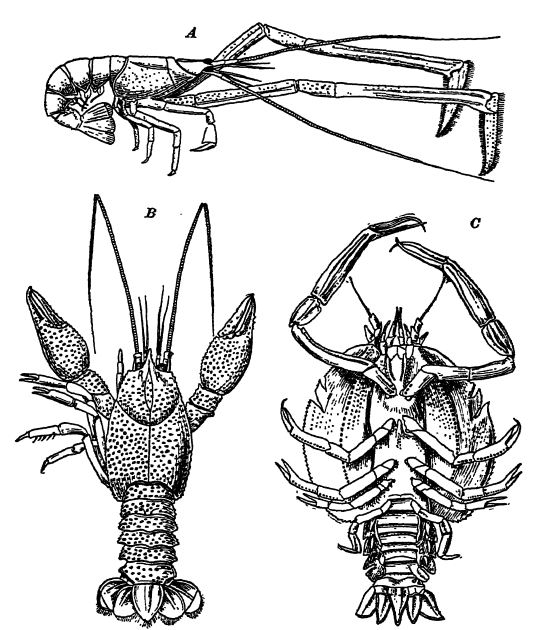
The most characteristic shell-fish of the Jurassic, however, were the ammonids. The crustaceans, usually rare as fossils, are represented by many kinds of lobsters in the Upper Jurassic about Solenhofen, Germany, due to unusually favorable conditions of preservation. The ancestors of the modern crabs also appear here (Fig., p. 521).
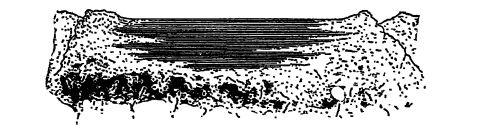
Life of a Jurassic Reef. — In the region about Solenhofen, during the Upper Jurassic, a series of reefs were built by sponges and corals. On the outside of the reefs the deposits are in the main thick series of dolomites and magnesian limestone in heavy beds, while the area inside, never over 75 feet thick, consists of thin-bedded, platy limestone of very fine grain and of extraordinarily uniform character, representing a limy mud flat, in part permanently under water, and in part flooded twice daily by the tides (Fig., p. 520). These deposits are the Kthographic limestones, which are used throughout the world for the engraving and etching of the monotone and colored prints known as lithographs.
In these platy limestones is found a most wonderful assemblage of animals of the sea and of the land, and even of the air, consisting of forms almost unknown elsewhere. Walther in 1904 monographed this region and its fauna, which amounts to 450 species. The life of the land is represented by a very few plants, more than 100 species of insects, probably blovm upon the mud flats from the lands near by, 6 turtles, 9 crocodiles, 1 dinosaur with young, 29 flying reptiles (Pterosauria, Fig., p. 523), 3 other kinds of reptiles, and the oldest known bird (Fig., p. 584), Of fresh-water animals there are none. Of marine fishes, mainly ganoids, there are 143 species, and of crustaceans, mainly of the lobster type (Decapoda, Fig., p. 521), 71 forms; of ammonids 7, annelids 13, crinids (comatulids) 4, some starfishes, brittle-stars, and echinids, and 8 medusse. All the other types of bottom-living invertebrates, mainly molluscs, are represented by but 40 species that were more or less accidentally drifted into the atoll.
¶ Collateral Reading
E. W. Berry, The Jurassic Lagoons of Solenhofen. Scientific Monthly, October, 1918, pp. 361-378.
W. T. Lee, Early Mesozoic Physiography of the Southern Rocky Mountains.
Smithsonian Miscellaneous Collections, Vol. 69, No. 4, 1918, pp. 1-41 .
C. Schuchert, Age of the American Morrison and East African Tendaguru Formations. Bulletin of the Geological Society of America, Vol. 29, 1918, pp. 245-280.
J. Walther, Die Fauna der Solnhofener Plattenkalke. Festschrift Haeckel, 1904, pp. 133-214.
| XXXIV. Dinosaurs, the Mighty Rulers of Mesozoic Lands | Title page | XXXVI. The Dragons of Medieval Time |