[ p. 524 ]
After the dinosaurs, the most extraordinary, and characteristic animals of the lands during Mesozoic time were probably the dragons of the air, better known as pterodactyls or flying reptiles. “ They must have had a grotesque resemblance to heraldic dragons ” (Thomson). From the distribution of their fossil remains, it is inferred that they were common and of considerable variety, occupying the place in nature that birds do to-day. Associated with them, but far more sparingly in number and variety, were the reptilian or toothed birds. The dragons died out with the Mesozoic, but the birds went on evolving into their present wonderful adaptation. Both stocks learned to fly independently, an adaptation also invented among certain stocks of mammals and insects, and less perfectly among the fishes and amphibians. In this chapter we shall study the dragons in some detail.
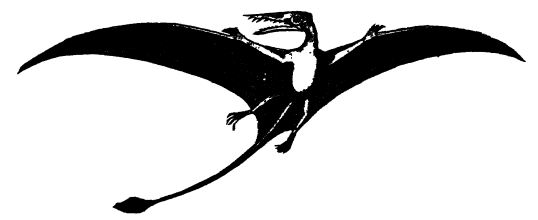
Probably the most anomalous animals of Mesozoic lands were the pterodactyls or pterosaurians which laid claim to the empire of the air in those medieval times. “ With outstretched pinions,” says Sir Richard Owen, the great comparative anatomist, “ [they] must have appeared like the soaring Roc of Arabian romance, but with the featmes of leathern wings with crooked claws superinduced, and gaping mouth with threatening teeth.” And according to another British authority, H. G. Seeley, “ The animals are astonishing [ p. 524 ] in their plan of construction. In aspect they are unlike birds and beasts which, in this age, hover over land and sea. They gather into themselves in the body of a single individual, structures which, at the present day, are among the most distinctive characters of certain mammals, birds, and reptiles.” In brain, respiratory system, breast-bone, shoulder-girdle and the large bones of the limbs, the pterodactyls were bird-like; their skull and backbones were reptilian in construction; while the hip-bones were most like those of dinosaurs. The neck-bones were always seven in number, and in this resemble the Mammalia. In all of these characters we see the independent origins of pterodactyls and of birds in reptilian or lizard stocks.
The first pterodactyl was described in 1784 by Collini from the Upper Jurassic at Mannheim, Germany. He regarded it as an animal living in the sea, but in 1801 the great Cuvier not only correctly interpreted it as a reptile, but called it a “ flying reptile.” He saw also that it was one of the fingers of the hand that was very much elongated to support the wing, and accordingly gave the creature the name of pterodactyl, from the Greek words meaning wing and finger.
“ There were pterodactyls as big as an albatross and that, like the albatross, sailed majestically over the sea; others, no bigger than a sparrow, fluttered merrily over the land in pursuit of insects; there were pterodactyls with long tails, pterodactyls with short tails and pterodactyls with no tails at all; and while some flew by day, others, to judge from the size of their eyes, anticipated the owls and flew by night.” (Lucas 1922.)
These flying reptiles were more or less bird-like in appearance, with the front limbs modified for soaring or for flight by flapping of the wings. They flew about as well as or perhaps even better than the associated medieval birds, and as well as modern bats, which are flying mammals. On the ground they walked about readily, either on their hind legs as bipeds or on all four as quadrupeds. When at rest they probably hung themselves right side up by the clawed fingers to trees and rocks. In size, some were hardly larger than sparrows, while the average attained a wing expanse of from 2 to 3 feet across; the largest of the known ones of the Cretaceous had the extraordinary spread of 25 feet, more than twice as large as that of the condor or albatross. Even so, the skeleton was of very light construction, probably not exceeding 10 pounds in weight in the largest ones, for the large bones were hollow and filled with air in place of marrow. It is probable that even the largest of [ p. 525 ] pterodactyls did not exceed 30 pounds in live weight, and the greater number weighed less than 10 pounds; their bodies were, in fact, but an appendage to a pair of wings. Lucas states that Langley’s original aeroplane required one and one half horse power for its thirty-eight pounds weight, while Pteranodon is estimated to have used but thirty-six thousandths of a horse power for the same purpose. Like birds, in flight pterodactyls were buoyed by internal air sacs that were in communication with the lungs, and in all probability their blood was as warm as that of birds. In most forms the tail was long, in some half the length of the entire animal, but in others it was short and even rudimentary.
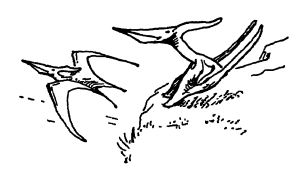
The heads were usually much elongated, sometimes large and deep, or small and compact, and in some forms no larger than in sparrows; in Pteranodon, however (see Fig., below), the head was 45 inches long and very narrow. The brain was birdlike. The jaws were generally provided with an abundance of long, slender, pointed, and more or less curved teeth, serving for catching and holding the prey and not for mastication. In some there were cutting teeth, and the anterior part of the head appears to have been covered with a horny beak as in birds and turtles. The neck was sometimes slender as in herons, in other forms strong as in eagles. The back was always short. The skin appears to have been naked, at least nothing of scales, feathers, or hair has been seen in the wonderfully preserved pterodactyls of the Solenhofen (Germany) limestones, where twenty-nine kinds have so far been recovered. Here quite a number of specimens show in full expanse the membranes of wings and the tail rudder.
Pterodactyls probably reproduced their kind from small eggs hatched out on the lands, as is general, though not universal, in reptiles.
Probably the most extraordinary and obvious single character of pterodactyls was the elongation and modification of the front limbs into flying organs. Not only were the larger bones of the arm and those of the hand elongated, but especially those of the fourth or wing finger. In Pteranodon, the wing finger attained a length of [ p. 526 ] 5 feet and the wings of 8 to 12 feet. To these bones was attached the wdng membrane, a very flexible leathery skin like that of bats. The inner end of this wing membrane was attached to the body, and in some forms was continued along the legs dowm to the ankle. A bird’s wing is a series of feathers, while in pterodactyls the wing was a membrane held out by one finger, and in bats the skin is stretched between the four fingers. The hind feet had either four or five unwebbed toes, and the front limbs had four fingers, the fifth or little finger being lost.
These Mesozoic dragons appear suddenly as whole skeletons in the oldest Jurassic formations (Lias) of England and Germany, though Seeley reports scattering bones in the latest Triassic (Rhsetic) of Germany and thinks he has seen bones from even older strata (Muschelkalk). Their origin therefore appears to go back to the Pe rmia n. Skeletons of pterodactyls are far more common than those of the medieval birds and occur in greatest variety in the Jurassic strata of western Europe. In America single bones of late Jurassic age (Morrison) were found by Professor Marsh of Yale in Montana and Colorado, but the group attained its maximum of size and numbers in the Cretaceous, when Pteranodon sailed far out over the chalk seas of Kansas (Niobrara time). Seeley states that Cope had a pterodactyl bone from the latest Cretaceous (Laramie) of the Great Plains, which, if true, shows that these extraordinary creatures died out about the same time as did the dinosaurs. During their existence the pterodactyls showed but little of evolution other than greater growrth. Some twenty genera are known, fourteen in the Jurassic and about six in the Cretaceous.
The remains of pterodactyls are found more commonly in marine deposits that were laid down nearest the shore, though they are known in unmistakable fresh-water beds (Wealden and Morrison). From the marine Greensand about Cambridge, England, many thousands of their bones have been collected by quarrymen, probably fifty fair to good skeletons being known. From this we may deduce a distribution over the lands and along the seashore, though the toothless forms of Kansas have been found 200 miles offshore. They were wholly carnivorous animals, feeding upon the life of the land and sea, but there is nothing in their skeleton to show that they could swim about in the water. They may have dived after fishes as kingfishers do now, and swallowed their prey aKve. It is accordingly thought they had gizzards.
The pteranodons were the organic aeroplanes of Cretaceous time and from a study of them and of soaring birds Langley obtained [ p. 527 ] hints for his invention of the first flying, or rather soaring, machine. Matthew says that Pteranodon was “ a marvelously elaborate mechanism, gigantic in size, perfected in everj" detail of adaptation to its singular mode of life, automatic and precise in its response to every gust of the changing wind, to every distant flicker of light or shade that might indicate some prospect of prey or warn of a lurking enemy.” They doubtless soared tirelessly across the Cretaceous seas from dawn to dusk in search of food.
¶ Collateral Reading
G. F. Eaton, Osteology of Pteranodon, Memoirs of the Connecticut Academy of Arts and Sciences, Vol. 2, 1910.
F. A. Lucas, Animals of the Past. Sixth edition. American Museum of Natural History Handbook Series, No. 4, 1922.
W. D. Matthew, Fljdng Reptiles. American Museum Journal, Vol. 20, 1920, pp. 73-81,
H. G. Seeley, Dragons of the Air. New York (Appleton), 1901.