| XXXVI. The Dragons of Medieval Time | Title page | XXXVIII. The Lower Cretaceous, and the First Appearance of Flowering Plants (Angiosperms) |
[ p. 528 ]
¶ Ammonites
General Characters. — The Mesozoic seas were characterized by an abundance of the shelled cephalopods known as ammonids (see Pl., p. 477, Figs. 4-16). These beautiful coiled shells, relatives of the nautilids, were exceedingly varied in size, shape, ornamentation, and in the character of their septa (the transverse plates dividing the shell cavity into chambers), and more than six thousand forms have been described by paleontologists. Probably the average size svould be between 3 and 4 inches, although they may range up to diameters of 8 feet (PacJiydiscus seppenradensis of the Upper Cretaceous of Germany), and if the coiled tube in such large ones were straightened out, the length would be betvreen 20 and 35 feet. The ammonids therefore exceeded the Paleozoic nautilids as much in size as they did in specific differentiation. They appear to have been more active animals and better swimmers and floaters than the nautilids and therefore crawled less over the bottom of the sea. If [ p. 529 ] they were good swimmers, they must also have had a functional hyponome (see Fig., p. 226) like the nautilids. The belief that they did swim well is deduced from the nature of the very thin shells, the wide distribution of some of the species, and the small depth, or narrowness, of the coiled cones (see Fig., p. 528). This statement applies to practically all the tubes that are wound in a plane like a watch spring, but where the shells are spiral, more or less unwound, or straight, they are thicker and the animals are believed to have crawled rather than to have swum (see Pl., p. 575, Fig. 16). Such are no longer thought to be degenerates, as heretofore, but to represent new, even if reversionary, adaptations in the search for food on the sea bottoms. A few* may” even have been fastened to the sea bottom (Nipponites). Before proceeding further, the student should refresh his memory by reading what has been said about nautilids on page 225.
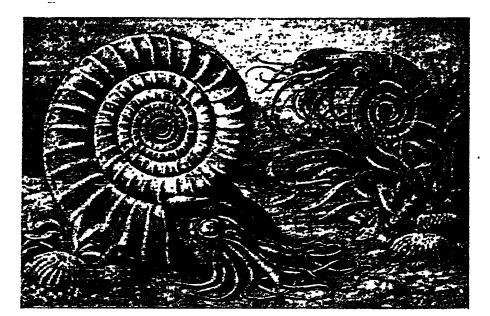
History of the Term. — The word ammonite goes back to 1732 and the days when fossils were regarded as minerals, as is indicated by the ending ite. The shells were so named because of a fancied resemblance to the horns of rams, pictured as one of the attributes of the Egyptian deity Ammon. In India these fossils are current as an article of trade, and they are used throughout that country in certain religious rites.
Comparison with Nautilids. — In many ways the shells of ammonids are like those of the pearly nautilus, but they differ therefrom radically in a number of respects. They” are nearly always more ornate, narrower or less deep, and are often distinctly keeled along the center of the outer whorls. Further, the mouth of the shells often has lobed extensions on the sides (lappets), and in general there is a median keel that may be drawn out into a sharp point, the rostrum (see Fig., p. 528). On the other hand, the siphuncle in nautilids is near the center of the septa, but in the ammonids it is always placed near or in contact with the cone on its outer or ventral side (also called venter). In nautilids the mouth of the shell is never closed by an operculum, but in the goniatids and ammonids it probably was closed in most forms by a covering when the animal was at rest. This covering, when thin and made of chitin, is known as the anaptychus, but when thick and consisting of carbonate of lime in two hinged pieces is called the aptychus. The body chamber is of variable length, sometimes as long as one and a half revolutions of the shell.
Nature of Septa. — However, all of these differences, while of importance, are not so valuable in classification as is the nature of [ p. 530 ] the septa (see p. 226). In the nautilids these partitions in the chambered shell are simple and more or less concave; in the ammonids, they are simple only in the central part, and each septum becomes more and more fluted or wavy toward its junction with the outer shell (Pl., p. 477, Figs. 10 and 14). When the outer shell is absent, as is so often the case in these fossils, the suture line, or edge of the septa, is always seen as a wavy line with a distinct pattern, and this pattern also becomes more and more complex with age (see Fig., p. 366). It is this complicated suture line, with its intricate lobes (inwardly directed) and saddles (curved toward the mouth of the shell), that makes these fossils so valuable in deciphering the chronology of Mesozoic time, since it indicates a progressive evolution that has been determined from the sequence of the strata, checked by the individual’s growth or ontogeny. The time value of the sutures was first noted by Yon Buch in 1830.
The question is often asked: Why did these animals develop so complicated a type of septum? Among the nautilids we rarely see any approach to the lobed type of septum and here the living chamber is not only variously deep but wide as well. In other words, the ventral side of the cone is rounded and broad, and the shells are usually considerably deeper than those of the ammonids. Therefore the side muscles holding the shell to the animal not only have a greater holding surface in the nautilids, but, what is more important, the cone is more or less round, and therefore rests more uniformly on all parts of the animal, while in the ammonids the shells are lenticular and are therefore more easily turned to one side when in motion through the resisting water. It was probably the narrowness and the appressed nature of the shells that led to lobation of the septa, through the necessity of increasing the holding power of the animal on the shell. In any event, lobed septa are seen only in lenticular shells of cephalopoda ( nautilids, goniatids, ammonids).
Evolution. — The deep-shelled nautilids late in the Silurian gave rise to small and narrow’-shelled goniatids with sparingly lobed septa. In most of the goniatids of the Devonian (Pl., p. 322, Figs. 1-6), the suture line of the lobes and saddles terminates sharply, but in the Mississippian the majority of the species not only have more lobes and saddles, but these are nearly all rounded. Thus we see a gradual change in the narrow-shelled cephalopods, beginning as true nautilids, and passing into various stocks of more or less narrow-shelled goniatids that finally gave rise in the Carboniferous to many lines of evolution among the primitive ammonids, resulting in the establishment of the latter in the warmer Permian waters of the Tethyian mediterranean (Fig., p. 431). The greatest variation among them took place during late Permian and early Triassic time. At the close of the Triassic they nearly died out, as explained [ p. 531 ] in the chapter on Triassic time. In the Jurassic, there was another rapid evolution out of one genus (Phylloceras), and the zenith of development was attained at this time. The waning of the ammonids began in the Lower Cretaceous, and during the Upper Cretaceous the stocks showed little of their old virility. Their complete extinction came at the close of the Cretaceous during the critical time of the Laramide Revolution.
¶ Belemniies, Squids or Ink-fishes
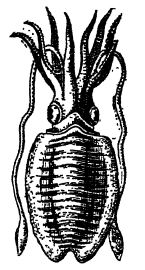
General Description. — In the Mesozoic we likewise see the rise of the belenmites, the ancestors of the cuttle-fishes (also knowm as cuttles or squids, Fig., opposite). The word belemnite comes from the Greek name for dart, the fossils being regarded at one time as the thunder bolts of Thor, the god of thunder (Fig. A, p. 532). Hugh Miller relates that the country folk regarded these fossils as “ of sovereign efficacy in curing bewitched cattle.” The belemnids were very active, highly carnivorous cephaJopods, which fed on fish, crabs, and molluscs.
They had large and fully developed eyes, were devoid of external shells, and because they had but two internal gill-plumes, the name Dibranchiata has been given to them. They had ten arms, possibly eight short and two long protrusible ones, as in the living squids (Fig., opposite). In the Mesozoic these arms were often provided on their inner side with bent chitinous hooks for holding, and, more rarely, with holding suckers. Later the suckers became the dominant type. At first the belemnids had a heavy internal skeleton, but during the Mesozoic, out of the belemnid stock arose the squids, animals that continued as geologic time went on to lose more and more of the ancestral skeleton, though there is still left a vestige of it in all of the living forms. In the squids, the brain is highly specialized, and they are the highest expression of alertness among invertebrates. For this reason they have been called the “ pirates of the deep.”
Ink-sac. — All Dibranchiata are provided with an internal ink-sac containing sepia, a brown-black fluid that mixes readily with the seawater; this the animals squirt in front of them when in danger [ p. 532 ] and then make their escape backward away from the defensive screen of colored water. The sepia of artists is a pigment made TOm this substance. Humboldt in his Cosmos (1844) says that this ink is so well preserved in Jurassic specimens that it still yields the color with which the animals’ image may be drawn. Like the other cephalopoda, the dibranchiates are provided with a siphon through which water is shot forward, propelling the animal backward. They can also swim by the aid of their side fins.
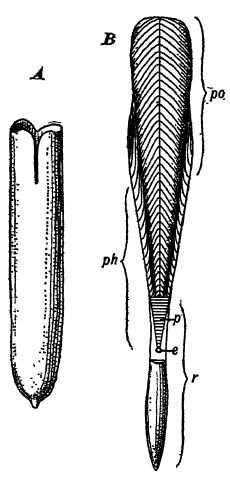
Nature of Skeleton. — The belemnids originated in the early Triassic (Pl., p. 477, Fig. 3) out of the Paleozoic orthocerids (Pl., p. 236, Fig. 19), in that the animals, as it were, made their way more and more out of the external shells and enveloped these by their mantles in such a manner that they became internal skeletons — an internal pedigree indicating their lineage (see Fig., opposite). Among the fossils the part that is usually preserved is called the guard, a more or less cigar-shaped, solid, calcareous body, pointed at one end, with a deep circular pit at the other. These guards are sometimes as long as 2 feet and as thick as 4 inches. In the pit of the guards and extending beyond them occurs the chambered and siphunculate 'phragmacone, the vestige of their orthocerid ancestore. This extends forward on the dorsal side into a more or less long piece, either of lime or of chitin, vhich is known as the proöstracum (see Fig. B, above). The belemlids are quite characteristic of the Mesozoic, are fine stratigraphic prides, and there are about four hundred kinds known, in some sixty genera.
[ p. 533 ]
The true sqviids of the Mesozoic retained only the proostracum and a completely modified remnant of the phragmacone, which together made a thick and wide, but meshy and therefore light, secretion of carbonate of lime, known as the cuttle-bone. Over the proostracum and projecting beyond it toward the head lay the pen, so called because it looks like a quill pen, made of chitin. In some of the living squids or cuttles there is left only the pen. In the Upper Jurassic of Solenhofen are found cuttle-bones fully 2 feet long, indicating animals with a probable body length of 6 to 8 feet; in the present seas live the greatest giants, whose bodies are 18 feet long, with the two protrusible arms attaining a length of 30 feet when fully extended.
¶ Collateral Reading
P. Bartsch, Pirates of the Deep — Stories of the Squid and Octopus. Annual Report of the Smithsonian Institution, for 1916, 1917, pp. 347-375.
C. Diener, Lebensweise und Verbreitxmg der Ammoniten. Neues Jahrbuch fiir Mineralogie, etc., 1912, VoL 2, pp. 67-89.
C. O. Dunbar, Phases of Cephalopod Adaptation. In “Organic Adaptation,” to be published by the Yale University Press.
R. Ruedemann, Observations on the Mode of Life of Primitive Cephalopods. Bulletin of the Geological Society of America, VoL 32. 1921, pp. 315-320.
E. Boese, The Permo-Carboniferous Ammonoids of the Glass Mountains, West Texas, and their Stratigraphical Significance- University of Texas, Bulletin 1762, 1917.
S. S. Buckman, Type Ammonites, Vols. 1-4 (others in preparation). London (Wesley), 1909-1923.
A. Hyatt and J. P. Sinna, The Triassic Cephalopod Genera of North America. U. S. Geological Survey, Professional Paper 40, 1905.
J. B. Reeside, Jr., Some American Jurassic Ammonites of the Genera Quenstedticeras, Cardioceras, and Amoeboceras, family Cardioceratidm. Ibid., Professional Paper 118, 1919.
J. P. Smith, The Middle Triassic Marine Invertebrate Faunas of North America. Ibid., Professional Paper 83, 1914.
| XXXVI. The Dragons of Medieval Time | Title page | XXXVIII. The Lower Cretaceous, and the First Appearance of Flowering Plants (Angiosperms) |