| XXXVII. Ammonites and Squids | Title page | XXXIX. Upper Cretaceous Time and the Birth of the Rocky Mountains |
[ p. 534 ]
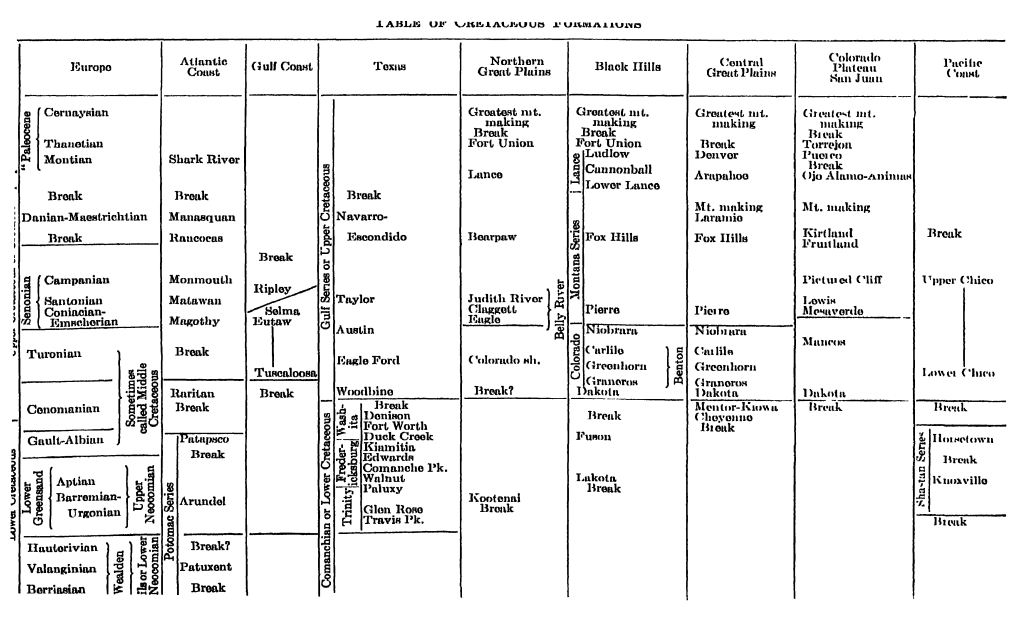
History of the Term Cretaceous. — In the early part- of the past centurj" the European geologists regarded the rocks overlying the Jurassic and beneath the Cenozoic as making up the Cretaceous system (so named from the Latin creta, chalk). At first, this latter system in England and France included only deposits of chalk, of Upper Cretaceous age, but gradually more and more formations, of other materials, were added because the fossils clearly linked them together. In this way the Cretaceous came to embrace so great a mass of heterogeneous strata that with the increase of knowledge it became necessary to separate the formations into Lower and Upper Cretaceous divisions. This usage is now generally accepted in Europe. In England, the physical characters of the uppermost Lower Cretaceous and the basal Upper Cretaceous are so much alike that no break in sedimentation is readily seen, but on the Continent the separation can usually be easily made out. Moreover, the Lower Cretaceous was a rather restricted marine transgression, with widely distributed continental deposits (Wealden, and less so Neocomian, see table, p. 537), while the sediments of the Upper Cretaceous are almost wholly of marine character and probably record the most marked spreading of the oceans in all geologic time. This spreading, however, began late in the Lower Cretaceous and attained its first great extension in the Tapper Cretaceous (Cenomanian and Senonian). From these facts we see that the earth underwent during the Cretaceous but one marked cycle of diastrophism. The physical evidence therefore classifies its formations into two divisions that in America are called Lower and Upper Cretaceous, though here the dividing line is not the same as in Europe.
It may be stated here that American stratigraphers are again coming to agree that their Cretaceous strata should not be divided into two independent systems of rocks or periods of time, but rather into two divisions of less import than periods. The evidence for this view is that during the last part of the Lower Cretaceous (as defined in America) or in Washita time, the Mexican sea transgressed the continent widely, spreading as far north as central Kansas and perhaps into southern Wyoming. Farther north the possible equivalent of uppermost [ p. 535 ] Washita has generally been classed as Benton or lowermost marine Upper Cretaceous. From Mexico north to central Texas the sea appears to have continued unbroken into the Upper Cretaceous (from Washita = Cenomanian into Eagle Ford or Woodbine = early Turonian).
Since the upper part and perhaps more of the Washita appears to be of the time of the European Cenomanian, which is at the base of their Upper Cretaceous, it follows that the dividing line in America between the Lower and Upper Cretaceous is not of the same time except in localities like the Rocky Mountain Province where the supposed equivalent of upper Washita lies at the base of the marine Upper Cretaceous; in Euroi>e, this line is at the base of the Cenomanian, while in America it is at the top of the Washita formation as in the Texas-iMexico province, but this line is older than the one in the Rocky Alountain area. (See table, p. 537.)
Stanton says (1922) that the Comanchian is a good provincial series and that the term should be applied only to the Mexican sea. Its application as a series term to the Lower Cretaceous of the Pacific coast he thinks is not justified by the present state of knowledge, and the recognition of Comanchian as a system of world-wide application is still less justified.
Lower Cretaceous of Europe. — In Europe the Lower Cretaceous appears in two phases: (1) a northern shallow-water, cooler, and more or less brackish one, terminating northward and westward in continental beds (the Wealden and Neocomian); and (2) a southern normal, marine, and warmer water phase that is of wide distribution in the area of the Tethjdan mediterranean. It is from this region and especially from France and Switzerland that the stratigraphic divisions are named. These are given in the table of Cretaceous formations, page 537.
Chalk Deposits. — Although chalk is not the dominant material of the Cretaceous, still, because of its conspicuous white color and its fine exposures in the cliffs along both sides of the English Channel (Anglo-Parisian basin), it gave the name to the great system of rocks following the Jurassic.
For a long time chalk was believed to be an oceanic deposit like the Globigerina oozes (see p. 72, and p. 115 of Pt. I) of the present abyssal oceans, but the kinds of fossils found in the chalks are indicative of shallow seas, and the formations are often accompanied by sands, while in closely adjacent areas the equivalent strata contain no chalk. In the Lower Cretaceous of Texas, the Kiamitia and Edwards formations have chalk associated vith shallow-water deposits. In central Wyoming there is much white chalk in the Niobrara formation, but in the western part of that state deposits of the same age are sandy shales or sandstones. In central Kansas the so-called chalk deposits, the equivalent of the Niobrara, are in reality very fine yellow muds almost devoid of chalk organisms. [ p. 536 ]- In central Texas the Austin chalk is also of the age of the Niobrara. In western Alabama the Selma chalk is 1000 feet thick, but of considerably younger age, and laterally it changes into marls, clays, and sands. Accordingly it is now held that the chalks are organic accumulations made in the main by the calcareous skeletons of minute pelagic plants and animals, in dear-water epeiric or shelf seas adjacent to low lands with mild climates.
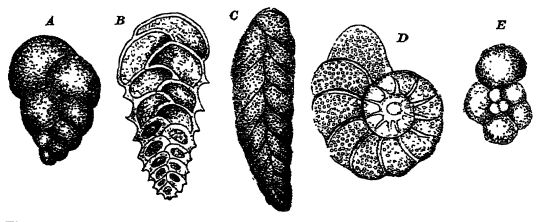
White chalk is a very fine granular limestone (in the AngloParisian areas 95 to 98 per cent calcium carbonate), composed in the main of entire or broken calcareous tests of floating or bottomliving Foraminifera (Fig., below) and of parts of exceedingly small floating calcareous algae (Rhabdospheres and Coccospheres). With them are often associated many kinds of shallow-water, thickshelled, bottom-lidng invertebrates, such as sea-urchins, bryozoans, brachiopods, and molluscs. In Europe the chalks frequently abound also in flints of different shapes and sizes, but in America these secondary alterations are rarely met with.
Significant Things about the American Lower Cretaceous. — In North America the Lower Cretaceous has two marine and independent developments, (1) in the Mexican geosyncline, extending widely over Mexico and northward across Texas into Colorado and Kansas (= Comanchian series); (2) a Pacific development known as the Shastan series of the Callfomic and British Columbic geosynclines. In addition there are two areas of fresh-water deposition, (3) the Kootenai strata of wide distribution in the Canadian Rocky Mountains and rich in coal deposits; and (4) the Potomac strata of limited extent along the border of the Atlantic in the United States. (See Pl., p. 539.)
[ p. 537 ]
[ p. 538 ]
Another feature of great significance is the bowing up during Jurassic time of the central Cordilleran region from Arctic Alaska into southern Mexico and the origin of a geosyncline to the east of it that in Upper Cretaceous times becomes the Rocky Mountain or Coloradic sea. This crustal movement is but one of many in Cretaceous times, and another is the breaking down of Gondwana, the bridging land between South America and Africa, with tremendous eruptions of lavas in Brazil. The most notable facts about the Lower Cretaceous life in North America are the appearance of flowering plants, and the apparent great dearth of dinosaurs.
¶ Mexican or Comanchian Seas
Comanchian Series. — Robert T. Hill a number of years ago made a special study of the Lower Cretaceous strata in Texas, and in 1887 he proposed for them the name Comanche series, because they occur in the home of the Comanche Indians. His ideas gradually prevailed and the rocks and their fossils are now being more and more widely recognized as representing a cycle of sedimentation and water movement, the Comanchian division. The succession is best known in central Texas, where there is an abundance of fossils in a thickness of 1500 feet. Hill also divided the Comanchian into three groups of formations, calling the lower Trinity, the middle Fredericks-burg, and the upper Washita.
In central Mexico, where this grouping is not yet clearly made out, the geologists adopt a two-fold separation into Eocretaceous (Lower) and Mesocretaceous (Middle).
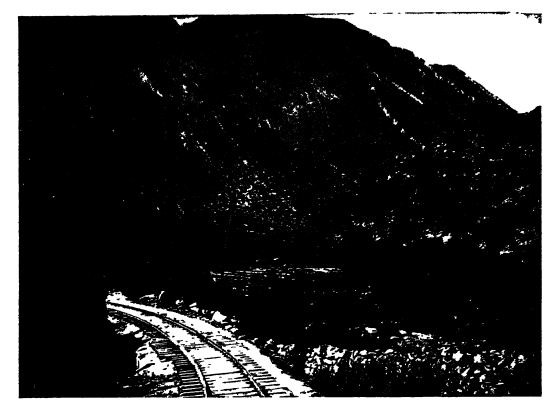
From southern Arkansas across central Texas into southeastern Arizona, and thence across almost all of Mexico to the Isthmus of Tehuantepec, are found limestones and marls that are of Comanchian age. These are the deposits of the most extensive inimdation by the oceans which befell Mexico and which was greatest here in middle Lower Cretaceous time. Moreover, they form the greatest area of Lower Cretaceous rocks and faunas in North America (see Pl., p. 539). Aguilera of the Mexican Survey states that these deposits make up the main mass of the limestones of the folded mountains of Mexico and in this respect contrast decidedly with the sandy nature of the Shastan sediments. The average thickness is between 3300 (Mazapil) and 4000 (Vera Cruz) feet, and almost all of it is limestone (see Fig., p. 540). At Bisbee, Arizona, the thickness is about 4700 feet, beginning with conglomerates, thence passing into sandstones, shales and limestones (650 feet), and ending with red shales and variegated sandstones. In northwestern Mexico, about Hermosillo, occurs a [ p. 539 ] [ p. 540 ] very similar succession of strata that are nearly 3000 feet thick and bear coal in the upper beds, according to Dumble. In central Texas, the typical area for Comanchian strata, the thickness is loOO feet, consisting of limestone, some chalk, but mainly marls and thinning out to a few hundred feet of sands and marls in Arkansas. In southern Texas and Mexico the Comanchian seas, are thought to go unbroken into those of Upper Cretaceous time.
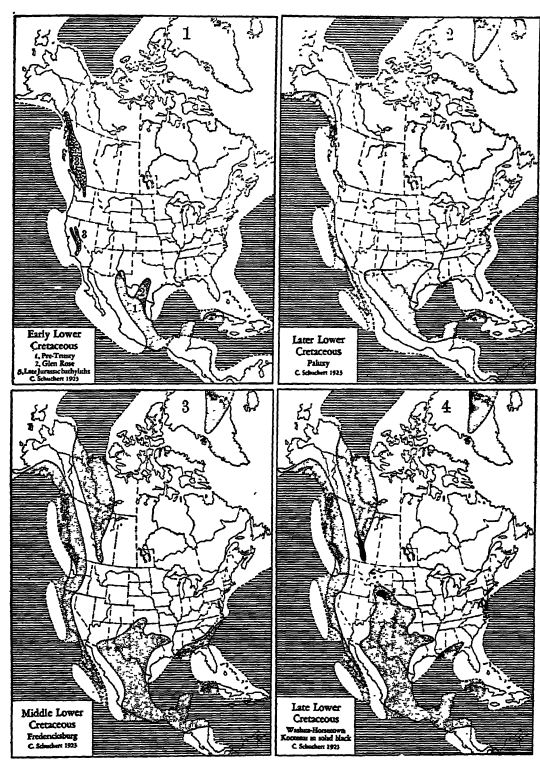
Epeiric and shelf seas dotted; oceans ruled. Fresh-water deposits in solid black, fci Map 1 are shown the more important areas of late Jurassic igneous intrusions, and in Map 2 the beginning of the spread of Mexican waters into the greater Comanchian sea. Note in Map 2 the small areas of Potomac deposits (solid black) along the Atlantic piedmont, and in Maps 3 and 4, the Kome beds of Greenland. Note also the presence of the Cordilleran Intennontane geanticline (see p. 141).
Great Plains Extension of the Comanchian Sea. — Late in Comanchian time (Washita) the sea of the Texan area spread northward across New Mexico and Oklahoma, to the south and west of the Ouachita Mountains, into central eastern Kansas, and southeastern Colorado (see p. 539, Map 4). This extension did not last long and its deposits consist in the main of muds and marls with sandstones in the west and southwest. The thicknesses are usually less than a few hundred feet, which in the north and east f.bin down to the vanishing point. The faunas here are always limited but include oyster-like shells (Gryphoea, Fig., p. 541), which often abound in great quantities; evidently the waters were shallow, turbid, and more or less freshened by the rivers flowing into this extensive bay.
[ p. 541 ]
The flora of early Lower Cretaceous time (Trinity), as found in Texas, was still Jurassic in character. On the other hand, the plants from the top of the Lower Cretaceous (Washita) found in Kansas show that a great change had come over the forest floras, as flowering plants f Angiospenns i were now present in great numbers and in forms like those of the succeeding Cretaceous.
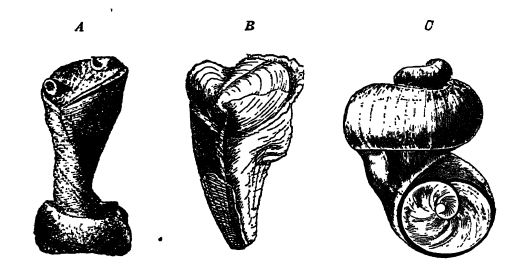
The marine invertebrate faunas were large and varied, consisting of about four hundred species, and were of normal marine character in Mexico and throughout Texas, becoming less so northward into Kansas and Colorado. The species were essentially of molluscs, with the ammonids making up about one third of the assemblages in Mexico and Texas, though farther north these latter are lacking more and more. Among the bivalves the most characteristic forms were the chamids Requienia and Monopleura, and the rudistids RadioliteS, etc. (Fig., p. 542).
The Comanchian fauna as a whole is very distinct from that of the Upper Cretaceous, but the change from the Kiowa or Denison fauna to the Woodbine of the Upper Cretaceous shows little if any greater contrast than is found within the divisions of the Benton. Making due allowance for differences in fauna due to littoral, deeper water, and reef facies, all of which are present in the Comanchian, this entire fauna is a unit showing only such progressive changes as are to be expected within a series (Stanton 1922).
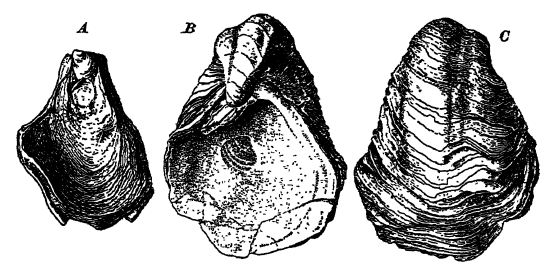
The Comanchian faunas are also widely distributed throughout Central America, and in the high Andes in northwestern and western South America assemblages of these aniTnals are present, though much modified by local evolution. In a general way it may be said that the Comanchian faunas were largely of mediterranean origin (Tethys), or rather that the Gulf of hlexico was in direct connection with the seas of Portugal, Spain, and southern France.
¶ Pacific or Shastan Seas
Shastan Series of the Californic Geosyncline. — As long ago as 1869, Gabb and Whitney applied the term Shastan to the Lower Cretaceous rocks of California, recognizing correctly that the strata [ p. 542 ] “contain fossils seemingly representing ages from the Gault to the Neocomian, inclusive (see table, p. 537). This development is wholly distinct, faunally and lithologically, from the Comanchian series The Nevadian Disturbance at the close of the Jurassic greatly reduced the width of the Californic geosyncline, making of it a narrow but deepened trough west of the Sierra Nevada and Klamath mountains throughout western California, but extending widely into Oregon west of the Blue Mountains. To the west of the trough lay a borderland of which the present Coast Ranges are a part. Into this subsiding trough the Shastan sea (LeConte) spread. The voluminous sediments poured into the Californic sea were coarse grained and were delivered to it by the rivers flowing out of the highlands to the eastward.
The deposits are essentially sandy shales with thin bands of sandstone, local conglomerates, and rarely thin limestones. The thickness in northern California appears to be between 9000 and 10.000 feet, of which about one third is of Knoxville time, while the remainder is of Horsetown time.
The maximum thickness of the Knoxville m northern California is about 20.000 feet, according to Diller and Stanton. Of this extraordinary thickness, about 16,000 to 17,000 feet is in general poor in fossils but occasionally there are beds replete with Aucella (A. piochii) a bivalve which is of boreal origin (see Fig., p. 504). The associated floras, however, Knowlton unhesitatingly refers to the Jurassic. (See p. 504.)
[ p. 543 ]
British Columbic Geosyncline. — Lower Cretaceous deposits are also known in northern Washington and along the Canadian and Alaskan coasts. The deposits of these areas are dominantly sandstones with sandy shales, and in most places include considerable thicknesses of volcanic material (from a few hundred feet up to 3350), lavas, tuffs, and ash beds. In the Queen Charlotte Islands, where these strata have coal beds, the depth is estimated at 9500 feet, and elsewhere, although somewhat less, the thicknesses are rarely as low as 2000 feet, but in places the Lower Cretaceous strata were entirely removed during the inteiwals of erosion. Finally, along the Arctic coast of Alaska there also appear to be Lower Cretaceous unfossiliferous strata that at Cape Lisbume are over 5000 feet thick.
The Lower Cretaceous sands and muds of the Pacific in most places overlap unconformably the older and often metamorphosed formations. This unconformity is usually a marked one, as in the Klamath Mountains and the Coast Range, or is of the erosional type. However, there are also disconformable contacts. The faunas are of the Indo-Pacific realm and are remarkably distinct throughout from those of the Comanchian seas, a condition indicating that the two provinces were completely separated from one another by a land barrier, the western Mexican mass. (See Pl., p. 539.)
The floras of the higher Knoxville (thirty-three species) and of the Horsetown (nineteen) were of the early Lower Cretaceous type (Lower Potomac), and flowering plants of the modern types (Angiosperms) are wholly unknown in them. In the Upper Knoxville (4000 feet) the small marine molluscan fauna was still of boreal origin (Aucella crassicollis biota). A marked change in the faunas took place in Horsetown time, as the life of the seas then had a Mediterranean (Tethys of India, also of Japan) aspect, a migration that made its appearance earliest in California and Oregon. It, too, was a molluscan fauna of about eighty species, of which over thirty forms were ammonids. This assemblage is known as the Indo-Paciflc fauna. (Stanton.)
¶ The Fresh-water Phases of Lower Cretaceous Time
Kootenai Continental Deposits. — In southern Alberta (Oowsnest Pass) and in southeastern British Columbia the Lower Cretaceous formations are of great thickness along the axis of the Rocky Mountains and are of fresh-water delta origin. These are the Kootenai deposits of the Rocky Mountain geosyncline, chiefly sandstones and sandy shales of very varied texture and appearance, and with many beds of good coal. The maximum thickness of the Kootenai is 5300 feet, with twenty-two workable coal beds, known to extend over an area of nearly 3000 square miles. To the east the Kootenai [ p. 544 ] thins rapidly to 200 feet, with two coal beds. In the Crowsnest area the coals aggregate 216 feet in thickness over an area of 230 square miles. Dowling estimates the coal of this region as equal to nearly 8,000,000,000 tons, and of this about 400,000,000 tons can be classed as anthracite.
The Kootenai is likewise present about Great Falls, Montana, where it is also coal-bearing, though the thickness here does not average over 450 feet, increasing to the west to 1500 feet, and thinning southward. The coal-bearing part of the Kootenai is represented by remnants as far south as central Wyoming. Other formations of about the same age occur in Wyoming, and in South Dakota (Lakota and Fuson formations), where about a thousand silicified cycad stumps have been found (one of which is illustrated in Fig., p. 27). The Kootenai in the Great Plains region directly overlies the Jurassic (Morrison), and may include equivalents of Lakota, Fuson, and Dakota (Lee).
Kootenai Flora. — The Kootenai fossils are essentially plants, a flora of eightysix species being known. It is still of Jurassic character, as no flowering plants occur, the forms present consisting mainly of ferns (thirty-four species), cycads (nineteen), and conifers (twenty-five), as seen in Fig., p. 507. The fiora is veiy similar to that in the Lower Potomac of the Atlantic border, twenty forms being common to the two areas. The botanists are disiwsed to regard the Kootenai flora as not younger than middle Lower Cretaceous.
Blairmore Formation. — In Cordilleran Canada the Kootenai is directly overlain by the Blairmore, 1700 feet thick, and the two are very much alike in rock characters. A conglomerate separates them, and both are of continental origin. Then in sharp contrast follow the marine Benton shales, there being no Dakota here nor in Alberta nor northern Montana. Therefore the Blairmore appears to be of Lower Cretaceous time (J. H. Sinclair 1917).
Potomac Continental Deposits. — In the chapter on Jurassic events it was stated that the mountains of eastern North America were reduced to a hilly coimtry during that period. It is also true that the main drainage ways, the present large eastward flowing rivers, such as the Potomac, James, Roanoke, etc., were established at the same time. At the very close of the Jurassic, during the Potomac Disturbance, it seems that the strand-line of the Atlantic Ocean had been extended further to the west (see p. 503), and the continental shelf tilted a little more seaward. In other words, eastern Appalachis was fragmenting and sinking into the depths of the Atlantic Ocean. In consequence, the stream grades became more active, and the sediments eroded from the upwarped region were transported eastward to a lower level and spread as the Potomac formation upon the peneplained Piedmont Plateau (the Weverton [ p. 545 ] peneplain) of ancient crystalline rocks. These deposits of the rivers are now seen all the way from near Philadelphia, past Baltimore and Washington, through Virginia into Georgia and Alabama (see Pl., p. 539). There are also scattering exposures in the islands off New England.
The Potomac formation is best developed in Maryland, where the thickness averages between 600 and 700 feet, and all the strata have a slight dip to the southeast, averaging about 40 feet to the mile. The rocks are exposed to the east of the elevated Triassic strata, and further eastward they gradually pass beneath the later Cretaceous and Cenozoie formations. The deposits consist chiefly of unconsolidated sandy clays, which at the base and in the west have greater amounts of sands and even conglomerates, and then the materials are usually arkosic or replete with fragmented feldspars. In addition, there may be considerable amounts of clay iron-stones (siderite) in the lower part (Arundel formation), and such have been mined in Maryland for more than a century. Because of the presence of these local deposits of iron, the formations assume a red color in weathering, and in the Upper Potomac the deposits are naturally variegated (Patapsco). The Lower Potomac begins with coarse materials highly variable from place to place (Patuxent formation), and finally in the Maryland region a restricted swamp land developed, as seen in the dark and carbonaceous deposits that are even locally lignitic (Arundel). Not only this, but the roots of the forests are still in the place of their origin, and it is in these swamps that seven species of dinosaurs have been foimd.
The Potomac formation is clearly divisible into a lower and an upper series by a marked erosional unconformity. Further, the floras are widely dissimilar in the two parts, since the Lower Potomac (Patuxent-Arundel) still retains the Jurassic aspect, while the Upper Potomac (Patapsco) strongly introduces the Upper Cretaceous assemblage of flowering plants or Angiosperms. The Lower Potomac is wholly of fresh-water origin, and was laid down on river flood-plains over the undulating Weverton peneplain, which had a relief of about 300 feet. On the other hand, the upper Potomac, although wholly devoid of marine fossils, may be of estuarine origin; that is, it may represent the fresh-water or landward part of the various deltas facing the Atlantic Ocean.
Western Greenland. — In central western Greenland occur middle Lower Cretaceous sandstones alternating with dark shales which have locally very thin and poor beds of coaL This, the Home formation, appears to be of fiesh-water [ p. 546 ] origin, and no marine fossil is known in it. The whole series is about 700 feet thick and reposes on a rather hilly floor of ancient (Proterozoic?) crystalline rocks (see Pl., p. 539). The flora is rich in ferns (forty species), cycads (eleven), and conifers (eighteen). Of flowering plants there are seven species.
¶ Movements toward the Close of the Lower Cretaceous
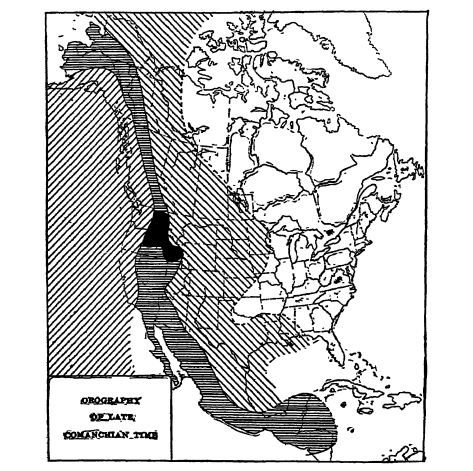
Central Cordilleran Disturbance (see Fig., below). — Along the Pacific coast from San Luis Obispo County, California, northward far into Oregon (Coast Range Mountains in wider sense), there is evidence of crustal movement during the Lower Cretaceous. Anderson states that the Knoxville is everywhere in this area penetrated and disturbed by dikes and masses of serpentine and accompanying peridotites. Moreover, in the Coast Range of southern California, where these intruded rocks occur, the Horsetown strata are also absent, while the Upper Cretaceous (Chico) imconformably overlies the older formations.
[ p. 547 ]
We have seen in previous chapters that the waters of the Pacific transgressed widely throughout the two western geosTOclines of the North American continent during the Triassic and again in the Jurassic, and that these floods occurred mainly in the British Columbic trough. In the area of the United States, however, uplift was making itself felt as early as Middle Triassic time, apparently bowing up a low arch in western Utah, eastern Nevada, and throughout Idaho, forming together the Columbia River Plateau (black area of Fig., p. 546), and this arch persisted into late Jurassic time. At the close of the Jurassic, the Sierra Nevada folds were thrown up to the southwest of this uplift, and it was then incorporated into the area of the Nevadian Disturbance. This late Jurassic movement narrowed the former wide extension of the Calif ornic and British Columbic geosynclines.
If we next study the paleogeography of Upper Cretaceous time it soon becomes apparent that the conditions of oceanic spreading had been further altered toward the close of the Lower Cretaceous, for subsequent to this time the Pacific geosynclines were narrow, and over what is now the site of the Rocky Mountains and far to the east in both Canada and the United States, a new inland sea appeared, the Rocky Mountain or Coloradic sea of Upper Cretaceous time, extending from the Gulf of Mexico into the Arctic Ocean (Fig., p. 546). The barrier that kept these waters apart was the newly bowed-up land to the west of the present main Rocky Mountain ridges, the Central Cordilleran Belt of Ransome, and this barrier continued to rise throughout all of Upper Cretaceous time. We see here therefore the beginning of the process which made the Central Cordilleran Belt of elevated plateaus extending from Arctic AJaska all the way into Central America, and it is for this reason that the movement is called the Central Cordilleran Disturbance (Oregonian Disturbance of Blackwelder).
This disturbance also manifested itself in Mexico, for in late Lower Cretaceous time western Mexico and Central America into Nicaragua were elevated, shutting out here more or less of the earlier Gulf of Mexico overlap.
Disruption of Gondwana (see Figs., pp. 431, 555). — The great equatorial land across the Atlantic, which had so long united northern Africa to Brazil, was broken up during Lower Cretaceous time and disappeared beneath the sea during the Upper Cretaceous. The evidence for this is at hand toward the close of the Lower Cretaceous (Gault time), when the Atlantic began to encroach upon Brazil and equatorial West Africa. Further and more extensive overlaps [ p. 648 ] were of Eocene time. We may therefore say that the present configuration of the Atlantic Ocean had its origin in earlier Cretaceous time. For other detail see the chapter on Jurassic time.
¶ Hawaiian Islands in Cretaceous Time
In the first part of this book (p. 116) oceanic islands are described and contrasted with the continental ones. It is there shown that such islands are of volcanic origin and that they consist in the main of extruded lavas built up from the floor of the ocean. The question must now be asked, How old are oceanic islands? The Hawaiian Islands rise from a depth of 15,000 feet to the surface of the ocean, and then some of them are continued 14,000 feet higher. The present great height above sea-level is probably of verj" recent origin (Pleistocene) and it is held that the work of the ocean waves and the rain run-off of the islands will reduce them almost to sea-level in a short time geologically. How often such cycles have been repeated, no one knows.
The Hawaiian Islands have almost no marine deposits other than those of the present strands. Therefore to ascertain their geologic age, naturalists are dependent upon the life on the islands. This life, chiefly plants, insects, and birds, is very peculiar in that it is composed of many unrelated stocks, clearly of waif origin, drifted here by oceanic and air currents. The plants have been studied as to their original homes bj’ F. B. H. Brown (1921), who shows that they arrived in three life waves. The oldest one, now restricted to the highlands, appears to be of Lower and Upper Cretaceous dispersal, from highland areas of Central and South America. We can therefore say that the Hawaiian Islands have certainly been in existence since early Lower Cretaceous time, and that they probably have more than once been highland areas. The second wave of organisms endured during late Eocene and Oligocene times, and its representatives are to be found in the main in the present lowlands of the islands. The third life wave was introduced by man and has been there but a few thousand years at the longest. The insects do not gainsay these conclusions and the land snails will probably eventually be found to harmonize with the evidence of the land plants.
From all these facts it appears that the oceanic islands of the Pacific are in the main old geologic structures, some of which certainly go back to the beginning of Cretaceous time. The oceans have probably always had islands and a submarine volcano can not be removed because it is subject to no marked erosive agents such as [ p. 549 ] waves and sands. On the contrary, even an inactive submarine volcano will continue to grow in elevation and circumference due to the organisms living on and about it. Bermuda in the Atlantic is a limestone island and these organic deposits, some hundreds of feet thick, cover an extinct volcano, as is shown bj’ a deep-water well that entered the igneous rocks beneath.
¶ Life of the Lower Cretaceous
Floras. — The floras of Lower Cretaceous time are e%mywhere divisible into an early and late phase of development. The older ones, Berry tells us, are those of the Jurassic retained into Cretaceous time, and they consist of ferns, cycads, and conifers (see Figs., pp. 468 and 507) . The rushes, however, had now dwindled into their present meagre representation, and the older Mesozoic ferns were giving way to the modern ones. Finally, in late Lower Cretaceous time, the cycads also began to wane, and their places were taken by the flowering plants or Angiosperms which were increasing in im’ portanee, for one third of these floras were of this type. They were the ancestors of the modern floras and prophetic of the rise of the living forests. In fact, at least three of the genera are still living (Sassafras, Populus, Celastrophyllum). Between three and four hundred species of Lower Cretaceous plants are known in America, and of these about two thirds are of the older development. Before the close of the Lower Cretaceous this early hardwood forest of modern appearance had spread to Alaska, Greenland, and Portugal, where plms, oaks, maples, and magnolias occurred, and later in the earliest Upper Cretaceous times it spread over the entire world.
Angiosperms. — The Angiosperms or modern plants have dominated the plant kmgdom since the early Upper Cretaceous. Their advent was as important in the plant world as was that of man among the animals. Their second modernization came early in the Eocene, and a third one in the cooled climates of Miocene time. Far more than 100,000 species are now living, more than of all other plants put together. Angiosperms are not only the highest plants stmcturally, but also the most diversified and widely spread, and the most adaptable to every kind of condition. They live in all climates and at all altitudes in which plants can exist, and make forests, prairies, and meadows. “ Ranging in size from tiny aquatics to giant trees several hundred feet tall, and ranging in their life span from that of a ainglft season to several thousand years, they are the most impressive members of the vegetable kingdom ” (Berry). At first [ p. 550 ] the Angiospernos were all tree-like or woody, the herbaceous ones being of relatively modern origin.
Fruits are confined almost exclusively to Angiosperms, and their variety is almost as great as that of flowers. These fruits are of prime value to many animals and especially to humanity. It seems more than a coincidence that Angiosperms should have arisen and become world-wide in dispersal before the widest deployment and most significant evolution of the mammals took place. Berry is correct in believing that human civilization could not have evolved but for the presence of this group of plants.
The most important single structure of the Angiosperms is their reproductive organs, the beautiful flowers. Their brightness of color and sweetness of scent bring insects and birds to them to suck their nectar and at the same time to cross-fertilize them. The parts of Angiosperm flowers are remarkably constant. On the outside is the floral envelope consisting of calyx and corolla, the latter being commonly composed of petals. Within are the stamens and at the center of the flower is the pistil containing the seeds.
The term Angiosperm has reference to the fact that the ovaries are closed, a condition found in no other plants. This is a protective device for the seeds while ripening, and the covering also helps later on in their dispersal and germination. Furthermore, the Angiosperm seeds have much nutriment stored in them, to make more certain the growth of the embryo. To fertilize the seeds in the ovaries, however, the pollen grains held on the sticky stigma surmounting the pistil must grow down through it until they enter the seeds.
In Angiosperms the woody or vascular system is the best developed conductive tissue and supporting skeleton of any among the plants, and enables them ah the better to store the nutritive materials. In addition, the large leaf surfaces lead to increased production of these materials.
Origin of Flowering Plants. — Where the Angiosperms or flowering plants originated is not yet known. In Lower Cretaceous times they arrive in North America, Greenland, and Portugal “ ready made,” as it were, and give no proof as yet as to their ancestry.
In 1917 came the surprising news that a genuine and even speciahzed flowering plant (Artocarpidium) had been discovered in the older part of the Lower Cretaceous of New Zealand (E. A. N. Arber). This clearly indicates that these plants had attained a world-wide distribution in the earlier half of Cretaceous time, that the stock is older than is generally believed, and that it may [ p. 551 ] [ p. 552 ] have originated in a cool climate during Jurassic or even Triassic time.
Sinnott and Bailey (1914-1915) hold that the Angiosperms arose in upland floras living in cool climates, certainly as early as the Jurassic and possibly even in the Permian; and that they originated from a palmate coniferous rather than from a pinnate cycadean stock. Wieland, on the other hand, holds that the Angiosperms arose out of a cycadaceous stock. J. H. Hoskins in 1923 announced the discovery of monocotyledonous wood in the Pennsylvanian (Conemaughan) of Illinois, but other botanists reject his conclusion.
Woody Angiosperms were the first of the flowering plants to arise. Of these trees and shrubs there are living to-day about 4200 genera, and of herbs only 2600 genera. The annual herbs, Sinnott says, arose out of perennial woody forms, and their reduction was due either to winters or droughts, giving rise to rhizomes in the groimd, or better stlll, to the annual production of seeds. Herbs can best adapt themselves to a cold climate by living over the period of low temperature under ground, or in the form of seeds.
It is also probable that the flowers of Angiosperms arose independently of insect pollenation, and that for a long time fructification took place through the aid of the wind. That flowers were visited by insects during the Lower Cretaceous, and that they then fed upon the pollen is probable, but the interdependence of flowering plants and insects so highly perfected to-day is a development that probably arose in Cretaceous time (J. J. Lovell 1917).
Dinosaurs. — Almost nothing is known of the Lower Cretaceous dinosaurs of North America other than the fragmentary skeletons of the Potomac formation, described by Lull, but in Europe they are often present in the Wealden and equivalent formations.
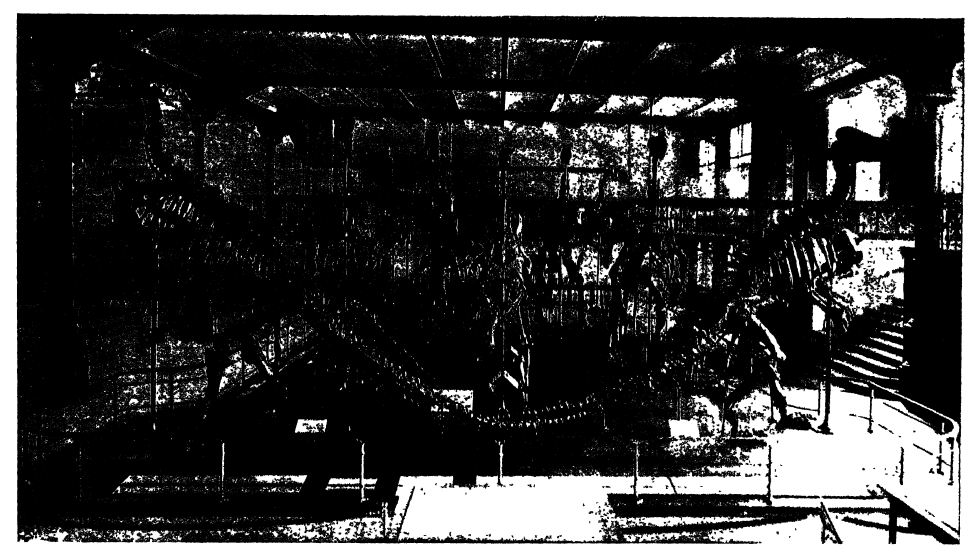
A most interesting burial of plant-feeding, bipedal, Lower Cretaceous dinosaurs has been found in the coal mines near Bemissart, Belgium. These are known as Iguanodon and the genus had long been known from single bones foimd in the Wealden of Europe. In taking out coal the miners came upon a river channel deposit cutting the coal, and in this, over 1000 feet beneath the surface, were twenty-two complete and seven incomplete fl.-niTnfl.lR (Fig-, p. 551).
Marine Life. — The ammonids were still plentiful, though less so than in the Jurassic, but began to show a great loss of vitality, in that but few new stocks arose. For other details see Chapter XXXVII. The belemnids were still abundant and flourishing.
The other invertebrate life of the sea was not very different from that of the Jurassic, and only a few of the more marked changes need be noted. The seaurchins were very varied and prolific in the warmer seas, and the heart-urchins (irregular types) here and in the Upper Cretaceous attained their climax of evolutiiHi (see Fig., p. 347). Among the bivalves, the ribbed oysters (Fig., p. 520) and the oyster-like Gryphaeas (Fig., p. 541) were very abundant, especially Tethys.
[ p. 553 ]
In the boreal seas, the aucellids (Fig., p. 504) were still plentiful, while in the equatorial waters of Europe, Texas, and Central America there arose remarkably aberrant stocks of bivalves, in which one valve was cemented to some object, the shell growing upward into a short or long, twisted, thick cone, while the covering valve was either twisted or a thickened and simple hood (Fig., p. 542). These were the chamids and rudistids, which also continued into the Upper Cretaceous and there gave rise to the caprinids and larger rudistids, shells that were veritable reef-builders.
¶ Collateral Reading
E. W. Berry, The Lower Cretaceous Floras of the World. Marjdand Geological Survey, Lower Cretaceous, 1911, pp. 99-151.
E. W. Berry, Paleobotany; A Sketch of the Origin and Evolution of Floras. Annual Report of the Smithsonian Institution for 191S, 1920, pp. 289-407.
Forest B. H. Brown, Origin of the Hawaiian Flora. Proceedings of the First Pan-Pacific Scientific Congress, 1921, pp. 131-142.
C. W. Gilmore, The Fauna of the Arundel Formation of Maryland. Proceedings of the U. S. National Museum, Vol. 59, 1921, pp. 581-594.
R. S. Lull, Systematic Paleontology of the Lower Cretaceous Deposits of Maryland : Vertebrata. Maryland Geological Survey, Lower Cretaceous, 1911, pp. 183-211.
Charles Schuchert, Age of the American Morrison and East African Tendaguru Formations. Bulletin of the Geological Society of America, VoL 29, 1918, pp. 245-280.
D. H. Scott, The Evolution of Plants. New York (Holt), 1912.
E. W. Sinnott and I. W. Bailey, The Origin and Dispersal of Herbaceous Angiosperms. Annals of Botany, Vol. 28, 1914, pp. 547-600.
E. W. Sinnott and I. W. Bailey, Foliar Evidence as to the Ancestry and Early Climatic Environment of the Angiosperms. American Journal of Botany, Vol. 1, 1915, pp. 1-22.
E. W. Sinnott and I. W. Bailey, The Evolution of Herbaceous Plants and its Bearing on Certain Problems of Geology and Climatology. Journal of Geologj", Vol. 23, 1915, pp. 289-306.
T. W. Stanton, A Comparative Study of the Lower Cretaceous Formations and Faunas of the United States. Ibid., Vol. 5, 1897, pp. 579-624.
T. W. Stanton, The Morrison Formation and its Relations with the Comanche Series, and the Dakota Formation. Ibid., Vol. 13, 1905, pp. 657-669.
| XXXVII. Ammonites and Squids | Title page | XXXIX. Upper Cretaceous Time and the Birth of the Rocky Mountains |