| XXXIX. Upper Cretaceous Time and the Birth of the Rocky Mountains | Title page | XLI. The Dawn of the Recent in Cenozoic Time |
[ p. 582 ]
In all of the present lands and on the surface of the seas there are living more than 15,000 kinds of birds, not one of which has teeth. Even in the unhatched embryo, teeth are discernible in but few forms, and then only as the merest rudiments. In the Cenozoic about 650 species of birds grouped in nearly 400 genera have been described, and here as in the living world all so far as known are toothless. Fossil birds are, however, exceedingly scarce until the Miocene and later deposits. Skulls of birds are very rare back of the Pleistocene, but in the early American Eocene (Green River) there is known a fine skeleton the skull of which is also devoid of teeth. All of which serves to emphasize the chief character distinguishing medieval birds, which is the possession of teeth.
Fossil eggs are known in eleven different kinds, one of Cretaceous time, the others of late Cenozoic. Feathers are preserved in nine species, and probably the finest impressions of such occur in the Solenhofen deposits of Upper Jurassic age. In the Mesozoic, good skeletons are known of about a half dozen species, all reptilian in character and provided with teeth.
Origin of Birds. — It is now widely accepted that birds in their general construction, and especially in their brain, skeleton, reproductive organs, and mode of development, are “ glorified reptiles.” The older idea of Huxley that the birds arose in the dinosaurs has given way to the theory that in late Permian or early Triassic times a small groimd-living lizard-like reptile of partly bipedal habit adapted itself to living in bushes and trees, probably for purposes of safety. The arboreal habitat, it is thought, led these reptiles to learn how to fly. These remote and primitive ancestral reptiles (Diapsida) are believed to have lived probably in the Pennsylvanian, and later to have given rise not only to the birds, but as well to the dinosaurs, pterodactyls, and yet other reptilian groups. The progenitors had small brains, comparatively sluggish habits, and a highly variable body temperature. During the trying arid climates of the Permian and Triassic were evolved hardier and more active warm-blooded carnivorous reptiles. Some of them when running [ p. 583 ] probably reared up on their hind legs, as do certain living lizards. These more active r unning and bipedal pro-avian lizards probably had their entire body covered with overlapping scales, and jumping about from branch to branch or tree to tree, learned not only to parachute, but eventually to flap their front limbs in aviation. In these efforts the scales changed into long and complicated fronds and finally became feathers that maintained the body warmth, the front limbs developed into wings, the skeleton became lighter (hollow and pneumatic), and in addition the body filled with an extensive system of air cells to help buoy up the bird while in flight- Birds are at once further distinguished by having feathers, a dermal feature which is as characteristic of them as hair is of mammals .
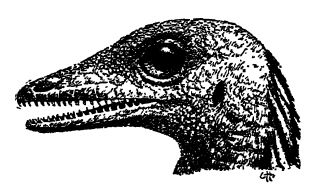
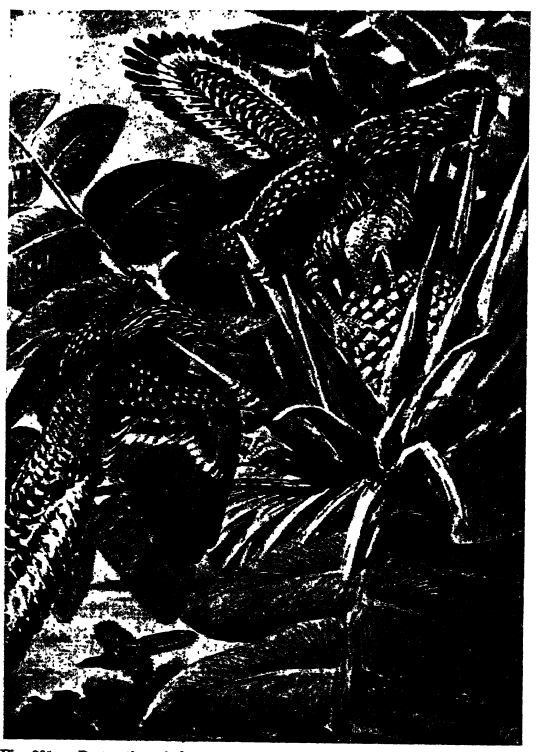
Jurassic Birds. — Birds appear as fossils for the first time in the Upper Jurassic and represent one of the most remarkable advances which the life of this period has to show. As yet, only a single kind of Jurassic bird has been found, and this is from the highest division, near Solenhofen, Germany. This bird, about the size of a large pigeon, is called Archaeopteryx (Greek fox ancient wing). It is also known as the lizard-tailed bird. It has many points of resemblance to the reptiles, and many characters which recur only in the embryos of modern birds (see Figs., pp. 583 and 584).
The peculiarities which strike one at the first glance are in the head and tail; there was no homy beak, but the jaws were set with a row of small teeth, while the tail was very long and in shape like the leaf of a date palm, composed of separate vertebrae (about 20), and with a pair of quill-feathers attached to each joint. This construction shows at once that in Archosopteryx the tail was not at all like that in modern birds, i.e., fan-like, with the vertebrae all anchylosed and the large feathers folding upon one another. The wing was constmcted on the same plan as that of a modern bird, but was decidedly more primitive. The four fingers were all free (in recent birds two of the three fingers are fused together); they had the same, number of joints as in the lizards and were all provided with claws. The plumage was thoroughly birdlike in character, but was peculiar in the presence of quill-feathers on the legs, and apparently also in the absence of contour feathers from the head, neck, and much of the body, leaving those parts naked. This very extraordinary creature was, then, a tme bird, but had retained many features of its reptilian ancestry.
[ p. 584 ]
In northeastern South America there lives one of the remarkable links with the past; the bird known as the hoatzin (Opisthocomus). It is the only known living bird having five fingers on its wings. The adult bird is said by Beebe to be reptilian in voice, action, fingers, and habits. The voice, a hoarse and croaking one, is frog-like. As babies “they crept on all fours, they climbed with fingers and toes, they dived headlong and swam as skillfully as Hesperornis of old.”
[ p. 585 ]
Cretaceous Birds. — In the early Upper Cretaceous strata of Kansas are found from time to time most excellent skeletons of large reptilian water birds of a species which Marsh called the “ regal western bird ” (Hesperornis regalis, Figs., pp. 559 and 579). It was in this genus that teeth in birds were first noted by Marsh and this discovery led him to predict that when the head of Archceopteryx was found it would be seen also to have teeth. The skeleton of Hesperornis measures 6 feet in length, though it did not stand higher than 4½ feet; its wings were vestigial and of no use in air or water, but the great feet were webbed, and paddled in the sea, curious as it may seem, with outward lateral mstead of downward strokes. The greater part of their lives was spent in the sea, and on the land they were more helpless than loons, humping themselves along as do the seals. Associated with these are found very rarely other much smaller birds with powerful wings (Ichihyornis, Fig., p. 559), which looked much like modern gulls and terns. Both of these birds, like those of the Jurassic, had small curved teeth and were flesh feeders.
There is a great deal of difference between the truly reptilian birds of the Upper Jurassic and those known next in the later Cretaceous. Lucas says these differences are greater than between those of the Cretaceous and the present. The older ones had long reptilian tails with the feathers in pairs on either side, while those of the Cretaceous appear to have had fan-shaped tails as in living birds. The distinctly three-fingered wings of Archaeopteryx are united in Cretaceous birds for the support of the feathers, but the skulls of all. Mesozoic forms are still reptilian in that the bones are not completely united as in living forms.
Origin of Flight. — A heavy and cumbersome flight was clearly present in Upper Jurassic time (Archaeopteryx) and excellent flight in small birds such as Ichthyornis in the Upper Cretaceous. In the late Cretaceous, the toothed birds of large size (Hesperornis), although devoid of flight, were great divers in the Kansas seas in search of fish. Toward the close of the Mesozoic it is thought that all birds began to lose their teeth and those with flight well developed deployed into the modern toothless types, while those with poor flight , (but not Hesperornis) gave rise to the flightless and toothless running birds like the ostriches and the even greater moas of the southern hemisphere.
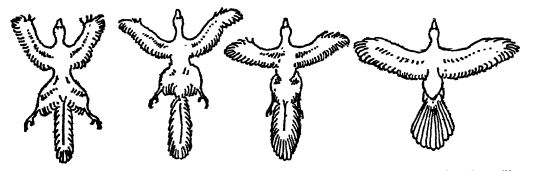
Two theories have been advanced explaining the origin of flight in the stages succeeding the arboreal phase of bird evolution, the pair-wing or Archaeopteryx theory, and the four-wing or Tetrapteryx [ p. 586 ] theory. These theories are illustrated in the figure below. Both of these hypotheses assign two phases to the origin of flight in birds; first, a primary ground-living phase during which the pecuhar characters of the hind limbs and feet were developed, with their strong analogies to the bipedal feet of dinosaurs; second, a purely arboreal phase leading to well developed flight.
Loss of Flight. — It is believed by the adherents of both these theories that following the treeliving or flying phase of birds, there occurred among the larger and therefore heavier ground -living forms (usually spoken of as struthious, the term having reference to ostriches), a secondary ground phase in which the power of flight was lost and a running locomotion re-developed. From the flying birds descended the water-living types, in some of which the wings are also lost, as in HesperorniSy which has only a vestige of the wings left, or in the living penguins in which the wing is changed into a swimming paddle. The divers of the Cretaceous seas represent one of the many instances where land-adapted forms become wholly aquatic, and their transformation developed as a result of the new habitat, resorted [ p. 587 ] to because of its greater amount of more easily obtainable food.
Nearly all the continents at some time during the Cenozoic had large ground-living ostrich-like birds. The tallest and heaviest of these were the moas of New Zealand, exterminated by the Maoris five or six centuries ago. There were about twenty kinds, the largest of which, Dinornis maximus, stood 10 feet high, 2 feet above the largest ostrich. Another closely related but smaller form was AEpyornis of Madagascar, a bird that laid the largest of all known eggs, 9 by 13 inches. It was the finding of these eggs by the early navigators that led to the vast exaggerations which thrill the reader with wonder and terror in the accounts of the Roc given by Sinbad the sailor in the Arabian Nights.
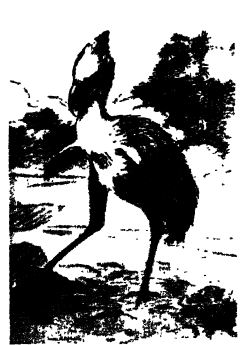
During early Eocene time there lived in Wyoming a gigantic running bird with only vestiges of wings, known as Diatryma. A specimen of this mounted in the American Museum of Natural History stands nearly 7 feet high, and shows a short but massive neck surmounted by a head as large in size as that of a horse. The most powerful of all ground-living birds of Cenozoic time, however, was Phororhacos, found in the Pampas formation of Argentina, standing 7 to 8 feet high, with a skull 23 inches long, heavy, and decidedly beaked, apparently the most terrible of birds of prey. It was not at all related to the ostriches, but rather to the living herons (see Fig., p. 686).
¶ Collateral Reading
F. A. Lucas, Animals of the Past. American Museum of Natural History, Handbook Series, No. 4, 1922.
F. A. Lucas, The Beginnings of Flight, American Museum Journal, Vol. 16, 1916, pp. 1-11.
W. D. Matthew and W. Granger, The Skeleton of Diairyma, a Gigantic Bird from the Lower Eocene of Wyoming. Bulletin of the American Museum of Natural History, Vol. 37, 1917, pp. 307-326.
H. F. Osborn, The Origin and Evolution of Life. New York (Scribner), 1917.
| XXXIX. Upper Cretaceous Time and the Birth of the Rocky Mountains | Title page | XLI. The Dawn of the Recent in Cenozoic Time |