| XLI. The Dawn of the Recent in Cenozoic Time | Title page | XLIII. The Evolution of Horses and Other Hoofed Mammals |
[ p. 614 ]
The lands of Cenozoic time were dominated by mammals, and the seas and oceans of this era were not devoid of them. Mammals were, in fact, as characteristic of the Cenozoic as reptiles were of the Mesozoic. It is true that archaic mammals originated as early as the Triassic, but at no time in the Mesozoic era did these small animals take the lead among organisms.
There are now living more than seven thousand kinds of mammals, twenty-one hundred of which are in North America alone. Of fossil mammals, there are known several thousand additional kinds.
General Characters. — Mammals, structurally the highest group of animals, are warm-blooded vertebrates with milk glands. These glands, which vary in nmnber from one to eleven pairs, are the mammary glands or breasts, the structures from which the class has taken its name, for mamma means breast. They are also present in the males, but are normally non-functional. All mammal s are more or less covered with hair, which is as characteristic of them as feathers are of birds.
With regard to the nervous system, the brain in mammals attains the highest degree of development known, and is most markedly convoluted in man. The body cavity differs from that of all other vertebrates in that it is completely divided into two parts by a muscular membrane, the diaphragm, which separates it into a thoracic cavity containing the heart and lungs, and an abdominal cavity containing the remaining viscera. In most mammals there are two sets of teeth, the milk dentition or temporary teeth which eventually fall out, and the permanent teeth which succeed them. The heart is four-chambered as in the other class of warm-blooded animals, the birds, and the course of the blood through it is the same in both. The period of fcetal development or gestation varies from three weeks in some mice to twenty months in the elephant.
Most mammal s have a completely terrestrial habitat, while the seals, sea-lions, sea-cows, whales, and porpoises live in the oceans. [ p. 615 ] One order of wide distribution, the bats, have developed the front limbs into wings, while other stocks have lateral or body membranes between the limbs, and spreading these, glide from tree to tree.
General Classification. — All mammals are separated into subclasses on the basis of the production of the young. In the most primitive subclass, the Prototheria, the young are not born alive but are hatched from eggs as in reptiles and birds. All other mammals are classified as Eutheria, and they produce living young. Of these the more primitive are the marsupial mammals or Didelphia, animals with an abdominal pouch; the young are born immature and are reared in the marsupium. All other Eutheria are the Placentalia or Monodelphia. The placenta is a special growth, partly of foetal and partly of maternal origin, in which the young develop during the period of gestation (see Fig., p. 415); the young are born in a relatively mature state.
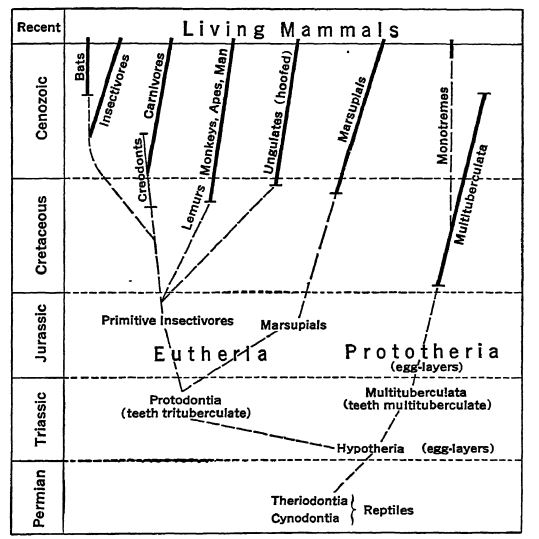
Origin. — The working out of the evolution of fossil mammals started in Europe early in the nineteenth century, but the rapid acceleration of our knowledge began with the discovery in the badlands of the Great Plains of the United States of the most wonderful succession of bone beds anywhere. The collecting [ p. 616 ] was begun by F. V. Hayden on the early Government siirveys, and the description by the pioneer vertebrate paleontologists Leidy, Cope, and Marsh. Since their time many other workers in America and Europe have added a vast deal of information, so that now our present detailed knowledge of mammal succession throughout the world is very good indeed (see Pl., p. 493).
In presenting the origin and evolution of mammals, we will follow in the main the work of Osborn (Origin and Evolution of Life, 1917). Beginning with Huxley, most students of mammals have held that they arose in small tree-living and insect-eating forms, and that the greater evolution took place during the Mesozoic era. The African tree-shrew (Tupaia) is considered to be the best living representative of this ancient tjTpe of mammal. Proof of the arboreal habitat of medieval mammals is seen in the adaptations of the hind feet for holding on to branches, especially among the ancestral primates.
The earliest mammals of the Mesozoic had their origin in active and more or less tree-living lizard-like reptiles of the Permian (Cynodontia and Theriodontia). These gave rise to egg-laying mammals (the Hypotheria) like the living duck-billed mole and echidna, now restricted to Australia and New Guinea, and to an extinct group, the Multituberculata, so named because of the many cones on the grinding surfaces of the molar teeth. These were the common kinds of ma mm als throughout the Mesozoic, and collectively are known as the Prototheria. Of greatest importance in the higher evolution was the introduction of warm blood, which may have been mitiated in some of the cynodont reptiles of the Permian (see Figs., pp. 417 and 615).
In the latter part of the Mesozoic arose the pouched mammals (marsupials), forms like the living kangaroos so wonderfully differentiated in Australia. They arose in small tree-living mammals like the present opossums of North and South America. The upwelling of the highest mammals, the Placentalia, also came late in the Mesozoic out of primitive insectivores. Their dominance of the organic world during the Cenozoic was largely due to a longer and better development of the imborn young in the placenta. (Study diagram, Fig., p. 615.)
The placental mammals during the Mesozoic and early Cenozoic differentiated from the primitive insectivorous arboreal ancestors into ten great branches. Ah, however, were still small-brained and small in size, archaic egg-layers and bearers of pouches. In addition, the mechanics of their skeletons was clumsy.
The nearly universal forest of cone-, and flower-bearing trees (soft and hard woods) was yielding space toward the close of the Mesozoic to the herbaceous plants and the grasses that made for a better and more abundant food in the open plains and meadows. With this great change in the plant Tvorld there came therefore an increased variety of environments, along with new feeding and locomotor habits. Osborn says that a mammal may seek any one of twelve different habitats in search of food, and that within each one of these there may be six entirely different kinds of subsistence. With the further freeing of these habitats through the [ p. 617 ] vanishing of the competing medieval reptiles, we see why the mammals burst, as it were, into domination of the lands toward the close of the Mesozoic era. The placental mammals spread into all the habitats, became very varied in adaptive structures and innumerable in individuals, most of the stock increased rapidly in size, and some became giants.
- Insectivores
- Bats
- Primates
- Lemurs
- Monkeys
- Apes
- Man
- Carnivores
- Seals (marine)
- Whales (marine)
- Hoofed mammals
- Manatees or sea-cows (marine)
- Rodents
- Edentates
This higher mammalian succession is a wonderful series of evolutions, and if the student wishes to follow it out in more detail than can be given here, he is referred to Scott’s A History of Land Mammals in the Western Hemicphere and Osbornes The Age of Mammals.
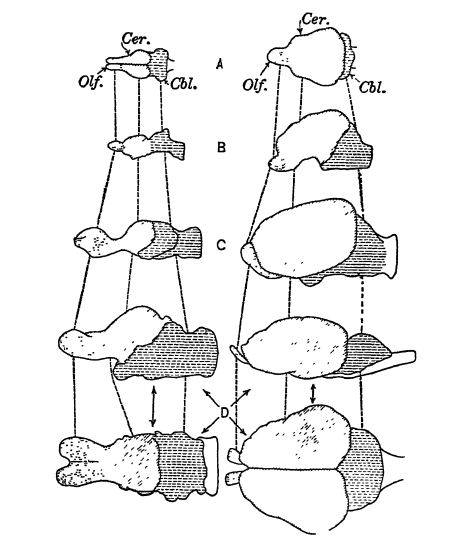
Increase Size of Brain. — In the Mesozoic mammals the brain, Lull states, was singularly old-fashioned, generally small, but alwaj’s relatively undeveloped in comparison with that of modernized mammals of equivalent bulk, especially in the part wherein the intelligence lay, the upper brain or cerebrum (see Fig., above). It was in the [ p. 618 ] Eocene that the brain in most mammals began to enlarge, so that here it was about one eighth that of living forms of the same stocks, and this enlargement was hy far the most striking in the upper lobes. That the brain in mammals increased in size throughout the Cenozoic was first suggested by Lartet in 1858, and demonstrated by Marsh in 1874 and again in 1885. Truly, the Cenozoic was the time of transition from an ignorant world of brutes to the present Age of Reason, the Psychozoic era.
¶ Mammal Succession in North America
The Cenozoic of North America opens with an archaic indigenous mammal fauna, a most curious, strange, and bizarre assemblage. It is plain that it is an advanced and diversified fauna, the descendants of Mesozoic mammals. Later appear unheralded as migrants the modern m ammals , and their introduction sounds the death knell of the archaic forms, for one stock after another vanishes and most of them are gone before the close of the Eocene, though the ancient flesh-eaters (creodonts) continue into the Oligocene. Where the modern mammals originated is not yet known, but it appears that there may have been three generating centers for mammals: (1) Africa and southern Asia, (2) Europe and north central Asia, and (3) North America. South America was stocked from North America, but for a long time in the Cenozoic both Africa and South America were isolated and each developed an independent assemblage.
Archaic Mammals. — The North American Paleocene mammals were still archaic, that is, they vrere very primitive, generalized, omnivorous or fruit-eating, dominantly placental, and small. None of them were as large as a sheep, the limbs were short, with five digits each, the tails were long and heavy, and the brains extremely small. They were closely related to one another and appear to have been the direct descendants of the Mesozoic mammals continued with some change into the Cenozoic. Of orders having living forms, there were present in the latest Mesozoic egg-layers and marsupials, besides insectivores, lemurs, carnivores, rodents, edentates, and hoofed placentals.
It appears that there was free intermigration of the archaic mammals between North and South America toward the close of the Mesozoic and into earliest Cenozoic time. Then all migrations ceased until the middle of the Pliocene, so that during most of Cenozoic time South America was an independent generating center of mammals.
[ p. 619 ]
Lower Eocene Mammals . — The most striking feature of the life of early Eocene time (Wasatch-Wind River) was the appearance in considerable numbers, both in western Europe and in North America, of the first representatives of the progressive or modernized mammals. Where they came from is unknown, but it is established that there was free migration between North America, Europe, and Asia during early Eocene time, though there was no further interchange until the Oligocene.
Among these Lower Eocene mammals were diminutive horse-like forms (Eohippus), fleetfooted rhinoceroses, tapirs without a proboscis, the first ruminants and pig-like forms, squirrel-like rodents, insectivores reminding one of the European hedgehop, carnivores, lemurs, monkeys, and probably also marsupial opossums. It was in the main the mammalian life of a mountainous country, superior in foot and tooth structure to the indigenous archaic fauna, and of a higher intelligence. In the struggle for existence the archaic mammals were the losers (58 per cent present in the Wasatch) and before the close of the Lower Eocene their number was far less (Wind River, 37 per cent).
Middle and Upper Eocene Mammals. — In the great abundance of mammals in the later Eocene there was no evidence of new migrants having come from Asia or Europe, but the fauna was dominantly that of the older Eocene with a small proportion of archaic forms (Bridger, 20 per cent; Uinta, 13 per cent), continued with persistent and diverpnt evolution. The changes were largely toward greater size, more muscular power, and the origination of new indigenous forms. There were many hoofed animals and all were browsers. This was again an upland or mountainous mammal assemblage, on the whole well balanced, with an equal distribution of arboreal, running, aquatic, burrowing, carnivorous, and herbivorous types.
During the later Eocene appeared tiny camels, true tapirs, oreodonts (an extinct group of ruminating hop peculiar to America, Fig., p. 621), giant pip or entelodonts (Fig., p. 620), armadillo-like animals with leathery shields, and primitive dog-like forms. In addition there were many hoofed forms, as titanotheres (Fig., p. 634) and the very characteristic gigantic uintatheres (Fig., p. 633) — mammals unlike anything now living — and fleet-footed rhinoceroses. The archaic flesh-eating creodonts were still present (Fig. 211, p. 620). Marsupials were represented by the opossums, and the lemurs and monkeys were stfll common, though they shortly afterward became extinct in North America.
[ p. 620 ]
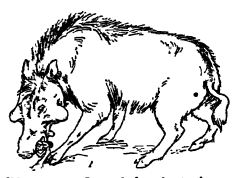
Oligocene Mammals . — It was during the Oligocene that mammals for the first time took on a modern aspect, for here nearly all were progressive forms. We now begin to get representatives also of still e-xisting families, and of such there were six of rodents, four of carnivores, and one of odd-toed hoofed mammals. Then in this period we get our first knowledge of the varied mammalian life of the open plains and of grazing mammals, indicating that the grasses were taking possession of the open country.
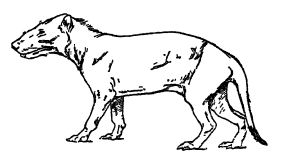
Early in the Oligocene took place m a second and more marked invasion from Europe. The interchange was considerable, yet it was not complete and the time of migration was of short duration. Europe lost its horses early in the Oligocene, but in North America there was continued evolution of the three-toed forms. The camels were also better represented (Fig., p. 631), and among them were grazers, these and other hoofed mammals being present in bewildering variety. The tapirs were not common, but of rhinoceroses there were many, some fleet of foot, some stocky, heavy, and amphibious in habit, and of the true rhinoceroses there were forms with and without horns. Rodents were also common, such as beavers, squirrels, pocket gophers, mice, and hares. Among the ruminants, peccaries were numerous, the entelodonts were of large size (Fig., above), and the oreodonts, not unlike the peccaries and wild boars in appearance and size, were exceedingly abundant, varied, and ran in great herds (Fig., p. 621). Among the carnivores, small dogs were remarkably abundant and diversified, in fact, more so than ever before or since. The last of the archaic creodonts occurred here, and as they vanished their place was taken by dogs and later by wolves and the first sabre-tooth cats; true cats, however, were not yet present.
Miocene Mammals. — The Miocene was the Mammalian Golden Age,” and the epoch is replete with interest because of the [ p. 621 ] changes wrought in the faunas and in the floras the alteration in climate to cooler and semiarid conditions. Great chains of mountains were being elevated, Eris was being tom apart (see p. 609), and these derangements in the topography and geography had their effects not only on the climate and life, but on the migrations of the mammals as well. The NIiocene, and especially the later Miocene, was therefore characterized by an increase of plains, though this statement is not based on the presence of fossil grasses but is deduced from the change that took place during this period in the mammalian teeth from those of the browsing type to the grind- ing or grazing kinds (Fig., p. 625). There were now large numbers of horses, camels, ruminants, and rodents with high-crowned, persistently [ p. 622 ] growing, grinding teeth. On account of the silica which the grasses contain, they are very abrasive and rapidly wear the teeth down.
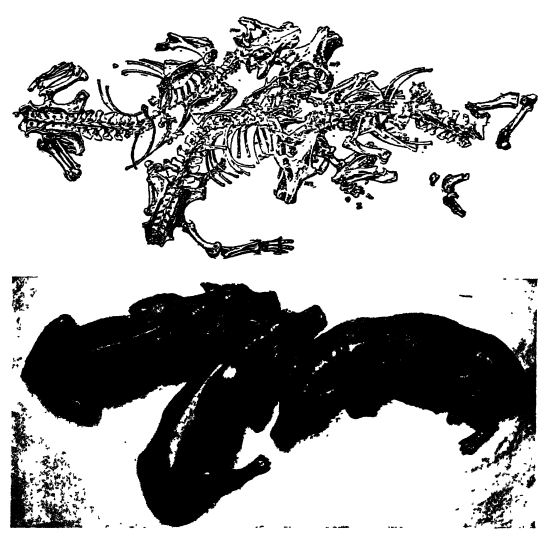
The third marked migration of mammals into North America took place not only during the Miocene but during the Pliocene as well, and the migrants came from Asia by way of the Siberia-Alaska bridge. The most conspicuous among Miocene forms were the four-tusked, browsing, long-faced mastodons, the short-legged rhinoceroses, the cats, and the beavers.
Prominent among the Miocene mammals were the horses, which roamed the plains in great herds. All were three-toed and at first all were still browsers, but in the later Miocene the grazing type predominated. Camels were also plentiful. Rhinoceroses were present in great variety, some hornless, others with a single horn on the end of the nose, and still others with an additional horn on the forehead. The commonest tjrpe were extremely heavy, with very short legs (Teleoceras); others were long in the legs and less massive in body. Peccaries aboimded, and the last of the giant pigs, the entelodonts, occur in the Lower Miocene, one of them being over 6 feet tall (Dinohyus). The oreodonts were still very common but vanished with the Middle Pliocene. The first of the true deer appeared in the Lower Miocene and m addition there were hornless deer and antlered deer-antelopes that were slender and graceful little creatures.
Among the carnivores, the dog kinds were in great variety, some small, others as large as the largest bears. True cats appeared here for the first time, and the sabre-tooth tigers were plentiful though not large. There were also weasels, martens, otters, and racoons, but no true bears are known in America before the Pleistocene.
Pliocene and Pleistocene Mammals. — Of Pliocene nia,Tnmfl.ls in America not much can be said, because strata of this age are scarce. The continent stood high and was undergoing elevation in the western portion, with the result that the rivers carried into the sea their loads of sand and mud.
Of mastodons there were several species; the horses, in considerable variety, were still three-toed; Uamas and the tallest of giraffe-like camels continued to live; rhinoceroses with and without horns were present; sabre-tooth tigers and true cats existed, some of them as large as the lion.
It is also interesting to note here that in Asia during the Pliocene arose the still living bovine family, the cattle, sheep, and goats.
[ p. 623 ]
Earlier in this chapter it was said that migration between North and South America had taken place very early in the Cenozoic, and that the latter continent then for a long time evolved mammals peculiar to it. Probably the most striking of these were the edentates, mammals like the tree sloths, ant-eaters, and armadillos still living in the forests of South America. In the ant-eaters there are no teeth at all and it was this feature that led Cuvier to give them the name edentates, meaning without teeth; unfortunately, however, most of the rest of the group have teeth, though not well developed, but peg-like and devoid of enamel. The tail is thick and heavy, suggestive of those in reptiles. Edentates are all sluggish animals.
The most striking of the South American edentates were the huge Pleistocene ground sloths and the highly armored glyptodonts related to the armadillos (Fig., p. 666) and looking like great land tortoises. Both of these animals migrated into the southern United States and are found there in Pleistocene strata.
Of North American mammals, there radiated over the same land bridge into South America in Pliocene time large sabre-tooth tigers (Smilodon), large cats, dogs, racoons, horses, llamas, deer, mastodons, tapirs, peccaries, etc.
Euro-asiatic connection with North America is again indicated by the migration of American camels into China and India during the Pliocene. At the same time the hollow- and twisted-homed antelopes came into America, and apparently also an ape (Hesperopithecus ) , along with the short-faced bears (arctotheres) now known in Oregon, Mexico, and South America. The true bears arrived from Asia during the Pleistocene.
In late Pliocene time the mammals attained their climax of development, and this continued into the Pleistocene. Here was also the time of their greatest vrandering, since the proboscidians, horses, and camels were world-wide in their distribution. Then came the Ice Age and the ascendancy of man, and one after another the magnificent mammals vanished. To get a picture of this climacteric late Pliocene mammal assemblageVe must go to the tablelands of Africa, but here too it is doomed soon to disappear through the advent of man.
¶ Collateral Reading
C. C. O’Harra, The White River Badlands. South Dakota School of Mines, BuHetin 13, 1920.
H. F. Osborn, The Age of Mammals. New York (Macmillan), 1910.
W. B. Scott, A History of Land Mammals in the Western Hemisphere. New York (Macmillan), 1913.
| XLI. The Dawn of the Recent in Cenozoic Time | Title page | XLIII. The Evolution of Horses and Other Hoofed Mammals |