| XLIII. The Evolution of Horses and Other Hoofed Mammals | Title page | XLV. Pleistocene Time and the Last Glacial Climate |
[ p. 640 ]
Among the animala of the Cenozoie, there was no group more spectacular in its evolution and distribution than the bulky trunkbearing elephant stock, and among present-day land mammals, they still lead in size, strangeness of form, and bulk of brain. Of living elephants there are, however, but two kinds, the larger, big-eared ones of Africa, some of which attain a weight of about 8 tons and a height of 13 feet at the shoulders, and the somewhat less heavy and smallereared type found in India and central Asia.
Elephant-like mammals are technically known as Prohoscidea, the proboscis being the trunk which is their most characteristic feature. This is in reality the greatly elongated nose, nostrils, and upper lip, forming a very flexible and powerful muscular adjunct to the head, and serving many purposes but used chiefly in gathering food and water and conve 5 dng them to the mouth far above the ground. The trunk is also a highly developed sense organ and when held high above the head can detect water and enemies far afield. Sight is far less well developed. As the proboscidian neck is very short and the head very heavy and the legs long and pillar-like, in the evolution of the group the long proboscis had to be developed to enable the upper lip to reach the ground for the purpose of food gathering.
The head of elephants is not only large, but is peculiar also in its great height compared to its width, in other words, it is bulldogllke. The height of the skull is an adaptation to give greater muscular area and therefore stronger leverage for the neck muscles which support the head and trunk. The upper part of the skull is, however, decidedly cellular. The greater transfiguration of the proboscidians took place in the head and in the trunk, beginning in long-headed forms with very short trunks and progressing steadily into the present high type of skull with long trunk.
The brain in elephants is large, about twice the size of that in man, and is primitive in structure in that the fore brain (cerebrum) does not cover the back brain (cerebellum) as in most other TninYimnlg
Elephants are now restricted in the wild state to the forests and jungles of southeastern Asia and central Africa. In the Pleistocene, [ p. 641 ] [ p. 642 ] however, their distribution was nearly world-wide and in all climates, even the very cold ones of Siberia and Alaska north to the Arctic Ocean. The more primitive forms are thought to have been stream and lake dwellers, that is, amphibious in habit, and not until the group took to the forests and grassy plains did their distribution become so general.
The remains of the Pleistocene proboscidians are commonly found near the surface and in peat bogs or marshes. Orange County in southeastern New York has yielded no fewer than thirty-one skeletons. It is usually the teeth or the large limb bones that are recovered and the finding of these in the Dark Ages led to the stories of giant ancient peoples. Or they were thought to be the remains of the “ huge earth-shaking beasts ” used by the Romans in their invasions of western Europe. It was the great naturalist Cuvier who first successfully demonstrated in the nineteenth century that the bones of elephants found in western and southern Europe were of species wholly unlike those living at present. One of these he called mastodon, which means nipple-tooth, in reference to the highly crested or coned nature of the grinding surface of the teeth, which is the common type.
Origin. — In 1901, Beadnell and Andrews made known three kinds of proboscidians from the late Eocene and the Ohgocene of Egypt (Maeritherium, Palaeomastodon, and Phiomia). The first and last of these have since been discovered also in southern Asia. The origin of the stock is therefore to be sought in the early Eocene of Eurasia or Africa.
Evolution. — Instead of there being but two main stocks of trunkbearing animals as commonly assumed, Osborn now determines twelve lines of evolving forms.
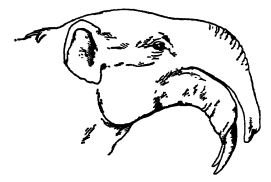
These group themselves into four main branches, as follows: (1) Themoeritheres, found in the Upper Eocene and Lower Oligocene of Egypt; these were small animals, devoid of a trunk, which lived in swamps and may or may not be proboscidians. (2) The specialized dinotheres, amphibious forms, some as large as the greatest mastodons, with no upper tusks but with lower ones that are large, stout, and curved downward as in no other stock of proboscidians, and with a trunk that was undoubtedly large and heavy; they occur in the Miocene and Pliocene of Europe, Asia, and Africa. (See Fig., above.) (3) The mastodons. [ p. 643 ] [ p. 644 ] a highly diversified stock, the main line of browsing proboscidians, originating in PalcBomastodon of the Lower Oligocene of Egypt, of world-wide distribution in the Miocene and especially the Pleistocene, and dying out during the last of the Ice Age. (4) The elephants, or grazing proboscidian stock, originating in the Pliocene, also attaining world-wide dispersal in the Pleistocene, and represented in the living world by the African and Indian elephants.
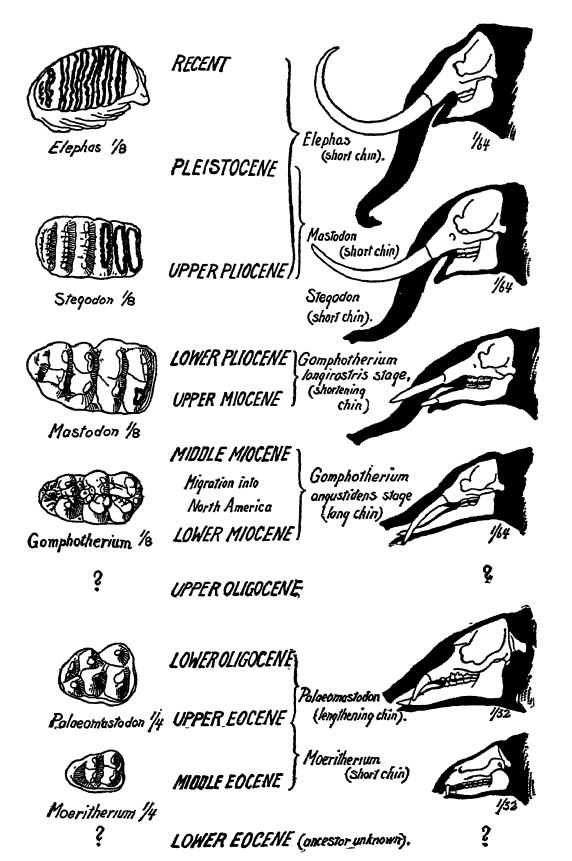
The oldest known proboscidian-like animal is Maeritherium of the Upper Eocene and Lower Oligocene of Egypt. This was about the size of a tapir but without even an incipient trunk. Even though it was at first thought to be the ancestral stock of all the trunkbearing mammals, it is now not clear what its relationship to the proboscidians is. In any event, it shows how these animals may have evolved. The head was long and narrow and the face rather short, with no suggestion of any trunk. The most interesting feature, however, was the appearance of tusks that originated in the second incisors, the other front teeth remaining small. The incipient upper tusks were quite prominent and directed sharply downward, while those of the lower jaw were nearly procumbent, with a slight upward inclination (Fig., p. 641).
Paleomastodon of the Lower Oligocene of Egypt, the oldest undoubted proboscidian, was much smaller and more generalized. It was about the size of a tapir, the narrow face was more drawn out than that of the older Moeritherium, and there was a well-developed, flexible snout rather than a trunk. The tusks of the skull were longer, compressed, and more outwardly directed; those of the jaws, while larger, pointed straight forward. All of the grinding teeth (premolars f, molars f ) were in place and functioned at the same time, which is not true of the later proboscidians (Fig., p. 641). The limbs were like those of elephants.
The many kinds of mastodons of the Pliocene and Miocene were smaller than those of the Pleistocene. Some were two-tusked (Dibelodon) and others were long-faced and had four tusks (Tetralophodon, Trilophodoriy, Gomphotherium). It was out of the long-faced forms that has come the fullness of proboscidian development. In North America the best known form is the American mastodon (Mammut americanum), skeletons of which are found from Florida north into Alaska, from Connecticut to California, and from central Russia eastward throughout Siberia.
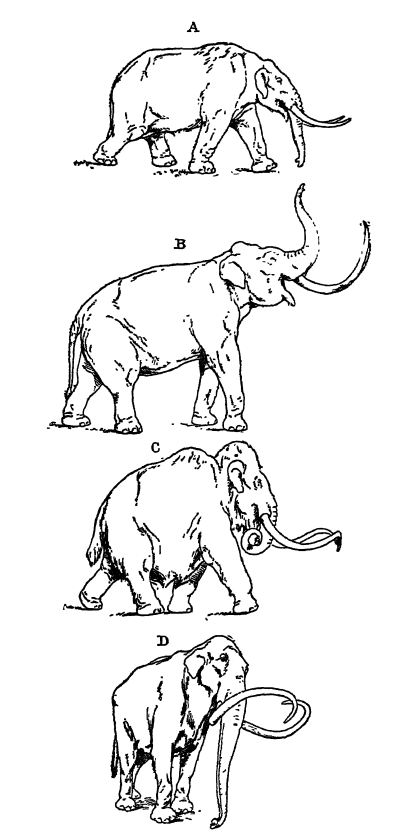
Of elephants there are at least a dozen extinct species. Matthew says some are nearest in relationship to the living Indian elephant (Elephas), others to the African (Loxodon), while still others (Stegodon) are intermediate between these and the older mastodons. Three [ p. 645 ] species occurred in the Pleistocene of North America, the hair mammoth and the Columbian and Imp>erial elephants, all of which were very large. Of these, the mammoth (Elephas primigenius) is best known, and its distribution was very wide, not only in America but in Europe and Asia as well. In Europe its remains occur as far south as Spain and Italy and in America from North Carolina and California northward. The term “ mammoth,” however, does not mean gigantic in size but comes from the Tartar word mama’ntee, meaning earthmouse, a habitat assigned these animals by a Chinese legend which says they lived underground and perished when they came into the light of day (see Fig. C, p. 643).
Summarizing the evolution of the Proboscidea, according to Lull: Increase in size and the development of pillar-like limbs to support the enormous weight; increase in size and complexity of the teeth and their consequent diminution in numbers and the development of the peculiar method of tooth succession; loss of the canines and of all of the incisor teeth except the second pair in the upper and lower jaws and the development of these as tusks; gradual elongation of the symphysis or union of the lower jaws to strengthen and support the lower tusks while digging, culminating in Gomphotheriurn; the apparently sudden shortening of this sjmaphysis following the loss of the lower tusks and the compensating increase in size and the change in curvature of those of the upper jaw.
The increase in bulk and height, together with the shortening of the neck required by the increasing weight of the head with its great battery of tusks, necessitated the development of a prehensile upper lip which gradually evolved into a proboscis for food-gathering. The elongation of the lower jaw implies a similar lengthening of the proboscis in order that the latter may reach beyond the tusks. The trunk did not, however, reach its greatest usefulness until the shortening jaw, removing the support from beneath, left it pendent as in the living elephant.
Migration. — Palaeomastodon or its descendants, the long-faced tetrabelodons, crossed from Africa by way of a land bridge through the Mediterranean from Tunis, Sicily, and Italy to Eurasia. This bridge was in existence in Oligocene time. From here the deployment was both to the west into Great Britain and possibly even to North America by way of an early Miocene bridge connecting America and Europe across the Shetland Islands, Iceland, and Greenland, and eastward across Asia and finally by way of Siberia as far as Nome in Alaska. Finally in the Pliocene the elephants spread from North into South America. Hence the proboscidians [ p. 646 ] have been world-wide travellers, equalled only by the horses, and exceeded only by man.
Elephants Contemporaneous with Man. — In western Europe there is excellent evidence that man was well acquainted with the hairy m amm oth, since toward the close of the Pleistocene he engraved its picture on bone and ivory and painted it on the walls of caves. There can be no doubt that man, the hairy mammoth, and other proboscidians were contemporaneous throughout the Pleistocene in Eurasia, and in America it appears that the moundbullders also knew either the elephants or mastodons, since they built mounds resembling them in shape.
¶ Collateral Reading
R. S. Lull, The Evolution of the Elephant. American Journal of Science, 4th series, Vol. 25, 1908, pp. 169-212. Annual Report of the Smithsonian Institution for 1908, 1909, pp. 641-675.
R. S. Lull, Organic Evolution, Chapter 34. New York (Macmillan), 1917.
W. D. Matthew, Mammoths and Mastodons. American Museum of Natural History, Guide Leaflet Series, No. 43, 1915.
H. F. Osborn, Evolution, Phylogeny, and Classification of the Mastodontoidea. Bulletin of the Geological Society of America, Vol. 32, 1921, pp. 327-332.
H. F. Osborn, The Evolution, Phylogeny, and Classification of the Proboscidea. American Museum Novitates, No. 1, 1921.
W. B. Scott, A History of Land Mammals in the Western Hemisphere, Chapter 10. New York (Macmillan), 1913.
| XLIII. The Evolution of Horses and Other Hoofed Mammals | Title page | XLV. Pleistocene Time and the Last Glacial Climate |