[ p. 667 ]
The title of this chapter is the same as that of one of Huxley’s famous books, in which he states: “ The question of questions for mankind — the problem which underlies all others, and is more deeply interesting than any other — is the ascertainment of the place which Man occupies in nature and of his relations to the universe of things.” Some of us may not be inclined to study man as a part of nature, but whatever our prejudices, man’s physical welfare and intellectual uplift into ever higher and higher states of civilization are unquestionably bound up with the ascertaining of our relations to the rest of nature. “Man is the paragon of animals, the climax of evolution” (Conklin). Our personal health and the correct understanding of our mental workings, combined with a study of our intercommunal relationships with the rest of nature, can only redound to the welfare of humanity. We need to study what man means in the Cosmos.
Man seems to us so very different from all the animals that we can not believe him to be related to them at all, and prefer to regard him as standing isolated and alone, something quite apart from all [ p. 668 ] organisms. When, however, we begin to study his body and compare it, organ by organ, with that of other animals, we see that his isolation disappears, and that it is the tliick veil of civilization in which he has so completely hidden himself that misleads us regarding his true position in the animal kingdom.
Comparisons between Man and the Other Primates. — Linnaeus in his classification of animals placed man at the head of them all, hence the term Primates from the Latin primus or first The most primitive Primates are the lemurs, and the higher forms are the anthropoids (means man and form ), because in them the brain is more highly developed than in any other animals. The latter division includes the New W’orld monkeys, the Old World monkeys (also baboons, mandrills, macaques), the gibbons and apes, and man.
The mean stature of presentday Europeans is 5 feet 6 inches, and we shall see later on that the oldest fossil men vary between this size and 5 feet 4 inches. Men of 6 feet in height did not appear until toward the close of the Glacial Period (Pleistocene) in the Aurignacian race of France. We are, therefore, not descended from a race of giants, but rather are we tending toward a taller stature.
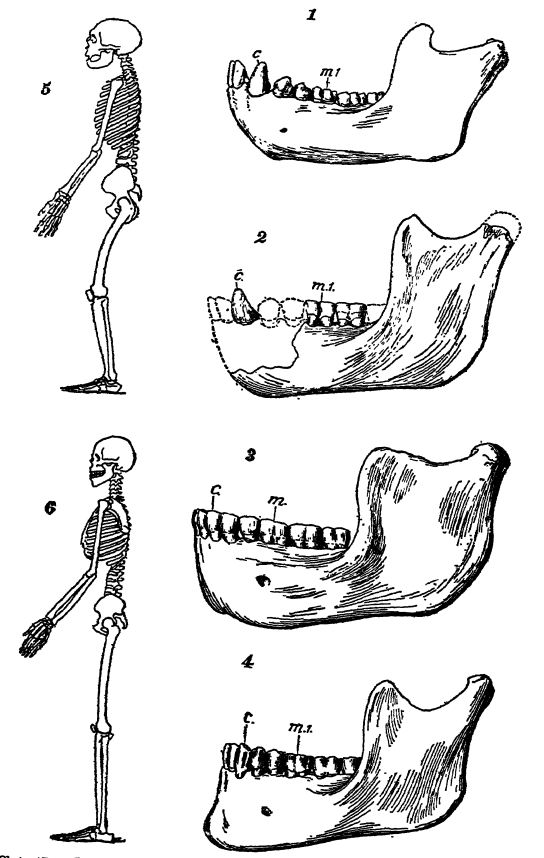
The erect posture of man is also of ancient origin, for it is fully developed in the oldest fossil men, and probably had its beginning in the gibbons of Pliocene time. It is, however, not so much in his postme that man differs from the large anthropoids as in his manner of progression. He is adapted to living on the ground, “ an adaptation which allowed him to escape beyond the hmits of forests and occupy the whole world.” It is, therefore, in the construction of the legs and in the setting of the entire foot upon the ground (plantigrady) that man varies much from the greater apes, and as the human leg and foot are already developed in the oldest known fossil man, it is [ p. 669 ] clear that this evolution also took place prior to the Pleistocene. It was during this earlier evolution of man that the great toe, set like a thumb and used as a grasping organ, was changed into the nongrasping toe of living man. The human type of leg and foot was, then, developed long before the human brain came to be as we see it now, for in the oldest fossil ape-man (Pithecanthro’pus) the brain is little more than half the size of that in living man. The large brain of man appears to be his latest acquisition; his foot, leg, and plantigrade gait are older, his size of body older still, and his erect posture quite an ancient character.
“ The skeleton of the gorilla is not at all human in appearance, the great crests on the skull, the massive jaws and face, the long stout arms, the short lower limbs with a thumb-like great toe, seem to assure us that even the most man-like of apes is a long way off from man himseK. Yet when we look more closely we see that every bone of man’s body is present in the gorilla; they occupy exactly the same place in the skeleton; each bone shows the same leading features; the differences relate merely to proportion, size, and detail. When we look at the skull of the young gorilla, before the massive, brute-hke crests have appeared, the human resemblance is more marked. In the skulls of the adult chimpanzee, these cranial ridges, which are developed to give attachment to the great muscles of mastication, are much smaller than in the gorilla. In the orang they are intermediate in size.” (Keith.)
Between the higher apes just mentioned, which Huxley refers to as blurred copies ” of man, and the smaller and lower apes, the gibbons, there is another break in the evolutionary steps quite as marked as the one between man and the great anthropoids. The head and body are much smaller, there are the same bones set together in the same order, but the proportions are different. The gibbons are of early Pliocene origin and have clung to the ancestral form more closely than any of the other apes. Between the gibbons and the monkeys there is a wider gulf than any we have so far seen, yet we can not well say the one is higher than the other. In certain features we see that the gibbons are related to the Old World monkeys, in others to those of the New World; we believe that there must be extinct ancestral gibbons which, did we know them, would show us that these three forms of primates have all arisen from a common stock at a long past period of the world’s history. Among the American monkeys we find quite small and low forms, such as the marmoset, which take us a little way toward the lemurs. “If at first we had seen the skeleton of man placed side by side with that of the [ p. 670 ] tiny marmoset we would have denied that there could be any possibility of a common origin for these two, but when we pass from the one to the other through a series which, while showing many breaks, leads us step by step from the one to the other, we begin to see that the miracle of man’s primate origin is not so impossible as it appears at first.” (Keith.)
The brain of the higher vertebrates consists of two main parts, a lower and hinder division known as the cerebellum, and an upper part, the cerebrum, that is again divided into right and left hemispheres. In the mammals previous to the Oligocene the lower brain is the larger, but beginning with this time the upper brain, where reason and memory are located, increases rapidly in size in nearly all stocks and finally is considerably greater than the entire cerebellum, and almost covers it.
In man the size of the brain depends to a certain extent upon the bulk of the body; tall men on the average have larger brains than small men. It therefore does not hold true that bulb’er men with larger brains are more able than smaller ones with less weighty brains, though the fact remains that many of the world’s most famous men had large heads and big brains. The brains of Bismarck and Cuvier each weighed about 66 ounces, that of the Russian novelist Turgenieff nearly 75 ounces, while that of Gambetta, the French statesman, weighed about 42 oimces, and that of Leibnitz, a great German philosopher and mathematician, less than 45 ounces. In adult men the weight of the brain varies between 65 and 34 ounces (average 49), and in women, due to their smaller size, it is between 56 and 31 ounces (average 44) or about 12 per cent lighter than in man. When the brain is contrasted with the entire weight of the body it is about as 1 to 45.
In the smallest gorilla the brain weighs 15 ounces and m the largest 20 ounces, while the weight of the entire body at maturity varies between 200 and 360 pounds, giving an average ratio of about 1 to 250. At birth the human brain weighs between 10 and 11 ounces, or about one fifth its size at maturity. By the end of the second year the human brain has attained two thirds of its adult size, and has then reached the same relative degree of development that the anthropoid has at birth. Maximum size of the brain in man is reached at about the twentieth year, and it then slowly loses weight into old age, when decrease is more rapid. “ Man’s prime is not a period,” says Karl Pearson, “ it is merely a point of time.”
Evolution of the Human Brain. — According to Elliot Smith, man’s most distinctive attribute, namely, higher- mentality, began even before the Pleistocene. [ p. 671 ] At the basis of this mental growth lay vision, the fundamental stimulus leading to inquisitiveness. This trend probably began with the lemurs of late Mesozoic time, since good vision in an arboreal environment is a prime requisite. It awakened the animal’s curiosity concerning the things aroimd it, prompting it to handle them. Thus were developed increased skill in movement, greater tactile sense, and better muscular correlations, and through these an empirical knowledge of the environing world. These changes reacted on the brain and through its development was opened “ the way for the wider vision and the power of looking forward that are so pre-eminently distinctive of the human intellect”. “ Our common speech is permeated with the symbolism that proclaims the influence of vision in our intellectual life.”
Later was developed, through seeing, concentration of attention, and finally mental concentration, learning through trial and error. With the acquisition of this new power of learning by experimentation, events in the world around the primates took on a fuller meaning; and this enriched all experience, not merely that which appealed to the senses of sight and touch, but hearing also. Better hearing eventually led to vocal expression, an achievement that distinguishes the human line at least as early as Pithecanthropus and Eoarllhropus. Speech exerted the most profound influence upon human behaviour, for it made it possible for most men to become subject to tradition and to acquire knowledge from their fellows without the necessity of thinking and devising of their own initiative.”
Geologic Rise of Primates. — The oldest lemurs appear in the American Paleocene (Fort Union) and Eocene (Wasatch) in small forms very much like the tarsier living in Madagascar. Diminutive monkeys appear a little later (Bridger), but before the close of the Eocene all primates seem to have become extinct in North America. [ p. 672 ] The Old World monkeys appear to have had an independent origin in the lemurs, and it was out of the former that the apes arose. In the later Oligocene of Egypt appears the oldest ape (Propliopithecus). apparently the progenitor of all later anthropoids. This was a small which spread in early Miocene time into Emope and there gave rise to the larger apes of the western part of that continent (Pliopithecus into Dryopithecas), It is, then, since Middle Miocene time that we may expect the rise of the human stockc The greatbodied primates of about this time probably divided into two independently evolving stocks, the one retaining the ancestral arboreal habitat, the other taking more and more to the ground. The former line of evolution gave rise to the gorilla and chimpanzee of Africa and the orang of Borneo and Sumatra, while the terrestrial stock developed into the ancestry of man. Living man is known as Homo sapiens (reasoning man) and in his varied geographical races is distributed over the entire earth. All men are but varieties of this one species, the negroid races being the most primitive. As we go back into the Pleistocene we meet with other human species, more and more primitive, and finally with the ape-man (Pithecanthropus) of Java.
Embryology of Man. — All animals, however simple or complex in construction, begin in a single cell with a nucleus, and the human species begins in the same way. But the human ovum does not become a wonderful growing microcosm unfolding ancestral characteristics until it is fertilized by the sperm. The Miracle of Birth lies in the Mystery of Union (Brian Hooker). All the higher organisms begin in comparative simplicity and develop through growth into greater complexity. The human ovum or egg, considered as a cell, is large, but actually is so small that about 125 of them when laid side by side have a length of one inch only; while the male or sperm cell that enters the ovum and starts its development is vastly smaller. Therefore, the tiny microcosm of living female and male matter has within itself the potentialities of the future man or woman, and the individual during its development and mature existence reveals not only the characters of its direct human ancestors but something of its animal line of succession as well. It is during the first three months of foetal development that all of the great changes or transformations take place and that all parts of the body are formed. It is, in fact, during t.bis early development that the human foetus strikingly resembles that of the lower animals. The remaining six months of gestation are those of growth and maturation.
The fertilized human ovum in its development divides into two cells, these again divide, and this division of cells continues, the cells arranging themselves in a definite manner into tissues and organs. We can not follow here all the early transformations, and need only state that at about the third week of growth the body cavity begins to appear, that is, the cavities which enclose the organs of the thorax and abdomen. The foetus is then in the ccelomate or vermian stage, that is, it now has a true body cavity and is therefore higher in construction than the coelenterate animals (see p. 282). Already in the second week the worm-like [ p. 673 ] embryo begins to have a segmented bod3’ and in the following week appear four grooves on the neck of the foetus. These grooves represent the gill slits of fishes, and the heart then also has the construction seen in fiiahes, that is, is two-chambered. No functional gills are actually developed, however, but the structure of these vestigial gills is a clear hint that the mammalian and human lines had ancestors with this type of breathing organ, that is, among the fishes and amphibians. By the sixth week all outward appearancd of the gill slits is gone; the foetus has passed from the gilled to the lunged stage, and the fish-like heart with its two chambers has changed into the three-chambered heart seen in the amphibia, and then into the four-chambered one of mammals. The heart begins to beat in the gilled stage, but the lungs do not come into use until birth. Before then the placenta serves the purpose of respiration (see Fig., p. 415).
Conclusions. — “ Identical in the physical processes by which he originates — identical in the early stages of his formation — identical in the mode of his nutrition before and after birth, with the animals which lie immediately below him in the scale — Man, if his adult and perfect structure be compared with theirs, exhibits, as might be expected, a marvelous likeness of organization. . . . And thus the sagacious foresight of the great lawgiver of systematic zoology, Linnaeus, becomes justified, and a century of anatomical research brings us back to his conclusion, that Man is a member of the same order as the apes.” (Huxley.)
¶ Men of the Old Stone Age
The time of the Old Stone Age is that of the later Pliocene and practically all of the Pleistocene. Everywhere the men of this time were fierce hunters and makers of but the crudest of stone implements. Probably originating in the rising highlands centering about the Himalayas, primitive man spread into the lower and warmer parts of Europe and Africa, not through directive migration, but as other animals do, through radial spreading and adaptation.
Stone Implements. — In many places have been found large and stones, chiefly of flint, that have rudely chipped edges and resemble weapons made by primitive man. These are known as eoliths, “ dawn stones.” They are found in strata of various ages as far back as the Oligocene, a time when no human being existed making stone implements- The older “ eoliths ” are flints fractured by nature through such causes as rock pressure, temperature changes, or wave-pounding in the littoral of the sea.
In the ape-man, with dawning intellect, pebbles may have at first served as missiles or even as hammers. The mere striking together of stones, and especially the brittle flints, would lead to the discernment of cutting edges and the production of flakes that could be used [ p. 674 ] for scraping, sawing, and sundering flesh and skins. At first such implements would be no better than those made by nature, and to separate the artifacts from those made through natural causes is most difficult. There is now, however, no longer any doubt about man-made eoliths and evidence of man-made fires occurring in the Upper Pliocene strata of southeastern England (Foxhall, Ipswich, Suffolk). Younger eoliths, of the First Glacial time, occur at Cromer, Norfolk. These are older than the oldest known human bones.
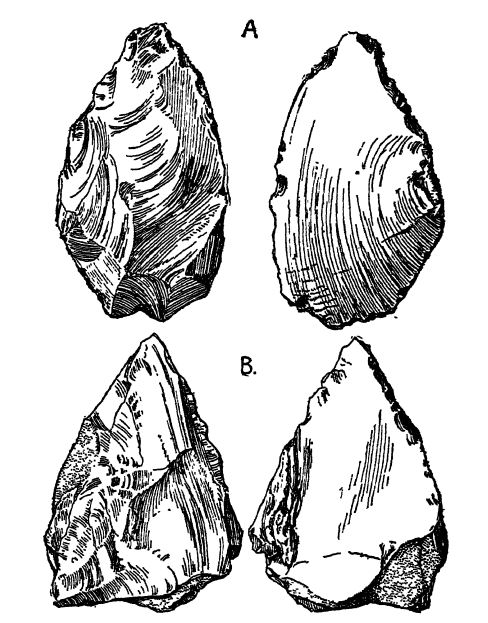
The oldest well made human artifacts are known as paleoliths, and among these the older ones (Paleolithic) are very crude in workmanship (Fig., p. 677). They are nodules of flint, reduced to the required shape and size by flaking with the hammer-stone, by means of oblique blows delivered to the right and left. These crude artifacts are short, thick, and irregular in form, with variable but comparatively small conchoidal fractures where the flakes were detached. The flakes obtained as by-products could also be used for small implements. For the greater part they are rude scrapers and knives, and none appear to be weapons of the chase, though their makers may have had rude wooden spears. The Neandertal men (see p. 681) showed far more sMU in the making of their artifacts, for they knocked quite large thin flakes (up to 7 inches in length) from the flint nodules and then trimmed these into the desired shape for lance-heads by finer secondary and tertiary chipping. These tools were made by the men of the Old Stone Age, men who were learning how to hunt animals for food and to defend themselves by their greater skill in the invention and use of improved killing devices.
A human chronology based on the state of the stone culture can not, however, be expressive of a correct human progression, since the Tasmanians when discovered were making Paleolithic implements, while the North American Indians had tools of a still better type (Neolithic), and their discoverers had advanced into a hi gh stage of civilization. Therefore long after some of the ancient hunters were making paleoliths, others remained in the Eolithic stage. The makers of paleoliths also learned to make implements and ornaments out of bone and horn, but none of these peoples had risen to the making of pottery or the herding of cattle and the raising of food plants. Man was still the hunter.
The Ape-man of Java. — In 1891 there was discovered at Trinil, Java, in volcanic material (lapilli) a great quantity of mammalign bones, of species which are now all extinct in that region. Among these were the remains of the oldest known bones of ancient man. [ p. 675 ] The geologic age of the fossils is somewhat uneertam, but Beny holds that the associated plants are early Pleistocene in time, since none are 3 "et extinct. This flora is not insular, but is continental in character. It was an upland evergreen forest flora, of a wet tropical climate with a mean annual temperature of about 70° F. Trinil man lived “ during the first or second time of glaciation in Europe.”
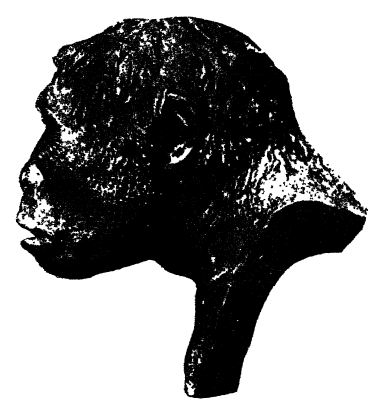
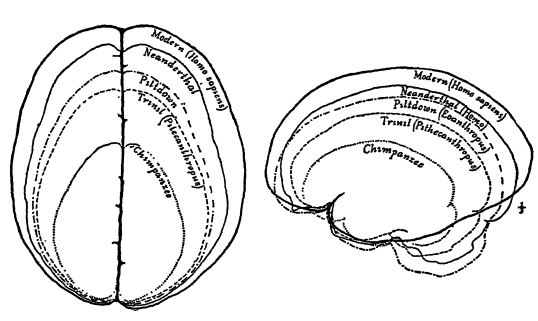
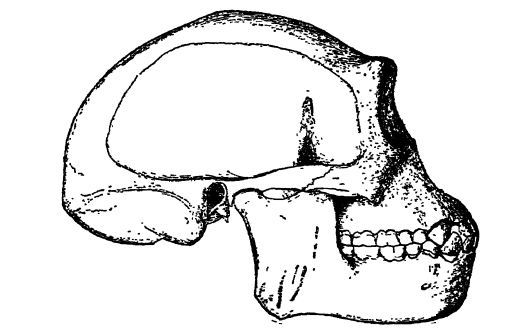
The human remains consist of the upper part of the skull, or cranial vault, three molar teeth, and the entire left femur. Dubois, the discoverer, named this human being Pithecanthropus erectus, which means the ape-man who walked erect (Figs., pp. 667, 668, and below) . It is interesting to note here that long before Dubois’ discovery, Haeckel, on theoretic grounds, predicted the finding of such an apeman, for whom he coined the name Pithecanthropus. The skull is the long-headed (dolichocephalic) type, and has a low crown with prominent brow-ridges, the forehead is more receding than that of the chimpanzee, and the volume of the brain cavity is approximately 28 ounces. The largest cranial capacity in the higher apes does not exceed 20 ounces, while that of a normal living human is never less than 30 ounces. As the average h uma n brain has a capacity of about 49 ounces, it is seen that Pithecanthropus must be included within the human family, and in his mental evolution had risen far higher than halfway between the apes and modern man. He is probably not in the direct line to the higher types of man, but represents a specialized and improgressive branch which became extinct in the Pleistocene (Smith). The femur is distinctly human, [ p. 666 ] [ p. 677 ] [ p. 678 ] of a being that walked more or less erect, and in all probability possessed a foot very much like that of Ihdng man. The brain cavity also shows that the ape-man had probably acquired the rudiments of vocal speech. PithecaMhropus is estimated to have stood 5 feet 6 inches high.
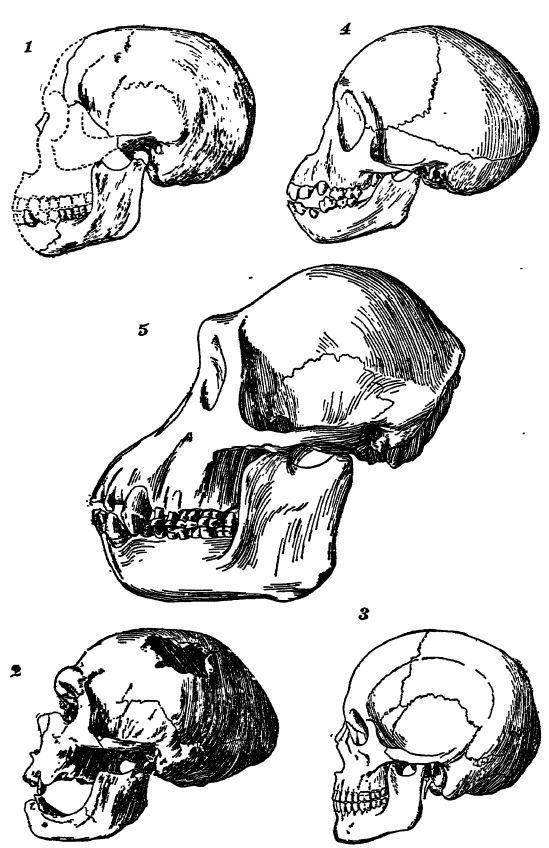
Eoantharopus of England. — In 1913 there was brought together the greater part of a human skull and jaw found in the plateau gravels at Rltdown, near Hetching, in Sussex, England. These remains are the oldest known of the human family in Europe and have been named the “ dawn Tnan ” or Eoanthropvs. The fragments have [ p. 679 ] been carefully set together and the greater part of the skull restored by Smith Woodward of the British Museum (Pl., p. 676, Fig. 1, and Pl., p. 678, Fig. 2). The lower part of the face is decidedly prognathous or “ snouty,” the forehead, though narrow, is not receding, and is as steep as in modern man, the brow-ridges are feeble, and the brain case is very thick, with a cavity content of nearly 43 ounces. The size of the brain, therefore, compares favorably with that of the average European, which has a content of about 49 ounces. The skull is low in proportion to length (brachycephalic), and even though it is archaic, is truly human; but the chinless lower jaw, with its large canines, is distinctly simian and very much like that of a young chimpanzee, and the neck is very thick. The jaw bone of the dawn man is, in fact, so decidedly like that of a chimpanzee that good authority pronounced it to be such, accidentally associated with the human skull. The subsequent discovery of a similar association, however, seems to render that theory imtenable. No other ape bones have ever been found in England. This strange creature, therefore, combines a human brain case with an ape’s jaw. It was probably able to speak, though in a rudimentary fashion.
The prognathous face and powerful jaws, with their large teeth, especially the canines, show that Eoanihropus was a human brute, hunting and defending himseK in the main with his fearful biting mouth. He was still a primitive slayer, though keener than any of his animal associates, and was destined through the manufacture of better implements to become a hunter of a higher order.
With Eoanthropus were associated very ancient types of Paleolithic implements (Fig., p. 677). The age of the plateau gravels is thought to be of the second interglacial warm time, when the hippopotamus lived in England; this is about early Middle Pleistocene (Fig., p. 663). Osborn, however, believes that the age may be Pliocene.
Attention should be directed here to Smith Woodward’s statements that at least one very low type of man with a high forehead was in erdstence in western Europe long before the low-browed Neandertal maji (p. 680) became widely spread in this region. Accordingly he inclines to the theory that the Neandertal race was a degenerate offshoot of early man and probably became esfinct, while surviving modern man may have arisen directly from the primitive source of which the Piltdown skull provides the first discovered evidence.
Heidelberg Man. — In 1907, at Mauer, Germany, not far from Heidelberg, there was found a well-preserved human jaw with all [ p. 680 ] of the teeth (Pl., p. 678, Fig. 3) . It was buried about 80 feet beneath the surface in river-deposited sand of early Middle Pleistocene age and possibly of the second interglacial warm time (Fig., p. 653). Alore recently eoliths have been found in the same stratum that held the jaw. The teeth, while powerful, are distinctly human, but the jaw bone is massive and broad and clearly more like that of an anthropoid ape. This man, known as PaleanOiropus heidelbergensis, had no fbin and was probably most closely related to Eoanthropus.
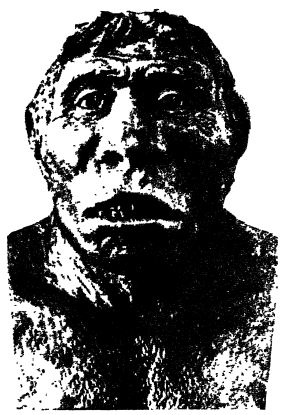
Neandertal Man. — In 1856 most interesting human remains were found in a cave in the little valley known as the Neandertal, lying between Diisseldorf and Elberfeld, Gtermany. Since then more than fifteen other men, women, and children of this race have been found in caves and rock shelters in Belgium, France, Gibraltar, and Krapina in Croatia (Pl., p. 676, Fig. 2, and Pl., p. 678, Fig. 5). Their implements, however, are found scattered throughout western Europe and eastward into Poland, the Crimea, and Asia Minor. In France these people are known as the Mousterians and they are thought to have been the first who dwelt in caves. They lived during the last glacial episode when the climate was cool and finally cold, a time estimated to be anywhere from 60,000 to 150,000 years ago. It was the time of the bison, horse, reindeer, and mammoth, on all of which the Neandertal men subsisted. The race lived for a long time geologically.
[ p. 681 ]
The Neandertal people (Homo primigenius) were a savage-looking race of stout build, short stature, averaging about 5 feet 3 or 4 inches, with legs slightly bent at the knee, and with disproportionatelly large heads (Pl., p. 678, Fig. 5, and Fig., p. 680). They made fairly good stone implements and knew how to kindle a fire, for hearths occm in their cave abodes. The Australians and Tasmanians of to-day, the “ most archaic types ” of humanity, are their nearest relatives, and yet these savages are not descended from the Neandertal men of Europe.
The face was singular, savage, usually more or less prognathous, and unlike that of any existing race. The nose was of unusual size and wide, the upper lip very wide, and at the base of the forehead there was a very prominent and continuous brow-ridge that extended from temple to temple. The lower jaw was heavy and massive and, as in the apes, was without a prominent chin. The brain was imusually large. The Gibraltar head, possibly of a woman, has a capacity of about 41 oimces, while the average of Neandertal skulls appears to be 49 (in one it is 53) oimces. This average is therefore greater than in the Australian and not much below that of Europeans, whose average capacity is about 49 ounces. The hair was probably wavy.
In at least two cases the skeletons were found in their original burial places, and from them we learn that they were laid away with their implements, paints, and food, indicating a ceremonial interment and offerings of food and implements to assist the departed in the spirit world.
The Man of Rhodesia. — In 1921, there was found in a bone cave at Broken Hill, northern Rhodesia, South Africa, an excellent human skull, besides other remains. The skull is of a radically different type from that of the African and European races of to-day, and nearest to the Neandertal skulls from Europe. The legs of the African man, however, were not bent as in the Neandertal people, but were straight and in all respects those of an ordinary modern man. The Rhodesian man (Homo rhodesiensis) is therefore not thought to be nearly so old as Neandertal man, although a first cousin of his; he is probably a modified “ hold-over ” into recent times. Keith thinks that Africa may well have been the cradle land whence were dispersed the Neandertal people.
¶ Men of the New Stone Age
We are now to take up for study the dawn of human civilization, which began roughly about 18,000 b.c. in the Orient and probably in the lower and warmer lands to iJie south of the highlands of Asia [ p. 682 ] Minor and India. The Neolithic people of the city of Susa, Persia, appear to go back to 16,000 b.c. and the mid-sea peoples of Crete in the eastern Mediterranean to about 12,000 B.c.
The New Stone Age of human development emerges in latest Pleistocene time and continues into historic times. The stone culture is improving rapidly and is called Neolithic, since the chipping of the flints is of the highest excellence, and in addition, many of the weapons and tools are rubbed into shape and often polished. In the Neolithic period, ne.xt to food and clothing, the most important object to the men of the New Stone Age was flint. Flint mines were to them what iron mines are to us.
The peoples of the New Stone Age began to make pottery and introduced the herding of cattle and communal life. Later on, permanent habitations in stone huts and skin wigwams, along with agriculture, became more general, and their pottery was made more and more on the potter’s wheel. Finally the metals, copper, gold, and iron, were introduced. Definite migrations and warfare began also with these peoples, and manufacturing and trading as well.
Aurignacian Man. — We now come to men of the human species ( Homo sapiens) who at first were still hunters but who had far greater skill in the making of Paleolithic stone and bone implements than did their predecessors, the Neandertals, whom they dispossessed. They appeared in western Eiux>pe at about the close of the Glacial Period, or about 17,000 b.c. These people came from the east, spreading westward from Asia Minor, and their remains are found throughout the great part of western and central Europe and most of the Mediterranean countries.
There were at least two races of Aurignacians, a dominant one, the Crô-Magnon people, of tall stature, the men averaging over 6 feet in height, with long anus, and long in the lower leg. They were remarkably long-headed (dolichocephalic), with a large cranial capacity ranging between 52 and 56 ounces. The face was short, the eye orbits were wider than long and depressed, and the browridges were strong. The other, or Grimaldi race, shows negroid characters, its members being but 5 feet 3 inches in stature (female) with extremely elongated lower limbs, flat nose, prognathous jaw, and slightly retreating chin. They are thought to be allied to the living Bushmen of Africa.
The Aurignacian races appeared throughout Europe at a time when the climate was colder than it is now and when the Neandertal men were vanishing. The animals of the chase living at that time were largely the reindeer and horse, and for this reason it is also spoken of [ p. 683 ] as the epoch of the reindeer. The Aurignaeian implements are of the later Paleolithic type, that is, the workmanship of the flints is better and constantly improves with time, and the race had many more kinds of tools to serve more purposes. They also used bone for awls and ivorj-" for skewers and ornaments, and made spears, bows and arrows, and fur garments. Themselves they ornamented with marine snail shells derived from the !Mediterranean and the Atlantic, with fossil shells from far inland places, with teeth of mammals, and even with those of human beings, and later with beads, bracelets and other objects manufactured out of shell and ivory.
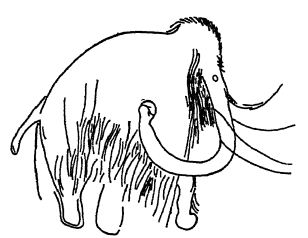
Armed with better weapons of the chase and a wider knowledge of their use, the Aurignacians were able to take better advantage of their enviromnent. Under these circumstances, they had more ease and time for reflection, and we witness in them the birth of bodily adornment, clothing, and the fine arts. Their achievements along these lines excite the wonder and admiration of all anthropologists. Sculpture and drawing appear almost simultaneously, and later comes painting. This art we find preserved in the caves of France and Spain, the art of one period being overlaid by that of later times, and as time goes on the workmanship is greatly improved. No daylight penetrates into these deep caves, and as the walls are not smoked, it is beheved that these early men had better methods of illumination than the torch; in fact, a few stone lamps like those made by Eskimos have been found. Animals of many kinds are depicted, at first as monochromes, the outlines done with charcoal (Fig., above), then engraved on the walls and even on the ceilings of the dark caves; later were added polychromes in red, brown, black, and several shades of yellow. The pigments were of mineral origin and were mixed with grease. These artists also engraved animals on stone, bone, and ivory. The human figure appears only in the later paintings, and in these are seen wigwams, garmented women herding cattle, and men dancing or chasing wild animals with dogs.
[ p. 684 ]
The Aurignacians also laid away their dead with their ornaments of life, their flint tools, and the food needed for the joui’ney into, or for use in, the life beyond.
Magdalenian and Later Races. — The Aurignacians were followed by the Solutréans and Magdalenians, men also of the Neolithic or polished stone period. These people not only made the same implements as the Aurignacians, but fashioned even better chipped flints and softer stones that were rubbed smooth and sometimes polished. The history of the race goes back perhaps 10,000 years, earher than the most ancient monuments of Egypt or Chaldea, and while they too were hunters, they lived in wigwams and herded cattle, sheep, and goats, and somewhere about this time farming of plants for food had its origin.
During the later part of the New Stone Age, the climate moderated and became moister throughout Europe. This was the time of the Azilian peoples. With this climatic change came others among the plants and animals. The reindeer, the main source of food and clothing for man, vanished from all of southern Europe and retreated farther and farther northward as the continental glaciers melted away. With this amelioration of climate, man also spread northward following the reindeer, arriving in Denmark about 12,000 b.c., and in Sweden about two thousand years later. The climatic changes appear to have disestablished all organic nature, and in the greater struggle for existence a long night fell upon the progress of man, his skOl, and his art.
The next great waves of progress, Evans tells us, came from two directions, first from the south through the valley of the Nile, and second from the Orient out of the valley of the Euphrates in Asia Minor. It was the Hellenic civilization that drew upon these sources, and it developed most rapidly in Crete, an outlier of Greece, where arose the Minoan civilization about 4000 b.c.
The use of metals first began in Egypt and Chaldea about 5000 B.c., when gold ornaments and copper implements and ornaments were made. This period is often called the Age of Copper, and was followed about 3000 b.c. by the Age of Bronze. These ages, however, have different dates in the various countries, the art arising in one and then slowly dispersing into ever wider areas. The Bronze Age arrived in central Europe about 2000 b.c. The Age of Iron had its rise in Palestine about 3200 years ago and the use of the metal then spread into India and to the Mediterranean peoples.
“ Gold was the first metal used by man, and it was the arbitrary value attached to it for its supposed magical properties as an elixir of life that initiated the [ p. 685 ] world-wide search for it which has now lasted for sixty centuries. . . . The search for gold has been the most potent influence in the development and the spread of civiKzation. . . . Many other materials to which a magical or economic value was attached played a part in this process of exploitation. Resin, timber, pearls, copper, flint, jade, turquoise, lapis lazuli, amber, tin, and eventually all metals, were some of the more obtrusive lures that impelled men to embark upon any adventure, however hazardous; and the search for these things was responsible for the world-wide diffusion of culture.” (Elliot Smith.)
Egyptian History. — Human evolution in the valley of the Nile begins with an old stone culture, followed by the crude Paleolithic implements found scattered abundantly over the desert, the makers of which are thought to have lived at least from 8000 to 6000 b.c.
The succeeding inhabitants of Egypt were the “ Pre-Dynastic ” people, a semicivilized race of migrant hunters, herders, and farmers. They had no connection whatever with the older Paleolithic people of the desert. The date of their migration into the valley of the Nile appears to have been 4000 b.c. They inhabited the valley from the delta into Nubia and were related to the present Arabs and Berbers. This race, with a later admixture of Semites and a slight infusion of negroid elements, formed the foundation of the highly religious Egyptian people of the historic period. They brought with them a civilization in the Neolithic stage of stone culture. This culture was of the highest. Their clothing was made of coarse and finely woven linen. They made pottery and rudely decorated it, ground soft and hard stones into urns and ornaments, and of metals used sparingly gold, probably found in Nubia and the Soudan, and copper which appears to have been imported from Sinai. They also were familiar with the making of a vitreous glaze. They were, however, devoid of a written language.
Historic or dynastic Egypt begins with the first evidence of a crude pictorial language in the rule of King Menes dating about 3400 b.c. Civilization was rapidly developed during the first and second dynasties (3400-2980 b.c.), which gave rise to the “ Old Kingdom ” (III to VI dynasties), and the latter culminated about 2475 b.c. A marked civilization had been developed, in less than 1000 years, along with a well developed written language and the earliest large memorial and religious edifices, the pyramids.
Man in North America. — JMany times during the past fifty years have the remains of fossil man been found in such geological associations as to lead their discoverers to assert the presence of man in North America, if not actually in the Pleistocene, at least in strata some thousands of years in age. According to the newer evidence interpreting the climate of the Pleistocene in this continent, the temperature began to become warmer less than 20,000 years ago. It now also appears that even before this greater change, the snow and ice had long been melted from the Cordilleran lowlands, thus permitting the migration of Asiatic peoples, animals, and plants into North America via a Siberia-Seward Peninsula land bridge. As the ice retreated northward from eastern North America, and with the continued amelioration of the climate, the red men or Indians [ p. 686 ] probably spread eastward and northward. Accordingly, the older records of man should be looked for along the Pacific coast and in the Southern States.
Mexican archeologists and geologists have long been calling attention to the occurrence of buried skeletons of man and something of his culture beneath from 15 to 30 feet of lava at San Angel, a southern suburb of the City of Alexico. These lava flows are believed to have taken place not less than 2000 years ago and it may have l>een even 10,000 years ago. To the northwest of this same city the identical culture is found beneath from 10 to 12 feet of sediments. On the other hand, the Aztec culture is modern since it occurs above lava flows and in the soil.
In 1916, Sellards reported the finding of human remains along with bits of pottery and charcoal at Vero on the Atlantic coast of Florida. The associated mammal bones were all of extinct Pleistocene forms, and this evidence appears to indicate about Middle Pleistocene time. The fossil plants, on the other hand, are of living species, and this evidence appears to Berry to indicate that the man of Vero is at best but a few tens of thousands of years old.
Ever since 1875 numerous argillite Paleolithic implements, and rare human bones, have been found deeply buried in the undisturbed gravel deposits of Pleistocene age at Trenton, New Jersey. In the upper one foot occur unmistakable Indian implements and pottery that are wholly unlike the implements of the deeper gravels. G. F. Wright and others are convinced that this evidence is unmistakable proof that man was present in North America toward the close of the Pleistocene.
It is a well known fact that throughout Pleistocene time mastodons roamed widely throughout the northern portions of North America, and that the last of them may have died out not many thousands of years ago in New York and Connecticut. Their bones are but little mineralized, and yet their ivory appears not to have been used by the Indians. In 1921, J. L. B. Taylor discovered in a Missouri cavern a leg bone of the Virginia deer on one side of which is scratched a rude effigy of what unmistakably suggests an elephant ” (Lucas). On the other hand, the Aztecs pictured elephant heads on the temple of Copan in Yucatan and the mound builders built elephant mounds in Ohio and Wisconsin and made pipes in cathnite shaped after the elephant.
John M. Clarke in 1887 dug up at Attica, New York, bones of the mastodon associated with bits of charcoal and pottery, and the late Professor Williston found in Logan County, Kansas, 20 feet beneath [ p. 687 ] the surface, an arrowhead that lay under a scapula of an extinct buffalo.
This and other evidence appears to place beyond doubt the probability that the mound-building Indians, mastodon, and a species of elephant lived together in North America not so very long ago. On the basis of the annually layered brick clays of the Hudson and Connecticut vallesrs, it would appear that this time dates back somewhere between 15,000 and 5000 years.
Birthplace of Man. — It is as yet impossible to say positively where man’s transition from the ape to the human form took place. The oldest known bones of ape-man are those of Pithecaiiihropus found in Java, and for this and other reasons it has long been held that man probably arose in Asia and in the cooler climes rather than in the tropical jungle. We have seen that much of central Asia was being elevated in IVIiocene time and that the great Himalayas rose yet higher in the Pliocene and are still rising. This time and region were, then, critical for organisms, as the climate was changing from that of the tropics to cooler and finally cold conditions, bringing on great changes among the plants and thus reacting upon the animals, man’s ancestors, therefore, had to adapt themselves to these changing conditions, and in order to protect themselves against the cold, clothed their bodies in the skins of the chase, and because of this covering lost their bodily hair. In addition, they had to adapt themselves to the animals and plants that remained, and many of these are not only still living in this region, but are now domesticated. The ox (Bos primigenim into B. tawnis), sheep, goat, pig, fowl, and pigeon are from India, while from wider Asia came the horse, camel, reindeer, elephant, peacock, goose, and ostrich. Still other forms reached Africa, and man there tamed the ass, domestic cat, greyhound, mastiff, and guinea hen. Of our domesticated plants the great majority are also of Asiatic origin. For these reasons it is thought that an ape line changed into man somewhere in central Asia, India, or China (Williston). However, the earlier evolution may have taken place in western Europe, since in England and Belgium are found the oldest human-made artifacts accepted by anthropologists as such.
¶ Résumé
Man, like all other living plants and animals, begins in a single, tiny, nucleated cell, and his further development is that of the Metazoa (p. 672), and more especially that of the mammals and his nearest relatives, the apes. Something of this vastly long ancestral history is repeated in the first three months of each human being’s existence and constitutes a metamorphosis far more wonderful and significant than the transformation of the caterpillar into the butterfly. In this development there is a fish-like stage, when the functioning heart and the vestigial gills are comparable to the same organs in fishes; then the heart is transformed into the type seen in amphibians, and next into that of mammals. At this time of development it is almost impossible to distinguish the human foetus from that [ p. 688 ] of other mammals, but the latent ancestral history impressed upon the embrj’O from the very beginning goes on reproducing more or less blurred characteristics of the apes and man.
We have seen that the ape-man Pithecanthropus was in existence in the earliest Pleistocene, a time estimated by geologists to be somewhere between 400,000 and 1,400,000 years ago. This apeman, however, was not in the direct line of evolution to man. Then there is no record of human bones for a long time, but as the true eoliths are of human workmanship, they are evidence of man’s presence in western Europe since late Pliocene time.
About early Middle Pleistocene time, human bones are again in evidence, first in Germany in Heidelberg man, thought to be in the direct line with living men (Homo sapiens), and secondly in the dawn man (Eoanthropus) of England, who is not in direct ancestry with the toen of the present. Later than either of these ancestral men are the Neandertal people, who are also not directly related to Homo sapiens. They made their appearance probably 150,000 years ago and lived almost into modern times; their remains are widely scattered throughout western Europe (Fig., p. 680). In all of these ancient men mentality was of slow growth, and yet as early as late Pliocene time, man in England knew how to kindle fire. The Keandertal men also made fires, and had a religious instinct, seen in the respect paid to the departed by laying them away in graves with ceremony. With the appearance of the Aurignacians about 20,000 years ago, the present size of the brain was attained. Human society and primitive farming had their rise about 10,000 years ago.
Future Hirnian Progress. — Human mentality now dominates the organic world, and to it all creation will soon be more or less subservient. Through his inventions, man will eventually control his environment and largely nullify the laws of natural selection and survival of the fittest to which all other organisms are subject. His future progress, however, is dependent upon himself, dependent upon whether he will learn to control himself for the benefit of human society, as the clashings of men and human civilizations are still due to his inborn “ predatory instinct.”
Human progress has been along three main lines of evolution, namely (1) bodily, (2) intellectual, and (3) social. Conklin says that during the last 20,000 years man has made no very marked progress in his bodily evolution, and that intellectually it is a question whether he is as far advanced as were the ancient Greeks. Future progress is therefore dependent upon the progress of human society through cooperative effort. Through carrful breeding man [ p. 689 ] can eliminate the unfit and undesirable, and raise the human stock to the level of the best of existing individuals.
“ To us it is given to cooperate in this greatest work of all time and to have a part in the triumphs of future ages, not merely by improving the conditions of individual life and development and education, but much more by improving the ideals of society and by breeding a better race of men who will ‘ mould things nearer to the heart’s desire’ ” (Conklin).
¶ Collateral Reading
E. G. Conklin, The Direction of Human Evolution. New York (Scribner), 1921.
Arthur Keith, The Antiquity of Man. London (Williams and Norgate), 1915. Arthur Keith, Man. Home University Librarv-. New York (Henry Holt), 1915.
Vernon Kellogg, The Biologist speaks of Death. Atlantic Monthly, MayJune, 1921.
George G. MacCurdy, The Eolithic Problem. American Anthropologist, new series, Vol. 7, 1905, pp. 425-479.
George G. MacCurdy, Human Origins: A Manual of Prehistory. New York (Appleton), 1924 H. F. Osborn, !Men of the Old Stone Age. New York (Scribner), 1915. New edition in preparation.
W. J. Sollas, Ancient Himters. London (Macmillan), 1911.
Griffith Taylor, Climatic Cycles and Evolution. The Geographical Review, Vol. 8, 1919, pp. 289-328.
J. M. Tyler, The New Stone Age in Northern Europe. New York (Scribner), 1921.