[ p. 75 ]
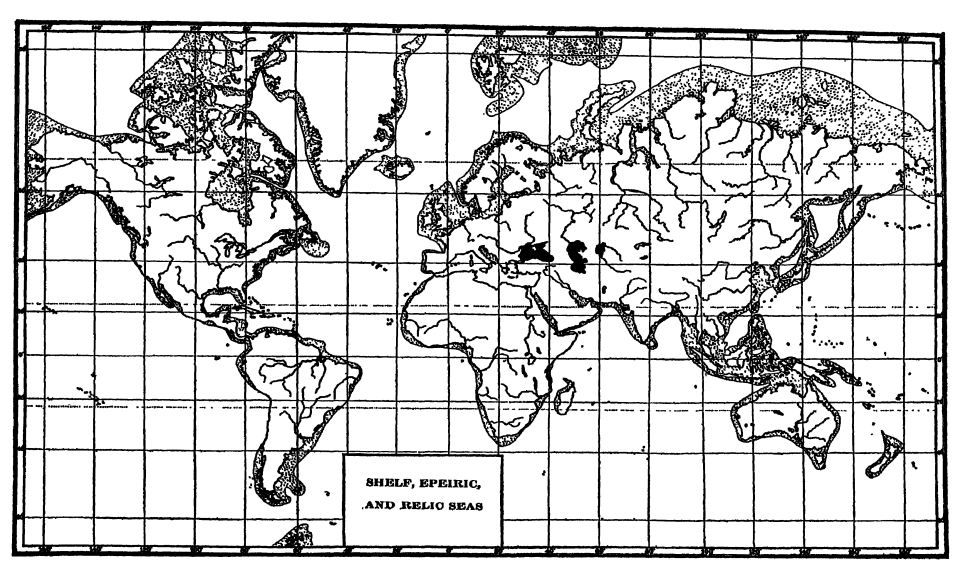
Rinds of Seas. — In the previous chapter we saw that the ocean basins are more than full, and that the waters have spread over parts of the continents to a depth of about 600 feet, developing the shelf or marginal seas and the inland seas. In general use the word sea is interchangeable with ocean, but in Geology it is more often used in a restricted sense and in its original meaning. It appears to have originated with the peoples of northwestern Europe who were familiar with the North Sea and the East or Baltic Sea. These are marginal and inland bodies of marine water that in the maia are under 200 feet in depth, and lie upon or within the continent; hence they contrast distinctly with the far deeper and larger mediterraneans and the abyssal oceans (Fig., p. 71).
The marginal or shelf seas lie upon the borders of the continental platforms, and the Germans often call them “ flat seas ” because of their shallowness and their flat bottoms. Examples are the North Sea, and the Yellow and Eastern seas of China.
Other shallow bodies of marine waters connected with the shelf seas or oceans, but situated wholly within the continental platforms, are in this book called epeiric seas (see Pt. I, page 111, and Pt. II, Fig., p. 77). Examples of these are Hudson Bay, the Gulf of St. Lawrence, and the Baltic Sea. In the geologic past all of the continents have been more or less widely flooded by overlaps of the oceans, all of which are thought to have been shallow and usually under 300 feet in depth, though in places they undoubtedly were deeper. Long ago Dana called these continental interior seas or interior seas, and his terms should have prevailed, but unfortunately the name “ continental deposits ” came to be applied later, not to the sediments of the shallow marine waters but to those of the fresh waters. As the term “ continental deposits ” in this sense is now ingrained in Geology, we can no longer use Dana’s “ continental seas,” without raising a question in the mind as to what is meant when their deposits are considered. Hence we propose here to use the term epeiric seas (meaning seas that lie upon the continents) for the bodies of water that flood the interior of the continents. As a rule, [ p. 76 ] these waters do not have the normal salt content of oceans (3.5 per cent), but are more or less freshened. In arid places they are, however, far more saline and at times pass into salt-depositing seas. The areas of these seas have in times past experienced great changes through variations of sea-level, sometimes being more or less completely emptied of their water, or filled with sediments and turned into land.
Relic seas and lakes are great bodies of fresh, brackish, or even highly saline waters now completely cut off from the mediterraneans and oceans, but whose present life shows clearly that they were once in open connection with them. The best-known examples of these severed bodies of marine waters are the Caspian Sea and Lake Champlain (Fig., p. 77). These lakes are therefore marine relics of the past that have gradually been freshened through the inflow of rivers. In the same way we speak of relic faunas or relic species, meaning that they are relics which have adapted themselves to their present fresh-water or brackish-water habitats in these relic seas (see Pt. I, p. 80). The Great Lakes originated very recently, have always had fresh waters, and are dammed river valleys.
The Caspian Sea is the largest land-locked body of water, with an areal extent of 170,000 square miles. In the south it attains a depth of 3190 feet. It has now no outlet and its waters are removed by evaporation. Formerly it was a vast inland mediterranean with epeiric connections extending to the Arctic Ocean and the Roman mediterranean. The fauna is a deficient one, having marine fishes, porpoises, and seals.
The best demonstration that Lake Champlain is a relic sea is seen in its elevated beach deposits of very recent origin (Pleistocene), which have an abundance of marine shells and the bones of seals and whales.
Extent of Seas. — At present the shelf and epeiric seas occupy about 5.1 per cent of the earth’s surface, or nearly 10,000,000 square miles, but in the past they were vastly greater, for the North American continent has several tiiyies been flooded by epeiric seas that covered from one third to about one half its areal extent. In fact, almost all of Stratigraphic Geology is a study of the sediments of epeiric seas, while it deals little with those of the shelf seas and scarcely at all with the ocean oozes.
Waves. — The surfaces of the oceans are never absolutely quiet, are usually least disturbed during calm rains, and are roughest when the winds are blowing strongly. “Wind is the mother of waves.” Storms are cyclonic and rarely have diameters of more than 500 miles, so that the “ fetch of the wind ” may be blowing in one direction up to this distance. The longer the “ fetch ” [ p. 77 ] [ p. 78 ] of strong winds, the higher the waves, that is, the friction of the wind upon the ocean surface pushes it into waves, the highest of which attain to 50 feet or more. Waves up to 40 feet high are of fairly frequent occurrence in the open ocean.
It is now certain that the waves of the greater storms in the oceans penetrate downward to at least 600 feet and in exceptional cases possibly even to 700 feet. Therefore even at these depths the muds may be stirred up and moved from place to place. At depths of 220 feet, gravel the size of hazelnuts is moved about, and stones weighing up to a pound have been drifted into lobster pots at a depth of 180 feet. Tidal and oceanic currents, moreover, penetrate to still greater depths, as stated in the previous chapter under currents.
Water waves are of two kinds, (1) waves of oscillation, and (2) waves of translotion. The former are the ordinary waves of water bodies, and in them the fluid moves in circles, running not only in the direction of the wind, but downward as well, though losing strength with depth. The water on the crests of these waves moves forward, and that in the troughs backward, hence the term oscillation, because the water oscillates back and forth and does not run continuously forward. The waves of water in currents are those of translation, and here the motion is all forward as the waves pass, and there is no compensating backward motion.
Life of Shelf and Epeiric Seas. — The seas are wholly transparent to the sunlight (diaphanous); accordingly, they constitute the only marine area where the bottoms are more or less covered with ground-dwelling plants, and all animals that feed upon such plants are restricted to these waters. As the seas are adjacent to the lands, receive the rivers, and feel the full effect of the waves and tides, it is natural that they should vary greatly in temperature, salinity, bottom scour, and sedimentation. Since the oceans are mobile, any movement within the earth’s mass is reflected by them and causes the seas to become shallower or deeper, or even to be transformed into dry land. Because of these constant changes in the physical, chemical, and organic environment, the epeiric and shelf seas are also the scene of severe struggles among their inhabitants and consequently are the principal arenas of marine biotic evolution. We may then say that the degree of intensity of all these interactions is most marked toward the land, and in the shelf seas diminishes away from it down the continental slopes.
The seas of the continental shelves are not only the regions of greatest abundance of marine bottom-living life, or benthos, as [ p. 79 ] previously stated, but also the ones from which all the other water bodies of the world have been colonized. Accordingly these regions are sometimes referred to as the “ cradle of evolution.” Here is found the greatest abundance of life, and as well the most severe struggle for existence. Survival is far more difficult in these seas than in the open oceans. From the shallow-water seas bottomliving forms and swimming organisms have made their way into the abysses and others have voluntarily or involuntarily attained to a life in the inland lakes and rivers through modification of their habitats from salt to fresh waters, or, by changing water-breathing organs into lungs, have even become denizens of the dry land itself.
The largest quantity of shallow-water marine life is in the temperate waters, and the greatest number of kinds occurs in the warmer waters. Bottom-living plants, the seaweeds, are most prolific in waters down to about 400 feet, and none go much beyond 600 feet. This is the most striking difference between the life of the shallower waters and that of the oceans proper, for the animals of the deeper parts of the shelf seas continue down the continental slopes, and, even though in reduced quantity, they are still comparatively varied and abundant at depths of 9000 feet. Beyond this they diminish quickly and over the abyssal plains they are very scarce indeed, consisting only of forms highly modified to cope with the peculiarities of their environment.
The life habituated to shallow waters can, as a rule, spread only throughout the shallow seas and along the shelf seas bordering continents, never across the ocean bottoms. Nor can it spread directly across the ocean surface, and even when in the larval state as floaters there is not time enough for it to be conveyed across to the far away shelf seas. When the earth had mild climates, the conditions were favorable for slow continuous radiation into all seas, and it was at such times that the cosmopolitan faunas were developed.
Effect of Rivers on Sea-life. — Rivers enter the sea through estuaries or deltas, changing the waters from normal marine to brackish or more or less freshened ones. Here the environment of the rivers meets that of the seas, blotting out most of the marine organisms, and not only piling up the greatest depths of sediments, but also bringing about the most marked variations in sedimentation. Very little of marine life has ever been able to withstand the environment of rivers and so accommodate or permanently adapt itself to brackish and even less so to fresh water.
[ p. 80 ]
¶ Divisions of the Seas
On the basis of their depth and the nature of their rock deposits, we may divide the seas into the strand, the shallow-water littoral, and the deep-water pelitic areas.
The Strand. — All students of the seas are agreed that the strand (the shore, beach, or foreshore) is the most easily defined region, since it lies between high and low tides. It has therefore also been called the intertidal region. In most places the strand is a narrow one, varying in width up to several hundred feet, but where the bordering lands are very flat it may attain a width of miles. Here the deposits are exceedingly variable in composition and usually coarse in grain, for it is naturally the region of most active wave force. Along the strand we may meet with cliffs, or rivers may bring in gravels, and from either source are formed conglomerates and coarse sands. Conglomerates, as a rule, are of continental origin, but those of the seas either occur at the base of formations, where they are made by waves beating against the cliffs, or are the interbedded gravel deposits brought by the rivers. Where the sea shades into the land may occur the finer sands or muds, which are often rippled, sun-cracked (Fig., p. 279), or trampled over by the land animals, frequently preserving their tracks (Fig., p. 473). It is very important to bear in mind that mud-cracking is practically restricted to the deposits of the strand and to continental formations (see Pt. I, p. 286), for these are the sediments that in the main are exposed to the air sufficiently long to be dried enough to bring about shrinking and tensional cracking. However, there are also areas of the strand, as in the present Runn of Cutch, India (8000 square miles), where marine playas (broad mud flats) are bared for months at a time from the sea. It is very probable that the sun-cracked Paleozoic water-limestones of the Appalachian region were formed in this way. This is also the region in which flat pebble limestone conglomerates are made.
The nature of the strand deposits is, however, dependent not only upon the topography of the land and the proximity of the rivers, but equally upon the climate and the waves and currents that are produced by the winds and tides. The winds constantly vary in intensity and shift in direction, and with them the waves and currents, bringing about, in the “ sea mills ” thus formed, a reduction in size of grain, an assorting of rock according to mass, shape (mica flakes), and specific gravity, and a drift of material now in this direction and now in another. However, the materials [ p. 81 ] of the strand are usually not in thick deposits and the marine conglomerates are as a rule under 10 feet, though they may attain locally to 100 feet.
Life of the Strand. — The strand is also the amphibiovs region, for sometimes it is a part of the dry land and again it is under the sea. For this reason its life is a peculiar one, highly adapted to an environment that is neither wholly of the one nor the other region; nevertheless most of the organisms are of the sea. When the tide is out they do not feed and most of them are buried in the wet ground, hidden beneath the rocks, under the seaweeds, or in pools of water. The kinds of animals that are peculiar to the strand are not many, for most of its dwellers are forms that also live in the adjacent region of permanent water.
The Littoral Seas. — Beyond the strand is the littoral region. Some use this term in place of strand, and still others include in it the entire depth of the seas. The Latin word, litoralis, means belonging to the seashore, and in this book we shall so use it, but continue the region from the lower limit of the strand to a depth of 250 feet, the latter point being chosen because at this depth most of the decided assorting power of the waves and their undertow ceases. The littoral region therefore merges landward into the strand and seaward into the deeper or pelltic waters. The waves of these shallow waters are most powerful and push the coarser material landward, piling it up toward the strand, while the finer substance is dragged seaward. The sediments, like those of the strand, are exceedingly variable, running from conglomerates to clean, coarse, shifting sands, dirty sands that consolidate and do not shift, and coarser muds. The offshore portions of delta deposits are also laid down in these depths and their shifting sands are dominantly rippled and occasionally much cross-bedded. These littoral deposits, due in the main to the inflowing of the rivers, are apt to have remains of land animals and more especially of land plants, such as leaves, stems, and wood, objects far less prevalent in the deeper water deposits. It should, however, be said that but little vegetable matter is entombed in the deposits of warm waters, for the great drifts of timber and other vascular or fibrous material are usually best preserved in temperate and colder waters.
As the storm waves act with some force to depths of about 250 feet, we see again why the littoral region is marked by conglomerates, by sands that are rippled and often more or less crossbedded, and by quick alternations of sands and muds, both vertically and horizontally; in a word, it is preeminently the region of heterogeueous [ p. 82 ] deposits. The Dogger Bank of Great Britain lies from 40 to 90 feet beneath sea-level and is churned by the stormy waves, unearthing mastodon teeth which the fishermen bring up on their lines. Eipple-marks have been seen in depths of 50 feet, others are known on sandy bottoms sounded at depths of 600 feet, and fine sand has been thrown on the decks of ships where the waters were 150 feet deep. Therefore, great storm waves in their oscillatory motion lift and rework the littoral bottoms, break up the muds into tabular fragments or roll them into mud-balls, and in this way also make the well-known intraformational conglomerates, so called because the fragments of which they consist are of the same deposit and age as the rocks in which they lie, and are not of foreign rocks, as is the case with the ordinary type of conglomerates. Intraformational conglomerates made of flat thin pieces of limestones or dolomites are commonly formed in playa deposits when the sea returns over the areas of mud-cracked and hardened deposits, breaking them up and drifting the pieces into deeper water.
The littoral region is also marked by hanks, those flat shallowwater areas far out from land, such as form the great fishing ground to the south of Newfoundland and to the east of the Maritime Provinces of Canada. These banks are due in the main either to marine planation, or to currents that have piled up sand and muds; it is, however, not only the currents that do this work, for searwater also rapidly precipitates the muds brought into the sea by the rivers. Thus all the coarser terrigenous material is dropped in the littoral, and only the finest particles are carried by the lessened currents into deeper waters.
To the tropical waters of the littoral region are restricted the great coral reefs, and consequently, with the assistance of the limesecreting seaweeds and the denitrifsdng bacteria, these and the adjacent deeper waters are the areas of greatest limestone making. Here also in the shallow waters are formed the calcareous oolite deposits. In the temperate and cooler waters the reef corals are absent, and even though calcareous algae are present they are of other kinds which are far less effective as makers of limestone. In the same waters but in depths between 35 and 90 feet are found those green seaweeds with wide and fluted blades that are yards in length, known as Laminaria. Growing in great tangles they form miniature forests and are characteristic of the Laminarian zone.
It is a well-known fact that pure sandstones are poor in fossils, but, when mixed with day and more especially when limy, do contain [ p. 83 ] them, sometimes in considerable abundance. This is because clean sands are laid down well within the zone of wave agitation, which not only washes out the mud and carries it farther oceanward, but also shifts the sand. Such places have no seaweeds living on the bottom, and are generally unfavorable habitats for life because of the shifting nature of the deposits and the grinding action of the sharp sands on the orgamsms. Further, the porous satiHr permit circulation and solution and have no diffused lime to protect the shells from such dissolving action. It is, therefore, in limy sediments that fossils are most abundant. The subject is referred to again later in this chapter (under diagenesis).
Deep-water Pelitic Region. — Beyond the littoral is the deepwater politic region, which includes all the waters of the continental shelves and the epeiric seas from about 250 to 600 feet. The word pelite is much used in the study of rocks (Petrology), and in the main refers to fine-grained mud rocks; in connection with the seas, therefore, the word is intended to have reference to the widely uniform and fine-grained character of the deposits of the deeper waters. To these depths the storm waves generated at the surface rarely attain with decided eroding power, sufficing only to stir the fine mud which is carried thus far from land, but in most places there is also some movement of the waters due to the tidal and oceanic currents. Here also the green seaweeds become less and less abundant with depth, while the brown and red algae are generally the forms of the deeper waters. On protected coasts, however, the continental slope into the oceans begins at about 240 feet of depth, owing to the lessened wave action.
The deposits of the pelitic region are the well assorted and -widely spread fine sands, and the sandy, clayey, and calcareous muds, along with greater accumulations of organic debris. It should, however, be understood by the student that sedimentation in the deep-water portion of the seas is dependent not only upon the currents, but also upon the height of the adjacent lands and the nature of their climate (whether warm or cold, dry or moist), upon whether the rocks are soft strata or hard crystallines, and upon whether the land is clothed with vegetation or is a desert. These general tendencies are further altered by the currents, so that locally even the pehtic waters have deposits that are characteristic of the littoral.
Origin of Concretions in Pelitic Waters. — Where cold and warm water currents impinge on one another they are shifted from time to time by strong winds, and in such regions it occasionally happens that the cold shore waters are blown far into the areas of deep water, killing off many of the warm-water animals. [ p. 84 ] Such an area occurs off the New England States, where in 1882 almost all of the fishes and other swimming animals were killed. The carcasses eventually fall to the bottom and form nuclei which in their decomposition set up the formation of concretions that are often phosphatic. Similar beds of concretions are also met with in the ancient deposits.
Stagnant Sea Areas. — In the shallow parts of the oceans and in all seas there are large-and small areas where the waters are stagnant, and because of the lack of currents the animals living on the bottom, the benthos, soon consume all of the free oxygen that has been absorbed in the main from the atmosphere. Such bottom waters are said to be stale,” and they are taken possession of by sulphurmaking bacteria which feed upon the micro-organisms and other life that fall from the sunlit, oxygen-absorbing surface zone. As the result of the bacterial life processes, the bottom waters become more and more foul through the liberation of sulphuretted hydrogen gas. Such bottoms deposit a very fine, black, ooze-like mud, on which but little life at best can maintain itself. The abundance of organic matter colors the muds blue-black to black and it abounds in petroleum and in sulphide metals, usually iron pyrite. Many formations of this kind are known in Geology, and some of them have a petroleum content as high as 20 per cent.
On the other hand, where the prevailing winds are strong toward the land, there is developed a marked seaward undertow that sweeps the bottom clean of deposits and of the organic products of decomposition from the abundant life of the littoral. The material gathers in the currentless depressions of the pelitic region, where it accumulates as black mud. Such dead grounds are known in many seas. Others, such as the submarine channel of the Hudson River, are known as mud holes.
Walther says that as long as a part of the seas is in open circulation with the ocean and its waters are constantly interchanged and the normal salinity maintained, there will live and be continued a normal marine fauna. As soon, however, as the free circulation of the water ceases, as in a quiet bay or between islands of an archipelago, all normal conditions are altered. Such stagnant places are characterized by accumulations of organic matter, by the development of poisonous sulphuretted hydrogen gas in the water, and by the vanishing of bottomliving organisms. Only the floating and swimming organisms or drifted plant material attain these quiet places, where they are often wonderfully conserved in the muds. This detailed preservation is well known in America, for in the black shales at Banff, Alberta, and Rome, New York, we have examples of trilobites retaining the antennse and limbs in an extraordinary state of preservation.
Mud Bottoms. — As a rule the areas of mud accumulation are devoid of attached seaweeds and, since the water currents are here very slight, little food is brought to the animals that might [ p. 85 ] othorwise liv© upon or in the mud. In consequence the mud areas have a scant life and are known as the desert areas of the seas. These observations of the present marginal seas also help us to understand the dearth of life in the majority of the green, blue, and black shale deposits of epeiric origin. When fossils of bottom-dwelling types do occur, they are in thin zones and more often swimming or floating forms.
¶ Sediments and Their Alteration
Kinds of Sediments. — In general it may be said that the sediments of seas are coarser in grain than the oceanic deposits, but of finer grain and far better assorted by the moving waters than the continental formations. The sediments of all strata are either mechanically formed or of organic origin. The former embrace the arenaceous deposits such as the sandstones and sandy shales, and the argillaceous deposits or mudstones, such as clay, shale, and slate. The organic deposits consist of limestone, dolomite, chalk, marl, and coal.
All of the sedimentary materials are derived in the first instance from igneous rocks (chiefly granites), and it has been calculated that such upon complete weathering should yield 80 per cent of mudstones, 15 per cent of sandstones, and 5 per cent of organic deposits (F. W. Clarke). These figures are, however, not borne out in the strata seen by geologists, for they average about 48 per cent of mudstones, 32 per cent of sandstones, and 20 per cent of organic deposits (Leith and Mead). These discrepancies are chiefly due (1) to the intermixtures of muds and sands, and mud and lime, as explained on p. 281 of Pt. I; (2) to the fact that the igneous rocks on weathering increase in volume at least 28 per cent; and (3) to the fact that considerable of the finest muds and much of the solution materials are permanently lost to the continents. What percentage of materials is thus transferred to the oceans is unknown, but it may amount to 25 per cent.
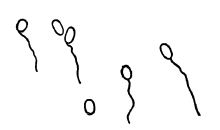
Deposition of Limestones and Dolomites. — The lime and magnesia carried in solution by the rivers to the seas are distributed far and wide by the marine currents. That small part which is taken out of the water through organic agency in the littoral is masked because of its dissemination through the thick deposits of these seas. For this reason it is usually said that limestones and dolomites are the deposits of the deeper waters and those far from the shore. However, back of the Keys of southern Florida, where the waters are warm and the land is limestone and but little above [ p. 86 ] sea-level, limestone and oolite deposits may be seen accumulating on the very shore. In the past few years it has become plain that the main areas of limestone and dolomite formation are the warm waters, for in the tropical regions not only do the rivers bring to the sea more lime, but the oceans are also far richer in denitrify ing bacteria (Fig., below) and it is these micro-organisms that in their physiological processes throw down the main amoimt of Ume carbonate. To this are added the structures made by the lime-secreting aJgse, of which there are many kinds, by the coral reefs, and by other hme-using animals. The calcareous muds in the deeper water of tropical and subtropical regions, in depths of from 600 to 2000 feet or even more, have from 80 to 90 per cent of lime, and of this from 10 to 50 per cent originates in the floating Foraminifera, while from 2 to 40 per cent is from bottom-living Protozoa. Proceeding poleward we meet with less and less of limestone accumulation, though this is locally variable, dependent upon the temperature of the surface waters that again are so largely altered by the great oceanic currents.
Walther says the conversion of the sulphate of lime of the oceans into the calcium carbonate of the limestones by organisms is the greatest quantitative change wrought by life upon the face of the earth.
Nansen has directed attention to the hemipelagic muds of the central Arctic Ocean, which he says are devoid of large organisms and are brown in color, with only from 1 to 3 and rarely 5 per cent of lime. He states that this mud is a mineral deposit devoid of life other than a few bottom-dwelling Foraminifera. The muds of the Arctic waters off Europe show far more lime, from 25 to 40 per cent, with a Tn aviTniim off Iceland of from 45 to 60 per cent, dropping at Jan Mayen again to 10 per cent. Most of this lime is from Foraminifera (Biloculina), It would further appear that more lime is present in the surface muds than in those beneath, an increase that may be due to the gradual warming of the climate in recent geologic time.
Diagenesis. — As limestones are of organic origin, naturally they should have an abundance of fossils, and most of them do. It is well known, however, that many are more or less crystalline, as are nearly all of the dolomites, and in this case fossils are usually absent or are so altered as to be almost unrecognizable. Here we are not dealing with metamorphism, because many such limestones and dolomites still remain horizontal and occur in areas unaffected by elevation and igneous injection. It is true that a process of alteration has taken place, but it was contemporaneous with accumulation and not ages afterward. The diagenetic changes are due to chemical alterations taking place on the sea bottom [ p. 87 ] and in warm waters. The Globigerina oozes of the present seas show no alterations and, even though they are the growth of warm surface waters, are accumiulated in the ice-cold depths of the ocean abysses. The limestones of shallow warm waters, as for instance many coral reefs, have lost most of their organic structures, and we learn by careful study that the carbonate of lime originally present in the form of aragonite has been converted into calcite. In addition, the original carbonate of lime in either form may be more or less replaced by magnesium carbonate and thus a calcium carbonate coral reef, or a limestone of vast extent, may be altered into a dolomite. Time, warm and shallow water, variable concentration of solutions, much oxygen, and a wealth of decomposing organic matter are the requisites that will completely alter calcareous organic accumulations into crystalline limestones and dolomites before complete consolidation has taken place. This alteration has been called by Walther diagenesis, from words meaning through and birth, or, in other words, it is a rebirth through contemporaneous alteration.
Iron pyrite and marcasite concretions and fossils of black shales axe also diagenetic products. Moreover, it has been held that the flints of chalk deposits are diagenetic in origin where the colloidal silica of sponges is progressively dissolved and redeposited about nuclei as flint and thus converted into these irregular lumps. On the other hand, the cherts of limestones develop near the surface in the zone of the circulating ground waters during the process of weathering, and are therefore not of diagenetic origin. As chalk is porous to ground water, and as the flints occur in both horizontal and vertical attitudes, it is probable that they, too, are formed after the sediments are uplifted sufficiently high to permit the circulation of meteoric waters.
¶ Collateral Reading
Vaughan Cornish, Waves of the Sea and Other Water-waves. Chicago (Open Court), 1910.
D. W. Johnson, Shore Processes and Shoreline Development. New York (Wiley), 1919.
J. Walther, Einleitung in die Geologie als Historische Wissenschaft. Jena (Fischer), 1894, Chapter 13, Die Diagenese.