[ p. 301 ]
CHAPTER X
PASSING ON THE TORCH
A. What It Means to Pass on the Tobch
B. The Family, the Geeat Torchbeakee
C. The School’s Cooperation in Torchbearing
D. The Church and Other Cooperators in Torch bearing
Questions to Keep in Mind while Reading This Chaptee
- Why is it important for each new generation to get the stored-up knowledge of the past?
- What are the main agencies that transmit this stored-up knowledge?
We have carried our story of man, the communicator, far enough to see that he has, through the long years, greatly multiphed his powers of communication. Beginning with hds abihty to talk, he has become able to write, to print, and to scurry around over the earth in steamships, railroads, automobiles, and airplanes. He has annihilated distance with the telegraph, the telephone, and the wireless. The whole world has become a great “whispering gallery” for his messages. Through trade, all lands cooperate in gratifying his wants. Money is the language of trade.
Just as man has devices to reach out to all the world of to-day, so also he has devices for communicating with the generations yet to be born; he has ways of passing on his torch of knowledge to coining generations. Let us notice how important it is that this torch should be passed on. Then let us study some of the institutions (such as the family, the school, the church, and the press) that have become our great torchbearers.
[ p. 302 ]
¶ A. What It Means to Pass on the Torch
(How much we leam from others; when we learn most easily; why man is the best learner.)
Accounts of feral men show that much is passed on to us by the group we live in. — About one hundred years ago, over in central Europe, a baby boy was one day left on the doorstep of a peasant’s hut. The peasant took the baby in, but for some strange reason he took care of him in a very queer way. The boy was kept day and night in a dark underground cell, where he did not see daylight or trees or animals or anything else of the outside world. He never heard anyone talk. He did not even have playthings, except two wooden horses. He never saw anyone. Even the peasant who took care of him came only when the boy was asleep.
When the boy was set free, after fourteen years of such life, he acted in a most unusual way. For example, he seemed to have no clear idea how far away things were; he reached for distant things, just as babies reach for the moon. The first time he saw a candle, he put his hand in the flame and was burned. He seemed to think anything that moved was alive, even to bits of paper or dry leaves blowing about. As for what we call manners or social customs, he had none. He Tmderstood nothing that was said to him and had no speech of his own. His senses of hearing and touch were quite strong, but it was difficult for him to walk.
We know of other cases of boys and girls who from their earliest days did not come into contact with other persons. We call them “feral” people, meaning that they have grown up alone or with animals rather than with other persons.
We leam most things from other persons. — As we read of such persons, we begin to realize how many things we learn from others. We find very few things out for ourselves; we [ p. 303 ] learn most things from others. We learn, for example, how to talk and write; how to make a fire, use tools, and build houses; how to eat and dress; how to begin and end a letter. We also learn what to believe about the past, about ourselves, and about the world we live in. This covers everything from the origin of the earth and man to why the wind blows, why water freezes, why we fought the Civil War, and who God is.
The early, plastic years. — The accounts of feral persons also show that even after they were found, it was very hard for them to learn the ways of the people who found them. They had trouble in learning to talk and in learning ordinary things about food, clothing, tools, etc. In other words, unless one learns the ways of his group early in life, it is hard ever to learn them. Our early years are our most plastic years. Plastic means easily shaped or molded. By the time we are three years old much has been done to “shape” our dispositions, our notions, and our habits. By the time we are fifteen or twenty-five we have largely been “set” in the ways we shall think and act through life.
Why is it necessary to pass the torch on? — How does it happen that we need to have the stored-up knowledge of the group communicated to us? If young robins were kept away from other robins from the day they were hatched, they would stm know how to make nests when they grew up and would in all other ways be quite competent robins. Beavers that had lived alone from babyhood would know how to make their houses and dams. Ants and bees that had thus been raised and later “found” by their groups could at once fit in with the group life. Speaking in general terms, the insects are free from any need of being educated. While the higher animals are not entirely free from this need, they are fairly free from it. Man alone, of all animal life, loses a very [ p. 304 ] great deal when cut off from communication with his own kind. He needs to be educated. Why is this true?
And here is another interesting question. How does it happen that, of all forms of hfe, man is the best learner? Dogs and cats and beavers and horses and other animals can be taught a few “tricks,” but just think how little they can learn compared with man. They are not nearly so plastic. They are more unchanging and rigid. Why is this?
Creatures having only instincts cannot learn. — Some of our scientists give a very interesting answer to the questions of the preceding paragraphs. Far, far back, they say, as the lower forms of life were slowly developing, a very interesting split, or fork, took place in that development. One branch was the road taken by the insects, such as the bees, the moths, and the ants. Those who traveled this road are almost entirely creatures of instinct. They have their whole equipment for life when they are born, and they are able to learn little or nothing. They are not plastic: they are rigid.
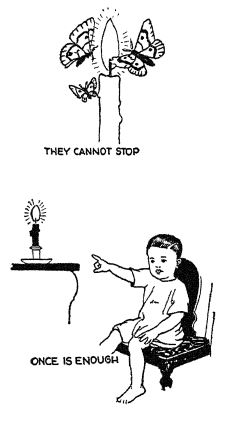
Take the moth, for example. The moment a moth emerges from its pupa stage, it has all of the abilities of a grown moth. It does not have to be told where and how to get its food; where and how to get shelter; where and how to lay its eggs and provide for its young. It does ah things by instinct. It can become a thoroughly capable moth without ever seeing or learning from any other moth. But there is another [ p. 305 ] side to the story. While it is “bom” with all the abilities of a grown moth, it is rigid. It cannot learn. For example, when it sees a candle flame, it flies into that flame. It gets scorched, and flies out. But it does not learn to avoid the flame. If it sees the flame again, in it goes, and that continues until either the flame is taken away or the moth is killed. It cannot learn. It has almost no ability to change. [1]
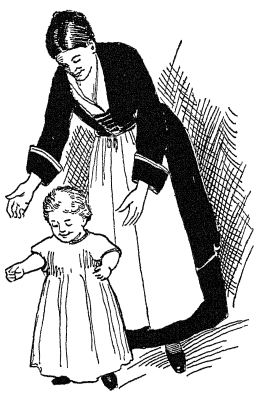
Man has instincts plus ability to change and to learn. — The other fork of the road was taken by those forms of hfe that were to develop into the mammals, such as the cat, the dog, the horse, and man himself. Those who took this path also have instincts; but they have, in addition, an ability to change. They are not rigid. They can learn. Of all who traveled this road, man is the most plastic. No other form of life has anything like his learning power.
Furthermore, the plastic period lasts longer with man than with any. other animal. He starts, indeed, with so little “set” that he is helpless. “As helpless as a baby” has become one of our common sayings. The moment the moth appears, it is able to take care of itself. The young faun can run almost from the time of its birth. The period of helplessness for such animals as the cat and the dog is a short one. How very different it is with man! A year is likely to go by [ p. 306 ] before a baby is even able to walk. Another year may go by before he has learned to talk. It will be several more years before he has learned how to secure his own food, provide his shelter, and protect himself from danger. Many more years will go by before he has learned all he needs to know if he is to hve well in this complex world of ours. This is the main reason why, in the eyes of our law, a person remains a minor until twenty-one years of age. During that whole period, says our law, this minor should remain in the care of his parents or other mature persons. He needs that long a period to prepare to be a full-fledged member of the group.
Every group has torchbearers. — It is now clear how important it is that we should have devices for passing on to the on-coming generations the stored-up knowledge of the race. If we were unable to do this, the race would be only a short time in returning to the wretched conditions of Neanderthal man, for we learn most of the things that make life worth while. Since we do have devices for passing on to the new generations all that the earlier generations have learned, each new generation has a chance to begin its climb of progress at the point reached by the preceding generation. “We stand on the shoulders of all the generations that have gone on before us.”
Every group or society has ways of passing on to its younger members its stored-up knowledge. Take the Iroquois. There was the story-teller whose stories of the customs and brave deeds and religion of the people were eagerly heard by young and old alike. In the winter nights of the long houses, the talk among the elders was picked up by the children. The councils were great places for the youngsters to learn the ways of the tribe. At the gens and village councils where local affairs were talked over and at the tribe and league councils where the laws and customs of the whole people were recited, [ p. 307 ] the boys and girls would drink in every word. At the festivals and dances they would learn of the “spirits.” In their plays and games they would imitate the deeds of their elders.
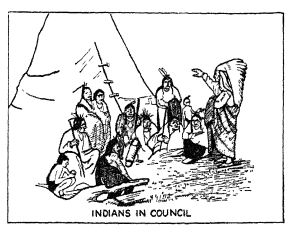
Although there were no schools, there was a certain amount of teaching. The father would show the boys how to make the canoe, the bows and arrows, and the other weapons of war and the chase. The mother would show the girls how to till the soil, prepare the food, and take care of the long house. In such ways, the Iroquois lads and lassies learned how to play their part in the savage hfe of the time. They learned to do the ordinary work of the tribe. Let us call that learning the industrial arts. They also learned the history, customs, reUgion, and ideals of the tribe. They were thus prepared to live in their group or society.
Our life to-day is more complex than that of the Iroquois. There are many more things to be learned. It is natural, therefore, that we shoxild have not only their ways of passing on the torch, but also many others. We still use the family, and story-telling, and play, and talks by elders. In addition we have schools and churches and books and theaters and many other devices. Let us look first at the family, the great torchbearer of the race.
¶ B. The Family, the Great Torchbearer
(The great transmitter of language, attitudes, opinions, customs, practical arts, and ideals.)
The colonial family taught the industrial arts to the younger generation. — We can best see what the family can do as [ p. 308 ] a torchbearer if we look at its work in a society where much of the life centered about the family. Let us choose for study the farm family of our colonial days. We know that in our colonial days the roads were few and poor. There were no railroads, and many famihes were located where there were no waterways. The result was that the farmer and his family lived very much to themselves. What the children learned they learned mainly from the family. For example, since the colonial family raised or made nearly all the goods they used, the children learned the industrial arts right in the home.[2]
Making farm tools. — Their farm tools (of which the modern city boy or girl scarcely knows the names) are a fair example of the things they made. These consisted of log boats and sleds for transportation, plows, harrows, pitchforks, hand rakes, shovels, ax handles, hoe handles, scythe snaths, singletrees, doubletrees, chps, clevises, ox yolks, and harness for the horse. All maimer of makeshifts were necessary to supply some of these articles. For example, horse collars were made of corn husks; hames, of crooked roots; clips and clevises, of hickory withes; ox yolks, of bent hickory wood; traces and bridles, of twisted deerhide; and pitchforks, from forked boughs or antler horns.
Providing lights. — The colonial family had to provide itself with lights for the evenings. Kerosene, gas, and electricity were unknown, so less satisfactory means had to be used. One such means was candlewood, which was nothing [ p. 309 ] more than the knots and hearts of resinous pine trees. Then, too, rashes were used, after being dipped in tallow or grease. Oils from fish, bear, whale, and moose all did good service. Alost important of all, however, were the candles made from the tallow of bayberries, and candles from animal tallow, whale oil, and honeycomb wax.
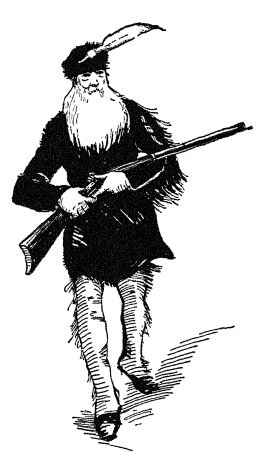
Making clothing. — The hides of animals killed for food on the farm or the skins of the deer, squirrels, raccoons, rabbits, beavers, and foxes shot or trapped in the woods were used for many purposes. Deerskins were made into hunting shirts, breeches, coats, leggings, and moccasins. Gloves and mittens were made from the skins of squirrels and beavers. Caps were made from the skins of raccoons, bears, foxes, cats, rabbits, and woodchucks. Bearskins were made into beds and bedding.
While the farmer and his boys were busy supplying leather clothing, the wife and daughter were manufacturing cloth for making other wearing apparel of the family. They raised flax in their owm little patch, harvested it, separated the cloth-making fibers from the woody part of the stock, and prepared the fibers so that they could be spun into thread. Then they wove the cloth. After the cloth was finished, they bleached it or dyed it. There remained the task of shaping it into garments.
[ p. 310 ]
The colonial family also taught ideas and ideals. — It is clear enough that the colonial family passed on to the younger generation most of the industrial arts of the time. But that was only a beginning of its work as a torehbearer. Schools were few, and often the hard-working mother taught the children to read and write. Around the fireside in the long winter evenings, the family would gather while an older member of the group read from the slender stock of books or from an occasional newspaper. Then too, from the family talk and actions the youngsters got most of their ideas of government, of loyalty, of right and wrong, and of religion.
The family is still our greatest torehbearer. — The colonial family was a small picture or miniature of the whole society of that time. One could, accordingly, learn in the colonial family almost all the important matters connected with living together in society.
To-day the family is not such a good miniature of the whole society. For example, many of the industrial arts are carried on to-day in large factories rather than in the home, so that the home is no longer the only place where the industrial arts are learned. Nevertheless, the family is still our most important device or institution for passing on to the young the stored-up experiences of the race. It is, indeed, almost the only such institution during the earhest and most plastic years. In the later years of the child’s life, the family shares its torchbearing work with the school, the church, the club, and the playground. But even in these later years children continue to learn by imitating the elders in the family, by being taught all sorts of things by the parents, and by taking part in the duties and joys of the family life.
A list of the more important deeds of the family as a torchbearer will show how much we depend upon it.
[ p. 311 ]
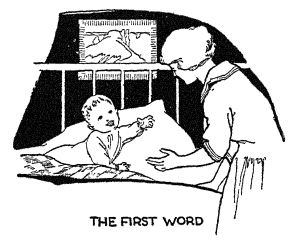
1. The family gives us our spoken language. — By this time we know how important language is if we are to live together well. But did you ever ask yourself how you got the language you are using? You got it in the family. Your mother and father and elder brothers and sisters hung over your cradle and coaxed you to imitate their gestures, their sounds, and finally their words. Your first word was a great event in the family. After that, few waking hours went by that they did not encourage you to talk and talk and talk. So thoroughly, indeed, did they do their work during your plastic years that they largely “set” your habits of speech for life. You can change these habits later, but it is not easy to do so.
The family, then, has given you the greatest tool you will ever use — speech.
2. The family largely “sets” the way our muscles and nerves are to act all the rest of our lives. — During our early years we are a “clean slate” upon which the family writes without knowing it. The reason is that we imitate the grownups. “He walks just like his father,” “That gesture of hers is exactly like the one her mother makes,” and a host of other sayings show how much the family affects our bodily actions. So also it affects our dispositions. Whether we are “spoiled” or “good as gold” or “stubborn” or “sunny” will largely be the results of the physical care we are given; of what we find to imitate; and of what is required of us during those early very plastic years.
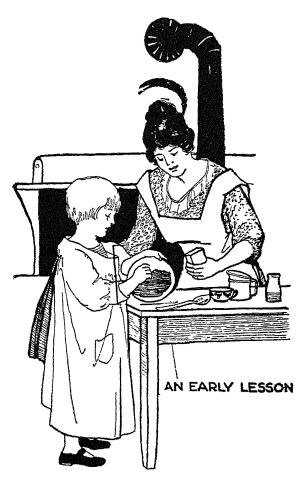
3. The family teaches us many of the industrial arts. — It is true that the family to-day teaches the industrial arts far less [ p. 312 ] than did the colonial family, but it still teaches them. Most girls still learn to sweep, sew, and run the house by learning from the mother. The country boy still learns many industrial arts from his family. Even the city boy is likely to have his shoproom where he and the other members of the family work on his special interests and “fads.” There is no doubt, however, that schools and business houses have taken over much of the task of passing on to the younger generation the useful industrial arts.
4. The family largely “sets" us in our ways of thinking, our tastes, our manners, our opinions and ideas. — This is just what we should expect. No one can know enough or have time enough to work out all these matters for himself. Accordingly, in our plastic years we pick them up from the adults in the family. If the parents or older children love art or books or music, the youngsters will ordinarily love them also; if the older members love amusement and sports, so also will the younger ones. If the father is a Baptist, a Republican, a Mason, or a member of a trade-union, the chances are the boy wiU be these also.
Of course, children do not always follow exactly in the footsteps of their elders, especially in these days when so [ p. 313 ] many other forms of communication beat upon them (see page 211). However, there are few sayings more common than these: “She is her mother’s own child,” “He is a chip off the old block,” “Like father, like son.” They show how true it is that the famity shapes us.
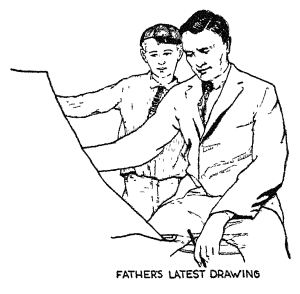
5. So also, the family largely “sets” us in our ideals and aspirations. — The teachings and examples of our elders, as well as the talk of the congenial family gathering, develop our ideals. In the family, more than in any other single place, we leaim to love, to wish to be of service to others, to be loyal to home and country, to know the difference between right and wrong, and to follow the teachings of religion. It has often been pointed out that high-mindedness runs a good deal “in families”; so also does low-mindedness. For better, and sometimes for worse, the family shapes us.
¶ C. The School’s Cooperation in Torchbearing
(What the school does; the arrangement of its work; the American, school system.)
We have come to see that we need the school. — The family is our greatest torchbearer, but we have found that it is mse to use other devices also. This is partly because our life is so complex that the family is no longer a miniature of the whole society. It is partly because our knowledge today, as shown by the list of sciences on page 157, is so large that the older members of the family cannot possibly get [ p. 314 ] time to learn it and pass it on to the children. Such work requires specialists who give all their time and thought to the task. Those specialists are the teachers in our schools. They study the enormous mass of knowledge of to-day and pick out the really important parts that we must all be sure to get if we are to live together well. Then they work out effective ways of passing these important parts on to us. Their work is done in schools where there are libraries, laboratories, workshops, playgrounds, and other helpful devices.
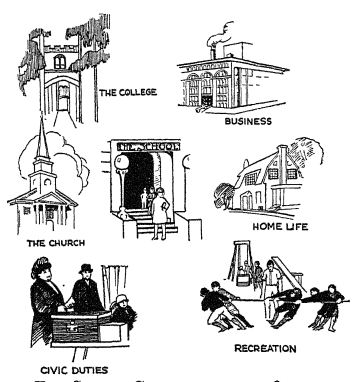
Our schools are the center of society’s effort to pass on the stored-up knowledge of the race.
Our schools teach us the great factors in human progress. — It is easy to say that our schools help us to live well in society — help us to play our part in human progress; but just what does that mean? What do we expect to find taught in our schools? Since this book is a story of human progress, its Table of Contents will point out to us the vital and important parts of our race experiences. It will point out the things we must imderstand if we are to live together well. Let us turn back to the Table of Contents.
Part I is merely introductory. It shows us how man once lived, so that we may have something against which to [ p. 315 ] measure his later progress. Parts II, III, IV, and V take up, one after another, the four great aspects of human progress. These parts deal with Man, the Harnesser of Nature; Man, the Communicator; Man, the Social Organizer; and Man, the Idealist and Aspirer.
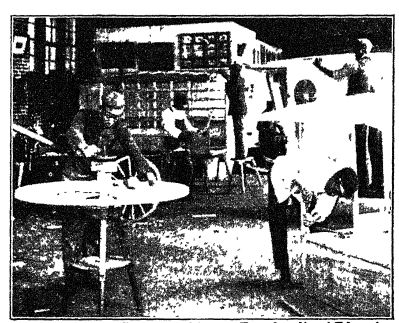
A Class in Wagon Making
Science the great harnesser of nature. — Part II shows that man must be a harnesser of nature if he is to hve well, and it points out that science is the greatest of all harnessers. Since this is true, there should be somewhere in the course of study in our schools, work in the sciences. So also, there should be courses applying the sciences to our ordinary vocations, to our industrial arts, to the task of making a living. Is that the case in the schools of your city? Are such sciences as geography, physics, mathematics, and chemistry studied? Are there vocational courses (courses preparing one to make a living) in shop work, domestic science, etc? Is anything done to let you know about the various vocations that exist to-day and how to prepare for them? Do you see how sensible such courses are?
Communication. — Part III shows that commxmication is essential to living together well. It follows that we should [ p. 316 ] have in our schools work in language and the language arts, and that we should have a chance to learn of the forms and means of communication. Do the schools of your city teach English? D o they teach foreign languages ? Is writing taught ? Is reading? Is typewriting? Are numbers taught, so that they can be used in communication? Do you see how sensible such courses are?
Social organization. — Part IV deals with man, the teamworker, the cooperator, the member of an organized society. Evidently, when we study Part IV, we are to see that man finds still another multiplier of his powers through cooperating with others in a group or society. That being true, we should expect our schools to give us the social studies (history, civics, economics, and sociology) so that we can learn how society is put together and how its work is done. We should expect to find our schools telling of our country, of what it means to be a good citizen, of some of the problems our country faces, of what we are doing about those problems, of the joy and worth-whileness of serving society. Do you find such things being done in your schools? Are any social studies taught? Do you hear of our national heroes? Are patriotic exercises held? Do you learn of the duties of the officials of the city government and how to help them? Do you see how sensible such work is?
Ideals and Aspirations. — Part V presents man, the idealist and aspirer. Already we have begun to see that right motives and ideals are absolutely necessary to living together weU. We may expect, then, to see our schools dealing with ideals and aspirations. Our schools do this in the social studies and also in art and music where man has so frequently tried to express his aspirations. We have thought it best not to have religion taught in our public schools, but in many other ways those schools deal with right motives, truthfulness, [ p. 317 ] honesty, service — with ideals and aspirations. Do you see how sensible this is?
Then, too, the schools, as we know, concern themselves a great deal with health and recreation. No argument is necessary to persuade everyone how helpful it is to have sound bodies and happy minds in doing the world’s work. Wholesome play, furthermore, is one of our best torchbearers, as we shall see later (page 324).
Schools are not a very old device. — The school is a young institution, as compared with our oldest social institution, the family. The family is old, older than the city or state — older even, than tools or clothing. But the school is new. Neolithic man, for example, did not have it, although he almost had it when the story-teller told the children the myths and customs and history of the tribe. In some societies, after man learned to write, schools were set up in which the priests or other wise men taught from their writings and especially from some sacred book. The ancient Egyptians, the Babylonians, the Hebrews, the Chinese, and the Hindus all taught selected members of the group in this way.
The Greeks (later the Romans copied the Greeks) had better schools, though their schools also were open only to the favored few. School life for the Athenian boy began at about the age of seven. He was placed in the hands of a private tutor, who daily led him through the streets of the city to add to his instruction in reading, wilting, music, and gy’mnastic drill. At fifteen or sixteen, the boy w’as placed in a public school. Here he talked with his elders and learned Greek laws and customs. After two years of this he had tw’o years of training in the use of arms. It is quite clear that the Greeks were anxious to pass on to the young healthy bodies, active minds, training as citizens, and love of the beautiful.
[ p. 318 ]
After the collapse of Rome in the fifth and sixth centuries, there were few good schools in Europe. They were not needed to pass on:lhe simple hving of the barbarians. Presently, however, schools arose again in the Christian monasteries, growing fairly -rapidly after the Rebirth of Learning that helps mark Jhe beginning of our modern life. But they were still for the favored few. Education for everybody is a recent matter. It is not one hundred years old in even our own country.
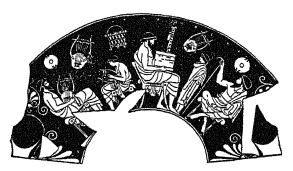
(Copied from an old vase.)
The present American school system is quite new. — In case after case we have seen that the last one hundred years have witnessed great strides in man’s progress. That is time of fire, metals, power, macnines, science, printing, afid transportation. It is also true of our schools. It is only within the last hundred years that we have really come to understand that we are hving in a new world, and that the education of children is the hope of the future. Only during the last few generations have we seen how important it is to make much use of schools in giving this education. Only during the last few generations have we taken these great steps to make our educational system what it is:
1. Free schools. — We have made the pubhc schools free. That is, they are maintained by public taxes and not by fees paid by the parents. They are free to all, rich and poor alike.
2. Compulsory attendance. — We require all children within certain age limits (the limits varying in different states) to attend school. These compulsory schools are our elementary (and sometimes our secondary or “high”) [ p. 319 ] schools. We try to make sure that everyone shall have a chance to learn the stored-up wisdom of the race.
3. Higher education. — We have extended free education up into our high schools, thus showing our belief that modern complex hf e needs a longer period of school training. Furthermore, many states and quite a number of cities have set up colleges and universities, open to all at very low tuition rates. Sometimes no tuition at all is charged.
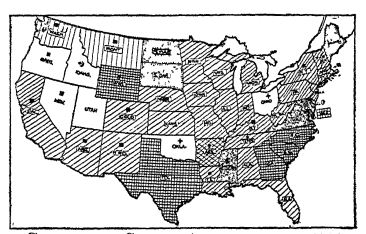
The states in white required school attendance to the age of 18. The heavier the shading, the lower the standard.
4. Governmental supervision and aid. — We have provided state systems of education, so that no locality may fail to provide satisfactory schools. These state systems vary somewhat from state to state. In general, however, our elementary and high schools are managed by the locality (the county, city, township or district) in the sense that local boards of educartion hire the officials and teachers and govern the schools. These schools are supervised by the state in the sense that the state passes general laws concerning courses of study, the powers of the local boards, etc. There is likely to be, too, a state superintendent in charge of supervision. These schools are aided by the National Government which has given over 150,000,000 acres of land to the states for educational purposes. Then, too, it has given milhons of dollars to aid industrial, commercial, and agricultural education. The Federal Bureau of Education studies educational problems and aids states and localities with its advice.
[ p. 320 ]
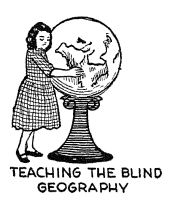
5. Private schools. — In addition to the public schools there is a host of private schools, ranging from the kindergarten up through the elementary school, the high school, the college, the professional school (see page 157 for the story of our schools of technology), and the university. Then, too, there are both public and private schools for our unfortunates, the blind and the deaf. There are pubhc and private schools for those who have to drop out and go to work before their education has been carried very far. These pubhc schools are “continuation schools” in which one can continue his schoohng while at work. The private schools are such institutions as the private “business college” for teaching clerical work, and the “corporation schools” of our large business firms for the training of their employees.
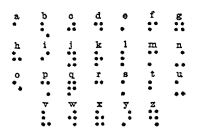
Instead of the dots the paper is raised or embossed at those points.
There is no doubt that we, as a people, are fully persuaded it is a good thing to use schools as one device for passing on the stored-up knowledge of the race. We rely upon them to train our leaders, knit our people together, give us good methods of work, show us how to keep in health, help us make good use of our leisure time, help us appreciate the finer things of life, and prepare us to live together well in a democracy. We ai’e such behevers in education that some writers say education has become a part of our religion. Of course, these writers mean by such a statement that we have come to think of education as one of the most important devices a people can use in its effort to live together well.
[ p. 321 ]
SOME PROOFS OF OUR BELIEF IN EDUCATION
50,000 teachers in colleges and technical schools
24,000,000 persons attend school every year
137,000 teachers in public high schools
2,500,000 persons attend high schools
12,000 teachers in private and public kindergartens
620,000 persons attend colleges and universities
706,000 teachers in elementary and secondary schools
$350,000,000 spent annually on colleges and universities
$450,000,000 spent annually on high schools
$1,200,000,000 spent annually on elementary schoolsBUT NOTICE THAT WE SPEND
$6,000,000,000 annually on movies, candy, and smoking
¶ D. The Church and Other CoOperators IN Torchbearing
(Religions and churches; young peoples’ groups; newspapers, books, and libraries.)
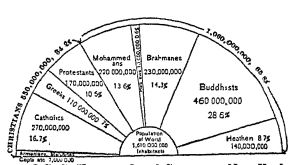
The World’s Main Religions
There have been hundreds of different kinds of religions in the past. There still are many kinds; but as time has gone on, four religions have been accepted by such a large proportion of the world’s people, that they are called the four great religions. They are (1) Hinduism and Brahmanism, whose followers are mainly in India; (2) Buddhism, whose followers are mainly in Japan, China, Burma, and Ceylon, (3) Mohammedan ism, whose followers are mainly in Asia and Africa; and (4) Christianity, with followers mainly in Europe, America, and Australia, although they are scattered all over the world.
[ p. 322 ]
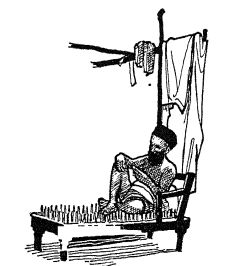
This fellow thinks he is pleasing his God by this act.
Everyone, is bom into some religion. — There has never been a people without a religion. It may have been a strange rehgion, as we think of such matters; but there it was and is, always. Furthermore, it has always been very influential in the lives of the people. A group usually feels that its religion is about its most important possession. It uses its torchbearers, therefore, to pass the group rehgion on to the later generations. In earlier days, this was done by the family, by the story-teller, by the medicine men, and by the priests. Today, it is done mainly by the family and the church, although other torchbearers also help.
Since Christianity is the chief rehgion of our country, let us look at the work of the Christian church as a torchbearer.
The Christian religion emphasizes right conduct toward others. — The most important thing we This feUow thinks he is pleasing his need to keep in Hund when we think of the Christian church as a torchbearer is this : the Christian rehgion holds that its teachings should be effective in our everyday hfe; and that they should affect the way man acts toward man just as truly as they should affect the way man acts toward God. That is rather a novel idea, as rehgions go. Most earlier rehgions concerned themselves only with how man should act toward God. Man must follow, said these rehgions, certain customs because these customs pleased God. Man must go through certain forms; he must be careful not to make his god (or gods) angry. Even to-day, some of the leading rehgions are mainly concerned with such matters.
[ p. 323 ]
But the Christian religion, which has its roots in the Jewish religion, emphasizes even more than does the Jewish religion the duty of man to be merciful, just, wise, kind, helpful. Jesus made an amazingly simple summary of His teachings when He said :
Thou shalt love the Lord thy God with all thy heart, and with all thy soul, and with all thy mind. This is the first and great commandment. And the second is like unto it. Thou shalt love thy neighbor as thyself. On these two commandments hang all the law and the prophets.
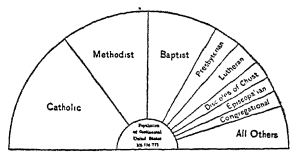
Membership in the Main Religions in Our Country
The activities of the church. — Once we have seen that our churches are I’eally all working at the same task — the task of passing on to men a religion demanding right living and right acting — it is easy to understand the devices they use in that task. The gathering of the congregations for sermons or masses gives chances for the message to be sent on. Such groups as the King’s Daughters, the Christian Endeavor, the Epworth League, the Sunshine Society, and a host of others turn the thoughts of their members in the desired directions. The Men’s Club, the Knights of Columbus, the Church Club, and other organizations bring groups together outside the church building for recreation or for discussion of questions of the day. Possibly the most important single activity of the church as a torchbearer is the Sunday School, since here the younger and more plastic members are very definitely shaped by the elders.
It would take pages to catalog all the activities of the church as a torchbearer. No two churches do their work just alike — and that is as it should be. Just as the needs of [ p. 324 ] to-day are different from those of one hundred years ago, so the work of a church that serves a country district may well be somewhat different from the work of a church that serves an immigrant population in a crowded city. This latter church is likely to do a great many things and to become what is known as an “institutional church.” It provides libraries, chess rooms, bathing rooms, bowling alleys, club rooms, playgrounds, schools — anything and everything that, at any hour of the day or night will draw in people who can be shaped or molded.
Young people’s groups act as torchbearers. — In addition to the molding or shaping of the yoxmger generation by the elders in family, school, and church, there is a whole host of groups in which the boys and girls do their own shaping — generally, it is true, with some guidance from their elders. There are various groups ranging from the street “gang” up through the ball clubs, the playground groups, the boy scouts, the campfire girls, and all the rest of them.
Boy and girl scouts. — What the boys’ and girls’ groups at their worst can do is seen in the lawless street gangs. What they can do at their best is seen in the work of the Boy Scouts, the Campfire Girls, and similar groups. Let the Boy Scouts speak for themselves in the statement on the opposite page, taken from their manual.
The playground groups. — Recreation and play relieve the strain of modern complex life. They relieve the monotony of modern factory and office work. They help to make healthy bodies and happy minds in young and old alike. These are good reasons for having our parks, theaters, bathing beaches, and roof gardens. But there is still another reason for them and for the playground movement that has swept over the country in the last generation. Organized play is one of our best torchbearers. In organized play we [ p. 325 ] [ p. 326 ] learn to act in cooperation with others; to be governed by the rules of the game; to sacrifice our own pleasure or vanity for the sake of the team’s success. Some one has said that the “sacrifice hit” of our baseball gamesteaches us one of the best lessons we learn. There can be no doubt that cooperation, obedience to rules, and self-sacrifice are emphasized in our organized play. And there can be no doubt that these qualities are needed in hving together well.
LAWS OF THE BOY SCOUTS OF AMERICA
A scout is trustworthy. A scout’s honor is to be tnisted. He does not violate his honor by telling a lie or by cheating or by not doing a given task when trusted on his honor.
A scout is loyal. He is loyal to all to whom loyalty is due: his scout leader, his home, his parents, and country.
A scout is helpful. He must be prepared at any time to save life, help injured persons, and share the home duties. He must do at least one good turn to somebody every day.
A scout is friendly. He is a friend to all and a brother to every other scout.
A scout is courteous. He is polite to all, especially to women, children, old people, and the weak and helpless. He must not take pay for being helpful or courteous.
A scout is kind. He is a friend to animals. He will not kill nor hurt any living creature needlessly but will strive to save and protect all harmless life.
A scout is obedient. He obeys his parents, scout master, patrol leader, and all other duly constituted authorities.
A scout is cheerful. He smiles whenever he can. His obedience to orders is prompt and cheery. He never shirks or grumbles at hardships.
A scout is thrifty. He does not want to destroy property. He works faithfully, wastes nothing, and makes the best use of his opportunities. He saves his money so that he may pay his own way, be generous to those in need, and helpful to worthy objects. He may work for pay but must not receive tips for courtesies or good turns,
A scout is brave. He has the courage to face danger in spite of fear, and to stand up for the right against the coaxings of his friends or the jeers or threats of enemies, and defeat does not down liim.
A scout is clean. He keeps clean in body and thought, stands for clean speech, clean sport, clean habits, and travels with a clean crowd,
A scout is reverent. He is reverent toward God. He is faithful in his religious duties and respects the convictions of others in matters of customs and religion.
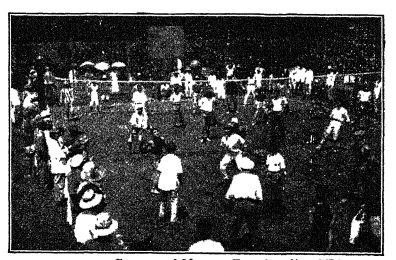
Organized Play: Volley Ball
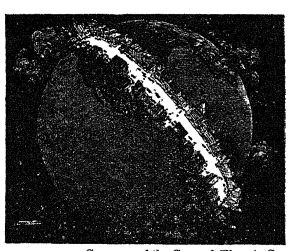
The wood used to make print paper for the United States every year would maice a heavy plank road sixteen feet wide around the world
Publishing is a way of passing on the torch. — Our account of the ways by which our thoughts and actions are molded would be quite incomplete unless we again mentioned our floods of printed communication.
The amount of this communication is so large that the figures mean almost nothing to us. One way of putting it is to say that every day five hundred acres of timber march into the jaws of our papermaking machines to give us the paper for our printing. And [ p. 327 ] the amount grows every year. The world of sixty years ago would have laughed at anyone who ventured to predict such floods of printing as we make use of to-day.

The work of the newspapers and magazines. — Our newspapers and magazines deal mainly with the happenings of the day. The time was when newspapers were small sheets of which a very few hundred copies were made for the local community. That time was only two or three generations ago, but it has almost disappeared from memory. The newspaper of to-day tells of everything and it reaches millions. -It has sections for domestic news, foreign news, financial news, sports, society, theaters and amusements, and real estate. It gives space to literature, editorials, education, and the “funnies.” It has something of appeal to everyone from the child of two to the man of one hundred. While its main concern is with the present, it does not hesitate to delve into the past or to peer into the future. Our weekly and monthly magazines also have matters of interest to everyone. They watch the men who serve the public, [ p. 328 ] suggest public improvements, deplore failures, tell of gi’eat discoveries and inventions, and, in general, keep us in touch with the world’s progress.
FLOODS OF PRINTED COMMUNICATION
(These figures are for the United States alone)
700 magazines for farmers
300 magazines for children
2,500 daily newspapers published
15,000 new books printed every year
40.000. 000 newspapers printed every day
20.000 periodicals of all kinds published
1.100.000 tons of paper used every year for books
1.500.000 tons of paper used every year for newspapers
95.000.000 monthly magazines printed each month
55.000.000 weekly magazines printed each week
Books and libraries. — As for our books, they are fairly permanent and thus reach over the generations better. Some one has said, “The book is the memory of the race.” It is certainly true that the written, and later the printed, record has been thus used from the time of earhest writing. The baked clay books and the papyrus and parchment rolls that have come down to us from Nineveh, Egypt, Greece, and Rome are like mirrors in which we see how those peoples hved, what they thought, how they were governed, and to what they aspired. What has been true of the books of the past will be true of those of the future. They will be a part of “the memory of the race.”
What books have meant and still mean to us may be seen from the use of libraries. There were collections of books in the temples and palaces of all the earher civilizations. The monasteries were the refuges of scholars and the keepers of books during the Dark Ages following the fall of Rome. Then the universities took up the task.
To-day, with our floods of printing, libraries have increased enormously. There are college and university libraries; national, state, and city hbraries; privately endowed hbraries; school hbraries. There are hbraries of law, medicine, history, commerce, agriculture, and engineering. And their size is staggering. A first-class university hbrary of to-day calls for 1,000,000 volumes. The New York Public hbrary has 2,800,000 volumes, the Library of Congress has 3,000,000, and these are smaller than the British Museum and the Bibhothgque Nationale (National Library) of Paris. Furthermore, ah hbraries are growing at such a rate that it is a real problem to know how to manage the books.
[ p. 329 ]
We must not think of our libraries as mere storage places for books. Far from it. They cooperate with the public schools and with government officials. They provide special reading for children, for clubs, for business men, for immigrants — for everyone. They conduct lecture courses and maintain exhibits. One can hardly think of a thing which some librarian somewhere is not doing to make the memory of the race available for our use. Books and libraries are among our greatest torchbearers.
Summary of the work of our torchbearers. — We have not made a complete study of our torchbearers. Several have not even been mentioned in this chapter. But we have gone far enough to see what is being done by some of our institutions today in shaping us to live in society. Of these, the most powerful is the family. It is the most powerful because it touches us when we are most plastic; because many of the other agencies work through it; and because we trust it so completely that we do not resist its shaping work.
The school and the church, taken together, are almost as powerful as the family. As well as we can judge, we are to rely upon the school more and more in the future. We are to rely upon our higher schools, the universities, to discover new scientific treasures — to lead in harnessing nature. We are to rely upon schools of all kinds, elementary, secondary, collegiate, technical, to serve in passing on the stored-up wisdom of the race.
An honorable place as torchbearers, too, must be given to the boys’ and girls’ groups, of w’hich there are so many kinds.
[ p. 330 ]
As for our printed torchbearers, we are greatly indebted to them. They re-create and inspire us. They circulate the wisdom of the race. They tend to bring about a oneness of our own people, and indeed of the peoples of the whole world.
¶ Problems
- What lessons do you draw from the accounts of feral persons?
- Look up the work “ instinct ” in a dictionary. Show how instincts are useful to us. Show that some instincts should be governed or controlled. Does the school make any use of our instincts in training us? How about the play instinct?
- Suppose that Neanderthal man had had only instincts, with no ability to change. What would our living be like to-day?
- What industrial arts have you learned? Where did you learn each one? What proportion of them was learned in the family?
- “One of the most important things the family does is to take care of the young.” Show why that is so important.
- In what ways, according to your friends, are you like the other members of your family? Make a list of the opinions and preferences you have that are like those of your parents. Make a list of those that are different. See page 312 to get a start.
- Why is it so important to-day to have older and experienced friends (our teachers) as guides?
- Work through the questions on pages 315 and 316.
- White out an argument for having vocational courses in the schools.
- Write out an argument for having in the school a school paper, a literary society, an engineering club, a musical club.
- Why is it wise to have free schools? Why is it wise to have compulsory schools? W’hy is it wise to have high schools?
- Write out a list of reasons why it will be best for you to go through high school. Make another list why it will be best for you to go through collie.
- White out an argument for having continuation schools for pupils who must drop out of the regular schools. [ p. 331 ]
- Draw up in three columns the main ways by which the stored-up experiences of the race were passed on ( a ) among the Iroquois, ( b ) in the colonial farm family, ( c ) in the United States to-day. Why do we need more ways of passing on the torch than did the Iroquois or the colonial family?
- “When we do our school work well, we are helping to do the work of society.” Why?
- Make a list of things done by your church which are not mentioned in the text. Point out how each of these things is an aid in torehbearing.
- Why is a religion that includes morality and ethics more worth while than one dealing solely with the worship of an unseen power? If necessary, look in a dictionary to find what is meant by morality and ethics.
- Read through the twelve boy scout laws. Does the family also try to get a boy to carry out such laws? Does the school? Does the church?
- In what ways do the Y. M. C. A. and the Y. W. C. A. act as torchbearers? Is that their main task?
- What did the writer mean by saying that the “ sacrifice hit ” in our national game, baseball, has had a great influence on our national character?
- Give five illustrations of cooperative action in games you play; five illustrations of the need of obeying law; five illustrations of following leadership; five illustrations of individual sacrifice for the good of the team.
- It is said that almost six hundred cities in the United States to-day have public playgrounds. Defend the expenditure of public money for this purpose.
- Pick out in to-day’s paper five things that help in passing on the experience of the race. Pick out five things that are likely to affect public opinion about the problems of the day.
- “Our habit of reading newspapers has helped to make us one united people.” How so?
- The account of our torchbearers in this chapter was incomplete in that it said nothing of the ways by w’hich our business houses pass on the stored-up experiences of the race. What are some of these ways?
- “Our knowledge can accumulate like a huge snowball, each generation of men adding something to it.” Show that this is true.
- Answer the questions at the beginning of the chapter, page 301. [ p. 332 ]
¶ Interesting Reading
Marshall : Readings in the Story of Human Progress, Chapter X.
- The Story of Paper Making (how paper is made: the enormous quantity used).
- Books and How They Are Made (the author, the publisher, the typemaker, the printer contribute to the “memory of the race”).
- The Newspaper (its origin : what it is : how it is made) .
See also:
Chapter II, 2. Woman’s Share in Primitive Culture (early division of labor).
Chapter VII, 2. Feral Man (what happens to persons who do not communicate with others).
Chapter XIII, 3. Woman’s Place in Modern Culture (the tasks andopportunities of woman in our society).
Chapter XIV, 1. Some Early Forms of Social Control (myths, magic, fetishism, totemism, and taboo).
Chapter XVII, 1. The Development of Ideals and Aspirations (what we owe Greek, Roman, Jewish, and Teutonic cultures: later forces developing ideals).
Problems to think over are given in these reading selections.