[ p. 333 ]
CHAPTER XI
COMMUNICATION AND LIVING TOGETHER WELL
A. Command of Language and Living Together Well
B. Our Mechanical Communicating Devices and Living Together Well
C. Torchbearing and Living Together Well
D. Ideals, the Guides of Communication
Questions to Keep in Mind while Heading This Chapter
- What may we expect of future communication through language?
- What may we expect of the future as regards the conquest of distance?
- What are our duties and opportunities as torchbearers for later generations?
- Can communication be used harmfully? If it can, what is to be done about the matter?
In this chapter we shall study four great factors in living together well. — As a result of our study of how man multiplied his powers by harnessing nature, we were able to make five statements (page 180) about our living together well.
Now that we have seen how man has multiplied his powers through communication, we can make additions to this list. These additions are the subject matter of the present chapter.
6. How well we shall live together depends upon the effectiveness of our language devices.
7. How well we shall live together depends upon the effectiveness of our mechanical devices for communication and trade.
8. How well we shall live together depends upon the quality of our torchbearers.
9. How well we shall live together depends upon whether man, the communicator, is guided by good ideals.
[ p. 334 ]
¶ A. Command of Language and Living Together Well
(How well we shall live together depends upon the effectiveness of our language devices.)
Language is by far our most important means of communication. Since this is true, our living together well in the future will surely depend upon our having good language devices. There are two matters to discuss in this connection :
(1) How may we expect the Enghsh language to develop?
(2) What is there for you and me — every one of us — to do about our own use of language?
The English language can be improved. — Let us begin by thinking of the possible development of the Enghsh language. What may we expect of it? Can it be made into a better tool in the future? We already know (pages 215 and 216) that language is a sort of hving thing. It shrinks; it grows; it changes. One way of seeing how much it can change is to look at this selection from Chaucer’s Canterbury Tales. It was written in our own language of some 500 years ago :
Singinge he was, or floy tinge, al the day;
He was as fresh as is the month of May.
Short was his goune, with sieves longe and wyde.
Wel coude he sitte on hors, and faire ryde.
He coude songes make and wel endyte,
luste and eek daunce. and wel purtreye and wryte.
That selection would be printed to-day thus:
Singing he was or whistling all the day;
He was as fresh as is the month of May.
Short was his gown, with sleeves long and wide;
Well could he sit a horse, and finely ride ;
And songs he could compose and well indite.
Joust and eke dance and well portray and write.
[ p. 335 ]
The change is certainly quite a large one. Yet the age of the Canterbury Tales is not very great, as we have learned to think of the life of our race.
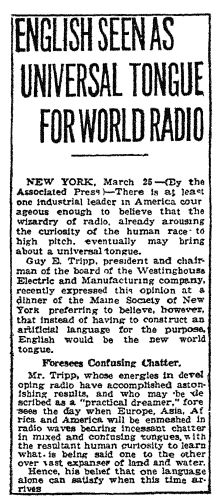
We must, then, expect language changes in the future. They will be so slow that we can hardly notice them, unless, indeed, science steps in. The scientific students of language (language has its scientists just as truty as has chemistry or history) point out that our language has “just growed,” like Topsy of Uncle Tom’s Cabin. It has not been “thought out ” very much. The result is that it has some defects. These scientists point out that the physicist can make good rules of action about machinery; the chemist can give rules of action about making substances; and the language scientist can give rules of action for making our language serve us better than it now does.
Certain language changes have been proposed. — There has been much talk at one time or another of making changes in our language. Probably you have heard of “simplified spelling.” It is argued that it would be easier and simpler for us to get command of language as a tool, if all words were spelled according to a few simple rules. Very likely you have also heard of such “universal” languages as Esperanto and Volapiik. The hope of the advocates of a universal language is that it may become the means of easy communication [ p. 336 ] between peoples who now speak different languages. Simplified spelling and universal language are only two samples of ways that have been suggested for making language simpler and more effective.
Such movements have not yet won their way. Perhaps the ones just mentioned never will. Perhaps they are only man’s “first fumbhngs” in the matter of language improvement. Man fumbled a long time with the steam engine, the telegraph, the telephone, and the locomotive before he hit upon the “right” ideas. Perhaps he is now in the fumbling stage as far as language is concerned.
Why not have the guidance of science in this matter? — This much is certain. There is just as good sense in having a body of picked scholars studjdng and reporting on wise language changes as there is in having commissions making studies of banking systems, employment exchanges, wastes in industry, plans of school systems, or a hundred other subjects that are much studied to-day. At first, this seems rather strange and almost startling. But when one thinks it over a bit, one sees it is quite sensible. Language is so important to us that it should be made just as effective as possible. Why not let science help to make it effective?
Wouldn’t it be interesting if we could see these paragraphs written in our language of a thousand years hence? Whatever they would look like, we are reasonably sure that a thousand years will see vast improvement in this multiplier of man’s powers. Perhaps a hundred years will do so. There are certain “fumblings” and other “signs of the times” indicating that science may be almost ready to turn its light on this part of man’s progress. Why not? We need only to make certain that we are following science and not foohsh fads. Our associations of scholars can save us from that error.
[ p. 337 ]
Everyone should strive to increase his command of language. — No matter what happens to the English language, every one of us should strive to increase his command of that language. Remember that language is a tool to think with. Remember that it is a tool for communicating with others. Do we wish to think as well as we can and to get the thoughts of others as well as we can? Certainly.
Language and making a better living. — The ability to think and to keep in touch w’ith the thoughts of others is very important in making a living. Anyone can see this is true of the work of such persons as scientists or statesmen or inventors. Pasteur, the great scientist who revealed germs to us, was noted for his ability to “pick the brains” of his fellow scientists. Roosevelt w’as alw’ays reading and talking problems over with others. Stephenson, the inventor of the locomotive, had little schooling, and he found that he had to study the thoughts of others as stated in mathematics and science if he was to succeed.
What is true of our great men is just as true of the rest of us. A young fellow, whom we shall call Willard Smith, works in one of the huge plants of Yoimgstown, Ohio. He began as a day laborer; became a semiskilled workman; then, a skilled mechanic. He is now a foreman and is soon to become an assistant superintendent. WTien the manager of the plant was asked why Willard advanced so rapidly, he said, “Oh, he uses his head. He knows what to do, and how and when to do it. He uses his head.” That tells the story. But behind that story is another story. It is a story of the hours Willard spent in a continuation school, in taking wmrk with a correspondence school, and in talking problems over with fellow workmen. “He uses his head,” and language — words — are the tools he works with in using it.
[ p. 338 ]
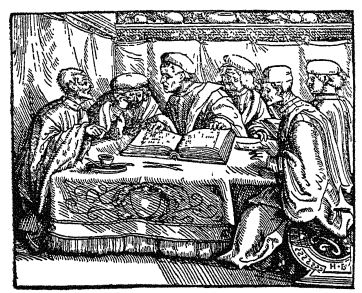
A Medieval Disputation
This old print shows a scholar of a medieval university defending his position against the criticisms of others. It was one way to arrive at the truth.
Language and increased ability to think. — Take another case. Helen Keller was both deaf and blind. She had no words until a skillful teacher showed her that there were such things. Miss KeUer has told her own story. She tells how her mind had little to work with before she was given words. She tells how a new world opened up to her after she learned that things had names. She began to use those names — words — to think with. Without words her mind was starved. When fed with words it grew wonderfully.
Suppose that you or I, at home or at school, come upon a new word, such as “lens.” It takes us some little time to make out just what that word means. We ask older people about it; we notice how it is used in sentences; we consult the dictionary; and finally we get the idea expressed by that word. Then we begin to use the word as a tool to think with. “Lens,” for example, helps us in thinking about the use of a microscope, a telescope, a camera, a pair of glasses, a sun glass, a bull’s-eye flashhght or lantern, or a moving-picture machine. Clearly, the more words we have, the more ideas we have, and the better we can think about various problems.

All we have said may be summed up thus : we increase our powers when we increase our command of language. We increase [ p. 339 ] our power to think; our power to make a living; our power to be of use and service to others. Increased command of language comes in two wmys: (1) by increasing the number of words one can use, and (2) by increasing one’s skill in using wmrds in sentences. Our teachers of literature and composition and foreign languages are all helping us to increase our command of language. But, of course, they can help us little unless we cooperate with them. They only help us to make a good start. We need to keep at the task ourselves all the rest of our lives.
How well we shall live together depends upon the effectiveness of our language devices. The devices should be good. Our command of them should be good.
¶ B. Our Mechanical Communicating Devices and Living Together Well
(How well we shall live together depends upon the effectiveness of our mechanical devices for communication and trade.)
Ability to harness nature has given the world a great ability to communicate and trade. — Books in physiology have made us familiar with the thought of our veins and arteries as a sort of transportation system of the body. The arteries carry “supplies” to every point; the veins carry away the used tissues. We are familiar, too, with thinking of our nerves as the telegraphing system of the body.
In this world of ours we find something similar. Highways, steamship lines, auto-truck lines, and railroads carry [ p. 340 ] supplies to and fro and enable the different parts of the world to trade and grow and prosper. Telegraphs, telephones, wireless, and the slower mails carry news and orders about and enable the parts to work in some harmony. It is easy to see that this is important and will continue to be important.
Will man be able to improve such devices in the future? Will he be able to expand his use of such capital goods (see page 195)? Of course, no one can know the answer to that question, for no one can know the future of science and invention. But there is every reason to beheve that man is only in the beginnings of effective communication and trade.

The world has increased such devices enormously in the last one hundred years. As the chart shows, there are less than three times as many people on the earth as there were one hundred years ago. But the tonnage of the world’s ships is ten times as great; the production of iron is sixty times as great; the production of coal is sixty-five times as great; the railroad mileage and the telegraph mileage are fifteen times as great (although we use only seventy years when we compare these) ; the commerce among nations is fifty times as great. The fact that commerce has mcreased fiftyfold while population has increased only threefold shows that man has to-day greater power to live well.
America has its share of these devices. — As for our own country, our need of conquering distance has caused us to have our full share of the world’s communicating and trading devices. Although we have only about six per cent of the world’s population, we have over sixty per cent of its telephones, [ p. 341 ] nearly ninety per cent of its motor cars and trucks, almost thirty-five per cent of its steam railroads, over thirty per cent of its periodicals, and almost fifteen per cent of its telegraph lines. No other people is more able to move goods or to send messages from place to place.
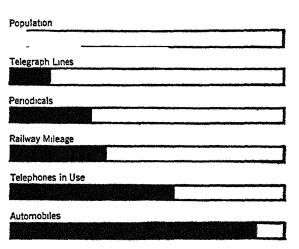
Each whole rectangle represents a total for the world The black part of each rectangle shows the share our country has.
This rapid progress of the past is still continuing. Just to amuse myself, I watched my newspaper for a few days to see what news items I could find about man’s conquest of distance. The list of these news items was so surprisingly long that I cannot give it in full. It had such items as these : The first airplane mail service from New York to San Francisco was put into effect and the mails crossed the continent in a little over twenty-six hours. WTiat a miracle that would have seemed to those pioneers of only seventy years ago who could not get letters in months! An aviator learned of the serious illness of his father and flew eight hundred miles one night to see him. A fleet of motor trucks was installed to carry fruits in fresh condition from a fruit belt to a city eighty miles away. A state pubhshed a map of its highways. It showed that railroads and fast automobile roads made all parts of the state accessible. Even the ordinary dirt roads would have seemed marvelous to our colonial ancestors. A cable company put the eighteenth cable across the Atlantic. It was a greatly improved cable. It could send more messages and faster messages than any other cable. A railroad placed an order [ p. 342 ] with a firm of builders for more powerful locomotives and larger cars. These few samples of the news of a few days show that man is forging ahead in his conquest of distance.
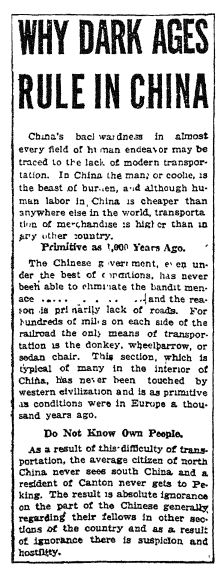
There is almost no limit to our dreams of the future. — In these same few days there were several items in the newspaper in which guesses were made about the progress of the next one hundred years in the conquest of distance. Of course, only guesses could be made, and we must not take these guesses too seriously. They merely show of what man is dreaming.
One writer pictured everybody having vest-pocket radiophones through which he could communicate with everyone in the country. Another thought that in a hundred years the postal service would be practically abandoned because letters would be too slow and clumsy a way of sending messages any distance. Another pictured a merchant m Chicago needing a shipment of goods from China. The merchant placed his order by radio, and a freight airship delivered the goods that same day, having traveled at the rate of 1,000 miles an hour, using atomic energy (see page 194) as power. Another thought that newspapers would cease to be used because they were clumsy and wasteful. Another spoke of starting around the world with the rising sun and arriving back at his starting point before [ p. 343 ] dawn the next morning, thus moA’ing faster than the earth turns on its axis and “beating the sun in the race.” Still another pointed out that we should do well not to smile at such strange suggestions. He said that the progress of the last hundred years has far surpassed all such “wild guesses” of the past. The wildest dreams of a hundred years ago have fallen far short of what has actually happened may not the same thing be true of the next hundred years?” he asked
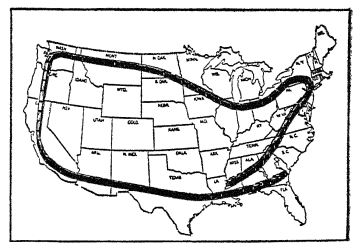
We Move Enormous Masses of Freight
If the freight loaded every week in the United States were put into one tram, that tram would reach around the country and overlap 200 miles.
Perhaps it will be well for us not to try to “lift the veil of the future” too high. Who can predict the path of science and invention? Nevertheless, our study of man, the harnesser of nature, has given us faith that he will make the future of man, the communicator, far more wonderful than the past has been. It has given us faith that we can have abundant capital goods to carry on our communication and trade.
There are, however, serious problems ahead. — It is not sufficient that we should be able to make plenty of such capital goods for the future. We must, in addition, be wise in our use and management of them.
Such communicating devices are, in the main, w’hat we call public utihties. That means they are businesses so vital to the whole people that we supervise them more than we do ordinary businesses. Right here is one of the hard problems [ p. 344 ] of our day. Some persons think that we ought to have the government own and manage these public utilities. Others say that we should continue our present plan of considerable supervision or regulation of them. Others say that our present supervision is too severe and that we are discouraging business men from building the communicating devices we need so badly. There is great confusion and clamor and argument about the matter. It is a “problem of the day.”
It is a problem too big for us to “settle” in our present study. All we can do is to see its outline. Whether we shall live together as well as we should depends upon whether we handle it wisely. If we do not, our ability to harness nature will not help us as much as it should in developing our mechanical devices of communication and trade.
¶ C. Torchbearing and Living Together Well
(How well we shall live together depends upon the quality of our torchbearers.)
When we talked in the last chapter of the work of the family, the school, the church, and the press, we tried to see these torchbearers as they would be when working at their best. We tried to see what their task is in our society. We did not stop to point out that these torchbearers do not always perform their task well. We did not mention the serious problems that arise in connection with these torchbearers. These problems are so numerous and important that you will be hearing of them and thinking of them all your life.
Serious problems confront our schools as torchbearers. — What is the situation in our schools? What may we expect of schools of the future? When we think how new our free compulsory schools are and how much they are accomplishing, we have a sense of pride. But that pride should not make [ p. 345 ] us blind to their defects. There are several problems in our schools needing attention.
1. Our people do not get enough schooling. — To begin with, we are not getting as much training as we should. A few years ago a commission made a study of our educational system. It found that not over one per cent of our workers in agriculture, in manufacturing, and in mechanical shops had been weU trained. Think of the vast human resources thus wasted because of lack of training! (see page 200). This commission also found that too small a proportion of our young persons between fourteen and eighteen years of age were in a high school of any kind, public or private.
Some consequences of dropping out of school. — Let us see what happened to one boy who left school early.[1] John Williamson, who was in the sixth grade, made up his mind he wanted to go to work. His parents did not need the small amount of money he could earn, but they did not realize how important it was for him to continue his school work. They allowed him to drop out. In the state in which he lived, he could get an employment certificate because he was fourteen years old. He got a position as a messenger boy.
At first he found the work very interesting. But after a few years it became tiresome and monotonous. John found, too, that his job was not one in which there were rapid increases in the rate of pay. After he had been a messenger boy for five years, he got but little more than he did the week he started. He thought of looking for another job, but he hesitated to do so. He saw’ that he had not carried his school w’ork far enough to be fitted for positions that paid well. He %vas not left to decide the matter for himself. One day the manager of the office called him in and told him that he would not be needed any longer because the company was [ p. 346 ] taking on some younger boys at about the same pay at which John started. He was sorry he had dropped out of school.
Or take the story of John Panello.[2] One February he was graduated from the grammar schools of New York City. He got his “working papers” from the board of health and began to look for work. After three weeks of looking, he got a job as errand boy for a dyeing and cleaning estabhshment. At the end of one week the boy who had had the job before came back, and John was “fired.” After a day’s hunt, he was taken on by a firm manufacturing ladies’ hats. Here he swept the floor, ran errands, and helped to pack. At the end of two weeks he left because he learned that another boy who had been there four years was still getting low wages.
His next job was with a millinery firm. At first he “went for stuff to the first floor,” then he ran a crimping machine, then he “got the cord downstairs for the men who make rugs.” After a week and a half of this “another feller asked him to come along and learn carpentry,” so he took a job at loading and unloading wagons for a firm that made wooden boxes! When he learned that the firm was to move to Staten Island, he. quit, having held the job for two weeks.
During the next three weeks, John did five different kinds of work for a manufacturer of jewelry and notions. Then another man said, “Come along. I have an office job for you.” This office job meant that he acted as shipping clerk and errand boy, answered the telephone and swept the floor for a [ p. 347 ] manufacturer of artificial flowers. There he stayed some time, getting five dollars a week, although he did not think much of the job. ‘‘What can I learn?” he asked — but found no answer.
EDUCATION PAYS
Young Farmers Find That to Be the Fact.
“In dollars how much does education Increase the earnlnir capacity oi the young farmer’” Is a question asked by some of the state agricultural colleges. The Georgia agricultural college collected the facta from 1,271 farmers of that state and found that those who had no schooling earned on an average of only $240 a year, those with a good common school education earned $S65 a year and those who had completed a high school course averaged $664. The men who had completed an agricultural short course and those who had gradu ated from the agricultural college -rtere earning an average of $1 254 a jear. The Kansas agricultural college had 1,237 reports. The average young farnaer with a common-school education earned $422 a year, the highschool graduate $654 The men who had taken a short course in agriculture earned an average of $S59 a year and tbe college graduate $1,452.
Some gains of longer training. — Compare these accounts of John 'Williamson and John Panello with what happened to a whole graduating class of a school where the boys, while working, went to school part time and got more training for their life work. This line --- illustrates the wage they were getting per week when they entered the continuation school. This line --------- shows their weekly wage after only a little over two years of parttime schooling. Would John Williamson and John Panello have done well to have attended this school? Of course, full-time schooHng would have been even better than parttime schooling. It would have been better not only for making a h\dng but for other aspects of living together well.
2. The training in the schools should be improved. — In the case of those who do attend school, there is reason to ask for improvement in the school work. Our scientists in education agree that our courses of study have not developed as fast as the conditions of living have changed. That is not surprising; conditions of living change so rapidly that it is not easy to keep our training systems up to date. Many schools have not yet been able to deal property with the matters mentioned on pages 314 to 317. Our experts also agree that buildings and equipment should be improved and that in some cases the salaries of teachers are too low to justify the expense of getting proper training.
Our ideals for our schools have not been high enough. We have not fully understood how important their work is. When there are courses of study that are not as helpful as [ p. 348 ] they might be; when the laboratory and library equipment is scanty; when the pupils “go to school” without even understanding why society wants them to do so it is not surprising that too much of our school work seems dull and stupid. Too often we “listen” instead of “do” or “take part.” Too often we “go through motions” instead of taking an active part in the work of the school which is such a vital part of the life of our society.
What you and I can do to make the schools better torchbearers. — There is a great deal you and I can do about such problems, both now and in the future. What we can do right now is to buckle down to our school work both for our own sake and for the sake of society. As for the future, the time is to come when our own children will be attending school. What kind of buildings and laboratories and libraries will they have? What kind of teachers? How easy will it be made for them to continue in school long enough to get good training? Shall we be willing to pay enough taxes to meet the needs of the case? Shall we be ashamed to spend for this torchbearer only the amount of our annual tobacco or chewing-gum bill?
Serious problems confront the family as a torchbearer. — The future of the family is being much discussed by the adults of to-day. Most of them are frankly disturbed. Many of them think the family is a poor torchbearer. Since the family is our most important social institution, it is worth [ p. 349 ] while to see why these persons are disturbed. What are the weaknesses and dangers of the fanaily to-day?
Distinguished Men of America and Their Education
Of each million with no Schooling 6 attained distinction
Of ejich million with elementary schooling 24 attained distinction
Of each million with high-school education 622 attained distmchon
Of each million with college education 5768 attained distinctionThe person with no schooling has 1 chance in I 50,000 of distinguished service
The person with elementary schooling has 4 times that chance
The person with high-school education has 100 times the chance
The person with college education has 900 times the chance
1. Ignorance causes some families to be poor torchbearers. — Some homes fall short of being a good place to train plastic youth. The trouble is that some parents, although they love their children, are ignorant of the right ways to rear them. On the physical side, unclean surroundings, poor air, and improper food and clothing cause many children to die quite unnecessarily and handicap many who live by giving them weak bodies. On the mental side, some parents, because of their poor training, cannot give the needed training in good customs and habits. They pass on to the children poor customs and silly superstitions.
They are like the tribe of Indians who controlled their children by having some of the elders dress as dreadful goblins and pretend to look for children to devour. The parents would pretend to fight them off. Thereafter, any mention of “gi-ving the child to the goblins” would indeed keep him quiet, but he was always haunted by foolish fears. Some parents to-day do almost as foolish things, not because they are cruel but because they do not realize that frightful memories will always lurk in plastic minds and cause fear of the policeman, the dark, goblins, ghosts, or what not. There are enough real troubles in the world without having such foolish fears added.
Parents, no matter how good their intentions, cannot do better than they know’ how’ to do. Fortunately, the situation is improving. Our city health work, the Federal Children’s Bureau, our visiting nurses, and many other agencies are spreading knowledge of better care of babies, with the result that the death rate is falling (see page 152) and health is improving. So, also, but more slowly, the knowledge is spreading that the growing mind needs as careful attention [ p. 350 ] as the growing body. We are learning not to fill the plastic mind with foolish fears and superstitions, or with poor ideals.
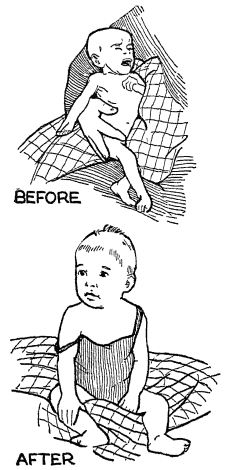
Our progress in this field need not be as slow as it is. You and I could help wonderfully. Imagine the great change that could occur if every boy and gii’l in the public schools would, from this day on, take good care of his or her younger brothers and sisters, and, later, of his or her own children. In a short time there would be a new world.
2. Does the new position of woman harm the family as a torchbearer? — It is said that the new position held by woman in our society is hurting the family. More and more, she is finding work that takes her outside the home. The coming of the power-driven machine has created many tasks as machine tenders for which the strength of women (and children) is sufficient. The factory has taken over much of the sewing, canning, and cooking the woman formerly did in the home, and she has followed this work and other work to the factory. In the last fifty years she has had more chance to get an education. Her education has made her available for clerical duties in business and for professional work, such as law or medicine. She has become interested in club work, civic work, pohtical activities, etc., to all of which she is now admitted. All this, it is said, is causing her to neglect her “natural work” in the family circle.
[ p. 351 ]
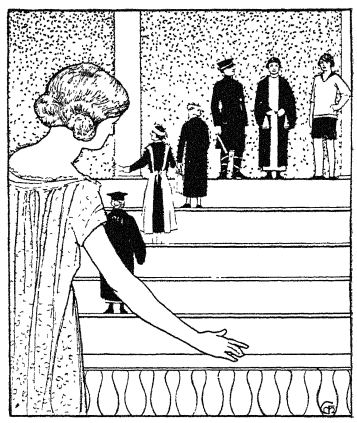
There is some truth in this statement, but there is a good side to the picture. To begin with, as far as “neglecting her family” is concerned, that can be true only of the woman who is married and has a family. Now, the truth is that the great majority of women who work outside the home are young unmarried women who work only during the years between the time they leave school and their marriage. It is much the smaller part of these outside workers who are married and have families. Do these neglect their homes? Some do, willfully. Some do because they must work to help support their children, if that can be called neglect. But most of them have become better fitted to train children. As we have seen (page 310) the family has become less and less a miniature of the whole society. The mother who has seen something of the parts of our society that are outside the home is better fitted to train her children to do the work of society.
The new position of woman means much for good family life. The time was when she was little better than a slave; when she could own no property; when all her goods as well [ p. 352 ] as herself “belonged” to her lord and master; when she had no rights over the children ; when she had no vote ; when she was not admitted to the higher schools. As late as the nineteenth century, an Enghsh judge ruled that a man might beat his wife if he used a stick no thicker than his thumb !
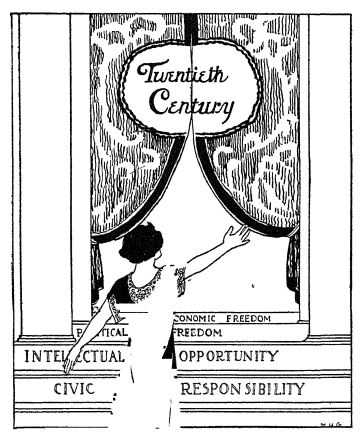
Can anyone really think that a woman in such a position would be fitted to be a torchbearer in our society? Canwe regret that all this has been changed in the last two or three generations? There is good reason to believe that the ideals and aspirations of the “new woman” may produce a family life better than that of the past.
3. The family is endangered by poor economic conditions. — There are bad economic conditions (such as poverty, unemployment, and work accidents) in our society, and they are hurting our family life.
Poverty. — Too large a part of our people (see page 178) live in poverty or near-poverty. This means many unfortunate things. Unsanitary and uhhealthful houses together with poor and insufficient food sometimes break up the family through sickness and death. The mother is sometimes forced [ p. 353 ] to "work out” and thus is unable properly to care for her family. The father sometimes has too little time free from work to take his full part in the family life. The family income is too small and the free time of the family is too limited to enable this group to take the part it should in the civic, religious, and social affairs of the community.
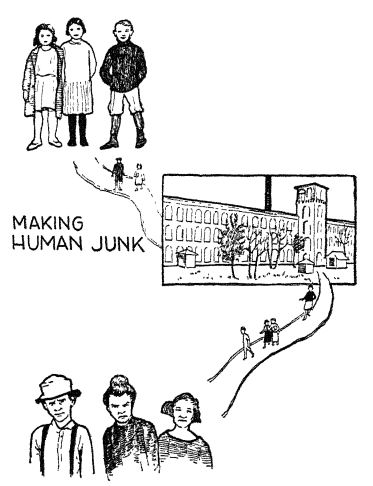
Such families do not get the books, pictures, and other “culture materials” that are so important. Although our schools are free, such families cannot make the best use of them. The children go to the mills and factories at too early an age. They are irregular in their school attendance because of poor health or lack of proper clothing. All these bad conditions are quite hkely to be at their worst in the crowded tenement districts where there are so many of our immigrants — the very persons most in need of the surroundings of a better American hfe. These are very serious statements. Too often children brought up in such conditions are unable, because of their poor health and poor training, to serve as [ p. 354 ] good torchbearers for the later generations. The bad conditions of one generation may too easily become the worse conditions of the next generation.
Even for families that are not ordinarily in poverty there are three great dangers through unemployment, illness, or death of the wage earner.[3]
Unemployment. — Take, as an example of the danger of unemployment, the story of a family we shall call the Wheeler family. Mr. Wheeler was a fairly good mechanic who suddenly found himself out of a job as a result of an industrial depression or “hard times.” He tried in vain to find work in order to support his wife and four small children. When his savings were gone, the neighboring shopkeepers gave him credit, for they knew he was honest. The depression was a long one, however, and the Wheeler family had to give up its home, sell most of its furniture, and move into a poor district. Here, by occasional odd jobs, he and Mrs. Wheeler managed to hold the family together. But it was a hard fight, and the children suffered in health and schooling until business picked up again. This shows that unemployment may hit a family hard. Indeed the Wheeler family, thanks to their earher thrift and prudence, fared much better than many other famihes have fared under similar circumstances.
Illness. — To see what illness can do, take the story of the Swanson family. Mr. Swanson was a foundryman, and a very good one, too. His wife and three children had a comfortable, pleasant little home. Either because of some carelessness of his own or because his workplace was dusty and [ p. 355 ] dark, he began to have a bad cough that the doctor discovered meant tuberculosis.
Manchester N. H.—Ten thousand workers, one-eigth of the city’s population in the cotton division of the Amoskeag Manufacturing Company’s plant have been laid off temporarily because business conditions. Overproduction was greater than orders, report reads. The shoe industry In this city is booming.
A Short News Item with Mitch Suffering Behind it
The doctor told him he must stop his voi’k and go to a sanitarium for at least a year. His savings would not support his family for three months, to say nothing of a whole year. The sufferings of the wife and children were very great, and the family was finally broken up. There are thousands of families like it in our cities; families that are not able to be good torchbearers because the wage earner is sick with tuberculosis or rheumatism or some other disease that makes it impossible for him to earn enough for his family. Sometimes the sickness is his owm fault ; sometimes it results from the kind of work he is doing; sometimes the cause is unknown. The results to the family are much the same no matter what the cause may be.
Industrial accidents. — Or take this case of a family that faced a serious problem because of an accident at the father’s place of work. Mr. Guardini worked in a large iron and steel plant. He and his wife and five little children were li\fing fairly comfortably on his wages. One day a terrible accident happened in the steel mill. No one was to blame, but that w’as little comfort to Mrs. Guardini when her husband was brought home dead. There was enough money to pay the funeral expenses, and ]Mr. Guardini had some insurance from his trade-union. About the best solution Mrs. Guardini could see was to break up her family and send the children to an orphans’ home. The wmrst that might happen seemed too terrible to think about.
The company, however, had a department called the personnel department which gave special attention to the working staff of the business. The superintendent of this department saw to it that Airs. Guardini and her family were cared for under the state law. In that state there was a law [ p. 356 ] providing for compensation for industrial accidents — a workingman’s compensation law. There was also a mother’s pension law which provided that widows hke Mrs. Guardini should receive payments until the children were old enough to help. Thousands of serious accidents occur in our industries every year, and not all our states have the kind of laws that saved the Guardini family from being broken up, or worse.
Clearly, there are economic conditions that sometimes make it hard for the family to do its torchbearing well. We must work to make such conditions better. Something can be done by helping unfortunate persons to become better trained, especially in health matters and in better ways of spending their wages. Our schools, churches, social settlements, charities, and others are working at that end of the problem. Society as a whole is taking action also. Public employment agencies help in bringing jobs and workers together. States provide pensions for mothers, pass laws fixing a certain minimum for wages, pass other laws providing compensation in case of industrial accidents and providing for insurance against illness or unemplojment. Cities pass laws requiring good fight, ventilation, and plumbing in all houses. Continuation schools are provided for those who must go to work. Trade-xmions and others strive for an eight-hour day in many industries and for a living wage. Immigration is restricted.
In these and in many similar ways we are trying to make conditions safe not only for the family but also for all our other institutions. No one should claim that everything we are trying is the wisest or the very best thing that could be done. No doubt mistakes are made. But, at least, we know the problem is there, and we are trying to find a solution.
[ p. 357 ]
4. Family ties may be weakened by outside amusements and unsettled homes. — It is said that so many amusements and forms of recreation are available in our cities to-day that the family is no longer the place to which the children turn for pleasant hours. “The family has become a temporary eating and meeting place in which roomers and lodgers too frequently mar the family group” says one writer.
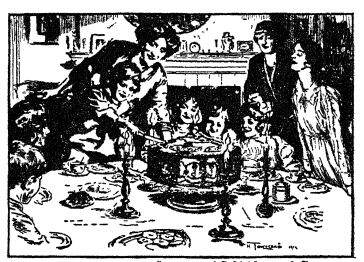
A Wholesome Home Group
Then, too, many families do not ovm their homes : they move about from house to house a great deal. They do not come to think of some one place as their “house of refuge” in which the family group has “shelter from the storms of Mfe.” A person can come to love a place. A sixteen-year-old boy had lived all his life in one house. One day, after a two weeks’ absence, he suddenly turned a corner and saw his home. “Oh boy!” he said, “Good old home!” His love for the -place helped him to be a good member of the family living in that place. Unfortunately our modern life is so full of changes that many children do not have a chance to come to love some one spot in a way that makes “home” seem dearer.
However, such conditions are not so true of country life as they are of city life. It is mainly in our larger cities that we find the outside amusements more attractive than crowded rooms. Furthermore, it is easy to overdo this [ p. 358 ] argument about amusements and unsettled homes. An outside amusement may give a subject for congenial family talk for days. It is as important for the family to have good contacts with the rest of the world as it is for it to have a center of its own. Then, too, even when the place called home changes frequently, the family group that tries to do so can still keep its sense of unity and companionship. Every one of us can think of several families that have done so.
Our family life compares favorably with what preceded it. — Sometimes we see what is going on to-day more clearly when we compare it with what has happened in other times and places. Let us compare the kind of family we have now with an earlier form of the family, for, of course, our kind is not the only kind that has ever existed.
Our family has developed out of the patriarchal family. That is the kind of family life described in the Old Testament, and in the histories of Greece, Rome, Japan, and China. Such a family consists not only of the father and mother and children but also of the grown-up sons with their wives and children. All hve together in the same house or in adjoining houses. The patriarch, or ‘‘Great Father,” is the sole source of authority and has full control over all members of the family, and his control is strict and severe. Among many peoples the women were little more than slaves. The father could do as he chose with the children, even to selhng them into slavery or kilhng them. He had complete control of all property. All religious and educational matters centered about him. It was a very stern and arbitrary arrangement.
Although our family has grown out of this patriarchal family, it is different from it in several ways. One difference is that there is no “great patriarch” with whom all the sons hve even after they are married. With us, when [ p. 359 ] two persons marry, they set up a new family and a new home. They then run their own affairs. The second difference is that, more and more, our family is becoming democratic. The husband no longer owns the wife; the arrangement between the two is one of partnership and mutual help. There are still some families w’here the husband doles out money and seems to think the wife is a sort of unpaid servant. But there are fewer such families as the years go by. More and more, husband and wife work together as affectionate equals.
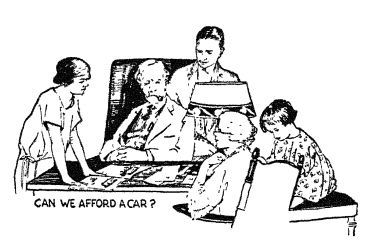
Our family is democratic in another way: the children are coming more and more to be treated as delightful comrades. This does not mean that there should be no discipline of the children. Quite the contrary. The children should play their part in the family and should be helpful in the family work. But, as one writer puts it, “the modern tendency is for the parents to live with the children rather than above them.”
The dangers facing family life can be met. — When we make such comparisons with earlier forms of the family, we are encouraged over our present situation. There is no denying, however, that dangers face our family. It is more unstable than we wish it were. As long ago as 1885 there were more divorces in America than in all the rest of the Christian world put together, and divorce has even been increasing with us since then. That is serious. We hope, and most of [ p. 360 ] us believe, that this state of affairs will change for the better as our living conditions become more settled. As we have seen, the last few generations have been ones of great change and unsettlement in nearly all of our living.
If we were to sum up what we have been saying about the family it might be put thus:
- There are some real problems ahead of this torchbearer. We wish it were more stable, more aware of its task, and better fitted to do that task.
- There are social and economic conditions working somewhat against the best family fife.
- We must work at this problem. Some things are already being done, but they are not enough. In particular our education should be of a sort that will help us to see how important the family is and will help us to lead better family lives.
- We, need not be discouraged. Real progress in family life has already been made. The problems facing it in the future can be solved, and we can solve them if we will
Since this has been rather a long account of the problems that confront our torchbearers, let us sxun up by reminding ourselves that we have been finding out that how well we shall live together depends upon the quality of such important torchbearers as the press, the school, the family, and the church, although we have not taken time to discuss the press and the church in this section.
¶ D. Ideals, the Guides of Communication
(How well we shall live together depends upon whether man, the communicator, is guided by good ideals.)
There can be no doubt that man has greatly multiplied his powers through communication. There can be no doubt that he will multiply them still more in the future. But [ p. 361 ] greater powers do not necessarily mean better Ihdng. Everything depends upon the use made of those powers. How well we shall live together depends upon whether we use our language devices, our systems of communication, and our torchbearers for better living or for evil living.
Everyone knows that is true. The telephone and the telegraph can be used to plan robbery or murder just as readily as they can be used to knit people together. The railroad, the steamship, the automobile, or the airplane can be used to commit a crime or to help a criminal escape as readily as they can be used for good purposes. The press, the school, or the family can be bearers of bad customs and harmful thoughts about as effectively as they can pass on right thinking. Man, the communicator, can communicate evil or good, as he chooses.
On page 205 we saw that good ideals must rule man, the harnesser of nature, if we are really to live together well. So also, good ideals must rule man, the communicator. But we shall hear more of ideals and aspirations in Part V.
¶ Problems
- Define or explain
Simplified spelling
Universal languages
Public utilities
Freedom of the press
Continuation schools
The “new woman
Industrial depression
Industrial accident
Mother’s-pension law
Minimum-wage law - What ideas are in these words: sunshine; justice; friction; smile? Is a dictionary a good place to find what ideas are in words?
- Watch for some new word in your school work. Write it dom. Then watch how you come to know what it means and how you make use of it in your thinking.
- “The ability to think and to keep in touch with the thoughts of others is highly important in our job of getting a living.” Show that Willard Smith (page 337) both gets a living and serves society. [ p. 362 ]
- Name some ways in which good communication helps us to have good city life. '“Our modern cities are possible largely because of modern transportation.” Show why.
- Of the dreams” on page 342, what ones seem to you likely to come true?
- What is a private business? AVhy does society feel justified in supervising a public utility?
- “Man’s ability to harness nature makes us feel that the press will be able to do its work well in the future.” Why?
- What lessons do you draw from the experiences of John Williamson and John Panello? What is meant by vocational courses? By vocational counsel? Does your school offer these?
- Does it not seem hard-hearted to enforce a law that a child must go to school when the family needs the money the child could earn at work? Is it really hard-hearted?
- If all children over ten years of age were put to work at once, would the labor power of the country be greater? If this were kept up for fifty years, would the labor power be then greater than it would have been if all the children had been kept in school until they were eighteen?
- Can you name any position for which you would need at least a iiigh-school education? One for which you would need a college education?
- Make a list of your duties in connection with making better torchbearers of our schools.
- Get from your father a list of reasons why he might become unemployed. Suppose your father should become unemployed. Find out what effect this would be likely to have upon him; upon you.
- The English system of health insurance arranged for a fund to which workers contributed one third. AVhen a worker became sick, he was given a certain allowance from this fund. Could some such plan be used for unemployment insurance? For accident insurance? How wmuld such plans help family life?
- Make a list of the different ways it might affect the younger children of the family to have the mother working in a factory.
- Talk mth others and make a list of the ways by which better knowledge of how to care for children is being spread.
- Show that the new position of woman ought to make her a better torchbearer in the modern family. [ p. 363 ]
- “One lesson we need to learn is the lesson of thrift. Thrift will mean better family life.” Do you agree?
- What things must a family have to be a good torclibearer? Here is a start: (1) a fair income, (2) well-trained parents. Continue the list.
- Why should you be careful not to frighten your younger brother or sister by stories of “things that will get them?” Just what are your responsibilities for your younger brother and sister? Make a list of these responsibilities.
- What is meant by saying that our family life to-day is democratic? Why should you prefer to be a member of a democratic family?
- Make a list of ways in which communication can he used for evil living. What’s the remedy?
- Answer the questions at the beginning of this chapter, page 333.
¶ Interesting reading
Marshall: Readings in the Story of Human Progress, Chapter XI.
-
Language Reform (some of the suggestions for simplified spelling, a reformed alphabet, and a universal language).
-
Good Roads (a realm of communication in which we have recently made much progress).
-
The United States Post Office (one way the government aids in developing communication to-day).
See also Chapters VII, VIII, IX, and X.
Problems to tliink over are given in these reading selections.