[ p. 273 ]
CHAPTER IX
MULTIPLICATION OF POWERS THROUGH TRADE; MONEY, THE LANGUAGE OF TRADE
A. Multiplication of Powers through Trade
B. Money, the Language of trade
Questions to Keep in Mind while Reading This Chapter
- How does trade multiply man’s powers?
- How is money a multiplier of man’s powers?
- How old is our trading and our use of money?
¶ A. Multiplication of Powers through Trade
(How trade helps us to live better; why modern trade is so large.)
Trade is a multiplier of man’s powers. — When man, the communicator, conquered distance with roads, steamships, railroads, airplanes, and automobiles, and when he annihilated distance with the telegraph, the telephone, and the wireless, he made possible a great increase of trade. Trade is another multipher of man’s powers. It enables him to get many things far more easily and better than he could get them without trade. That means greater abihty to live well.
Trade enables m to get goods we could not otherwise have. — A group that did not trade could have only the goods produced in its own territory. That might mean poor h\ing. For example, a sandy desert cannot raise the food supplies so easily grown on the plains of lUinois; the plains of Illinois caimot produce the borax so easily secured in one of our deserts; the temperate and frigid regions cannot produce many products of the tropical zones. So it goes, [ p. 274 ] the whole world over. Man was greatly handicapped when he could have only the goods produced in his own locality. Fortunately, to-day he has conquered distance. He trades with others. He draws upon the resources of the whole world. Surely that is a great multiplication of his powers.
Trade, A Goddess of Plenty
Trade enables us to get goods more cheaply than we could otherwise get them. — Even when it is possible to raise or make a certain thing in our own locality, it is often easier and cheaper to get it elsewhere through trade. It would be possible, for example, to build expensive greenhouses in such states as Ohio and New York and raise tropical fruits. But that would be an expensive and wasteful way for the people of these states to get their oranges, bananas, and early vegetables. It is far better for them to raise wheat and corn; to manufacture plows and shoes; to make clothing and flour; and to do the many other things their climate and resources enable them to do easily and well. They can then trade some of these products for the fruits of California and Florida. All regions concerned get the goods they wish more easily and cheaply through such trading. This is only another way of saying that trade increases man’s power to live well.
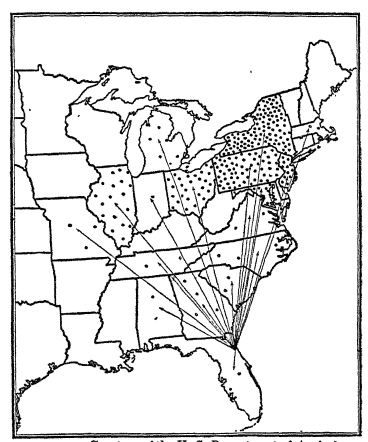
Early Potato Shipments from Florida
This shows shipments from one district only. Each dot represents ten cars
Trade enriches our lives and widens our mental horizons. — Everyone who has studied domestic science knows how [ p. 275 ] important it is to have a diversified diet. It “tones up” the whole body. It gives health and vigor for work. Now the stomach is not the only organ that gets a “diversified diet” as a result of trade. The brain does also. Because of trade, messages go to the brain through our eyes and ears, telling of strange goods and persons from all over the world. Someone said, “I was not the same person after I bought an elephant’s tusk from India and a lion’s skin from Africa.” That is a picturesque way of saying that trade is one of the ways by w’hich we come into touch with the rest of the world, one of the ways by which our minds reach out and grasp new ideas. Of course, when trade does this, it increases our powers; it gives us greater ability to think and to plan; it makes our lives fuller and better.
Early trade was meager. — Trade is another of man’s devices that reaches back beyond the time of neolithic man for its scanty beginnings. These scanty beginnings were, of course, foundations upon which the later development of trade was built. But it is fair to say that trade has come to [ p. 276 ] be used as a really great multiplier of man’s powers only in the last two hundred years.
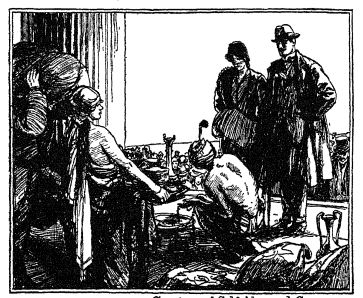
East Meets West in Trade
Our account of how slowly good means of transportation and communication developed for thousands of years after the time of neolithic man lets us see that trade and commerce must have developed slowly also, for trade depends upon transportation. Of course, through these thousands of years slow additions were made to man’s trading powers. Indeed, as we study history we find that there were several little spots on the earth where trade became somewhat important, Just as there were several little spots where sciences grew and books were made. But after all, these early trading nations — such as the Babylonians, the Phoenicians, the Greeks, the Romans, and the Italian cities — were little spots of the earth. The great masses of the w’orld’s peoples were not touched by them.
Then, too, even in these trading nations, trade was not nearly so important as it is in our living to-day. In most cases, these peoples lived in groups called “patriarchal families.” Each family group was largely self-sufficing, as was the gens of the Iroquois discussed on page 39. Such trading as took place was mainly in silks, spices, perfrunes, precious metals, and other comforts and luxuries for the [ p. 277 ] rich. There was not much trading in ordinary goods for common people or for slaves. The patriarchal group as a whole bought and sold little; the humbler members of the group bought and sold almost nothing. In other words, in these trading nations, the life of the masses of the people was not organized on the buying and selling plan; it was organized on the plan of “make it and use it yourself.”
As recently as 400 years ago there was little trade. — But let us leave these trading nations and take a look at the life of our mother country, England, only 400 years ago. There were few cities. There were no scattered farmhouses such as we see. Nine tenths of the people lived in little groups called manors, or vills. Except for the lord of the manor and his family, the people of a vill knew or cared little what went on in the rest of the world. They lived in old customary ways that had come down to them through the centuries with almost no change. The lord of the manor would occasionally buy some silks and spices, a purse, a hat, a girdle, a pewter pot, a pair of gloves, some salt for curing meat, some tar as medicine for the sheep, or some iron (see page 92) to parcel out for the scanty tools and weapons. But the ordinary people did almost no buying and selling. They lived on day after day, year after year, raising or making nearly all their own stuffs. It was a dull, stupid, unchanging way of living.
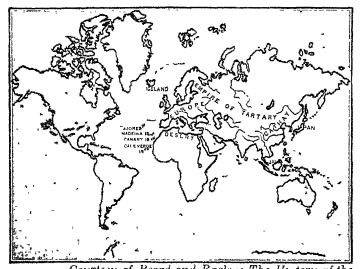
The White Part Shows The Known World of Fifteenth Century
It is true that in the towns, where perhaps one tenth of the people hved, there was a town market on certain days of the week, and there was also some buying and selling at the little shops, as we saw on page 132. But many of the townsmen cultivated land and raised their own stuffs. There was nothing hke the bustling, enormous trade of a modern city. Then, too, at a handful of places there were held “fairs” for a few weeks, once or twice a year. These [ p. 278 ] were busier trading places. Foreign merchants came to them with their wares. But think how meager this occasional, or periodic, trading was as compared with the continuous trading of to-day. Man had not yet learned to be a great multiplier of his powers through trade.
Why early trade was so meager. — It often helps us to understand the conditions of our life to-day if we see why earlier people did not have them. Let us, therefore, see why the trading of only a few hundred years ago in England was so small.
1. To begin with, people did not hnow much about the rest of the world or about goods from other places. The common man lived and died in his own little hamlet. He seldom saw goods from other lands. People from the nearest town were to him foreigners and almost enemies. Even the rulers, scholars, and traders knew little of the world as compared with what we know to-day. Above is a map showing the known parts of the world before Columbus made his famous voyage. How limited the people of that time would be in their knowledge of places where interesting goods could be secured ! W e must remember, too, that there were no public schools, few printing presses, no public mail systems, no newspapers — few of the information spreaders that are so common to-day. Trade with other lands would not be large under such conditions.
[ p. 279 ]
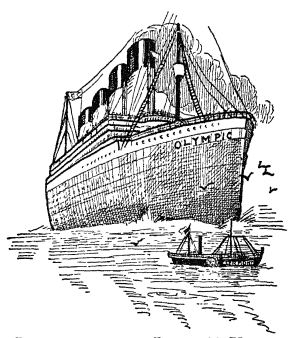
Think what the sailing ship of 400 years ago must have been.
2. In the second place, the means they had for carrying themselves and their goods from place to place were poor and even dangerous. On land the merchant must carry his pack or lead his pack horse. The roads were worse, if possible, than our own frontier roads. Traders often fell through the few tottering bridges or were drowned at the fords. Their pack horses sank out of sight in the mire. Could land transport and trade flourish under such conditions?
On the sea, conditions were better, but they were far from good. The wooden sailing vessels of the time were small and frail. It would take a fleet of them a year to carry as much as a single freighter takes on a single voyage these days. Chances were hardly even, furthermore, that these ships would ever return from a long voyage. Shipwreck always threatened, and bad food supplies and bad sanitary conditions often caused more than half of a ship’s crew to die of disease during a long voyage. It must be remembered, too that until after the invention of the compass and the astrolabe (a device for finding latitude), sailors who were long out of sight of the land could not know just where they were or precisely in what direction they were going. There was lack of maps and lack of knowledge of winds and currents. It was a bold master who sailed his ship beyond the sight of land in those days.
[ p. 280 ]
3. There were dangers, too, arising from the weak governments of the time. To-day, the government with its armies and navies and policemen make it safe for traders to carry on their work. It was far different in the old days. Governments were weak, and they did not concern themselves greatly with trade in any event. The result was that on the roads robbers and even the lords of the manors plundered the traders. On the rivers and seas there were pirates. The trader who escaped the pirates had his troubles when he dealt with a foreign people, for they were quite hkely to regard him as an enemy. If they did, his own government would probably not help him.
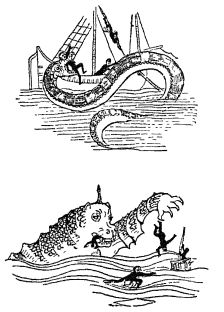
4. Added to these real dangers were the foolish fears and superstitions haunting men of those days. Science had not yet explained the world. Unknown lands, so men Imaginary iteRROEs thought, were peopled by goblins and monsters against which puny man could do nothing. Over the unknown seas, men said, hovered huge vultures that could lift a ship in their claws as easily as a hawk could lift a mouse — and the finish of the sailor would be worse than that of the mouse. Since they thought the world was flat, there was, of course a “jumping-off place” over which too venturesome ships would be dashed. There were huge rocks or cliffs which clashed together and smashed ships between them. There were serpents for which a ship would be but a light breakfast. There were — but why go on with the list? It is as long and as terrif 3 dng as the imagination of ignorant [ p. 281 ] man. A mind full of foolish fears and superstitions was an unfortunate mind for traders to have.
5. Finally, the whole way of living and thinking of the people was on a nontrading basis. If the people of that time had known what trade would have meant to them, they might perhaps have overcome the other difficulties. But they did not know. They had always lived in selfsufficing groups and all their thinking was in terms of that kind of life. As we look back at their living we see that it was a very poor living, for we can compare it with what we have to-day. But they knew of nothing better. It never entered their heads to strive for the better living which would come from trade. They went on living as people always had lived.
Man’s progress as a hamesser and communicator enabled him to be a great trader. — Our study of man, the harnesser of nature and the communicator, has already shown us how all this w’as changed. All we need to do is to look at the charts in our notebook. They will bring back to mind what has happened.
Beginning with the great discoveries, of which the voyage of Columbus in 1492 was but an example, man began to increase his knowledge of other lands and other goods. At first his knowledge grew slowly. As the charts show, the last one hundred and fifty years are the years of abundant printing, widespread education, conquering distance, and even annihilating distance. They are the years in which, the world has shrunk until “it is everyone’s back yard.”
The charts show the same story concerning man’s means of carrying himself and his goods from place to place. Within the last one hundred and twenty-five years his steamships, railroads, and auto trucks have enabled him to transport for great distances the ordinary things of life — sand, coal, [ p. 282 ] lumber, stone, machinery, and clothing — things that affect the living of every one of us. The poorest, humblest citizen of to-day is more affected by trade than was the noble or the rich man of earlier times. A network of communication (see page 270) reaches and serves every one of us.
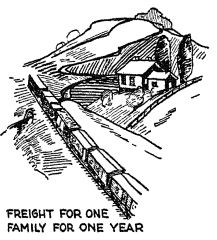
Quite as wonderful a change has taken place in our ways of thinking. We know how the “rebirth of learning” (page 164) began to shake men’s minds out of their old customs and ways. That work was continued by the geographical discoveries, the printing press, and the development of science. While our minds to-day are not entirely free of foolish fears and superstitions, they are far more free than they were only a few hundred years ago. To-day an unknown region does not fill us with terror; it invites us. We like to explore. To-day a new way of acting or thinking does not cause us to shrink; it whets our curiosity. We want to learn new and better ways. To-day no one would dream of trying to live in a little self-sufficing group, making all the things he consumes. We wish and expect to reach out for the resources of the whole world.
The recent enormous progress in trading. — It will be easier to show the great increase of trade during the last few generations by a chart than by words. Let us look at the chart (on the opposite page) showing the increase that has taken place in the trade among the different peoples of the world since 1800. What an astounding increase there has been! Now that we know that trade increases man’s abihty to live well, the chart becomes not merely a chart of trade but a sort of picture of man’s progress.
[ p. 283 ]
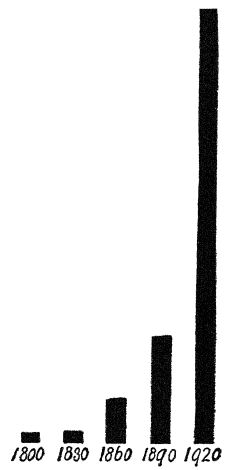
But this chart of trade among different peoples (foreign trade) is but the merest beginning of the story. The trade that occurs within a nation (internal, or domestic trade) is far greater in quantity than its foreign trade. We have no record of our nation’s internal trade. We cannot get exact figures, but we know they are enormous. Every body is a “ trader ” to-day. Everybody specializes at one task and trades his goods or services with others. The result is that we are to-day a trading, or “market” society, as compared with earlier self-sufficing societies.
We may summarize our study of the multiplication of man’s powers through trade, or the use of the market, thus: Trade multiplies man’s powers because it enables him to get goods he desires far more easily and cheaply. It places the resources of the world, rather than those of his petty locality, at his command. Although men living Growth or the Wokuj’s before neolithic times had the beginnings of trade, and although there have been several fairly important “trading nations” in history, the last one hundred and fifty years have been the ones during which man’s ways of living have been most rapidly revolutionized by trade. In the case of trade, as in so many other cases, there was but slow progress for thousands of years after the time of neolithic man. In the last few generations progress has been by leaps and bounds.
[ p. 284 ]
¶ B. Money, the Language of Trade
(What money does; its forms; credit and our financial institutions.)
Barter is a slow, awkward way of trading. — We saw on page 45 that the Iroquois carried on their trade in a very clumsy way. They called it an “exchange of gifts.” The name we give it is “barter.” Barter means the “swapping” of one product for another without the use of money.
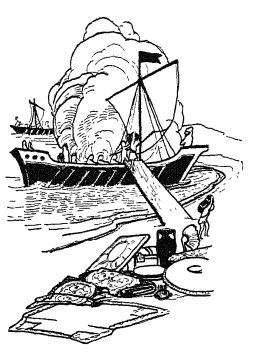
In the early stages of man’s progress, barter was his only method of trading. Various schemes were used. In the longago days of Carthage, we are told, the Carthaginians bartered with some of the natives of Africa thus. The Carthaginians would sail up to the shore, unload their vessels, and spread the goods out on the shore. They would then go back on board and raise a great smoke, as a signal to the natives. The natives would come dowm to the shore, look the goods over, spread out their own wares, and then withdraw. The Carthaginians would come back and take a look. If they were satisfied they left their goods, loaded the natives’ wares on board ship, and sailed away. If they were not satisfied they went on board again and waited for the natives to add more to their layout. Eventually, the trade was made, but what a slow, awkward way of trading it was!
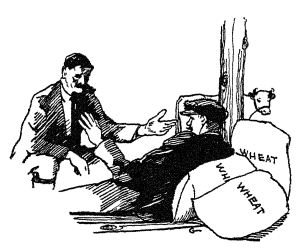
Barter to-day would be almost as slow and awkward a way of trading as it was in the days of Carthage. Suppose there were no such thing as money and John Smith has a [ p. 285 ] cow he wishes to trade for wheat. He makes inquiries and finds several persons who would like to get his cow, but they have no wheat. He finds others who would hke to sell wheat, but they do not want a cow. After a long search he finds James Riley, who happens to have wheat to sell and who wishes a cow. But now a new trouble arises. After much dickering, they conclude that a co’w is worth fifty bushels of wheat, but Smith can use conveniently only twenty-five bushels. He must now set out with the other twenty-five trying to find someone who happens to want wheat and also happens to have something Smith cares for. Even if his search is a lucky one, he is likely to find himself in the same old trouble of making the quantities come out even.
Money, the language of trade, is a multiplier of our powers. — But notice now how simple it would be for Smith if money existed. He could take his cow to market and sell her for, say, $75. There were plenty of persons who wanted his cow, you will remember. Then he could take his money and buy the twenty-five bushels of wheat that he wished at $1.50 per bushel. There were plenty of persons who were willing to sell wheat. He would have $37.50 left to buy other things he needed, or to put aside for future needs. The use of money would certainly have saved Smith a great deal of time and trouble.
Money really is one of our communicating devices; it is the language of trade. We use it to say how much we want [ p. 286 ] a thing, or how much some one must give us for something he wants. Barter exchange is hke talking with signs and gestures; it is slow and clumsy. Money exchange is like talking with words; it is quick and accurate. It is one of the devices by which man, the communicator, has multiphed his abiUty to communicate.
Gold has come to be used as the basic or standard money. — Like so many of man’s devices, money is really a very old one, but its greatest use has come about in the last few hundred years. Let us see how this has happened.
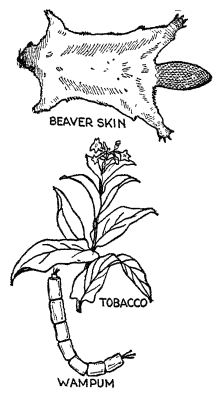
The difficulties of barter were seen even by primitive people. All over the world men who did even a little trading slowly came to use some one thing, or good, as a language of trade. All sorts of goods have been thus used. Some peoples have used beaver skins: a thing was worth so many beaver skins. Others have used cattle or sheep or wheat or tobacco or dried codfish or fishhooks or little bars of iron or the red scalps of woodpeckers or strings of polished shells called “wampum.” Gradually, through the centuries, it came to be seen that some things were a better language of trade than others, with the result that the nations of the world have come to use the precious metals, especially gold, for this purpose. There were good reasons for deciding on gold. Gold has a good deal of value for its weight and is accordingly fairly converdent to carry around in trading. It does not rust, so it can be kept a long time. It can easily be [ p. 287 ] divided into smaller parts or hammered and melted into larger chunks and is thus convenient for buying goods requiring either much or little gold in exchange.
For the present, then, let us think of money as little chunks of gold used as “counters,” or “tickets,” or “communicating devices” to say how much things are worth. At first money really was just chunks of gold, and a trader needed to have some way some of measuring the gold. The natural way was to weigh it. There are still, in our tables of weights and measures, the words “grains” and “barleycorns” from those long, long ago days when grains of wheat or barley were used as standards of weights (see page 161). The Persian table of weights for gold and silver has, as its smallest weight, a barleycorn, and three barleycorns equal one pea. A necessary tool of a trader of those days was a pair of scales with which to weigh the chunks of gold.
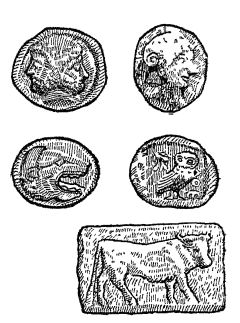
Gradually man came to use coins and to have the coins made hy the nation. — Slowly, through agelong practices, man worked out a better plan. After chunks of gold came to serve as the language of trade, it was seen that this language could be more easily used if some way could be found for making sure how much gold -was in each chunk. In other words, instead of using rough chunks or bars of metal, coins eventually came to be used. Coins were made in China more than 3000 years ago by making molds of sand and pouring in hot metal. A design was made in the sand, and this design then showed on the coin. All [ p. 288 ] peoples who have made progress in trading have had coins. They were used, for example, in Greece and Rome and in the Europe of the Middle Ages.
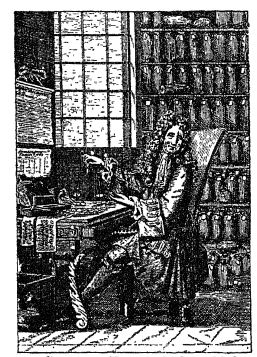
An Early Banker with His Scales
In time, man learned another lesson about the language of trade. Only a few hundred years ago, cities and states and lords and bishops all made their own coins for use in their own petty territories. It accordingly happened that a “franc” might have in it one amount of gold in one petty province; fifty miles away a coin of the same name might have more gold; seventy-five miles away it might have less gold; and so on. This caused much confusion and again made necessary the use of scales in trading.
The lesson was gradually learned that it was wise to have only the nation issue coins, so that the whole nation might have the same language of trade. We can see how wise that is by thinking of the United States to-day. It helps greatly in knitting our people of the forty-eight states together to speak the same language. What if we had forty-eight different languages! So also it helps in trading that we all use the same language of trade, the dollar. What if we had forty-eight different kinds of dollars!
We do not need to try to imagine the consequences. We have had actual experience. In colonial days, different colonies had different systems of money. It was so confusing [ p. 289 ] that when our national constitution was draxvui up (ratified in 1789), a clause was inserted reading thus: “The congress [not the various states] shall have power to coin, money, regulate the value thereof, and of foreign coin, and fix the standard of weights and measures; to provide for the punishment of counterfeiting the securities and current coin of the United States.” In another place the constitution says: “No state shall coin money; emit bills of credit (make paper money); make anything but gold and silver coin a tender in payment of debts.”
The national government has carried out these provisions. It has its own mints, or shops for making coins, and its own printing estabhshments for making paper money. Every coin that we use is made by the government so that everyone knows what to expect in it, and it is made by scientific methods and machinery in such a way that everyone feels safe in accepting it in trade, for he knows it is “good.” The same thing is true of our paper money. The government does this work, paying for the work out of taxes, so that we may have a convenient language of trade. It has the same reason for doing this that our state governments have for maintaining schools or for maintaining good roads, — namely, to give us good means of commrmication.
What is in our language of trade. — In our ordinary language, we need short words and long words of different meanings. So also in our language of trade, money, we need several kinds. We need a kind and size, such as the cent, that will be convenient for small transactions. We need a kind and size, such as the $1000 bill, that will be convenient for big transactions. We need a kind and size, such as the smaller bills, that will suit transactions of medium importance. Man has slowly learned this and has slowly developed devices to meet these needs.
[ p. 290 ]
Token coins. — Since gold is exceedingly valuable, it is not entirely convenient for small transactions. Take our own money. The gold dollar is so small it is hard to handle. We ceased to coin it in 1890, and now we make gold coins in four sizes only: the $2.50 piece, called the quarter eagle; the $5.00 piece, called the half eagle; the $10.00 piece, called the eagle; and the $20.00 piece, called the double eagle. We make our smaller coins out of cheaper metals, such as silver and bronze and nickel, and call them “representative” or “token” money. They “represent” or “are a token of” the standard gold coin. The government makes only as many of these token coins as are needed in trade and always stands ready to redeem them in gold, if anyone wishes. This redemption makes them “as good as gold.” Every trader knows they are perfectly safe.
Token -paper. — So also, for very large transactions gold is not entirely convenient. The $20.00 gold piece weighs something over an ounce. A payment of even $100,000 (and that is not a large payment these days) would mean quite a load to carry around. To carry in coin the funds needed for a long journey would be a nuisance. Then, too, gold coins wear out in use, even if they do so very slowly. It is well to find something to represent them that is not so valuable and clumsy.
We have come to use paper money for this purpose, and it serves us very well. A $1000 bill weighs no more and takes up no more space than does a $1.00 bill. Paper is therefore, very convenient for large units of money. Of course, just as in the case of the token coins, the government stands I’eady to redeem its token paper money in gold, if anyone wishes. There must be no doubt that all the language of trade is good language — language that everyone will be willing to use.
[ p. 291 ]
Our government has handled our language of trade fairly wisely. Some mistakes have been made, but the work has been so well done that you and I do not need to know all the details about the different kinds of money we use. It is all safe, and “good as gold.” A bird’s-eye view of our monetary system shows that gold money is our standard, our unit of measurement. We have various kinds of “token” money, or “representative” money, for the sake of convenience. All our coins are issued by the national government. As for our paper money, part of it is issued directly by the national government, and part of it is issued by banks under very careful governmental supervision.
Our present great use of money is quite new. — On page 286 we said (1) money is really a very old device but (2) its great use has come about in the last few centuries. We have gone far enough in our study to see that the first statement is true: money, as a language of trade, is a very old device. Skins, cattle, sheep, and what not were used as money even before coins of metal were known, and there have been coins for thousands of years.
But the great use of money has come about in the last few centuries. That seems strange to us. We are so accustomed to selling om goods for money, buying almost everything we use with money, seeing wages paid in money, paying taxes in money, hearing of interest and rents being paid in money, thinking in ternas of money, using money for almost ever 3 rthing between the cradle and the grave, that it seems as if all other peoples must have hved this way. The truth is that such wide use of money is quite recent. No earlier peoples have hved in any such way. Perhaps it will be easier for us to get our minds accustomed to this fact if we recall that the same thing is true in other parts of our hving. Tor example, the beginning of scientific knowledge goes back [ p. 292 ] thousands of years. At times and at a few spots on the earth, there were a few scientists. But the great outburst of scientific knowledge, as shown by the chart on page 166, has been quite recent. So also with the use of money.
It becomes obvious that this is true when we remember that earlier peoples Uved in a self-sufficing way and, therefore, had no great need of a language of trade. That was decidedly true of the Iroquois. It was largely true even of the “trading nations” and of the England of four hundred years ago. True, all of these and many other peoples made some use of money. But we have become a “market society.” Our whole scheme of living is planned and organized around the use of money. Our story of man, the trader (see page 283), gave a hint that this would be true.
We plan, measure, and organize in terms of money. — In the family. — We see how true this is in our family life. Every family uses money every day in buying the things it uses. The home is purchased or rented. The clothing store, the grocer, the butcher, the baker, the druggist, and the physician supply a family with goods or services in return for money. Books, theater tickets, golf sticks, tennis balls, travel — all are possible to the family that has money to offer in exchange. So also, money measures what the family sells. The farmer’s family sells mainly the farm produce it raises. The city family sells mainly the services of its grownup members. In either case payment is made in money.
Gradually, families have learned that certain items have to be provided year after year, and that those items take about so much money. If they spend too much on one item, they must spend less on other items. Their income must be made to “go around.” The wise housewife of to-day makes out a budget at the beginning of the year in which she estimates what she can wisely spend for food, rent, clothing, fuel [ p. 293 ] and light, medicine, insurance, savings, etc. As the months go by, she watches her expenditures and compares them with her budget estimates. If her bills for some items run too high, she must find a way of cutting those expenses or of spending less for other items. She works all this out in dollars and cents — in money. Money thus becomes a device for planning and measuring and organizing the life of that family.
In business. — So also, money is a device for planning and measuring and organizing the work of every business man. Many business houses make up budgets for their businesses in which they estimate the income from each class of work, the expenses, and the gains. Then they watch their actual operations, month after month, and take such action as seems wise.
A POSSIBLE BUDGET FOR A FAMILY OF FIVE WITH A $2,000 ANNUAL INCOME Items % of Income
Items % of Income Food supplies 30% Clothing supplies and repairs 16% House and house operation (rent, insurance, repairs, taxes, hoiLsekeeping supplies, and labor) 33% Health, education, recreation 11% Savings 10% Total 100%
Even a business that does not make out a budget plans everything in terms of money. The factory owner decides whether to buy one machine at $300.00 or another at $325.00 ; whether to buy a machine or to hire more workers; whether to expend $500.00 for advertising in a paper or’ $300.00 for advertising on billboards; whether to sell all his product at $5.00 per unit or to make two brands, selling one at $3.50 and the other at $6.75. The farmer decides whether to buy cattle and feed them his hay or to sell the hay in the market ; whether to buy a tractor or horses for plowing. So it goes, everywhere. All businesses axe planned and organized on the basis of dollars and cents.
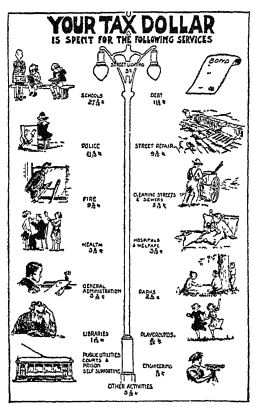
In government. — So also, money is a device for planning and measuring and organizing much of the work of our city, [ p. 294 ] state, and national governments. Our servants, the public officials, plan the things that should be done and what it will cost to do them. In this will be included costs of army, navy, education, maintaining parks, paying policemen and firemen, keeping up playgrounds — hundreds of things. They figure out what taxes should be laid and what they will yield. There are taxes on incomes, on real estate, on inheritance, on personal property, on corporations, as well as many kinds of fees and special assessments. The public officials think through all their plans and finally organize a budget of governmental income and expenditures just as did the family and the businesses discussed above.
Very many institutions and devices are connected with our use of money. — Since this language of trade is so important in our hfe to-day, it is natural that there should be many devices and institutions connected with it. We have already talked of mints and budgets. We might well talk of savings banks, commercial banks, postal savings banks, trust companies, investment banks. Wall Street, the stock exchange, the money market, checks, promissory notes, bills of exchange, bonds, trade acceptances, and a host of others. A glance at the financial pages of any newspaper will show a perfect maze of financial institutions, financial terms; and financial devices. These affect our [ p. 295 ] living in such important ways that we have come to speak of “the financial organization of society,” or “the pecuniary (that means monetary) basis of society.” These are large words used in our scientific writings to say w’hat we have been saying in this chapter: money has become so important that our fives are planned or organized around its use. Our “market society” is also a “money society.” This has come to be true only in the last few hundred years.
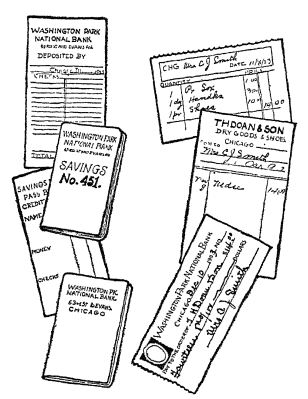
Our society is now a credit society. — A writer once said, “We use money so much that we hardly use it at all.” That was his way of saying this “money society” of ours has become able to use “credit” to do the work of money.
When a housewife has a tradesman “charge” her purchases until the end of the month, she “buys on credit.” If she pays her bill at the end of the month by a check drawn on a bank, as most housewives do, she uses “credit” and not real money. Suppose the tradesman keeps his funds in this same bank. He “deposits” the check. The bank subtracts that amount from the housewife’s account and adds it to the tradesman’s account. No actual money was used, yet business was transacted. To-day most buying and selling is “on credit” rather than for cash, and most payments are made [ p. 296 ] by check. Probably ninety-five per cent of our wholesale business and eighty-five per cent of our retail business is thus conducted. So also, if I borrow money, I give a “promissory note” (promising to repay). The lender usually hands me a check and not actual money. When I repay, I hand him a check. When business houses borrow, as they do in enormous quantities, the matter is handled the same way, although the paper documents used sound more impressive.
Odd as it sounds, the writer was entirely correct. We use money so much we hardly use it at all. We make much more use of checks, drafts, promissory notes, bills of exchange, etc., than we do of actual money. This does not mean that money has ceased to be important. Quite the contrary; it has become more important, for all this credit work is carried on in terms of money.
It is very important to have good money. — Since our whole way of living is organized around the use of money, it is highly important that our money should be good money. Particularly, it ought not to change in value rapidly.
Suppose we lived in some topsy-turvy world where we did all our measuring of length by yardsticks that had a magic trick of growing much longer or much shorter as they chose. How could one plan buildings, or roads or ditches or anything else requiring length measurements in such a crazy world? It would be so confusing that progress would be greatly checked, would it not? But suppose we lived m some world where all dollars (which measure values) had a magic trick of suddenly changing m value. Would it not be a very difficult world in which to carry on family planning and business and public work? Would not our ways of living be very much disturbed? Would not progress be cheeked?
[ p. 297 ]
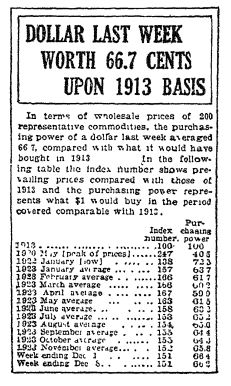
Now this thing that we supposed is not so absurd as it sounded. Gold changes in value. Since the dollar is, after all, only a chunk of gold, “the dollar” changes in value (prices rise or fall) along with the gold. Fortunately, gold does not usually change in value with great speed, so that it serves us fairly well. But it serves us only fairly well, and one of the problems of the day is that of working out a system of money that will be “ stable.” That means one that will not fluctuate in value.
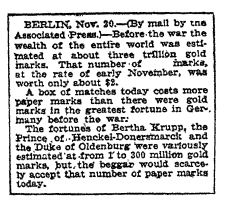
Sometimes nations get into unfortunate situations where they cease to pay gold for paper money as they have promised. They cease to redeem their paper money in gold. When this happens, they sometimes print enormous quantities of paper money, which then changes in value very rapidly. This happened, for example, in Russia and in Germany after the World War. Before the war, our dollar was worth four marks. October 1, 1923, it took 3.800.000.000 paper marks to equal one dollar. A month later it took 167.000.000.000. After another month it took 7,000,000,000,000. The results in Germany were very serious. Business became more like gambling than like ordinary business. No one felt safe in making plans with the value of the mark changing so rapidly.
[ p. 298 ]
We cannot stop to try to understand the whole science of money. It is a difficult subject, one that demands careful and hard study. There are, however, certain matters that should be clear to anyone.
- Money is a very useful device. It multiplies man’s powers by serving as a language of trade.
- We have come to plan and organize all our ways of living around the use of money.
- This makes money so important to us that we are anxious to have our money good money. The nation that blunders in handling its money harms its people. One of the most common blunders of the past has been that of printing enormous quantities of paper money that could not be redeemed in good money.
- In the matter of good money, as in so many other aspects of oxxr living, it is well to turn to our scientists for counsel and advice. It is too important a matter for “tinkerers” to handle.
¶ Problems
- Define or explain, using the dictionary if necessary
coinage, barter
trade, budget
a self-sufficing group, money
astrolabe, doUar
internal trade, token money - “Trade enables us to get goods we could not otherwise have.” Give several illustrations not found in the text.
- “Trade enables us to get goods more cheaply than we could otherwise get them.” Give several illustrations not found in the text.
- “Trade enables us to lead a more diversified life.” Prove this.
- “Trade multiplies man’s powers to live well,” How?
- “Trade and commerce did not play as large a part in the living of the early trading nations as they do in our living to-day.” Show that this is true. [ p. 299 ]
- What were the reasons for the meager trade and commerce of four hundred years ago? Do those reasons still exist?
- How do you account for the fact that there has been such a great expansion in trade in the last one hundred years?
- We are a market society instead of a self-sufficing society/’ What does this mean?
- Man’s way of living has been revolutionized by trade/’ Show that this is true.
- “ To-day everybody is a trader.” Explain. How does that differ from the situation in the early trading nations?
- Give examples of barter in modern life. Do you ever “swap" things? Even when you do, do you sometimes figure out what the things swapped are worth in money?
- Tell why skins, while better than nothing, are a poor form of money. How would baskets of vegetables do as money? What are the good points of gold for this purpose?
- Why did a colonial family have little use for money? Does a farmer to-day use money as much as a merchant in a city? Does a farmer to-day use it as much as the colonial farmer did?
- In the Middle Ages one could travel hardly fifty miles without needing to have his money changed. Why? Why are money changers not necessary as we pass from one state to another in our country?
- Some of the designs on money are intended to remind us of something in the nation’s history. Eind some such designs on our money.
- The government stands ready to redeem a worn coin with a new one. Does this not cost the government something? Does this cost not come out of taxes? Why do we redeem these worn coins? Do we do it when the government does it?
- From time to time, the government redeems and destroys wornout paper money and prints new bills instead. Does this not cost something? Why does the government do this?
- What is counterfeiting? Why do we have laws providing for the punishment of counterfeiters? Do counterfeiters harm society?
- “Money has become a device for planning and measuring and organizing many of the activities of the family." Explain.
- “Money has become a device for planning and measuring and organizing most of the activities of business." Explain. [ p. 300 ]
- “Money helps us decide what we want to work at, what we want to buy, what we want to do.” Show that this is true.
- “The owner of money can command. He can get workers to work for him, landowners to let him have land, and owmers of capital goods to let him use them.” Is this true?
- “We are a credit society.” What does this mean?
- “The government does not make the value of gold or of the dollar. All it does is to call 25.8 grains of gold, nine-tenths fine, a dollar. This does not say what the dollar is worth or will buy, any more than the law that sixty pounds of wheat make a bushel says what the wheat is worth.” Do you agree?
- Answer the questions at the beginning of the chapter, page 273.
¶ Interesting Reading
Marshall: Readings in the Story of Human Progress, Chapter IX.
- Early Fairs and Markets (the main trading places of the days of small trade).
- Coins (the origin of coins; how our coins are made and are kept in good condition).
- Paper Money (how our paper money is made and kept in good con dition).
- The Commercial Bank (how it came into existence; wkat it does).
See also :
Chapter XII, 3. Linking Country and City (the marketing of wheat as an illustration of linking country and city).
Chapter XII, 4. Modern Storage (one of the specialized tasks in the marketing work of society).
Chapter XVI, 1. Improving Our Market Machinery (one example of how we improve the knitting together of our specialists).
Problems to think over are given in these reading selections.