[ p. 365 ]
PART IV
MAN, THE TEAM WORKER AND COOPERAT0R: SOCIAL ORGANIZATION
PURPOSES OF PART IV
- To show that good ways of organizing to do things are also multipliers of our powers.
- To explain what is meant by social organization.
- To give a view of our main methods of social control.
- To show the relationship of social organization to living together well.
CHAPTER HEADINGS OF PART IV
Chapter XII. The Cooperation of Speciallsts.
Chapter XIII. Finding Our Places and Pulling the Load.
Chapter XIV. Social Control: Custom, Law, Public Opinion, and the Sense of Divine Approval.
Chapter XV. Social Control: the Nation and Government.
Chapter XVI. Social Organization and Living Together Well.
[ p. 366 ]
Who would have thought that men could have become such able harnessers of nature and communicators?
What has happened may be put this way. Man had no teeth that would serve him as well as those of the wolf and the tiger serve them. Very well. “He made for himself an artificial tooth. He took a stick and sharpened the end. He hardened this sharp point in the fire, or he inserted a piece of flint.” Later, he hurled it by means of the bow. Much later, he put a “tooth” in the gun, and then no animal could compare with him. His arms were not strong. He “extended” his arms with tools and then he multi-phed his extended arms a thousandfold by setting the tools in machines and turning on the power.
So, also, man’s legs were not as swift as those of the hare or the deer. His swimming was far poorer than that of the fish. Very well. He made for himself artificial legs and fins. These are seen to-day in the automobile, the locomotive, and the power boat. He had no wings, but to-day how powerful are his artificial wings! They carry him across the ocean or the continent. As for his messages, they move with the speed of fight when he so wills. And he has language and not mere cries!
In Part IV, we are to read of man as a teamworker in organized society. We are to talk of such matters as competition, private property, social control, government, law, the gain spirit, and cooperation through exchange. These, too, are devices by which man has greatly increased his powers.
[ p. 367 ]
CHAPTER XII
THE COOPERATION OF SPECIALISTS
A. Specialization, Another Multiplier of Powers
B. The Cooperation of Specialists through Author ity AND through Exchange
Questions to Keep in Mind 'U’hile Reading This Chaptee
- Why has man found it worth while to specialize?
- What are the main forms specialization has taken?
- How can specialists be knitted together effectively?
Man, the hamesser and communicator, is also a codperator. — Thus far our story of human progress has shown how man has multiplied his powers in two great realms, or fields, of his activity.
As a hamesser of nature, he has multiplied his puny po wers by agriculture; by domesticating animals; by taming the winds to his use; by conquering fire, the metals, steam, and electricity; and especially by becoming a scientist At’ho masters nature by making her obey her own laws.
As a communicator, he has developed methods of keeping in touch AA-ith his fellows that seem marA’elous. Language, first spoken and later written and printed, has allowed him to store up the wisdom of the ages, to add to it, and to pass it on to later generations. To-day he has access to the wisdom of the past ages and to the AAisdom of all present peoples. In addition, he has access to the products of the AA’hole world because of bis transportation and trade.
In Part IV, we are to study another great field of man’s actmty. We are to study him as a teamworker in a social [ p. 368 ] organization. This study will begin with a sketch of how man organizes to get things with which to live. In this sketch, we shall see that our society is a vast cooperation of specialists, (Chapter XII) in which, by various devices, each of us finds his place and helps pull the load (Chapter XIII). Then we shall see how social control is secured (Chapters XIV and XV) and how social organization helps in living together well (Chapter XVI).
¶ A. Specialization: Another Multiplier of Powers
(The many forms of specialization; its advantages; its newness.)
The main kinds of present-day specialization. — We have grown quite accustomed to living in a society of specialists. It seems quite natural to have doctors and lawyers and teachers and street-car conductors, and what not. It seems [ p. 369 ] equally natural that each of these persons should do just one thing, while others build houses for them, prepare meals for them, make clothing for them, run laundries for them, or amuse them.
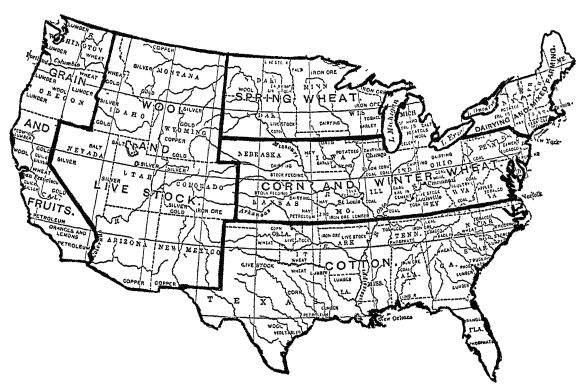
When regions specialize in producing the goods for which they are best fitted and then use the market to exchange these goods for those of other regions, all of us fare better.
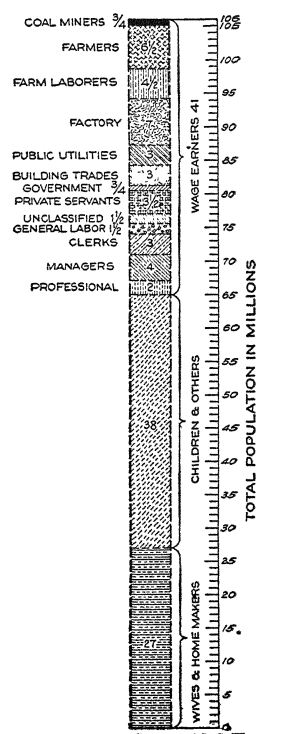
Our dependence upon specialists is very great. Our census hsts more than 7000 kinds of them, and new ones with new names are created in our bustling world every day. The amount of specialization today is so vast that there is no space even to mention the details. We can speak only of its great classes or kinds or groups.
1. Territorial specialization. — Everyone w’ould think first of all of our specialization by regions, or territories. That has already been sufficiently discussed (see page 274).
2. Occupational specializortion. — Then, one would naturally mention our specialization by occupations. Anyone can fill several sheets of paper with the names of different occupations to-day. There are so many of them that it is easier to group them into classes.
[ p. 370 ]
( a ) There is one group, or class, of occupations that are “close to nature.” That takes in such pursuits as farming, dairying, fishing, lumbering, mining, trapping, and grazing.
( b ) There is another group that works on the products of this first group. Here one would list manufacturing, transporting, and marketing.
( c ) Still another group is concerned with services rather than with things, and takes in teaching, medicine, law, governing, amusing, and art.
Each of these can be broken up into minor occupations. Take the task of amusing, for example. Can you not easily name a dozen occupations, beginning with acting, whose work is to amuse? Or take manufacturing. Can you not easily name fifty different kinds of manufacturing?
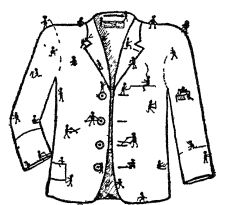
Thirty-nine Specialists to Make a Coat
3. Division of labor. — Then there is the specialization of workers, or division of labor, that takes place within one of oUr huge modern business houses. In a shoe factory, for example, we should find that no one works through the entire process of making a shoe. The undertaking is divided into many scores of separate operations, each of which is performed by some worker who does nothing else. We should find in such a factory that:
( a ) A “lining stitcher” sews together the different pieces of the fining;
( b ) A “closer on” stitches the fining into the shoes;
( c ) A “gang-punch operator” punches the holes for the eyelets;
( d ) An “eyeleter” puts in the eyelets with a machine; [ p. 371 ]
( e ) A “hooker” puts in the hooks mth still another machine;
( f ) A “heel slugger” drives into the heels a row of brass or steel nails;
( g ) A “heel scourer” sandpapers the heel;
( h ) A “heel breaster” trims the front of the heel;
( i ) An “edge blacker” blacks the edges of the heels;
( j ) An “edge setter” hardens this blacking with a block of steel cut to fit the edge and heated by gas.
There are separate persons to stamp on the name of the company, to polish the shoes before thej’" are inspected, to inspect them, to put in the laces, to wrap them, to box them, and so on almost indefinitely. Such specialization is not at all unusual. It is found in almost every industry of any considerable size. It is foimd in office work as well as in the factory.
4. Specialized capital goods. — One must not overlook the fact that machinery and buildings are also specialized in the modem plant. Our architects plan or design special buildings for different industries; our engineers design special machines for special uses. For example, in the shoe factory mentioned above, most of these specialized workers used specialized machines. There is specialization of capital goods.
5. Specialization in management. — Our businesses have become so large and complex that even the task of managing them has been split up into simpler tasks with specialists in charge. In medieval days, the master craftsman could make the goods, sell the goods, and take care of the whole business.
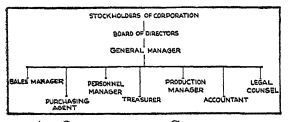
To-day the general manager of a business has many assistants. The production manager supervises the factoi’y end of the business; the sales manager takes care of advertising and selling; the personnel manager deals with the labor force; [ p. 372 ] the treasurer watches financial matters; the chief accountant takes care of the records. Each of these managers may have a whole staff of specialists under him. For example, the personnel manager may supervise a medical department, an employing department, a restaurant department, a safety -engineering department, and a miscellaneousservice department. We have specialization of management as truly as we have specialization of workers and of capital goods.
There can be no doubt that one good way of describing our society is to call it a society of specialists.
Specialization is a multiplier of our powers. — There is just as good reason for our great use of specialization as there is for our great use of fire, power, and the metals.’ Indeed it is the very same reason. It multiphes our powers.
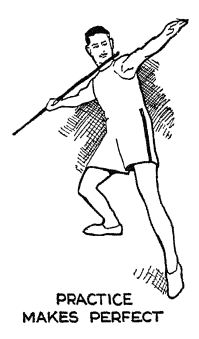
1. By increasing skill and dexterity. — Anyone who studies typewriting or takes piano lessons expects to practice. The reason for practicing is that our brains, nerves, and muscles are made in such a way that the repeated doing of a thing increases our ability to do it rapidly and well. “Habit paths” get formed in the brain cells and nerves. As a result, the muscles respond more and more quickly, more and more accurately. This is just as true of play as it is of work. “Practice makes perfect” in making brooms, adding figures, making speeches, running the typewriter, plajdng baseball, or [ p. 373 ] pitching horseshoes. “Jack of all trades and master of none,” is an old saying. It means that if one would be master of anything, he must do it over and over; he must specialize. This specialization multiplies our powers by increasing our skill and dexterity.
2. By assigning tasks according to talents. — There is another reason why the group’s powers are increased by specialization. Speciahzation makes it possible for each member of the group to give all his time and energy to doing the things for which he is best fitted. We are all different. Nfo two of us are exactly alike in our bodies, our tastes, our minds, or in any other way. We are “born different,” and we become still more unlike as a result of different training and experiences. Each of us should do what he can do best. “It is very wasteful to use an elephant to pull a flea’s load and very foolish to use a flea for an elephant’s load,” runs an old proverb. It would be a mistake to use an Edison to shovel sand; a big powerful man to thread needles; a tiny, weak fellow to unload pig iron ; an ignorant laborer to be president ; an illiterate blockhead to be a scientist. It would be quite as great a mistake to let the Edisons, scientists, and laborers do the things they can do best in only those brief periods of time that would be left after making their own clothes, cooking their own meals, raising their own food, and all the other thousand and one things of life. Specialization makes it possible for the group to avoid such mistakes, and to use its members “according to their talents.”
This gain of specialization is Just as true of regions or territories as it is of persons. With his steamships and railroads and other modern means of transportation, man has become able to have regions specialize in producing the goods for which they are best fitted. Everybody is better off, because nature’s gifts are thus used to the best advantage (see page 368).
[ p. 374 ]
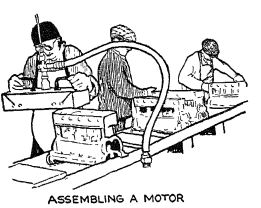
The Task Has Been Simplified
3. By simplifying tasks. — There is still another reason why specialization increases the powers of the group. Think of such a complex task as that of putting together the hundreds of parts of an automobile. If one person did the whole job, he would have to be a very capable person who had spent much time studying automobiles. See how this is handled in one plant. The complex job of putting an automobile together has been divided up into hundreds of simple tasks, and those tasks have been “laid out” in their proper order, so that each worker does one little thing over and over again.
The main framework of the chassis is started on a moving platform. As it moves along, one worker drops a part into place; the next inserts a bolt; the next screws up the nut of the bolt; and so on. At the proper point of the trip, the engine (which has been put together along a route of its own) is dropped into place; so are the wheels, the body, — everything. Finally out the door it goes under its own power, followed by another and another and another every few seconds. The whole complex task has been done, but only a few workers have done complex things requiring much time to learn. Furthermore, workers have been assigned to jobs according to their talents.
4. Minor advantages. — Some minor gains are also claimed for specialization. It is said that when tasks are thus divided up and a simple motion is made over and over again, it helps one to see how a machine can do the work and thus causes inventions to be made more frequently. It is also pointed out that different tasks require different tools. If [ p. 375 ] one man put an entire automobile together, he could use only one tool at a time, and scores of others would lie idle.
There are some disadvantages in specialization, (see Chapter XVI). But it is clear that specialization is just as truly a multiplier of man’s powers as is fire or the metals or the steam engine or the printing press or the railroad or the telephone. Good ways of organizing to do things are just as important as good tools to do them with.
¶ B. The Cooperation of Specialists through Authority AND THROUGH EXCHANGE
(How specialists are made into a smoothly working society; the market and those who work in it.)
Specialists must be knitted together. — “ How we manage to keep the world’s work moving fairly smoothly and still have it all done by specialists is little short of a miracle to me,” said one writer.
It is rather a wonderful thing, when one stops to think of it. Here are thousands of kinds of specialists, each at work on his own task — often a very small and narrow task. How does it happen that, in the main, about the right number of persons is making watches or raising watermelons or sewing buttons on coats? How does it happen that we ai’e not continually facing a great scarcity of some kind of goods or facing a surplus of other kinds? How does it happen that almost any product you or I chance to want is waiting just around the corner for us? How does it happen that, in a large city, day after day and week after week, specialists from all over the wurld send in about the right amoimts of fuel, clothing, food, building material, or drugs to supply that community? It is a rather wonderful thing.
All such questions simply call attention to the fact that if the work of society is to be spht up and done by millions [ p. 376 ] of specialists, there must be some way of knitting these specialists together again into a smoothly running society. There must be some way of keeping their work “in balance,” so that they will be doing what society needs to have done. Along with the sphtting up there must be knitting together. And there is.
Specialists are knitted together by authority in an army or within a plant. — Thus far, our society has found two main ways of knitting specialists together. One way is by commanding them to do what we wish — by the use of authority. That is the way we use in an army. The modern army is really a collection of specialists: infantrymen, cavalrymen, artillerymen, truck drivers, medical men, cooks, mechanics, machine gunners, paymasters, roadmakers — literally himdreds of different kinds of specialists. Everyone knows how they are knitted together into a good fighting machine. They are knitted together by authority. They obey the commands of the officers. These commands are given in accord with plans previously worked out, and everything usually goes smoothly.
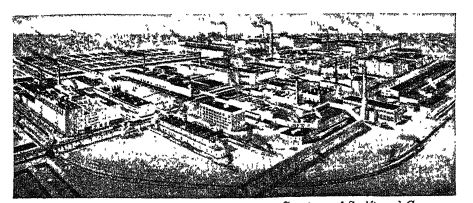
Bird’s-eye View of a Modern Plant
In such plants specialized machinery and thousands of specialized workers are knitted together into great producing agencies.
We use this same scheme within the walls of our business houses. Take the putting together of automobiles. This [ p. 377 ] work is all planned, so that the different parts come together in the right quantities, at the right time, and in the right place, much as branches flow into rivei’s. The management of the firm places the right men at the right places and tells them the right things to do. The plant is knitted together by authority.
It is possible to knit the specialists of a whole society together by authority. — But while we frequently use authority to knit together our specialists after they enter the army or an automobile factory or a government office or any of our plants of to-day, that tells a very small part of the story. How do we settle how many shall go into the army, as compared with how many shall make automobiles, as compared with how many shall make the other goods we wish? Do we use authority? We could do so, and we have done so in times of great emergency. In the World War, we “drafted” (ordered) men into the army; arranged for some to stay out of the army and build ships; told others to help run the railroads.
Authority could thus be used even in normal times. There are, indeed, a few small groups that do use that method. Here is the way one of these American groups runs its affairs. [1]
The use of authority illustrated in one commuoistic group. — About one hundred and twenty persons, beheving that goods should be owned “in common” rather than by individuals, live on some 7500 acres of land in one of our western states. They choose for themselves two leaders or officers who manage the affairs of the community. One of them, the preacher, handles the religious work. The other, the Wirt, manages and directs the rest of the community work. The Wirt has under him such helpers as the farm boss, the head [ p. 378 ] miller, the carpenter, the blacksmith, the shoemaker, the head cook, and so on. He hands out to them the supplies they need and receives from them the product of the work done by their groups. He is the general manager who plans the work and sees that the plans are carried out.
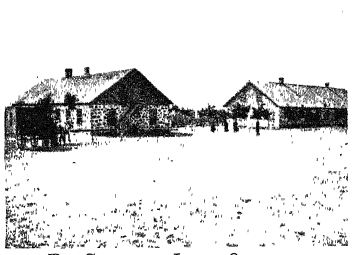
The day starts early. The first hour sees one group miUdng, another feeding the stock, another cooking the breakfast, another putting the sleeping rooms in order. Aiter breakfast, the squads are changed, and each goes to the work of the day. The men of skilled trades go to the little shops where most of the manufactured goods used by the community are made. The farm hands go to the fields. The children go to school. The women go to household duties and to the gardens.
All things owned in common. — Everything that is raised or made belongs to the whole community. Food and clothing are kept in community storehouses and used as needed. There are no separate kitchens in the various houses. Instead, there is a conununity kitchen and a community dining hall where all get exactly the same simple fare. Even the household furniture of the families belongs to the whole community, as does also the clothing a person wears. Children do not inherit goods from their parents. The goods formerly used by a person who dies are taken up and handed out to others as needed.
[ p. 379 ]
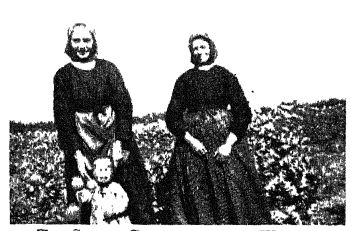
It is quite clear that these people have a scheme of working together cooperatively. It is based on community property and community direction. Each member of the community gives himself entirely to the group. He works under the general and kindly direction of officials he helps to choose. Everything he makes or raises belongs to the group. There is a community laundry, community barn, community bakery, community granary, community mill, community broom shop, community cellar, communitjr creamery; there are community chicken coops, community beehives; community everything, absolutely everything.
The individual has nothing but his own family life and his own thoughts. Even these are so largely set by customs handed down through centuries that in some real sense they are community affairs also. On the other hand, the individual is not oppressed. Quite the contrary. Out of the group storehouses he is clothed; in the group dining room he is fed ; in case of sickness or accident he is cared for. Everyone is supposed to work faithfully and well; in return he or she lives as well as any other person in the group, even if the living is simple.
Communistic experiments usually short-lived. — This way of organizing to live together has always seemed attractive to some small groups of persons, and it certainly is one way of getting the task done. It must be said, however, that few such ventures have been long-lived. When they have [ p. 380 ] lasted some time (the one described started back in the sixteenth century in Europe), it has usually been because they have been held together by the powerful ties of some strong religious belief. One of the elders of the group we have described explained why they had held together and had kept their property in common thus : “ Of course, we feel the temptation to work each for his own interest. Everyone does. But we cannot feel that it would be right to yield to it.” It does not matter to them that others think differently about it. They are firm in their own faith. They hold to a simple life; they refuse to yield to the “temptation of having each work for his own interest.”
Our individuals knit themselves together through exchange. — This story of a communistic society shows that the specialists of a whole group can be knitted together through authority. But in the main, such methods have not lasted and have not made for progress. Instead of that way, we use a scheme in which society merely lays down certain broad, general “rules of the game.” Then it lets its individuals take the lead and knit themselves together. They do this by exchanging goods with one another; by using “the market.” This exchange by individuals is the second great way of knitting together the speciahsts of our society. It is the way we have come to use most.
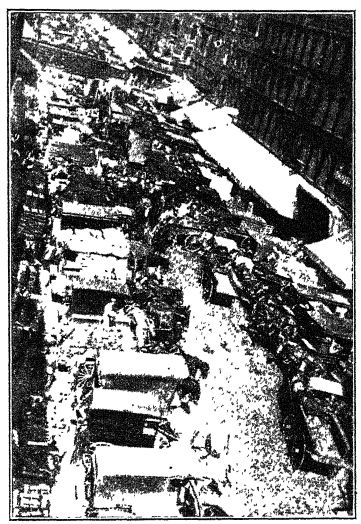
Feeding a city illustrates the knitting together of specialists. — As one small sample of how the specialists of our society are knitted together by means of the market, let us look at the way a city is fed.
The produce market of a city.[2] — There is a street in the city of Chicago that is only a few blocks long — South Water Street it is called. It is one of the busiest streets of the world, [ p. 381 ] for here much of the perishable produce that Chicago needs is handled. It is the great wholesale market of this produce. This produce comes into Chicago by the truckload, the carload, and the shipload, a steady stream. It comes by truck from near by farms; it comes in special refrigerator cars across the continent; it comes by boat from the fruit belt of Michigan. By daylight in the summer months, and even before daylight in the winter, the street begins to be busy. The short, narrow street is packed with thousands of wagons and trucks that are bringing in their loads to the sales place, or are carrying them out to the hundreds of retail stores throughout the city. Even the sidewalks are so filled with the produce for the day’s sales that in places buyers must move in single file.
The warehouses. — There are scores of warehouses. Each warehouse is likely to specialize in some particular class of [ p. 382 ] products. Here is one devoted entirely to trading in cheese. There is a four-story building filled with Spanish and Bermuda onions. Yonder are thi’ee warehouses with hundreds of bags of potatoes piled from floor to ceiling. Here is a gi’oup the cellars of which are full of ripening bananas from Central America and pineapples from Porto Rico. There is another group almost bursting with citrus fmits from Florida and California. Yonder are several handling only fresh vegetables. These are fitted up with special devices for keeping vegetables fresh and for improving the condition of those injured during their travels. Shallow tanks of cold running water freshen asparagus from California or spinach from Texas or lettuce from Florida, California, or New York.
The cold-storage warehouses are a tribute to the skill of man, the harnesser of nature. In them he has tamed the climate and adjusted it so that he may store for considerable periods of time such products as cheese, butter, poultry, eggs, apples, and potatoes. These products are collected during the seasons of the year when they are most abundant and stored for use in seasons of less abundance.
Produce dealers are agents in knitting together producers and consumers. — We cannot stop to describe all the dealers who work in this huge market, but we must look at a few of them. There is the hu’yer who is sent out by South Water Street firms to purchase goods. He goes through a producing territory, making contracts with producers for all or for part of their output, or buying from day to day wherever he can secure goods at satisfactory prices. He keeps in close touch with his employer, advising him by letter, telegraph, or telephone of the outlook as to quantity, quahty, prices demanded, and competition from other buyers. In turn, he is told about the situation, in the Chicago market, and is instructed how much to buy and what to pay. The buyer ships his purchases, [ p. 383 ] by means of the transportation companies, to his employer, the South Water Street produce merchant.
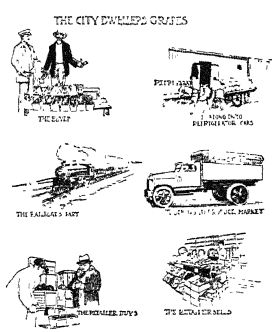
Not all goods come into the market as a result of the work of these buyers. Sometimes groups of producers organize themselves into cooperatives and have an agent to sell their produce. Sometimes producers combine their shipments and send them in carload, or even train-load lots, and have them sold at public auction, usually at railroad freight yards or at steamship piers. Fruits are especially likely to be handled this way. Sometimes producers ship direct to commission men in South Water Street who sell for them and charge a commission. It is clear that there are many possible channels for supplying the food of the city.
The wholesale grocer also works at the knitting together process. — The part played by the wholesale grocer is another important piece of service. He deals in commodities of a less perishable nature. He also, like the produce merchant, has his buyers out in the producing regions, even in those of far-distant countries. He imports tea from Japan and China; coffee from Brazil, Colombia, Java, and Arabia; cane sugar from the West Indies and from Hawaii; oHves from Spain and Italy. The fig trees of Turkey, the terraced rice fields of China, and the date palms of Persia supplement the food products gathered from the farms, orchards, pastures, and streams of our own country.
[ p. 384 ]
Much of this material, after it comes to the wholesale grocer, must be specially prepared before it is ready to be put into the hands of the retailer. For this purpose special machinery may be used, such as large mills for grinding spices, machines for cleaning the coffee, ovens for roasting it, and machines for measuring it into the packages demanded by the retail trade. Olives arrive in large hogsheads. They are washed and bottled in brine, or the stones are removed and the ohves fill ed with pimentos from Mexico. Brazilian nuts come in a very rough condition; they are polished in rotating cylinders.
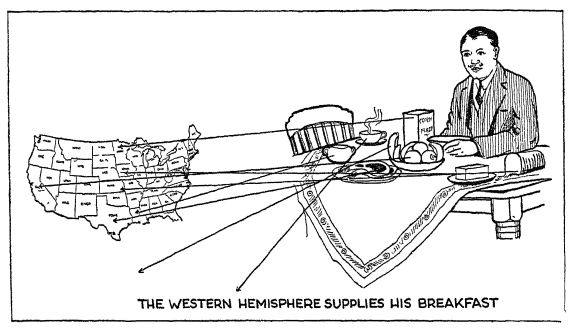
All such work the wholesale grocer needs to stand ready to do, although some of it to-day is taken over by the producers, or by specialists in packing. This work done, the wholesale grocer must store in warehouses until the goods are demanded, deliver in trucks to the retailer, give credit to the retailer, help the retailer advertise certain goods, and even give him suggestions about how to keep his accounts. The retailer looks upon the wholesaler as the great reservoir of goods, from which supplies can be secured as needed.
[ p. 385 ]
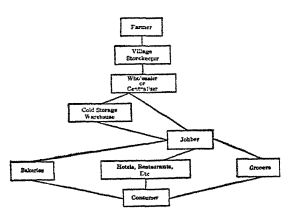
Others who help feed a city. — Now all this is but the beginning of the story of the feeding of a city. There remains the story of flour and the bakeries; the story of the restaurants and hotels and boarding houses and homes; the story of the provision merchants who deal in meats and meat products; the story of the retail grocers and delicatessen men. However, these stories are all fairly well known; they do not need to be told here. The feeding of the city shows that ways have been found to knit together the specialists of the city with the specialists of all the rest of the world. It is done through “the market,” through exchange.
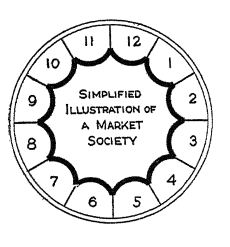
A simple illustration shows the work of the market. — The way the specialists of our cities are knitted together with those of the rest of the world is typical of the "way it is done tliroughout our society. This may be shown by a simple illustration. If our society were a small group of twelve, and if there were only a dozen goods and services in the world, we could easily picture the situation to our minds. It would be as if there were a dozen booths in which the goods and services were made, opening out into a market place. On the counter running around in front of the booths the goods could be displayed. Each of the specialists would sell his own wares and with the money he would buy such other wares as [ p. 386 ] he chose. The twelve, working as speciallsts, could make far more than they could have made as jacks-of-all-twelvetrades. They would cooperate with one another (be knitted together) through exchange.
This simple illustration shows the main features of what is done in our real society. In our real society, there are more than 100,000,000 persons in the United States alone, and these cooperate not only with one another but with people of other nations. We have thousands and thousands of different kinds of goods and services. Many of these goods are made by thousands of persons working in giant factories scattered all over the world. No tiny booth arrangement around a Mttle market place would serve to knit all this together. But if we use the word market to mean all the billions of exchanges that go on every day in these tens of thousands of goods and services, we see that the specialists of our society are knitted together by these exchanges in the market just as truly as the imaginary twelve were by using the tiny booths.
Middlemen do much of our marketing work. — When we think of the market in that way, we realize that it is so huge and its work is so enormous that speciallsts must arise to do some of this marketing work. We have them in hordes. Merchants, commission men, wholesalers, retailers, department stores, specialty stores, mail-order houses, traveling salesmen, advertising agencies, produce merchants, hucksters, and peddlers are a few of the many we all know. We should include in this list of persons who work in the market, those who work in our banks, railroads, steamships, insurance companies, and warehouses. Speciallzation has been carried as far in the market as it has in other parts of our living together.
We have come to call these persons who work in “the market” for us middlemen. In the old days, when each person [ p. 387 ] [ p. 388 ] made or raised practically all the things he used, there were, of course, no middlemen. The producer was also the consumer; they were one and the same person. That state of affairs may be illustrated by this diagram: In the old days Producer = Consumer
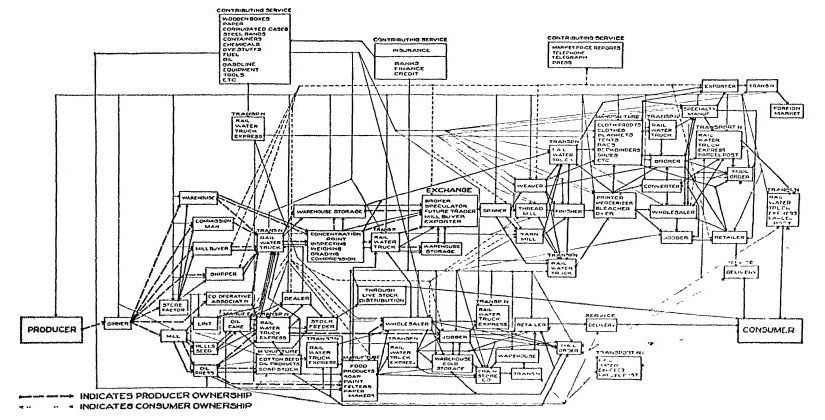
The cotton is produced in our southern states It goes to the cotton Kin. and then the fiber and seed* are split up into dozens of products. These pass through the hands of scores of buyers and sellers who are added in their work by spenalists who transport, insure, finance, store, and communicate. When we reflect that this diagram been made very simple, and that similar diagrams can be rnade for other products we use, we see that the market that knits us together a very complex and wonderful thing
Later (let us say in the medieval towns) the producer made goods himself and sold them direct to the consumer. On pages 131 and 132, that way of doing things is described . It may be illustrated by this diagram: Producer | Consumer. Still later (to-day, let us say) everyone has become a specialist. Speciahsts working in the market are the go-betweens, or middlemen, of the specialized producers and the consumers. This diagram illustrates that way of doing things:
Millions of specialized PRODUCERS sell goods through
hosts of specialized MIDDLEMEN who pass the goods on to
the millions of CONSUMERS, who are themselves specialized producers of other goods
We rely mainly upon individual initiative in this knitting together through exchange. — As was said earlier, the community, as a whole, merely lays down the general rules of the game in our knitting together of specialists. How it does this is to be explained more fully in Chapter XIV. But we already know the main outlines of the story. We know that there is such a thing as government; that there are laws saying individuals may do some things and may not do others and may do stiU others only under certain conditions. For example, individuals may not steal or damage one another’s property; they may engage freely in ordinary businesses; they may become doctors only if they pass the state medical examination, or restaurant keepers only if they pay the license fees. In addition to using law, the community also [ p. 389 ] uses public opinion and custom in laying down rules of the game to control the individual.
Then the community says to its individuals : “Now, act according to these general rules and specialize, for by specialization your powers will be greatly increased. Then exchange with one another the goods and services you make. If necessary, let some of your number specialize in running this exchanging, — in being middlemen. Since money is the language of trade, use money in your exchanging. Those of you who are wise enough, or fortunate enough, to make goods greatly in demand by others, will ‘make money.’ Those of you who are unwise or unfortunate enough to make goods that are not demanded will ‘lose money.’ Since everybody will wish to ‘make money’ so that he can buy from others the things he wishes, you will all be anxious to make what the community demands. That is the way we shall get the ‘ right quantities made and have our living go on smoothly.”
That is how, in our society, our specialists are knitted together : how they cooperate. It is left mainly to the individual. Individuals, rather than the community, work out the knitting together. They take the lead (we say they take the initiative) and they knit themselves together, or cooperate, through exchange. We call this a scheme of “individual initiative,” meaning that indimduals take the leadership in acting.
Summary view of the cooperation of specialists. — The results of our study of man, the cooperating specialist, may be summed up thus:
- Specialization is a multiplier of our powers. Ways of organizing to do things are as important as tools with which to do them.
- Specialists must be knitted together. This may be done by authority or through exchange. We use both [ p. 390 ] methods. The main use of authority takes place within plants. Exchange is so widely used that our society is properly called an exchange or market society.
- The leadership or initiative in this knitting together through exchange is taken by the individual. Society lays down general rules of the game.
- Although specialization is a very old device, its great development has taken place in the last one hundred and fifty years. The reason is simple enough. Only in the last one hundred and fifty years has man been a great harnesser of nature, a scientific planner, and a great communicator. He had to be all these if he was to be a great speciahst. Not until he was making many different goods with many tools could there be the 7000 different tasks fisted in our census volumes. Not until he had become a fairly scientific planner would he be able to split complex jobs into their specialized parts. Not until he had become a good communicator could he have the transportation devices that would let him carry goods from specialized producers to consumers all over the world. That is why the great specialization [ p. 391 ] of to-day has occurred so recently that the change is ill the memory of persons still living.
- Since ive have reason to expect in the future still greater development of man’s poweiis as a harnesser of nature and communicator, we may reasonably expect a further increase of specialization.
- There are evils and disadvantages in specialization, but that is a story to be told later.
- And we must never forget that the story of our cooperating specialists is a part of the stoiy of living together in organized society. Other parts of. that story.are to be told in later chapters.
SPECIALISTS OF 1415 IN ENGLAND
Woolen weavers; plasterers; armorers; parchment makers and bookbinders; chandlers; spurriers; lorimers; barbers; curriers; pouchmakers; bottlers and capmakers; httisters; tilemakers; millers; furriers; harvesters; bowlers; winedrawers; drapers; linenweavers ; innkeepers; vintners; ironmongers; spinners and vestmakers; bowyers and fletchers; cooks and watercarriers; shearmen; carpenters; brokers and wool packers; mercers; fullers; shipwrights; spicers; perterers and founders; masons; cutlers ; bladesmiths ; painters ; scriveners; illuminators; pardoners; dubbers; tanners; coppers; fishmongers; mariners; tilers; marshals; girdlers; nailers and sawyers; smiths; plumbers and patternmakers ; bakers ; cordwainers; tapestry makers and couchers; butchers and poultry dealers; saddlers, glaziers, and joiners; tailors; potters.
As complete a list of the specialists of to-day would fill twenty pages of this book.
¶ Problems
- Define or explain
Specialist
Knitting together by exchange
Specialization in management
Cooperation of specialists
Territorial specialization
Communism
Division of labor
Middlemen
Knitting together by authority
The market - Make a list of persons who are quite highly specialized workers. Make a list of some who are not very specialized. Can you make a list of absolutely unspecialized persons to-day? Can you think of anyone to-day who engages in every kind of work necessary to produce all the commodities he uses? Compare your lists vith those of other students,
- Suppose that John Jones is the best lawyer in the state as well as the best stenographer. Should Jones do his ovm stenographic work or should he hire a stenographer? Show that your answer illustrates one of the gains of specialization.
- Bananas can be raised in hothouses in Canada. Would Canada be wise to get her supply of bananas that way? Show that your answer illustrates one of the gains of specialization.
- Specialization is partly responsible for the fact that wonien are doing more and more work outside the home. Why?
- “The housewife to-day must be a specialist in buying.” Is that true? What courses in the school curriculum would be helpful in preparing girls to be skillful purchasers? [ p. 392 ]
- Is there specialization of regions or territories in your town? Is there a “business district”? Are there other districts?
- Name three goods which could be produced in your neighborhood or region, but which You get more cheaply by buying from people in other districts (see question 3 on page 298).
- Work out an organization chart of the public schoo system of your city. Is there specialization of tasks? Pick out illustrations of specialization in your own school.
- Are the grocer’s delivery men among the cooperators who provide us with a loaf of bread? Are the men who work at paving streets? Are the people who pay taxes? Is the policeman?
- “Each person or community tends to gain whenever any other person or community increases its powers.” Explain why this is true.
- “All labor is noble.” Every calling is sacred.” Prove that a farmer raising potatoes in Michigan may be cooperating in missionary work in India.
- Make a list of the reasons for calling specialization a multiplier of our powers. Make a list of its main forms*
- Give five illustrations of knitting specialists together by authority.
- Show that in the communistic group discussed on pages 377-380 there was an organized way of doing things. Show that the people cooperated.
- “In communism there is likely to be a lack of progress because no one fares any better than others if he happens to be especially able or capable.” Do you agree?
- Make a list of as many agencies as you can that are directly concerned with providing a city’s food supply. Name ten other agencies that help this first list of agencies and are therefore indirectly concerned with providing a city’s food.
- How can city people who work all day making automobile parts, or running street cars, or copying figures on adding machines know that some farmer will produce butter and eggs for them?
- How do the people of a city help to satisfy the wants of the various persons who send them food?
- Try to trace some ordinary commodity of to-day, such as a loaf of bread or a bottle of milk, through the work of ail the different persons who had a hand in producing it.
- “Commerce does not increase the wealth of the nation since it only transfers goods from one person to another. Time and energy arespent merely in passing things on.” Is this true? [ p. 393 ]
- “The fact that producer and consumer can l 3 e thousands of miles apart results from man’s ability to harness nature and to communicate.” Show that this is true.
- What is a wholesale market? A retail market? Is a grocery store a market? Is a factory that hires labor a market? Is a bank that lends money a market?
- Our society is often spoken of as “a market society.” Show why this is a good description.
- Answer the questions at the beginning of this chapter, page 307,
¶ Interesting Reading
Marshall : Readings in the Story of Human Progress, Chapter XIL
- Colonial Cloth Tvlaking and a hlodern Factory (an example of the growth of specialization).
- Canning Corn (an example of specialists working to supply our food).
- Linking Country and City (the marketing of wheat as an illustration of linking country and city).
- Modern Storage (one of the specialized tasks in the marketing work of society).
See also:
Chapter II, 2. Woman’s Share in Primitive Culture (early division of labor).
Chapter IX, 1. Early Fairs and Markets (the main trading places of the days of small trade).
Chapter XIII, 1. The Social Life and Industries of Ants (division of labor and place finding governed by instinct).
Chapter XIII, 3. Woman’s Place in Modern Culture (the tasks and opportunities of woman in our society).
Chapter XVI, 1. Improving Our IMarket Machinery (one example of how we improve the knitting together of our specialists).
Problems to think over are given in these reading selections.