| XII. The Cooperation of Specialists | Title page | XIV. Social Control; Custom, Law, Public Opinion, and THE Sense of Divine Approval |
[ p. 394 ]
CHAPTER XIII
FINDING OUR PLACES AND PULLING THE LOAD
A. Groups with Few Place-finding Problems
B. Place Finding in Our Society
C. Individual Initiative, a Multiplier of Our Powers
Questions to Keep in Mind vtiile Reading This Chapter
- How can one find his proper task or place in a society of specialists?
- How can one know what use to make of his property in such a society?
- What motives ought to govern one in placing himself and his property?
- Just how is individual initiative a multiplier of our powers?
The last chapter revealed us as a society of thousands and thousands of specialists, each working at a single task and yet all knitted together. We are knitted together mainly by the market, although authority is also used. There can be no doubt that this plan of a society, this scheme of social organization, works fairly well. We have, made a good deal of progi’ess under it. But where do you and I fit into the picture? How is it settled what our particular task is to be? The piupose of this present chapter is to show that there are answers to such questions.
¶ A. Groups with Few Place-finding Problems
(Place finding in an unspecialized society and under a caste system.)
Let us first look at two societies where the problem of finding the “right” place for each individual is handled in a way quite different from the way we have come to use.
[ p. 395 ]
No place-finding problem in an unspecialized society. — In the time of neolithic man, there was no problem of finding one’s place in society. The Iroquois girl did not need to ask herself whether it would be best for her to be a teacher, a secretary, a clerk, or a doctor. The Iroquois boy did not need to ask whether he should be a lauyer, a mechanic, a preacher, or a dentist. There were no such occupations. There was only one occupation: that of just hving along in the gens. Or perhaps we should say there were two occupations :
(1) that of being a woman in the gens, and
(2) that of being a man in the gens.
The woman would till the soil, prepare the food, take care of the children, and make the household utensils. Why? It was the custom. The man would be the hunter, the fisherman, and the warrior. It was the custom. Each and every woman did all parts of the “woman’s work ” ; each and every man did all parts of the “man’s work.”
This meant that when a child grew up, he did not “look for a job.” There were no “jobs.” All there was for him to do was to go on living as the gens had always lived.
The caste system as a place-finding device.[1] — In an unspecialized society, then, there are no place-finding problems. All its members work and live alike. Let us now look at a [ p. 396 ] society that is somewhat specialized, but has a scheme of social organization resulting in its having few place-finding problems. That is the case under the caste system. The caste system is a scheme of social organization in which people have come to be divided into classes in a very sharp and rigid way.
Many, many generations ago, a horde of invaders (they were members of the Aryan race) poured down from Central Asia, through the mountain passes, and into the plains of India. The three main occupations of these Aryan invaders were the work of the priests, or Brahmans; the work of the soldiers, or fighters; and the work of the farmers. They made slaves or laborers of the dark-skinned peoples they found on the plains. These became a fourth group, — a despised group called the Sudras. This happened at a time when these peoples were very much ruled by custom. As the generations went by, there came to be four quite distinct classes or castes of the population. Gradually these four groups spht up into many others. To-day there are about 2500 of these classes or castes.
The rigid rule of a caste system. — One very interesting thing about this caste system is the fact that birth determines for all one’s hfe in what caste one belongs. In whatever caste he is bom, there he must stay. He can never rise out of it. Neither can his children, for marriages must occur within caste bounds.
It is hard for us to realize what a rigid matter caste has become in India. We have nothing hke it. Caste rules govern every detail of the Hindu’s hfe from the cradle to the burning ghat that reduces his body to ashes. The morning bath, the cooking of food, the cleansing of utensils, the forms of worship, the shape of the turban, the style of clothing — everything is done according to caste rules.
[ p. 397 ]
What one shall work at is mainly fixed by caste, since nearly all the vocations are organized on caste lines. For example, there is a tailor caste, a goldsmith caste, a washerwoman caste, a barber caste, a potter caste, a sweeper caste, and so on.
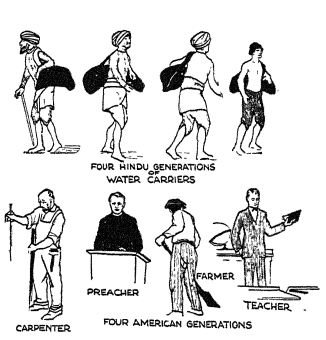
It is not merely the custom to do everything according to caste rules; it has become part of the Hindus’ rehgion. They beheve that their gods have commanded that all human life shall be governed by caste.
Since they are one of the most religious peoples in the world, the grip of caste is strong upon them.
A caste system, prevents good cooperation. — Perhaps the worst aspect of this caste system is the way it checks the widening of
sympathy and the desire to serve others. In general, a highcaste person must have as little as possible to do vith a lowcaste, or with a foreigner. He is forbidden to touch, or be touched by, even the shadow of the low-caste, who is regarded as unclean or untouchable.
The low-caste man is handicapped at every step of life. The mail carrier will throw his letter on the ground; the high-caste judge wiU not let him in a court room. He must crowd to the side of the street as the high-caste man pa.sses by. He cannot get a drink of water from the public well. When pestilence sweeps through his village, he is left to die [ p. 398 ] at the roadside, untouched by the high-caste passer-by. We can picture what this means in India, when we remember that there are about 60,000,000 of the untouchables, and their numbers are rapidly increasing. Among others, they include the small farmers, the weavers, the shoemakers, the tanners, and the sweepers.
Since the foreigner, too, is considered unclean, it is not easy for the Hindu to have a feeling of sympathy and cooperation with the people of other nations. A boy from Ohio was one day walking through the narrow crowded streets of a city in India. He decided to buy some native sweets at one of the little open shops. The shopkeeper was clearly not anxious to sell to him. Instead of handing him the parcel of candy, he put it on the mud floor. When the boy offered the money, the shopkeeper drew back quickly, and motioned the boy to leave the money on the floor where the parcel had been. He would have broken his caste and become polluted if he had given the parcel into the boy’s hands or taken money from him. According to caste rules, one must not have direct dealings with a foreigner.
Summary of the results of a caste system. — From this accotmt of the caste system of India, we see several things:
1. Ways of doing things that seem very repulsive to us, seem quite natural (and indeed the only proper ways) to others who have been trained differently. The caste system seems right to the Hindu. It is, he thinks, the way of the gods. A child bom in a sweeper’s family is placed there because of evil done in some former life. A child born in a Brahman’s family is placed there by higher powers because of good done in an earher existence. A high-caste man can thus feel that his favored position has been earned: — earned in an earlier existence. It seems as right to the Hindu that [ p. 399 ] birth should determine the whole life of a person as it seems wrong to us.
2. Whether right or wrong, a caste system is surely one way to organize a society. It settles, by the accident of birth, what part everyone shall play in society; what he shall work at; how he shall deal vdth others; how he shall think about others; how he shall take care of most of the little details of hfe, including even the style of his clothing.
3. The caste system of India has become so rigid through custom, race prejudice, and religious prejudice that there is a terrible hopelessness about the system. The low-caste cannot rise: it is thought wrong even to wish to rise. It is believed that the gods have put him where he is, that they will be angry if he even thinks of escaping. This keeps the individual from striving to improve his condition, and there is little chance for progress without that striving. The caste system, in other words, checks the individual from taking the leadership or initiative. It keeps the individual, and especially the low-caste man, from being active and aggressive. It must be said, however, that the system does not absolutely prevent change. Indeed, changes are occurring at this very time.
4. A caste system checks the growth of sympathy and the love of serving others. It is true that it promotes these feelings within the caste but it tends to confine them to one’s own caste, or at least to a narrow range of castes. The result is, a society organized on this plan can hardly be fully [ p. 400 ] cooperative; can hardly get the spirit of “all pull together.” Now, cooperation is a real multiplier of our powers. It follows that the caste system tends to prevent the group from rising to its full powers, — to its full capacities. Such a group does not Uve together as well as it should.
UNTOUCHABLE CLASS
Grand Assembly of Hindus Unanimously Lifts Ban.
The Hindu Maha Subha (Grand As uembly of the Hindus), which held Sts seventh annuitl session In Benares recently, attended by about 6,000 delegates from all parts of the country, after a heated discussion passed unanimously a resolution removing the ban against the “untouchables” with regard to schools, public wells, meeting places and temples.
This result was mainly brought about by the tact and willingness to compromise displayed by the leaders Of the reform party, particularly Bandit Malaviya, in overcoming the opposition of the orthodox section Bandit Malaviya in the course of his presidential address, describing the miserable condition of the “untouchables,” and their oppression by the higher castes, said;
“We regard ourselves as polluted by the touch of the very shadow at any one of the depressed classes, and we refuse them the privilege of leading healthy, decent, civilized life.
We in America do well to oppose anything tending to develop a sharp class, or caste, system.
¶ B. Place Finding in Our Society
(The promptings of the gain spirit; social regulation; personal tastes; the desire to serve.)
The account we have just had of persons finding their places in two other societies does not tempt us to try such methods for ourselves. We should not wish to be members of an unspecialized society, for we should be sorry to lose that multiplier of our powers, specialization. We should not wish to be members of a caste system, for in such a system cooperation is not well developed, and the group does not live as well as it should. Let us now see how place finding is handled in our own society.
Individuals follow the gain spirit in placing themselves. — Our own society is so complex that it is not easy to describe the plan we follow in finding our places. We do it, in large part, by following the promptings of the gain spirit, but what does that mean? Let us notice several cases. In my mail this morning, I find four letters. Here are extracts from two of them. The other two will be noticed later (see page 408). Number one says:
I have been teaching school for five years. I like the work very much, but the salary is not enough for the modest needs of my family. I have been -wondering whether it would be -wise for me to become an aecoimtant. If I do so, what salary might I reasonably expect? How much would it cost to prepare for this new work?
[ p. 401 ]
Number two says:
I shall be graduated from high school this June, and I realty do not know what to do next. My father is a lawyer. He adxdses me not to take up law. He says there are too many in that profes.sion already.
I think I should like to study either engineering or business. Can you tell me where I can find something to read about these tasks? I should like to know what the work is like; ivhat the pay is; and what it costs to learn each.
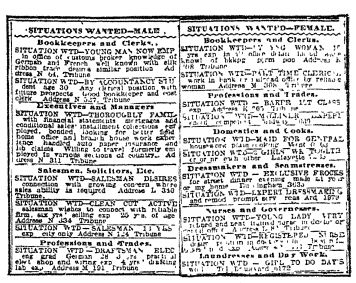
These letters are not unusual. They put down in black and white questions that are in the minds of millions of us. “What work is society paying well for these days? What will it cost to prepare for that work? How can I find out what pays best?” Those last three words tell the story. We do, or try to do, what pays best. Sometimes our information is poor; often we make mistakes and must try something else. But we follow the promptings of the gain spirit, to a very great extent.
Property also is placed according to the promptings of the gain spirit. — In addition to placmg ourselves, there is also a need of getting private property into tasks or places where it serves. As we know, private property means that private persons own land and buildings and machinery and what not, instead of their being ovmed by the group. The person who owns property can either lend it to others or he can use it himself in business. If he uses it himself, it enables him to rent land, hire workers, buy machinery and raw materials, and, in general, to manage and operate the business. If he makes a profit, he keeps that profit. If he makes a loss, he loses some of his property. Naturally, he tries to [ p. 402 ] get into a business for which society has a demand, hoping thus to make profits. He follows the promptings of the gain spirit in placing his property. Let us watch a case of property placing, noticing at the same time something of the forms of organization used in business.
Edwin Grant inherited $3500 from his father. What use should he make of it? There is not space to tell all the things he thought of, but here are a few samples :
- He thought of “investing it in himself” by using it in taking an engineering course.
- He studied whether to let the government use it by subscribing for a. loan that the government was making. The government wanted money to build a canal. It would pay 4 per cent interest and would pay back the principal after 30 years.
- A new ice-cream business was just starting up. It was a corporation and it needed a capital of $50,000 to make its start. The agent of the corporation tried hard to get Grant to take stock to the extent of his $3500, saying that he believed the company would be able to pay 10 per cent dividends.
- Here is what he actually did with his money, and also with himself. He started a business of his o-wn. It was successful and he later enlarged it by making it into a partnership and still later by turning the partnership into a corporation.
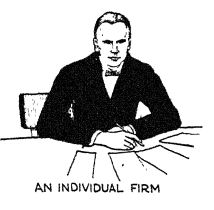
Setting up an individual firm. — Grant had been employed in a large printing plant.[2] He saw that his employer was making money, and he decided to use his inheritance and the money he had saved in starting a printing business of his own. His work had made him familiar with the [ p. 403 ] mechanical side of the business. He therefore had little trouble in picking out a good building in a good location, and in buying and setting up his machinery. Then he made his purchases of materials, such as paper and ink, and began business. He was a hard worker and a fine fellow. Through his friendships and through the good quality of his work his business soon began to show a steady growth.
The change of an individual firm into a partnership. — After he had been in business two years he decided that he ought to take in a partner. His reasons were that (1) the business was so successful that money was needed for buying more machinery, and (2) he needed some one to take care of the buying and selling, so that he could give more time to the shop. A salesman of another printing house was persuaded to be the new partner. The two men consulted a lawyer, who drew up a simple partnership agreement, or contract. This stated what each put into the business, and how profits would be dixTided (see page 404) .
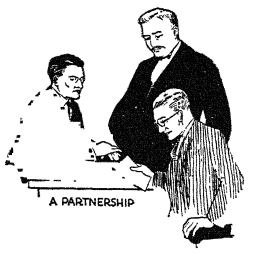
The new’ firm w’as very successful. The work w’as better done because of the more speciahzed management. It presently became wise to take in a third, and then a fourth, partner. The amormt of money invested in the business rose to $100,000. Even this amount was hardly enough to take care of the business which came to the firm.
[ p. 404 ]
THE PARTNERSHIP ARTICLES
Edwin Grant and Herbert Camp, both of the city of Zanesville, Ohio, hereby mutually agree to become partners under the firm name of “Grant and Camp” to conduct the trade and business of printing in the said city for the period of ten years from date.
The said Grant invests his stock of presses, paper, ink, and other material, estimated to be worth ten thousand dollars ($10,000) and the said Camp invests ten thousand dollars ($10,000) in cash.
Both partners shall give their entire time and shall share losses and gains equally.
All amounts earned or received by either partner for work, materials, or anything pertaimng to the business shall be deposited in the First National Bank of Zanesville in the name of both partners, and shall be checked out as needed for expenses and supplies by the signatures of both partners. An equal amount shall be drawn each Monday morning for each partner for salary and personal expenses, but a balance of five hundred dollars ($500) shall always be kept and held.
When the finn shall be dissolved, all debts shall be paid, after which the balance shall be divided equally between the partners.
Witness our hands and seals this sixth day of September, nineteen hundred and thirteen.Attest; Edwin Grant (L.S.)
Rachel Carroll Herbert Camp (L.S.)
The change of a partnership into a corporation. — Somewhat unexpectedly a good chance came up to enlarge the business again. It seemed wise to do so. The presses were crowded with work, and a larger business would mean the chance to purchase materials in such large quantities that they could be bought at a low price. Then, too, the larger business would make possible still greater specialization of machinery, workmen, and management.
However, the four partners did not have enough funds of their own and they hesitated to take in more partners. Since one partner can bind the others by his contracts, a firm hesitates to have a large number of partners. They again consuited [ p. 405 ] their lawyer and he advised them to form a corporation. This is what he told them :
All we need to do is to get blanlvs from the Secretary of State at the State Capital. When filled out they will give the name of the Company, its purpose, its place of business, the amount to be invested, and some statements about how the company is to be managed. At small expense, we can get from the Secretary of State a “charter” or “certificate of incorporation” for the company.
In your case, the thing to do is to have the ownership of this new business divided into 2000 shares or parts, worth $100 each. This makes $200,000, and I understand you wish to have a business of about that size. Your shop, machinery and materials are now worth $100,000. You can turn these over to this new business, taking 1000 shares in exchange. The remaining 1000 shares can be offered to others at $100 each. Of course, you four partners can buy some of the remaining 1000 shares.
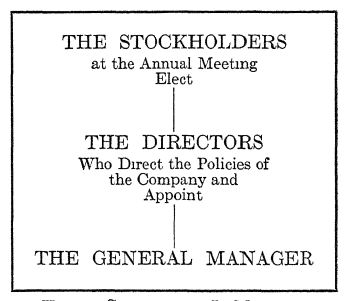
Each share will be entitled to one vote at the annual meetings of stockholders. These stockholders will elect a board of directors who will direct the policies of the corporation. The thing for you men to do is to own more than 1000 shares among you, and thus be able to elect yourselves to the board of directors.
Probably you will have no difficulty in getting others to invest. The business is a good one; you men are known as good managers; and there is an important point about a corporation that appeals to investors. A person who takes a share is liable only for the amount he puts in, if the business fails. We say the shareholder’s liability is “limited,” whereas the liability of a partner is usually unlimited.
The partners decided to change the business into a corporation. Each partner received 250 shares in exchange for his part of the old business and then took 10 more shares at [ p. 406 ] $100 each. The four partners thus held a total of 1040 shares and therefore had the majority of votes in a stockholders’ meeting. The remaining 960 shares were quickly taken by others. At the first meeting of the stockholders, the four partners and two other persons satisfactory to them, were elected directors. These directors appointed Edwin Grant general manager of the corporation.
The business continued to be successful. Every year the profits were divided among the shareholders in proportion to the number of shares each owned.
Summary of place finding through the gain spirit. — This account of the work of the gain spirit shows us several things about place finding in our society.
- To a considerable extent, individuals try to find out what tasks will pay best. Then they go into these occupations.
- Individuals in our society often do more than merely place themselves. Often they also put property at work at things likely “to pay.” Since ours is a “market society” this “property” can hire workers, rent buildings, buy materials and be used in other ways to make goods.
- Our society has come to have certain schemes for organizing to handle the businesses that result from such actions. Edwin Grant started with what we call the individual firm. Later he had a partnership. Still later he was a shareholder of a corporation. We should think of these as organizing devices, as ways man has developed of working with others.
Although we follow somewhat the promptings of the gain spirit in finding our places in present-day specialized society, we do not depend entirely on those promptings. Ear from it. In some cases society steps in with a “thou shalt” or “thou shalt not.” In other cases, we follow our own tastes and [ p. 407 ] preferences, which may or may not agree with the promptings of the gain spirit. In still other cases, our desire to be of service may cause us to enter some occupation other than the one the gain spirit suggests.
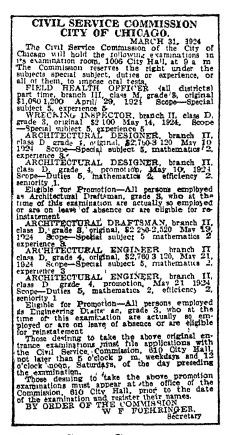
Society directs us to our places to some extent. — Do you wish to be a lawyer? In most states you may practice law only after passing an examination in the law. This examination is conducted by the state in order to safeguard its citizens from foohsh legal advice. Are you thinking of medicine? There is a state medical exanaination to be taken. These are but examples. The same situation exists in accountancy, in dentistry, in government bureaus, and in many others.
There are, too, a good many things that society absolutely forbids. We are not allowed to “find a place” as a robber or a gambler, even if the gain spirit does urge it.
In property matters, also, society steps in with regulations. It does not allow property to be used for making impure foods or alcoholic liquors. It allows property to be used for making certain drugs only under very careful rules.
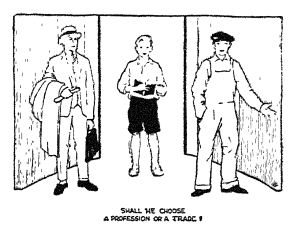
Society does not use merely law in directing us. Public opinion also directs us. A trade-union man, for example, does not feel free to take a job at some plant where a strike is in progress. Because of a foolish prejudice, many persons go into “white collar jobs” rather than into those requiring [ p. 408 ] overalls. The fact that some jobs give the holder social position makes them attractive to certain persons. Prejudice and pubhc opinion probably direct us a good deal more in our place finding than law does.
We also follow our personal tastes and preferences. — Money is not the only worth-while thing in this world. Many, many times we refuse to follow the promptings of the gain spirit because it is in conflict with our personal tastes. An example of this is shown in the third letter in my morning’s mail, (see page 400). It says, in part:
Perhaps you remember that I prepared for work in finance and that I went to work in a bond house. Upon the whole I have done well, I suppose. Certainly, I have been promoted several times, and I am getting a good salary.
But, frankly, I do not like the work. That is no criticism of the work. It is all right. I simply do not like it. From my early boyhood I have always thought of doing the work my father did (he was a lawyer) and now I believe I shall not be happy at any other task. At any rate, I shall give up my present work the first of the month, and begin the study of law.
This letter shows early family surroundings “setting” one’s tastes in a way one never forgets. It is not always so easy to account for one’s tastes. No matter what causes tastes to be what they are, they enter largely into our place finding. Probably most of the teachers in our schools of law or medicine could make more money by practicing. They prefer to teach. The same thing is tme of many other kinds of teaching. Then, too, there are our artists, the painters, sculptors, and writers. Most of them are rather indifferent to the promptings of the gain spirit. They are moved mainly by personal tastes to do the work they are doing.
Many are influenced by a desire to serve. — The fourth letter in my morning mail reads thus:
I am now pastor of a church in the southern part of the city. The work is pleasant. While the salary is not large, I am content with it. But [ p. 409 ] more and more I have come to feel that the best part of my present work is the educational part. When I went into my present work I hope I did so from a desire to be of service to society. I hope and believe it is the same desire that causes me to ask about the chances and ways of changing to the teaching field. I have no quarrel with preaching. Par from it. I just feel that my best service lies in another field.
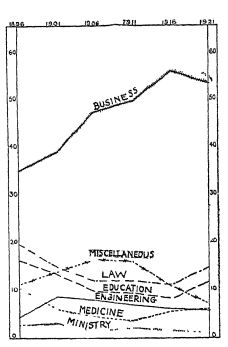
The one question that really mattered with this man was “how can I serve best?” Fortunately for society there are many such persons. They are found in the ranks of teachers, preachers, settlement workers, government officials, physicians, lawyers, business men, and others. I know several very successful business men who are in business mainly to see if they can help find a solution to what we call our labor problem; several physicians and lawyers who are far more concerned with serving humanity than with making dollars. Everyone knows such persons in all sorts of occupations.
Summary of our place-finding activities. — This discussion of how Voc-itions Named we find the “right” places for ourselves and our property in this highly speciahzed society is certainly in sharp contrast with the discussion of how it is done under a caste system. We do not have the matter settled by the accident of birth. We follow the gain spirit in part; obey social control in part; follow our personal tastes and preferences in part; and seek the field of greatest service in part. Some of us, it must be admitted, just “drift.”
Our society, at its best, is not organized on the plan of having us drift into places and then dawdle along. Quite [ p. 410 ] the contrary. Society is organized on the plan of having the individual (and that means each one of us) take the lead and work things out. In other words, society makes use of the plan that our scientists have come to call “individual initiative.”
¶ O. Individual Initiative, a Multiplier of Our Powers
(Working through private property and competition.)
Time after time we have seen that our society makes great use of individual initiative. It is left to individuals to decide what place they shall try to occupy in society; to decide how their property shall be used; to knit themselves together into a society of producing specialists. Society lays down general rules, and then expects the individual to scratch for Iiimself. Why is this? The answer is that through long ages man has come to feel that individual initiative multiplies the powers of the group, because of the way it spurs the individual on.
In primitive society, the individual was not thus spurred on. Nearly everything was owned in common (see page 63) and all, persons in the group lived the same dull, unprogressive hfe. As we have seen, through thousands of years this has been changed.
Individual initiative is a multiplier of our powers. — To-day it is as if society said to each of us: “See here, through thousands of years of blundering around it has become fairly clear that you human beings need to be spurred on. It doesn’t seem to be in you’ to work hard without this spurring; you have not yet developed enough love of your fellow man to work hard without a system of rewards and punishments. Very weU, let’s try the following system until we find something better.
[ p. 411 ]
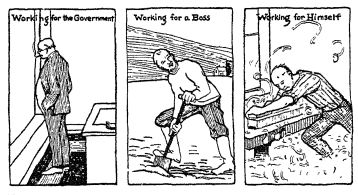
“1. In the first place, let’s use specialization, since that is a multiplier of our powers. Once we have our specialists, we can knit them together mainly through using the gain spirit in the market.
“2. In the second place, let’s set up a system of rivalry, or competition. The person who makes good in this competition shall be rewarded; the one who does not shall be punished.
“3. In the third place, let’s use private property instead of communism. Private property will have these advantages:
“(a) It will give the individual something to work with in this competition. He can own land, buildings, machinery, materials, his own labor, etc., and can put them to work.
“(b) It will give the individual something to work for in this competition. If he succeeds and makes profits, his reward will be more private property. He will have more wealth. If he fails and makes losses, the punishment \vill be that he loses some of his property. He will have less wealth.
“Here, now, is the idea behind it all. Where one sows, he reaps. No one should reap unless he sows. The better he sows, the more he can reap, and we’ll try to provide, by rules of the game, that he shall sow and reap only things that are helpful to society.”
This imaginary talk by society shows why we are justified in calling individual initiative another of the multipliers of man’s powers. It develops his “will to do,” his prudence, his care for the future, his watchfulness to prevent waste, [ p. 412 ] his sense of being responsible for results. There is no doubt that it has been, and still is, one of the great causes of human progress.
Since private property and competition are devices used in connection with our scheme of individual initiative, we need to know more about them.
Private property gradually came to cover many things. — No one knows the exact steps by which man came to have private property. Our first clear view of it is in the custom of the primitive warrior and primitive woman having the “exclusive right” to their own weapons, tools, clothing, and ornaments. Such things came to “belong” to one “private person” and not to the whole group, or to any other person. That is about as far as such exclusive rights extended among primitive peoples. It was so in the case of the Iroquois, you will remember (see page 63).
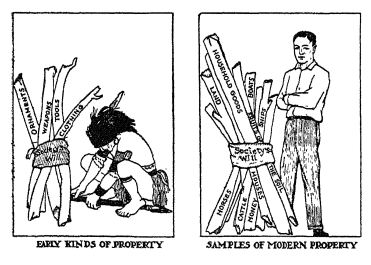
Gradually, through thousands of years of trial-and-error fumbling, it came to be felt that rights in private property worked well enough to be extended to other things. If we think of private property as a bundle of sticks, we may say that in primitive times there were only a few sticks in the bundle — such as weapons, tools, clothing, personal ornaments. Gradually other sticks were added to the bundle: property in horses, in cattle, in other domestic animals, in household goods, in houses, in fruits of the soil, in land, in money, in boats, in human beings (slavery), [ p. 413 ] and in many other things. What sticks would be in the bundle varied from society to society and from time to time. In the United States to-day, the bundle is very large indeed.
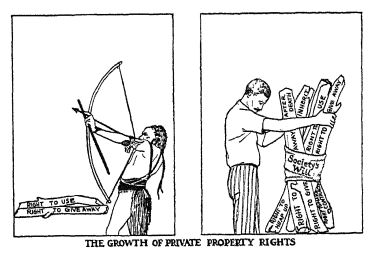
Private property gradually came to include many rights. — Just as the number of things in the bundle gradually increased, so also there was a gradual increase in the number of uses a private person was allowed to make of those things. In other words, there was an increase in the rights over these things. Among the Iroquois for example, there were only two rights that were fairly clear; the right to use and the right to give away. From the time of neolithic man, however, there has been an increase of “rights,” varying, of course from society to society and from time to time. In the United States to-day, we have such property rights as these:
- The right to use.
- The right to give away during life.
- The right to give away after death, called the right of bequest.
- The right to inherit from members of the family.
- The right to heap up property without limit.
- The right to dispose of property by sale or lease or by making other contracts.
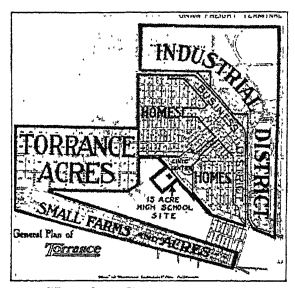
Society says what private property shall be. — We must not suppose that all the changes that have taken place in private property have been in the direction of enlai’ging it. Many changes have been in the direction of diminishing it. [ p. 414 ] For example, we no longer permit private property in public roads, bridges, or human beings (slavery). Many nations do not now allow private property in telephones, city waterworks, telegraphs, etc. Then, too, society does not hesitate to seize (and pay for) private property that may be needed for public use, such as land for school houses or parks or playgrounds or railroads. This right of society to take needed property is called the right of eminent domain.
Again, the state feels free to take part of our property by taxation. In the main it does this to secure funds to carry on needed public services, but in many cases it goes farther. Some states have diminished the right of inheritance by levying heavy inheritance taxes. Some states have diminished the right to heap up property by levying income taxes the rate of which is very heavy on the larger incomes, and by “excess profits” taxes on xmusual profits.
Again, we limit in very distinct ways the rights of private property in our pubhc utihties, our industries in which the public interest is especially strong. For example, we say what kinds of contracts they may make and we limit their profits. There is, too, limitation of private property rights under the police power of the state (which assumes that everything must yield to the common good). As a result, the right to use property does not mean the right to use it in any way one chooses. The ashes from my furnace are my own, but I may not do what I please with them. I may not [ p. 415 ] even pile them in my own back yard if the wind blows them into my neighbor’s house. So also, I may not use my land in a residential district for a dangerous powder factory, or for some factory that spreads poisonous gases. The zoning laws that so many cities are passing do not hesitate to limit the use that may be made of property in the various zones.
What then is private property? It is no one thing. It has varied from time to time. It varies from nation to nation. In general, it is whatever bundle of rights society allows individuals to have over a changing bundle of things. It is one of society’s devices for getting things done, and it is a good device. Very few persons to-day would argue for wiping it out. But, of course, changing conditions may justify changing it somewhat from time to time, as they may justify changing any other useful device.
So much for private property. Let us now examine competition.
What competition does in our society. — Our scientists who study such matters (the economists) describe our society as a competitive society. This means simply that we strive and compete with one another in furnishing things to “the market” and in “making money” with which to buy things from the market. This competition is found in many parts of our living together. Let us look at a few examples.
1. Through competition we settle into our places in society. — Suppose that Oscar Charles starts out to be a lawyer. Others compete with him in that work. It turns out that he “can not hold his own”; he was not fitted to be a lawyer. It is best for him and best for society that he shift to some other occupation. Eventually, he turns to teaching and there he serves society successfully. Competition helped to determine what he should do; it helped to get him into a place suited to his talents.
[ p. 416 ]
2. Through mnpetition it is determined what industries shall go on. — Several years ago there was a perfect craze for bicycles, and many persons put themselves and their property at work making bicycles. Presently, others began to offer cheap motor cars instead. Bicycles and cheap motor cars competed for the market. The outcome was that the bicycle industry ceased to be so important. So also the electric-light industry has checked the growth of the kerosene-lamp industry; the sweeper industry has cheeked the growth of the broom industry; the kerosene-cook-stove industry has checked the growth of the coal-cook-stove industry. It is mainly through the competition of goods in the market that it is determined what industries will pay best and thus continue in existence.
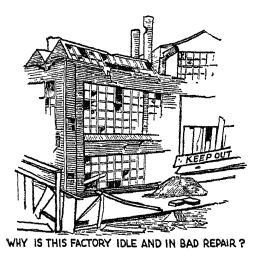
3. Through competition it is determined what firm shall survive in an industry. — Just as competition helps determine what industries shall go on, so it helps determine what particular firm shall survive. Not every firm in the motorcar industry, the electric-fight industry, the sweeper industry,
or the kerosene-cook-stove industry has prospered. Not every firm in the bicycle industry has failed. Some firms have better locations than others. Some have better managers than others. The capable firm gradually wins business away from the poor firm by better service or lower prices or both, irue competition lets those survive who are best fitted to serve.
4. Through competition it is determined what methods of doing things shall survive. — New ways of doing things are continually being invented, and sometimes these new ways [ p. 417 ] drive the old ways out of existence. The railroads have largely driven out the canals. The steamship has largely displaced the sailing vessel. The Bessemer and open-hearth methods (page 98) have displaced the Cort method. All the enormous changes in methods of doing things that have come to pass in the last few generations have won their way through competition.
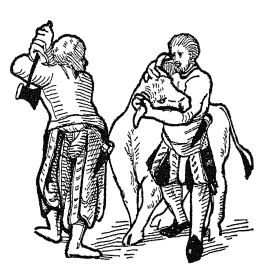
From an old print
Compare This with the Packing Plant Shown on Page 376
Hit the line hard. — We certainly hve in a very interesting society. Apparently everyone is busily engaged in chasing about after his own speciahzed affairs.
Actually, we are all engaged in a vast cooperative enterprise. In this teamwork we use many devices. Among them are the gain spirit, individual initiative, private property, social regulation, and competition. Some of these are devices for getting us into our places. Others are devices to make us work hard, to make us pull our share of the load. As we shall see later, the arrangements are not perfect, but that is another story.
What we are trying to do was once put thus by Theodore Roosevelt: “To borrow a simile from the football field, we believe that men must play fair, that there must be no shirking, and that success can come only to the player who hits the line hard.”
As we study this statement, we see that it says: (1) Our society is one of teamwork; we are all cooperating in the wonderful enterprise of living together. (2) There are rules of the game and we must honorably live up to them, each in [ p. 418 ] his own place. We must gouge neither our opponents nor our teammates. We must play fair. (3) There is much to be done in our society. Let us work hard. (4) Much depends upon individual initiative. He who would succeed must hit the line hard, playing always as a worthy member of the great team, society.
¶ Problems
- Define or explain:
Finding one’s place
A partnership
The right of inheritance
A caste system
Inheritance tax
Income tax
The gain spirit
Individual initiative
Right of eminent domain
Private property
Limited liability
A zoning law
An individual firm
Competition
A corporation. - Why is it better for us to endure the trouble of finding our places in our society than to live in an unspecialized society?
- Why is it better for us to endure the trouble of finding our places in our society than to live in a caste society?
- “It would be a terrible thing for America if we should come to have rigid classes that would, through the centuries, develop into castes.” Do you agree? What things would be different, if this should happen?
- Does one’s position with us depend upon his birth? Does it depend more on his performance? If it does, should that make one work and strive harder?
- “The caste system checks the growth or widening of sympathy.” Why?
- “The market knits our specialists together and it also, through the promptings of the gain spirit, helps each specialist to find his place.” Explain how this is done.
- Several times in his business, Edwin Grant borrowed money from a bank. Show that our banking system is a device for helping get property into businesses where it is needed.
- How are the profits of a partnership divided among the owners? How are the profits of a corporation divided? [ p. 419 ]
- Show that the individual firm, the partnership, and the corporation are devices for organizing to get things done. Is a caste system such a device, too? Is a communistic society?
- Give cases or illustrations other than those in the text in which society takes a hand in placing an individual or property.
- Give cases or illustrations other than these in the text in which an individual follows his personal tastes in finding his place.
- “Persons often use property for purposes out of which they know they will get no gain.” Is a gift to a college such a case? Mention several cases. Why do persons use their property thus?
- “He who makes good in competition shall be rewarded; he who does not make good shall be punished.” What are these rewards and punishments, in the business world?
- “We shall try to arrange it, by rules of the game, that the individual shall reap only through serving society.” Give illustrations. Is that why burglary is forbidden?
- Talk with your father about the number of things over which he has property rights. Has he property rights in his own labor? Can he sell it?
- “Property is one of the unchanging rights of every individual.” Show that this is nonsense.
- “Private property means the right to do what you please, for all time, with everything in the world.” Point out the parts of this statement that are untrue.
- Suppose that we can prove that John stole a knife from James. Show that although John has possession of the knife it is still the property of James. Show, then, that private property rights are something society stands ready to enforce, if necessary.
- Give illustrations other than those in the text of competition settling what industries shall go on. Give illustrations of its settling what methods shall survive.
- “Competition determines what firm shall survive in an industry.” Just how does competition do this?
- individual initiative, taken in connection with private property and competition, can develop strong characters, earnestness, productiveness, inventiveness, and energy.” Show why this is true.
- Answer the questions at the beginning of this chapter, page 394.
[ p. 420 ]
¶ Interesting Reading
Marshall: Readings in the Story of Human Progress, Chapter XIII.
- The Social Life and Industries of Ants (division of labor and place finding governed by instinct).
- Slavery (a way once used to get the work of society done).
- Woman’s Place in Modern Culture (the tasks and opportunities of woman in our society).
See also:
Chapter II, 2, Woman’s Share in Primitive Culture (early division of labor).
Chapter XV, 2. What a State Does (a partial list of the ways in which the state touches our lives) .
Chapter XVI, 2. Vocational Guidance (how one city school system handles this work).
Chapter XVII, 2. Michael Faraday (an example of devotion to scientific truth).
Chapter XVII, 3. Thomas Nast (an artist who was a standard bearer of ideals and aspirations).
Chapter XVII, 4. Howard Taylor Ricketts (an example of devotion to the ideal of service).
Problems to think over are given in these reading selections.
| XII. The Cooperation of Specialists | Title page | XIV. Social Control; Custom, Law, Public Opinion, and THE Sense of Divine Approval |