| XIII. Finding Our Places and Pulling the Load | Title page | XV. Social Control: the Nation and Government |
[ p. 421 ]
CHAPTER XIV
SOCIAL CONTROL: CUSTOM, LAW, PUBLIC OPINION, AND THE SENSE OF DIVINE APPROVAL
A. Custom, A Link with the Past
B. Laws, the Exact and Definite Rules of the Game
C. Public Opinion, a Tool of Educated Democracy
D. The Sense of Divine Approval
–
Questions to Keep in Mind while Reading This Chapter
- What part does custom play in our living?
- Where does our law come from? What is its task?
- How can public opinion be made an effective tool of democracy?
- What is meant by calling conscience and religion means of social control?
In the last two chapters we have seen that man, the social organizer, makes his Uving by means of a great cooperation of speciahsts. In this process he makes use of such devices as the market, the gain spirit, private property, competition, and social control. In the next two chapters, we shall learn more of the device, social control.
There is need of social control. — A man once had a strange dream. He dreamed that he stood at the busiest street corner of one of our large cities and looked at the scene. On one side of the street three lines of automobiles were moving north in swift and orderly fashion; on the other side, three hnes were moving south. In the center two lines of street cars’ went clanging on their way. On each sidewalk two great crowds of people were hurrying along, each crowd keeping to the right. Two policemen were taking care of the [ p. 422 ] traffic, letting east and west traffic through at proper times. Although the traffic was very dense, there was not much confusion. Nearly everyone seemed to know what was expected of him.
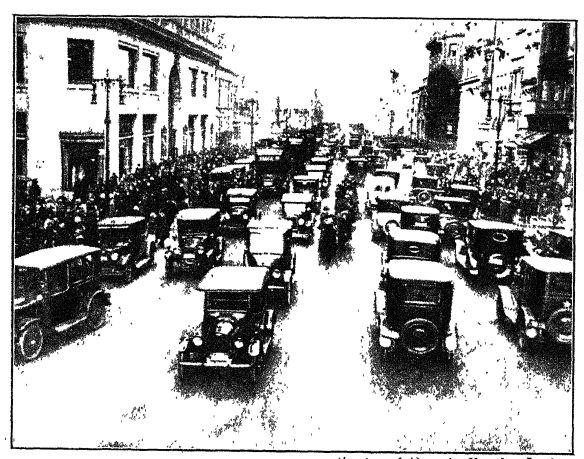
Order in a Busy Street
Then came the strange part of the dream. A sudden madness fell upon that street. The persons in the street, including the policemen, forgot all the “rules of the game.” They forgot that it was the custom to keep to the right; they forgot all the traffic laws of the city about parking, about who had right of way at crossings, about how to pass a street car, about the kind of signals to make — everything. In a twinkling of an eye, that comer saw a wild, cursing, fighting [ p. 423 ] mob scrambling over the wreckage of dozens of automobiles and street cars. Orderly progress had ceased.
This nightmare of the happenings at a busy corner when social control was lost for a moment is a fairly good illustration of what would happen in our whole society if we should suddenly forget our customary ways of doing things and all government and law. Our society of specialists is about as busy as that street corner, and the opportunities for getting things into a terrible snarl are about as numerous. It is fortunate for our living together well that man, the cooperator, has methods of social control. We shall examine some of the main kinds of our social control in this and the next chapter. Custom, law, public opinion, the sense of divine approval, and government are the ones that will be studied.
¶ A. Custom a Link with the Past
(Where our customs come from; the advantages and disadvantages of custom; custom the basis of institutions.)
Early man worked out practices that changed very slowly. — Let us recall certain things that we have learned about the way early men lived.
1. Trial-and-error practices. — We have learned that the people of those early days could not think things out by our modern scientific methods. Their method of finding out the “right” way and the “wrong” way of doing things was that of blind tinkering and trying — that of trial and error, (see page 145). It is hard for us really to understand what a slow, groping process that was. The most ignorant of us have had such a mass of stored-up knowledge handed on to us by the torchbearers discussed in Chapter X that our gropings have a good deal of thought and plan behind them. Not so with early men. They blundered and tinkered for [ p. 424 ] generation after generation. Very slowly it came to be felt that certain ways “worked” and other ways did not. Some of the conclusions they reached seem absurd to us to-day, but they did not seem absurd to early man.
2. Slow changes. — We have learned that in those long ago early days, there were very few changes in ways of hving, and these changes were exceedingly slow ones. Rarely, indeed, did early man find a multiplier of his powers that would change his ways of living, and then thousands of years would go by with only slow additions to his powers. We have had more change in the last one hundred years than early man had in thousands of years. As compared with our rapidly changing life to-day, we say that the hfc of early man was fixed, rigid, unchanging. This does not mean that absolutely no changes ever occurred. We have seen that slow changes did occur. But the word “fixed” describes their living better than the wmrd “changing”; whereas the word “changing” describes our living better than the w’ord “fixed.”
3. Early torchbearers. — We have learned that even very early man was a communicator. He could pass the experiences of the race and its ways of doing things along to later generations. He had quite a few torchbearers for this purpose. The talk and councils of the elders; the yarns of the story-tellers; the examples and teaching of the fanoily group; the ceremonies, feasts, and dances; the games and sports of the children; these were some of the more important torchbearers.
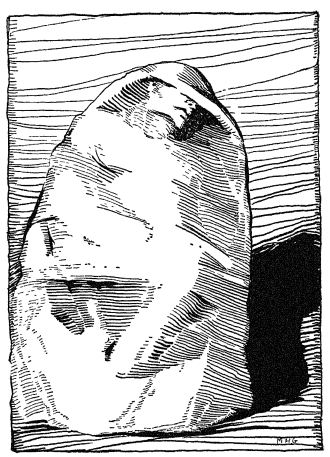
He lacked freedom of thought and freedom of movement.
4. The cake of custom. — If we add together these things we have learned about early man, we can easily understand how “right” ways of doing things would be learned (oh! so slowly !), and would be passed on down through the generations of an “unchanging” society. The whole group, or [ p. 425 ] society, through thousands of years would come to have very set, rigid, fixed ways of doing almost everything. W’e call these fixed, imthinking ways, the ways of custom. W’e say that such a group is controlled by custom. Our scientists talk of such a group as being “held in the cake of custom.” By cake, they do not mean our table delicacy: they mean the kind of rigid, stiff chunk we get when clay “cakes” in drying out. A group, then, that is held in the cake of custom is one whose thoughts, acts, beliefs, and ways of living are ruled by customs. Some of these customs are wise; some are foolish. Some are good; some are bad. They rule, in any event. And their rule is very rigid and unyielding.
Custom did secure some group cooperation — but it also hindered progress. — There were both good and bad features about this cake of custom. Its best feature was that it did hold the group together and did set ways of doing things. We must remember that schools, churches, trading, government, laws, etc., as we know them, did not exist in those days. Those early peoples had only custom. Custom set what was to be [ p. 426 ] done and how to do it. It gave rules of the game for the cooperation of the group. To be sure, to-day we know that many of those rules were poor ones. But it was worth while to get started at having rules. It was a step in progress.
The worst feature of custom was its lack of change, its rigidity. Everyone must do things as they had always been done. Clothing and food and shelter must not change, generation after generation. Dances, festivals, initiations into grown-up membership with the tribe, and all other aspects of living must go on as they had always gone on. On the other hand, certain things must not be done at all. They were “taboo.” Certain foods must not be eaten; certain actions would offend the spirits, and must never be done.
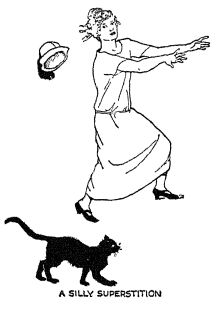
Life went on century after century with almost no change. If it is hard to believe that people could be so unchanging, we must remember that custom ruled men’s minds completely. There have been plenty of cases wEere savages who have accidentally broken some taboo have actually died of fright when they saw what they had done. And the taboo might be as foohsh as “don’t walk under a ladder,” or some other silly superstition. After all, it is not hard to see why custom ruled their minds so completely. All the torchbearers of such a group passed on custom, custom, and nothing but custom. A new idea rarely entered peoples’ heads. Of course, this caused progress to be very slow indeed.
How the cake of custom was slowly softened. — But, through the long ages, practices and the resulting customs [ p. 427 ] did change a little. Gradually, some new multiplier of man’s powers, such as agricxilture, would be found and then ways of living would change. Or a group wandered into a new territory where living was different and new customs arose. Or some captive, brought back from a raid on another tribe, might have a new practice that would be taken up by his captors. Slow progress was made.
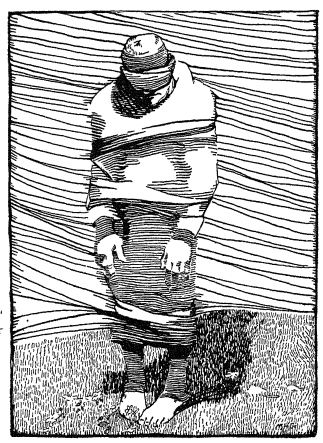
We know how slow this progress was. In case after case of the matters we have studied in this book, there were thousands of years during which man made only slow additions to the powers he had had as long ago as the time of neolithic man. There were a few little spots on the earth where progress was somewhat faster, but as recently as four or five hundred years ago the people of our mother country, England, were still very largely boimd by the cake of custom. (See pages 277 and 281.)
We know, too, why it is that more and more we are break ing away from blindly following old customary ways. We have seen how the Rebirth of Learning began to open men’s minds; how the great geographical discoveries and explorations gave knowledge of other peoples and other ways of [ p. 428 ] living; how the printing press could spread the new thoughts and new ways. We have seen how in the last one hundred or one hundred and fifty years man has become such a wonderful harnesser, communicator, transporter, and trader that his mental horizon has widened greatly. Most important of all, he has become a scientist, and a scientist insists on carefully tested knowledge. (See page 144.) He refuses to act and think in certain ways just “because it has always been done that way.” The great school systems and the press and the talk and discussions in which all of us engage gradually spread scientific knowledge and kill customary ways that can be shown to be no longer “right.”
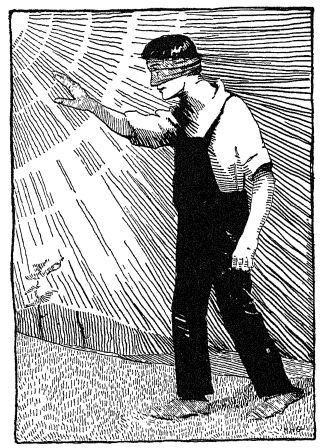
The cake of custom has softened a bit. But no one should imagine that it was an easy task to soften it or that the task has been finished. Even to-day one occasionally sees an account in the newspaper of a foohsh community in our own country thinking that there is some witch in its midst! For that matter, I know several persons who refused to ride in an automobile or to use a telephone because they “couldn’t believe the Lord ever intended such pesky new-fangled contraptions to be used. The good old ways were good enough [ p. 429 ] for them.” If persons can talk thus after all that the last hundred years have meant, it is certain that customary ways die hard.
Here are the more important ways in which custom affects our living to-day.
1. To custom we owe many foolish fears and silly superstitions. — Custom harmfully affects our living to the extent that our torchbearers, such as the family, the school, and the press, have passed along to us many foolish customary fears and superstitions and taboos. Anyone who made a hst of these would be surprised at its length. The fear of ghosts, the dark, goblins, and ogres might well begin such a list. Then would come such superstitions as Friday and thirteen being unlucky; a rainy day for a marriage causing a sad married life; and a new moon seen over the left shoulder meaning misfortune. What a blessing it would be if our minds could be free of such stuff! Our minds could be free if our torchbearers would stop passing the trash on.
2. Custom saves us much time and effort. — Custom helpfully affects our living by giving us ways of getting a great many things done and out of the way. Because of custom we continue to call the days of the week after the old Teutonic gods: Wednesday is Wodin’s day, Thursday is Thor’s day. We continue to call the months of the year after Roman gods and heroes: March is named after Mars, August after Augustus. We follow old Teutonic customs and festivals in our Easter observances, our Santa Claus, and our Christmas tree.
We lift our hats to ladies; shake hands (rather than rub noses as some peoples do) in greetings; regard it as bad manners to smack our lips when eating (although some peoples think that the only proper way to eat); keep to the right [ p. 430 ] when passing (although some peoples keep to the left); begin and end letters in customary ways; wear certain kinds of clothing according to sex; give Christmas gifts and birthday presents; send invitations to parties in the “proper form”; use knife and fork and spoon “properly”; decorate our heroes with badges; sit in chairs instead of crossing our legs on the floor; think it very improper to appear in public in pajamas, but quite all right to be seen in bathing suits; wave our hats when cheering at a ball game but applaud only with our hands in the theater and never applaud at all in church; whistle for a dog but not for a eat; wash our faces and comb our hair before breakfast; — there is no end to our customary ways.
Such harmless customs are great time savers and effort savers. They enable us to take care of a host of the small things of life without thought. Suppose that we had no customs, but that from the time our eyes had opened this morning we had had to think out and plan out absolutely everything, even to debating with ourselves whether certain things were worth doing. What a lot of time and energy we should have wasted puzzling how to get out of bed, whether to wear clothing, what kind of clothes to wear, how to wear them, how to wash, how to part our hair, or whether to fix it at all. We should never have reached the breakfast table, if, indeed, we had decided that there should be one! Customary ways are great helps.
3. Custom is the foxmdation of our institutions. — Custom affects very greatly our living because it is the soil out of which most of our institutions have grown.
Think back over our accounts of man, the trader (pages 275, 284) ; of money as the language of trade (pages 286-289) ; and of the many financial institutions we have to-day (page 294). Trading began in very awkward practices. Through [ p. 431 ] the long centuries those practices gradually changed and money came to be used. The use of money was, for still other centuries, just a customary practice. Finally peoples came to use coins. Much later governments passed laws about coins and coinage. If our account had been a full one we should have seen that banking began with “fumbling practices” of money changers and goldsmiths in providing places for the safe-keeping of money. Gradually people came to think and plan about banking institutions. Finally governments passed laws about them. Clearly, our laws and institutions connected with trade and money have grown out of practices that “worked” and became customs.
What is true of our trade and money is true of just about everything else. It is true, for example, of private property, of competition, of the family, of the school, of the church, of law, of government, and of our forms of business organization. If it is true of such important matters as these, it is easy to believe that it is true of most other aspects of our living together. How this has all worked out may be put in the form of a diagram thus :
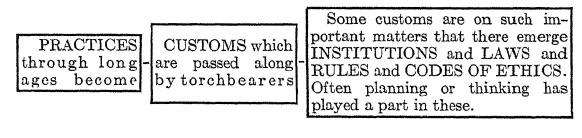
Custom is a powerful means of social control. — There is no doubt that custom is one of the main means of social control used in our society. Although it no longer holds us in a rigid “cake,” it still guides a whole host of our unimportant acts, and it is the basis or foundation of our institutions and laws and codes of conduct in quite important matters. It is handed down to us mainly by the two torchbearers, [ p. 432 ] family and church, but men’s minds are so full of it that the school and the press and our ordinary talk and discussions also hand it on.
¶ B. Laws, the Exact and Definite Rules of the Game
(Common law and statute law; what law does; how law should be regarded by the members of the group.)
Another of our devices for social control is law. It has its roots down deep in custom, but it has also made use of thinking and planning.
The two parts of our law illustrated by the law of mining. — Our law is made up of two parts, — common law and statute law. What these terms mean can best be understood by seeing how these two parts of our law came into existence in the case of our law on mining.[1]
What is now the state of California, as well as much other territory in our Southwest, once belonged to Mexico. The treaty with Mexico (the treaty of the Guadalupe Hidalgo), which finally settled that we were to have this land, was made February 2, 1848. On February 12, 1848, the officer representing the United States in that region (the mihtary governor) proclaimed that the Mexican laws and customs concerning mining should no longer apply. Since there was no United States law on mining, this left the territory without any mining law. Now notice how that mining law came into being.
Common law grows out of customary practices of the people. — In the same year, 1848, gold was discovered in that region and a regular flood of gold miners poured in. What happened? These were an order-loving people. Very quickly certain “practices” or ways of laying out the claims, the width and depth of the claim, the number of claims one [ p. 433 ] person might own at one time, what should be considered good proof of the ownership of a claim, etc., came to be “accepted.” These practices came from many sources. Some of them came from the former Mexican mining practices. Some came from the thousand-year-old practices and customs of tin mining in Devon and Cornwall, England. Some of them were just worked out on the spot by the miners themselves. Taken together, the rules and regulations growing out of these practices came to be known as the Miners’ Common Law for that region.
Statute law is made by our legislatures. — As time went on, it was seen that most of this Miners’ Common Law was very good indeed, but that some of it needed to be changed. Our Federal Congress studied the matter and, in 1866 and again in 1872, passed statutes setting up statute mining law.
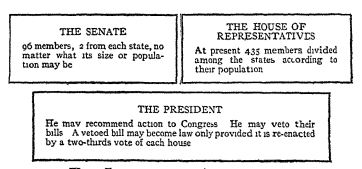
Statute law, then, is law or a system of rules set up by our governing bodies. We call such rules statutes or enactments. In America the usual procedure is this. In either the upper house or the lower house of the legislature, a member introduces a hill dealing with some matter on which a law is desired. A bill usually starts “Be it enacted, that, etc.” If this bill, after being considered in the proper way, lis passed or enacted by one house, it then goes to the other. If the members of this second house also vote in favor of it, it goes to the Governor (to the President in the National Government). If he does not veto (veto is a Latin word meaning “I forbid”) it, we have a statute, a piece of statute law.
[ p. 434 ]
How our common law started in England. — Most of our common law is much older than the Miners’ Common Law. Most of it started long ago in early practices in the mother country, England.
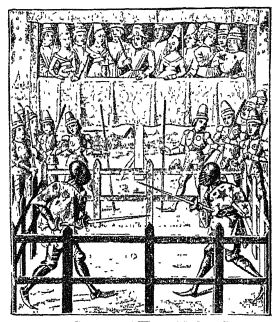
Trial by Combat (Taken from an old print)
Let us go back to the England of a little less than a thousand years ago. It had only a small population, living in little scattered groups. What we call government was far simpler than it is now; the people were held in the cake of custom. Simple and unchanging as the life was, of course disputes would occasionally arise; disputes that had to be settled somehow. One way of settling them was to have some one in authority hear the quarrel (this has become our court system of to-day) and state what were the customs of the land on such matters. This was not a bad way of settUng such a quarrel. It was a much better way than another method the people had of letting the opponents fight it out — as if the stronger man would always have justice on his side!
As time went on, persons we call Judges (who represented the government) came to preside in these courts and to declare the customs of the land, sometimes making use of twelve men — the beginnings of our jury system. Furthermore, it came to pass that some of these decisions were written down. Then they could be studied and followed by [ p. 435 ] other judges. One decision followed the ruling of a preceding decision. We call that “following precedent.” In this way, the law based on the customs of the day gradually became a quite definite, well-known law that was the same in every court, — was “common” to all England.
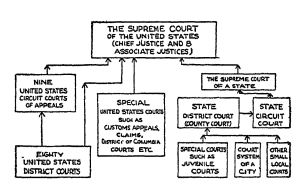
This is, of course, merely an outline of our court system. The arrows show how certain important types of cases can be appealed up to the Supreme Court of the United States.
Judges not really the makers of law. They interpret and apply it. — Sometimes the common law is called “judgemade ” law, but that is not the best name for it. It was really “made” by the practices and customs of the people. The judges merely declared or applied law that had already been “made.” They acted as interpreters and then as torchbearers to pass it on to other districts and down to later generations — much of it down even to us.
From this story of how common law has come down to us, anyone can see that it is fairly rigid law and that it changes very slowly. In the main, precedent is followed. It is natural, therefore, in such rapidly changing times as ours, that some piece of common law may not be good sense now, even though it was good sense when it started. But our judges are not free to make great changes in it, any more than judges made it to begin with. The best they can do is to interpret and apply it as sanely as possible. When a piece of common law has outhved its usefulness, the legislature should get to work, and enact a statute abolishing this particular piece of common law and setting up good statute law in its place. The judges will then apply the good statute law on this subject.
[ p. 436 ]
The three things done by statute law show the importance of the work of our lawmakers. — This brings us back to our statute law. As we have just seen, some statutes are enacted in order to wipe poor pieces of common law out of existence. That is good service. Other statutes merely restate good common law so that anyone may see it set down in a simple way that is absolutely uniform throughout the state. That, too, is good service. Other statutes do a third useful thing. When some new problem arises on which no common law has grown up, the legislature enacts statutes that are to be the law of the land on that problem.
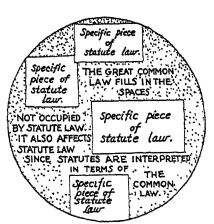
As we think of these three services of statute law, we see that in statute law we have an opportunity to work our modern scientific knowledge over into definite rules of action for our society. What a wonderful chance this gives the members of our legislatures to be of service to the group! How careful we should be in selecting our representatives for the legislature! How much use they should make of our libraries of books (the memory of the race, you will recall) and of advisers having expert knowledge in various fields!
What our statute law and common law, hand in hand, accomplish. — Statute law and common law do their work hand in hand. Statute law is the part of the law that has been worked out by the legislatures. But no legislature could be wise enough to frame laws covering every possi ble dispute that might ever arise. Therefore, there are still large areas of the law that are simply the result of customary practices. Our courts carry out both statute law and common law. [ p. 437 ] Both are law, — one just as truly as the other. Both have been “approved” by the community as part of its rules of the game. Both help wonderfully in living together well.
Law says, “Thou shall not,” — it prohibits some things. — Some persons have wrong ideas about law. They think of law as something that is always saying “Thou shalt not.” Now, it is true that we do use some of our laws for the thou-shalt-not purpose. The other day a man stole an automobile. When he came before the judge in the court he found (what he already knew) that society had forbidden stealing other people’s property and that it punishes those who do so. There are many things, such as stealing, murder, setting fire to people’s property, betraying the government, etc., that are harmful to living together well, and society has said, “Thou shalt not.”
Law also says, “I’ll help” — it promotes some things. — But we must not think of law merely as a great thou-shalt-not. That is only one aspect of law. Another aspect of law shows it to be a helper. Remember that law is society’s desire, or wish, or will, set forth very definitely. Sometimes society wishes something done, and uses a law to help get it done. Take the laws, for example, by which the United States government helped build transcontinental railroads by giving them strips of public land and by loaning them money. Or think of the laws providing for schools and the laws for raising taxes in [ p. 438 ] order to build roads with the money. As a matter of fact, law says “I’ll help” more than it says “Thou shalt not.”
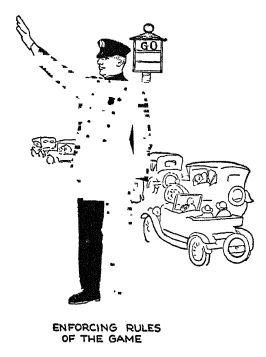
And even more frequently law helps by saying, “I’ll just give rules for doing things so that everyone will know what to expect of everyone else.” Our partnership law lets each partner know his rights and duties and lets the customers of the partnership know their rights and duties. Our corporation law does the same. (See page 405.) Our contract law tells howto make contracts that will bind those who make them. This work of law — the work of making it possible for everyone to go about his affairs with the rules of the game certain and well known — is a most important service. It enables us to work together and to live together with quiet confidence that we know what to expect. We can therefore give our full thought to our work.
An estimate of law as a means of social control. — These things may be said of law as a part of our social control.
1. In a democratic country like ours the laws are really made by ourselves, for they are made by persons whopa we elect to represent us. Of course, our common law has come down to us from the everyday practices of earlier generations. But even this common law can be changed by our representatives.
We ought not to think of law as some goblin “that’ll get us if we don’t watch out.” We ought to think of it as a statement of the ways of living that long experience has [ p. 439 ] shown to be good. A physician gives us rules of good health; he makes better rules as he learns more about the human body. Our laws are part of the rules of good health for a community; we can make better laws as we learn more of how a community is put together and what will make it healthful. Is not that one of the reasons why social studies are taken up in our schools?
2. Law is expensive, it costs money, it means taxes. — Our law is not made and carried out by magic. We pay for it. There is always the cost of electing and paying the members of the legislature and of conducting its meetings. There is the cost of the system of local, state, and federal courts, including buildings, and the salaries of judges and other court officials. There is the cost of maintaining prisons, jails, reformatories, and police systems.
In thinking of the taxes we pay we should remember that everyone mentioned in this list of costs is our servant. We pay for his work and we want that work done honestly and well. When a police officer or a judge protects and aids a known wrongdoer (and this is sometimes done) we ought to despise him as we would one who put harmful germs in the reservoir from which we get our drinking water. In both cases harm is done to healthful living together. Of the two cases, that of the corrupt officer of the law is the more despicable, for he is a thief as well. He has taken public naoney for work and has not done his work.
3. Law should he carefully drawn and then observed hy all . — Law works best when society is quite clear as to what it wants done and is willing to have a definite rule that everyone, great or small, must obey. Such an expensive and definite device ought to be used with great care.
Unfortunately we are not as careful as we should be. Each year our national legislature passes several thousand [ p. 440 ] laws. Each year our states pass about 15,000 laws and our cities about 200,000. It is estimated that the United States has to-day more statutes and ordinances than all the rest of the world. The ordinary man would need one third of a lifetime merely to read the laws applying to him! It is clear that all this mass of statute law cannot have been thought out carefully. There is a good deal of confusion in it.
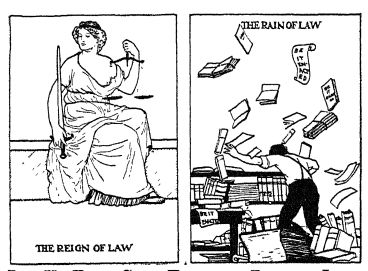
The worst of this confusion is that it lessens our respect for law. It is of tremendous importance that we keep our respect for law. No game is clean unless the players respect the rules. No society is safe unless its members respect its rules. We ought to be like the Greek philosopher, Socrates. He was in prison and sentenced to death. Some of his friends, by crooked work, arranged to set him free. "No,” said Socrates, "above all things we should faithfully keep the laws. I will not escape.”
¶ C. Public Opinion, a Tool of Educated Democracy
(How pubEc opinion controls; how it is formed; when it can do its work well.)
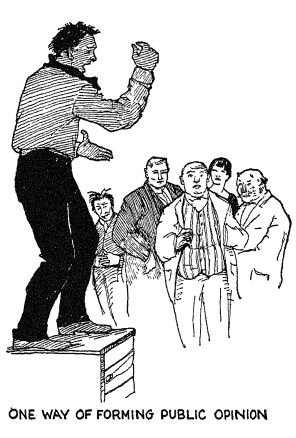
An illustration of the formation of public opinion. — On December 12, 1922, the people of the State of Illinois went to the voting places or polls and voted by a large majority to reject the new state constitution submitted to them. [ p. 441 ] For many years the old constitution had been regarded as unsatisfactory. The new one was the result of much planning and thinking on the part of a constitutional convention organized for the purpose. While the new constitution was being drafted, and especially after it was submitted to the people, a very earnest discussion of its provisions went on all over the state. In newspapers, in pamphlets, in club meetings, in tradeunion halls, in public meetings, arguments were made for and against the new constitution. Gradually public opinion unfavorable to the document was formed, and at the polls a public judgment was given.
Public opinion is an important means of social control. — This account of the rejection of a new constitm tion shows pubhc opinion being formed on a matter of great public interest
where a definite decision or judgment was needed. On less important questions, public opinion is formed in much the same way, although it may be formed more slowly and with less heat of argument. No matter how it is formed, it is one of our important means of social control.
In everyday affairs. — In the first place, public opinion guides and controls the ordinary person in his everyday life. No one likes to have the other members of the group “down on him,” and so no one (or almost no one) will disregard [ p. 442 ] public opinion. This is not merely because one feels uncomfortable when the group does not like him. In addition to one’s feelings in the matter the group has ways of “getting at him.” It may snub him and his family; it may refuse to buy and sell with him; it may shut him out of pleasant and profitable happenings. The very word “boycott” comes from a case where a group took such action against a man. In Ireland a man named Boycott became disliked because of the way he dealt with tenants. The group would have nothing to do with him. He learned to his sorrow that public opinion can greatly influence people’s actions.
As a director of government. — Another important way by which public opinion plays a part in social control is through its effect on government officials. This is especially true in a democracy Mke ours where election and reelection depend upon keeping a favorable public opinion. Some of our presidents, for example, have been careful to “feel out” public opinion before taking an important step. They have arranged for a news item concerning this step to get widely published. They then have watched the “drift” of public discussion of this item, as the discussion appeared in editorial comment or in speeches of important persons. Oim senators and representatives in congress and in our state legislatures are always watching the drift of public opinion as seen in editorials, letters from their constituents, speeches, pamphlets, and “resolutions” of all sorts of groups. Often it is said that we have “government by public opinion.” That is claiming a little too much for public opinion, but there is a great deal of truth in the statement.
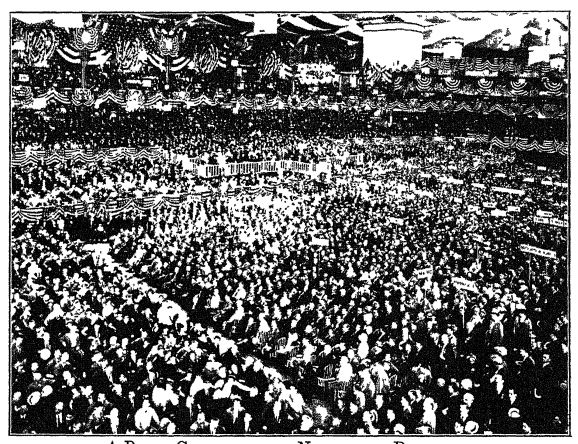
Groups that help to form public opinion.[2] — Political parties. — One way by which we form pubhc opinion is by the use of political parties. Everyone knows of the Republican [ p. 443 ] and Democratic parties. As time has gone on these parties have worked out schemes of organization for holding themselves together; for forming “platforms” or declarations of what they believe in; for nominating men for office; and for persuading people to vote on their side. They issue tens of millions of pamphlets and books, hold public meetings, have parades, send out “workers” to persuade the wavering, put up posters, advertise in the papers, publish arguments in the papers — do any and all reasonable things to form a public opinion favorable to their cause. Any political groups that oppose these main parties, including occasional groups of “independents” who break away from them, find it worth while to follow much the same tactics.
[ p. 444 ]
Nonpartisan groups watch political matters. — There have grown up, in many places, nonpartisan groups which influence public opinion by studying and reporting on the qualities of persons nominated to office by any party; or by studying and reporting on the actions of officials who have been elected. The Municipal Voter’s League of Chicago and the Civic Leagues of St. Louis and Cleveland are examples of groups that publish their judgments of the fitness of candidates for office. The New York Bureau of Municipal Research and similar bureaus in such cities as Philadelphia, Cincinnati, and Chicago, as well as various “civic leagues,” “citizens’ associations,” and what not, are examples of groups that study city governments, suggest improvements, and keep the public informed. Worthy of mention too, are the “City Clubs” of various cities. These groups have clubrooms as centers of operation. Through committee reports, through public discussions, and through bulletins they influence public thought and conduct.
Groups formed for some one purpose. — Then, too, there is a great host of groups interested in some one matter. At this they work, studying, planning, making suggestions, and reaching the public by letters, bulletins, advertisements, news stories, public meetings, or other devices. Here is the merest beginning of a list of such groups. It does not matter if you do not at this time understand the work of each of them. There are immigrants’ protective leagues, civilservice-reform associations, housing associations, playground associations, infant-welfare societies, law-and-order leagues, legal-aid societies, juvenile protective associations, municipal-ownership leagues, immigration-restriction leagues, commission-government clubs, short-ballot organizations, anti-tuberculosis societies, public art leagues, and taxreform associations. There is almost no end of them.
[ p. 445 ]
Furthermore, groups formed primarily for business or social or educational or other purposes often carry on some activities affecting public opinion. Examples are our chambers of commerce, boards of trade, real-estate boards, churches, women’s clubs, parents’ associations, labor unions, union-league clubs, bankers’ associations, bar associations, credit-men’s associations, accountants’ clubs, and manufacturers’ associations.
Each of us can help form public opinion. — All of these groups and many others like them work more or less steadily at forming public opinion upon the questions of the day. Some of these groups are futile; some are effective. Some are narrow and prejudiced; some are broadminded. There are all sorts and kinds. And of course, one group frequently opposes and contradicts another. The whole truth seldom or never is found in the sayings of any one group. We must be able to pick and choose.
One very good feature of this host of opinion-forming groups is the fact that each of us can find groups in which he can take an active part. We do not need to stand on the side lines and watch the game. We can be — and should be — among the players. And many of us are players. It has been estimated that in the city of New York alone there are six thousand organizations affecting public opinion. No one knows the total for the country as a whole, but it certainly runs into the scores of thousands.
Then, too, it is possible for individuals to help form public opinion without acting as members of a group. The editor of a newspaper, a writer, or a publisher can do so, for example. Society is so large and complex to-day, however, that individuals can usually be most effective in helping to form public opinion when they act in groups rather than alone.
[ p. 446 ]
Public opinion compaxed with custom and law. — These things may be said of public opinion as a part of our scheme of social control.
1. It involves thinking and discussion. — Control by public opinion is not the same thing as control by custom. Control by custom is “unthinking.” We act as custom says without stopping to think about it at all. Real public opinion, however, comes after thinking and discussion and communication with others. It seems probable that man, the scientist and communicator, will gradually turn more and more to public opinion and less and less to custom as a means of social control.
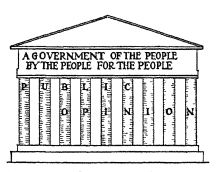
2. It supplements law. — Public opinion is not as sharp and definite as law, but it is more quickly formed and is far less expensive. Often it is a first step in getting statute law. Par more often, however, it stops short of actual law and merely “puts pressure” on persons to act as it wishes. It is a good addition or supplement to law.
3. Circumstances under which it works best. — Clearly, pubhc opinion will work best as a part of social control when the group is a thinking, educated group; when there are good channels of discussion and communication; and when there are good leaders of the discussion. Public opinion will be a better and safer means of control when “the public” understands what it means to live together and is open-minded to truth; when the press, the pulpit, and other channels of communication are entirely honest and fearless; when experts with good ideals lead the discussion. Expert guidance will become more and more important as [ p. 447 ] democracy develops more and more complex problems of living together. At this moment, it must be admitted, public opinion is too much influenced by custom and prejudice; too little influenced by expert knowledge.
¶ D. The Sense of Divine Approval
(The part played by conscience and religion in social control.)
Since we have already discussed the church as a torchbearer (see page 321), we need only mention here the fact that conscience and rehgion are powerful means of social control.
The inner voice of conscience controls. — Public opinion is often a changeable, fickle thing. Both it and law are mainly “outside pressures” brought to bear on us. But inside of each of us is “the still, small voice of conscience” talking to us in a rather unchanging way of right and wrong, — of honesty, loyalty, justice, duty, good faith, fair dealing. It tells us what we ought to do, no matter what public opinion or law or anything outside us may say. Just where our ideas of right and wrong come from would be hard for us to tell. Many of them are rooted deep in custom. Some are based on education and reason. Some are based on bad training, and are therefore poor ideas of right and wrong. Wherever they come from they control us mightily.
The power of religion as a means of social control. — Religion often adds a sense of divine approval to conscience. It thus gives a feeling that law or public opinion can never give. That is shown in our saying, “God sees what I do and knows what I think even if men do not.” Religion, therefore, strikes deeper and is more personal and searching than most other forms of social control. Then, too, there is a sense of great power behind it. It makes us feel that God, the all [ p. 448 ] powerful, is on the side of and that, sooner or later, evil must be conquered. What a powerful means of social control religion is!
¶ Problems
-
Define or explain:
Social control
Statute law
Following precedent
Custom
Judge-made law
Public opinion
The cake of custom
An enactment
Public judgment
Taboo
A bill
Conscience
Common Law
An ordinance
Political parties -
Show that the family, the school, the trade-union, the business man’s club, and the church are means or agencies of social control. Mention other agencies.
-
How do customary ways get established? Why is a society in which custom is strong an unchanging society? Why is social control by customary ways likely to be somewhat poor social control in a rapidly changing society?
-
“Custom is a thoroughly bad form of social control.” Is that true? “One is always safe if he guides himself by the good old customs the race has built up.” Is that true?
-
“A tremendous amount of our living together has its roots down in custom.” Show that this is true.
-
“If a new idea opposes the customary thinking of the day, that idea will have a hard time getting widely accepted.” Show why this is true. What is meant by saying that someone “is ahead of his times?”
-
If a man violates custom what will the penalty be? If he violates law what will the penalty be?
-
Custom was far more powerful among primitive people than it is to-day. Why? Is it likely to be more or less powerful in the future? Why?
-
In America there are millions of immigrants from various countries. What effect does this have upon our customs? Does it make them more changing, or less changing?
-
Give an example of customs that control us but have never been enacted into law.
-
“Common law has been approved by the group.” How? By a vote? “Statute law has been approved by the group.” How?
-
If a law becomes out of date, what can be done about it? Can it be repealed? Can it be left on the statute books, but not enforced? Which way would be more likely to increase our respect for law? [ p. 449 ]
-
Wiiat is the main task of a legislature? Of a system of courts? Are courts torchbearers? Are legislatures?
-
“Law is ever-changing, ever-growing.” Why should this be true?
-
Why is it important that we should have respect for law?
-
Give illustrations other than those in the text where the law says, “Thou shalt not”; where it says, “141 help.”
-
Why is public opinion a better device for social control when the people are educated? “The school is the cornerstone of democracy.” What does this mean?
-
How does public opinion control you or me? Has it punishments? Has it rewards?
-
What have political parties to do with public opinion? What have they to do with government?
-
Mention some groups in your own town that help form public opinion. If your teacher approves, let each member of the class wite to some such organization in which he is interested, and get its statement of purpose and the conditions of membership. Then compare your organization with others.
-
Ask several adult friends with what organizations they are associated. Find out why they joined: whether they do much in the organization.
-
I can mention several organizations that are trying to mold public opinion in a way I dislike. I think the “platforms ” of these organizations are wrong. Nevertheless, I am glad they exist, much as I hope they will not succeed. How can that be true?
-
What did the writer mean who called such groups with their talk and discussions “educators of democracy”? What did he mean when he said they helped make possible our progress in good government?
-
Make a list of the various ways by which such groups may affect public opinion. Here is a start: ( a ) public debates, ( b ) advertisements in papers, ( c ) . . . etc.
-
Why are freedom of speech, freedom to form groups (called freedom of organization), and freedom of the press important to our society if we wish to live together well?
-
“Public opinion seems likely to become a more important means of social control as time goes on.” Why? Why is it a better means today than it was five hundred years ago?
-
Do “great men” have much influence on public opinion? Did Washington? Name as many living persons as you can who are greatly influencing public opinion. [ p. 450 ]
-
What are some of the things conscience tells us that are not touched by law? Is telling the truth one?
-
Answer the questions at the beginning of the chapter, page 421.
¶ Interesting Reading
Marshall: Readings in the Story of Human Progress, Chapter XIV.
- Some Early Forms of Social Control (myth, magic, fetishism, totemism, and taboo).
- How Laws Are Made (a law traced from the days of forming public opinion to the governor’s signature).
- Dangers in Modern Industry (an example of social control in con serving our human resources).
See also:
Chapter II, 4. The Oeh-da, the Good Spirit and the Bad Spirit (an Iroquois myth of the creation).
Problems to think over are given in these reading selections.
| XIII. Finding Our Places and Pulling the Load | Title page | XV. Social Control: the Nation and Government |