| XIV. Social Control; Custom, Law, Public Opinion, and THE Sense of Divine Approval | Title page | XVI. Social Organization and Living Together Well |
[ p. 451 ]
CHAPTER XV
SOCIAL CONTROL: THE NATION AND GOVERNMENT
A. The Nation, a Mtjltipliee of Man’s Powees by Enlarging His Cooperation
B. Democracy, a Multiplier of Man’s Powers by Developing the Individual
Questions to Keep in Mind ivhile Reading This Chaptee
- How did we come to have nations and governments?
- Why is democracy called a multiplier of our powers?
- What are the main problems confronting democracy?
This chapter continues the discussion of social control. — In the last chapter we examined some of our means of social control — customs, law, public opinion, conscience and religion. In this chapter, we are to continue the discussion of social control by examining the nation and government. These are our most important political institutions.
We are so accustomed to living in a world-society made up of nations and their governments that we seldom wonder how such things came to be. Of course, when we do stop to think of such matters, we reahze that these political institutions, the nation and government, have probably had just as long, slow a development as private property has had or the church, or the school, or the law. That is precisely the case. In this chapter, we are to discuss how the simple groupings of primitive man expanded into nations with their governments; and how government has fallen more and more into the hands of all the people of a nation.
[ p. 452 ]
¶ A. The Nation, a Multiplier of Man’s Powers by Enlarging His Cooperation
(How we came to have nations; how government helps in living together.)
How, through the long centuries, did such groups as those of a few dozen miserable Neanderthal men change into nations with governments? As one would expect, it happened in no one rigid way. In different parts of the world there were somewhat different ways by which man expanded his groupings.
Sometimes nations and their governments have resulted mainly from conquest. — Quite hkely the process of forming a “nation” with its “government” was often fairly simple, although it took a long time. Suppose that, in some spot, there was an early human group. This group would have subgroups, such as the men, the women, families, the warrior class, the old men, the children, etc. Naturally, there would be some persons who were more important (had more influence) than others. This would be true of the arrow maker, the story-teller, the medicine man, the successful warrior, or the wise old man of the group. Then, too, some subgroups, such as that of the old men, would have more influence than certain other subgroups. It is easy to think of these persons of influence as being a small bit — a very small bit — hke our modern oflflcials. It is also easy to think of the customs and taboos, etc., as being a small bit — a very small bit — like our modern laws.
Groups of early men were frequently at war with one another. When one group conquered another, the conquered people would be “ruled” either as individual slaves or as a subordinate group. If this process took place time after time (as it did through the long centuries) it is easy to see [ p. 453 ] how there could finally be a large and powerful group (let us call it a nation) in which there would be “rulers” and “ruled.” This may be called the conquest theory of the rise of nations and governments.
Sometimes other causes helped in forming nations and governments. — We do not need to assume that conquest was the only cause of the development of nations and government. Very hkely feelings of kinship, feelings that benefits came from the cooperation of larger groups, feelings of the need of having ojSicials and rules to protect property rights, and other feelings helped to develop these important political institutions. In other words, there were probably cases where the above diagram will help us to understand what happened.
Out of the FAMILY grew the GENS or CLAN and in time this enlarged in various ways into the TRIBE which by natural growth, or by conquest, or by reaching understandings with other tribes sometimes made a FOLK If this folk had progressed to the point of living a settled life and had a reasonably stable government, it might properly be called a NATION
One Possible Way by Which Nations Were Formed
The early family could be a fairly large group with the beginnings of “government” and “officials.” — We already know that the family is one of our very oldest institutions, — one of our very oldest social groups. It has had various forms at various times and among various peoples. If, however, we stride past all the earlier centuries and come at once [ p. 454 ] to neolithic times, we find that the patriarchal family is the form most frequently found. Let us, therefore, discuss only that form. This patriarchal family quite readily resulted in the formation of a fairly large group. At its head was the patriarch. When the sons married, they brought their wives home to five with the group, and their children of course increased its numbers. When the boys of this younger generation married, still other clusters were added to the home hive, and so it went. Then, too, these patriarchal families often picked up servants and slaves and adopted persons. When such a group prospered, its numbers could increase rapidly.
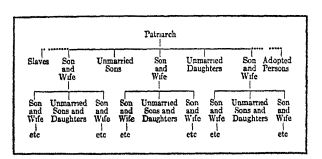
Such a family made a very close, compact group. As we think of its members, we should be inclined to talk of brothers, nephews, cousins, cousins once removed, etc. To them, however, all kinship ties were felt to be very close. Among some peoples there was no such wmrd as cousin. All were brothers or sisters, or at the most, nephews and nieces. Sometimes even servants would be treated as children of the family.
By force of custom, the patriarch was the ruler of the group, generally a rigid and often a despotic ruler. His word was law, his command was final. The cooperation of the group in tending their herds, making their tents, preparing their utensils, or fighting for access to drinking water was all done under his authority. He arranged the marriages of the sons, as when Abraham arranged for the marriage of Isaac with Rebekah in the Bible story. Among some peoples, he sold members of the family into slavery, or even [ p. 455 ] slew them if he thought it wise. If his group was a fairly large one, he might have his favorites act as assistant managers.
The next larger grouping was the gens. — In the days of the early patriarchal family, man was a poor harnesser of nature. Even the groups that had progressed most knew only the beginnings of agriculture, or of keeping domesticated animals. Because of man’s meager ability to harness nature, there were but few spots on the earth where large patriarchal families could hold together and still have a good food supply. This was true even of those who led moderately settled hves. It was still more true of the nomadic families that moved about in search of pasture for their herds.
As a result, while there may have been some cases of a patriarchal family clinging together and becoming so large as to deserve the name of tribe, it was more usual for the large famihes to split up, and to send out offshoots of new patriarchal families from time to time. Naturally the feeling of kinship still continued after the split had occurred. The result was that the families of one kinship were united with one another in a way that we have come to call a gens, or clan.
Just how close this union of the different parts of a gens or clan would be depended upon many circumstances. If they were a fairly settled people, and especially if the food supply was large enough to enable them to settle near one another, it was easier to have a close kinship tie. If they were a roving people, and especially if scanty food caused them to wander far apart, it was harder to have a close tie. If there were enterprises in which cooperation gave needed strength (as in ease of being raided by others, or in case of a desire to seize the rich territory of others), the gens held together more closely than when such enterprises were lacking. [ p. 456 ] Here, as in the rest of man’s development, the ways that proved to be effective, through the long generations of trial and error, were the ways that became the customs of the people. And, as we know, customs, once formed, rule mightily.
The next larger grouping was the tribe with its “government” and “officials .” — A clan or gens that was being held together fairly closely might form an even larger and more powerful group in various ways. One way would be by “natural increase,” which means by children being, born to the group. Another way would be by capturing individuals from other peoples during wars, raids, or wife-stealing expeditions. Another way would be by conquering a whole people and then taking them intO’ the group either as equals or, more commonly, as inferiors and slaves. Another way would be for several gentes tO’ unite because of some early blbod-tie, or because of conquest, or because of agreement. There were thus various circumstances under which it was effective to have. a group large enough to be called a tribe.
As, through the long centuries, gentes were expanded or grouped into larger bodies called tribes, a certain amount of specialization of duties would take place within the group. There might well be a head chief or ruler for the whole tribe there would be small chiefs in the clans; there would be medicine men or priests; there would be ways of organizing, for wars and for the chase, for tilling the soil, and for other purposes. In other words, some framework of government [ p. 457 ] would slowly come into existence. This framework would have different details among different peoples. It would always be a part of the slowly developed customs of the people, and not something that had been carefully thought out or planned. Government, like our other social institutions, has its roots deep down in custom.
The next larger grouping was the folk. — To continue with our story. There were places and circumstances in which a group larger than an ordinary tribe would be formed. An ordinary tribe might grow larger through natural increase, or through adding individuals from time to time. Or it might conquer other tribes. Or several tribes, after generations of trial and error, noight unite with one another in a fairly permanent way. For lack of a better term let us call such a large group a folk. Of course a folk would have a framework of government, and would have “officials.”
Man’s settling down made possible nations with fixed territories. — In some way or other, it frequently happened that early men enlarged their groups. We must now survey the story of man’s groupings with his “settling down” process in mind. Early men were homeless wanderers who moved about in search of food. That continued to be true for a long time. It is true even to-day of quite a few peoples, — the desert nomads, for example.
When man was a poor harnesser of nature, there were but few spots on the earth where he could exist without wandering. Such spots would have to furnish food at all seasons (for he knew little of storing it) ; materials for making shelter; and supplies for his herds, if he had any. There were not many such places. Therefore, in the main, man wandered about for thousands of years without any marked signs of settling down. Then he spent still other thousands [ p. 458 ] of years fitfully wandering, settling, wandering, settling, wandering, and finally coming to rest.
Since that is true, we can see that under some circumstances our story of man’s groupings would be a story of restless wanderers. In your history you will read of such cases. For example, you will learn of such terrible leaders as Attila the Hun, and of the even more terrible Genghis Khan, and their folk. You will see that barbarian folk swept down over the Roman Empire and destroyed it. History is full of restless migrations of tribes and folk.
On the other hand, you will read of cases where, thousands of years ago, tribes and folk settled down and, having settled, were able to build up a fairly good culture. That was the case in the fertile valley of the Nile; in the valley of the Euphrates and Tigris; and in the early “city-states” of Athens, Sparta, Carthage, and Rome. Such folk with fixed territories deserve the name of nation. Your study of history will show that we owe more to these early settled nations than we have had space to acknowledge properly in this book.
The essential features of a nation. We are now in a position to make a list of the main features of a nation. They are:
(1) a group of people (usually a fairly large number of like-minded people)
(2) living in a definite territory
(3) and having some definite framework of government
(4) which is administered by officials.
So also, we can now see the difference between a nation and its government. “Government” is by no means the same thing as “nation.” Government is merely one device (an important one, of course) that a nation uses in getting its tasks done. It is the main political device of the nation.
[ p. 459 ]
The Iroquois, an iUustration of a folk becoming a nation. — Thus far our story of man’s expanding groupings has been told as a sketch of ways in which this expansion might have happened. Let us now look at an illustration.
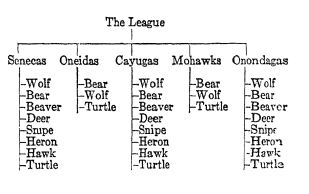
Our account of the Iroquois showed us a people that, according to tradition, had long been wanderers. At the time the whites of Europe discovered them they were becoming a settled folk. True, they would wander off in groups, at appropriate seasons, for hunting or fishing. But their villages were likely to remain in one place for ten or fifteen years. They were settling down.
They had never developed the strong patriarchal family, but they did have clans or gentes in the various tribes. Then, too, the tribes were grouped into a league and had, therefore, formed a folk. There was a certain amount of framework of government in the clan, in the village, in the tribe, and in the league. It is true that the league government operated only on occasions. A strong, firm nation had not yet been formed. In other words, the Iroquois were a group that had made use of the gens and tribe and were probably in the process of settling down and forming a nation.
The reason for man’s expanding groupings and government. — Now that we have before us a sketch of how men expanded their groupings, let us ask why. Why did men not “run in pairs” with their younger children as some animals do? Why did they form great clusters?
Two reasons are usually given. The first is that man is by nature “social”: that he has a “social instinct” causing [ p. 460 ] him to form groups, and to be miserable and unhappy when not in a group. That may be true. It certainly seems true of some insects and animals. Whether true of man or not, there is a second reason that could explain man’s groupings. It is this. Through long centuries of trial and error, it was found that it worked best (and therefore became the custom) to gather into groups. Cooperation in groups made possible better hunting; it gave better protection from animals and from other groups of men. Cooperation through grouping was found to be a multiplier of man’s powers. No one reasoned it out or planned it. It was just “felt” to work well.
So also, it came about that a machinery developed for managing this enlarged cooperation, a machinery we now call government. At first the machinery was very simple, such as the customary rule of the important persons of the tribe or the patriarch. As time went on and the groups became larger, the machinery also became larger and more complex. To-day, we in the United States talk of the executive branch of government with its host of officials; the legislative, or law-making branch; and the judicial or law-applying branch. We have local government for smaller areas and national government for the nation as a whole. All this can be traced back to the earlier stages of man’s progress.
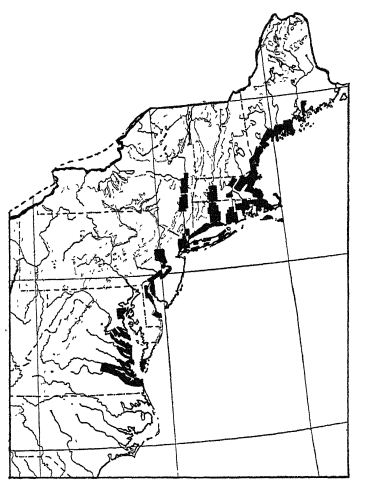
Notice how the settlements cling to the seashore and the navigable rivers.
The United States, an example of modem expanding groupings. — The account of the formation of nations and governments shows how man began to have such institutions. Once he had them, new nations and governments might be formed in other ways, especially by colonization.
Take our own case. As the map shows, about 1650 there were on our eastern coast scattered settlements. Some of the settlers had come in the hope of securing rehgious freedom; most of them came as a business venture. The mother country, England, claimed this land, and these settlers were [ p. 461 ] therefore really little hives that were still a part of the English nation and were under the English government.[1] For each hive there was some form of local government.
Let a century go by. During that hundred years more settlers have poured in. The hives have become more numerous. Partly as a result of their own actions and partly as a result of the actions of the mother country, these hives are grouped into colonies — the “thirteen original colonies,” we call them. Each colony is a member of the British Empire.
Next, the mother country and these thirteen children get into a dispute. The thirteen children themselves together and declare (1776) they are to be independent. They win their independence by the sword. During the war they are a “confederation.” After the war they come to feel the need of a closer union. In 1787 they draw up a “constitution” for “The United States of America,” — almost 4,000,000 people.
[ p. 462 ]
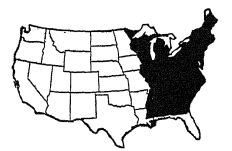
This new nation has as its territory a great belt of land stretching inward from the Atlantic coast. As time goes on, it adds to its territory by negotiation, by purchase, and by conquest. As for its people, they increase tremendously. Part of the increase is the result of an inpouring of 35,000,000 immigrants, most of them becoming members of this new nation. To-day the nation stretches from ocean to ocean (and out across the seas) and has 110,000,000 people in its borders under a form of government called a republic.
Of course this sketch of the development of our nation has nothing in it that we did not already know. It is told merely to remind ourselves that to-day, just as in the past, man finds it worth while to make use of the nation and government in his cooperation.
¶ B. Democracy, a Multiplier or Man’s Powers by Developing the Individual
(Early despotic rule; what democracy is and how it won its way.)
“Man is a pohtical animal,” said an old Greek philosopher. So he is. He is also a tool-making animal, a communicating animal, a nature-harnessing animal, an institution-making animal; in short, he is the kind of animal that is ever busy in multiplying his powers. Since it multiplied his powers to expand his groupings into nations and to have governments, he did so. How he probably did it was sketched in the last section. As, time went on, this pohtical animal found that he could still further multiply his powers by using a device called democracy. This word democracy comes from two Greek words meaning “the rule of the [ p. 463 ] people.” Our task in this section is to find out what “the rule of the people” means, and why it multiphes our powers.
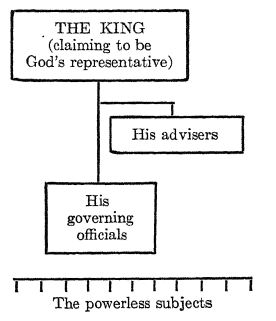
Early nations were usually ruled in a harsh way. — Our sketch of man’s expanding groupings showed that war and conquest played quite a part in the formation of early nations. That usually meant that some strong leader secured and held a great deal of power. In those days it did not shock people for the ruler to have great power. Such an idea was in their minds (thanks to custom) from the still earlier days of the harsh, despotic rule of the patriarch. Since such things were true, it is not surprising that earlier nations (with only a few exceptions) came to be ruled in a despotic way. They were not ruled by the ordinary people. Far from it.
Of course, just how government was carried on varied from nation to nation, and from time to time. We can get a fair picture of the process, however, by taking a snapshot of one of the early states of western civihzation that was ruled by a despotic king.
The position of the ruler. — As the diagram shows, the king was at the head of the nation. Frequently, he or one of his ancestors had been the leader of a tribe that had conquered other tribes, most of whose members were now slaves or half free. He was likely to have some kind of advisory body, or council (selected mainly from his band of warriors), whose advice he heeded or disregarded as seemed to him best or safest. Since there were many details in the task of [ p. 464 ] running a nation, he had under him a group of officials to carry out his wishes. Some were leaders in his army, others were tax collectors, others were judges, others were sheriffs to keep the peace, and others managed his finances. All were “his.” They took orders from him and from no one else — from the common people least of all.
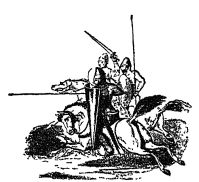
Mail-clad Warriors
Such a king ruled by force of the hold of custom on men’s minds and by might, — the might of the sword, the arrow, and the lance. He and his mail-clad warriors could, if occasion arose, ride almost unharmed through a host of the ignorant and poorly-armed common people. Then too, the idea gradually developed that he was God’s representative on earth. Every king was glad to encourage this idea. It added the authority of religion to the authority of the sword, and thus made him more secure on his throne. In time, the doctrine of “the divine right of kings” became widely accepted. “The king can do no wrong,” it was said, even though he sometimes acted far more like a representative of the devil than of God.
The bulk of the population was not free. — As for his lower-class subjects, some were free men (especially the artisans and traders of the towns) but moi’e were half free (they were called villeins in England), and in some states the bulk of the population were slaves. For example, a survey of England made less than a thousand years ago (1086) showed that there were about seven times as many slaves and halffree men as there were free men. The figures were even worse in many other early states. Whether slave, half free, or free, the lot of the common man in an early nation was none too [ p. 465 ] good. He could not read nor write and his “betters” frowned upon such accomplishments for him. He was gripped by custom, blinded by’ superstition, and beset by fears of both this world and the next. It has been said of him that “his mind barely worked.”
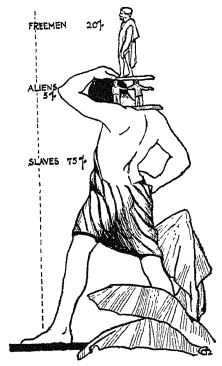
The “rights” of the ordinary man. — It is true that he had, according to custom, a certain number of “rights.” But if the king chose to trample down his grain during a hunt or even to seize his property, there was really very little he could do about it. If the king or his officers threw him into prison (some pretext could easily be found), the chances were excellent that he would rot there, for who would get him out? Who would even get a trial for him? And prison always yawned for the common man. If he did not agree with the king’s brand of rehgion, if he gathered with others to talk of the king’s doings, if he criticized the king or his government, if he was suspected of having arms, he was very likely to bring down upon himself the king’s wrath. That wrath might well mean sudden and brutal searching of his home, arbitrary seizure, imprisonment without trial, and cruel punishment.
Even so, the situation was better than what preceded it. — All this seems to us a terrible state of affairs. It certainly was. However, we must not forget that it was better than the still earlier conditions; it was a forward step in human progress. After all, the king could not wisely go too far. Even [ p. 466 ] [ p. 467 ] when he had no fear of revolt (and he often had that fear), he would be foolish to cripple too seriously the industry of his people, for that would cripple his own living. Then, too, the arbitrary rule of a warrior king was better than a chaos of helter-skelter raiding and pillage among warring tribes. It was a beginning of real order. It meant the cooperation of a large group. On the average, men were safer in their lives and property, and were better fed, clothed, and sheltered than they were in the days of the wandering tribes.
WHAT OUR CONSTITUTION SAYS OP CIVIL RIGHTS
Our constitution is about 140 years old. It was thought wise to insert these clauses. What a short time we have been, safe in our civil rights!
Congress shall make no law respecting the establishment of religion or prohibiting the free exercise thereof ; or abridging the freedom of speech, or of the press; or the right of the people peaceably to assemble.
The right of the people to bear arms shall not be infringed. The right of the people to be secme in their persons, houses, papers, and effects, against unreasonable searches and seizures shall not be violated.
No person shall be held to answer for a capital, or otherwise infamous crime, unless on a presentiment or indictment of a grand Jury; nor shall any person bo compelled in any criminal case to be a witness against himself, nor be deprived of life, liberty or property without due process of law.
In all criminal prosecutions, the accused shall enjoy the right to a speedy and public trial by an impartial Jury.
Excessive bail shall not be required, nor excessive fines imposed, nor cruel and unusual punishments inflicted.
No state shall deny to any person within its jurisdiction the equal protection of the laws.
The privilege of the writ of habeas corpus (this provides for finding out whether an accused person may properly be held), shall not be suspended unless when in case of rebellion or invasion the public safety may require it.
No bill of attainder (sentence on an accused by act of legislature instead of using a court trial) or ex post facto law (providing punishment for acts done prior to passing the law) shall be passed.
Occasionally, too, there would be a king who used his great power to help the progress of his people. To take a case outside our western nations, there was Asoka (264-227 B.c.) of India. “He seems to have ruled his vast empire in peace and with great ability. He organized a great digging of wells in India and the planting of trees for shade. His officers supervised charitable works. He founded hospitals and public gardens. He made provision for the education of his people, including the women. For twenty-eight years he worked sanely for the real needs of men. From the Volga to Japan his name is still honored.”[2] To him his great power became his great opportunity to serve others.
Democracy is a better plan than rule by a despot. — But there were very, very few kings like Asoka. There were, accordingly, few cases where despotic rule worked well. Despotic power over his fellow men was not good even for the monarch: almost always he became selfish and cruel. It was not good for the people. It was bad that their ordinary human rights (as we think) were not respected. It was worse that they had no feeling of responsibility for the affairs of their country, no individual initiative in helping to make a better country. As we look back over the pages of history, we see a better form of government slowly emerge. [ p. 468 ] It is democracy, the rule of the people. The great thing about democracy, the rule of the people, is that it makes everyone responsible for the affairs of his country. It develops the individual’s power and initiative in getting an ever better country.
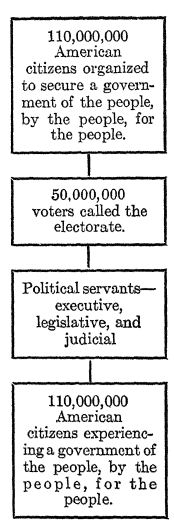
Citizens rule for the good of all. — The diagram shows the main features of democracy in our country. There is no arbitrary ruler at the head of the nation. There are 110,000,000 free American citizen rulers. “All persons born or naturalized in the United States, and subject to the jurisdiction thereof, are citizens of the United States, and of the State wherein they reside” says our national constitution. That great document further says that the purpose these citizens have in being banded together in a government is “to form a more perfect union, establish justice, insure domestic tranquility, provide for the common defense, promote the general welfare, and secure the blessings of liberty.” Stirring words, surely, and well worth committing to memory. How strange they would have seemed to an early despotic ruler, mindful mainly of his own welfare and caring little for that of the people!
What the electorate is, and who form it. — Every one of these citizens who can do anything at all can take some part in the government of the nation. Even a child can help a street cleaner or a policeman, for example. But about one [ p. 469 ] half of our citizens[3] (about 50,000,000) have an especially important part in the government. They are the ones who, under our rules of the game, have the right to vote, or to elect our public servants. We call them the electorate.
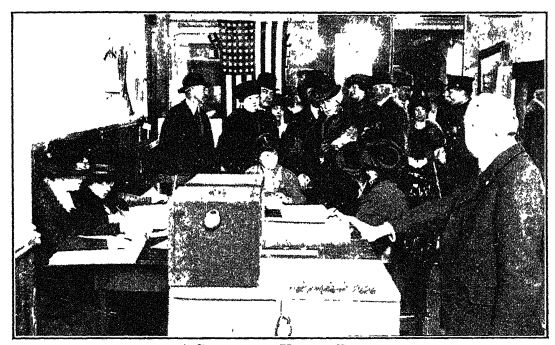
The election officials and the ballot boxes are in the foreground. Voters are waiting in lines.
The various states (Ohio, California, Florida, etc.) say who may vote, or be in the electorate. Oui’ national constitution merely provides that “the right of citizens to vote shall not be limited on account of sex, race, color, or previous condition of servitude.” Most states have forbidden minors to vote because of a minor’s lack of knowledge; they have forbidden foreigners, because criminals have shown they are not cooperative; they have forbidden foreigners, because foreigners lack interest in our affairs. Some states have made other limitations.
[ p. 470 ]
Government officials are the citizens’ servants. — As shown by the diagram on page 468, the electorate selects our public servants. This selection is made in various ways, and with many devices and safeguards. Then these servants, using a good deal of clattering governmental machinery, set about the task of taking care of the affairs of the people. We are not now concerned with all the details of how it is done or how well it is done, for we do not wish to become confused by the noise of the machinery. A very simple idea is behind it all. In a democracy the government is just a device used by the people to carry on their cooperation effectively. The officials of a democracy do not “rule” ; they merely serve the people. They carry out the wishes of the people according to plans approved by the people.
How the people came to rule. — When we compare the diagrams on pages 463 and 468, we see that on page 463 the common man is powerless and on page 468 he is a ruler. How did such a great change come about? The whole story cannot be told here. It is too long, and its telling belongs in history courses. But I can give you a sketch of what happened.
Through the long centuries, democracy (remember democracy means the rale of the people) found that she had three ways[4] by which she could gradually climb into power. (1) She could dicker and bargain for power. The king was always greedy for money and was nearly always willing to sell “privileges,” that through the years came to be regarded as “rights.” (2) She could fight for power. Some of the most inspiring happenings in history are the battles between the people and arbitrary rulers. (3) Her artists, writers, painters, sculptors, and philosophers could hold up ideals and aspirations that strengthened her followers and helped persuade even her enemies.
[ p. 471 ]
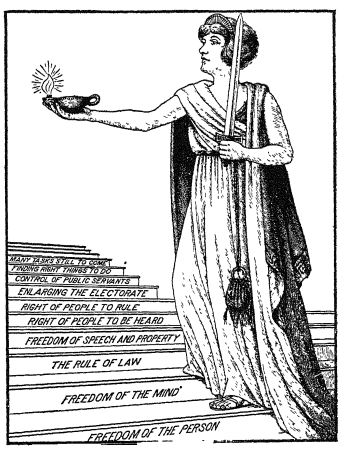
Her climb was a long one and a hard one. It meant hundreds of steps. We can look back and see these steps running in long series or flights. Here is one possible list of these series:
- The people had to become free in their persons. Slavery and serfdom had to disappear.
- The people had to become free in their minds. The rule of the people would do more harm than good unless the people were able to think and plan.
- The people had to get the right to be ruled by law rather than by the whim of a ruler.
- The people had to win freedom of speech and freedom to have property and rights in property (page 413).
- The people had to get the right to be heard in framing and running the government.
- The people had to turn this right to be heard into a right actually to frame and run the government. Officials then became the servants of the people.
- The people had to enlarge the number who coTold be members of the electorate. (Even after the American [ p. 472 ] Revolution only about one person in thirty could vote in this country.)
- The people had to learn how to guide and control their public servants.
- The people had to find out the right things to do in a government of the people, by the people, for the people.
Many tasks still before democracy. — We must not imagine that the tasks of democracy have all been finished. Far from it. Her problems to-day are quite as serious as those of the past. There is no reason to suppose that they will be any less serious in the future. Man is always pressing on — always “becoming,” one writer has said — and the conditions of his living are ever changing. There will always be problems of social control for democracy to solve.
How can democracy control her public servants? — As just one sample of democracy’s present day problems, let us look at the problem (see number 8 above) of the effective guidance and control of our public servants. We wish to be sure that our public servants carry out our wishes and that they do so in an economical and effective manner. We expect this of all our servants — policeman, mayor, alderman, teacher, governor, legislator, judge, jailer, president, congressman, and all the rest. It is no simple problem. Here are some of the more important things that have to be watched.
1. Citizens must themselves have good ideals of public service, so that they will not tolerate poor service. There is an old saying, “A stream will not rise higher than its source.” We need not expect that our citizen servants will have any better ideals than the citizen masters. Unfortunately we Americans have not yet developed very high ideals of pubhc service. We are loose and careless about the matter. This is one of our very serious problems.
[ p. 473 ]
2. Citizens tnust see to it that good servants are selected. — In the ease of servants who are elected, we must see that the electorate has good methods of selecting candidates, fair methods of balloting, and ways of having the candidates pledge themselves to serve well. In the case of servants who are appointed, we must have ways, such as are sketched in 5, below, to cause the persons who make the appointments to be careful to appoint good servants.
3. Citizens must provide a body of rules to govern the acts of their servants. — Our national and state constitutions and some of our laws supply such rules. For example, on page 466, there is a statement of some of the things our servants may not do. Of course, as conditions change, these rules — these constitutions and laws — need to be amended from time to time.
4. Citizens must have ways of knowing what their servants are doing. — Because we wish to know what our servants are doing we have annual reports by our public officers. We have public (not secret) meetings of our legislatures and courts and we have official records of what goes on in these legislatures and courts. We have access to public records. So also, we like to have easy access to our servants (we are often a nuisance to our governors and presidents and interfere sadly with public work), and we encourage private bodies like city clubs and bureaus of municipal research (see page 444) to tell us how public affairs are being carried on.
5. Citizens must have ways of holding public servants accountable for their acts. — For this purpose we have impeachment devices designed to remove judges and executives who fail grossly in carrying out our rules. We have laws providing for punishment in our courts for certain misdeeds of our servants. We have ways of telling our servants [ p. 474 ] by letters, petitions, resolutions, and remonstrances what we think of their acts (see page 442). And, of course, we can always refuse to re-elect or re-appoint those who serve us poorly.
In the last generation certain other devices have come to be used in about one third of our states. The “referendum” provides that certain acts (especially laws) of the public servants must be “referred ” to the electorate for a vote before becoming effective. The “recall” means that the electorate may vote to recall an unsatisfactory public servant, thus putting him out of office before his term has expired. The “initiative” provides how legislation may be initiated, or started, by the electorate itself without waiting for action by the elected servants. There is still much dispute whether these new devices are wise and, if wise, how they should be used. We do not need to go into the merits of the case. We need merely to understand that they are illustrations of the ways by which democracy is trying to have good control of her servants.
Let us bear in mind that this discussion of how democracy keeps control of her servants shows only one example of the many, many problems confronting democracy to-day. We can see that democracy has not yet fully “arrived”; it is just “becoming.”
The position of democracy to-day. — We have taken most of our illustrations from our own democracy, but we must not suppose that ours is the only possible form of democracy. Even a nation with a king may really be a democracy! Take the case of England to-day. England has a king, but he is a figurehead. He is merely a device used in the government. The people rule. The diagram showing how it is done is quite hke the diagram of our own organization on page 468. The main difference is that in the English [ p. 475 ] diagram shown below the king is inserted as a convenient way (for them) to get certain things done.
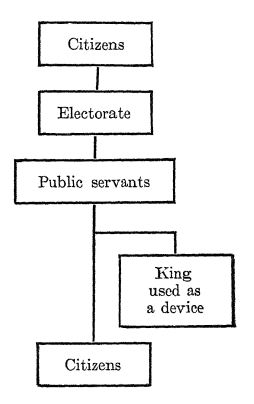
It is amazing how democracy has swept over the world. Two thousand years ago — yes, two hundred years ago — there was little rule by the people. Even in the most advanced countries, democracy was just fighting its way to the front. To-day more than half of the peoples of the world five in democracies; a mere handful are still the subjects of arbitrary kings; the rest are in various transition stages.
Political institutions can be multipliers of men’s powers. — Now that we have made our survey of two pohtical institutions, the nation and government, let us make a summary of the main reasons why they are multipliers of our powers.
1. The nation multiplies man’s powers because it enables him to have a larger group in which to work out his cooperation. In some real sense, the strength of all of us is available for the use of each of us. One device that helps greatly to make this vast strength available for each of us is government. It is a pohtical device that helps knit together the speciahsts of our society. It is a device that helps us conduct our many activities in an orderly way. It thus increases our ability to make progress.
2. There are many kinds or forms of government. Some are better than others. Man is coining to rely more and more upon those forms of government that use “the rule [ p. 476 ] of the people.” The reason is plain. Democracy, with all its crudeness and faults, is a multiplier of man’s powers. It places responsibility upon every individual. It thus develops his initiative and gives him pride of achievement. It rests upon the faith that men can rise to their opportunities, if they will only pay the price of hard work and careful thinking.
¶ Problems
- Define or explain, using a dictionary if necessary:
Political institutions
Impeachment
Government
Writ of habeas corpus
Initiative
Constitution
Referendum
Electorate
Recall
Republic - “Government has not yet arrived. It is merely becoming. That will always be true.” What does this mean? Is it true of all social institutions? Why should we wish it to be true?
- Why did the patriarchal family make possible a fairly large group?
- Do you think that men reasoned matters out in the long ago past and, persuaded by reason, came together and formed nations and governments?
- How did abundant food supply and shelter affect the groupings of early man? How did they affect the “settling down” process?
- “There is so little slavery to-day that we seldom hear of it and almost never reflect that it was once the usual thing.” Why was slavery once so usual?
- Notice the essential features of a nation as given on page 458. Does the United States meet the requirements?
- “The Iroquois were just on the point of being a nation.” “The Iroquois had become a nation.” With which quotation do you agree? Why?
- “Man increases his powers by expanding his codperation.” Give reasons why that increases his powers. Write a paragraph telling why man has found it worth while to expand his groupings into nations.
- What are the main points of difference between the way our nation was formed and the way the earliest nations were formed?
- Why does democracy increase individual initiative? [ p. 477 ]
- “The lot of the common man was none too good in the typical early nation.” What was the matter with his lot?
- The first ten amendments to our constitution are called our “bill of rights for the ordinary citizen.” Show that is a good name. (Most of the material on page 466 comes from these ten amendments.)
- Government by the early arbitrary king was a step in human progress.” How can arbitrary government be considered a step in progress?
- Children are citizens, although not members of the electorate. Make as long a list as you can of things children can do to assist in government. Can they be witnesses in a court trial? Can they assist city officials?
- What differences do you see between the officials of an early king and those of a democracy?
- Look at the flights of steps (pages 471 and 472) that democracy has climbed, or is still climbing. Explain why each flight must be passed before there can be true democracy.
- “Citizens must have good ideals of public service.” Why?
- Are you a member of any club? Does it have a set of regulations for your servants, the officers of the club? Are there ways of knowing what your servants are doing? Of holding them accountable? How do you determine what the club should do? Notice numbers 6, 8, and 9 on pages 471 and 472.
- “Citizens must have ways of knowing what their servants are doing.” What are some of these ways? Find out from your family how they learn what their city servants are doing.
- “Citizens must have ways of holding their servants accountable for their acts.” What are some of these ways? Find out from your family how they hold their local servants accountable.
- “ Democracy will never arrive. It will always be arriving.” What does this mean?
- Notice again the numbers on pages 471 and 472. Under which heading does each of the following come? Do not try to say what should be done in each case. Be content with being able to see what is being attempted in some of the plans of our day:
( a ) The recall of judges
( b ) Easier ways of amending constitutions having them appointed.(e) Electing judges rather than
( c ) The short ballot
( d ) The budget - Answer the questions at the beginning of the chapter, page 451.
[ p. 478 ]
¶ Interesting Reading
Marshall: Readings in the Story of Human Progress, Chapter XV.
- The United States Department of Agriculture (an example of the work of one national executive department).
- What a State Does (a partial list of the ways in which the state touches our lives).
- The City Water Supply (how a city performs one of its tasks).
- Lighting a City (how a city performs another task) .
See also:
Chapter IV, 3. Inventions and Patents (what the government does to encourage inventions).
Chapter V, 3. Our IMeasuring Devices or Standards (how standards help us: the work of the Bureau of Standards).
Chapter IX, 2. Coins (the origin of coins; how our coins are made and are kept in good condition).
Chapter IX, 3. Paper Money (how our paper money is made and kept in good condition).
Chapter XI, 2. Good Roads (a realm of communication in which we have recently made much progress).
Chapter XI, 3. The United States Post Office (one way the government aids in developing communication to-day).
Chapter XIV, 2. How Laws Are Made (a law traced from the days of forming public opinion to the governor’s signature).
Chapter XIV, 3. Dangers in hlodern Industry (an example of social control in conserving our human resources).
Chapter XVI, 1. ImproAdng Our Market Machinery (one example of how we improve the knitting together of our specialists) .
Chapter XVI, 2. Vocational Guidance (how one city school system handles this work).
Problems to think over are given in these reading selections.
| XIV. Social Control; Custom, Law, Public Opinion, and THE Sense of Divine Approval | Title page | XVI. Social Organization and Living Together Well |