| XV. Social Control: the Nation and Government | Title page | XVII. Ideals, the Guides to Living Together Well |
[ p. 479 ]
CHAPTER XVI
SOCIAL ORGANIZATION AND LIVING TOGETHER WELL
A. Specialization and Living Together Well
B. Place-finding Devices and Living Together Well
C. The Team Spirit and Living Together Well
D. Planning a Changing Social Organization and Living Together Well
E. Guidance by Ideals and Aspirations
Questions to Keep in Mind while Reading This Chapter
-
What tilings in our social organization threaten our living together well?
-
Why is it so important to have good social control?
-
Will any of our social institutions change in our life time?
What is social organization? — The last few chapters have shown that man is an institution-maker just as truly as he is a tool-maker. He has developed all sorts of institutions. In Part III we studied such institutions as the family, the church, the school, and the monetary system. In Part IV we have been examining, among others, the market system, private property, competition, law, and government. These are, of course, only a few examples of our more important institutions. But they are enough to show that good ways of organizing to do things are quite as important as good tools to do things with.
These institutions fit into one another more or less smoothly. Taken together, they make up that complex thing we call our social organization.
[ p. 480 ]
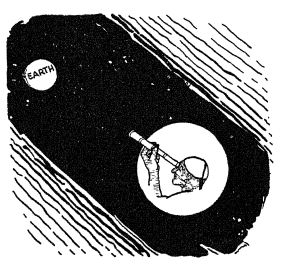
When we think of any ordinary machine, we think of its being guided or run by someone who turns on the power and supervises the work. But if we call this social organization of ours, with all its institutions, a vast machine for getting done the work of living together, we cannot point to anyone who runs it. True, we select our representatives to run the governmental part of it. But the rest of it is run by everybody’s finding his place and helping pull the load. This “works” because, through the ages, om torchbearers have handed down to all of us much the same customs and ideas and ideals. As a result, we are able to live and work together fairly smoothly.
Our social organization works in a fairly orderly way. — And this social organization really does work. If a “man on Mars” is able to watch us through some magic telescope, he sees a very orderly people, cooperating very smoothly upon the whole. He sees them come out of their homes in the morning and wend their ways by all sorts of locomotion to thousands of different kinds of work. He sees these tasks all knitted together in such a way that, in the main, the vast population is decently fed, clothed, sheltered, amused, educated, and governed.
There are, of course, hitches. Sometimes there are too many vehicles on one street, too many persons trying to get on one train, too many persons not able to find their places readily in society. Sometimes some great madness, as in the recent world war, seems to possess us. Sometimes persons [ p. 481 ] make a living by harming society: by burglary, by political graft, by cheating in business. But this “man on Mars” sees that the strange machine does get things done. And, if he happens to have been watching us for five hundred or one thousand years, he sees that we are far better fed, clothed, sheltered, amused, educated, and governed than we were in the past. He sees too, that our institutions have developed out of those of the past in a fairly orderly, progressive way.[1]
But we must face certain problems. — If, however, this man on Mars turned his magic telescope on our preparation to five together still better in the future, he would find many things that need attention. Instead of making a long list of “problems of the day,” let us follow the plan used in Chapters VI and XI and make additions to our list of matters upon which our living together weU in the future depends.
Thus far we have been able to make nine statements about our living together well. They may be found on pages 180 and 333.
Now that we have seen how man has multiphed his powers by means of social organization, we can make additions to the list. These additions are the subject matter of the present chapter.
10. How well we shall live together depends upon whether we make effective use of specialization as a multiplier of our powers, and upon whether we knit our specialists together effectively.
11. How weU we shall Uve together depends upon the effectiveness of om place-finding devices.
12. How weU we shall live together depends upon our developing an effective spirit in pulling the load.
13. How weU we shall Uve together depends upon whether we make wise changes in our social organization in order to meet the new situations in our civiUzation.
14. How weU we shall Uve together depends upon whether we guide our social organization by good ideals and aspirations.
[ p. 482 ]
¶ A. Specialization and Living Together Well
(How well we shall live together depends upon whether we make effective use of specialization as a multiplier of our powers, and whether we knit our specialists together effectively.)
There are evils in specialization. — We have learned to think of specialization as a multiplier of our powers. It is just that. But it has in it possibilities of harm.
The monotony of specialization. — For one thing, specialization can mean a terrible monotony. Often the worker at a highly specialized machine makes, over and over again, just a few motions. This monotonous working at a narrow task turns out much product, but its effect on the worker is not good. He has little chance to get the “pride of workmanship” that anyone feels who sees an object take full shape under his hands. He becomes indifferent, — a listener for the closing whistle. There have been cases where the monotonous doing of one thing over and over again even caused the breakdown of nerve centers and serious injury to health. A little later we shall tallc of “sour indifference” among our workers. The dull monotony of highly specialized work is partly to blame for this sour attitude.
The narrowness of specialization. — For another thing specialization can mean a terrible narrowness. Consider the ease of Carrington Tanner, who went directly from the eighth grade to a highly specialized job in a factory. All he did was to stand beside a moving platform and thrust a certain set of bolts into place as a metal casting passed him. What did he learn that would be helpful in giving him promotion to some responsible task in management? What did he learn that would make him a good “ all-’round ” mechanic? Nothing. One of the crying needs of industry to-day is the broadly trained man who can adjust himself quickly to new [ p. 483 ] situations and can take responsibility. But narrow specialization does not produce such men.
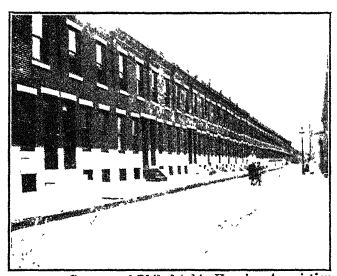
Monotonous Living Quarters for Workers at Monotonous Tasks
Specialization at its worst can be as narrowing to a whole community as it can be to an individual. Sometimes the whole life of a community is wrapped up in the making of one thing. The narrow, monotonous lives of people in such districts are often harmful to others as well as to themselves. Such people become narrow or “provincial” in their thinking. They become xmable to imderstand clearly the problems of other districts. This means that they are not as helpful members of a democracy as they should be, for in a democracy one district often votes on matters that are very important for other districts.
It is possible to offset the evils of specialization. — Of course, the fact that there can be some bad effects of specialization does not necessarily mean that we should cease to use it. It is a good device when rightly used. But we must be careful to offset its evils.
One way to offset the narrowing effects of specialization is for all of us to remain in school long enough to get a broad education before going out to our socialized tasks. Various ways can be found to relieve those of us who are already at tasks that are monotonous and narrowing. Frequent rest periods, reasonable hours of work, and wholesome recreation greatly offset the evils of monotony. Contact with broaden [ p. 484 ] ing influences at the theater, library, or elsewhere during leisure time will help us to avoid narrowness.
A campaign against the evils of specialization can thus make good use of the school system, the recreation center, the movies, the pubhc library, the shorter workday, and many, many other features of our society.
We must make certain our specialists are knitted together effectively. — Even after we have found ways to offset the evils of specialization, we need to have our specialists knitted together effectively. We know from Chapter XII that knitting together is done by authority and through exchange. To the extent to which it is done by authority, our problem is one of securing ever-better social organization and control. That is to be discussed later in pages 498 to 507. To the extent to which it is done through exchange, our problem is one of developing more effective marketing methods. “Marketing” is a very large topic, indeed. We do not need to discuss it here. It is enough for us to know that both our business men and our governments are striving to find everbetter ways of marketing. They are making all sorts of studies and all sorts of experiments. They are seeking to find ways of knitting together our speciahsts with as little waste of society’s energy as possible.
How well we shall live together depends upon whether we make good use of the multiplier of our powers, specialization. We shall need to offset its evils, and we shall need to knit our specialists together more effectively.
[ p. 485 ]
¶ B. Place-finding Devices and Living Together Well
(How well we shall live together depends upon the effectiveness of our place-finding devices.)
The importance of place-finding devices is very great. — Upon the whole, our scheme of leaving it to the individual to find the “right” place for himself and his property (see pages 400 to 412) is a good scheme. It spurs each of us on to make a success in life and to give good service to society. We are all working in cooperation with one another. All of us fare best when all of us are in our “right” places and are pulling hard at the load.
Since that is true, one would suppose that our society would have many devices, or helpers, to give each of us the best possible chance of finding his right place. There are some such helpers, but they are absurdly few and poor for such an important matter. One critic says, “We turn people loose blindfolded and tell them to find their places. They fumble around and, like as not, are square pegs in round holes all their fives. What an awful waste of our human resources! What an effective way of harming ourselves!” Perhaps that criticism is a little too strong, but certainly we are not doing all we should be doing to help persons find their places.
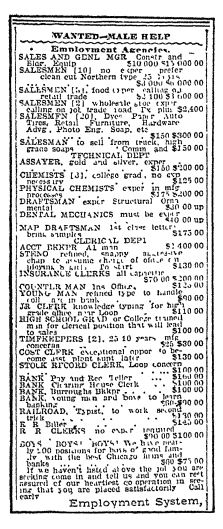
What is done to help the individual find his place? — Let us take some samples of what is being done in this field. In our more progressive schools courses are given explaining the duties of the main occupations and pointing out how to prepare for them. Some school systems have a “vocational counselor” or “placement officer,” who aids pupils to find out about the tasks of our society and who “follows up” the work of graduates and former students. A few schools have schemes by which pupils may “try out” Jobs in their senior [ p. 486 ] year and thus learn at first hand what is required for each kind of work. Less helpful, but still very much worth having, are assembly talks by lawyers, doctors, merchants, and others concerning their work and how to prepare for it.
Out in industry, firms advertise for help at the factory gate and in the newspapers. The United States Government and some states and cities run free employment exchanges that bring worker and job together. Private persons also run employment exchanges. For a fee they find workers for employers and employers for workers. There are other institutions that merely spread information concerning occupations. Several private bureaus publish reports telling of opportunities in various work.
How small the activities mentioned in the last two paragraphs are!
What is done to help the owner of property find its place? — So also, there are some devices to help the owner of property find the “right” places for his property to go to work. Our various governments maintain a few of these devices. For example, the Consular Service of the National Government publishes reports of openings for American capital and for the sale of American goods in f oreign lands. V arious states have bureaus telling of opportunities for settling on public lands. Many cities have agencies for giving information (sometimes it is [ p. 487 ] misinformation) of business opportunities in these cities, hoping thus to build up their conununities.
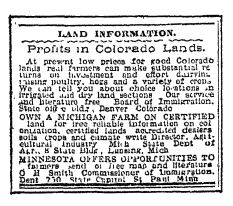
In addition to governmental agencies, there are private agencies. There are hundreds of “trade journals,” most of which print news of conditions in their trade. Many banks print and distribute bulletins about business conditions. Sometimes these give hints of business opportunities. Every large newspaper has, on its financial page, news and gossip of conditions in various businesses. Bond houses will give advice concerning investments. The trend of prices of stocks will sometimes show the skilled observer that certain lines of business are profitable and that others are not. There are engineering firms which, for a fee, will investigate and report concerning possible business ventures.
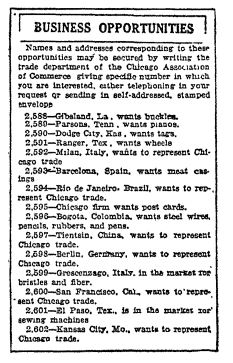
But all that has thus far been done to help the individual find the right place for his property is a mere beginning. We must do much more.
What can be done to help the individual find his place? — Probably the best way to help the individual find his place is to extend the work of our schools, colleges, and universities in this field. The merest beginning has been made in training persons to serve as vocational counselors in the schools. The merest beginning has been made in studying the kinds of tasks in [ p. 488 ] society and the best preparation for them. The merest beginning has been made in putting such facts before pupils and parents and in helping them to learn of the various forms of society’s work. All this is a proper task of our educational system. Our society is too complex for the family to be able to handle the task well. The church is not equipped to do it. The school, of all our institutions, can do it best. Our schools will need more money to enable them to accomplish this task. But it will be a good investment for society if the task is well done. It will mean much for our hving together well.
Probably the next best way to help the individual find his place is for our large employers, such as business houses and government bureaus, to enlarge their departments or bureaus that deal with the workers. These departments are often called “personnel departments.” A well-managed personnel department can greatly shorten the period of “fumbling around” by the worker. By various tests it can make a fair judgment of the worker’s skill and abihty at the time he applies for work. It can thus help to start him at a task for which he is well fitted. By careful schemes of training and promotion, it can help his development after he is at work. It ought to be said, too, that a good system of public employment agencies run on a country-wide basis so that every employment office could know of opportunities all over the country, might cooperate with both schools and business houses in finding the right places for our speeiahsts.
What can be done to help the owner of property find its place? — The problem of helping the owner of property to find its right place is a more difficult one to solve. Clearly the problem is worthy of attention, for society loses when capital goods — buildings, machinery, and materials — are not used in the right tasks.
[ p. 489 ]
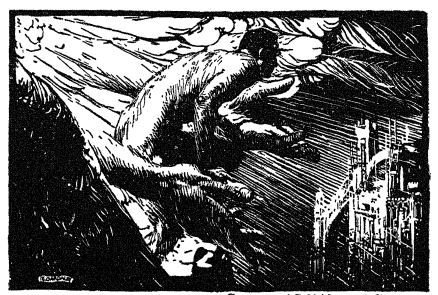
We must show the individual his opportunity
It is easy to see some things that can be done. Our state governments can watch more carefully to see that “fake” and fraudulent enterprises are not allowed to ask citizens for funds, and to see that proper enterprises tell the whole truth when they seek funds. Several states are already working in this direction in their “blue-sky laws,” which regulate the efforts of business houses to secure funds. Then, too, our various government bureaus can go much farther than they have gone in making known facts about the demand for goods, shortage of goods, the surplus of goods, what amounts other nations can produce, etc. And our schools can show pupils what devices society already has for helping get property into the right places, and how these devices can be used.
Some persons think that greater publicity should be given to the profits being made in the different lines of business. They argue that since we depend upon the gain spirit to place our competitors, we ought to make sure that these competitors know in what lines of business gains are being made. They say we are already moving in that direction ; that anyone can, for a fee, get such business houses as Dun’s or Bradstreet’s (who specialize in making reports about firms) [ p. 490 ] to find out fairly accurately what profits are being made in certain lines of business; that our banks get such information from persons who come to them to borrow money; that the government has the information in the income tax reports; that it would be possible to publish helpful general reports about profits in different lines of business without betraying any secrets of a given firm.
The problem of helping property find its “right” place is not an easy one. We cannot solve it on a page. We can only see its outlines. But we can be quite certain that a society which asks its competitors to place their property according to the promptings of the gain spirit is foolish not to find good ways of providing these competitors with facts upon which to work. Only thus can society be well served.
We must remove the blindfolds. — How well we shall live together depends upon the effectiveness of our placefinding devices. We cannot expect individual initiative, competition, the gain spirit, and private property to work best when our specialists are blindfolded.
¶ C. The Team Spirit and Living Together Well
(How well we shall live together depends upon our developing an effeetive spirit in pulling the load.)
A few years ago a football team of a middle western college started its season with excellent prospects. It had won the championship of its section the year before; its best players had all returned; there was excellent material among the substitutes. But, for various reasons, petty Jealousies broke out in the team. Each player came to feel that the others were shirking and were getting more honor and credit than they deserved. The spirit of “teamwork” — of “all-pulltogether ” — disappeared. The result was that this team lost every game except one with a ridiculously weak opponent.
[ p. 491 ]
Distrust and jealousy are marring our teamwork. — Now a football team is really a collection of specialists working together. Each player has certain duties, and these duties should fit together in team play. Exactly the same thing is true of our society of speciahsts. There should be a spirit of “teamwork” — of “all-pull-together” — if society is to get the best results from the work of its speciahsts. Uniortunately, there has developed in our society a great deal of “sour indifference” about pulhng together in good teamwork.
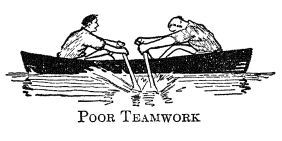
We see examples of this in every newspaper. We hear examples of it in many conversations of adults. Farmers think that city people work short hours and get high wages as compared with the low prices the farmer gets for his products. The employer often thinks that the worker shirks and gets paid more than he is worth. The worker replies that the employer “profiteers”; that he squeezes work out of labor at low pay and sells the product at high prices. The producer often tMnks that he gets the “short end” of the bargain because the middleman charges more than his marketing work is worth. The consumer often thinks that he is “fleeced” by both the producer and the middleman. The average man often thinks the “cards are stacked” against him in favor of the “big fellow,” who has some monopoly or some “political pull.” Such expressions as “grafter,” “profiteer,” “tax dodger,” “robber,” “monopolist,” “protected criminal,” “unfair competition,” “grab,” and “he got his, let’s get oms” are heard on every side.
These are only a few examples of the many that might be given showing that our team play is poor. Since the conflicts [ p. 492 ] between the worker and the employer are the most noticeable cases of lack of teamwork, let us hear what is said by these two parts of our society.
An example of distrust by the worker. — Here is what one person,[2] who thinks labor is being “double-crossed,” says about the situation.
You are a workingman. You know how hard it is for the most careful and industrious workman properly to care for his family. If he is fortunate enough never to be sick, or out of work, or on strike, or to be involved in an accident, or to have sickness in his family, he may become the owner of a cheap home, or, by dint of much sacrifice, his children may be educated and enabled to enter one of the professions. He may be enabled to save enough to provide for himself and wife a pittance to keep them from pauperism and beggary in their old age.
To attain that level of comfort and decency he must deny himself and his wife and children many things they ought to enjoy. They have to forego many innocent pleasures; to live in poor streets, greatly to the disadvantage of the children’s health and morals; to concentrate their energies on the narrow and sordid aim of saving money; to cultivate the instincts and feelings of the miser.
The horses in the stables of the rich men of this country, and the dogs in their kennels are protected against such overwork and such anxiety as the workingman and the workingman’s wife must endure. Greater care is taken of the health of many horses and dogs than the most favored workingman can possibly take of the health of his boys and girls.
An example of distrust by a small manufacturer. — I showed the foregoing quotation to a small manufacturer. Here is what he said:
Our friend is not fair in his statements. The workingman can rise in America, Most of our business men, statesmen, and professional men have thus risen. Take my own case. I began by selling goods behind a counter. I have had no pull, no special favors, no property but what I have earned, and I have earned that honestly. True, I am only a “little fellow” and probably that is all I ever shall be, for my ability is not great. Just the same, I, and thousands like me, are evidence that America is still a land of opportunity for the person with thrift and industry.
[ p. 493 ]
Furthermore, our friend doesn’t know the other side of the picture. I have had my own slowly growing business for twenty years and not a year has passed without burdens, anxiety, sleepless nights, and hours of work far in excess of those of a workingman. Don’t talk to me of my being free from toil and anxiety, or of my being able to live in luxury.
As far as that goes, one of my main reasons for anxiety is that one can’t get his money’s worth out of the wages he pays these days. Wages keep climbing up, the unions keep asking shorter hours, and the workers are more careless and less industrious than they once were.
It is only fair to say, though, that others cause trouble too. I notice that some of my competitors get away with tricky, shoddy work. Too many people seem to be grabbing rather than rendering good service, these days.
What are the causes of such faulty teamwork? — There is neither time nor space to give similar quotations from the farmer, the consumer, the middleman, the producer, the large manufactm’er, or other specialists of our society. The fact that such quotations are very easy to get shows that our teamwork is being marred by jealousies, suspicions, and accusations. What can be done about it?
The first thing to do is to find the causes of this distrust. When we know these causes we can judge what remedies will work well. The main causes are:
- We do not yet understand our teamwork. Consequently we sometimes make a botch of it.
- Some cheap, selfish persons keep stirring up suspicions and jealousies.
- There are in our social organization real evils that continue to cause sour feelings.
1. We do not yet understand our teamwork, consequently we sometimes make a botch of it. — No matter how willing and earnest a green player on a football team may be, he spoils the plays until he learns exactly what they are and what his part is in each play. The same thing is true of the specialists in our society. Now, as we have seen, many features of [ p. 494 ] society’s teamwork are very recent, very rapidly changing, and therefore not well understood by all. Our specialization itself is new and changing; our marketing methods of knitting together our speciahsts are new and changing; many of our rules of the game are new and changing. It is, then, no great wonder that we often bump into one another and no great wonder that we sometimes think the other fellow is not playing the game as he should. If we really understood what he was trying to do and what his difficulties were, we would probably be more patient with him and have more respect for him.
If we can only fully realize that our living together to-day is a gigantic piece of teamwork, we shall come to have more respect for our team mates. Worker, manager, farmer, city dweller, capitalist, professional man, and all the others will come to feel more like taking off their hats to one another than throwing bricks. We are all working at one task, — that of living together in organized society. The work of each of us is difficult and worthy of respect.
2. Some cheap, selfish persons keep stirring up suspicions and jealousies. — In some of our trade unions, cheap labor politicians sometimes keep in office and keep "soft jobs” by telHng the workers they are oppressed and the politician will try to save them. In some of our employers’ associations cheap agitators sometimes get and hold jobs by continually crying that workers are radicals and that capital is in danger. In some of our cities cheap politicians sometimes get votes by “whanging the big drum” and shouting that the rural districts are voting against the city’s best interests in the state legislature. These are merely three examples of hundreds of such cases in our society. They are old, old, contemptible tricks, but somehow they still work.
Probably it is useless to hope that such selfish persons will [ p. 495 ] reform and cease their harmful work. Probably the only way around the difficulty is for the rest of us to learn enough about our society to be able to distinguish unselfish leadership from selfish leadership. We certainly want our leaders to show us any dangers they see. We certainly do not want them to stir up distrust and suspicion merely as a means of keeping in office. Fortunately, most of them are of a good type. It is an old saying, however, that even one mad dog can bite many.
3. There are in our social organization real evils that continue to cause sour feelings. — The most serious cause of distrust and jealousies among our specialists to-day is the fact that very real evils do exist in our society.
Monotonous work and poor living conditions. — For one thing, our modern, large-scale, highly specialized industry has meant for some persons dull, monotonous conditions of work that “sear the soul of a man” and make him sour at almost everything. This has often gone hand in hand with poor living conditions that increase the sourness. Furthermore, our free education, plentiful printing, movies, and whatnot, contrast such unsatisfactory ways of working and living with more pleasant conditions enjoyed by others. Even if these unfortunates were themselves entirely to blame for their condition (and they are not always to blame) they could hardly help feeling restless and envious.
Trusts and monopolies. — For another thing, we have too blindly worshipped competition. Competition is really very useful. But in large sections of our living together, trusts and monopolies have taken its place. Often that is what we should wish. We wish it, for example, in our public utifities, such as the telephone, the street car, and the railroad. Where we have made our mistake is that in some cases we have gone on pretending there was competition when there was [ p. 496 ] really monopoly. Then, when we did not regulate and control this monopoly, its owners made large monopoly profits. Very naturally, the rest of us began to suspect a lack of fair play. One of our serious problems is the proper control of trusts and monopolies so that the rest of us can have more faith that our individual initiative has a fair field for its work.
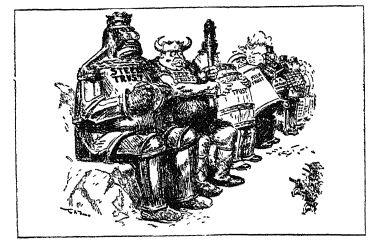
A Cartoonist's Statement of How Weak the Individual Is Compared with Monopolies
Uncontrolled gain spirit. — This monopoly evil is really just a special case of a whole group of evils that have sprung up because we have not properly controlled the gain spirit. We have seen, many times, that this gain spirit is a useful device. But like most other useful devices it can be used either for good purposes or for evil purposes. It has too often been used for evil purposes.
You will remember that the idea behind our use of the gain spirit was this: the gain spirit would spur us on, and we would so arrange the rules of the game that a person would make gains only provided he served society. We haven’t succeeded in so arranging the rules of the game. Shrewd men have found many ways to make gains without rendering service. They form monopolies and charge monopoly prices. They destroy carloads of potatoes so that the price of the remainder will be higher. They spread rumors that a certain business is in poor condition; buy its stocks at a low price; spread rumors that its condition has improved; and sell the [ p. 497 ] stocks at a profit. They let a highway get into bad shape (and even make it bad) and charge a tourist high prices for pulling his automobile out of the mire. These are only examples of thousands of filthy tricks, large and small, by which gains are made without serving. Such gains are seen by others. They arouse distrusts, jealousies, and suspicions.
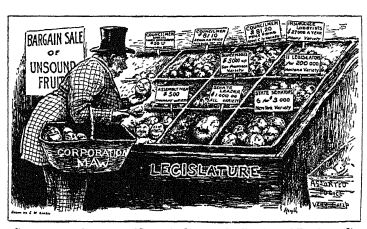
A Cartoon of Public Servants Being Bought
It is not merely in the business world that we have failed to make the best use of the gain spirit. We have failed also in other parts of our living. Greedy politicians have paid large sums of public money to themselves and to their grafting friends for little or no service. Some judges and police officers have taken bribes and given “protection” to vice and criminals. Some aldermen have taken bribes to vote for awarding fat contracts in street paving to the briber. Senators and representatives have sometimes voted to expend public money in ways that would give gains to them or to their bribers. The handhng of our governmental affairs by our representatives ought to be clean. Too often it has been and is filthy.
Two things that would help remove these evils. — There is no easy cure for such evils. If, however, the following things could be done, we should have made great progress :
1. We ought to be made to rmderstand that when one gains by harming society, he harms every one of us. As a result of his actions there are fewer good things of life and [ p. 498 ] more distrust and jealousy to mar our teamwork. When we really understand this, we shall become indignant. We shall not tolerate such acts.
2. When we become thus indignant, we shall use our schools, our press, our pulpits, and all our other torchbearers to build up sound public opinion. This public opinion will say that individual initiative, the gain spirit, private property, and competition are good devices and should continue to be used. It will also say that those who misuse them are traitors to society who must be snubbed, boycotted, and, if need be, put in jail. It will also say that honesty, the desire to serve, and honor are far more worth while than the dollar.
In other words, there is ahead of us the task of building up good ideals and good social control to meet the evils that are nibbling away our cooperative spirit. We must undertake this task, for how well we shall Mve together depends upon our developing an effective cooperative spiiit in pulling the load.
¶ D. Planning a Changing Social Obganization and Living Together Well
(How well we shall live together depends upon whether we make wise changes in our social organization in order to meet the new situations in our civilization.)
As we have seen, there are many parts — many institutions — in our social organization. We have also seen that a good social organization is very much worth while because it is a multipher of man’s powers. What shall we expect of the future of our social organization? Will it have a form that will aid in living together well?
Social organization is ever changing. — Our complex social organization is a changing thing. It is all the time adding new parts and discarding old ones. As it stands to-day, some [ p. 499 ] of its parts are very old. That is true of custom, government, the family, rehgion, and private property, for example. Others of its parts, such as our banking institutions, democracy, and our pubhc schools, are fairly new. If we had time to take a Journey down through the past, we should find the path cluttered with institutions that ceased to be used after they had ceased to meet the needs of changing conditions.
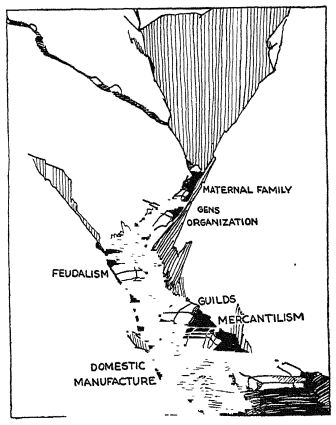
You have heard the names of some of them: gilds, domestic manufacture, maternal family, and feudahsm. If we could look into the future, we should certainly see new institutions being added while some of those we have to-day are being changed and even thrown away.
The heat of new ideals and ideas should be applied gradually. — Since change in our institutions is as certain as the rising of to-morrow’s sun, it is worth while to get a sensible attitude toward those changes. Take the Job of cleaning an ordinary drinking glass. If one suddenly pours boiling water into a cold glass the result is hkely to be a broken glass. The heat suddenly expands the inner surface of the glass, while the outer surface holds firm. A strain is developed, and if the strain is severe enough, the glass breaks.
[ p. 500 ]
There is no need of having such a break. If one begins with warm water and gradually increases the heat to the boiling point, the glass will be saved. There will be time for the heat to spread through the glass and expand the outer surface enough to relieve the strain. Boiling water, properly apphed, does not break a glass. It is the foolish sudden use of boihng water that sets up a strain and causes a break.
We have ahead of us a problem very like this case of cleaning a drinking glass. The “drinking glass, society,” needs cleaning, but we ought to use care in the cleaning. The outer surface of this glass is a fairly rigid mass of customs, beliefs, laws, and institutions. There are present, for example, private property, competition, certain ideals of family hfe, contract law, and a host of others. Although these institutions are fairly rigid, they can change. They can expand if a little time is given for the heat of the new ideals and new ideas to penetrate them. Let us, then, apply the heat of our ideals and ideas gradually. It is better to clean slowly than to have a shattered glass.
And, after all, the cleaning does not have to be overslow. It is true that in the past some of our institutions have changed quite slowly. The growth of the number of “things” and “rights” (see page 412) in the bundle of private property, for example, took centuries. But those wei’e the days of slowly changing customs. To-day, changes are much more rapid.
The glass was once broken in France. — The possibihty of a shattered glass is a real possibility. Many times and among many peoples, the framework of society has been shattered, and a long period of picking up the pieces and framing a new society had to be endured.
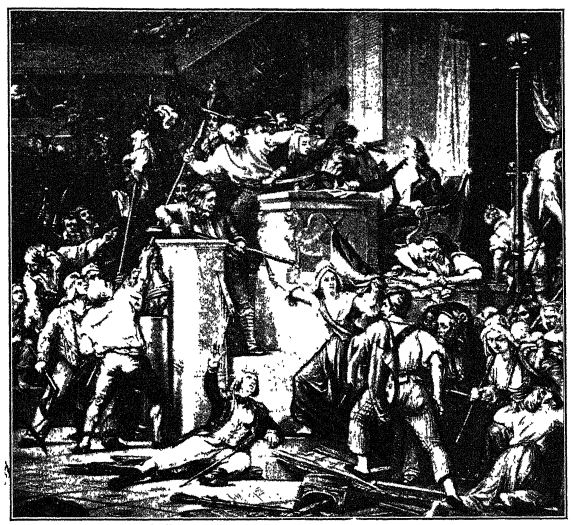
Rioters are in the convention hall demanding food
One such case was the French Revolution of 1789. The French nation of that time was full of evhs and oppression. [ p. 501 ] Arbitrary government, heavy taxation, depressed industry, terrible poverty, and brutal treatment of the ordinary man were the results of the long rule of the aristocrats. The glass needed cleaning. But those controlling the institutions that made up the outer surface refused to let them expand. The oppressed lost patience; and hot ideas of “hberty, equality, and fraternity” broke the glass. There followed scenes of bloodshed so terrible that the period is called “the reign of terror.” The craze that swept over the minds of the people [ p. 502 ] is illustrated by the fact that women took their knitting to the places of execution and put a knot in the knitting as each head fell into the basket of the guillotine. The craze of the revolution was followed by the dictatorship of Napoleon, and not until after 1815 did Europe begin to breathe regularly again.
Now, in the main, we beheve that the ideas behind this revolution were sound ideas. We are glad they triumphed. Our regret is that the stubbornness and selfishness of the ruling classes, together with the hot impatience of the reformers, caused the change to be made in such a cruel, wasteful way. The framework of the society could have been expanded gradually without undue strain. Instead, the break was brought on. It was a risky and perilous way of making progress.
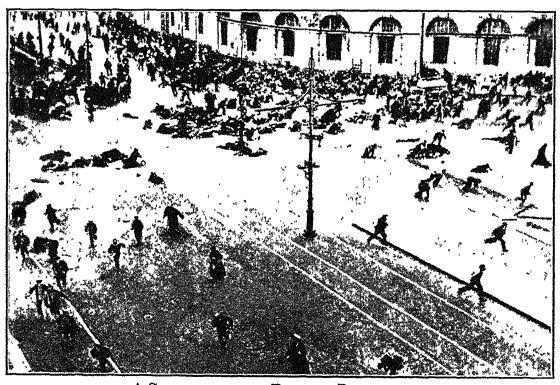
In this unusual picture the people in the streets are being slaughtered by machine guns located on the roof of the building shown.
The glass was broken in Russia. — Another case very like this is found in Europe to-day. In the Russia of 1917 the glass [ p. 503 ] needed cleaning. The autocratic rule of the Czar and the aristocrats had brought about eAuls like those in the France of an earlier century. Here, also, the outer surface was held rigid. Here, also, hot unrest would not wait. The result was a shattering of the framework of Russian society, with horrors worse than those of the French Revolution. The whole truth of what happened is not known. But it is known that thousands were executed; industry was disrupted; millions met death by starvation. We hope that, as in the case of France, the shattered pieces can be framed into a successful society. But it is too early yet to be sure. All we can be sure of is that such a break is a wasteful, risky, and perilous way of making progress. Man, after all these thousands of years, ought to have sense enough to find a better way.
How shall we make satisfactory progress? — Let us return to the cleaning of our own glass. It needs cleaning. How can we clean it without shattering it? Three things are needed.
1. We should not resist all change. — Let us not resist gradual expansion of the outer surface of the glass, if it can be shown that this expansion will be in the service of society. Fortunately, we have no ruling classes such as were the curse of France and Russia. Our officials are our servants. Unfortunately, we do have some stubborn persons who think, or pretend to think, that our institutions are permanent and unchanging and that anyone who talks of changing them is a sort of traitor-to society. That, of course, is such nonsense that it does not deserve a word in reply. All human progress shows it to be nonsense.
There are others who fear that if change gets started it will go too far. They fear that private property will be wiped out, competition abandoned, capital destroyed, expert opinion disregarded, madness enthroned. There is no good ground for such fear. Such extremes are sought by but a handful [ p. 504 ] who have failed to understand what multipliers of our powers have meant for human progress. The best way to discredit this handful is to stand ready and eager to modify our institutions whenever it can be shown that the change will help clean the glass — will be of service to society.
In other words the first needed thing is this : Let us be openminded and fearless about changes, asking only that it be shown that they will result in progress. One of the most dangerous members of our society to-day is the person who resists all change. He is helping to cause a strain that may result in a break.
2. We should not expect too rapid change. — Let those of us who wish changes made learn a lesson from the story of human progress. It is in the nature of the case that customs and laws and institutions change somewhat slowly. We know how our customs (which are fairly rigid) are handed on by our torchbearers. We know how our laws and institutions and ways of thinking have their roots down deep in these customs. (See page 430.) Let us give a little time for the heat of our new ideas and ideals to penetrate to the outer surface of the glass. No vital change that we could bring about would work well in a democracy unless the great mass of people had studied it, tested it, and made it a part of their thinking. Even in these busthng days we should not try to remake our institutions overnight. Another of the most dangerous members of our society to-day is the harebrained “reformer” who wants society at once to leap throughany hoop he happens to pick up. He is helping to cause a strain that may result in a break.
3. We should make our changes in orderly ways. — Let us all bear in mind one enormous difference between our case and that of former France and Russia. We have in the very framework of our society provision for making needed [ p. 505 ] changes according to the will of the people. If our federal and state constitutions need to be changed, there are in those very documents rules for making amendments. If some of our common law has outlived its usefulness, the legislature can remedy that by passing statute law. (See page 435.) If the position of the worker is too insecure, there is an orderly machinery for providing workingmen’s insurance, minimum wage, employment agencies, and what not. (See page 356.) If the gain spirit and competition and private property are failing to serve man and to multiply his powers as they should, there are orderly ways of making them do their duty. If our ideals have gone wrong, there are orderly ways of educating us to better ideals. (See Chapter XVII.)
The Congress, whenever two thirds of both Houses shall deem it oecessary, shall propose Amendments to this Constitution, or, on the Application of the Legislatures of two thirds of the several States, shall call a Convention for proposing Amendments, which, m either Case, shall be valid to all Intents and Putposes as Fart of this Constitution, when ratified by the Legislatures of three fourth of the several Sutes, or by Conventions m three fourths thereof, as the one or the other Mode of Katiiicatioa may be proposed by the Congress
How Our National Constitution May Be Amended
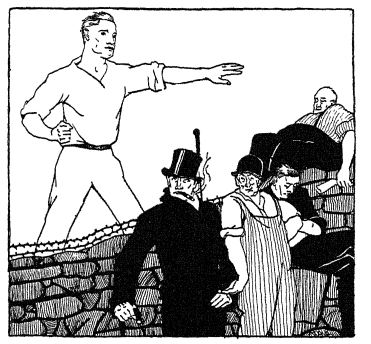
Of course, the orderly way is not always an easy way and it is not always a quick way. One difficulty is that we — even the reformers — are too lazy to undertake the hard study necessary to understand our social organization. It is far easier to talk of evils than it is to think out ways of removing the [ p. 506 ] evils without harming the rest of the organization. Another difficulty is that there really are forces which somewhat block the orderly way. The trust magnate tries to avoid being controlled; the grafting politician tries to prevent getting a better machinery of government; the lazj’-or stupid citizen hates to take the trouble to think about our living together well.
But, after all, if our hot ideals and ideas are “right,” reasonably good ways exist for carryingout the will of the people in an orderly way, and these ways can be made even better. Another of the most dangerous members of our society to-day is the fellow who is unwilling to use our orderly ways of making changes. It is far wiser to use them than to build up a strain that may cause a break.
In this whole matter of change in our social organization, we have great hope of the future. It is true that our social sciences are not as well developed as our other sciences. (See page 157.) But it is also true that we are making rapid progress in building up our economics, political science, sociology, geography, and history. We see ahead of us, if only dimly, the time when we shall cease to depend so much upon mere custom. We expect to stop “fumbling around” ; we expect to get scientific rules of action in dealing with our social institutions. We expect to rely less and less on age-long [ p. 507 ] practices and customs; and more and more upon intelligent public opinion and scientific knowledge.
1897 Child Labor Law enacted.
1897 Certain Safety Devices required.
1901 Child Labor Law strengthened.
1903 Child Labor Law improved.
1907 Factory Inspection Bureau set up. 1907 Safety and Industrial Health Law.
1907 Safety on construct-ion work required.
1908 State Examination of miners.
1909 Women’s hours limited in some trades.
1910 Safety work in coal mines.
1911 Furtlier limiting of women’s hours. 1911 Protection from occupational diseases. 1913 Improvement of Coal Miners’ Laws. 1913 Workingmen’s Compemsation Law.
Fifteen Years of Legislation Concerning Workers in One State
This shows that improvement can take place at a fairly rapid rate. It oufiht to be noticed, too, that some states have moved forward even more rapidly and that it is hardcT to make changes in our law than in some of our other institutions.
For the present, we might wisely be like the Greek philosopher Plato, of whom Emerson wrote: “One would say he had read the inscription on the gates of Busyrane, — Be bold; and on the second gate, — Be bold, be bold, and evermore be bold; and then had paused well at the third gate, — Be not too bold”
¶ E. Guidance by Ideals and Aspirations
(How well we shall live together depends upon whether we guide our social organization by good ideals and aspirations.)
There is no doubt that in social organization man has found another multiplier of his powers. Effective plans and w-ays of doing things are quite as important as tools to do them with. Specialization, the gain spirit, private property, government, law, and the other matters we have studied in Part IV, are as important as fire, the metals, power, machines, transportation devices, and all the other tangible, physical things discussed in Parts II and III,
That is all true. And it is equally true that all these devices may be used for either evil living or good living. Multiplication of powers may result in multiplied harm, or in multiplied benefits.
If our social organization is to result in better living together, wm shall need to be guided by ideals and aspirations. In the first place, each one of us wiU need to be guided by his owm personal ideals and aspirations concerning his proper part in our society. In the second place, the whole society will need to fix its eyes upon some goal or goals. There will be need of both individual and group ideals and aspirations.
Just what that means for our living together will form the subject matter of Part V,
[ p. 508 ]
¶ Problems
- Define or explain
- ( a ) Social organization
- ( b ) The monotony of specialization
- ( c ) The narrowness of specialization
- ( d ) Provincial thinking
- ( e ) Trade journal
- ( f ) Personnel department
- ( g ) Blue-sky laws
- ( h ) Monopoly profits
- “Our society is one of order”, not of chaos.” What does this mean? Is it true?
- Give illustrations other than those in the text of monotony of work because of specialization. If you do not know of any cases yourself, ask the older members of your family. Do the same with, respect to narrowness because of specialization.
- Why is it important in a society of specialists that each of us should find his right” place? Does that mean that there is just one right place for you, or could there be a good many?
- We turn people loose blindfolded and tell them to find their places.” Suppose you were to start to-day hunting your place. Are you blindfolded? Are there helpers to whom you can turn?
- Give illustrations other than those in the text of means for helping the individual find his place. If you do not know of any yourself, ask the older members of your family. Do the same with respect to means for helping to find the right place for property.
- Talk with others to see if you can learn of any business house that is managing its personnel in ways like those mentioned in the text, page 488.
- Find out how some of the older members of your family came to choose the occupations in which they are now engaged.
- Make a list of three or four occupations which you now think might attract you as life work. What preparation is needed for each?
- Look through to-day’s paper to see if you can find any suggestions that some person or group thinks another is not “playing fair ” in the game of life. Ask the older members of the family if they think anyone or any group is getting more than is deserved. Perhaps you can get these older members to read the section on the team spirit and living together well and to talk it over with you.
- A certain famous person once said: “I hate X.” “I didn’t think you knew X,” replied a friend. "Of course I don’t know him. I couldn’t [ p. 509 ] hate him if I did. One can’t hate a person he knows” was the answer. Why is it important, in our society, that one specialist shall come to understand something of the work of other specialists?
- “The newness of our ways of living together makes it hard to get good teamwork.” Why? What can be done about it? Is this book doing anything?
- Cite cases other than the ones given in the text where persons are engaged in stirring up distrust and suspicion. What do you think of such persons?
- Why must we find ways of controlling monopoly?
- Ought we to try to wipe out individual initiative? To wipe out the gain spirit?
- It is said that the people of New York to-day have poorer schools, poorer streets, and many other forms of living poorer because of the grafting done by Tweed’s gang in an earlier generation. Could this be true?
- Which expression seems to you descriptive of the political grafter: snake, wolf, buzzard, robber, good citizen, Judas Iscariot, traitor?
- “When one gains by harming society he harms you and me.” Why?
- What is meant by calling custom "unthinking” or "unplanned” social control? Name some forms of "planned” social control.
- What things in your school show that we are pa3dng attention to the social sciences and therefore to social organization?
- Why is the person who resists all change in our social organization a dangerous member of our society?
- Why is the person who wishes changes to be made very quickly a dangerous member of our society?
- Why is the person who is not content to have changes made in an orderly way a dangerous member of our society?
- “No vital change would work well in a democracy unless the great mass of the people had studied it, tested it, and made it a part of their thinking.” Why?
- “We ought to stop finding fault with our institutions.” “We ought to think of our institutions as being the result of past progress but as being something that can be improved.” “We ought to assume that all institutions are out of date.” With which of these three quotations do you agree?
- Answer the questions at the beginning of the chapter, page 479.
[ p. 510 ]
¶ Interesting Reading
Marshall: Readings in the Story of Human Progress, Chapter XVI.
- Improving Our IMarkei jMachinery (one example of how we im prove the knitting together of our specialists).
- Vocational Guidance (how one city school system handles this work).
- Wastes in Industry (some of the defects of our scheme of social organization) .
See also Chapters XII, XIII, XIV, and XV.
Problems to think over are given in these reading selections.
| XV. Social Control: the Nation and Government | Title page | XVII. Ideals, the Guides to Living Together Well |