[ p. 511 ]
PART V
MAN, THE IDEALIST AND ASPIRER PURPOSES OF PART V
- To discuss ideals and aspirations as another great factor of human progress.
- To discuss the ideals needed for our future living together well.
CHAPTER HEADING OF PART V
Chapter XVII. Ideals, the Guides to Living Together Well.
[ p. 512 ]
Did you ever hear of Frankenstein’s Monster? There is a story of how Frankenstein, a scientist, made a huge man-like thing and put the spark of life in it. It was very powerful; and the gruesome, frightful thing came to use its tremendous powers to kill and wreck. It finally destroyed itself.
This story has a lesson for us. Our civilization, thanks to science, has in it tremendous powers. But how are those powers to be used? Are they to be used to give us better and nobler lives? Or is our civilization with its giant powers, its vast mechanical devices, and its huge institutions some monster that we have brought into existence only to have it kill and wreck, — and finally destroy itself?
The answer rests with you. You will make our civilization either a blessing or a monster.
[ p. 513 ]
Chapter XVII.
IDEALS, THE GUIDES TO LIVING TOGETHER WELL
A. The Impoetance of Ideals and Aspieations
B. The Ideals and Aspirations of the Individual
C. The Ideals and Aspirations of the Group
D. What Does the Future Hold?
Questions to Keep in Mind while Reading This Chapteb
- Are ideals and aspirations worth having?
- As best we can judge, whatideals are most worth emphasizing to-day?
- Is there challenging work ahead of us?
As we think back over the story of human progress, it becomes clear that we have now studied three great factors or forces upon which that progress depends. We have seen in Part II that our progress depends upon our ability to harness nature, science being the greatest of all harnessers. Our progress also depends (see Part III) upon our ability to be good communicators. It also depends (see Part IV) upon our ability to be good social organizers, — upon our abihty to work cooperatively through many social institutions. There is a fourth factor, without which these other three would not enable us to live together well. This fourth factor, ideals and aspirations, is to furnish the subject matter of our study in Part V.
A. The Importance of Ideals and Aspirations (Ideals are basic to living together well: artists, research workers, and other standard bearers of ideals and aspirations.)
The importance of ideals as illustrated by the work of Jesus of Nazareth. — Nineteen hundred years ago the greatest [ p. 514 ] person of all time was carrying on His work. He w’as absolutely without “ influence ” or “ pull. ” His race was weak and despised; His family were humble craftsmen, — carpenters; His birthplace was a manger. A poorer start in hfe cannot easily be pictured. Then, too, when He grew up his work was not the kind that usually brings fame or power. He was not a warrior leading troops to battle; He was not a ruler of a nation. He was a teacher of ideals and aspirations.
But notice how great an influence these ideals and aspirations have had. His followers are so numerous that His teaching constitutes one of the four great religions (see page 321). The milhons of Christians acknowledge Him as their Lord and Master. His sayings (as best they can understand them and live up to them) set the one great standard of therr hopes and thoughts and acts. Even the peoples who reject him as a god (as do the Jews, Mohammedans, Buddhists, and others) think of Him as a great teacher, as a man who actually thought god-like thoughts, did god-like deeds, and spoke god-like words. He is one of a small number of really great forces that shape human history.
Such has been, and is, the influence of one set of ideals upon human progress. Surely, ideals and aspirations are multipliers of our powers. Or perhaps it is better to think of them as pointing the way to the best use of our other multipliers. “Man is an upward-looking animal,” said the ancient Greeks.
One writer’s list of the six greatest men in history includes only standard bearers of ideals and aspirations. — The work of Jesus is clearly one of the best illustrations we could find of the tremendous importance of ideals and aspirations. Since, however, many peoples think of Him as a god, let us take another illustration which shows the importance of the ideals of mere men.
[ p. 515 ]
Some time since, a well-known English wiiter was asked for a list of the six greatest characters in history — greatest in the sense that they had had great effect upon human progress. At the head of his list, he placed the penniless teacher of Nazareth. Next he named Buddha, another Jesus-like type of man, who also told the world of the sin and uselessness of selfishness. Then came the Greek scientist, Aristotle, who stood for scientific method (see page 168). “First of all, let’s get the facts,” he said. Again and again man, the harnesser of nature, has turned to that simple formula of progress. Akin to Aristotle’s work was that of the Enghshman, Roger Bacon, of the thirteenth century, whose cry “Experiment, experiment!” helped to rormd out scientific method and to “set men to thinking along new, fresh fines.” And there was Lincoln, who was placed in the fist because he stood for the best ideals and aspirations of America; for equal opportunity; for quiet faith in a government of the people, for the people, and by the people. Finally there was Asoka, Asiatic monarch of the third century, b.c. (see page 467) who harnessed nature, provided torchbearers, and tried to carry out the ideals of Buddha.
No doubt others would make a somewhat different list. I confess I should wish to make changes in it. But what a list it is! Only two were rulers; the rest were humble scientists and teachers. Even the two rulers were placed in the list, not because they were rulers, but because they were idealists and aspirers; because they served their fellow men. When one thinks how enduring their fame has been, as compared with the fame of conquerors and money grabbers, he begins to understand the saying of one our writers that many persons try to push their way into fame and fail; but a few rare persons forget themselves into fame. These rare souls are always standard bearers of man’s ideals and aspirations.
[ p. 516 ]
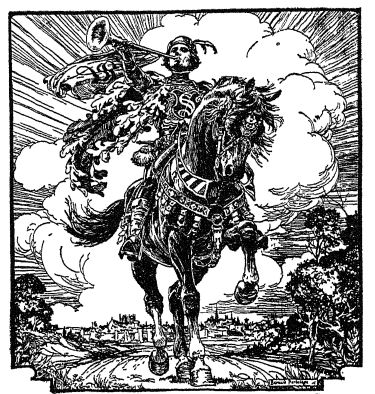
The Call to Service
Who are our standard bearers of ideals and inspirations? — Standard bearers of man’s ideals and aspirations! What a wonderful task that is! Who are these standard bearers?
As has just been said they include, among others, our truly great leaders who have had the rare power to forget themselves, and to pick out from our race experiences the simple truths that point the way to progress. In your study of history you will become able to add other names to the hst of six just given.
But these famous persons are merely the standard bearers who stand out a bit ahead of the rest of us. Every one of us who tries to do right, every business man who is square and honest, every faithful preacher, every teacher who teaches unselfishly and well, every doctor who cares most to serve his patients, — every one of us who tries to do right is a standard hearer of ideals and aspirations. Furthermore, every one of us is a member of various groups — the family, the church, the club, etc. — that are also standard bearers.
But let us think together, for a few paragraphs, of two sets of standard bearers of aspirations who are not always [ p. 517 ] thought of as standard bearers. They are artists and those engaged in research.
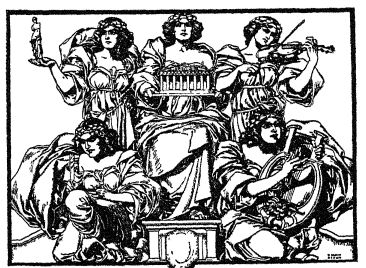
The Main Beanches of Aert
Can you tell what branch of art each figure represents?
The artist as a standard bearer of human aspirations. — Too often the word artist is used as meaning only those who draw or paint. In a better and broader sense, however, it includes these and also those who work in music, architecture, sculpture, and literature. Let us use it in this broader sense.
There can be no doubt that the work of the artist has great influence over us. Take music, for example. The great Chinese teacher Confucius, said,
“Desire ye to know whether a land is well governed and its people have good morals? Hear its music.” The German statesman, Bismarck, said that song was one of the chief agents in making a united nation of Germany in the last century. The myth of Orpheus being able to charm his way through the terrors of Hades by the use of music shows what the ancients thought of its power.
But we do not need to depend upon the opinions of others for our knowledge of the power of music. We know how the musicians of an army increase its fighting powers; how a passing band thrills us and tempts us to follow; how a song will stop a panic in a burning theater; how the mother’s lullaby soothes us when tired or ill; how the music at church seems the best and truest part of our worship; how the [ p. 518 ] singing at a school game seems our best expression of school loyalty. Music has very great influence over us.
What is true of music is Just as true of other forms of art. They all move us profoundly. Harriet Beecher Stowe’s book of the 1850’s, Uncle Tom’s Cabin, aroused so much feeling against slavery that Lincoln more than half meant what he said : “This is the little woman whose book caused this great war.” Two generations ago a series of cartoons by Nast in the New York magazines and newspapers did much to cause the people of that city to break the rule of a gang of corrupt politicians. The cathedrals of Europe have for centuries greatly moved thousands of worshippers. Every form of art has a great influence upon us.
The artist interprets life. — The reason for this great influence of art is very simple. The true artist forgets himself in his work and makes a sort of summary of man’s ideals and aspirations in a painting, a song, a drama, or what not. For example, what Harriet Beecher Stowe did was this. She looked beneath the surface of our living together in the 1850’s and gathered into her book a story that expressed the emotions and wishes and aspirations of her fellow men concerning slavery. She became a standard bearer of om aspirations in that matter.
Nast did a similar thing in his New York cartoons on graft. Every real artist does it. He sees greater, simpler truths than others do ; he sees them more clearly. He shows us duller persons our inmost dreams, joys, and aspirations; he explains us to ourselves, and he explains others to us. We ought, therefore, to think of a true artist as a standard bearer of oior aspirations who takes some method (painting, music, literature, etc.) of communicating to us the great truths he sees in Mfe.
The research worker as a standard bearer of man’s aspirations. — There is another worker who deserves to be placed [ p. 519 ] alongside the artist as a searcher for the great truths of life. He searches and searches. We call him, quite properly, the re-searcher.
Several times in this book we have crossed the trail of the worker in scientific research. In our story of man, the harnesser of nature, we saw him patiently building up the sciences basic to medicine, engineering, and agriculture. We saw him at work in the laboratories of our universities, our business houses, and research institutions. In our account of man, the communicator, we saw him building up the knowledge that will give us better and better means of communication. Then, too, he is at work in the social sciences, slowly gathering facts out of which we hope some day to get better ways of cooperating in organized society. In whatever field he works, he seeks just one thing, truth. In him man’s aspiration for truth and knowledge is at its highest.
Ideals are very real and very important. — We have taken this closer look at the artist and the research worker because they are rendering such good service that we should all undei’stand their work and should have a chance to think about such work as a life task. But no matter what we work at, we can all be standard bearers of ideals and aspirations. And there is no more important task in our society. Although we cannot feel or taste or see them, there are no things in fife more real than ideals and aspirations — no things more impoi’tant to our living together well. As we have studied the various multipliers of man’s powers, we have always found that mere multiplication is not enough. Greater powers may be used either for evil living or for living together well. A great need of our day is a set of ideals that will cause om great powers to be used for living together well.
Time after time we have seen that we need good ideals to guide us. Let us now add to the list of fourteen statements [ p. 520 ] given on pages 180, 333, and 481, concerning living together well, two more (numbers 15 and 16) that talk very definitely of the development of ideals and aspirations. We shall need to talk of two kinds: (1) individual ideals and aspirations, that guide you and me and every one of us, and (2) group ideals and aspirations that guide the actions of our various groups.
15. How well we shall live together depends upon whether we can hold fast to the good individual ideals of the past and at the same time build up needed individual ideals for the future.
In particular, we need to emphasize the ideal of service, and we need to carry our ideals over into impersonal situations. We shall see what that means in Section B (pages 620 to 528) of this chapter.
16. How well we shall live together depends upon whether we. can hold fast to the good group ideals of the past and at the same time build up needed group ideals for the future.
In particular, we need to emphasize the ideal of directing our energies to producing, generation after generation, an ever better man in all his aspects — harnesser, communicator, social organizer, and aspirer. We shall see what that means in Section C (pages 528 to 533) of this chapter.
¶ B. The Ideals and Aspikations of the Individual
(How well we shall live together depends upon our ability to develop better individual ideals of service.)
Individual ideals and aspirations develop readily in faceto-face groups. — Perhaps the main influence in forming a person’s ideals and aspirations is that of his little face-toface groups such as the family, the school, the church, the playground group, and the club. I shall not need to argue this point. Our study of torchbearers in Chapter X has quite prepared us to see that it is true.
[ p. 521 ]
If we go back to early men, when ideals and aspirations were in their early shaping, we can see the point even more clearly. Of course, the family was one of the very earliest groups and it is easy to see how ideals of love and service would grow up between mother and child. But let us pass by all the slow development of thousands of years and take a look at the face-to-face groups of neolithic man.
Take the Iroquois, again, as our example. An Iroquois lad, as he grew up, was a member of such face-to-face groups as these; the family, the gens, the village, the play groups, the hunting-party groups, the war-path groups. In all these he lived in a very intimate and personal way with a small number of other Iroquois. The ways that proved “right” became customs and developed into ideals of courage, hatred of enemies, patience in the chase, respect for elders, kindness and sacrifice for members of the group (but not for others), and loyalty. It was not hard for the individual Iroquois to hold fast to such ideals. In the first place, the group kept hammering them into him through the rule of custom. In the second place, his natural sympathetic feelings for those he met so frequently face to face led easily to such ideals.
Our society, however, has many groups that are large and impersonal. — To-day our face-to-face groups continue to be good places for the development of individual ideals of loyalty, patience, squareness, sacrifice, kindness, and service. But, as we have seen so many times in this book, in addition to being members of such face-to-face groups, we have become members of far larger groups — groups of a huge size never dreamed of by neolithic man — groups that do not meet face to face or day to day.
For example, we are members of a huge city or county, of a state, of a nation, even of a world society. We belong to a [ p. 522 ] trade-union or to an employers’ association having members in the United States and Canada, and relationships with similar groups in Europe. We belong to a church whose members are scattered all over the world. We are one of 50,000 stockholders scattered all over the United States if we own stock in one of our large corporations. If we chose, we could easily make a hst of fifty such huge groups and these fifty would be only examples of the hundreds that exist. The growth of knowledge, the wonderful developments in communication, and the great increase in our ability to organize to do things are the reasons why we have been able to form such large groups.
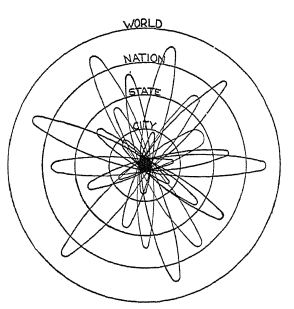
It must be clear that in these huge groups the members cannot have a personal interest in one another. Their relations are impersonal, rather than personal. It is therefore not so easy, in these large groups, to hold fast to individual ideals of loyalty, patience, squareness, sacrifice, kindness and service. Let us look at a few examples[1] of the way we live together to-day so that we may see how true this is.
The impersonal life of a large city is a good example. — Picture to yourself the life of a person in a small village. He knows and calls by name every man, woman, child, and dog he meets. He meets the same persons day after day in the [ p. 523 ] store, at social gatherings, at chui’ch, and at town elections. He knows all about everybody else; they know all about him. He would not think of doing anything that would harm his friends and neighbors.
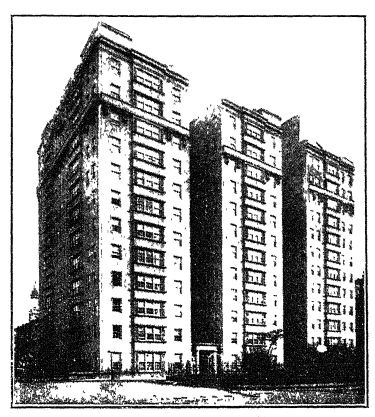
As many people live here as would be found in a large village, but most of tiiem remain strangers.
Follow this man as he moves from the village to a new home in a city. Perhaps he moves into a flat building in which twenty or thirty other families live. These families are strangers to him and are likely to remain strangers. He does not meet them in church or in the shop where he works or on the street. Everywhere he goes he sees new faces. Strangers jostle him on the ears and in stores; strangers manage the plant from wliich his water supply comes; strangers govern his city — strangers whom he may come to know by name but generally not by sight; strangers run the electric-light plant which furnishes his flat with light. He entrusts the teaching of his children to strangers. He depends on strangers to take care of him at the hospital if he is sick. He may never even see his milkman.
In other words, in our modern cities great masses of people [ p. 524 ] come together without taking a personal interest in one another. “There is no place so lonesome as the crowds of a great city” has become a common saying. Now, w’hen personal interest is lacking, we often neglect the rights of others. Persons who go from small communities to large cities often “go wrong” in various ways because they are no longer held by personal ties and friendships, and have not yet become clear enough about their duties to that vague thing we call “society” to keep them from doing harmful acts.
This lack of personal interest that exists everyivhere in our society affects the way persons act toward one another. In the old days, if a village carpenter knowingly put a piece of poor wood in a child’s swing and the swing broke and the child was hurt, the carpenter could hardly help feeling guilty. The result was that the carpenter was careful. But how about this case? A worker in a steel mill is careless and lets a poor lot of metal go through. This metal goes through other factories and is finally made into a defective wheel. Six months later this wheel bursts in a shop two thousand miles away and kills five workers. Will the responsible person have a guilty feeling? Probably he will never even hear of the accident. Even if he does, he has no way of knowing that the wheel was made from the poor metal that he turned out. Or take still another case. In a farmer’s house there is a case of scarlet fever. No one could imagine this farmer taking a neighbor’s child into the house so that the child might catch the fever. Yet this farmer might be careless in sending his milk to a city, and this milk might carry the fever to fifty strangers without the farmer’s ever knowing it.
There is need of extending our ideals to cover our impersonal ways of living. — To sum up what we have been talking about: In the old days the results of a person’s acts, whether good or bad, were almost always felt right in his [ p. 525 ] own little group. He and everybody else knew who was responsible. He had a personal interest in the results of hte acts for he saw those results working out among his friends. To-day, our world has been so knitted together that the consequences of one’s acts may be felt thousands of miles away, and our ways of doing things are such that there may be no way of finding out who is responsible. Even if someone could know he was responsible, he would not feel as badly over evil consequences to strangers two thousand miles away as he would over evil consequences to his friends or his family.
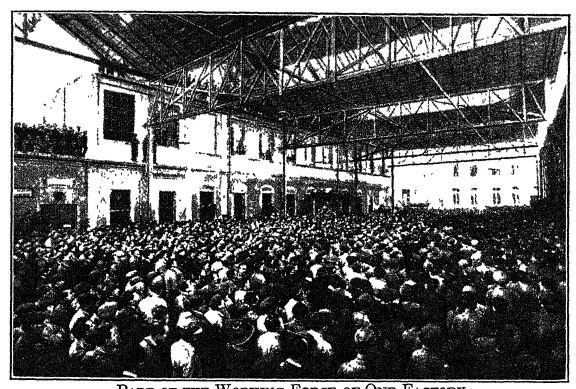
Relations between owners and workers must be somewhat impersonal in such a huge group.
What can be done about it? Clearly we cannot retxirn to the old ways of making goods and living together. We wish to keep the new ways, for they are very effective. But we must find means of avoiding the evils of these new ways. [ p. 526 ] One way to do this is to get good ideals to guide us in our acts. We must get everyone to understand how far the consequences of his acts may reach. Next, we must get everyone to feel anxious not to harm the members of this impersonal “society,” as he is to-day anxious not to harm his friends of his face-to-face groups. This is only another way of saying that we must extend our ideals so they can guide us in the impersonal ways of living together that have developed so fast in the last hundred years.
Good ideals of service are the ones needed. — I hope this does not sound vague. If it does, it can be said in another way. What we need is to become fiUed with the ideal of service.
We cannot stop to see what it would mean in each of our 7000 and more occupations if we all were filled with the ideal of service, but we can look at a few examples. The table on page 527 shows how differently four sets of persons act when the ideal of service — the professional spirit in our work — is regarded more highly than the promptings of the gain spirit. If we are to live together really well in the future, our individual ideals must come to guide us in some such way as this. Only thus can we work together cooperatively in pulling the load in our society.
Service, the path of true happiness. — It is worth pointing out, too, that only thus can we be truly happy and contented. Hear the story of Faust, in this connection.
The great poet, Goethe, gives us in his Favst the results of some sixty years of thinking over what things are really worth while in this fife. As the story runs, Faust was permitted to taste, one after another, the pleasures that so many men crave. He tried knowledge, riches, power, beauty — and on down the list. But he did not find any of them really satisfying. In his old age, he set about a task of draining lands and reclaiming them from the sea. He did this to show his command [ p. 527 ] of nature, but there came to him a sudden realization that he was providing a chance for millions of free people, still to come, to engage in noble labor. This realization that he was rendering service to others brought him, at last, his long sought Great Moment of perfect happiness.
“Then dared I hail the moment fleeting:
Ah, still delay — thou art so fair!”
The life of service in which self is forgotten, says Goethe, is the only one that brings true contentment.
| Examples of how one acts when ruled primarily by the gain spirit. | Examples of how one acts when ruled primarily by the professional spirit. | |
|---|---|---|
| A lawyer | “Anything to win a case.” Takes a case only if there are big fees. Helps crooks and grafters harm society if well paid for helping. | Expects to make a good living but only by serving society. As amxious to see justice done as to win a case. Will not help crooks and grafters in their plans. |
| A physician | Gives advice that will increase his fees. For enough money will provide harmful drugs. Not much interested in preventive medicine, for that reduces the amount of sickness. | Expects to make a good living through clean, honest service. Prevents all the sickness he can. Serves the , unfortunates who arc not able to pay him as carefully as he does the rich. |
| A manufacturer | “Anything to make money. WiU misrepresent goods. Will evade factory inspection laws. Will adulterate his products. Will be proud of unfair bargains made by shady methods. | Understands that he is a specialist making goods for society. Has pride in good quality. Expects to make money by methods that benefit society. |
| A merchant | “Anything to make money.” Will trick a customer if he thinks he will not get caught. Will be unfair in his competition with other merchants. | Realizes his job is important in society and does it cleanly and well. Will not stoop to unfair competition. Expects to make money by methods that benefit society. |
[ p. 528 ]
How well we shall live together depends upon whether we can hold fast to the good individual ideals and aspirations of the past and at the same time build up good individual ideals for the future. In particular, we need to emphasize the ideal of service.
¶ C. The Ideals and Aspirations of the Group
(How well we shall live together depends upon our ability to develop group ideals of producing ever better man.)
Important as it is to develop sound individual ideals of sertdce, that is only half of the story. It is equally important that our groups (and especially that large group we call society) should have good ideals — good lights to guide their way.
Groups have ideals and aspirations.[2] — Family ideals. — Groups have ideals just as truly as individuals have them. Twelve years ago an immigrant family from Rumania settled on a thirty-acre farm in southern Michigan. The ideal of this family is a good education for the children. It has meant hard work and the saving of every penny to carry out this ideal, but the group is succeeding. The brother and the older sister have gone through the local liigh school and they are now working their way through the State Agricultural College, where the boy is studying engineering and the girl, home economics. The younger sister, who is now in the high school, helps the father and mother with the farm during the winter months. During the summer they all raise fruit and vegetables for sale to near-by towns and to automobile tourists who drive by.
The fact that this family group has made up its mind that the children shall have as full access as possible to the stored [ p. 529 ] up knowledge of the race gives them a standard for Judging all their acts. Shall they take a pleasure trip? Not if it costs too much and will cut down the money for schooling. Shall the girl get a new dress? Upon the whole, the old one will do, and the boy’s books will be expensive this autumn. If some act will help the family realize its ideal, it is called good policy; if it will not, it is called bad policy. Each member of the family guides his conduct according to the effect it will have on the group ideal.
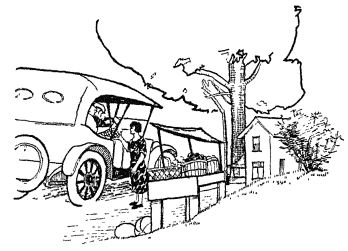
Communities have ideals. — Villages, cities, and other communities also try to work out munistic community described on page 378 has the ideal of living according to their understanding of the teachings of Jesus, and they have held to that ideal through several centuries. It has meant simple living; at times it has meant persecution by others. But they hold to their ideal. It is a standard by which they judge their acts.
A village in Illinois had, for several years, the goal of getting some railroad tracks elevated. One city kept in mind for years a plan of a “city beautiful” with parks, boulevards, statuary, and fine architecture. A certain township developed the ideal of sending all students who wished to go to a neighboring high school. Every community has had, at one time or another, fairly definite ideals and aspirations that have guided the conduct of its members.
[ p. 530 ]
Groups within cotmnuniiies have ideals. — As matter of fact, every group is certain to have ideals and aspirations of some sort. A trade-union group will have very definite ideals in mind; some employers’ associations will cling to quite different ideals. A chamber of commerce of a city will have one set of aspirations; they may be quite different, in part, from those of the American Farm B.ureau. Various engineering societies, as well as some associations of doctors and lawyers have even put their ideals in written form and think of them as rules of conduct or codes of ethics for their members. There arc literally thousands of groups in our society, and all of them h.ave more or less definite ideals or standards. As we have seen, the ideals of different groups are sometimes in conflict. That is not surprising in such a complex society as ours. The arguments and discussions of such groups are one way by which our public opinion on questions of the day is formed.
And there are national aspirations. — Nations, too, have ideals. In time of war or other gi’eat crisis, national ideals are likely to become quite definite and plain. At the time of our Revolution, for example, the colonists thought they [ p. 531 ] were not properly treated by the British government. They sought independence, and Patrick Henry’s famous utterance, “Give me liberty or give me death,” is a good expression of our ideal at that time. In the recent world war the statement of President Wilson, “The world must be made safe for democracy” set forth our national aspiration. The reason why war-time ideals can usually be made quite clear and plain is this: the war is usually about some fairly definite matter, and it is easy to direct the whole nation’s attention to the task that is to be done.
THE FOUNDATION of busmen is confi dence, which springs from integrity, fair deal mg, efficient service, and mutual benefit.
EQUITABLE CONSIDERATION is due in business alike to capital, management, cmploj"ees, and the public.
OBLIGATIONS to itself and society prompt business unceasingly to strive toward continuity of operation, bettering conditions of employment, and increasing the efficiency and opportunities of individual employees.
CONTRACTS and undertakings, written or oral, arc to be performed in letter and in spirit Changed conditions do not justify their cancellation without mutual consent.
WASTE in any form, — of capital, labor, services, materials, or natural resources, — is intolerable, and constant .cffoit will be made toward its elimination.
UNFAIR COMPETITION, embracing all acts characterized by bad faith, deception, fraud, or oppression, including commercial bribery, is wasteful, despicable, and a public wrong. Business will rely for its success on the excellence of its own service.
A Code, of Business Ethics
This is part of a report, made by a committee of the Chamber of Commerce of the United States.

This novel picture was printed in Franklin’s paper to urge the ideal of union upon the colonists.
It is much harder to state the ideals of a peace-time society. So many things are being done by so many groups in our rapidly changing society that it is quite natural we should hear many different versions of America’s ideals. Everyone has heard the following: “The square deal for everyone,” “Pair play,” “Equal rights for all and special privileges for none,” “Justice,” “Liberty,” “Democracy,” “Good faith,” “Life, liberty, and the pursuit of happiness,” to mention only a few of the more prominent. One trouble with many such statements is that we do not all agree on their meaning. For example, what seems to some laboring men to be a square deal and justice may appear to some employers as anything but square or just.
Our group ideal is to produce ever better MAN. — But, after all, these various ways of stating the aspirations of our society are not as different as they sound. In the main, they are just so many different paths that may be taken to arrive at one and the same place. It is something like climbing a mountain. If one wishes to see waterfalls, the best route is path number 1. If his taste runs to giant oaks, path number [ p. 532 ] 2 is his route. If he likes cliff climbing, there is nothing better than path 3. But all paths load to the top of the mountain eventually.
What is this one place to which all our group ideals load? What is the “mountain top” of our aspirations? It is the producing of ever better man in all his aspects — harnesser, communicator, social organizer, and aspirer. “The goal of all our activity is man, ever better man,” says one writer. “Just as every person should serve the group, so also should the group try to make the living together of its members better and better,” says another.
Now we cannot afford to be vague about the meaning of these fine phrases. If we are to follow their teachings we need to know exactly what those teachings are. Let us take the general statement: “Our group aspiration is that of producing ever better man in all his aspects — harnesser, communicator, social organizer, and aspirer.” Now let us run down through the Table of Contents of this book. Evidently the statement (see Part II) covers the aspirations of those who desire a further harnessing of natui’e: who advocate the wise use of our natural resources; who see the need of more and better capital goods; who deplore the waste of our human resources; who urge the fuller development of all forms of scientific knowledge. AU these aspirations are but parts of the larger aspiration, “the goal of all our activity is man.”
So also, the statement covers (see Part III) the aspirations of those who see the importance of ever-better communication. These persons want better language devices, flourishing trade, a good system of money, prosperous systems of coriimunication, good schools, good churches, and a free and independent press because these multiply men’s powers. They help in producing ever-better man. They make everyone’s Imng richer and nobler.
[ p. 533 ]
Again, the statement covers (see Part IV) the aspirations of those who desire better social organization and social institutions. Everyone desires the best use of specialization; of the market; of competition; of private property; of the gain spirit; of individual initiative; of democracy; of liberty; of justice; of law; of public opinion; of government. True, there is difference of opinion concerning what use is the best use. But that is largely difference of opinion concerning what path to take. There is no doubt in anyone’s mind that we wish to reach the top of the mountain. We all wish to use these devices as the means of producing ever-better MAN.
Such an ideal can be an effective guide to group action. — As we have said so many times, our ways of living together have been changing so rapidly in the last one hundred and fifty years that we are in a good deal of confusion. We are hke a sailing ship blown about by sudden and shifting winds; battered by ever changing seas ; pulled hither and thither by ocean currents. (These winds, seas, currents are our violent discussions of property rights, competition, justice, socialism, etc.). But fortunately we are like such a ship in another particular. We have a compass on board. We can, if we will, guide our course steadily in the direction of producing ever better M.4.N. If we do this, the batterings and flounderings and driftings will be but incidents of our voyage, for we shall come to port.
How well we shall live together depends upon whether we can hold fast to the good group ideals of the past, and at the same time build up needed group ideals for the future. In particular, we need to emphasize the ideal of directing our energies to producing, generation after generation, an ever better man in all his aspects — harnesser, communicator, social organizer, and aspirer.
[ p. 534 ]
¶ D. What Does the Future Hold?
(Our unsolved problems — a challenging; opportunity for each and every one of us )
Every careful business man who hopes to make a success of his business does two things. From time to time he makes a list, or inventory, of the goods he has on hand so that he can know exactly what resources he has; and he makes plans for the future. Of course, he can never feel entirely sure how his plans for the future will work out. The future is unknown and uncertain.
As we come to the close of our story of human progress, we are in much the position of such a business man. We have made a fairly careful inventory of man’s resources. We have, on occasion, tried to look into the future. What does the future hold?[3]
The older generation once thought it saw clear sailing ahead — but it is now uneasy. — I wish I could sit down with you and talk of that future. Since I cannot, I shall try to write of it in the same spirit in which I talk to my own children who are in the room with me as I write. Of course, I am not of your generation. I am of that older generation that has seen the most wonderful multiplication of man’s powers and activities the world has ever known. And I have studied and tried to understand such matters. In view of these facts, you might naturally suppose that I could make positive predictions about man’s future progress. But I cannot.
The truth of the matter is that we persons of the older generation are puzzled by what we so dimly see in the future. For a long time we thought everything was going wonder [ p. 535 ] fully well in our society. We were harnessing nature at top speed; we were living better than any other people had ever lived; our sciences were growing like magic ; we had developed wonderful individual initiative; we, in America, felt that our form of government was a model for liberty-loving people. In brief, we felt that, although man had had a long, slow, bitter climb for thousands of years, he had reached a place where an easier and more abundant future opened out before him, as a fertile countryside opens out before soTue one who climbs to the crest of a hill.
We are not now so satisfied wfith ourselves. We are uneasy. We see that evils like poverty, unemployment, bad government, crime, selfishness, graft, unfair competition, the conflicts between worker and employer, the wrong use of the gain spirit, and broken family life (and these are the merest beginnings of the list) remain in our midst, and sometimes even get worse. Perhaps the outbreak of the world war in 1914 and the terrible sufferings and disasters that followed were our greatest shock, for w’e saw that our social organization was a good deal more unsatisfactory than some of us had supposed.
We are passing our problems on to you with no solutions ready. — In other words, practically everyone of my generation would admit to you that we have not succeeded in solving our social problems. It may be that we are passing most of them on to you in quite as bad shape as we found them.
And practically everyone of my generation would admit to you that we do not know the answers to these problems — certainly not in any detail. We are ashamed of our ignorance. It does seem that we should have done better. Perhaps our minds have been too much in the grip of custom for us to be able to think clearly. Anyhow, there is no use pretending that we have found answers when we have not.
[ p. 536 ]
We have thought that certain solutions were promising. — We can, of course, tell you of some of the solutions we have regarded as most promising. That may help a bit.
1. The eugenics program. — Many of us feel that it is highly important to do all reasonable things to improve the human stock. This is called the eugenics program. The hope of this program is to build up a stroirger and abler race — one that can better bear the burdens of our complex civihzation.
Such a program deserves to be studied. But, of course, it is not all that is needed. And even without it we ought to do far better than we are doing. You may remember that some persons think we are not using more than three per cent of our present human resources wisely (see page 202).
2. The social reform program. — Many of us think a good deal of change is necessary in our social organization. But when it comes to saying just what these changes shall be, we are like the persons who were building the tower of Babel in the Bible story. A confusion of tongues is upon us. We cry “lo, here! ” “lo, there! ” and get relatively little done.
As I see it, the truth is that this older generation does not know enough about social institutions and social organization to hand you a nice little package of remedies. Our social sciences are just developing. We are just begiiming to imderstand how to live together well. That being true, we should proceed thoughtfully and carefully in making changes in our social organization. There is no possibility that the older generation can finish such a task. It will have to be handed on to you. For that matter there is no reason to suppose that the task ever will be finished as long as man continues to make progress.
3. The educational program. — Practically all of us believe that education is to be one of the important means of [ p. 537 ] solution. “Education” includes scientific research and then broadcasting knowledge through schools, churches, the press, business houses, clubs, classes and writings for adults, etc. This education is needed along all lines, but it is perhaps most needed in the field of the social sciences. But, of course, education is a slow process. It is too slow to enable the older generation to solve all the problems confronting us. Most of them will be handed on to you. Our best thought is that you will do well to work mightily at education. If you do, probably your generation will not need to make quite as shamefaced confessions as I am making to you.
4. The program of emphasis upon ideals. — Practically all of us believe that one of our great difiSiculties is a lack of clear ideals. We are so confused by the rapid changes in our society that we do not have ideals clearly in mind. How shall we get them? Some say, by turning more definitely to religion. Others say, by using education. Others say, by using these and any other devices we can lay our hands on, for it is highly important that we have something to steer by.
This development of ideals is also a slow process. Someone has well said, “The great loyalties of a people are a slow growth, like the oaks of the forest.” That being true, we would do well to cling to the good ideals of the past while new ones are shaping up. We cannot go wrong by emphasizing for individuals the ideal of service, and for our groups the ideal of ever-better man (see pages 620 to 533) . But even for these aspirations, details need to be worked out. My generation has a few years more of work in it, but it w’ill not do more than get started at the task. The task will be handed on to you.
No generation ever had a more glorious opportimity than yours. — You can readily see that we are passing on to you very heavy burdens and responsibilities. They are nothing [ p. 538 ] less than the safeguarding of o\ir civilization. Will you rise to the task? If you do ncji, quite likely there is terrible suffering ahead of the vorld. If you do, the chances are that all future history will look btick at your generation as one of the most wonderful periods in the entire story of human progress.
You probably have the greatest opportuiuty that any generation has ever known. Think back over our sketch of human progress. The worst of the grinding physical toil of man’s climb is behind us. Nature has been harnessed and can be harnessed far more effectively. With just a little sense used, we can live together well, as far as that aspect of our progress is concerned.
So also, man has become such an able communicator that he can work cooperatively in great societies, and even as a world group. Of course, great improvement will always be possible in this (as in any other) realm, but the hard part of man’s climb as a communicator is behind us.
This means that you can concentrate your attention and work mainly upon the other two aspects of man’s progress: man as a social organizer and man as an idealist and aspirer. In these two aspects, there is still hard chmbing ahead. But look at your equipment for this climbing! In the first place, you can be more free from worry about command over nature than could any earlier generation. In the second place, earlier generations have shown you how to make scientific studies and how to build up exact knowledge. That is like putting a saw, a square, a hammer, and nails into a carpenter’s hands. With such good tools he has a chance to do good work. In the third place, the character of the problem has been seen, — at least in its outlines. That is half of the battle.
In other words, we earlier generations have done the fumbling around as social organizers and aspirers. You have the chance to build fairly rapidly. You can build upon our work [ p. 539 ] and you can be guided by our mistakes. Bad as some of our mistakes have been, you will not need to tear down much of our work. You do not need to go through the agony of revolution.
And the future is safe in your keeping, if you think straight and fight hard. — Surely this means that you ought to be able to rise to your responsibilities, serious as they undoubtedly are. My own belief is strong that you will do so. I have entire confidence in the future of man’s progress as guided by you. I envy you the joy of your battle and achievement, for I know the furious battle will end in a glorious victory, — if you think straight and fight hard.
¶ Problems
- Define or explain :
Ideals
Artist
Professional spirit
Face-to-face groups
Individual ideals
Group ideals
Impersonal relations
Codes of ethics - “The really great man is one who forgets himself into fame.” What does that mean?
- Make as long a list as you can of persons (e.g. preacher, teacher, etc.) who are primarily standard bearers of ideals and aspirations.
- “Every one of us who tries to do right is a standard bearer of ideals and aspirations.” Show that this is true.
- Why is the work of the true artist very much worth while? Why is the work of the research worker worth while?
- Someone has said that the Lord’s Prayer is the work of an artist: that every sentence and idea in it was already in use in religious writings; that Jesus did an artist’s work in picking out the nuggets of gold and making them over into a statement highly expressive of man’s aspirations. Is that the land of tiring an artist does?
- How do you account for the fact that a good collection of ancient Egyptian art tells a great deal about the living of that people?
- “A great need of our day is artists who can tell us to what we are really aspiring. Every puzzled, bewildered people has great need of artists.” What does this mean? Is it true? [ p. 540 ]
- What reasons can you give for having work in art (in the broad sense of the word) in the school curriculum? Is the expenditure of public money for works of art and for instruction in art justifiable?
- Is a life career in art one that might be attractive? Why is it a good place in our society? JIow is a true artist helping to puli the load in our society? Answer the same questions in the ease of the research worker.
- “The discussions of our face-to-faec groups are often concerned with the ‘right thing to do’ or ‘ the fair thing’ and are therefore great developers of ideals.” Watch the discussions of some of our face-to-face groups to see if this is true.
- Why is it easier to have good ideals in face-to-face groups than in larger groups?
- Why is it harder to be governed by our ideals to-day than it was one hundred years ago? Is part of the difficulty due to the fact that it is harder to know what is the right thing to do?
- The Associated Advertising Clubs of the World fight a stern battle against falsehoods in advertisements. Show that they are helping to build up ethics and ideals in our impersonal world.
- Several organizations or associations of engineers, lawyers, doctors, etc., have printed little “Abodes of professional ethics” which are expected to govern their members. Show that they are helping to build up ethics and ideals in our impersonal world.
- A gang of rowdies broke a street lamp. One of them said that they had had fun and that nobody had been harmed. Show that lie was mistaken; that their actions caused a burden to society.
- It is said that it is easy for disputes between employer and employees to be more bitter to-day than was the case one hundred years ago. Give reasons why this may well be true.
- Are all of these persons wrongdoers?
a. A person who puts poor cork in life-preservers and sells them.
b. A person who picks your pocket.
c. A person who sells short measure.
d. The politician who grafts school money by arranging for a company in which he owns stock to repair buildings at a high figure.
e. The workman who puts poor material into the brake of an automobile he is repairing. [ p. 541 ]
f. The owLier of an unsanitary tenement house.
g. The newspaper editor who prints cheap personal items.
h. The manager of a corporation. - Look at the chart on page 527. Make out a similar chart for the policeman, the preacher, the grocer, the real estate man, the farmer, and the majmr.
- Talk mth your family to see what are the ideals of that group.
- Make a list of ideals that you think should govern you. Can you tell where any of them come from?
- Make a list of groups that have members in you community. Here is a start: some trade-union, boy scouts. Continue the list. Can you name an ideal of each group in your list? See if all of these ideals fit into the large ideal of “ever-better man.”
- Look on page 444 at the samples of groups that are trying to form public opinion. Clearly each group has ideals. As best you can judge, do these ideals all fit into the ideal of “ever-better man”?
- Ask some members of the older generation how they feel about the future of our civilization. Get them to read the section on what does the future hold” before they answer.
- Look in to-day’s paper. Find some thmgs that would not have happened if everyone were filled with the ideal of service.
- Show that there will be a great opportunity for leadership in your generation. What qualities will a leader in your generation need? Knowledge? Idealism? Anything else?
- Answer the questions at the beginning of the chapter, page 513.
¶ Interesting Reading
Marshall: Readmgs in the Story of Human Progress, Chapter XVII.
- The Development of Ideals and Aspirations (what wo owe to Greek, Roman, Jewish, and Teutonic cultures: later forces developing ideals).
- Michael Faraday (an example of devotion to scientific truth).
- Thomas Nast (an artist who was a standard bearer of ideals and aspirations) .
- Howard Taylor Ricketts (an example of devotion to the ideal of service) .
Problems to thinlv over are given in these reading selections.