| III. Fire and the Metals as Phases of Man’s Harnessing of Nature | Title page | V. Science: The Creative Stage of Man’s Harnessing of Nature |
[ p. 106 ]
CHAPTER IV
POWER AND THE MACHINE AS PHASES OF MAN’S HARNESSING OF NATURE
A. Man’s Conquest of Power Devices
B. The Power-driven Machine
Questions to Keep in Mind vtiile Reading This Chapter
- By what methods has man been able to harness power for his use?
- What is the modern machine? What is its composition?
- What has the power-driven machine meant for our living together?
In the last chapter we saw how man has multiplied his powers by becoming able to command fire and the metals. In this chapter we shall see how he has harnessed great forces of nature by means of the steam engine, the gas engine, and the electric motor. The forces thus harnessed are used to drive the millions of machines, great and small, now used for all sorts of work.
It is easy to see that our power engines are merely devices to harness forces of nature. In the steam engine we have harnessed the expansive power of steam and made it push pistons back and forth to do our bidding. We have done the same thing in the gas engine, in which the expansive force of an exploding gas moves the pistons. We have harnessed the “pull” of the magnet in our electric motors.
How we have done these remarkable things will become clear as we go on with our study. At this time, however, we can see that the multipliers which we are to study in this chapter — power engines and machines — were made possible by man’s earlier harnessing of fire and the metals. [ p. 107 ] Without the metals for our engines and motors we could not have any “harness” strong enough to hold the giant natural forces that have been tamed. Without fire we could not have the metals. Without fire we could not turn water into steam. Isn’t it interesting how, in man’s long climb upward, one multiplier has made possible another? That fact gives us great hope for the future. We hope that the multipliers we have to-day will give us many more multipliers in the future.
¶ A. Man’s Conquest of Power Devices
(How man Has Harnessed power with w:hich to drive his machines.)
Even neolithic man had power devices — Man began to harness powers outside himself as long ago as the time of neolithic man. We have already seen an illustration of this in his bow and arrow, for the bow was nothing but a device to propel his arrow by harnessing the springy force of the wood. At this same time, too, he began to use domesticated animals as beasts of burden. No one knows just how man turned wild animals into domesticated animals. Perhaps he followed herds of wild animals around in the hunt and gradually learned to fence them in valleys, so that they would be available for slaughter as he needed food. Perhaps, with this as a start, he next tamed them and kept herds both as a food supply and as beasts of burden. Or perhaps he began by carrying home from the hunt young animals, or wounded animals, or animals that had been caught in his traps, and the children played with them and tamed them. Perhaps some animals, such as the dog, hung about man’s shelter to pick up food and finally became tamed. And perhaps the domestication of animals came about through all of these and other ways combined.
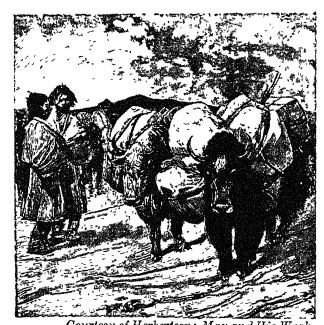
A Yak Caravan
Slow as these animals are, they are great aids to their owners because they arc able to carry heavy loads.
Whatever may have been the way or ways by which man learned to tame certain animals, there can be no doubt that [ p. 108 ] since the time of neolithic man he has used domesticated animals not only as sources of food supply but also as sources of power. Some tired hunter must early have found that the dog could bear a load upon its back, and one writer has suggested that the expression “to work like a dog” dates from that time. Man did not confine himself to the use of the dog. He has used quite a long list of animals as his beasts of burden and as his means of pulling or dragging loads. The horse was perhaps first used in Asia; the ass, in Egypt, although apparently it came to be more widely used in rougher regions, where its surefootedness made it a most valuable servant. The auroch was early tamed in Europe and used as a plow ox. The ox became man’s servant in Egypt; the humped ox, in India; the buffalo, in India and other far eastern regions. In Tibet there wms the long-haired Yak, which was well suited to the high, cold plateaus. In South America the llama and alpaca wei’e domesticated. In arctic regions man used the reindeer; in desert regions, the camel, whose ability to go for long periods without water was a most valuable asset; in various places, and especially in India, the elephant. All these and others were among man’s early powergivers. He used, of the animals nature gave him, those which were best fitted for his needs and could most readily be tamed.
[ p. 109 ]
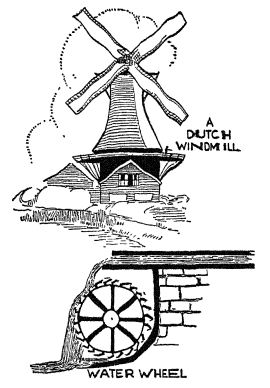
After animals the winds and waters were harnessed. — Presently man began to harness the winds and the waters. We do not know just what the beginnings were. We do know, however, that man very early learned to use sads to catch the winds to drive his boats. Of course, sails a-ie still used on our pleasure yachts and on a good many of our freight vessels. Much later man learned to harness the winds by means of the windmill. With it he groimd his grain, pumped his water, and did other work formerly done by his own hard toil. The windmill is still man’s servant, as many of our farmers can bear witness. Still later, man learned to harness the streams at rapids or at waterfalls by causing the water to run against the paddles of a great wheel. As this wheel revolved, it turned its axle, and the axle turned machines that did useful work.
Man had few power devices and machin es two hundred years ago. — Once maxi lad learned to tame animals and to command the winds and swift streams, hundreds and indeed thousands of years went by with only slow additions to his ability to harness the forces of nature. Prom time to time he added a few animals to his list of servants. Gradually he learned to make sails, windmills, and watermills of befter materials and in better shapes. But “multipliers” were sadly lacking.
How true this is may be seen from the pictures on page 110. They come from an old book which tells of the power devices [ p. 110 ] and machines available in 1750 a.d. These were little better or more numerous than those of ancient Greece or Rome. The author points out that a man with a rigging about his neck can carry as much by pushing a wheelbarrow before him as two can carry on their shoulders with a pole, or as two can carry by a hand barrow. He shows, too, that by using a lever one can move an even greater weight on rollers than on the wheelbarrow. He might well have shovm horses pulling a still heavier load on a wagon. In the background there is a crane used in unloading a ship. The old writer points out that this is a veiy useful device, “in which one, walking, draweth weights out of a ship or letteth them down into a ship.” Of course, horses also could be used for this purpose. In the foreground a man is winding a rope around a capstan. This pulls up a heavy weight, which is then allowed to fall and drive a pile into the ground.
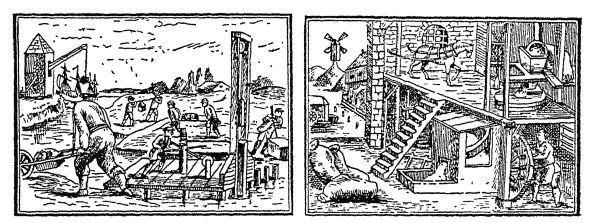
The left-hand picture shows various simple devices by which man was able to increase his powers. The riffht-hnnd picture shows that animals and the winds and the w'aters had been harnessed. How simple and primitive it all looks compared with our machines of to-day!
These were the more important* “simple machines” which man then used as aids in his heavy work. The other picture shows us something of the mechanical powers that were available. There is a mill in which one stone is placed above [ p. 111 ] another, the power being provided by the man on the first floor turning a wheel by hand. The picture of the horse shows (the illustration does not show just how the work was done) that horse power was also used for turning such a mill. Back of the wall a water wheel can be seen and still farther back, a windmill. At the side is a ship mill, the paddle wheels of which turn as the water rushes by.
As we look at these pictures of the power devices that man had down to 1750, we reahze how meager they were as compared with the giant engines and machines of to-day. We realize, too, that since 1750 man must have found many “multipliers.” Let us see what they were.
Two thousand years of speculation about steam. — We begin wdth the story of the steam engine. As a really useful instrument the steam engine is a thing of yesterday. It was, however, preceded by nearly two thousand years of wondering about steam and what it could do; of tinkering with its power without seeing how that power could serve us.
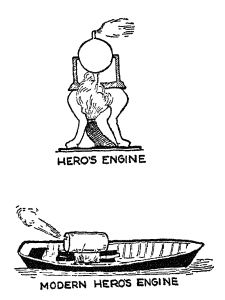
About 130 B.c. Hero of Alexandria made the so-called “aeolipile,” or “ball of the winds.” This, as the picture shows, was just a globe partly filled with water which could be heated and turned into steam. It had hollow, bent arms out of which the steam rushed. The kick, or reaction, of the steam caused the globe to"revolve. Many a boy to-day has used exactly the same idea by punching two or three holes in one end of a tin can, putting some water in it, and placing a fire under it on a board or a crude boat. When steam pours [ p. 112 ] from the holes, the boat moves as a result of the use of this “can of the winds.”
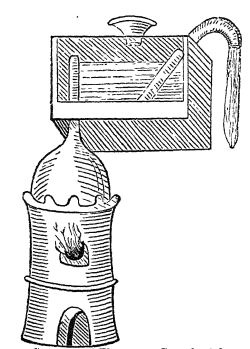
Porta’s “Engine,” 1601 a.d.
This crude picture is copied from Porta’s book. Above the furnace is a boiler, which reaches up into a box filled with water. The steam crowds into the box and forces the water out the pipe at the right. Steam does some work!
Hero’s “engine” was merely a toy of no practical use. If any similar toys were made later, we know little or nothing of them until about the year 1601 a.d. In that year an Italian, Porta, made a device for forcing water out of a tank by means of the expansive power of steam. This seems child’s play to us to-day, but it is interesting and important in the development of the history of the steam engine. It showed that men had come to understand that the expansive power of steam could he used to do work.
Porta’s “Engine,” 1601 a.d.
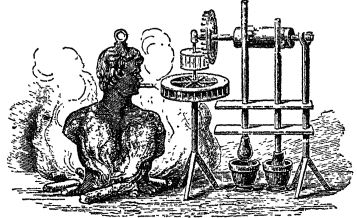
Branca's Engine, 1629 a.d.
Branca tells us that this device could be used for pounding drugs and for other purposes. Steam does work!
From this time on we hear of several steam devices, but we shall stop to study only one of them, the engine of the Italian, Branca. In 1629 Branca described an engine which, as the picture shows, was simply a jet of steam blowing against a flanged wheel. The steam made the wheel turn Just as swift water makes a water wheel go around. There is no [ p. 113 ] new idea in the Branca device. It used the kick of steam, and Hero did that centuries earlier in his “ball of the winds.” It is, by the way, exactly the same idea that is used today in the steam turbine engine, in which the force of a blast of steam is apphed to a series of flanged wheels. Isn’t it interesting that an idea which was used as early as 130 B.c. had to wait until 1884 A.D. before it gave us the steam turbine engine?
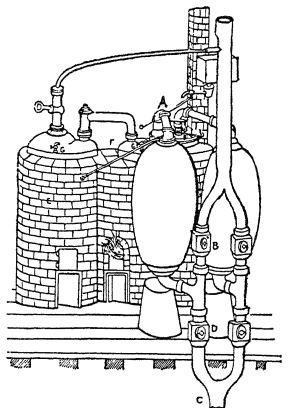
Savery’s Engine, 1698 a.d.
The brick work was a furnace and boiler. The stopcock A would be turned and steam let into the oval vessel. That stopcock would then be closed and cold water would be allowed to trickle over the outside of the vessel. By cooling the vessel in this way, the steam inside was condensed into water, and since 1,700 cubic feet of steam make only one cubic foot of water, there would be a partial vacuum in the oval vessel. The stopcock marked D would then be opened on a pipe C leading down into the water which was pumped out, and the weight of pressure of the outside air would cause this water to rush up into the vessel. This stopcock D on the down pipe would then be closed, the steam cock at A again opened, and the rush of steam into the vessel would force the water up the pipe leading up to the top of the mine. After this had occurred, the stopcock marked B on the up pipe would be closed, the steam would be condensed by having the water trickle over the vessel, and the whole proceas_would go on again.
Torricelli, Savery, Papin, and Newcomen gave us engines that worked. — Torricelli’s discoveries . — We come now to the time of really important happenings leading directly to our steam engine of to-day. The Itallan scientist, Torricelli (born 1608, died 1647), made what was then the amazing discovery that air had weight and that the weight or pressure of air was sufficient to “do work.” Everyone knows to-day that it is the weight or pressure of the outside air that causes mercury to rise to a height of thirty inches in a vacuum tube (a barometer) at sea level. Everyone [ p. 114 ] knows that it causes water, which is much lighter than mercury. to rise in a vacuum tube to the height of thirty-three feet, and that we make use of this fact in our suction pumps. But w’e know such things because of the studies of Torricelli and the long line of scientists since his day.
Savory’s air-pressure engine. — This power of the air to do work because of its weight was used in 1698 by Thomas Savery to make a water-raising engine. As can be seen from the picture on page 113, this engine had no pistons. It was simply a device that let the weight or pressure of outside air push water up into a vessel in which a vacuum had been made. This engine really worked. It was used not only in pumping water out of mines but also in supplying houses with water. Savery’s engines were, however, not very satisfactory. They were very slow, wasteful of fuel, and unsafe.
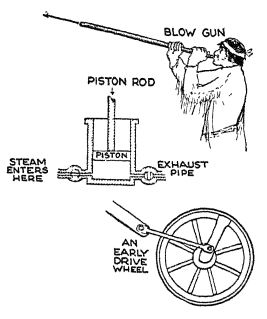
Papin’s piston. — The next step was for someone to invent a piston. This was done by one Dennis Papin, a French scientist, who, it happens, was also the inventor of the safety valve. There is notliing hard to understand about a cylinder and its piston. As is shown by the accompanying diagram, the piston fits closely inside the cylinder. There is a pipe through which the steam is fed into the cylinder, and its expansive power pushes the piston up. You can do exactly this same thing by taking a tube and putting in it a soft paper wad that fits fairly snugly. By blowing into the tube you can make the wad slide along to the other end. That is all there is to the piston, but man [ p. 115 ] had to be on the eai’th many thousands of years before he learned to use it in a steam engine, although very primitive savages used exactly the same principle when blowing poisoned arrows from a blowgun.
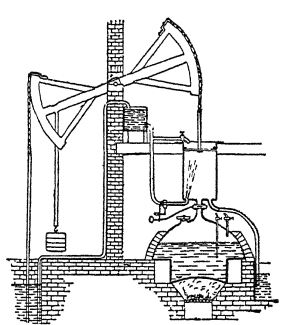
Newcomen’s Engine, 1705 a.d.
At the lower right-hand corner are the furnace and boiler leading up into the cyhnder. The picture shows a jet of cold water being thrown into the cylinder from its lower lefthand corner This will cause a vacuum and the weight of the outside air will push the piston down.
Newcomen’s air-pressure piston engine. — The next important step was taken by the Englishman, Newcomen, who, in 1705, made an engine which used the piston. Oddly enough, however, his engine did npt use the expansive power of steam. It used merely the pressure of air. The picture shows that Newcomen’s engine had a beam with a weight attached to one end. This weight would drop and pull the piston up to the top of the cylinder which you see below the other end of the beam. Steam would then be let into this cylinder from the boiler below and the stopcock turned off. A jet of cold water was then forced into the cylinder. This condensed the steam and made a vacuum in the cylinder. The pressure of the outside air forced the piston down and caused useful work to be done at the other end of the beam.
In this engine, as in all the earlier engines, these stopcocks were txirned by hand, and the process was a slow and awkward one. A bright but lazy boy, Humphrey Potter by name, who had been hired to open and close the cocks of one [ p. 116 ] of Newcomen’s engines, found a way to attach strings to the moving parts of the engine in such a way that these strings would open and shut the valves at the right time, and thus cause the engine to run itself more regularly, rapidly, and dependably. This made the engine “automatic” or “selfrunning.” All our modern engines are automatic.
Watt added the basic features of the modem steam engine. — The engine of Newcomen was so nearly the modern steam engine that it is hard to believe that fifty years had to go by before the next really great improvement was made. Such was, however, the case. The genius of James Watt (born 1736, died 1819) was needed.
Steam pushes the piston! — In the year 1763 a model of one of Newcomen’s engines was sent for repair to the University of Glasgow, where Watt was a mathematical instrument maker. He became very much interested in the machine and worked out many improvements. In 1782 he patented his great device — that of using the expansive power of steam to push the piston instead of depending upon the pressure of the outside air to do it. And in that same year he patented the so-called “double-action device, ” which means that the expansive power of steam was applied first to one side and then to the other side of the piston. He now had the essential features of the modern steam engine.
The importance of precision. — Watt is known as the father of the steam engine although, as we can easily see, he really built upon the work of the inventors who had gone before him. Watt had the great advantage of being both a scientific man and a very able mechanic. His scientific training enabled him to know what he ought to do. His mechanical skill enabled him to do it well and to make his engines really effective. This mechanical skill was far more important to him than it would be to an inventor to-day, for [ p. 117 ] in Watt’s time there were not many “instruments of precision” which made possible careful measurements and fine work. There were, furthermore, very few smiths who could make parts properly and fit them together as accurately as is needful in a steam engine.
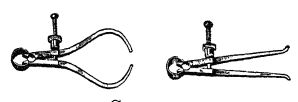
These are instruments of precision for meas cvlmders made possible the unng length. We have other instruments tor measuring weight, time, etc.
For example, Watt thought himself very fortunate if his cylinders came within three-eighths of an inch of being true cylinders. Automobile mechanics to-day work in terms of one-thousandth of an inch in their cylinders! It was a terrible task to get really good cylinders in Watt’s day. They were very expensive. It is perhaps not too much to say that the invention, in the late 1700’s, of a machine that would bore cylinders made possible the wide use of the steam en gine, since it enabled engine builders to get good cylinders at a reasonable cost. This shows us one reason why we are today able to build so many and such good machines. We have learned “to make machines to make machines.” They do their work more rapidly and more accurately than we could do it with hand tools.
The compound engine and the turbine. — The story of the later development of the steam engine is not a matter which greatly concerns us, but we ought to know of the compound engine. It was known, as far back as Watt’s time, that not all the “push” of the hot steam was used up in the cylinder. Various experiments were conducted, especially those of Woolf in 1804 and M’Naught in 1845, and as a result we have to-day the compound engine which lets out into a second (and even into a third) and larger cylinder, the steam that has done only a part of its work in the first [ p. 118 ] cylinder. This gives us the “double expansion” and the “triple expansion” engines. Since such engines get more work out of the steam, they save coal. They cost more, however, because of the cost of the added cylinders and the more complex mechanism.
We ought to know, too, of the turbine engine. As we have seen (see page 113), this engine runs because of the kick of jets of steam against flanged wheels. These engines cost a gi’eat deal to build, but they are very powerful for their size. They are, accordingly, quite useM in cases where there is not much space available. The really effective turbine steam engine is a very recent device. It dates from 1884.
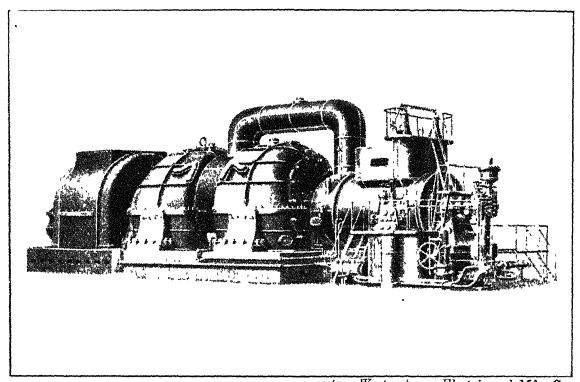
A Modern Turbine Engine
By noticing the ladders one gets some idea of the size of this giant.
Summary statement of the harnessing of steam. — Here is a summary of the stages of the harnessing of steam in the engine:
[ p. 119 ]
- Men learned that the expansive power of steam could do work.
- Men learned that the weight of air could do w’ork.
- Men learned that the weight of air would do its work on a piston in a cylinder.
- Men learned that the expansive power of steam would do its work on a piston in a cylinder.
- Men made and are making great improvements in the steam engine.
The gas engine and the electric motor came much later. — Once man had learned to use the “push” of steam to move pistons back and forth, it would seem easy to take a next step and use the “push” of an exploding gas for the same purpose and thus get the gas engine. As a matter of fact, man was a long time taking this step. Huygens, in 1680, exploded gunpowder in a cylinder fitted with a piston, and then cooled the cylinder and caused the outside air to “ do work” in Just the same way that it did work in Newcomen’s steam engine. This was a beginning. But it was not until about 1867 that our inventors gave us the gas engine in such form as to be a really useful servant. Its great development has taken place only in the last twenty-five years.
For our purposes the gas engine is just another device to harness natoe’s powers, and we do not need to study its mechanism in the way we worked through that of the steam engine. We need merely to recognize the fact that, in its own place, it is a useful device. It is used where relatively small amounts of power are needed, as in the automobile, in farm machinery, and in small factories. It is also used to furnish large amounts of power in our steel mills because the gas is secured so cheaply from the blast furnaces.
So, also, we do not need to work through the mechanism of the electric motor. The ideas behind the motor are very [ p. 120 ] simple, even if the machine is complex. The scientist Faraday, in 1831, discovered how to cause electrification cheaply and regularly by means of a machine. He found that when a wire is moved near a magnet, an electric current is started in that wire! That being true, he made a machine that -would move many wires past a magnet in an even, orderly manner. Each wire produced a little current. Added together, a good total w’as secured. That was our first dynamo, or machine for harnessing electricity.
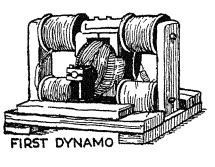
The next step (takeir much later) was to make the electric motor. Eventually it was discovered that if an electric current were turned into wires arranged in a certain wmy and placed near a magnet, those wires would “push themselves,” so to speak. That being true, if these wires were properly fastened on a cylinder, or “drum,” their push would cause the drum to revolve on its axis and do useful work. That is the simple idea concealed in the complex electric motor.
Although Faraday found out how to make an electric current by mechanical means in 1831, it -was not until fortytwo years later (in 1873) that -we found out how to run a motor by means of this electric current. Since that day progress has been rapid. Electricity is now “generated” at coal mines or at waterfalls and is transported over wires for scores of miles and then turned back into power by the motor. Its use in street railways, in terminals for steam railways, in factories, and in other ways is steadily increasing. It -will certainly play a great part in the power of the future. Many persons predict that the future is to be an “age of electricity.”
[ p. 121 ]
The use made of mechanical power to-day is tremendous. — Now that we know the kinds of modern power engines, let us inquire how much of this power is used to-day. What does it mean for our living together?
Meaning of horsepower. — When Watt was working with his engine, he tried to estimate the amount of work it did. Naturally enough, he compared its work with that of a horse. His study convinced him that a sturdy dray horse, pulhng a load along the street, did work equal to lifting 33,000 pounds one foot in one minute. He called this “one horsepower” and it has ever since been used as our power standard. When we say, therefore, that an engine has lOO horsepower, we mean that it is capable of doing this amount of work: it can lift 100 times 33,000 pounds (or 3,300,000 pounds) one foot every minute.
Figures too vast to have meaning. — No one knows exactly how many horsepower are available in the United States to-day in our steam engines, our gas engines, and our electric motors. The following estimates are probably too low, but at least they give us something to think about.
| Horsepower Used in Various Ways in the United States | |
|---|---|
| In manufacturing | 32,000,000 |
| In street railways | 5,000,000 |
| In electric light and power | 20,000,000 |
| In naval vessels | 11,000,000 |
| In merchant vessels | 45,000,000 |
| In locomotives | 70,000,000 |
| In automobiles | 250,000,000 |
| In miscellaneous ways | 2,000,000 |
| Total | 435,000,000 |
The total is 435,000,000 horsepower. Our minds can not grasp what is meant by 435,000,000. We get still less from the statement that this means that our mechanical powers [ p. 122 ] in the United States to-day could lift 14,355,000,000,000 pounds one foot every minute.
Let us translate these figures into terms which we can grasp. The number of gainfully employed persons in the United States is about 50,000,000. Our mechanical powers are equivalent to the use of 4,350,000,000 such persons. Our human workers are thus multiplied at least eightyfold by the use of mechanical slaves! Or put it another wmy. Every man, woman and child in the United States has forty mechanical slaves!
A review of the story of man’s harnessing of power. — Let us think back over this fairly long account of man’s harnessing of power and recall its main points.
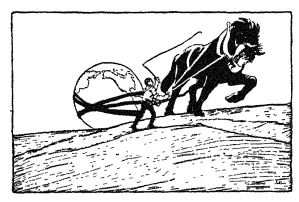
1. A long period of slow progress . — For thousands of years man made very slow progress in his power devices. Animals, the winds, the waters, the springy substances were practically the entire list from the time of neolithic man down to about 1750. Even after man learned that there was some kind of force in steam, two thousand years went by before there was a steam engine. Such facts put real meaning into the statement : ‘ Man’s progress has been a long, slow climb.”
2. Importance of science. — Although we have not yet studied the part that scientific knowledge plays in man’s harnessing of natoe, we begin to sense the fact that it is a very important part. A scientist proved that the weight of air can do work and thus pointed the way to the early engines. Other scientists showed how to make exact measurements and thus made possible “instruments of precision,” [ p. 123 ] and these made possible well-built machines. Faradayshowed how to generate an electric current. These are only a few samples of the aid that scientists have rendered.
3. Importance of multipliers. — We get a new sense of the importance of multipliers. One multiplier makes possible another: fire and the metals made possible the power engine. One multiplier multiplies another: the engine, by hauling loads and running machinery, enables us to make vastly more metal and so multiplies our metal. A multiplier may even multiply itself : a given machine may make other machines which will make more of the original machine I We harness nature and then drive her to harness herself! And we do it ever faster and faster. As a result we use to-day such quantities of power that the figures cease to have much meaning other than to produce a feeling [ p. 124 ] that we have greatly multiplied our control over natural forces.
The Modern Substitute for the Throwing-stick
4. The newness of it all. — It is ainaziing how short a time we have had our modern power devices. As a means of seeing more clearly how new our power devices are, let us make a chart similar to the one on page 84, using this heading:
Six Hundeed Years of Harnessing Power
Locate on this chart the more important events mentioned thus far in this chapter. Where do you find them in large groups?
¶ B. The Power-driven Machine
(What the machine is and what it has meant for our worldng and living together.)
We have talked a great deal of tools and power and machines. It is now worth our while to see just what a modern machine is, and how it is related to tools and to power. We can do this best by a series of illustrations.
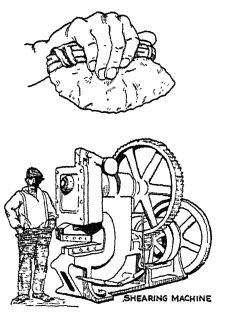
The machine is a tool set in a mechanism and driven by power. — Cutting machines. — On page 19 is a picture of the crude stone knife of Neanderthal man. He got it by breaking off a flake of flint. The sharp-cutting edge had to suffice as a knife. Here is a picture of the so-called “woman’s knife” of our American Indians, the knife of neolithic times. Neolithic man had learned to put a grip or haft on the knife. The knife that we use to-day is not greatly different except that our knife is made of steel. But now [ p. 125 ] notice what we have when we take this simple tool, the cuting knife, fit it into a big mechanism and apply power to it. We have a monster shearing machine. At one stroke it cuts down through a piece of steel many square inches in area.
Digging machines. — Take another case. On page 33 there is a picture of the digging stick of primitive man.
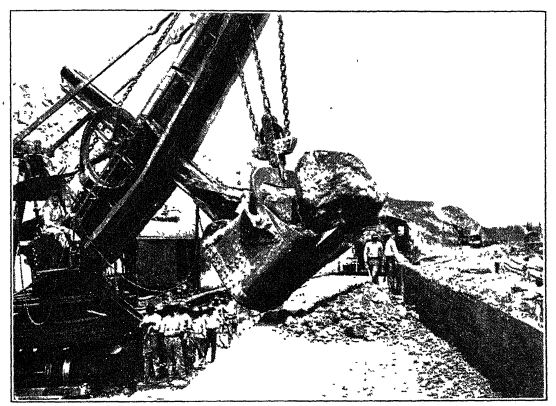
An idea of the size of this monster can be secured by noticing how it compares with the pictures of the men.
There is also a picture of a bone attached to a handle, the primitive hoe. We have all seen the hoes and shovels of to-day. Such a simple tool as the shovel, attached to a complex mechanism and driven by steam power, makes the huge steam shovel (above), which can handle four hundred cubic yards of material per hour. When this giant is used as an ore scoop, it will pick up ten to fifteen tons with as [ p. 126 ] much ease as jmu could scoop up a double handful of sand. It does the work of scores of men.
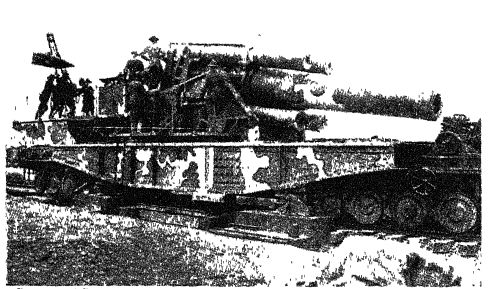
Throunng machines. — Let us look at another illustration. Neanderthal man could pick up a stone and hurl it at a foe or at some animal prey. On page 86 there is a picture of the throwing-stick of neolitliic man. If you have ever been in the country in the autumn, you may have seen a boy take a cornstalk three or four feet long, dig out a little hole in one side of the stalk near one end, insert a pebble, and then by means of this throwing-stick hurl the pebble several times the distance he could throw it by hand. But compare that with some huge machine of war which harnesses the expansive power of exploding gunpowder and hurls more than half a ton of metal a distance of twenty or thirty miles. Indeed, you may have read how, during the World War, smaller shells were thrown a distance of seventy miles.
Hammering machines. — On page 19 is a picture of a crude stone hammer used by Neanderthal man. He simply seized a suitable rock and pounded with it. On page 22 there is a picture of the hammer of neohthic man, which had a handle or haft. The carpenter’s hammer of today is not different in principle although it has been improved in its materials. But compare these with the modern steam hammer (the first steam hammer was patented in 1842), which strikes a blow of a hundred tons or of one hundreth of an oxmee, as its operator chooses. It does this under perfect control and does it automatically. The hammer has been set in a mechanism that is worked by power. The results are amazing.
[ p. 127 ]
Grinding machines. — On page 36 there are pictures of the mortar and the crude stone mill used by the Iroquois in grinding their meal. As time went on, man learned to make this tool of better materials, to set it in a mechanism, and to drive it by power. The result is the modern flour mill, making in a single day enough flom to fill 17,000 barrels.
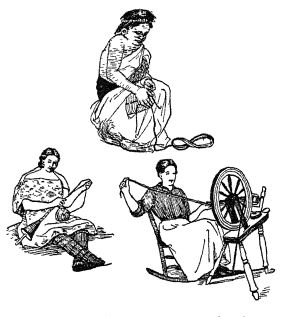
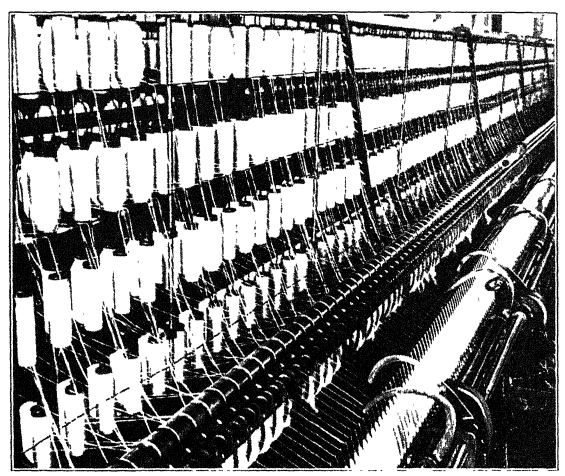
Spinning machines. — Or notice the picture of an Indian squaw rolling a thread between her hand and her knee. She could not make much thread in a day. Then look at the picture of the spindle, which is just a tool for twisting thread. Such a tool made it possible to turn out far more thread in a day. This same tool, as far as principle is concerned, has been attached to a complex mechanism and is now driven by power. On page 128 it is shown doing its work in a great modern factory. Hundreds of spindles are whirled in huge machines at the rate of 10,000 revolutions per minute. What a multiphcation of simple tools!
What the machine is . — From these illustrations we can readily see what a machine is, and why it is able to do its work so well. A machine is a tool (or many tools) set in a mechanism which is driven by power. It is a device for multipl 3 dng the use of simple tools. It multipUes the use of tools, in the first place, by holding far more of them than can be grasped by man’s hands. It multiphes their use, in the second place, by driving them far faster and with much more power than man’s arm possesses.
[ p. 128 ]
It is worth noticing that the simple tools which are set in our machines are not in their nature (but merely in their shapes and materials) different from the grinding tools, the perforating tools, and the various other tools described on page 85 when we were taking a peep into the tool chest of neohthic man. The spindle and the hammer are good illustrations of this fact. Great as our progress in the last hundred years has been, it nevertheless rests back upon’ the progress made thousands of years ago by early man!
The list of our gains from the machine is an impressive one. — If we were to make a list of the gains that have resulted from our use of the machine, it would run thus:
[ p. 129 ]
1. Immense power. — Our power machines (such as the engine) enable us to harness the expansive power of steam, the expansive power of a burning gas, and the power of electricity. They force these giants to do our work for us. When such giants do our bidding, we can produce more goods and better goods.
2. Rapid and tireless work. — Our machines can work steadily for long periods of time. And they can work more rapidly than can the human hand. They are tireless. Their wood and iron know no fatigue. They need no rest periods except for repairs and cleaning. The fact that they can work so continuously and so rapidly is another reason why they enable us to produce more of the goods we need.
3. Accurate and delicate work. — They enable us to do many kinds of fine and delicate work, which we could scarcely do without them. Since we can now build them so accurately, they work very precisely. The machine that set this type you are reading put the letters in line far more precisely and with much more accurate spacing between lines than you could print them with a pen. In watchmaking we use machines to make watch parts so small that the whole watch movement (which contams 150 different parts) can be covered by a dime. The parts are, furthermore, all perfect. This so-called ‘ ‘ iron monster ” — the machine — can work with an amazing delicacy of touch and can accordingly give us goods of excellent quality.
Men worked together very simply in the days before the power-driven machine. — The power-driven machine has had a great influence on the ways we work and live. We can see this more clearly if we go back only one hundred and fifty or one hundred and seventy-five years and see how people worked and lived when they had almost none of these [ p. 130 ] devices. We can do this by taking a snapshot of English life as it was before 1750.
Hand-tool manufacture. — On page 110 there are pictures of the power devices and simple machines that people then used. Wind-powez’, water-power, and horse-power devices are shown, but we need to remember that most of the power used was man-power and that the few machines of that day were very weak. Nearly all the work of that time was done by persons using tools, not machines.
Goods were not made in giant factories in those days. They were made in little workshops that were usually unoccupied rooms of the house in which the maker lived. The very word “manufacture,” which comes from the Latin words manus and facio and means “making by hand,” shows how things were made. The hats, knives, spurs, gloves, candles, clothes, and other goods of the day were made by hand with simple hand tools. The work was so simple that people “learned trades” by living and working for several years as apprentices in the family of one of these “manufacturers.” When the apprentice was sufficiently trained, he started just such a shop for himself and, perhaps, began to train other apprentices.
Simple small-scale conditions. — Of course, there were not in these simple workshops great numbers of persons working for wages, as is true in our factories of to-day. Commonly the “manufacturer” worked alone. He might have an apprentice or two. They did not get wages; they got training. Sometimes he had two or three “journeymen,” who did work for wages. In the main, the manufacturer owned his own tools and worked on goods which he himself owned and sold. He had few assistants, and most of these assistants were not wageworkers. They were apprentices who were learning the trade.
[ p. 131 ]
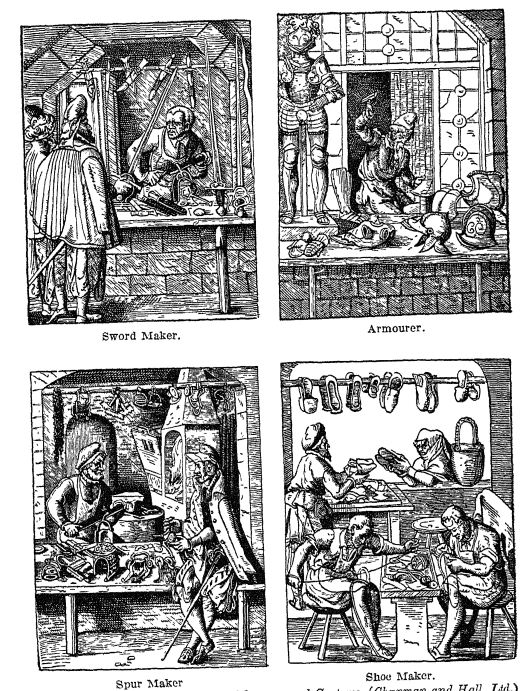
Manufacturing before 1750
These pictures, which are quite typical, show hand-tool work carried on in little ahops. Notice that the customers have come directly to the little shops. In how many cases does the “ manufacturer” have workers.
[ p. 132 ]
The goods were sold or marketed in an equally simple way. Most of them were sold to fellow townsmen. Quite conunonly the fellow townsmen came to the little shop, and the goods were "made to order.” Or the goods might be made and displayed for sale in the shop window (see the picture of the shoe maker) or in the town market place. It is true that some goods were sold to people of other towns. A few were sold to people of other countries. Most of the marketing, however, was done with neighbors and was of a simple, personal kind.
The society in which these people worked and lived was equally simple. It was a group life very unlike ours. If we think back over our account of man’s harnessing of nature, we remember that the houses of that day must have been small and wretchedly heated and lighted. If the streets were paved at all, they were paved with rough cobblestones. There could have been no matches, gas lights, electric lights, waterworks, railroads, street cars, steam engines, high buildings, big stores, moving pictures, or many other things which make up such a large part of our city life to-day. It was a simple, humdrum existence.
Since 1750 great changes have occurred in our working and living together. — This quiet life was very quickly and very greatly changed. Let us make a list of certain happenings, asking ourselves AA’hy each event meant a great deal in our harnessing of nature and in changing our ways of working and living together. Let us think of each event in the following list as one the meaning of which we are to explain.
1. Metals. — Between 1739 and 1762 men learned to use coke and anthracite coal for smelting iron ore. What did this mean in our mastery of metals? What would increased mastery of metals mean in our working and living together?
[ p. 133 ]
2. Power. — Between 1769 and 1784 Watt learned to make a steam engine that worked well. What did this mean in our working and living together?
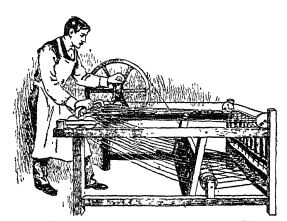
Hargreaves’ Spinning Jenny
Compare this with modern spinning as shown on page 128
Whitney’s Cotton Gin
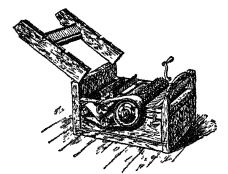
3. Machines. — Between 1764 and 1792 man learned to make cloth by machinery instead of tools. For example, in 1764 Hargreaves made a machine that would spin eight threads at a time. Others made machines that would spin many more than eight at a time and do it very rapidly. In 1785-9 Cartwright made a loom (a machine for weaving cloth from threads) that was driven by water power. Of course, it was not hard to see that the steam engine could also drive looms. In 1792 Whitney invented the cotton gin, a machine that took seeds out of raw cotton pods very rapidly and so furnished the great quantities of cotton needed for machine spinning. These are only samples. What would they mean for cloth making? Could people make more cloth? Better cloth? Would these machines need larger places to work in little workshops? Would they cost so much that not everyone could afford to buy them? Would those who could not afford to buy the machines probably work for those who could afford to buy them?
[ p. 134 ]
In thinking about the changes that were taking place in our living, we need to remember that this introduction of machines into cloth making is just one illustration of what was taking place in all industries. The “machine age” was coming in.
4. Transportation. — Between 1750 and 1830 we greatly increased our ability to move ourselves and our goods about. Great improvements were made in canals and in roads. Then, in 1807 Fulton gave us the steamboat. In 1819 the first steamship crossed the Atlantic. In 1825-29 the first steam railroad was built. We shall hear more of these and other communicating devices in Part III, but even now’ we can see something of what they mean to us. In what w’ays do they let people move about to other lands more freely? What things can you name which you probably would not be able to eat or to wear except for such devices? In w’hat ways have they helped to bring together and to feed in great cities the thousands of w’orkers employed in our factories? Do these workers use them?
5. Scientific knowledge. — From 1700 on, great advances took place in physics, chemistry, and our other sciences. After 1830 and especially after 1860, we set up schools for training mining engineers, electrical engineers, chemical engineers, mechanical engineers, and a host of others. Without waiting to read about them in Chapter V, can you tell some of the ways these engineers affect our working and living together?
It is quite clear that since 1750 great changes have taken place in our working and living together. Before 1750 was the tool age. After 1750 is the power-driven-machine age. Most of the things we use have been made, wholly or in part, by machines. Can you name even one thing you use which has not been touched by a machine? Can you name many?
[ p. 135 ]
As time has gone on, an increasingly large part of our goods is made in giant factories employing great numbers of workers. True, many small factories still exist and will continue to exist, but they make only a small part of our goods. For example, in 1920, 3.6% of our 290,000 factories made nearly 68% of the total product; 20.6% of our 290,000 factories made nearly 92.6% of the total product. All the rest of them (nearly 80%) were so small that they made only 7.4% of the total product. In other words, more than nine tenths of our manufactured goods are made in large plants. How different this is from the situation before 1750 when everything was made in small shops!
The great changes we have described are a part of the Industrial Revolution. — We have come to call the period since 1750 in which these great changes (and others which we have not mentioned) have been taking place, the period of the Industrial Revolution. We call it this, because in a short time such great changes took place in working and living together that it seems a very different world — a revolutionized world.
As a means of seeing how rapidly the changes came about, let us make another chart similar to the one on page 84, giving it this heading:
¶ Six Hundred Years of the Power-driven Machine
Locate on this chart the more important events mentioned on pages 124 to 134. Is it not clear that many important events took place fairly rapidly? Did we need six hundred years in this chart?
Let us now make a table which will review these changes and show that they were great changes. We shall have the table deal only with town life and with manufacturing. Parts of the table are left blank for you to fill in.
[ p. 136 ]
| Some Conditions bedore the Industrial Revolution | Some Conditions To-day | |
|---|---|---|
| Where were the goods made? | In small shops; generally in the home. | In great factories. We call it large-scale production. |
| Did people work in groups at making things? | ||
| Did workers use tools or machines? | ||
| How did people learn to make things? | By the apprentice system. There were no public schools. | In public schools and sometimes in schools run by employers. Apprenticeship not greatly used. |
| Where ere goods sold? | Mostly to people of the same town. | All over the world. We say there is a world market’ to-day. We get goods from everywhere. |
| Did most people work for wages for others? | ||
| Did the workers own their tools? | Generally, yes. We must remember that the manufacturer was usually also the worker! | Sometime’s, but. not often. The tools to-day are set in very expensive machines. |
| Did the worker own the finished goods? | ||
| Did the worker generally expect to be a manufacturer sometime? | Yes. Apprenticeship was long, but once a person became skilled there were few expenses in starting his own business. | He has some opportunity to do so but most workers do not expect to do so. [ p. 137 ] |
| Did people move about much? Did they know much of the rest of the world? | Very little. A seventhgrade boy or girl of today knows vastly more about the outside world than an old person of that day knew. | Very much. Are not our relatives usually scattered? Do we not have immigration? Do we not find geography and history of other peoples important? |
| What did a town look like? | Small houses, wretched streets. Towns were usually so small that the ‘‘manufacturers” often tilled land outside the town. | |
| How would a city look after dark? | ||
| Would there be crowds of people on the streets going to work in the morning and returning at night? | ||
| Would parts of the town have clouds of smoke from factories? | ||
Did this chapter justify its heading? — The heading of this chapter was “Power and the Machine as Phases of Man’s Harnessing of Nature” (fire and the metals were discussed in the preceding chapter). Is it not clear that man ig harnessing nature when he uses power and machines? Is it not clear that we harness nature to-day vastly more than did primitive man? Is it not clear that we are able to live better as a result? Is it not clear that we have become good harnessers of nature so very recently that probably we are just beginning to be good harnessers? Is it not clear that one thing our schools are trying to do is to make us good harnessers of nature?
[ p. 138 ]
¶ Problems
- Define or explain:
Air pressure, Turbine
Automatic, Safety valve
Natural environment, Piston
Multipliers of man’s powers, Instruments of precision
Gang, or group, labor, Industrial Revolution - Give some illustrations of the use to>day of domestic animals for power; of the use of the winds; of water.
- Notice some big locomotive. Where is the power supplied? What is the power? Where is the piston? What illustrations can you see in the engine of the need of very precise work? If a neolithic man could suddenly see one, would he think it was magic”?
- Different peoples at different times have held slaves. Is slavery a device for harnessing power? Does it increase the total power available or merely determine who shall command existing power?
- If we were to build the pyramids to-day, what devices should we use?
- Savery’s engine could draw water up only about twenty feet instead of the thirty-three feet mentioned on page 114. Why? All these early engines were ineffective compared with the same kind of engine if we were to build one to-day. Why?
- Write out a paragraph telling what Watt contributed to the steam engine.
- “The machine to-day is a tool plus other things.” What other things?
- Why cannot as large quantities of goods be made with hand tools as with machines? Are hand-made goods always better than machinemade goods?
- Look again at the pictures showing the power devices and machines of the 1700’s (page 110). Take each device and mention sometlhng we have to-day that makes the old one seem puny and feeble.
- “We make machines to make machines to make machines to make goods we desire.” Why is that worth while? Why go at it in such a roundabout way? Why not go directly at making the goods?
- “Machines not only make more machines; they make better machines than can be made without them.” Why?
- Can you name any power devices and machines that you use when you play? When you are on your way to play?
- Can you name any machines that help us enjoy our leisure time? [ p. 139 ]
- It costs a great deal more to build a factory and start it running than it used to cost to start a simple workshop. Prove that this is true.
- Take any article of food on your dinner table and talk over with your parents the extent to which it is a result of power and machinery.
- “One doesn’t really understand what it means to get a drink from a faucet until he realizes how much nature had to be harnessed before it was possible.” In what ways did fire help? Metals? Power? Machinery?
- “One doesn’t really understand what it means to switch on an electric light until he realizes how much nature had to be harnessed before it was possible.” In what ways did fire help? Metals? Power? Machinery?
- In how many cases do you know who made the different articles you are wearing? Would a person living in 1700 know in more cases than you?
- Find out how many of the articles in your home are made in factories. Are your clothes so made? Your shoes?
- Write out a paragraph telling what the steam engine has meant to the way goods are made.
- How many uses can you name for the gas engine to-day?
- “The machine is a device for multiplying the use of simple tools.” Illustrate.
- Someone has said that an inventor usually makes merely some minor addition to things that have been worked out before. Does this seem true to you? If true, does it mean that the work of inventors is unimportant?
- “We build upon the progress of the past.” Give four illustrations of this from our account of man’s harnessing of nature.
- “Man’s progress has been a long, slow climb, but apparently he is now getting on ground where he can run.” What docs this mean? Is it true? What illustrations can you give that the earlier climb was slow?
- What studies in your school deal with any part of the problem of harnessing nature? Does mathematics? Show that it helps to make possible instruments of precision.
- Recently a man who had been in a penitentiary for thirty years was freed. The story runs that he was taken through one of our cities and that he was terribly frightened. He could not judge how fast automobiles and street cars were running and had several narrow escapes. Do you see how this might well be true? Does it show how our living conditions are changing?
- Amuse yourself by imagining what surprises you could spring on a Rip Van Winkle who went to sleep in 1870 and just woke up to-day. What are some of the things you could do to him? [ p. 140 ]
- On page 119 there is a statement of certain stages in our harnessing of steam. By what date had each stage been reached?
- Make the charts mentioned on pages 123 and 135.
- Answer the questions at the beginning of this chapter, page 105.
¶ Interesting Reading
Marshall: Readings in the Story of Human Progress, Chapter IV.
- Effect of Machinery upon Rural Life (what the power-driven ma chine has meant for country dwellers) .
- Inventions and Patents (what the government does to encourage inventions) .
- Thomas Alva Edison (a glimpse of an inventor at work) .
See also:
Chapter III, 2. The Manufacture and Use of Artificial Gas (one of man’s invisible servants).
Chapter VI, 2. Petroleum and Its Uses (what one natural resource means to us : the need of conservation) .
Chapter VIII, 3. The Mastery of the Air (a quite recent chapter in the story of man’s conquest of distance).
Chapter X, 1. The Story of Paper Making (how paper is made; the enormous quantity used).
Chapter XII, 1. Colonial Cloth Making and a Modern Factory (an example of the growth of specialization).
Chapter XII, 2. Canning Corn (an example of specialists working to supply our food).
Problems to think over are given in these reading selections.
| III. Fire and the Metals as Phases of Man’s Harnessing of Nature | Title page | V. Science: The Creative Stage of Man’s Harnessing of Nature |