| IV. Power and the Machine as Phases of Man’S Harnessing of Nature | Title page | VI. Harnessing Nature and Living Together Well |
[ p. 141 ]
CHAPTER V
SCIENCE, THE CREATIVE STAGE OF MAN’S HARNESSING OF NATURE
A. Science: Man’s Greatest Tool
B. Man on the Highway of Progress
Questions to Keep in Mind while Reading This Chapter
- How does scientific knowledge increase man’s powers over nature?
- How did man get this scientific knowledge? How has it developed and of what is it composed?
In our study thus far it has been said that scientific knowledge is the greatest of all harnessers, but we have not stopped to see what that means or why it is true. Those are the tasks of this present chapter. This does not mean that the chapter is to be a textbook in science. By no means. A study of the laws of the various sciences is worth far more time than that. You will wish to spend years at it. All we shall do in this chapter is to see science as a servant of man; to see it as a tool — a thinking tool — which man finds tremendously useful.
¶ A. Science: Man’s Greatest Tool
(What science is and why it is the greatest of all harnessers.)
Two stages in the development and use of knowledge illustrated. — When I was a country lad of twelve, the state, as a means of protecting crops, offered a reward of ten cents for each ground-hog scalp turned in at the county courthouse. My father gave me a .22 rifle and told me that I could keep any money I got from ground-hog scalps. This [ p. 142 ] was a task to a boy’s liking. It is not surprising that I became a good marksman.
One day, while walking along a river which flowed through our farm, I saw some fish swimming. At that time the shooting of fish was not forbidden by the game laws of the state, so I tried to shoot some. I was not able to get a single fish. I tried again and again on succeeding days, using various schemes in my shooting, but I got veiy few fish. Happening to mention my diflSculties to my father, he said, “Of course; you must aim below a fish in the water in order to hit it.” When I asked him why, he could give me no reason. He simply said that he knew that it was true, that he had been told that was the way to shoot fish, that he had tried it, and that it worked. I went back to the river with this rule in mind, and, sure enough, it worked.
1. The trial and error stage. — Quite without knowing it, I had illustrated in my fish shooting two stages, or steps, in the development and use of knowledge. The first stage is the trial and error stage which is “a groping after something by trying everything.” One tries and tries various things. Some “work,” or “are right”; others “do not work,” or “are wrong.” Perhaps you have seen a boy trying to put a wireless set together by such methods. You have almost certainly seen a baby trjdng to fit puzzle blocks together by “trying everything.” That was the stage I was in befoi’e I talked with my father.
2. The rule of thumb stage. — This first stage is followed by a second stage in which one comes to use “rules” based on the ways that “work,” without knowing why they work. We say that such rules are rules of thumb. Perhaps if I had kept at the job of shooting fish I should have stumbled upon the fact that I needed to shoot below them. Others had done so and had passed that rule on to my father. He passed [ p. 143 ] it on to me. But neither of us knew “the why” of it. We merely shot fish by rule of thumb.
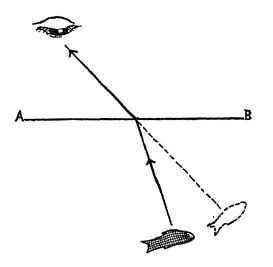
Two more stages in the development and use of knowledge illustrated. — A few years later I studied physics at the high school in the neighboring city, and one of my textbooks talked of this very problem of shooting fish! In the book the problem was worked out by men of science who had found the “why” of it. Scientists had discovered, after much study and experimentation, that when a ray of light goes on a slant from one body (like the water) to a less dense body (like the air), the ray of light actually bends, or refracts, in the process, so that the fish was really nearer the bank of the stream than it seemed to be. In the diagram the line AB represents the surface of the water. A ray of light going from the fish bends at the surface of the water and goes to the eye of the observer in such a way that the fish seems to be farther away than it really is.
The physics book explained all this. It pointed out that since rays of light act this way, one needed to aim under the place where the fish seemed to be. This was a rule of action based on a scientific law about the way rays of light perform.
3. The stage of forming scientific law. — My high-school experience showed stages three and four in the development and use of knowledge. The third stage is illustrated by the scientists who study how rays of fight act under all sorts of circumstances and conditions. These men are not interested in shooting fish. They are curious about rays of fight and [ p. 144 ] eager to know how they act. After much study, experimentation, and measuring, they find that rays of light bend, or refract, certain amounts under certain conditions. They then draw up brief general statements (we call them “law’s” of science) about that bending. Here is one such general rule: “a ray of light passing from a more dense to a less dense medium is refracted away from the common perpendicular.” The very word “science” becomes full of meaning to us when we reflect that it comes from a Latin word which means “to know.” Now, the “knowing,” or knowledge, of the scientist is not vague. It is knowledge which has been carefully measured and tested and then stated in a general way. In brief, this third stage is that of the discovery and formulation of scientific law.
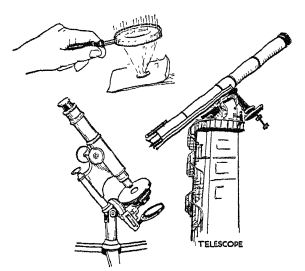
4. The stage of rules of action hosed on scientific law. — The fourth stage is that of making rules of action based on scientific law. How do these differ from the rules of thumb (seepage 142) of the secondstage? Very much! To begin with, rules based on scientific knowledge are more measured and exact and accurate : hence they give better results. They are worked out with instruments of precision, (see page 117). More important still, they are general and may therefore be used for many purposes, thus multiplying man’s powers. Take our light rays. Science gives general statements about them. They always act in certain ways under certain conditions. There was nothing peculiar about their action in the fish-shooting case. They act the same way with other bodies, as you can readily see by putting a coin in a dish and then standing where the edge of the dish just hides the coin. Have someone pour water into the dish, and you now see the coin ! In other words, once we know how light rays act, we can get rules of action not only for shooting fish but for other purposes as well. By way of an example of these other purposes, [ p. 145 ] we build our microscopes and telescopes in accord with the laws of light, and new worlds are opened up to us! Clearly our powers are greatly increased when we make use of laws of science which are general in character.
The development and use of knowledge illustrated by medicine. — Let us work through these same four stages of the development and use of knowledge, using medicine as our illustration.
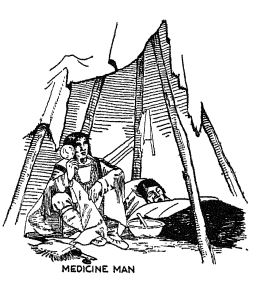
1. Trial and error in primitive medicine. — The trial and error stage is seen in the medical work of all primitive peoples. When one of their number becomes ill, many things are tried in the hope that something will help. Drums are beaten to frighten away the evil spirit causing the illness. Or perhaps some more pleasing dwelling is provided for the evil spirit, such as a yellow bird for a jaundice-spirit or a frog for a chill-spirit. Strange mixtures are prepared for the patient to drink; he himself is beaten or rolled about or starved (see page 62) ; some one else fasts for him, — these are only a few samples of what blind ignorance, anxious to help without knowing how to help, does in such a case.
[ p. 146 ]
2. Rule of thumb in medicine. — As time goes on through thousands of years, such a group will gradually enter the second stage and develop rules of thumb concerning what to do in sickness. They gradually find that a certain kind of leaf makes a good bandage for a wound; that a certain drink made by steeping another kind of leaf gives relief when the patient is hot with fever; that a tight bandage helps certain kinds of pain. These are just rules of thumb. /The people do not know why the rules work.
Of course, along with good rules of thumb there are certain to grow up bad rules of thumb, and it is amazing how long people keep on following the bad rules. We do not need to go clear back to primitive peoples to find bad rules being followed in sickness. For example, we need to go back only a few score of years to find this remedy still proposed: “Against all kinds of witchcraft, take a great beetle; cut off his head and wings; boil him; put him in oil and lay him out; then cook his head and wings; put them in snake fat; boil; and let the patient drink the mixture.” What nonsense! Another example is the use of a powder scraped from the tombstones of saints as a remedy. It is true that such remedies were a bit unusual, but it was quite usual to advise people to wear charms to ward off sickness and evil spirits.
Even after many rules of thumb, good and bad, have been made, there will still remain kinds of sickness and pain for which no rules have been worked out. For these, the drumbeating and pinching and pounding and other trial and error methods are still likely to be used.
3. Building up the sciences basic to modern medicine. — The third stage is that of the slow building up of scientific knowledge in the form of general laws. The sciences that have been found most useful in dealing with sickness are [ p. 147 ] anatomy, which tells of the various parts of the body and how they are put together; physiology, which explains the usual or normal workings of these parts; bacteriology, which makes general statements concerning germs, or bacteria; psychology, which tells of the workings of our minds; and chemistry, which treats of the composition of substances, including our bodies and drugs and foods.
We cannot stop to discuss these sciences. They are quite new. It was not until 1628 that Harvey discovered the circulation of the blood and thus gave a basis for a real understanding of the work of the heart and lungs and blood. It was not until 1743 that Haller did the great wmrk in anatomy that has caused him to be called the father of anatomy. It was not until the work of Lavoisier (1743-94) that chemistry was put on its modern basis.
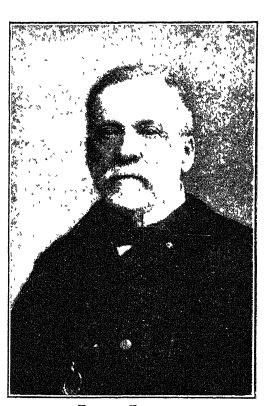
This brings us down to the nineteenth century. In 1839 the really effective microscope was invented; in that same year the cell theory, which showed how our bodies are made up, was estabhshed ; in 1837-40 came the work of Muller, who is called the founder of modern physiology; in 1846 and 1847 anaesthetics, those great relievers of pain, were discovered in; 1859 Pasteur began the studies which resulted in understanding that many diseases are caused by germs; in 1868 antiseptics, or germ-killers, were used in surgical operations; in the early 1880’s the germs of [ p. 148 ] typhoid, pneumonia, tuberculosis, hydrophobia, cholera, diphtheria, and lockjaw were identified; in 1895 the X-ray, later so useful in diagnosis, was discovered. These are only samples of our progress in the basic sciences, but they are enough to show that the third stage in the development and use of medical knowledge is very recent, — that it is still in its beginnings.
4. Rules of action based on scientific law. — The fomth stage is that of making and using rules of action based on scientific law. We are just getting started in that stage to-day in our dealing with disease, and we are making much use of what we call “institutions” in the process. Let us look at some of the institutions that are giving us rules of action about health matters. The examples that we shall examine are our medical schools, the United States Public Health Service, and the work of city health departments. They are only examples.
WHAT IS STUDIED IN ONE UNIVERSITY SCHOOL OF HYGIENE AND PUBLIC HEALTH
(The students have studied the basic sciences before entering this school )
1 Microorganisms which cause disease
2 Rchistance and immunity, vaccines arid serums
3 Primitive animal parasites, eg malarial parasite
4 Parasitic worms, eg hookworm5 Insect disease spreaders, e g mosquito and Sea
6 Control of infectious diseases, especially epidemics
7 Water supply, waste disposal, housing, and ventilation
8 Bodily functions and health9 Chemical aspects of hygiene
10 Mental aspects of disease
11 The principles of nutrition and diet
12 Health rules for the individual13 Motherhood and child hygiene
14 Legal aspects of sanitation and hygiene
15 Records and statistics of births, deaths, sickness, etc.
16 Administration of public health work
Our medical schools teach rules of action. — The first institution that should be mentioned is the medical school. We have in the United States to-day over one hundred and fifty medical schools for the training of our physicians. Now, these schools, in trainiag physicians, teach them rules of action growing out of the scientific laws of anatomy, physiology, chemistry, psychology, and bacteriology. If one wishes to practice medicine to-day, he must spend several [ p. 149 ] years studying these basic sciences; several more years in the medical school learning good rules of action and how to make rules of action himself; and then at least one year working in some hospital under the supervision of some experienced physician.
The Public Health Service makes rules and helps carry them out. — Another very interesting institution is the United States Public Health Service, one of the bureaus of our Government at Washington. [1] It is the duty of this service to cooperate with state and local health officers in dealing with health problems too large for the local authorities. It helped California fight the bubonic plague in 1900 ; it helped New Orleans fight yellow fever in 1905. In general, it helps at any time and place where there is an unusual outbreak of such epidemics as diphtheria or typhoid or infantile paralysis. Then, too, the Public Health Service gives advice, when asked, to city health departments; prevents diseases from being carried into the United States by the passengers or crews of ships; watches to prevent diseases from being carried from state to state on railroads and steamboats; and studies health problems in very many ways.
Our cities make and apply health rules. — The health institution with which we are most familiar is the health service of the city. We have asked our city servants to do so many things to safeguard our health that it is not easy to hst them all.[2]
Disposing of wastes and providing pure water. — One of the first things we had them do was to get rid of wastes and refuse, which were great breeding places of harmful germs, [ p. 150 ] and of flies, which carried the germs to our food. We had our public servants build and operate systems of sewerage and of garbage collection and disposal.
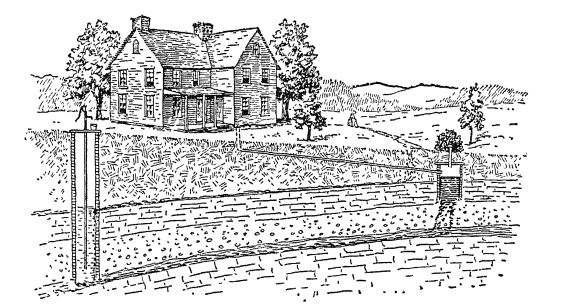
This diagram shows that soils he in layers, or strata. The impurities of the cesspool at the right are draining down into the well Wells m cities are unsafe.
Then, too, we use our public servants in getting a supply of clean, pure water. People can not have their own wells in the city, because they are sure to be unwholesome and to scatter such diseases as typhoid. Instead we build great [ p. 151 ] waterworks for the whole community and pay for them and their operation out of taxes. Some of these works are wonderful pieces of engineering, bringing water great distances. New York City brings water from the Catskill Mountains; Los Angeles, from the lower Sierras; and Chicago, from far out in Lake Michigan. Man’s command over metals and power made such feats possible.
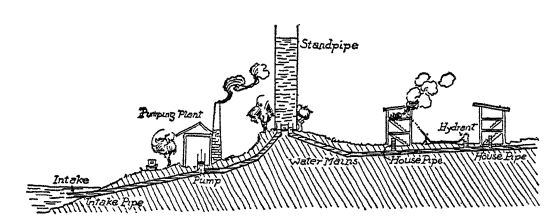
This diagram, illustrates how water can be pumped out of a lake or river into a standpipe. The high standpipe gives the pressure which sends the water through the mains to the houses and hydrants. We may thank power, fire, and the metals for this device.
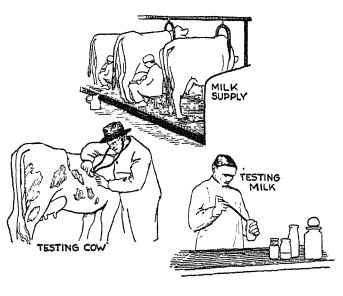
Clean, pure food. — After achieving waste disposal and clean water we turned our city governments toward securing clean food. Bakeries are now regulated in most cities to keep the bread clean. Basement bakeries are usually forbidden. Restaurants are supervised. To some extent our city officers protect for us such foods as fish, ice cream, and meat, although most of our meat comes now from large packing houses that are inspected by the F ederal Government. As for our milk supply, the farther city dwellers got away from the cow and the larger the number of people who handled the milk, the more impossible it was for anyone to know whether the milk he bought was going to be food or poison to him. It is no simple task to get good milk to the city dweller. If it is done thoroughly, inspectors must go out to see that proper care is taken on the dairy farms; transportation must be watched; bottling stations supervised; milk depots inspected; the milk itself frequently tested — all to see that it is kept free from dirt and disease-spreading germs.
[ p. 152 ]
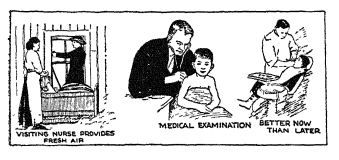
Protecting health of children. — Let us look next at what the city health service does for little children. One of the great tragedies of our time has been the needless deaths of so many babies. Of the deaths each year, one half are of children under seven. Many of these child deaths would not have occurred if proper food, clothing, air, bathing, and other care had been given. The first step in preventing these child deaths is to have a system of prompt reports so that it may be known where all newborn babies are. Then comes the work of the visiting nurses, who call and give help and advice where needed. Infant-welfare stations are established where mothers may go for help and guidance about the care of their babies. Certified-milk stations are established where safe milk can be bought at reasonable prices. Clinics are held where expert physicians offer their services. Especially in the summer, such stations have saved thousands of lives in our larger cities.
As children grow older, a modern city does not forget them. Through medical examinations in the schools it discovers troubles in eyesight, in hearing, in teeth (troubles that can usually be rather easily helped) and gives advice and assistance to parents in curing them. It tries also to help children to live correctly by teaching them hygiene. In some states health officers examine children wffio apply for working certificates to see whether they are in fit condition and to guide them to wholesome work.
Protecting general health. — For the general health of the city we have still other activities. Health departments watch for, report, and isolate contagious diseases, such as [ p. 153 ] measles, diphtheria, and smallpox. They try to keep such diseases from spreading. They also help in the treatment of the sick either at home or in contagious-disease hospitals.
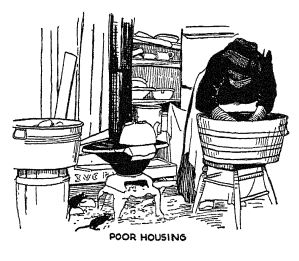
Cities have begun to pay attention to the houses people live in. Most cities require in houses a certain amount of air space for every person, a definite amount of window space in proportion to the size of the room, air shafts in the center of large tenements, sanitary plumbing, and running water. But so little has been done that the dangers to public health from overcrowded and unwholesome dwellings are increasing rather than diminishing. Here we meet the great difficulty that some famifies do not earn enough to pay for good living conditions.
Finally, we have learned that there is no real health without good play and a chance to be outdoors. The playgrounds and parks help the city in many ways. They keep people out of places of amusement that are not wholesome. They give an opportunity to meet friends in a social way, and above all they supply relief from the dull grind of factory and store life.
These activities vary greatly from city to city. Some cities do all these things and more. Others do few of them. Sometimes such things are done well; sometimes there is the merest pretense of doing them. We have gone just far enough to know that, if we will, we can make our cities places of light and air and wholesomeness.
Surely, when we compare the trial and error pounding and yelling and dancing of the primitive medicine man’s way of [ p. 154 ] fighting disease with our own methods, we can have no doubt that our own ways are verj’’ much better. Scientific law and rules of action based on scientific law are meaning much in giving us better health. And let us remember that what is being done in the field of medicine is just one example of our many, many uses of scientific knowledge.
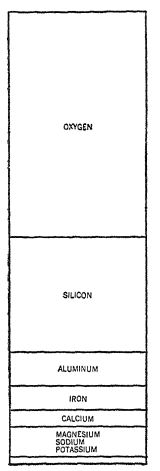
Eight elements make up about 9S per cent of the earth’s crust, while the other eighty-four elements make up less than 2 per cent of that crust. Some of the eighty-four W'hich we hear much about are hydrogen, carbon, phosphorus, manganese, sulphur, nitrogen, gold, silver, chlorine, chromium.
Chemistry illustrates the creative stage of man’s harnessing of nature. — It may be worth while to look at still another illustration. Let us take chemistry. Chemistry treats of the make-up, or composition, of substances. Our chemists have made many astounding discoveries, but the one which interests us most just now is this: Although there are perhaps 300,000 very different kinds of substances in this world, these substances are all made up of various combinations of ninety-two elements! It is not surprising that so many substances can be made of ninety-two elements; the 750,000 words in our language are made up of only twenty-six letters, and such letters as X and z are not used a great deal. The surprising thing is that our chemists have been able to discover these elements and “tame” them for the use of man.
Of all the sciences chemistry is perhaps the best example of what we have called the creative stage of man’s progress (see page 28). The reason is plain. Once we have learned what the basic elements used in our world are, we can “create” substances in just [ p. 155 ] the same way in which we create new words (such as “jazz ”) every year by the use of some of the twenty-six letters of our alphabet.
So, also, we can tear substances to pieces and make new combinations just as we can tear a word into its letters and make new words out of them. What a wonderful mastery this is over nature! What creative power it gives us !
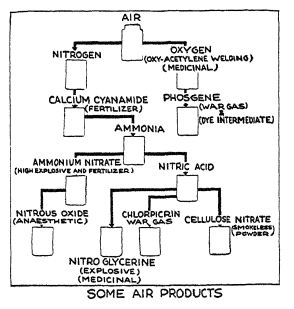
But a word of caution is necessary. The matter is not as simple as it sounds. Substances cannot be torn to pieces and new ones built up as easily as we can arrange letters to suit our taste. Far from it. We have seen how hard it is to break up iron ore and to get iron (which is an element) from it. That is one of the simpler cases. Some substances resist far more than does iron ore. Further, the various elements (once we have them) cannot be juggled about as we choose. Some are stubborn and combine with others very haltingly. All of them act in accord with “laws of science” and not in accord with whims of humans.
How our scientists learned all this and what it all means is too long a story for this place, and it should be told by your science teacher in any event. It is enough for us, at this time, to know that it is a story of molecules and atoms. Just as words I are made up of syllables, which are made up of letters so also substances are made UP of molecules which are made up of atoms [ p. 156 ] and there are ninety-two different kinds of atoms, and, therefore, ninety-two elements.
Some practical consequences of the use of chemistry. — The practical consequences of man’s ability to work with these ninety-two elements (even if his work with them is done with difficulty) are almost beyond belief.
The utilization of wastes. — For one thing, man has become able to use great quantities of materials that he once thought were waste. Chemistry makes it possible to recombine molecules and make new substances. Sewage and garbage, even, are thus worked over into new substances. Slag from blast furnaces was once thrown away; now it is used to make cement. There are literally thousands of goods made to-day from materials that were once called w’aste. For this we may thank chemistry.
Goods produced more cheaply. — For another thing, the chemist has shown us how to make, and make cheaply, things that were formerly obtained from nature at great expense. Once, when man wanted dyestuffs,[3] he searched the wide world over to find colors. He sent divers down into the Mediterranean to rob the shellfish of his purple. He sent ships to the new world to get Brazil wood and to India for indigo. He robbed the lady cochineal bug of her scarlet coat. Man had to use the colors of plant and insects. But to-day any kind of dye found in nature can now be made in the laboratory as soon as its composition is understood. Usually, too, it can be made more cheaply and purer than when extracted from the plant or insect.
New substances created. — Again, the chemist has made substances very useful to man, which are not found in nature at all. For that matter, steel is such a substance.
[ p. 157 ]
A great range of sciences and scientific institutions now serve man. — What is true of chemistry’s service to man. is true of other sciences as well. We need and use them all. Fortunately the list of them is steadily growing.
A wonderful institutional life has grown up around man’s scientific knowledge. There are institutions devoted to passing on to others the knowledge that has been acquired. Of these, our schools and colleges are the best illustration. Then there are our schools of technology which translate the basic laws of science into practical rules of action. A partial list of such schools includes medical schools, dental schools, mechanical-engineering schools, mining-engineering schools, schools of commerce and administration, schools for [ p. 158 ] training social workers, schools of education, and agricultural schools. Finally, there are institutions which carry on research. These institutions work out new basic laws and verify or improve the old ones. In this group are found our great universities; research bureaus of government departments; the National Research Council, which encourages and helps research in all institutions; private foundations, such as the Rockefeller Foundation for Medical Research and the Bureau of Economic Research; and hundreds of research bureaus in our great business plants.
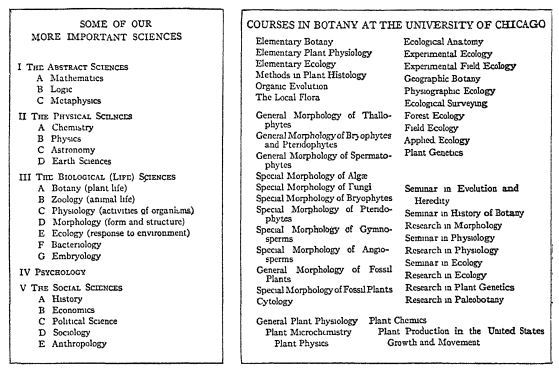
The purpose of the list of courses at the right is to show how far we have gone in our study of one science. It is by no means an extreme case. Others have been earned farther. Donot try to understand all the terms.
“Man has struck his tents. He has left the valleys of superstition and brutish life. He is out on the highway of progress.”
¶ B. Man on the Highway of Progress
(How we got our science and what we owe to it.)
Man began to heap up acquired knowledge thousands and thousands of years ago. — No one can say when man began to heap up the knowledge that was to become the science of to-day. Presumably the process began far back in the dim past. The trial and error stage, we know, is found even among animals. All of us have seen cats and dogs and other pets learn to push doors open by the trial and error method; all of us have heard of mice or birds or monkeys using the same method to get at food which had been put in a place hard for them to reach. Of course, early man could do as much.
Indeed, man had great advantages over animals in such work. He had a better mind and could think things out. He had a better memory and could store up in his mind the “ways that worked.” He could learn that it was not worth while to repeat the ways that did not work.
[ p. 159 ]
Then, too, the fact that he was a communicator helped him a great deal, for he could pass down to younger generations knowledge of ways that worked. The result was that, as the centuries rolled on, a modest fund of knowdedge was built up.
Early man’s knowledge was not scientific knowledge, but it was at least a beginning. — But there is a great difference between mere knowledge and science. Science is knowledge, but it is knowledge plus. “Science is exact, regular, arranged,! classified knowledge.” It is knowledge that has been carefully tested and measured and then put into the form of a general law. The savage knew a great many practical facts about stones and climate and food plants and animals. He had practical rules of thumb about making tools, raising foods, and many other matters. But he was thousands and thousands of years away from having general, scientific laws.
Fortunately for us, early man was not satisfied to stop with what knowledge he had. He was always adding to it. He was always trying to arrange it and classify it and make it general. Our study of the Iroquois showed that early man was a why-asking and a how-contriving person. He was a walking question mark! He wns also a persistent generalizer. True, his generalizations -were often poor ones. The best explanations he was able to work out about the world he Mved in are called “myths,” “behef in magic,” and “superstition” by us. But let us very honestly salute those early “explanations” -and the curiosity that caused him to make them. They are the humble beginnings of scientific inquiry and scientific law. Early beliefs were at least guesses at the why and how of things. Through long ages these guesses were improved and corrected and made into truer explanations. We are still doing the same thing.
[ p. 160 ]
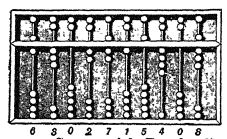
The Chinese Abacus
The Chinese counting board consists of movable balls of bone or ivory strung on rods of bamboo. The first rod on the right is the “units” rod, the next is the “tens” rod, the next the “hundreds” rod, and so on. Each ball above the horizontal rod represents 5 If one of these is pushed down to the rod and three are pushed up from the bottom, we have eight (one of the fives plus three of the ones) .
There could he no science until men had become able to tabulate, calculate, and measure. — We can readily see why early man had such poor success in making general explanations of a sort that we should be wilhng to call science. Since science is exact, regular, arranged, and classified knowledge, it follows that man had to become able to measure, to count, and to classify before he could have scientific knowledge. Before one can cut down a tree, he must have tools to work with. Before man can make a science, he must have tools to work with.
If we think of very earhest man, thousands of years went by before he could measure or count at all. Then other thousands of years went by before he became an orderly, systematic counter and measurer. Still other thousands of years went by before he became able to make general rules or laws of science.
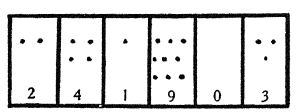
Numbers and counting. — Let us begin with numbers and with counting.[4] Quite as you would expect, man started to count “on his body,” and we have counted by fives and tens since the time of the savage days when fingers and toes were thus used. Among the Tamanacs of the Orinoco the word for five means “whole hand”; six is “one of the other hand”; ten is “both hands”; fifteen is “whole foot”; twenty is “one man” ; and so on. As for our numbers, the Roman numerals I, II, III, etc., have come down from the days of picture writing, when a mark meant “one” — perhaps one finger. The very words we use show how we began to keep track [ p. 161 ] of our counting, for our word “calculate” comes from a Latin word meaning “pebble.” In early days people “ calculated” by putting pebbles in heaps as counters. The word for pebbles in time gave us the word for calculate. The Chinese abacus, or counting board, is just a scheme to keep track, in separate colmnns, of the number of pebbles that have been set aside for units, tens, hundreds, and so on. Our Arabic numbers are merely another way of doing the same thing, as may be seen from the following pebble-andArabic-number abacus showing the number 241,903. As you see, our Arabic numbers are just a kind of shorthand, a set of symbols, to use instead of quantities of pebbles ! They are surely much more convenient.
Measuring devices. — Precisely the same kind of story can be told of our measuring devices. Man first measured, as he first counted, on his own body. He began to measure by putting his hands or feet alongside objects. From those days there have come down tons such words as “foot,” “hand,” “span,” or “mile” (from the Latin mille passus, meaning “thousand paces”). The time came finally when people (the Egyptians and Babylonians were among the earliest) made pieces of wood or metal of exact lengths to serve as standards. From that time measuring devices did not vary according to the size of the man who did the measuring. As time went on, standards were fixed for other kinds of measuring, such as weight and volume. To-day we have very many kinds of accurate measuring standards.
To-day, the governments of all civilized peoples set such standards by law. Our own government maintains at [ p. 162 ] Washington a Bureau of Standards whose employees are constantly studying and working on measurements and standards. In the vaults of this bureau are kept the standard copies of the metre, kilogram, yard, pound, etc. Here are kept measuring devices that are little short of marvellous : a balance that will weigh within one-two-hundred-millionth part of its load; calipers that will measure to one tenthousandth of an inch; ohmmeters that will measure electrical resistance from one one-hundred-thousandth of an ohm to 100,000 ohms; interferometers that will detect movement of one five-millionth of an inch; heat measurers of wonderful range and fineness. Year after year we find ways to make finer and finer measurements. Small wonder that our tools and machines to-day enable us to do accurate and delicate work! Small wonder that our scientists can arrange and measme more rapidly than they could a thousand years ago! Small wonder that we are wringing nature’s most hidden secrets from her!
Man has certainly made much progress in his measuring tools since those primitive days when savages began to count or measure on parts of their bodies. Is it not interesting that primitive man (quite without’ being aware of it) was at work making the measuring tools which were later to be used in making sciences? Does it not make you feel that there are some real and worth-while things being worked out in the world when you see that thousands of years ago our savage forerunners were laying the foundations for the modem science that is of such benefit to us to-day? Does it not make you feel that, in a very real sense, you and I are cooperating with those unkno-wn toilers of oiu’ dim past in carrying on the work and progress of the world?
The great development of science has occurred in the last two hundred years. — When man became able to count [ p. 163 ] and measure, he had the mental tools for beginning to make sciences, for he could now observe, measure, record, and arrange knowledge in an exact, orderly fashion. But it was a long, slow process.
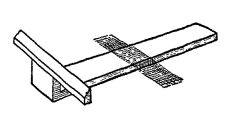
This is really a sundial The position of the shadow tolls the time of day.
The beginnings of science. — Over four thousand years ago people who lived in Egypt, Assyria, and Babylonia had made much progress in the art of Hving together. They had good rules of thumb in many fields. Their practical knowledge was far enough advanced for them to have painters, gem cutters, smiths, musicians, shoemakers, tanners, wine makers, sculptors, brickmakers, and many others. These peoples had, furthermore, so developed their measuring devices that they had a good bit of orderly, arranged, exact knowledge about the movement of the stars (astronomy) and the length of what we call the year and the hour. They knew how to survey and to compute areas and volumes (geometry: geometria means earthmeasurement and may well have sprung up in the Nile Valley where the floods made necessary much surveying every year to And out the boundaries). They knew many causes and cures for diseases. Bince these ancient far-Eastern peoples had this measured knowledge, which they expressed in general rules, we sometimes say that their work marks the birth of science.
Greek science, the dark ages, the rebirth of learning. — Of course, the full story of the development of science would take a thick volume. We cannot stop for it. In your history classes you will learn that these far-Eastem peoples did not carry their science very far. Some writers even refuse to call their knowledge scientific knowledge. It happened, [ p. 164 ] however, that their knowledge spread in various ways to the Greeks, who carried it farther and certainly gave it a scientific form. Later, it spread to Eg3rpt and to the Hindus and Arabs, who played their part in its development. Then followed a period of very slow progress — a period of decline, even — a period of “the dark ages.” A “rebirth of learning,” or Renaissance, or Great Awakening, took place in the thirteenth, fourteenth, and fifteenth centuries.
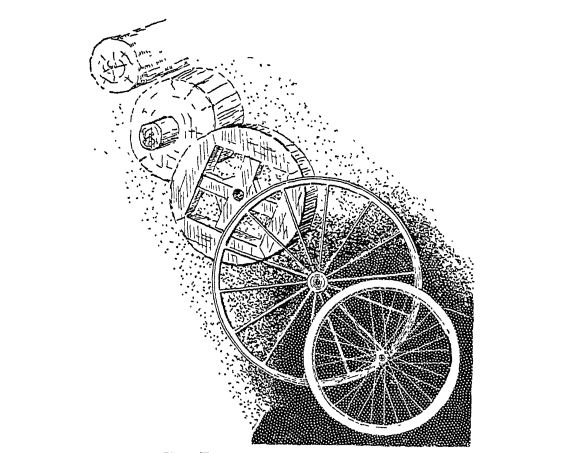
Here is pictured the development from the log used by a savage to roll his canoe along the beach to the modern wheel with its pneumatic tire. We build upon the progress of the past.
All of us know some of the things that happened about the time of this rebirth of learning. Man rediscovered that the earth was round (the Greeks, Alexandrians, and Arabs knew it long before), and Columbus discovered America. [ p. 165 ] Copernicus (and Gallileo with his telescope) demonstrated that the earth is not the center of the universe but that the earth and other planets revolve around the sun and that far, far outside of this “solar system” there are great stretches of other suns and perhaps of other worlds (Aristarchus the Alexandrian thought so about 250 b.c.). The mariner’s compass, which enabled sailors to go far out at sea without getting lost, and the printing press, which greatly increased man’s ability to pass knowledge along to others, date from this period. The most significant gain, however, was in spirit, attitude, and outlook. Men became experimenters; they refused just to “take another’s word for it.” They watched, observed, tried things, kept records of their experiments — all with the idea of making knowledge the “exact, regular, and arranged” knowledge that is science.
The recent great development. — This sketch of the history of science can be made more real by looking at the chart on page 166, which shows the life periods of the great thinkers. It is easy to see that there was a long period of slow growth, a period of decline, a rebirth of learning, and that we are now in a great outburst of activity. Since the chart comes down only to 1900 and includes almost no names of living scientists, it does not show that this outburst is still going on. If living scientists were included and the chart were brought down to the present day, its right side would be black with names.
This chart makes certain points clear to us. We see how true it is that we have heaped up our acquired knowledge over a long period of time, and yet that, measured against man’s long stay on the earth, science is a very new thing. Its large development has occurred only in the last two hundred years. Its application in rules of action through [ p. 166 ] [ p. 167 ] our schools of technology is a matter of the last fifty or seventy-five years. This helps us understand why the charts we made on pages 84, 102, 123, and 135 showed that so many of the important happenings in man’s harnessing of fire, metals, and power are matters in the memory of living men.
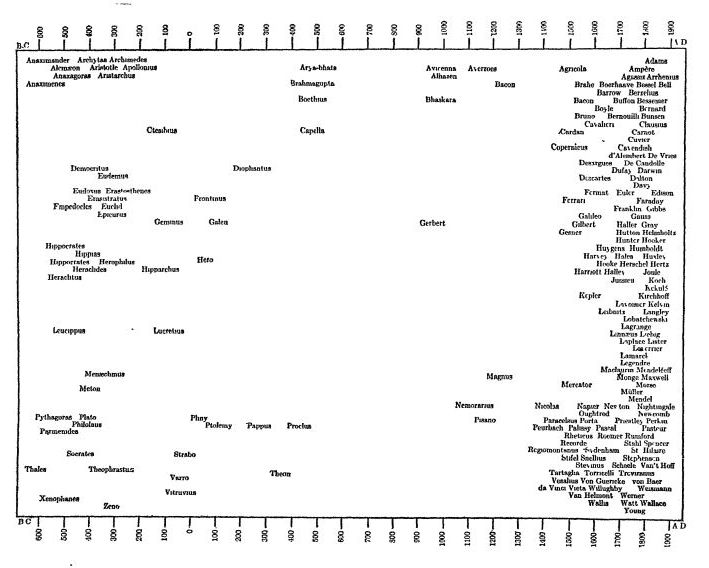
This chart shows that the Greeks made their greatest contributions 600 b c. to 300 b.c,; then come some Hindu, Alexandrian, and Roman names. The chart is blank for about 300 years. Then comes a rebirth of learning, but there are not many names for another 500 years. The last 200 years mark the great outburst of scientific knowledge.
A summary statement of what science does. — The ways by which science has multiplied man’s powers are so numerous and so dazzling that it is not easy for our minds to grasp what it all means for our hving together. If, however, we think back over our illustrations of the development and use of scientific knowledge, we see some points fairly clearly.
1. Science greatly increases man’s powers over nature. It enables him to get rules of action from great general laws. It marks what we call the creative stage of man’s development. He is no longer content with merely adapting things. He now creates in his own laboratories and workshops not only substances that may be found in nature, but many that do not there exist. Science is making him the ruler of the physical world.
2. Although the sciences which treat more directly of our living together, such as biology, economics, sociology and poHtical science, are stm very new, these sciences have already begun to tell us general laws about living together. [ p. 168 ] We know, for example, that certain kinds of mental diseases can be inherited and that it is dangerous to our living together that they should be passed down to younger generations. We know something of the motives that make people form groups and some of the things that happen when groups are formed. But the full discussion of the contributions of the “social sciences” must be postponed to Part IV.
3. One of the most important things about science is the frame of mind, the mental attitude into which it puts us. There is such a thing as the “scientific habit of mind,” and it is worth getting. A person with the scientific habit of mind will be an inquiring, careful, measuring, testing, generahzing person who will follow facts rather than opinions. His mind wiU be freed from such fears and superstitions as men once had, for he wiU see the world in terms of law and not in terms of magic. If his mind is really “scientific,” it will be one full of imagination and one that senses the great beauties of our world, for there are few more beautiful or imaginative ideas than those which are connected with how our world is put together and how it may be made to serve man.
One hundred years versus all earlier years. — Wallace, in his book The Wonderful Century, compares the progress [ p. 169 ] of the nineteenth century with the progress made through all the thousands of years before 1800.[5] Thanks to science, the Kst of man’s great achievements in the last hundred years is as long as that of all preceding centuries.
We get quite as striking a view of what man’s ability to harness nature has meant during the last one hundred years if we imagine ourselves able to take a journey back through a hundred years and keep a record of the commonplaces of to-day that disappear during the journey.
“We quickly lose the wireless, the telephone, the phonograph, and the graphophone. We no longer see the cable cars or electric railways. The electric lights have gone out. The telegraph disappears. The sewing machine, reaper, and thresher have passed away, and so also have all india-rubber goods. We no longer see any photographs, photo-engravings, photolithographs, or snapshot cameras. The wonderful octupleweb printing press, printing, pasting, cutting, folding, and counting newspapers at the rate of 96,000 per hour, or 1600 [ p. 170 ] per minute, shrinks at the beginning of the century into an insignificant prototype. We lose all planing and woodworking machinery, and with it the endless variety of sashes, doors, blinds, and furniture in unlimited variety. There are no gas engines, no passenger elevators, no asphalt pavement, no steam fire engine, no triple-expansion steam engine, no celluloid articles, no barbed fences, no time locks for safes, no self-binding harvesters, no oil or gas wells, no ice machines, or cold storage. We lose air engines, stemwinding watches, cash registers and cash carriers, the great suspension bridges, the great tunnels, the Suez Canal, ironframe buildings, iron-clad war vessels, revolAmrs, torpedoes, magazine guns, machine guns, linotype machines, all practical typewriters, all Pasteurizing, knowledge of microbes or disease germs, sanitary plumbing, water gas, soda-water fountains, air brakes, coal-tar dyes and medicines, nitroglycerine, dynamite and guncotton, dynamo electric machines, aluminum ware, electric locomotives, Bessemer steel with its wonderful developments, ocean cables, enameled iron ware, Welsbach gas burners, electric-storage batteries, the cigarette machine, hydrauhc dredges, roller mills, patent-process flour, tin-can machines, car couplings, compressed-air drills, sleeping cars, the dynamite gun, the McKay shoe machine, the circular-knitting machine, the Jacquard loom, wood pulp for paper. Are alarms, the use of anaesthetics in surgery, oleomargarine, street sweepers. Artesian wells, friction matches, steam hammers, electroplating, nail machines, false teeth, artificial limbs and eyes, the spectroscope, the moAung pictures, acetylene gas. X-ray apparatus, automobiles, and — but, enough! the reader exclaims, and indeed it is not pleasant to contemplate the loss. We shrink from the thought of what it [ p. 171 ] would mean to live without access to the progress of the last century.” [6]
ONE CENTURY COMPARED WITH ALL PRECEDING CENTURIES
Some steps %n progress in the nineteenth century
1 Railways
2 Steamships
3 Electric telegraphs
4 Telephone
5 Matches
6 Gas illumination
7 Electric lighting
8 Photography
9 The phonograph
10 X-rays
11 Spectrum analysis
12 Anaesthetics
13 Antiseptic surgery
14 Principle of conservation of energy established
15 Molecular theoiy of gases
16 Velocity of light directly measured and earth’s rotation experimentally shown
17 The discovery of the uses of dust
18 Chemistry, definite propor tions
19 Meteors and the meteoritic theory
20 The proof of glacial epochs
21 The proof of the antiquity of man
22 Organic evolution estab lished
23 Cell theory and embryology
24 Germ theory of diseaseSome steps in progress in alt preceding ages
1 The mariner’s compass
2 The steam engine
3 The telescope
4 The barometer and ther mometer
5 Printing
6 Arabic numerals
7 Alphabetical writing
8 Modern chemistry founded
9 Electric science founded
10 Gravitation established
11 Kepler’s laws on the Motion of Planets
12 The differential calculus
13 The circulation of the blood discovered
14 Light proved to have finite velocity
15 The development of geom etry
16 Gunpowder
17 Paper
18 Fire making 19 Tool making 20. Agnculture
21 Domestication of animals 22. Metals and pottery
And what of the future?
We are creatures of the twilight. — “Everything seems pointing to the belief that we are entering upon a progress that will go on, with an ever more confident stride, forever. We are in the beginning of the greatest change that humanity has ever undergone. There is no shock, no epochmaking incident — but then there is no shock at a cloudy daybreak. At no point can we say, ‘Here it commences, now; last minute was night and this is morning,’ but insensibly we are in the day.
“It is possible to believe that all the past is but the beginning, and that all that has been is but the twilight of the dawn. It is possible to believe that all that the human mind has ever accomplished is but the dream before the awakening. We can not see, there is no need for us to see, what this world will be like when the day has fully come. We are creatures of the twihght. But out of om’ race .and lineage minds will spring, that will reach back to us in our littleness to know us better than we know ourselves, and that will reach forward fearlessly to know this future that defeats our eyes. A day will come, one day in the unending succession of days, when beings shall stand upon this earth, as one stands upon a footstool, and shall laugh and reach out their hands amidst the stars.” [7]
[ p. 172 ]
¶ Problems
- Define or explain: (use the dictionary if necessary)
Rule of thumb, A scientific attitude of mind
Trial and error, Research
Scientific law, Technology
Bacteria, Chemical elements
Antiseptic, Personal hygiene - What has been done in your own town to keep the streets and roads clean? What still remains to be done in order to improve the conditions in your town?
- Some persons do not like to have their houses placarded when there is a case of scarlet fever in the house. Are they in the right about that? Is the card put there to punish them?
- How does your family dispose of garbage? Why is it wise to spend money on the proper removal of garbage? When the city removes garbage, how does it get the money with which to pay the cost of doing the work?
- From what source does milk come to your house each day? What precautions do the public health authorities take vfith regard to the milk?
- What are some of the ways by which the family can add to the precautions taken by the public in regard to food?
- Make a list of the things done in your school to safeguard health. Do you include gymnasium work? Good light and air?
- “Man’s command over metals and power makes possible the water supply of the modern city.” Explain.
- Could some plague which might start in California spread to other parts of the country more readily to-day than it could fifty years ago? How do we prevent any such spread?
- “The United States should be interested in health conditions in South America.” Why or why not?
- “The railroad is a great menace to public health and no one should ride on the railroad.” How can you answer this argument?
- “ Modern medical activities are based on scientific laws.” Illustrate.
- What services does chemistry render for our living together well? Write out an argument for your taking chemistry in school.
- Watch yourself as you work in some science-class laboratory. Do you measure carefully? Do you record what happens? Do you test out laws of science? [ p. 173 ]
- “Man’s power to communicate made possible the development of science.” Is this true?
- One great teacher said, “One of the most important things in the world is curiosity. It should be encouraged in our schools.” Why did he say that?
- Name some debts that modern science owes to early man.
- Write out a paragraph giving the best reasons you can why school authorities provide training in arithmetic.
- “ Magic is the explanation which primitive man gives for unusual happenings. “There must be some law here which I do not yet know,” says the modern scientist when he sees an unusual happening. Which one is more likely to believe that unusual happenings are worth studying and can be made usual and ordinary?
- Draw up a list of superstitions of to-day which go back to the days of magic. Here is a start: “Breaking a looking glass means seven years of bad luck.” “Turn back when a black cat crosses your path.”
- “Science knocks superstitions and silly fears out of our heads by showing us that nature acts according to laws.” Do you agree?
- Write out a paragraph giving reasons why a scientific attitude of mind is worth having.
- Are any measurements used in your kitchen? Are standards of measurement important when buying vegetables or fruits? Do you suppose a city might wisely have a department to test the scales and other measuring devices of retail stores such as groceries?
- Does science have anything to do with the ordinary affairs of your home? Does your mother make use of it in any way? Do you? Is your house built according to rules of action growing out of science?
- Does science have anything to do in giving you health? In giving you recreation? Education? Means of making a living?
- In what ways has the microscope been of service to man?
- Some wealthy persons think that one of the very best ways they can use their money is to give it to institutions that will spend it in research. Is this good sense?
- How do you account for the fact that Wallace’s list of striking steps in progress (see page 169) is as long for the nineteenth century as for all the earlier centuries?
- “Science is the creative stage of man’s harnessing of nature.” Explain.
- Answer the questions at the beginning of the chapter, page 141.
[ p. 174 ]
¶ Interesting Reading
Marshall: Readings m the Story of Human Progress, Chapter V.
- Louis Pasteur (a modest scientist confers untold benefits upon mankind) .
- The IMeasurement of Time (the calendar, the sundial, the water clock, the hourglass, the clock, the watch, the chronometer, and observatory time) .
- Our Measuring Devices or Standards (how standards help us: the work of the bureau of standards) .
See also:
Chapter III, 4. Harnessing Rays of Light (what the lens has meant for living well).
Chapter IV, 3. Thomas Alva Edison (a glimpse of an inventor at work).
Chapter VI, 1. The Conquest of Yellow Fever (how science has removed one of man’s greatest dangers).
Chapter XVII, 2, Michael Faraday (an example of devotion to scientific truth).
Chapter XVII, 4. Howard Taylor Ricketts (an example of devotion to the ideal of service).
Problems to thinli over are given in these reading selections.
| IV. Power and the Machine as Phases of Man’S Harnessing of Nature | Title page | VI. Harnessing Nature and Living Together Well |
¶ Notes
The account of the work of this service is based on Lesson B-14, Lessons in Community and National Life. ↩︎
This account is based on Lesson C-19; Lessons in Community and National Life. The original phraseology is followed in part. ↩︎
This account is based on Slosson, Creative Chemistry. ( The Century Company.) In part the original phraseology is followed. ↩︎
This is based largely on Tylor, Anthropology, (Macmillan & Co., Ltd.) ↩︎
The chart is adapted by permission from Wallace, The Wonderful Century, (Dodd, Mead and Company). ↩︎
Adapted from Byrn, Progress of Invention in the Nineteenth Century , (Scientific American). ↩︎
A. S. Cushman, Chemistry and Civilization, pp. 130-32, (E. P. Dutton and Company). ↩︎