| V. Science: The Creative Stage of Man’s Harnessing of Nature | Title page | VII. Sign Language, Spoken Language, Written Language, Printed Language; Multipliers of Man's Powers |
[ p. 175 ]
CHAPTER VI
HARNESSING NATURE AND LIVING TOGETHER WELL
A. Some General Statements about Living To gether Well
B. Natural Resources and Living Together Well.
C. Science and Living Together Well
D. Capital Goods and Living Together Well
E. Human Resources and Living Together Well
F. Good Ideals and Living Togeth e r Well
Questions to Keep in Mind while Reading This Chapter
- Are we living together as well as we should?
- Upon what does it depend whether we shall live together well?
¶ A. Some General Statements about Living Together Well (Are we living as well as we should?)
As we think back over man’s really wonderful achievements in harnessing fire, metals, power, and machines, and as we reflect how much these and scientific knowledge have increased our powers, we might expect to be living together in almost an ideal way. This, however, is far from being the case. We have to-day no very great surplus of the good things of life. Scarcity and famine have not been banished from the earth; they are only half a step behind us in our upward climb. Even the small smplus that we have is shared in such a way that some of us have much and others of us have little; poverty and the fear of poverty are very [ p. 176 ] real things for great numbers of us. Then, too, there are millions of us who are or have been in bad health quite unnecessarily. There are millions who have not shared in the store of acquired knowledge in such a way as to enable them to do their best work for themselves or for society.
These are serious statements. Are they true statements? If they are true, can anything be done about the matter?
The surplus of good things is neither great nor rapidly growing. — Our wealth. — As far as the good things of life are concerned, we are the most fortunate people in the world, for, on the average, we have more wealth than the people of any other nation. When measured in dollars the total seems very large. In 1919 it was $294,145,000,000, a sum so large that the figures mean nothing to us. If, however, we divide this enormous total by the number of people there were in the United States in 1919, we find that the result does not look so impressive. It gives us an average wealth (we call this per capita wealth) of only $2750. This $2750 does not represent what we get each year; it represents all we have.[1]
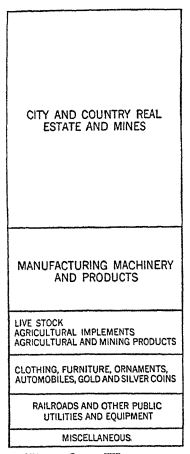
The diagram shows what is contained in this wealth of ours. Half of it is real estate and mines. The other half is made up of railroads, waterworks, telephone and telegraph equipment, live stock, machinery, manufactured goods, agricultural [ p. 177 ] commodities, clothing, furniture, precious metals, etc. One writer calls our wealth “the materials of civilization.”
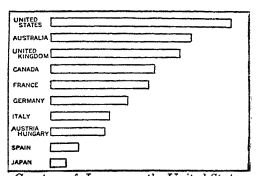
Per Capita Income of Various Peoples
The length of the rectangles gives a basis of comparison. The United States is easily in the lead.
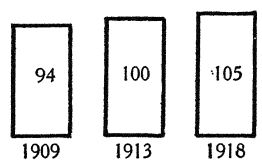
When we represent the per capita income of 1913 by the figure 100, the figure 105 represents our income for the year 1918 and the figure 94 represents what the situation was 1909.
Our income. — Thus far we have talked of our total wealth. Now let us talk of our income — of the amount of goods which becomes available for us to use every year. This is the yearly product or yield of our agriculture, our mining, our manufacturing, our transportation, our banking, our teaching, our medical work, and all the other varied activities of this complex life of ours. (The work of the housewife in running her household is, however, not included in these figures.)
As regards income, also, we are the most fortunate people of the world. The diagram above shows clearly that we are much more fortunate than any other group. We are more fortunate, even, than the other English-speaking nations. But even so, our annual income is not enormous. It amoimted to only $586 per capita for the year 1918. This income, too, is growing rather slowly as the chart to the left shows.
Fortunate as we are in the United States, it is quite clear that our surplus of good things is not great, and it is not increasing as rapidly as we should like.
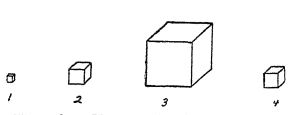
No 1 shows the wealth of the average poor family (65% of our population). No. 2 shows the wealth of the average middle—class family (33% of our population) No 3 shows the wealth of the average rich family (2% of our our population). No 4 shows the wealth each family would have if our wealth were evenly distributed.
Our wealth and income are in relatively few hands. — All of us know quite well that the good things of this world are [ p. 178 ] not evenly divided. We talk of the rich, of the well-to-do, of the middle class, of the poor, and of other groups of our society. These words have no exact meaning. It is, however, clear that about one fiftieth of our people own more than half of our wealth, whereas almost two thirds of our people own only one twentieth of our wealth. When we remember that our total wealth is not enormous, it becomes plain that a good many of us are not in a very fortunate situation.
Our annual income is more evenly divided than is our wealth. But here, also, a great many persons are not in a very favorable situation. We do not have full and exact figures of income for our people. The figures below for the year 1918 must be regarded as our best estimate. They show that about one fifth of the income receivers took about one half of the income, leaving the remaining half of the income to be divided among four times as many persons. And we must remember that the total income was disappointingly small.
Many of our people live in poverty or the fear of poverty. — Just what do these figures mean? They mean that there are in the United States to-day great numbers of people “who are poor in the sense that they are not properly fed, clothed, sheltered; people who from birth have less than enough of these absolute necessities; who, in the [ p. 179 ] main, toil long and hard for even the amount that they do have; who toil in more or less constant fear that even this small amount may fail them.”[2] A few years ago a careful student estimated that in some parts of our country as much as 20% of the population had too little of even the bare necessities of hfe. He estimated that in the United States as a whole, in even fairly prosperous years, there were as many as ten million persons who were in poverty. The worst of it is that these people who are poor are always in danger of falling to an even worse position. They live on the edge of a precipice of want and suffering.
How Those Who Received Personal Income in 1918 Were Grouped (37,569,000 Persons)
The most prosperous 1% took 14% of the total income
The most prosperous 5% took 26% of the total income
The most prosperous 10% took 35% of the total income
The most prosperous 20% took 47% of the total income
The remaining 80% took 53% of the total income
When such things are true (and they are true), we have no right to be too proud of what we have accomphshed. We have no right to feel that we have solved the problem of hving together well. We have no right to feel, either, that there is some easy solution, such as that of dividing up our goods evenly. One trouble with that solution is that there is no great surplus to divide!
Our physical well-being is far from satisfactory. — Of course there is very much more to this life of ours than food, clothing, and shelter; very much more even than these necessities plus music, art, recreation, and the comforts and luxuries of hfe. We might have all these things and still be miserable if we were in poor health in either body or mind. Now, the truth is that we have made but the merest beginning of hving together well as far as health is concerned. This country alone has 40,000 persons who are totally deaf; 53,000 who are totally blind; 74,000 who are insane; 25,000 who are killed every year in industry; and 800,000 who are hurt so severely that they are out of work for four weeks or more. Epidemics are still far too common.
[ p. 180 ]
In this chapter we shall study five great factors in living together well. — We have looked at only a few examples of our ill-living. But those examples are convincing. Clearly, we are so far from living together really well that it is worth while to think about the matter very seriously. Accordingly, one of the things that we shall do in this book is to build up a list of general statements about how to live together well. We cannot make a complete hst at this time. We can only make a start, by putting down now the statements growing out of our work up to the present time. We shall add to the list in Parts III, IV, and Y.
At this time we can make five statements.
- How well we shall live together depends upon the natural resources that are available.
- How well we shall live together depends upon the scientific knowledge that is available.
- How well we shall live together depends upon the capital goods (tools, machines, materials, etc.) that are available.
- How well we shall Uve together depends upon the hiiman resources that are available.
- How wen we shall live together depends upon whether we use our natural resoiurces, our capital goods, our scientific knowledge, and our human resources for better living or for evil living.
¶ B. Natural Resources and Living Together Well
(How well we shall live together depends upon the natural resources that are available.)
We have not used this term, “natural resources” often although we have talked a great deal about the things it includes. It includes, among others, such matters as rainfall, soil, climate, water power, beds of iron ore, veins of coal, winds — in brief those goods and forces that Mother Nature freely gives to us.
Good natural resources are absolutely vital to living together well. — We need only to look at such a list to realize [ p. 181 ] that man is absolutely dependent upon nature. Nature gives us the basis for everything we use and everything we do. We saw that the Iroquois were helped in their hunting, fishing, agriculture, tool making, and house building by the fact that they were living in a very favorable environment. We know that nomads (people who live by means of their herds and drive them about from pasture to pasture) are largely dependent upon nature; that they are “creatures of their environment.” It is true that, as man grows in his power to harness nature, he becomes more able to command his environment. He transports goods from one place to another; he builds houses to protect himself from the rough climate; he provides clothing for the same purpose. Nevertheless, even in our own hving together (and we have learned to command nature in many ways) beds of iron ore, veins of coal, good soils, and good climates are very important. Other things being equal, the more abundant nature is, the better we shall hve together.
Civilized man makes heavy drains upon natural resources. — As matters are to-day, we should be careful to use our natural resources weU. The geologist Shaler has pointed out that the lower animals and primitive man make no drain on nature’s stores that she does not, herself, replace. The primitive man, who merely appropriates such gifts of nature as nuts and fruits, does not diminish the amount that will be available the next year or the next century.
Civihzed man is, however, a spoiler. He tills or cultivates the ground. When he does this, he tears away the protecting carpet of grass from the field, and a single heavy rainstorm may carry away an inch of fertile soil from some hillside. This is more than would be carried away in five hundred years in the appropriative period of man’s food getting. So, also, civilized man raids the forests for lumber. [ p. 182 ] Even when we do our lumbering properly, we use up our forests faster than nature grows them. When we do our lumbering improperly, the rains no longer soak gently down into the earth. They tear out gulleys, wash away the fertile soil, msh rapidly down into rivers, and cause the floods that we so frequently read about in our newspapers.
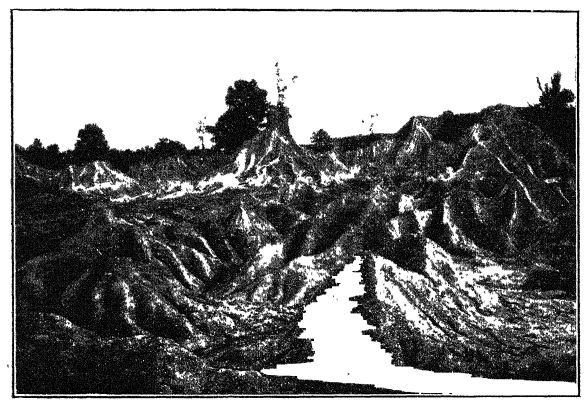
All trees were cut from this land and the rains are washing the soil away and making deep gullies.
Again, man’s drain upon iron ores to-day is so great that there is probably ahead of us a time when we shall again need to use iron sparingly. Perhaps we shall have to substitute other metals, such as aluminum.
Some possibilities in the use of our power resources. — We have looked at merely a few examples of the drains civilized man makes upon natural resources. But even these few examples are more than we shall have time to study [ p. 183 ] in detail. We must choose some one case. Since man’s mastery of power is one of his most important achievements (see Chapter IV), let us choose for study those natural resources from which we secure our power.
Coal. — Our greatest source of power to-day is coal. This coal is stored sunshine of thousands of years ago! The sun enables plants to grow. Every day the earth’s plants absorb thousands of tons of carbon from the air. When they decay, they give this carbon back to the air. If, however, a mass of plants should become covered by water, most of the carbon would not get back to the air but would be held in the plants. Suppose that this mass should become covered by layers of sediment. Pressure and heat would, through long ages, change it into peat, into lignite or brown coal, into bituminous coal, and into anthracite coal. In the long-, long-ago world there were a few spots where just the right combination of great masses of plants, water, pressure, and heat made possible the veins or beds of coal which we use to-day. There are, of course, only a certain number of [ p. 184 ] such veins, and nature would need ages to make new veins. When we use a ton of coal, therefore, we diminish by that much our supply of coal.
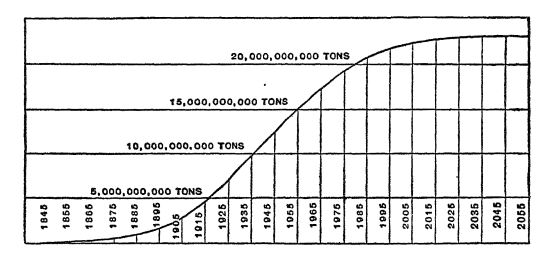
Notice how recently we have begun to consume coal on any considerable scale and how rapidly we are increasing that consumption
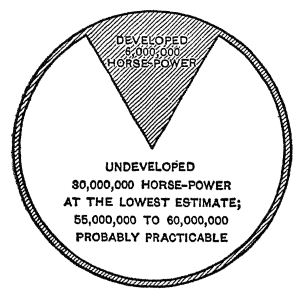
Clearly we have only begun to develop our water power — our “white coal” as it is called.
We have, scattered about in various places in the United States, a stock of coal that would make a mountain 18 miles long, 18 miles high and 18 miles wide, and we have mined less than 1% of the original amount. We are, however, using our coal more and more rapidly. Further more, many veins of this coal are not very accessible, and many other veins are of quite poor quality. To make a long story short, the end of our coal supply is clearly in sight within the next few centuries. This is true both of the United States and of the other Water Power in the United States countries. If we think of man’s future in the light of his long past, we see that our coal is a very temporary power resource. It will be used up. If we are to hve together weU through the coming centuries, we must some day find other power resources.
Petroleum and natural gas. — We shall not find sufficient power resources in the other fuels of to-day, petroleum and natural gas. Their supply is even more limited than that of coal. As far as that part of our petroleum which flows from wells is concerned there is a supply for only a short period of years. It is true that there are great quantities of petroleum, w’hich can be “manufactured” out of our shales. But as things are to-day, this “manufacture” of petroleum is an [ p. 185 ] expensive process. The fuel thus obtained would be an expensive source of power.
Water power has long been a servant of man. With our modern ability to convert a fall of water into electricity and to carry the electricity many miles, there is little question that the time wiU come when water power will be more useful to us than our waning coal supply. Our water power does not diminish through use, for it is continually being replaced by nature’s rains.
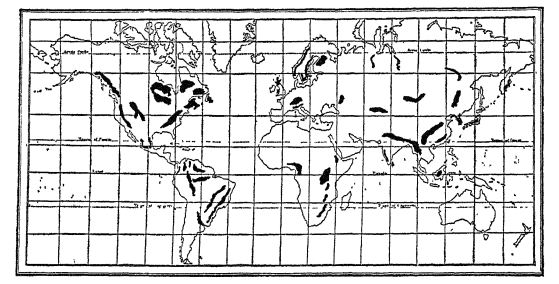
The black spots show the areas where conditions are such as to make development of water power possible. The Americans are especially fortunate.
It must be remembered, however, that water power can not be developed everywhere. We can have good water power only in those regions where there is good snowfall or rainfall; where the flow of water is regular or can be made regular by making reservoirs; where the height above sea level is sufficiently great to get a “fall” as the water returns to the seas; where the surface conditions (topography) are such as to concentrate this fall at one point or at a few points, so as to be of service. The map shows that these [ p. 186 ] areas are neither very numerous nor very large, and some of them, as the world’s population is distributed to-day, are located at points which cannot serve many people. A shifting to winter power will probably mean considerable shifting of population also.
Tides and ocean waves. — Valuable as our water resources are, there can be no question that, as our coal and oil wane, we shall have to turn to other powers. One power that man has long dreamed of using is the tides. There is here perfectly enormous power — power that would suffice for any thinkable population on this earth. But how to utilize it is the problem. There have been and still are on ocean coasts a few “tide mills” which catch the water in such a way as to make it turn wheels as in an ordinary waterfall. The tides are, however, not continuous. They do not even come at the same hour every day. It follows that any large use of tidal power must apparently be in connection with storage batteries and must wait for some plan which we cannot yet picture of providing “harness” at the shore lines. The same remark can be made of any possible utilization of the waves of the sea. We do not now see how to utihze these ocean powers on any large scale, but it is possible that we shall ffiad some way to use these powers later, when the scarcity of coal begins to pinch.
Plants. — We have a power resource, too in om plant life. Only to a slight extent will this come from burning the wood of our forests. That amount will not go far and it will be needed for other purposes. We shall perhaps get power through the ability of our chemists to procure alcohol and vegetable oils from our plant life. How great use wiU be made of such power resources in later centuries we have, of course, no means of telling at this time. We dream of finding here quite considerable resources.
[ p. 187 ]
The sun’s rays. — We also dream of using the sun’s rays. A few ‘'solar engines” which catch the sun’s rays and turn them into mechanical horsepower are already in existence. Up to the present time, however, we have not been able to make solar engines that can compete with the coal-heated steam engines. Perhaps we may be able to do so in the future, but here again the areas in which we can have steady, intense, dependable heat for such purposes are so located as not to serve great masses of the world’s present population. Of course, the hot deserts are the places of dependable sun’s heat, but these are poor places in which to live.
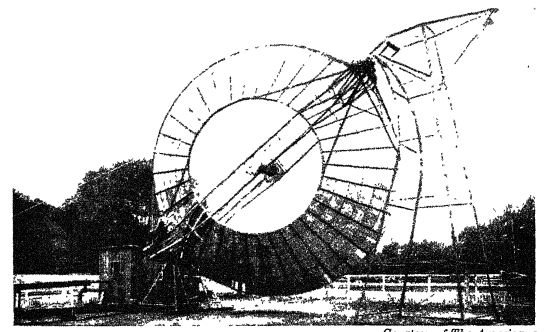
One Type of Solar Engine
The engine is mainly a big reflector to catch the sun’s rays. It is expensive to build in proportion to its power, and it is not easy to protect from the wind.
The winds. — Very likely we shall depend upon the winds more in the future than we do to-day. They are, of course, uncertain. Not until they have been harnessed up with some storage-battery device will they be a dependable servant. However, as coal becomes dearer, it will not be surprising if man harnesses the winds more effectively.
[ p. 188 ]
We must use our natural resources wisely. — Our civilization is a civilization that is built upon power. What we have seen of our power resources is enough to disquiet us concerning the possibility of our living together well in a far distant future, unless we become able to command power resources not being used to-day.
It should be remembered that we have been discussing power as just one example of our use of nature’s gifts. Nature’s gifts, such as our power resources, our forests, our soils, and our metals, are not so abundant that we dare be careless in our use of them. We should “conserve” them. That means we should use them wisely.
¶ C. Science and Living Together Well
(How well we shall live together depends upon the scientific knowledge that is available.)
We make the best use of our natural resources and our other goods only through scientific knowledge. Indeed, as we saw in the last chapter, the spread of scientific knowledge is mainly responsible for the great outburst of invention in the last sixty years. Scientific knowledge is our greatest aid in wringing nature’s secrets from her and in making them available for man’s use.
We can get some idea of what acquired knowledge means to us to-day by remembering how meagerly the 15,000 Iroquois lived and then realizing how much better 15,000 of us would live if we were to move into just such a territory, taking with us our modern libraries, scientists, schools of technology, and perhaps enough “capital goods” to make a start. There can be no doubt what would happen. Fifteen million of us could live in that territory many, many times better than the 15,000 Iroquois lived, and 15,000,000 is a thousand times 15,000. That gives us some measure of the [ p. 189 ] progress we have made. For much of that progress we may thank acquired knowledge.
What will be the future of science. — What may we expect to happen in the future as far as our scientific knowledge is concerned? Will it continue to grow as it has grown in the past and especially as it has grown during the last century, or will our science cease to grow? It is well for us to remember that in ancient Egypt scientific knowledge grew for a time and then declined; that in the wonderful nursery of science, ancient Greece, it flourished for three centuries and then declined; that in Alexandria it flourished for a century and then shrank; that among the Arabs a period of progress was followed by a decline. Will history repeat itself with us? That is a possibility.
Our science is widespread. — While it is possible that our scientific knowledge may cease to grow, there are good reasons why it is not at all probable this wiU happen. It is probable, indeed, that our scientific knowledge will grow faster and faster. For one thing, our science is much more widespread than earlier science was. Earlier science was in little pockets of the earth’s surface — in Egypt or in Greece or among the Arabs. Our science is spread over many nations. This makes it much less probable that any catastrophe (such as a war) can harm the science of to-day as seriously as catastrophes injured science in these earlier pockets.
In addition to our science being spread over many nations, it is also much more widely spread among the people of those nations. After all, those w’ho had any chance to get scientific knowledge among the Egyptians, the Greeks, and the Arabs were few and far between; only a small part of those populations had a chance even to learn to read and write. The situation is very different to-day, as the chart on [ p. 190 ] page 166 shows. To-day we number our scientists by the thousands. We number by the millions the persons who have a chance to become scientists because they have a chance to learn to read and write.
Schenectady. N. Y , Aug 19,— [Special.]— Dr. Charles P. Steinmetz, the electrical wizard, known the world, over, believes that at the rate we are traveling the world is making gigantic strides by leans and bounds
1923 to Be Primitive in 2023.
The Wizard visualizes an amazing transformation in life in 2023 When another century has rolled into history people will be amazed at our helplessness in our struggle for advancement, more so than we are in looking back on the almost primitive days when the steamboat made its first appearance on the Hudson river.
Will Have Spotless Nation.
Palls of smoke will no longer hang over cities, streets will be free of refuse, people will be healthier in the centers of population, and every city will be a “spotless town.” That is to be the work of electricity, also.
Steinmetz sees all those things and hundreds of others that even he, with, his remarkable insight into the workings of science, does not feel sure in speculating on.
Surely, with science so widespread over the earth’s surface and so widely understood by the persons living on the earth, it is not probable that our scientific knowledge will be wiped out. It is not even likely to have to pass through any such period of eclipse as did European science during the dark ages before the great awakening (see page 164).
Our science is sturdy. — And our science, which is so widespread, is much more vital and sturdy than was the science of earher peoples. To begin with, we are more curious and inquiring than any of these earher peoples, with the possible exception of the Greeks. Curiosity is one great foundation stone of scientific knowledge.
Then too, we are far better equipped for carrying on scientific study than any group of people in the past. Measuring devices are another great foundation stone of scientific knowledge, and we have certainly developed measuring devices of more kinds and of greater fineness than were ever dreamed of by earlier scientists.
We have built up, too, a wonderful group of agencies or institutions designed to keep our science growing. Our schools steadily spread scientific knowledge; our printing devices do the same through books and newspapers; our transportation and communication enable the scientist in [ p. 191 ] one part of the world to have access to the scientific knowledge of all the rest of the world. Our universities and our business houses have built up research agencies the goal of which is that of “extending the bounds of knowledge.”
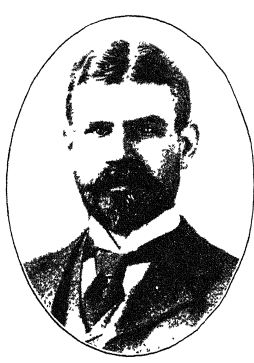
This man laid down his life to help save the rest of us from yellow fever.
Motives to increase science. — The wide spread of our science, then, makes its position secure, and our measuring devices and institutional life make it vital and sturdy. In addition, we have strong motives to increase our scientific knowledge. We have learned how useful science is in the service of man — how much it helps us to harness nature and how important it may be in our living together well. This vision of what science may mean has begun to appeal to the best that is in us: to our ideals. The service of science may, indeed, call for heroes. Science has had its heroes, who have even laid down their lives that yellow lever and typhus and other scourges of man might be conquered.
Quite aside from this heroism, there is a spirit of adventure in serving science; there is a challenge even to the most gifted imagination. What could be more interesting and more challenging than the attempt to understand how this world of ours is put together? It is not surprising that all of us have come to feel that the servants of science are worthy of honor and esteem; that the work of science is worthy of support by taxes and gifts; that each of us has a privilege, an opportunity, and a duty in mastering the [ p. 192 ] knowledge that has been acquired and in extending its boundaries.
A dream of the creative possibilities of science. — Let us now tie up this discussion of the future of scientific knowledge with the discussion of the future of our natural resources and especially with the future of power. We saw that our civihzation is built on power, and that as far as our present power devices are concerned, the time may come when our civihzation will be in danger. Can the scientists come to our rescue? There can be little doubt that our scientists will steadily improve our existing powers. Will they be able to harness powers of which we are not dreaming to-day? Of course, no one can answer such a question as that and be certain that his answer is correct. However, since we all like to wonder about things that may happen, and since the things our scientists have already done are quite as wonderful as any of the stories we read in the Arabian Nights, let us see what it would mean if our scientists should, some day, learn to harness the atom and make it work for us.
The molecule. — We know that everything, whether solid, hquid, or gas, is made up of little particles that we call molecules. These molecules, even in solids, are always in violent motion, rushing about, colhding, and rebormding in every direction. Pull a coin out of your pocket and look at it. It seems very quiet. As a matter of fact, there are in it trillions of molecules dashing about. The coin is just one huge reservoir of energy. Or, notice the air on a still day. There seems to be no motion in it; yet each molecule in that air is dashing about at a rate faster than that of a rifle bullet and is colliding about five biUion times a second with other molecules. These molecules are so exceedingly small that it would take more than a hundred million of them side by side to reach an inch. This does not mean much to us until [ p. 193 ] we remember that that number is about as large as the population of the United States to-day. As many persons as that, placed side by side, would reach around the world. [3]
The atom and electrons. — Now these molecules, small as they are, are made up of atoms that are much smaller. You can get an idea how small these atoms are by remembering that if a little bubble of gas the size of an ordinary pin head were made as large as the world is to-day, its atoms would then be the size of tennis balls. But these atoms are made up of even smaller things. Atoms are made up of electrons, “particles” of electricity, centering about a “nucleus.” If an atom that we talked about above were made the size of St. Paul’s Cathedral, each electron in it would be about the size of a small bullet.
By carrying further the statements on page 155 we can see this story of electrons more clearly. Just as words are made up of syllables, which are made up of letters which are made up of curves and straight lines, substances are made up of molecules, which are made up of atoms which are made up of electrons around; a nucleus
And now we come to the power story. In most substances the electrons are being held together in the incessantly active atom, but it is possible to cause the atom to break up and shoot out electrons. That is what is happening in radium all the time. These electrons are shot out of atoms at a speed which may approach 160,000 miles per second. One writer has calculated that it would take 1,340,000 barrels [ p. 194 ] of powder to give a bullet the speed of one of these electrons. He says that a small copper coin contains energy equal to eighty million horsepower. A few pounds of matter contain more energy than we can to-day extract from milhons of tons of coal. Half a brick contains as much energy as we now get from a small coal field. Every breath we draw contains enough energy in the atoms of the air to drive the wheels of the workshops of the world.
Harnessing the atom. — Will science ever tap this enormous energy? Some scientists beheve that the day will come when we shall be able to harness and to utilize atomic energy. No one knows when this will happen; it may be a thousand years; it may be done to-morrow; though undoubtedly it will take a fairly long time to develop power machines that can make use of such forces. It took us several generations, you will remember, to develop effective steam engines. The devices that will be necessary to use atomic energy, will, of course, be much more complex and much more difficult to develop. It may be that we shall never find ways to release atomic energy except at a cost greater than the energy is worth.
One thing is certain: if we ever do learn to harness atomic energy and to harness it in any effective way, the result will be a new world to five in. We have seen that the harnessing of metals and of steam and gas and electric power have made our world very different from the world in which people lived before this harnessing occurred. These devices made it possible for us to use natural powers and thus to multiply our own powers. Now the natural powers concealed in the atom are much greater than any natural powers we have yet harnessed. We can hardly think up appropriate illustrations to show the difference. We cannot even pictme the situation. If this energy is harnessed and if this [ p. 195 ] natural power is only used wisely, it will mean enormous things for our living together well.
Science is not magic. — We must, however, keep our vits about us. Even if the atom is ever torn apart under such conditions that its power is harnessed, it will not all be clear gain any more than the blast furnace is all clear gain. There will be preliminary work to be done. We shall still build machines to build machines to build machines to make goods. We shall still need to be careful that our powers are used for good and not for evil purposes. We now know what science means and what magic means, and so the expression “we cannot live together well by magic” should convey to our minds this thought : we should not expect to be relieved of the necessity of work — hard work — of planning, of forethought, of being conscientious in our use of our abilities. There is no magical way of getting something for nothing in our effort to live together well. The way of science is not the way of magic. It is the way of orderly, painstaking effort.
¶ D. Capital Goods and Living Together Well
(How well we shall live together depends upon the capital goods — tools, machines, materials, etc. — that are available.)
“Capital goods” is a term we have not used in earlier chapters. It is the general term that economists (scientists who study man as he tries to get goods with which to gratify his wants) have hit upon to include blast furnaces, tools, engines, agricultural implements, domestic animals, factories, raw materials, and many other things which man works upon or works with.
At this time we need only to learn the term from the economist. We have already seen how true it is that man has come to use these capital goods more and more. Their [ p. 196 ] use in metal making, in power producing, and in food getting has made it a very different world to work in and to live in (see pages 100 and 132). Truly, how well we shall hve together depends in large part upon the capital goods that are available.
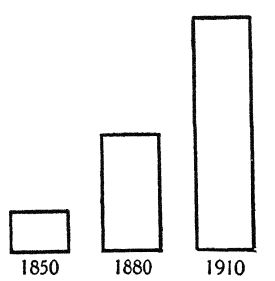
There was in the United States in 1910 five times as much per capita of capital goods in fisheries, in livestock, machinery, tools, implements, railroads, business buildings, and improvements as there was in 1850. Notice that this is true per capita.
Our use of capital goods is not all clear gain. — There is no doubt that we have made real progress in this matter of capital goods. In the first place, we have many more of them than we had formerly, as the diagram shows. In the second place, the capital goods we have to-day are much better (more productive) than those of the past. We have seen many illustrations of this. Notice, too, the diagram below.
But we cannot rest on our oars in this matter of capital goods. It is very easy to be too hopeful over what has been accomplished; very easy to assume that our problems have largely been solved and that we do not need to work hard. This is very far, indeed, from being the case.
How Machinery Helps in Wheat Raising
The upper line represents the average time used by a farmer in raising a bushel of wheat 100 years ago. The lower line represents the average time taken now that he is using machinery.
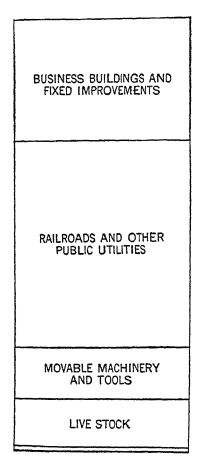
The chart does not include raw materials, etc. It includes only those capital goods that act upon materials.
Much preliminary work needed. — While it is entirely true that capital goods are very useful, we need to remember that all is not “clear gain” in our use of capital goods. It is true that a blast furnace is very productive of [ p. 197 ] iron; it will turn out as much iron per day as 200,000 of the toiling African savages mentioned on page 90. But that is not an entirely fair way to state the matter. These savages spent little time and energy in getting ready to make iron. They went at it directly. With us, however, there are vast quantities of preparation. We make engines, cars, cranes, ships, steel shovels, bricks, factories, and other capital goods for months and even for years before we get a single pound of iron from the furnace. All this preliminary work takes time and energy.
What is true of the blast furnace is true of every other form of capital goods. When we think how useful and how productive the modern machine is, we shall do well to remember the vast deal of preliminary work which we go through when we make machines to make machines to make machines to make machines to make consumers’ goods for us. Only by remembering this can we get a fair idea how much such devices have contributed to our living together well.
Much wear and tear. — Then, too, we need to keep in mind another cost, wear out as they are used. These capital goods They have to be replaced. Replacing them does not increase our powers; it merely keeps them what they were. Worse still, many capital goods rust out in idleness or are made useless by some new invention. As an illustration of the way they fade away, [ p. 198 ] take our great annual output of iron. You will remember that the figures were quite startling and gave the impression that we ought to live very well indeed (see page 95). The truth of the matter is that the annual wastage of our iron through rust alone is very great. One writer thinks that on the average we lose in this way about one fourth as much as we produce. Or take the machines in our factories. They wear out, they break, they become out of date, they are thrown out on the scrap heap. Our factory owners set aside every year out of their earnings a very considerable sum to repair and replace machines. This is just what we should wish them to do. The energy that is thus used in keeping up our stock of capital goods is, of course, used wisely. There can be no doubt, however, that it is a costly matter. Using capital goods is not all “clear gain.”
Fields of use limited. — Then, too, in thinking how much our capital goods mean to us in our living together well, we need to remember that they are not equally important in every part of our life. We use them a great deal in transportation and in manufacturing. We use them somewhat less in agriculture. We do not make much use of them in painting pictures or in selling goods or in all such personal services as teaching, preaching, law, and medicine. In other words, these helpful devices are helpful mainly in certain parts of our living together.
What can we expect of the future as regards our capital goods? — Clearly, as far as our capital goods are concerned, the problem of living together well has by no means been solved. We have made great progress, but there is still an almost endless lot to do in improving our capital goods, increasing them, making them useful in new fields, and above all in making sure that we use them helpfully and justly. Even if we should harness the atom, these statements would [ p. 199 ] remain true. That explains why there is real point to what we hear to-day about the wisdom of preventing waste and about the wisdom of encouraging thrift. The householder who lets water faucets run unnecessarily, the boy who willfully breaks a street light, the Hallowe’en party that destroys property, the nation that unnecessarily uses up capital goods in carrying on wasteful wars — all these are using up energies of society to no useful purpose. Since wasted goods must be replaced before we can go forward, these persons are preventing, by just so much, our moving forward to a better living together.
How well we shall live together depends upon the capital goods that are available.
¶ E. Human Resources and Living Together Well
(How well we shall live together depends’upon the human resources that are available.)
It is very important that we should use wisely our natural resources, our acquired knowledge, and our capital goods. It is even more important that we should use ourselves wdsely. Indeed, that is the main thing in living together well to-day.
The many forms of human waste. — It is so foolish to use unwisely our human resources, so foolish to waste ourselves that it seems almost impossible that such wastes should occur. They do occur, however, and they are enormous. The diagram on the next page gives some of the ways in which men go to waste.
We have no way of knowing what these wastes are costing us. We cannot even guess, for example, how much society loses because people are not well trained for their work. Everyone who has thought about the matter agrees that the sum is huge. We cannot even guess, either, how much [ p. 200 ] society loses because all of us, both the well trained and the poorly trained, make such poor use of our abilities. We do not work nearly as much as we are able to. Few of us, indeed, exert ourselves even to the point of helping to keep healthful and happy. We are like a piece of steel that we permit to rust away and disappear rather than use it enough to keep it bright and keen. Our scientists who have studied this matter (the psychologists) agree that most of us hardly tap the powers that are within us.
Some Forms of Human Waste [4]
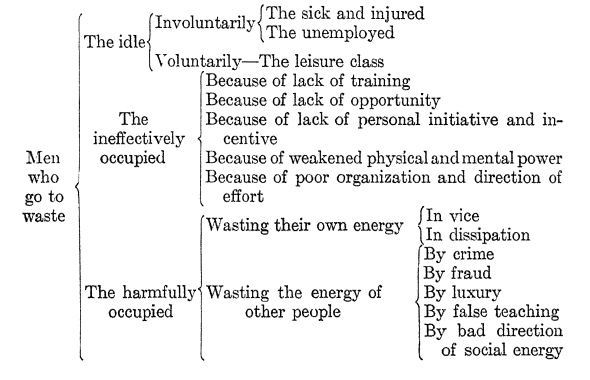
And then, as the diagram shows, there are the wastes due to dissipation and vice, to crime and fraud and false teaching, to weakened physical and mental power because of poverty or sickness; to the fact that a good many very able men and women are voluntarily idle. One writer has pointed out, as [ p. 201 ] an illustration of this last waste, how much society loses in health and happiness when some great physician retires from his work just because he has become wealthy enough to retire. He is much needed by the community. Society loses his services when he retires.
Some of the wastes shown in the diagram can be stated in fairly definite amounts. Here, for example, are some samples of present-day losses due to unemployment and illness and accident in the United States alone:
- 2.500.000 persons, on tlie average, unemployed every day.
- 2.400.000 persons, on tlie average, ill every day.
- $500,000,000 loss annually by deaths from tuberculosis.
- $100,000,000 loss annually by illness from malaria.
- $135,000,000 loss annually by illness from typhoid fever,
- $250,000,000 loss annually by illness from hookworm.
- $2,225,000,000 loss annually from accidents. Every six seconds somebody is injured while at work; somebody is killed every eight minutes.
- $26,000,000,000 loss in this generation from shortened life because of tuberculosis alone.
- 25,000,000 have defective vision.
This list of examples could easily have been made four or five times as long, but even these few examples are startling enough when we remember that we could prevent 75% of such losses if we just made use of the knowledge we have to-day. An even larger percentage of these losses could be prevented in the future by increasing our scientific knowledge.
Even if we are not able to give any figure that tells the total of all the forms of human waste occurring in our country, we may be quite sure . these losses are enormous. In dollars they must run into scores of billions per year. In misery and suffering and disappointments they simply cannot be [ p. 202 ] measured at all. It is easy to believe the writer who said that we are not making wise use of more than 20% of our human resources. Some persons have put the figure as low as 3%.
Using Our Powers Effectively
The short line shows what we actually get done. The long line shows what we cotoid get done if we used our powers effectively.
Fortunately we are doing much to conserve our human resources. — If we become gloomy when we think how we are wasting ourselves, it is at least encouraging to know that we are making very real progress at every one of the points mentioned in the diagram on page 200. If we made a complete list of all the gains we are making in conserving our human resources, it would almost be a list of all the things men are doing to-day to improve their living together. Although we cannot wisely try to make such a long list as that, we can see a few of the more important examples of what is being done.
Diminishing illness and accidents. — We have already seen that, thanks to the growth of medical knowledge and of institutions which turn that knowledge into rules of action, we are making great gains in diminishing illness. The diagram on the opposite page, showing how the death rate has dechned in a hundred years in one of our cities, shows that progress is taking place. Similar progress has taken place in the last twenty-five years in our business houses where better medical attention and gi-eater emphasis upon “Safety First” are reducing illness and accidents.
Diminishing unemployment. — So also we are doing many things to reduce the amount of unnecessary idleness. Better banking laws make our industries more secure so that failure in business does not throw so many men out of work. Better employment agencies (run by the Federal Government, by states, and by cities) let the workers know of jobs that are open. Employers in seasonal industries turn to manufacturing other products in slack times so that they [ p. 203 ] can use their workers the whole year around. Governments and business groups publish information about business needs. Labor unions help their members find employment. All these and many other methods are helping to reduce this particular form of human waste.
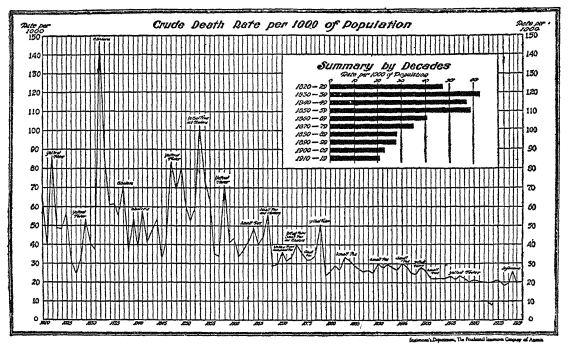
What a satang in human life this reflects! Notice how much more effectively epidemics have been handled in the last generation.
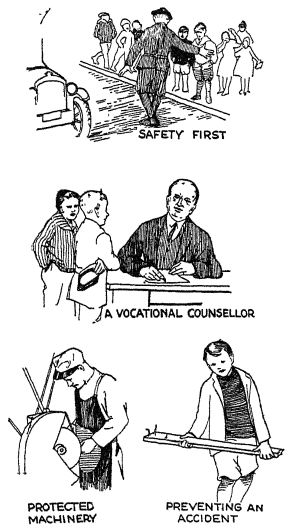
By preventing accidents, by vocational guidance, by protecting machinery, and in hundreds of other ways we are conserving our human resources.
More effective employment. — There is almost no end to the list of agencies in our society that are trying to have persons more effectively employed. To mention only a few examples, our public schools and our business houses and our universities are working at the task of giving better training; our vocational-guidance work seeks to find better opportunities for us and to place us in tasks for which we are best fitted; our more progressive business houses select workers carefully and then train them and fit them into their jobs; our states pass minimum-wage laws, hoping thus to make sure that certain groups of our people get an [ p. 204 ] adequate living and do not become weakened nor poorlytrained. And these are only a few examples of our efforts.
As for the wastes due to persons being harmfully employed, we have laws by which we try to control fraud and crime and vice. But we do not depend upon these laws merely. We try to develop public opinion that -will be opposed to such harmful wastes. We try, through the church and the school, to give good ideals and desires to all our people.
Clearly enough we have come to understand that it is important not to waste our human resources. The National Government, the state governments, the city governments are all working at the task of making conditions better in this field. Churches, schools, and business houses are working at it. Labor unions, employers’ associations, women’s clubs, and many other groups are working at it. Even you and I, by the mere fact of going to school, are working at it, for we are preparing to use ourselves more effectively.
If we wish to live together well, we must make wise use of our human resources.
[ p. 205 ]
¶ F. Good Ideals and Living Together Well
(How well we shall live together depends upon whether we use our natural resources, our capital goods, our scientific knowledge, and our human resources for better living or for evil living.)
We must not make the mistake of supposing that if a people had good natural resources, good capital goods, good acquired knowledge, and good human resources, this people would be certain to live together well. Truly they ought thus to live; but they might not, and they would not unless they used all these things for good living and not for evil living.
It is easy to see that this is true. In wars, for example, we know that natural resources and capital goods and science and human beings are used in ways that cause misery and suffering. The same thing is, alas, true of times of peace. All of us have heard of land (which is a natural resource) being used for harmful amusements; capital goods being used to make harmful drugs; scientific knowledge being used to make others suffer and even to slay them. Human resources are so frequently misused that it is a common saying that there is no crook as dangerous as a skillful crook.
Clearly, neither natural resources nor capital goods nor science nor human resources are in themselves enough. They must be used with right motives and with just intentions. Since all of Part V is to be given to the study of “Man, the Idealist and Aspirer,” we need not spend more tune upon the topic at this place. It will be sufficient just now for us to remember that great powers may be used in evil ways.
We must use them for good purposes if we are to live together well.
[ p. 206 ]
¶ Problems
- Define or explain
Capital goods, Human resources
Consumers’ goods, Natural resources
Per capita, Vocational guidance
Depreciation, Natural enviromnent - Can we measure our wealth in any other way than in dollars? If measured in pounds, acres, etc., could we add it all up and say what the total was? Is money a measuring device?
- What is the difference between wealth and income? Could a person with little wealth have a considerable income? What is the difference between total wealth and per-capita wealth?
- If our total annual income were evenly divided among our people, could everyone “have his own automobile and servant”? How much would each person get? Is it important that more goods should be produced?
- It has been said that if goods were evenly divided we could ail live well and still not need to work more than one hour a day. Does that seem probable to you? Suppose that the statement were true, would it be better to work more hours a day anyhow?
- Since man has already become a fairly good harnesser of nature, how do you account for the fact that our surplus of good things is somewhat limited? Do you think this surplus is likely to grow faster in the next fifty years than it has grown in the last fifty?
- What does poverty mean to those who endure it? Build your answer around health, education, recreation, safety, hopefulness in life, effect upon children.
- Does poverty harm only those who endure it or does it harm the rest of us also?
- Name some natural resources which man is not likely to use up," Is sunshine one? Is coal? Is the force of gravity? Is water power?
- Suppose that we should wake up to-morrow morning and find that all the coal in the world had disappeared but that everything else was just as it had been before. What would we do about it?
- Suppose that we should wake up to-morrow morning and find that all the finished iron in the world had disappeared but that iron ore still remained. What would we do about it?
- Coal is condensed sun’s rays." What does this mean?
- “Our civilization is built upon power.” What does this mean? [ p. 207 ]
- There is to-day much talk of the wisdom of “conservation” of our natural resources. Does that mean refraining from using them, or does it mean using them wisely?
- Suppose that we should wake up to-morrow morning and find that all the iron ore in the world had disappeared. Picture the consequences.
- The gross income of a certain factory was $600,000 per year. The wage bill was $300,000; the raw-materials bill, $200,000; taxes, $2500; interest on borrowed capital, $30,000; depreciation was figured at 5% on a factory valued at $400,000; the rest was profit. What was the amount of profit?
- “Useless destruction of capital goods hinders our progress. Wise destruction of them helps it.” Explain.
- Suppose that w’e should vrake up to-morrow morning and find that all acquired knowledge had disappeared. Picture the consequences.
- Will science diminish, stand still, or grow in the future? Give your reasons.
- What mil happen if we harness the atom?
- What arguments can you give for taxes to support public schools? To support research work in state universities?
- Suppose a man had $1,000,000 to give to some enterprise that would be helpful to man. He asks your advice about a wise way to give it. Confine your advice to enterprises connected with the five points on page 180.
- Are human resources wasted in ( a ) the care of the sick; ( b ) the care of persons too young to work; ( c ) the care of persons too old to work; ( d ) compulsory school attendance; ( e ) premature death?
- Name as many occupations as you can that are dangerous. Name as many as you can in which there is very little danger.
- Several states have set up employment agencies. Do such institutions have any connection with the problems raised in this chapter? What is meant by calling unemployment a “waste of human resources”?
- We hear much of vocational guidance. What bearing has vocational guidance on the matters raised in this chapter?
- If all children over ten years of age were put to work, would more goods be turned out next year? Suppose this policy were kept up for twenty-five years. Would society have more goods on the twenty-sixth year than it -would have had by having had the cMldren continue in school until they were eighteen? [ p. 208 ]
- “We cannot live together well by magic.” Grant that. How can we live together well? Does getting lessons well have anything to do with the matter?
- “Without right ideals, all harnessing of nature is in vain — it is even harmful.” What does this mean?
- Do you picture man ever returning (the world over) to the state of neolithic man? Give reasons for your belief.
- Answer the questions at the beginning of the chapter.
¶ Inteeesting Reading
Marshall: Readings in the Story of Human Progress, Chapter VI.
- The Conquest of Yellow Fever (how science has removed one of man’s greatest dangers).
- Petroleum and Its Uses (what one natural resource means to us: the need of conservation) .
- The Preservation of Foods (the origin and the benefits of canning, dehydration, and refrigeration).
See also:
Readings in the Story of Human Progress, Chapters III, IV, and V. Problems to thinlc over are given in these reading selections.
| V. Science: The Creative Stage of Man’s Harnessing of Nature | Title page | VII. Sign Language, Spoken Language, Written Language, Printed Language; Multipliers of Man's Powers |
¶ Notes
Several of the wealth and income charts are based on King, The Wealth and Income of the People of the United States. (The Macmillan Company.) ↩︎
Cf. J. H. Hollander, The Abolition of Poverty, pp. 1-8. (Houghton Mifflin Co.) ↩︎
These paragraphs are adapted from Thomson, The Outline of Science. (G. P, Putnam’s Sons.) The original phraseology is followed in part. ↩︎
Adapted by permission from Carver, Principles of Political Economy. (Ginn, and Company.) ↩︎