| VII. Sign Language, Spoken Language, Written Language, Printed Language; Multipliers of Man's Powers | Title page | IX. Multiplication of powers through trade |
[ p. 237 ]
CHAPTER VIII
MULTIPLICATION OF POWERS BY CONQUERING DISTANCE
A. Frontier Roads and the Conquest of the Wa terways
B. The Conquest of the Land by the Railroad
C. The Automobile and the Conquest of the Air
D. Electricity Annihilates Distance in Message Sending
Questions to Keep in Mind while Reading This Chaptbb
- What powers has man developed as a transporter?
- What powers has he developed as a message sender?
- What do we mean by saying that man is shrinking the earth?
Man, the communicator, found that talking, and later writing, and much later printing were not enough. He needed effective ways of carrying himseff, his goods, and his messages from place to place. This part of the story of his progress may be called his conquest of distance.
Our own country is the best example of man’s conquest of distance. — It so happens that, of all the countries of the world, our own is the best to use for a study of man’s conquest of distance. We have not only settled a vast territory; we have knitted it into a really United States.
In the early sixteen hundreds (the first settlement of Virginia was in 1607 ; and that of hlassachusetts in 1620), a few scattered settlements were made on om‘ Atlantic coast. The land was a wilderness, wfith no roads and even with very few Indian trails. The dark, grim covering of forest was [ p. 238 ] unbroken for a thousand miles inland, save where some winding river or craggy mountain pierced it.
Small wonder, then, that the first hundred years enabled the colonists to paddle and hack their way inland only about one hundred miles (a mile a year!) and that the second hundred years added only about two hundred more miles (two miles a year!) to the conquest. The population map of 1790 shows that, in the main, we had penetrated to our great eastern mountain barrier and that we were beginning to go through the three great breaks in that barrier; the HudsonMohawk way (marked 1 on the map); the Pennsylvania way (marked 2 on the map) ; and the Cumberland Gap way (marked 3 on the map). Remember that almost two hundred years had gone by in this conquest of three hundred miles. Then, as the population maps of 1820 and 1880 show, in three quarters of a century we conquered 3000 miles, — through to the Pacific coast! And this vast stretch of territory has been firmly knitted together into one nation I This is one of the great achievements of human history. It is a remarkable conquest of distance. In this chapter we are to study some of the more important devices used in this conquest of distance.
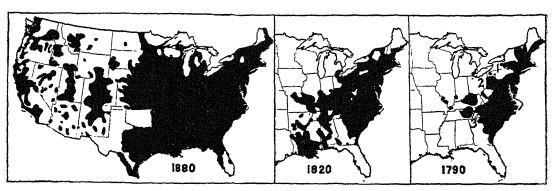
The areas in black are those in which there were two or more inhabitants per square mile in the years mentioned.
[ p. 239 ]
¶ A. Frontier Roads and the Conquest oe the Waterways
(The use of roads, rivers, canals, and the steamboat in the conquest of a continent.)
Frontier-land travel was very difficult. — When one talks of frontier-land travel in our country he covers a period of at least two hundred and fifty years, from the first settlement in 1607 to the time (say 1880) when we ceased to have a frontier. During all these years there was always some part of the country in which land travel was only a little better than it was in the time of neohthic man. Always one word fitly described it, and that word was “terrible.”
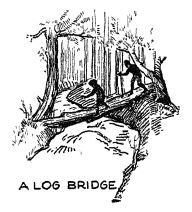
Wretched colonial roads. — In the early colonial days, wheeled vehicles were unknown. They had been rare in the mother country England. They were useless in the new country, where the only roads were the narrow Indian trails. Of course, as settlements increased, it became wise to widen these trails, and from 1650 on we hear of colony after colony making provision for road making. On these roads, wheeled vehicles began to appear. But we must not think of these colonial roads as being like ours of to-day. “ Road making ” often meant merely clearing out fallen timber, blazing or notching trees so that one would not lose the road, throwing logs into marshy places, and cutting stumps so that they did not stick up too far. There were few or no bridges, and the fords were dangerous.
The early American road was a frightful thing. Watery pits were encountered wherein horses were drowned and loads sank from sight. The first postrider’s trip between [ p. 240 ] New York and Boston (made in 1673) took three weeks. We cover that distance to-day in less than two hours by airplane. As late as 1766 it took two days for a passenger coach to go from New York to Philadelphia. It now takes two hours by train. It was not until 1782 that coach service was installed between Boston and New York, and the trip took six days. In 1796 it was said of the road from Philadelphia to Baltimore, “chasms to the depth of six, eight, or ten feet occur at numerous intervals. Coaches are overturned, passengers killed, and horses destroyed by the overwork put upon them.” Before 1800, the turnpike, a road surfaced with fine stone, was rare on the Atlantic seaboard and, of course, quite unknown elsewhere. No wonder people did as much of their travel as they could in vdnter, when the frozen ground and snow let them use sleds.
Roads to the West. — If these were the roads of the eastern settlements, what were those leading to the West like? As one example, let us look at the “Wilderness Road” which Daniel Boone made to the west through Cumberland Gap in 1775. The only tools for road building that Boone and his men carried were axes. Boone went first, picking out the way and cutting notches, or “blazes,” on the trees. His men chopped down the small trees and underbrush. They went around the larger trees. The path was made wide enough for horses but not for wagons. This was the famous Wilderness Road!
As another example, take the Cumberland Road, or National Pike. This road was started (with the aid of the United States Government) from Cumberland, Maryland, in 1806-8 and now runs out into Ilhnois. The aim was to have a great highway connecting the East and the West. At first, even this road was very crude. Only those trees that were less than one foot in diameter were cut level with [ p. 241 ] the surface of the ground. The larger trees might have stumps fifteen inches high. If, however, they were in the center of the road they must be “round and trimmed so as to present no serious obstacles to carriages”! Imagine going over such a road in the springless wagons of that time!
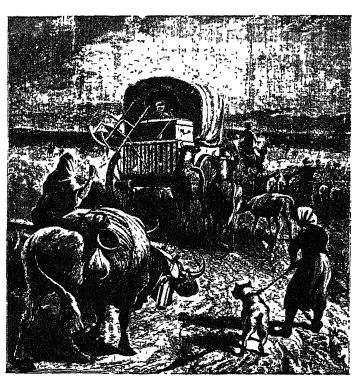
While this old print is not a picture of the Cumberland Road, it shows one kad of tramc that went over that road.
Soon, however, the road was improved, and it became a great channel of communication with the West. The traffic grew as the country grew, and, in time, companies were organized to handle it. The freight traffic was handled mainly in the huge Conestoga wagons with six or eight horses attached. The passenger traffic was handled by stagecoach fines.
The National Pike was by far the best road to the West. As for the roads in the Middle West itself, there were veryfew good ones. At their best in dry weather, they were passable. At their worst in wet weather, they may be illustrated by the main street in early Chicago where a coach remained mired for a week with a sign painted over it “no bottom here”!
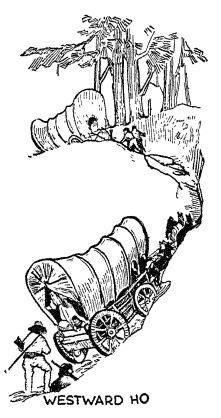
Early transcontinental roads. — Once the settlers had penetrated to the treeless plains of the farther west, they [ p. 242 ] could travel over the level prairies in the famous “prairie schooner.” But when it came to conquering the desert west and the mountain passes of the farthest west, it was a different story — one that repeats the hardships of the earlier conquest of the Appalachians, and therefore need not be told again. The emigrations to Oregon, beginning in the 1840’s; the trek of the Mormons to Utah in the 1840’s; the rush to California after the discovery of gold in 1848 — these are the great chapters of that story. They are chapters athrill with suffering and heroism and conquest.
The use of rivers in the settlement of the country. — The account of our frontier roads shows how slow and difficult the task of conquering our distances would have been if roads had been our only means of transportation. Fortimately there were other means.
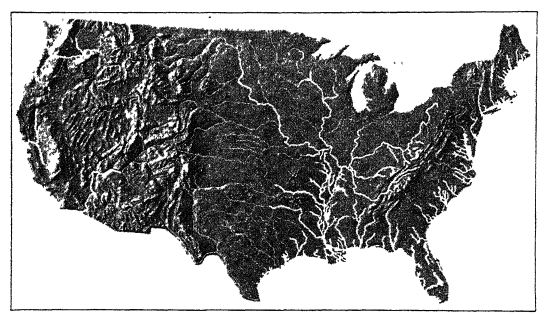
To begin with our colonial days again, the map on the opposite page shows that the settlers were able to use waterways. Along the coast, where the colonists first settled, the ocean ser"ed. As they pushed inland, the many navigable rivers (see the map) gave them access to the country. After they broke through the barrier of the mountains and began to settle the interior, they were again helped by the navigable rivers. The most-used route was overland to Pittsburgh and then down the Ohio and Mississippi and up their tributaries. The map shows that these streams touched a great stretch of territory, and thus helped greatly in the settlement of the West.
[ p. 243 ]
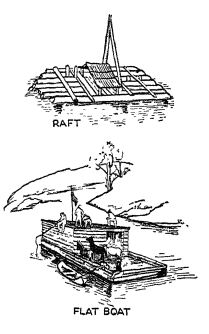
The flatboat — When a pioneer moved west with his family and his few household goods, he usually made or bought a flatboat at Pittsburgh for the later stages of his journey. The flatboat was, as one would guess from its name, a flat, rectangular vessel that drifted down the stream with the current or that was propelled by long oars. Several families would embark in one of these boats with their farm equipment and drift for himdreds of miles to their unknown new homes.
One author tells of the life on the flatboat, how, “some backwoods genius on the cabin roof would touch the resin to his fiddle-bow and send the wild strains … to the wooded shores and back again; while the family mule gave vent to his emotions in a loud heehaw, the pigs squealed, the children shouted and danced in the melody of the combined orchestra, and the women rolled up the bedding, milked the cow, hung out the wash, and killed a few chickens for dinner.”[1]
[ p. 244 ]
There were other aspects of the flatboat voyage that were not so kindly. In the forests along the shore, broken only by occasional trading posts or settlements, were the Indians. They were not willing to give their waters and their forests to the white man and often attacked the river boats. Then, too, the rivers of those days were full of logs and old snags that added to the dangers of the trip.
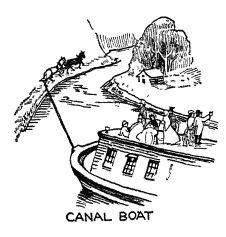
Canals were also important helps in the settlement of the West. — As we look at the map on page 243 we see that there are great stretches of the country in which there are no navigable rivers. These regions had to be opened up by roads, by railroads after they were invented, and by canals. Just now we are interested in water transportation, so we shall deal only with the canals.
The Erie Canal. — One region, in particular, invited canal building.
This was the Hudson-Mohawk Valley in New Yox’k, leading out from the Atlantic into the Middle West.
It was a reasonably level, well-watered territory, and everyone could see that a canal through the region would connect the vast water routes of the Great Lakes basin with the Atlantic Ocean. This would make a great "water highway” to the growing West.
After several false starts, the State of New York began building the Erie Canal through this territory in 1817. It [ p. 245 ] was a hard task. Mechanical excavators had not yet been invented. The work had to be done with teams and scrapers, with shovels and wheelbarrow’s. "WTien it was finished in 1825, it was over 350 miles long, 40 feet wide at the top, 28 feet wide at the bottom, and 4 feet deep. Compared with our engineering works of to-day it was just a good big ditch. Ditch that it was, it meant a great deal to our people. The whole nation, and especiallj’-the State of New York, celebrated for days the union of the Atlantic and the Lakes.
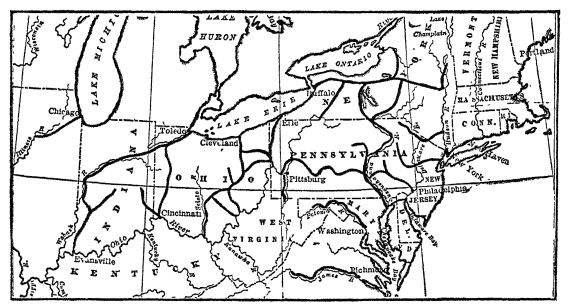
Notice how they connected the waterways of the middle west with the Atlantic Ocean.
Other canals. — There is, in this canal building, a story your history teacher will tell more fully than it can be told now. The early settlers in our Middle West did not live very full lives. The land w’as even richer than it is now, but there w’as not much use in raising more products than the family itself would consume. The only ways to market before the Erie Canal was opened in 1825, w’ere by the long voyage down the Ohio and Mississippi and then over the seas; or by the still longer and harder voyage up current [ p. 246 ] and then over the rough mountain roads. The Erie Canal was so much easier and cheaper a way to market that a sort of craze for canal building swept over the Middle West from 1825 to 1840. It was in this period that most of the canals shown on the accompanying map (page 245) were built. Some of these canals were poorly located, and most of them were gradually driven out of business by the coming in of the railroads after 1828. But they served their purpose. They were steps in human progress.
The steamboat meant a multiplication of man’s transportation. — While the beginnings of our water transportation can be told without reference to the steamboat, its great development was due to man’s servant, steam.
It is hard to know just where the story of the steamboat begins, since the invention of the steamboat depends (as is always the case) upon so many other inventions, and especially upon boats and the homely water wheel. These matters go far, far, back in man’s history. It is said, for example, that back in the days of ancient Rome, one of the Roman emperors crossed to Sicily in a boat moved by paddle wheels, turned by oxen.
Fulton and the Clermont began a new era. — But it was the use of steam to drive paddle wheels, and later the screw, that gave us real mastery of the waters. As was true of the steam engine, there were many unsuccessful and many nearsuccessful attempts to make a steamboat before the American, Robert Fulton, solved the problem. The pictures give a few examples of these early attempts. There was much to learn; much to do. How different should the shape of the vessel be from that of a sailing vessel? Where should the engine be placed? What was the right size of the paddle wheels? Where should they be placed? How much fuel would the boat need to carry? Where should it be put?
[ p. 247 ]
These are only examples of the mechanical and scientific problems that had to be considered.
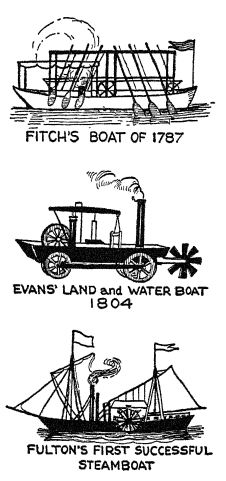
In 1807, when Fulton’s steamboat, the Clermont, was ready to be launched, there was interest in the experiment on both sides of the Atlantic. Most people, of course, ridiculed the idea, and it was hard for Fulton to keep up his faith until the day of the first trip dawned. We may imagine his anxiety on that day, especially when his boat balked for about half an hour. The boat ran. It made the trip from New York to Albany in thirty-two hours, a wonderful achievement in those days. And those days were only a little over 100 years ago.
It helps us see what a new thing the steamboat was when we read how people acted when they first saw it. “Some persons took to the woods in fright. Some prayed for protection from the monster which was marching on the waters.”
Later work of the steamboat. — Once the problem of the steamboat had been solved, the need of good transportation in the Middle West soon caused steamboats to appear on the Ohio, the Mississippi, and the Great Lakes. True, the steamboats could not be used on the canals. The “wash” of the waves would ruin the banks. Steamboats could, however, gather up from the shores of the Great Lakes traflhe for the Erie Canal; and they could carry crops down the Mississippi and over the seas to our Atlantic cities and to Europe. Inland [ p. 248 ] trade developed in every way. By 1850 the trafSc on our inland waterways was equal to that between all the countries of the continent of Europe. Man, the communicator, was knitting together a united nation, one whose every section depended upon every other section; one where each of us could cooperate in the better Hving of all of us.
To-day, there are not many steamboats on our rivers and canals, but steamships carry nearly all of our lake and ocean trafSc. Steam rather than the sail has now become our great servant on the waters.
¶ B. The Conquest of the Land by the Railroad
(What the railroad is and what it means for living well.)
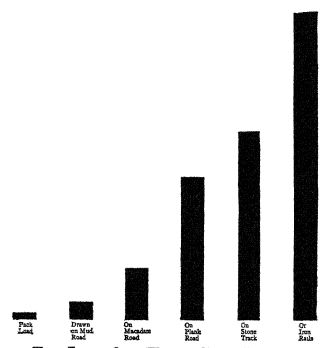
This chart shows why the “iron horse” on a railroad means so much for living well.
Let us again look at our map on page 243. Important as navigable rivers and canals were, they would not suffice for the conquering of our West. They could not penetrate the rough regions. They froze up in winter in much of the territory. Something else was needed. This something else was the railroad.
A road of rails is a very old device. — No one can say when man first made a road of rails. We know that in ancient Greece roads were hewn out of stone with ruts cut deep to fit carriage wheels. We do not know just when the idea came of raising the tracks above the level of [ p. 249 ] the road, but it, also, is a very old idea. On smooth rails, wheels moved with much less friction. Men and animals could draw many times the load they could draw on the muddy roads.
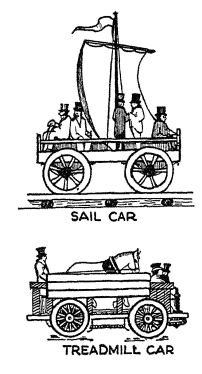
As one might expect of question-asking and problem-solving man, somebody was always tr 3 ring to get better power to apply on these railroads. Sails were tried, but they were not very practicable. The wind did not always blow in the right direction. Treadmills were put in the cars, and the tramping of a horse or mule turned a machine that drove the car. But nothing was found that was as effective as the horse-drawn car until after much experimentation with steam and later with electricity.
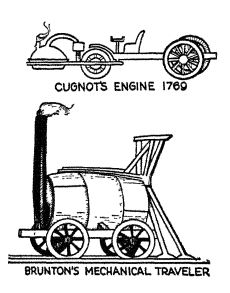
Early experiments with the locomotive led up to Stephen son’s Rocket. — Since roads made of rails were not very numerous, it was natural that some of the early attempts to use the steam engine for land travel would be worked out on ordinary roads, thus foreshadowing the automobile of a hundred years later. A Frenchman, Cugnot, had an engine that ran on the streets of Paris at the speed of about three miles an hour (1769), imtil it upset one day with a crash. Brunton (1813) made his queer “mechanical traveler” which kicked itself along with poles, looking like some strange [ p. 250 ] grasshopper. One day it exploded. Trevithick (1803) made an engine that actually pulled a load. The story is told of his engine nearing a toll gate, which was opened in great haste by the tollkeeper, who thought that the devil was driving by in his carriage. He assured “dear Mr. Devil” that there would be no toll to pay if he would only drive on as fast as he could!
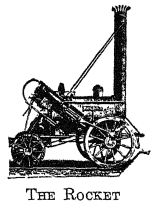
These are only three examples of dozens of early experimental locomotives. They all lacked elements of success. Some were faultily made; others used too much fuel; others could not get up steam fast enough. For one reason or another, they did not work well enough to be really successful. Finally, there came a time when an Enghshman, George Stephenson, using all that had been done by others and making improvements of his own, made the first successful locomotive. As early as 1814 he made one that worked well; but it was not until 1829 that a pubhc demonstration of his “Rocket” made it clear that a new era of transportation had dawned.
What our early railroads were like. — It is hard for us to-day to realize what our early railroads were hke. On the opposite page is a picture of a railroad train of 1831, placed alongside one of our present-day locomotives. A description of the first trip of this train would tell of passengers being jerked off their seats and thrown into heaps when the train started and stopped. It would tell of the clothing of the passengers being set on fire from a deluge of sparks from the wood being burned in the engine.
Other accounts of these early roads supply further details. Trains almost never ran at night. It was too risky. When they did run at night, they made a headlight by putting in [ p. 251 ] front of the engine a flat car carrying a pile of sand, on top of which a fire of pine knots had been kindled. As for signals, there were none. When a train pulled into a station, the engineer would climb a pole and look up the road to the next station, if he could. If a train was long overdue, the only way to find out what had happened was to set out with another locomotive and go cautiously until the lost train was found. Often it was found off the track or stopped by a “snake head.” These snake heads were terrible things. The railroads of those days had rails of wood with a strip of iron nailed on top. The nails would sometimes come loose, and, as the car passed over the iron strip, the strip would curl up around the wheel and thrust itself up through the floor of the ear “like a snake head,” — never, as far as is known, to the joy of the passengers.
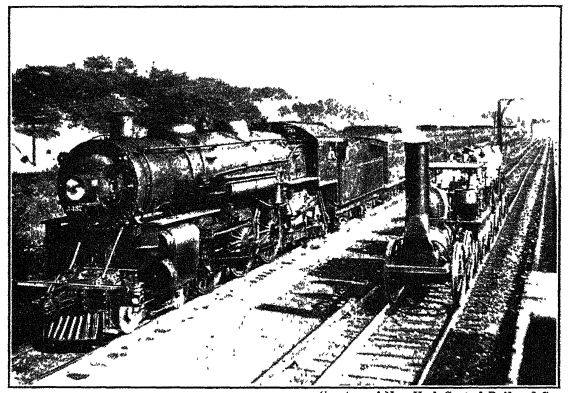
A Modern Locomotive Compared with an Early Train
[ p. 252 ]
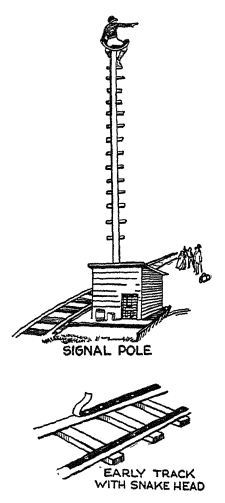
We rapidly developed the greatest railway system of the world. — Many of these early troubles were soon corrected. The others were endured, for the transportation-hungry nation realized that the railroad was what it had long wished for, — a cheap and rapid means of communication that could go into rough territory. Every conamunity clamored for a railroad, and the railway net spread rapidly. By 1850 the railroad began to drive all canals, except those most favorably located, out of business. By 1853 four lines ran from the Atlantic Coast to the Middle West. By 1869 the Atlantic and the Pacific had been Joined by iron bands.
Then came the time of plentiful and cheap steel (see page 95). The result was stronger tracks, bridges, and cars; more powerful locomotives; faster schedules; and heavier loads. The development of the electric motor (see page 120) presently made possible the use of electricity on our city tracks, in our great terminals, and even out through the country.
To-day, the railroad net simply blackens certain parts of the map and reaches out through all other parts. What can be accomplished on this net staggers the imagination. A single modem Pullman train does the work of 500,000 porters. A freight train does the work of 1,000,000. No other people move about so much or so rapidly as we do.
[ p. 253 ]
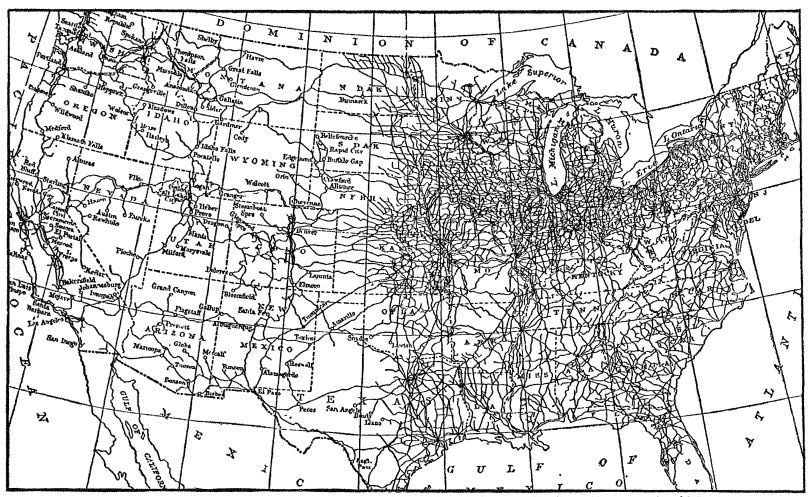
The Railway Net of To-day
[ p. 254 ]
No other people trundle about such masses of freight. No other people have ever been so knitted together by transportation devices. We are one country.
¶ C. The Automobile and the Conquest of the Air
(The automobile, good roads, and the airplane; their effects upon living together.)
The achievements of man with steamships and railroads have indeed been wonderful. These servants have given us our main arteries of transportation. But they are, after all, only our main arteries. In the last generation we have supplemented them with two devices well known to all of us, the automobile and the airplane.
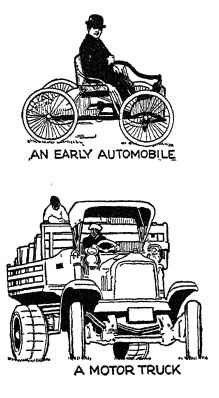
The automobile is only a generation old. We saw on page 249 that over 100 years ago persons were experimenting with engines that ran upon the ordinary highways. The work of Cugnot and Trevithick was especially interesting. But the time was not ripe for the automobile. It had to wait almost a century.
One reason why we did not have the automobile sooner was that we were too much interested in building railroads. A more important reason, however, was the fact that a steam engine was too heavy and clumsy for road purposes; a lighter and more convenient “power plant” was needed. As we know, this Ught power plant was supplied in the 1860’s and the 1870’s by the gas engine and the electric motor Xmotortruck * (see pages 119 and 120) . Then came [ p. 255 ] many experiments with “horseless carriages” both in this country and in Europe. We do not need to work through the details of the invention of the automobile. We already know what we need to know for purposes of our story. Man, the harnesser of nature, harnessed her forces in the gas engine and the electric motor and then apphed them to transportation.
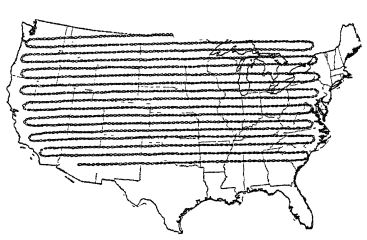
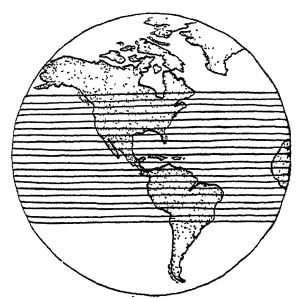
A procession of our automobiles would reach this far.
Although young its influence is very great. — How very recent the automobile is may be seen from the fact that in 1896 there were only four gasoline -burning cars in the United States. Yet in 1924 we had over 15,000,000 motor cars and trucks.
They have become a commonplace of travel and transportation in every nook and corner of the land. Making them has become one of our greatest industries; advertising and selhng them is one of the largest items of our commerce.
Already we are beginning to feel their effects upon-our living together. Great fleets of motor trucks compete with the railroads in hauling produce to our larger cities. Other trucks dehver goods to our retail stores and to our homes. The passenger car makes a thirty-mile trip both shorter and pleasanter than was a five-mile trip twenty years ago. It has made the whole life of the farmer different, for he is no longer limited to a few miles from his doorstep. The passenger car and the motor bus carry thousands of city dwellers [ p. 256 ] to and from their work and then provide pleasure for leisure hours. The governments — city, state, and national — make use of this new device to aid the pohce, the sanitary forces, the army, and the mail service.
Automobile trips of hundreds of miles — even across the continent — are not unusual. Every summer one may see cars pass his door, bearing hcense numbers from practically every state in the Union. Quite aside from the pleasure these tourists get, we need to remember that such movement from place to place causes them to think of our land as one united country.
We are becoming a nation of good roads. — In a very real sense, the story of the automobile is also a story of good roads. Our roads of the 1880’s and 1890’s were probably the worst roads in any civilized nation. Gradually, however, as our railroad net filled out, we came to see that good roads were needed. The farmers found that bad roads either prevented hauling their goods to market at the right times or made that hauling very expensive. They saw that when good roads went through a district, that district rose in value, and they became more prosperous. The city dweller saw that good roads meant cheaper food supplies and added pleasure and recreation.
As a consequence, we began to pay more attention to our -roads. Universities and business houses dealing in road-making material carried on tests and research in the best methods of road building. The Federal Government made grants of funds to states. State governments gave advice and money to local districts. Local governments iucreased taxes and issued bonds to get money for road building.
Although we are just getting well started at this work, the results are already good. Great trunk hues hke the [ p. 257 ] Yellowstone Trail, the Dixie Highway, the Lincoln Highway, and the Liberty Way stretch out through many states. Some states maintain “state” lines crisscrossing the whole state, and these are fed by improved “county” roads. When we reflect that on such roads the automobile may with safety run at a speed the passenger train of two generations ago could scarcely maintain, we see that the automobile and the good road are the fitting climax of our conquest of distance on land.
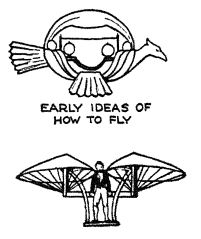
And then came the airplane. — Next came the conquest of the air. Men have always wished to fly. They have watched the birds and envied their swift motion and easy pathway through the air. How much easier it would be, they have thought, to fly than to walk slowly over the ground. In the stories they invented for their children, there have always been seven-league boots and magic caps and magic carpets that easily carry their owners as on wings over great distances.[2]
But when it came really to conquering the air, man found it a hard task. His body was much heavier than the air, and he had no wings. How was he to keep aloft? Here also the answer was to come through [ p. 258 ] the light “power plant” of the gas engine. It was able to drive a machine with planes, or flat surfaces, shghtly tilted so that the pressure of the air (which we had known about since the days of Torricelli, see page 113) would cause the machine to rise. With steering apparatus added, the problem was solved.
The American, Langley, made some of the important pioneer experiments in aviation. Two other Americans, the Wright brothers, made the airplane a practical machine. The first successful flight in an airplane driven by a propeller was on December 17, 1903, over the sand dunes of Kitty Hawk, North Carolina. The flight lasted for twelve seconds. By the next year they were able to make a turn in the air. On October 17, 1905, they made the first flight that lasted over half an hour. It was for 33 minutes and 17 seconds.
With that as a beginning, man has conquered the air. He has exceeded the speed of a bird, and he cuts capers in the air that no sane bird would try. The airplane has become the scouting machine as well as a battle machine of war. It has crossed the Atlantic; it has crossed our continent; it has soared around the world. For fast freight and mail it has no rival. It is used not only for emergency passenger travel and recreation but also for regular passenger traffic. What the future may have in store for it we can hardly guess.
There are three eras in man’s conquest of distance by transportation devices. — A review of the story of man’s conquest of distance shows that there have been three periods or eras in that task:
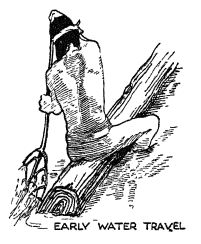
1. Before neolithic man. — The first era lasted through long thousands of years, down to the time of neolithic man. Man had to depend upon his own legs for walking and upon his arms for paddling. The sandal, the moccasin, the carrying stick, and a rude boat were his best tools.
[ p. 259 ]
2. From neolithic man to 100 years ago. — With neolithic man the second era began. Neolithic man found multipliers by taming animals for transport on land and by harnessing the winds for travel on the waters. Then came slow additions resulting in the wheeled carriage on land and the sailing vessel for the seas. But as late as 1834, an English statesman, needing to make a hasty trip from Italy to England, made no better time than Caesar (102-44 b.c.) could have made.
3. The last hundred years. — The third era began only a little over a hundred years ago — almost in the memory of men still living. It is the era in which man, the harnesser of nature, makes nature’s powers fetch and carry for him. Man, building on his progress of the past, has harnessed steam and electricity in such devices as ( a ) the steamship, ( b ) the steam and electric railway, ( c ) the automobile, and ( d ) the airship. With these he shuttles and scuttles about at dizzy speed. Four hundred years ago Magellan’s crews went around the world in three years. It could be done to-day in forty days, using just our regular ways of travel. It could be done in less if one were out to make a record.
Before we go on to our study of the next section, let us free our minds of the necessity of remembering dates by making another chart similar to the one on page 84. A good heading will be:
¶ Six Hundred Years of Conquering Distance by Transportation Devices
On this chart let us insert the dates and events mentioned in pages 244 to 258. It is then ready for the notebook.
[ p. 260 ]
¶ D. Electricity Annihilates Distance in Message Sending (The telegraph, the telephone, the wireless.)
The steamship, the railroad, the automobile, the airplane have enabled us to “shrink the earth” until a person living to-day is more famihar with the whole world than one living five hundred years ago was with his local province. But even these multipliers of his powers have not satisfied man. Even the speed of the airplane is not fast enough for his messages. From very early days he has tried not merely to conquer distance but to annihilate it; to send his messages great distances with practically no loss of time. The story of how he has done this is the story of the telephone, the telegraph, and the wireless. It is told in the next few pages.
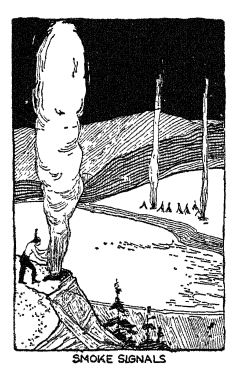
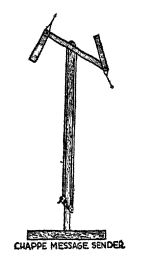
Early ways of sending messages continued down to a hundred years ago. — As is true of so much of human progress, the story of the rapid sending of messages goes far, far back in human history. We are told how more than 3000 years ago the news of the capture of a city was sent by a chain of beacon fires built on mountain tops. We are told how more than 2000 years ago rows of torches, by being first hidden and then displayed, flashed messages in a way not greatly different from the Morse alphabet of to-day. The Indians of our own plains were skillful in sending messages of smoke by day and fire by night. Then, too, there was the invention of the [ p. 261 ] three Chappe brothers of France who in 1791 sent messages to one another by mounting long arms of wood on posts and making the angles stand for letters of the alphabet. We still use a similar device to-day in the semaphores of our railroad and in the flag signaling of the Army and Navy. One should mention, too, the heliograph. This is a mirror shaped so that the rays of the sun can be reflected. Messages are sent by the flashes as far as one hundred miles.
We have in message sending another case where from the time of neohthic man until recently very slow progress was made. Man could send messages almost as rapidly in the days of the neolithic savage as he could in the year 1840. And these neolithic ways of sending messages are not entirely satisfactory. Most of them are useful only for short distances and become useless if they cannot be seen. In fog or in storm, they cease to be helpful. They carmot be sent around a corner; they must go in a straight line. They are very poor as compared with the telephone and the telegraph. But we could not have the telegraph and telephone imtil man had become a scientist and had harnessed electricity.
How electricity was harnessed for message sending. — In just what ways man has harnessed electricity is a story w’hich must be told by your science teacher. For our purposes, we need to know only the more important steps.
1. Over 3000 years ago the Greeks found that when the yellow substance, amber, was rubbed, it attracted light things, such as bits of straw. The Greeks had no idea what caused this. They concluded that there was “life” in amber; that there w’as an “amber soul.” We know to-day that the nibbing caused electrification, and that electricity
[ p. 262 ]
made the straws cling to the amber. This work of the Greeks marks the beginning of knowledge of electricity.
2. Along about 1600 a.d. two scientists, Gilbert and Guericke, found that many other substances would act the same way as amber. Sparks of electricity were actually “made” by rubbing certain substances together. This was a real beginning of harnessing electricity, for man could now, at his will, cause electricity to display itseh.
3. Two hundred years went by. Then a scientist, Volta, made a pile of strips of two different kinds of metal with acid-moistened cloth between the strips. From this he got a continuous current of electricity as compared with the occasional sparks made by friction. This was, of course, a great step forward in harnessing electricity. At about the same time another scientist. Gray, discovered that electricity could be led, or conducted, from one place to another by the use of metal wires. This was another great step forward.
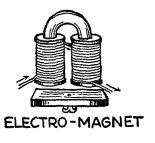
4. Then in 1818-1823, through the work of Oersted and Sturgeon, it was discovered that if a wire were wound around a bar of soft iron and an electric current turned on, the bar became a magnet as long as the current remained on. Much use of this fact was later made in the tele“ graph and telephone.
5. In 1831, Faraday discovered how to make electricity continuously and in great quantities by means of the dynamo, (see page 120). Electricity wms thus made a cheap and dependable servant.
Early experiments resulted in the telegraph of Morse.** — When these things had **been done, the time was ripe for some genius to put together the store of knowledge that had heaped up, make a few additions, and have the electric telegraph. A really scientific explanation of the telegraph [ p. 263 ] (“telegraph” comes from two Greek words and means “far writing”) would require much space. We can see the essence of the matter, however, by following the Scotchman, who explained it to his friend thus: He asked his friend to imagine his dog being stretched and stretched until he reached from Edinburgh to Glasgow, the tail being in Edinburgh and the head in Glasgow. He then pointed out that if someone should step on the tail in Edinburgh the dog would yelp in Glasgow. “Now,” so the Scotchman said, “it is not convenient to stretch a dog such a distance, so the telegraph people use a wire which seems to act just as well.” [3]
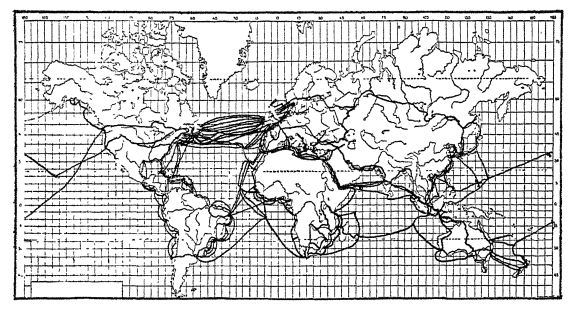
In other words, what we do with the telegraph is this. We start an impulse at one end of the line, and this is carried at tremendous speed to the other end of the hne. At this other end is a bar of soft iron with a coil of wire around it. When the electricity is turned on, this bar becomes a magnet, and dra-ws to it a little piece of iron so adjusted that [ p. 264 ] it clicks. When the electricity is turned olf, a spring draws the chck-producing iron back in place for the next click. All that remains is to work out an alphabet of short and long intervals between clicks (dots and dashes), and the modern telegraph has been made.
An American, Morse, is usually given credit for the invention of this kind of telegraph, although there are others who claim the honor. In 1837, he sent a message through more than three miles of copper wire. After several years of persuasion. Congress gave him a grant of $30,000 to build a line from Washington to Baltimore. In 1844 the line was completed and carried as its first message the now famous sentence, “What hath God wrought.” It took some time to persuade the people that the telegraph was a really useful instrument and not a toy, but as tune went on it came to be used more and more. To-day the extent of its use is almost beyond description.
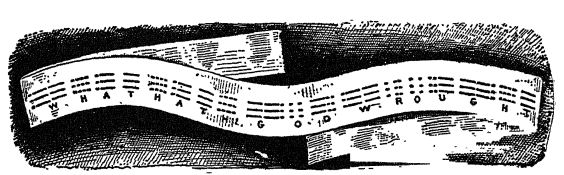
The Tape of the First Telegraphic Message
Of course, the cable is a telegraph wire stretched under the ocean. However, the difficulties connected with getting a line strong enough and with insulating it so that electricity would not be carried off by the water were so great that it was not until 1858 that another American, Cyrus W. Field, laid the first trans-Atlantic cable.
[ p. 265 ]
The telephone enables us to send sound great distances. — In 1877, advertisements were distributed in various cities of an exhibition of a new marvel. The telephone (“telephone” comes from two Greek words and means “far sound”) had just been made a working instrument. It was so new and strange an instrument that people flocked in hundreds to hear Alexander Bell, the inventor, tell of its wonders.
A year before, there had been a famous Exposition at Philadelphia to celebrate our country’s one-hundredth birthday. Back in a small dark corner of the educational exhibit was Bell’s telephone. One day, when the judges were inspecting the various exhibits. Bell was greeted warmly at his booth by the Emperor of Brazil, Dom Pedro de Alcantara. He had met BeU years before, when Bell had helped him make plans for a deaf-mute school. The fact that an Emperor knew Bell interested the judges, and they drew towards Bell’s booth. Bell took up the transmitter and gave Dom Pedro the receiver. By this time the fifty judges had gathered aroimd, close enough to hear Dom Pedro exclaim in great excitement, “My God, it talks.” Then came the scientists to see if it really did talk. They, too, were amazed. For the rest of the time, the “talking machine” was the most popular exhibit at the exposition.
The basic things in the telephone. — As is true of other devices, the telephone dates far back in history for its begimiings. Long, long ago in ancient India, men talked with one another at some distance by using a device very much like that used by boys to-day when they attach tin cans to the ends of a firm string or a wire and talk to one another. The string or the wire carries the vibration of the voice. In the telephone, electricity is harnessed to carry these vibrations.
Bell, the inventor of the telephone (he was but one of several w’ho were working the problem out) finally saw that [ p. 266 ] if the vibrations of the voice were made to strike against a thin metal disk, this disk would also vibrate. He found a way to have these vibrations of the disk affect an electric cm’rent. This current would go over a wire. He also found a way to change the impulses of this current back into vibrations in another disk at the other end of the wire. The telephone of to-day, has, therefore, these essential parts: (1) a transmitter, (2) a vibrating disk starting electrical impulses, (3) a wire to carry the impulses, and (4) a receiver at the other end that turns the electric impulses back into disk vibrations. These are heard as the sound of the voice.

The voice sets up vibrations in the air (A) m front of the mouthpiece. These cause the diaphragm (B) in the transmitter to vibrate m its turn. This vibration causes bits of carbon (C) in me transmitter to change their positions shghtly. This change causes a variation m the electnc current flowing through the circuit (D) to the receiver of the distant telephone. These electnc vibrations coming to the receiver pass through the coil (E) and cause the magnet within the coil to exert pulls upon the iron diaphragm in the receiver (F). This sets up vibrations in the air (G) at the ear of the listener and these vibrations are identical with those made by the voice of the speaker in the distant transmitter
The increasing use of the telephone. — It took Bell and his friends years to get the device ready to be widely used. For example, some way had to be found for multiplying the number of people who could be reached. The first telephones reached just from one house to another. Later all the wires were led to a central place (now called the telephone exchange), and a system was worked out by wMch a telephone user calls the exchange, and the exchange connects him with any other telephone subscriber.
Another hard problem was that of carrying the messages for a large number of nfiles. However, within eight years [ p. 267 ] after the invention of the telephone, “long distance” telephoning was possible between New York and Boston, a distance of 235 miles. In 1892 Chicago was connected with New York. By 1913 New York could reach Salt Lake City, and finally in 1915 she was able to talk with San Francisco and the other west-coast cities.
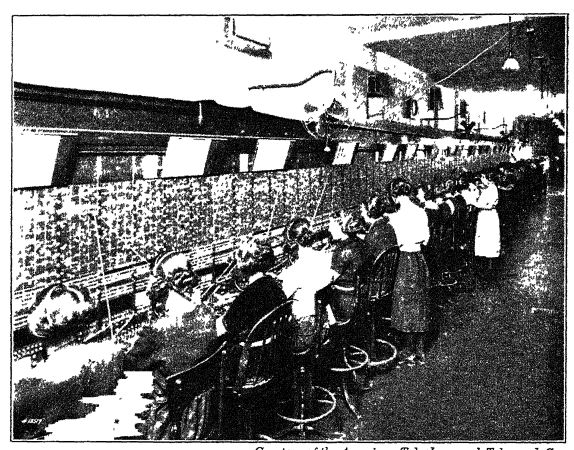
A Telephone Exchange
What the annihilation of distance has meant. — We are so accustomed to the telegraph and the telephone and the cable that we never stop to think what they mean for our living together. But let us ask ourselves a few questions. What difficulties woxild our modem hotels and skyscrapers have if there were no telephones? Could we operate our [ p. 268 ] railroads as well or as safely? Do we ever use the telegraph or the telephone in highly important ways in times of crisis, such as fire, sickness, or theft? Do they help the business man who has branch houses all over the country? Do they mean a better life for the farmer? Are they useful in time of war? Do they help gather the news we read in the paper? Do housewives live in a different way because of them? Do the police protect us better because of them?
RADIO WILL CARRY COOLIDGE’S MESSAGE TO MILLION AUDITORS
Washingrton, D. C., Dec. 5.— Tha voice of President Coolldge, address* ing congress tomorrow; will be carried over a greater portion of the United States and will be heard by more pie than the voice of any man. in history.
“Listeners in the largest of auditoriums number less than 30,000, but an ordinary radio audience for any one of the big broadcasting stations on an ordinary occasion is 300,000. Put in the event of the President of the United States making an address o-ver radio, there would be an audience of at least 15,000,000 people Mr. McDonald asserts that with 15,000,000 persons hearing the President’s voice and as many more seeing him in motion pictures, there is no use of Ml. Cooldge, or any future President, wasting strength and en eigy m travehng about the country appearing before and talking to cowpa i itively small groups in various places.
Is it not clear that they have “placed all mankind within earshot of one another”? Messages have been sent around the earth in twelve minutes, and that time can be greatly reduced. Indeed, if all connections were made a message could go around the world in less than one second! As a practical business matter, a man in one of our large cities to-day can reach a friend in any other large city anywhere in the civilized world in an hour’s time, if he has reasonable luck. The whole world is everyone’s back yard.
The wireless. — Within the last few years the work of electricity as the carrier of messages has been extended to the wireless. In 1896, Marconi took the first steps in the development of the practical wireless, although the principles on which it is based had been discovered by Hertz eight years before. For a time the development was slow, but to-day anyone can purchase a few of the more difficult parts, and then can make for himself at a cost of a few dollars a [ p. 269 ] wireless receiving station enabling him to listen to conversations, lectures, and concerts from all over the country. I know a boy who sits in his room in Chicago working a set that he has made. A turn or two of his dials, and he listens to a concert at a station in Schenectady; another turn or two and he hstens to a song from Cuba; another turn and he hears a lecture being delivered in San Francisco; more adjustments, and operas, weather reports, daily news, children’s stories, and bedtime stories can be heard from Boston, New York, St. Louis, Minneapolis — any place he chooses. One night he listened to the President of the United States who, seated in Washington, was talking to the whole American people. What hath God wrought!
Let us again make a chart for our notebooks similar to the one on page 84, this time using the heading:
¶ Six Hundred Years of Annihilating Distance in Sending Messages
What does the chart show?
Summary of the conquest of distance. — Truly man is a communicator and a multiplier of communication. He talks; he writes; he multiplies his written language by printing. He multiphes his powers to reach others by conquering distance in his transportation and by annihilating distance in his messages.
Certain points stand out clearly.
- It is his abihty to harness nature that has given man such power of communication. This chapter has only applied the story of man’s control of fire, metals, power, machines, and science to his communication. That fact gives us a hint of what we may expect of the future.
- Our great multiplication of communication has made us really a people of the United States. We are united by [ p. 270 ] language, by means of transportation, by trade, by messages as no other great mass of people has ever been united in such a huge territory. If one can imagine the map of the railroad net (see page 253) set on top of another map of our really good roads of to-day, and this set on top of another map of the telephone and telegraph lines, and this on top of another map showing the distribution of our newspapers, he begins to see something of the way we are knitted together.
- And it is all so recent. It is so new that the thought fairly takes one’s breath. We have barely begun to live together in our present ways. We say that we are living in a new world.
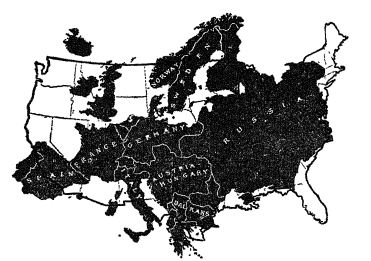
The United States and Europe
Good communication is one reason why we are a united country.
¶ Problems
- Define or explain:
Conestoga wagon, Prairie schooner
Flatboat, Volta’s pile
Turnpike, The Rocket
National pike, The Clermont
Stagecoach, Electromagnet - The Romans had been very good road builders. How do you account for the fact that the roads of Europe in the seventeenth century were poor? Give reasons why our ovm colonial roads were so poor.
- Why was the Erie Canal the most successful canal? Make a list of the things it meant for the western people. For the eastern people. Why is a canal that connects two large systems of water routes likely to succeed better than one not thus located? [ p. 271 ]
- Why was the steamboat so important for the western settlers? What did it do for them?
- Give as many reasons as you can why a voyage around the world ivould be safer and quicker to-day than it was in Magellan’s time.
- What things can the railroad do better than the steamboat?
- Draw up a list of points comparing travel in a stagecoach with travel in a Pullman car. Include, among other things, speed, eating, sleeping.
- A seventh-grade boy, watching a great locomotive pull into a station beside him said, “Well, I begin to see what the men in the engine cab are doing for me.” Do you?
- How does roadmaking to-day differ from that of Boone on the Wilderness Trail?
- Why is it better to have a whole state plan and supervise its roads than to leave the matter to the villages and townships? Who owns the highway?
- Talk over with others the ways in which the automobile has made life different. Has it helped in getting work done? In recreation? In time of sickness?
- “The railroad, steamship, airplane, and automobile are great educational agencies.” How so?
- What were the great channels of communication to the Middle West before 1820? What were they thirty-five years later?
- For what business purposes is the airplane suited? For what war purposes? For what recreational purposes?
- Go back over the steps in the harnessing of electricity (pages 261 and 262). Explain the significance of each as a preparation for the telegraph and telephone.
- In wdiat w-ays does the telephone aid a business man in a city? A farmer? The police? A newspaper? Does the telephone benefit you when it aids the above?
- Make a list of instructions on the proper use of the telephone.
- Make a visit to the nearest telephone exchange and write a description of what you see.
- “Machinery has increased the possibility of exchange of goods and ideas.” Show how.
- It is said that the diet of an American is more varied than that of the people of any other nation. How do you account for this? What are its consequences? [ p. 272 ]
- What inventions help unite people in a nation? What inventions help bind country people to city people?
- “Uniformity of speech, customs, and manners is a result of communication in the United States to-day.” “ Local peculiarities of speech, manners, and customs are likely to diminish.” How does communication tend to have this result? Why is this result important?
- “Modern changes in communication have made many aspects of our living together very different.” Cite cases.
- “The United States gives a great opportunity to a manufacturer because it is all one huge market.” Why is it all one huge market?
- Notice the eras of transportation mentioned on page 259. How do you account for the fact that the second era is so much longer than the third? In which era has most been accomplished? Are you sure?
- Make the charts called for on pages 259 and 269.
- Answer the questions at the beginning of this chapter, page 237.
¶ Interesting Reading
Marshall: Readings in the Story of Human Progress, Chapter VIII.
- How Nature Affects Primitive Transportation (an example of the importance of nature in our living together).
- Cyrus West Field (a life of devotion to the idea of laying the Atlantic cable).
- The Mastery of the Air (a quite recent chapter in the story of man’s conquest of distance).
See also:
Chapter XI, 2. Good Roads (a realm of communication in which we have recently made much progress).
Chapter XI, 3. The United States Post Office (one way the government aids in developing communication to-day).
Problems to think over are given in these reading selections.
| VII. Sign Language, Spoken Language, Written Language, Printed Language; Multipliers of Man's Powers | Title page | IX. Multiplication of powers through trade |