© 2026 Jan Herca (license Creative Commons Attribution-ShareAlike 4.0)
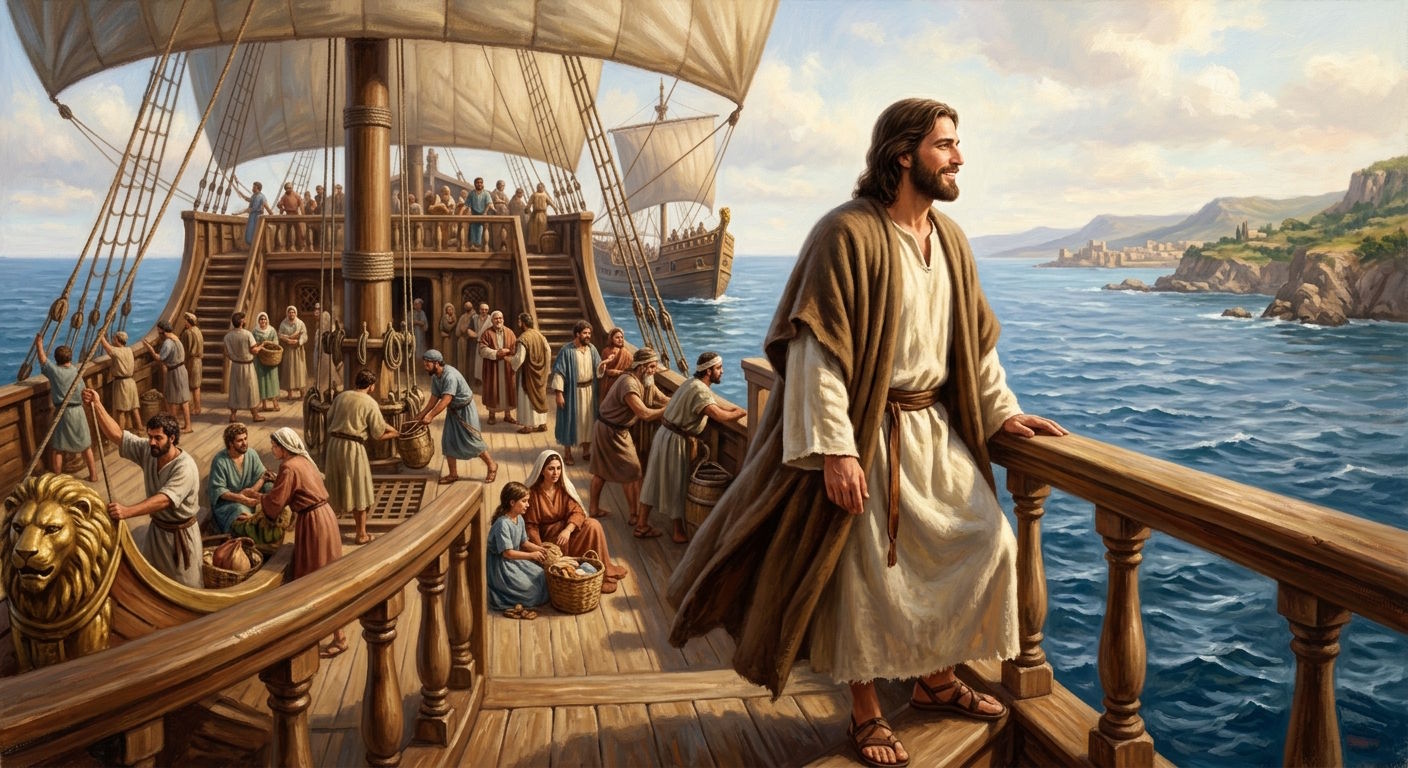
If we consider what the study of the New Testament has revealed about the life of Jesus, the general opinion is that the Master barely left Nazareth before his public ministry as an itinerant rabbi. This view is not illogical, since the evangelists made no effort to depict Jesus’ infancy, childhood, and adolescence. We only know of the journey his parents made from Nazareth to Bethlehem (which some would like to question [1]), and the journey from Nazareth to Jerusalem, during which Jesus remained alone in the holy city for a few days.
Were it not for the revelations of The Urantia Book, which present a life of Jesus that fits much more with a logical and rational view of a man of his time, nothing would lead us to have any other idea of Jesus than that of a man who lived virtually his entire life ignorant of the affairs of the rest of the world. Any subsequent explanation as to why this man could occasionally converse with others without using his native Aramaic, speaking instead in Greek, or why he had no qualms about traversing Samaria and Phoenicia, where mainly Gentiles lived, would have had to be attributed to his divinity. He did the things he did because he was not human, but a god. That is why he could speak any language or travel through non-Jewish territory without feeling lost.
The Urantia Book offers a far more complete and coherent view of a Jewish man of the first century CE, an era characterized by a peaceful Roman Empire, friendly relations with the Parthians and other distant empires, and widespread travel that did not occur again for nineteen centuries (UB 121:1.7). A Jesus hidden in Nazareth makes no sense when he is supposed to be a heavenly being who comes to have close contact with the human beings he created. Only The Urantia Book rescues readers from this absurdity to which biblical scholars have subjected them for ages and paints a far more consistent and truthful picture of what Jesus’s relationship with the world he knew might have been like. This is one of many reasons to believe that this book is indeed a revelation.
Jesus undertook a remarkable multitude of journeys in order to learn about the world. Despite severe financial limitations, as his family was almost always mired in abject poverty, and despite the constraints of caring for his family on behalf of his father, who died prematurely, Jesus nevertheless engaged in an extraordinary travel habit. He did so because the conditions of his time allowed it. During the Roman Empire, roads became quite safe, and navigation across the Mediterranean, now free of pirates, was largely free of danger. It is for this reason that only twenty years later, the Apostle Paul was able to undertake those remarkable and frequent voyages throughout the Roman Sea, carrying the Christian message far and wide. This same wanderlust permeated many others in the first century, and it was not merely a pastime for a privileged few. If one deeply desired to travel and see the world, the first century of our era was the ideal time to do so.
In the following paragraphs, we will formally recount the information provided in The Urantia Book regarding all the journeys, both short and long, that Jesus undertook during his life. This will also give us a complete count of all the major towns and cities Jesus visited, which will show the extent to which this Jesus who appeared in Palestine as a preacher doesn’t need to justify himself by claiming divinity. The human Jesus already had such enriching experiences and life events that it’s understandable the people of his town were amazed when he decided to begin his public ministry among them.
¶ Nativity in Bethlehem
Mary and Joseph left Nazareth early in the morning on August 18, 7 BC, and arrived in Bethlehem in the mid-afternoon of August 20 (UB 122:7.4-7). On their first day of travel, they arrived at the foot of Mount Gilboa, by the Jordan River; the next day they had lunch at the foot of Mount Sartaba and spent the night in Jericho; on the third day they arrived in Jerusalem at midday and then went on to Bethlehem. The day after their arrival, Jesus was born.
Days later, Joseph and Mary traveled with the child to Jerusalem for the purification ceremony and then returned to Bethlehem (UB 122:9.1).
¶ Flight to Egypt
Mary and Joseph fled with the child, leaving Bethlehem around mid-October of 6 BC. They remained in Alexandria for two full years (UB 122:10.4). The Urantia Book does not indicate what route they took to get there, although we are told that “to avoid attracting attention they traveled alone.” It may mean that they made the journey on foot, although it is a long distance of many days.
¶ Return to Nazareth
Mary and Joseph returned with the infant Jesus at the end of August of 4 BC, sailing to the port of Joppa, and from there walking to Bethlehem (UB 123:0.4). They remained in Bethlehem for about a month before deciding to return to Nazareth. “At the beginning of October in 4 BC they left Bethlehem for Nazareth by way of Lydda and Scythopolis. They left early on a Sunday morning,” and it took them four days to reach their former home (UB 123:0.6). They decided to go to Galilee without passing through Jerusalem and without using the usual western routes to avoid Archelaus’ territory and the less safe routes as much as possible.
¶ An Epidemic
In July of 3 BC, because of an epidemic in Nazareth, Mary took Jesus and James, his younger brother, to a country house several kilometers south of Nazareth, on the road to Megiddo, near Sarid. They stayed there for two months and then returned to Nazareth (UB 123:1.7).
¶ Travels with His Father Joseph
Jesus frequently traveled with his father on his work. In 1 BC he accompanied his father to Cana, Bethlehem of Galilee, Magdala, Nain, Sepphoris, Capernaum, and Endor (UB 123:3.8). These trips were likely part of the child’s training, which Joseph assumed when Jesus was five years old (UB 123:2.13).
In 2 AD, Joseph took Jesus occasionally (about a week each month) near Magdala to the home of an uncle who was a fisherman, and also to the farm five miles south of Nazareth belonging to one of Mary’s brothers (UB 123:6.1). These weeks away from Nazareth were offered to Jesus as a reward for his good performance at the Nazareth school. This arrangement continued into 3 AD (UB 124:1.2).
At the end of June in 3 AD, Jesus first ascended Mount Tabor with his father (UB 24:1.6).
During the year 3 AD, Jesus made many pleasure and business trips with his father to towns near Nazareth, such as Cana, Endor, and Nain (UB 124:1.12).
At the end of the year 4 AD, he spent two months fishing with an uncle on the Sea of Galilee (UB 124:2.7).
During the year 5 AD, Jesus continued to travel with his father and also frequently visited his uncle’s farm south of Nazareth and his fisherman uncle’s house in Magdala (UB 124:3.1).
Around mid-May of 5 AD, the young Jesus accompanied his father on a business trip to Scythopolis, the principal Greek city of the Decapolis, the ancient Hebrew city of Beth-shean (UB 124:3.6). He attended a performance with his father at the amphitheater in this city.
¶ The First Trip to Jerusalem
March 20 of 7 AD was an important day in Jesus’ life: his graduation from the school associated with the synagogue in Nazareth (UB 124:5.4). To mark this significant occasion (his bar mitzvah), his parents took him to Jerusalem for Passover.
They left Nazareth on Monday, April 4, 7, went to Jezreel, left Shunem to their left, then went east around Mount Gilboa, seeing Scythopolis in the distance, and after three hours made camp near a spring in the vicinity of the Jordan, where they spent the night (UB 124:6.1-5). Joseph and his family would have preferred to use the Samarian route that passed by Jacob’s Well and Bethel, but the other pilgrims in their group were unwilling to mix with the Samaritans.
On the second day (April 5), they passed near the mouth of the Jabbok at the Jordan and made their way to the base of Mount Sartaba, where they spent the second night (UB 124:6.6).
On the third day (April 6) they passed near the cities of Phasaelis and Arquelais, admiring their magnificent architecture and beautiful palm gardens, and continued on to Jericho, where they spent the night (UB 124:6.7).
On the fourth day (April 7), they traveled west from Jericho, ascending the Mount of Olives, where before reaching the summit they stopped to rest in Bethany (meeting Lazarus’s family for the first time). Afterward, they journeyed to Jerusalem, where Jesus was most deeply impressed by the view of the city from the top of the Olivet (UB 124:6.8).
Saturday, April 9, 1977, was the Passover festival, and Jesus celebrated it with his family and several others at Lazarus’s house in Bethany (UB 124:6.1; UB 125:2.1).
The following Wednesday (April 13), Jesus was allowed to visit his new friends Lazarus, Martha, and Mary in Bethany (UB 125:2.7).
On Sunday (April 17), his parents began the return journey with the group of families from Nazareth, mistakenly believing that Jesus was also with them (UB 125:3.1). Upon arriving in Jericho, they discovered his absence and spent the night there in deep concern, while Jesus spent the night in Bethany.
On Monday (April 18), Mary and Joseph searched unsuccessfully for Jesus throughout Jerusalem, while Jesus spent much of the day at the temple and in Bethany (UB 125:4.2-4).
On Tuesday (April 19), the same thing happened as the previous day. Mary and Joseph searched all over the city and even came very close to where Jesus was in the temple, but they did not find him. Jesus was still sleeping in Bethany, and his parents were at the home of some relatives where they had been staying during the festivities (UB 125:5.1-10). It is striking that during those days it did not occur to them that Jesus might be in Bethany or that their friends there might know something about him. This must surely be attributed to their nervousness and anxiety.
On Wednesday (April 20), they finally found Jesus in the temple when they were about to travel to Bethlehem, thinking that he had gone there to the home of Mary’s relatives (UB 125:6.1-8). They returned to Nazareth that same day, spending the night in Jericho and arriving home three days later.
¶ Before Herod Antipas
In the year 4 Jesus went to Sepphoris with several of his uncles to claim the compensation owed to his father for his death while working as a laborer on a construction site in the city (UB 126:5.7).
¶ The Journey to Jerusalem with James
In the year 12, Jesus took his brother James to Jerusalem for Passover. They set out alone and traveled along the road through Samaria. This was the first time Jesus had crossed Samaria, which he was surely eager to see. They drank at Jacob’s well and passed through Bethel. They celebrated the Passover meal with their friends from Bethany. Their return journey took them via Jericho and the Jordan Valley, along the eastern road, another road Jesus had not traveled, since when his parents took him to Jerusalem they traveled along the road on the western side of the Jordan (UB 127:3.1-5). On these journeys, Jesus began to show a recurring pattern: he was always seeking new places to explore, regardless of the people he encountered.
¶ Solo Journey to Jerusalem
In the year 14, Jesus traveled alone to Jerusalem for Passover. He went by way of Megiddo, Antipatris, and Lydda, the same route his parents had taken when they returned with him from Egypt. He celebrated the Passover meal with Lazarus and his sisters in Bethany, the first Passover meal that Jesus modified to omit the symbolism of the Passover lamb (UB 127:6.3).
The Urantia Book does not tell us which route Jesus took to return to Nazareth, but we can guess, perhaps using the eastern bank of the Jordan. It is clear from his various trips to Jerusalem during those years that he used a different route each time. His goal was always to meet new people and see new places, as the book mentions repeatedly (UB 125:2.12; UB 126:5.8; UB 127:3.7).
¶ The Trip to Jerusalem with Joseph
In the year 15, Jesus traveled with his brother Joseph to Jerusalem to celebrate Passover there. They went by the usual route along the Jordan (that is, along the western bank), but returned by the eastern route, through Amatus, in Perea, probably crossing the river ford at Bethabara (UB 128:1.14).
¶ The Trip to Jerusalem with Simon
In the year 17, Jesus stopped working for three weeks and took his brother Simon to Jerusalem for Passover. They traveled along a new route for Jesus, through the Decapolis, passing through Pella, Gerasa, Philadelphia, Heshbon, and Jericho. They returned to Nazareth by the coastal route (also a new route for Jesus), passing through Lydda, Joppa, Caesarea, and around Mount Carmel, through Ptolemais and Nazareth. The return journey took five days. The Urantia Book confirms that Jesus’ intention with these travels was to become as familiar as possible with the land of his people, Palestine (UB 128:3.1-2). On this occasion, the book mentions two notable encounters that occurred on this journey: one with a wealthy merchant from Damascus, and another with Stephen, who would become the first martyr of the Christian church. Jesus’s eagerness to meet foreigners caught his mother’s attention when they returned to Nazareth (UB 128:3.8), but it fits well with the character of someone who is supposed to be a Son of God, coming into the world to help in the salvation of all humankind.
¶ The Stay in Damascus
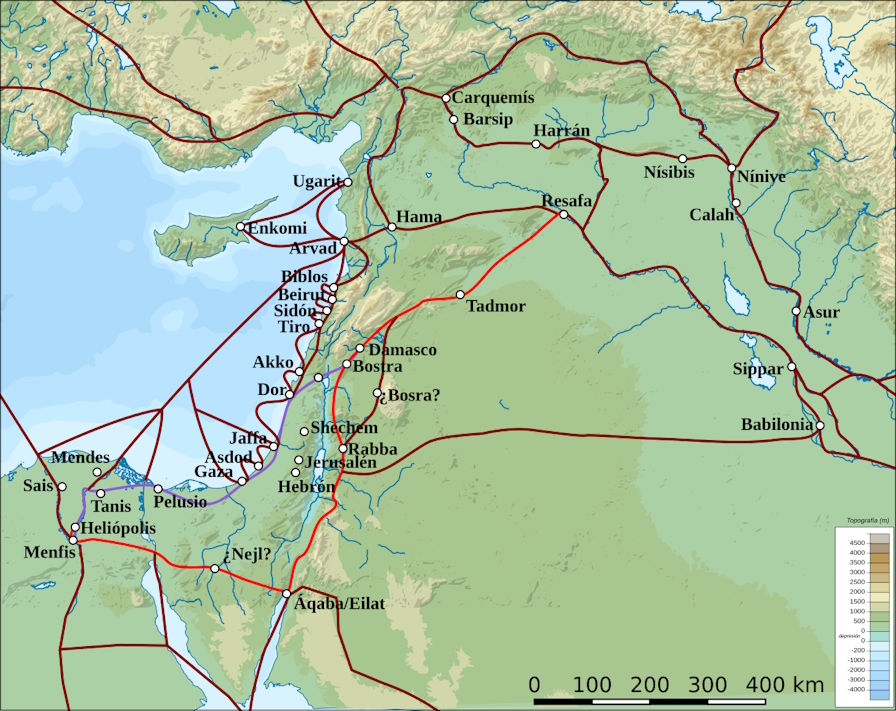
The last four months of the year 17 Jesus lived in Damascus (UB 128:4.1). It was the first time he had traveled to Gaulanitis, or Syria. Gaulanitis, or the Golan, was a region or tetrarchy under the rule of a different Herod than Antipas. We do not know the route he took to get there, but it is logical that he used the Roman road that formed part of the so-called Via Maris. This route went from Nazareth (UB 121:2.2; UB 123:5.7) to the Sea of Galilee (Magdala), passed through Capernaum (UB 129:1.7), crossed the Jordan River somewhere south of Lake Hule, and ascended toward the Gaulanitis, passing through Quneitra until reaching Damascus. Throughout this journey, the slopes of Mount Hermon remained to the left.

¶ Journey to Caesarea Maritima
In mid-June of the year 18, Jesus traveled to Caesarea Maritima, on the coast, where he had been with his brother Simon the previous year. There he met with five prominent Jews from Alexandria who wanted to offer him an important job as an assistant at the main synagogue in their city (UB 128:5.2). This event in Jesus’ life is somewhat enigmatic. While The Urantia Book states that the trip to Damascus was due to Jesus befriending a Syrian-Jewish merchant, in this instance, it is not explained why these friends from Alexandria knew the young man from Nazareth. It simply seems to be suggested that they were part of the family and friends in Alexandria who welcomed Jesus and his parents when they fled Bethlehem (UB 128:5.5), and that they knew Jesus’s location in Nazareth.
¶ The Journey to Jerusalem with Judah
In the year 19 Jesus took his brother Judah to Jerusalem for Passover. They went up the Jordan Valley and returned by the same route. We are not told which bank of the river they traveled on, but since Jesus, because of his brother’s impulsive nature (he had joined the Zealots), decided not to go through Samaria, it is possible that they traveled along the eastern route, which avoided any proximity to Gentile cities (UB 128:6.3-4). On this journey, a noteworthy situation occurred when Jesus and Judah, due to the latter’s actions, had to spend the festival days under arrest in the Roman prison.
¶ Stay in Capernaum
On a rainy Sunday morning in January 21, Jesus left Nazareth intending to travel and settle for a time near the Sea of Galilee. On this journey, he passed through Tiberias, Magdala, Bethsaida, and Capernaum. He spent more than a year in Capernaum, making it his new home. He only returned to Nazareth in October 21, and a few days later went back to Capernaum (UB 129:1.1-6).
¶ Stay in Jerusalem
In March of 22, Jesus left Capernaum and stayed in Jerusalem for two months (UB 129:2.1). There he celebrated Passover with the family of Zebedee, who joined him upon their arrival. They were all invited to celebrate the Passover meal at the home of the former high priest Annas, who was related to Salome, Zebedee’s wife.
¶ The Journey to Rome
During his stay in Jerusalem during Passover in the year 22, Jesus met a wealthy Indian merchant, Gonod, and his teenage son, Ganid. He agreed to accompany them on a journey around the Mediterranean they planned to make to Rome. Jesus, Gonod, and Ganid left Jerusalem on Sunday, April 26, 22 (UB 130:0.1-3), and arrived in Rome by the Appian Way on a date that is not specified.
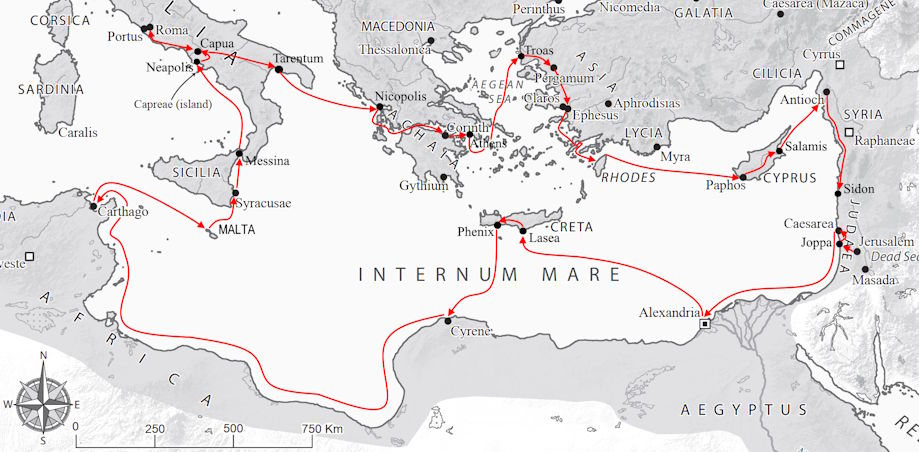
The voyage across the Mediterranean may have followed this route and chronology:
- From Jerusalem to Joppa (by land): they spent at least one night there, UB 130:1.3.
- From Joppa to Caesarea (by land): here they stayed “longer than expected,” perhaps a week, due to damage to the ship, UB 130:2.1.
- From Caesarea to Alexandria (by sea): we are not told how long they stayed, but it is very likely two or three months, since we are told of “their second week” there, UB 130:3.7, and Alexandria was the second most important city in the Empire. If they stayed in Rome for 6 months, they must have stayed in Alexandria for a proportional amount of time as well.[2]
- From Alexandria to Lasea[3] on the island of Crete (by ship): we do not know how many days, perhaps a week, visiting Good Havens, also called Kaloi Limenes, and making a trip to a mountain near Phoenix[4], UB 130:5.1, UB 130:6.2.
- From Phoenix to Cyrene[5] (by ship): two days for a stopover, UB 130:6.6.
- From Cyrene to Carthage (by boat): we are not told how long they were there, perhaps only three days, since only one conversation of Jesus is mentioned, UB 130:7.1.
- From Carthage to the island of Malta or Melita (by boat): we do not know how long they were there, but from the brief description given, perhaps a two-day stopover, UB 130:8.1.
- From Malta to Syracuse on the island of Sicily (by boat): where they stayed for a week, UB 130:8.2.
- From Syracuse to Messina or Zancle[6] (by boat): one day, UB 130:8.3.
- From Messina to Neapolis or Naples, where they finally disembarked: we are not told how long they stayed, but since Gonod had “much business to attend to,” it is reasonable to think about five days, UB 130:8.4.
- From Neapolis to Capua (by land), following the Appian Way, where they stayed for three days, UB 130:8.6.
- From Capua they continued along the Appian Way[7] and arrived in Rome, on foot with their cargo carried by mules.
 .jpg">

¶ The stay in Rome
The Book of Urantia does not provide us with any chronological or toponymic information about Jesus’ long stay in Rome and its surroundings. It does not tell us the date he arrived or the date he left for his return. We only know that three days after arriving they were received by Emperor Tiberius[8], that within a week of being there Jesus had already made friends with several religious leaders, and that he remained in the city “almost six months” (UB 132:0.1; UB 132:0.4; UB 132:4.3).
From Rome, Jesus, Gonod, and Ganid made five trips to various places of interest, one of them to the northern lakes and Switzerland (UB 132:7.1; UB 132:7.3). It is unclear whether these trips occurred at the end of their six-month stay in Rome, or whether they were trips made at various times during those six months. Since we are told that they made “five trips away from Rome,” meaning that all the trips had Rome as their point of departure and return, it is reasonable to think that they did not make these trips at the end of their stay in Rome (since it would not have made sense for them to return to the capital of the empire each time) but rather at various times during those six months. Therefore, the six months encompass the entire time in Rome, including the five trips they made.
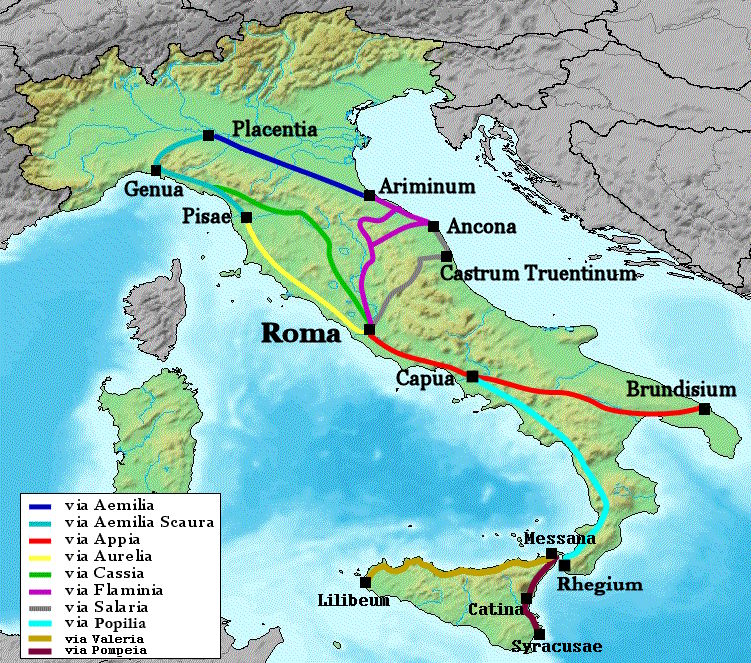
It’s curious that we’re told they made exactly five journeys from Rome because there were five main roads leading out of Rome:
- The Appian Way, which ran from Rome to Capua and Neapolis in the south. They had already traveled this road on their arrival journey, so it seems unlikely they would have retraced their steps on any of the five trips. Furthermore, it was the route they followed on their return journey.
- The Salarian Way, which started at the Porta Salaria and went to Castrum Truentinum on the Adriatic coast, passing through Reate and Asculum in the Abruzzi Mountains.
- The Via Flaminia, which led from Rome to Ariminum (Rimini), was the main route north. It passed through Narnia (Narni), Mevania (Bevagna), Nuceria (Nocera), Helvillum (Sigillo), Fanum Fortunae (Fano), and Pisaurum (Pesaro). This road then continued along the Po Valley as the Via Aemilia to Placentia (Piacenza), passing through Bononia (Bologna), Mutina (Modena), and Parma. One could ascend to Verona via the Via Claudia Augusta from Mutina or the Via Postumia from Placentia. From Verona, roads led to the lakes of northern Italy: Lake Benacus or Garda (with Sirmione a popular tourist destination known for its thermal springs); Lake Sebinus or Iseo (with its Isola mountain), beyond Brixia (Brescia); Lake Larius, or Lake Como, near Como; Lake Ceresius, or Lake Lugano; and Lake Verbanus, or Lake Maggiore.
- The Via Cassia, which led from Rome to Arezzo, Florence, and Lucca. It originated from the previous road and then branched off at the Milvian Bridge, passing through the valleys west of the Apennines and near Lakes Bolsena and Trasimeno.
- The Via Aurelia, which led from Rome to Pisa and the Ligurian coast. It passed through Palos, Torre di Chiaruccia, Graviscae, Ansedonia, Populonia, and Pisa, near where the previous road ended. The journey could then continue using the Via Aemilia Scauri, an extension of the Via Aurelia, following the coast towards Luna (Luni) and Genoa, although over very rough and rugged terrain.

¶ The journey to the lakes of Italy and Switzerland
It seems quite likely that of the five journeys Jesus made with Gonod and Ganid, one of them consisted of traveling to Switzerland via the lakes of northern Italy. This journey could have been as follows:
A first leg would have taken them from Rome to the Po Valley (in northern Italy). They would have departed from Rome northwest along the Via Flaminia, reaching Ariminum (Rimini) on the Adriatic coast; from there they would have continued along the Via Aemilia in a straight line, passing through Bononia (Bologna) and Mutina (Modena) until reaching Placentia (Piacenza).
They would then visit Lakes Garda and Iseo. From Piacenza, they would take the Via Postumia, which led them to Verona, and from there they could have detoured a few kilometers west to visit the Sirmium peninsula (Sirmione) and Lake Garda. In Tiberius’s time, Sirmione was already a luxury destination for the Roman aristocracy (the poet Catullus had already spoken of its beauty years before). Returning west along the Via Gallica (which connected Verona with Milan), they would pass through Brixia (Brescia), and after a short journey northwest, they would have reached the shores of Lake Iseo.
To travel to Switzerland, they had several options,[9] but one they could have used was the Via Spluga. It wasn’t a paved road, but it was the shortest route to Lake Constance. From Brixia, they could have gone to Bergomum and Comum (Como) on the southern shores of Lake Como. This lake was also very popular with Rome’s patrician families. There, instead of skirting around it, it was common to embark for a faster crossing to a post called Summus Lacus (Samolaco). From here began the true ascent of the Alps, passing through Clavenna (Chiavenna) to a pass at 2,113 meters called Cunus Aureus (Spluga Pass). The descent would take them through Curia (Churya) to Lacus Brigantinus (Constance), directly into the heart of present-day Switzerland and the headquarters of the legions on the Rhine.
An important note about this journey is that, despite the Roman Empire’s road infrastructure, it represented an epic crossing of 25 to 30 days. The Alps had just been pacified by Tiberius himself and his brother Drusus, so the route would have been safe and well-equipped with rest stops. However, to make the journey shorter and safer, Gonod may have planned to use a raeda (a four-wheeled chariot). Every 20-40 km there were lodgings called mansions that offered food, lodging, and stables. This journey to Switzerland undoubtedly represented an experience of discovery for the travelers, with stone military camps, theaters like the one at Brigantium (Bregenz), and intense commercial activity involving timber, cheese, and slaves.
¶ The Journey Along the Via Salaria
This could have been one of the other five journeys that Jesus, Gonod, and Ganid made around Rome. Since it seems the travelers wished to explore the entire Roman Empire thoroughly, it is not surprising that Gonod wanted to travel with his son along each and every one of the major roads leading from Rome. On their outward journey, they had already traveled the Appian Way. On the previous trip, they had traveled the Flaminian and Aemilian Ways. We can assume that the journey to Rome via the Appian Way does not count towards the other five journeys they made from Rome, nor does their return journey along the Appian Way to Taras (Taranto). The trip to the northern lakes and Switzerland should be considered one of the five journeys. Therefore, they must have taken four other main roads to explore all of Italy. The Via Salaria, due to its commercial importance, was quite likely one of Gonod’s interests.
This journey represented the route of the authentic and genuine Rome. The Via Salaria was the oldest road in Rome, the road of “white gold,” salt. Traveling along it was to immerse oneself in the heart of rural, mountainous, and aristocratic Italy.
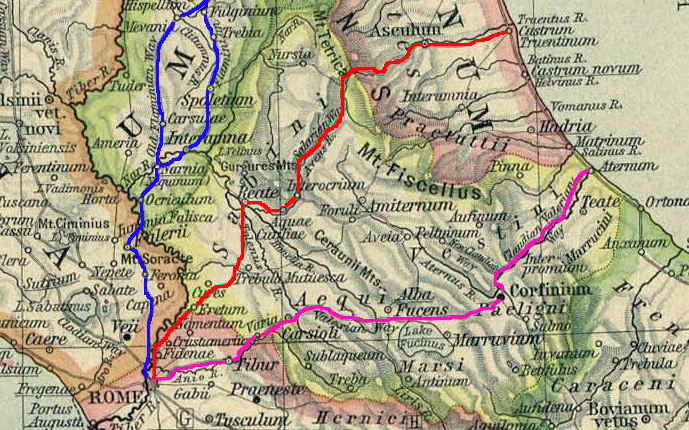

They likely left Rome via the Ponte Salario, crossing the Anio River. In Tiberius’s time, this bridge was a historical symbol of the city’s defense. Upon leaving, they could see the suburban villas of families seeking to escape the noise of the Suburra without straying too far from the Senate.
They then traveled to Reate (Rieti) through the Sabine region, famous for its pure air and austere people (the ancestors of the Roman “old guard”). There they would encounter the Roman bridge over the Velino River and the Rosea plain, renowned as the most fertile in Italy. It was said that if a stick was left in the ground overnight, by morning the grass would have covered it! There, it was essential to taste the Sabine olive oil. At that time, it was considered the best in the world, even surpassing that of Hispania or North Africa.
Afterward, they likely made their way to Aquae Cutiliae, the fashionable spa town near present-day Ciutadella. Its cold mineral waters were even appreciated by Emperor Tiberius, who was not one for excess but was very much a fan of health. The Lacus Cutiliae, a lake with a floating island, was considered by the Romans to be the Umblicus Italiae, the geographical center of Italy.
Further on, the journey became spectacular and a little cooler as it crossed the Apennines (Iterocrium and Falacrinae). This was the home of a family that was beginning to gain importance, the Flavians, where a young man named Vespasian lived, who would become emperor. Here, Tiberius’ Roman engineers kept the road in impeccable condition, even in the steepest sections, to ensure that the salt supply was never interrupted.
The final destination was the imposing city of Asculum (Ascoli Piceno) and the Adriatic Sea. The city was built almost entirely of travertine, with monuments, theaters, and temples that rivaled those of Rome. The journey ended at Castrum Truentinum, where the Salaria met the Adriatic Sea. Here, the travelers surely saw the large salt pans where the product that gave the road its name was extracted.
¶ The Journey along the Via Cassia
This journey may have been the third of the journeys that Jesus, Gonod, and Ganid made along the Italian peninsula. It was the essential tour for getting to know Etruria. While the Appian Way was the road of politics and the wealthy, and the Salarian Way was the road of merchants, the Cassian Way was the road of culture, mysticism, and sophistication.
In the 1st century AD, this road traversed a landscape of rolling hills, volcanic lakes, and cities that were powerful long before Rome was even a village.
They likely left Rome via the Milvian Bridge, the junction where the Cassian Way branched off from the Flaminian Way. Shortly after departing, they would have encountered imposing funerary monuments of the elite and then arrived in Veii (Veio). Veii was Rome’s great rival. In Tiberius’s time, it was a much quieter city than the capital, with ancient temples that offered a glimpse into how Rome absorbed Etruscan culture. Even then, one could still see the remains of its walls, destroyed by the Romans in their war with the Etruscans, and the famous sanctuary of Apollo Veii.
The next stop must have been Sutrium (Sutri), a city literally carved out of the volcanic tuff rock, with an amphitheater that was an engineering marvel because it wasn’t built upwards, but rather hewn directly into the mountain. It was a cool and shady place, ideal for escaping the Latium sun.
The next city was Volsinii (Bolsena) and its lake, Lacus Volsiniensis (Lake Bolsena), whose shores were dotted with villas belonging to Roman senators. There, wealthy Romans enjoyed sailing, visiting the Temple of Nortia, and indulging in fine food, especially wine and fish from the lake. In The Urantia Book, there is no indication to the contrary that the long conversation Jesus had with a wealthy Roman senator might not have taken place in a villa in this area, where Jesus and his traveling companions could have been invited to spend the day. We see the senator leave his couch and wish Jesus goodnight, an unmistakable sign that Jesus stayed overnight at this senator’s house (UB 132:5).
The next stop was Clusium (Chiusi), continuing north, one of the oldest cities of the Etruscan league. There, one could visit Etruscan tombs (such as that of the legendary King Porsena), which were already considered fascinating “antiquities” at that time. The travelers surely acquired some souvenirs made from the area’s famous black pottery (bucchero).
The final stop on the journey was Arretium (Arezzo), one of the most important industrial centers of the empire, where one could purchase expensive souvenirs of the famous Terra Sigillata, the bright red ceramic tableware that adorned tables throughout the empire, from Britain to Syria.
¶ The Journey Along the Via Aurelia
This could have been the fourth journey of Jesus, Gonod, and Ganid. On this trip, they might have traveled along the Via Aurelia, a coastal route, bathed by sea breezes and pleasant sunsets over the Tyrrhenian Sea. While the Via Cassia runs inland, the Via Aurelia hugs the coast to the northwest, heading towards Gaul.
In the 1st century AD, this was the route to the most spectacular seaside villas and the ports that fueled the capital’s luxury.
Had they made this journey, they would have left Rome through the Porta Aurelia (near what is now San Pancrazio), and the first thing they would have seen from the top of the Janiculum Hill would have been a fabulous panoramic view of Rome before descending towards the coast.
The first stop would have been Alsium (Palo Laziale), a place of retreat, where even Tiberius himself or members of his court had villas.
The second would have been Pyrgi (Santa Severa), with temples dedicated to Leucothea-Ilithia, cyclopean stone walls, and the ancient port of the Etruscan city of Caere.
The third would be Cosa (Ansedonia), located on a hill, with an acropolis offering the best views of the entire Tuscan archipelago and Mons Argentarius (Mount Argentario). There they surely marveled at the Etruscan Tagliata, a canal carved into the rock to prevent the port from filling with sediment. It was an engineering masterpiece that any cultured Roman loved to observe.
The next city was Populonia, a city of iron and sea, the only Etruscan city built directly on the coast, with breathtaking views of the Piombino Canal, and a remarkable metal industry.
The final destination was Luna (Luni), the port of white Carrara marble (Luni marble), which was shipped en masse to Rome to build temples and other monuments.
¶ The Journey Along the Via Tiburtina
This journey may have been the fifth and final one of Jesus, Gonod, and Ganid in the area surrounding Rome. It wasn’t one of the longest or most important roads, but for the Roman nobility, it was a route of great interest. The Via Tiburtina (which later became the Via Valeria) was the Roman elite’s favorite escape route when the city’s heat became unbearable. It wasn’t just a trade road; it was the direct access to the aristocracy’s “spa.” It was also the road that led most quickly to the rugged landscape of the Apennine Mountains.
The first obligatory stop was Aquae Albulae, the “miraculous” waters, located in the plain below Tibur, a famous set of sulphurous hot springs. Its milky-white waters (hence the name Albulae) were reputed to cure all kinds of ailments, from war wounds to skin problems. Augustus had made them fashionable. The smell of sulfur was intense, but the facilities were pure luxury. Even today, the area (Bagni di Tivoli) continues to exploit these springs.
The second stop was Tibur (Tivoli): the “Hamptons” of Ancient Rome, located at the end of the Via Tiburtina, where the foothills of the Apennines began. It had a cool climate with a constant breeze. There, one could visit the Sanctuary of Hercules the Victorious, a colossal architectural complex that literally “hung” over the hillside, serving as a religious center, market, and theater; the “Waterfalls of Anio River,” spectacular waterfalls; and the villas of famous Romans, such as that of the poet Horace or those of aristocrats seeking otium (creative leisure).
At the top of the Tibur acropolis, they would surely admire the circular Temple of the Tiburtine Sibyl (which remains an icon even today), a center of prophecy where Romans came to consult the oracles of the Albunea Sibyl.
The Via Tiburtina was famous for its hydraulic engineering. Along the way, they surely stopped to admire the imposing arches of the aqueducts (Aqua Marcia and Aqua Claudia, the latter under construction or being expanded during Tiberius’s reign) that ran parallel to the road, carrying fresh mountain water directly to Rome.
It is quite possible that once in Tiburtina, the three travelers felt like continuing on to the Apennines, to Alba Fucens, following the Via Valeria, which led into the higher mountains. Alba Fucens was a monumental city at the foot of Mount Velino (almost 2,500 meters high), next to Lake Fucino (now drained). At that time, it was known as a fortified “Little Rome,” the place where the Senate used to “host” (under guard) captured foreign kings. It was a city with exceptionally pure air, with a Roman amphitheater set against the backdrop of snow-capped peaks.
¶ The Return from Rome
The return journey from Rome began on an unspecified date and ended on December 10, 23, the date on which Jesus, Ganid, and Gonod said goodbye in Charax.
The return route and its chronology may have been as follows:
- Along the Appian Way they traveled to Tarentum (called Taras or Tarentum at that time), sending their cargo in a caravan of pack animals while they traveled the road “on foot” (UB 133:0.2); The conversation about the castes of India that Jesus had with Ganid is told to have taken place “halfway to Tarentum,” perhaps in the vicinity of Aeclanum (UB 133:0.3); the duration of the journey could have been 21 days [10].
- From Tarentum to Nicopolis (by sea): a slow journey as we are told (UB 133:2.4); they spent “several days” there, perhaps three or four (UB 133:2.5).
- From Nicopolis to Corinth (by boat): They stayed two months in Corinth (UB 133:3.11; UB 133:4.13), a time which allowed Jesus to hold more than twenty meetings with Crispus, presumably on different days (UB 133:3.2).
- From Corinth to Athens (in a small boat that could be transported overland on a rail from one port in Corinth to the other); We are not told how many days they spent in Athens, but since Gonod had little business to attend to (UB 133:5.1) and they confined themselves to visiting the places of interest, it can be thought that they were there for four or five days;
- From Athens to Troas (by boat): we are not told how long they were in this city (UB 133:6.1), but it is possible that it was several days [11].
- From Troas to Ephesus (on foot): the reason for this long and strange journey on foot is not given, but it must have taken no less than two weeks, since it is well over 300 km [12]; nor is it specified how long they spent in Ephesus, but we know that they were there for at least three days, so perhaps they stayed there for a week (UB 133:6.2).
- From Ephesus to Rhodes (by boat, stopping for a day [13]): UB 133:7.1.
- From Rhodes to Paphos on the island of Cyprus (by boat).
- From Paphos to Salamis (on foot and using animals): we are told that they planned to spend several weeks resting in Cyprus (UB 133:7.2); the first two weeks went well, but Ganid fell seriously ill in the mountains [14] (UB 133:7.3), which meant “three more weeks of convalescence” (UB 133:7.4), and we must assume that when he recovered they continued the journey and it took them “another week” (UB 133:7.5); that is, in total they were in Cyprus for a month and a half.
- From Salamis to Antioch of Syria (by ship) [15]: We are not told how long they stayed in Antioch, the third most important city in the Roman Empire, but since Gonod had “a great many businesses” to attend to and the city was large and had many attractions, it is not unreasonable to think that they were there at least for a week (UB 133:8.1).
- From Antioch of Syria to Sidon (by caravan): We are told that they used a “camel caravan” to get to Sidon and then on to Damascus [16] (UB 133:8.4).
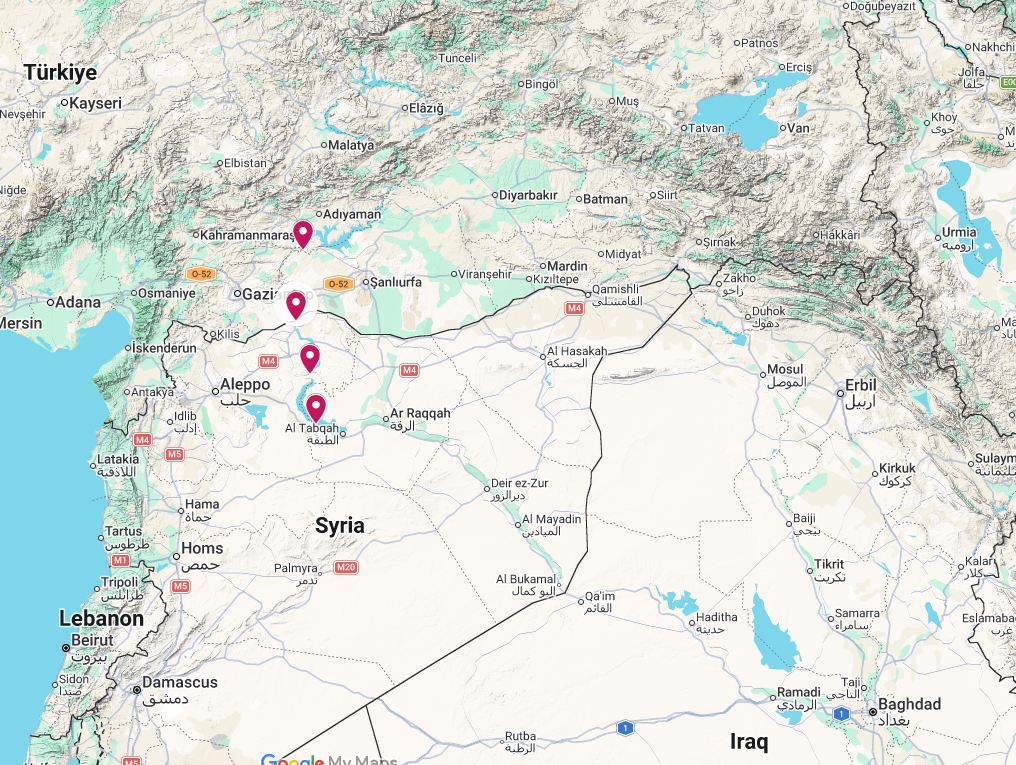
- From Damascus to Thapsacus [17], then to Larissa [18], and from there to Babylon (by caravan): indications of the caravan journey are almost nonexistent in The Urantia Book (UB 130:0.3), and it is difficult to make conjectures. Of the stay in Babylon, we only know that they “spent some time” (UB 130:0.3), which seems to suggest that they were there for one or two weeks. This makes sense because we are told that they “extended their stay in these parts three weeks” (UB 133:9.2) when referring to Ur and Susa.
- From Babylon to Ur and other places (on foot): We are told that they spent part of those three extra weeks in Ur, but it is difficult to say for sure what other places they visited. Some of these could have been Uruk (about 60 km northwest of Ur, Wikipedia) and Larsa (about 20 km southwest of Ur, Wikipedia).
- From Ur to Susa (by boat?): This (Wikipedia) is where they must have spent part of those extra three weeks. It’s rather odd that they made this journey, as it represented a long distance north only to have to return south to Charax, following the same route. Susa was located on the Choaspes River (Wikipedia), which was supposed to flow into the Tigris (though it no longer does), near its confluence with the Euphrates, and very close to Charax Spasinou. Therefore, it’s possible they made this long journey by boat, traveling upriver, and then returned by waterway as well.
- Charax [19]: This town was the place of farewell to Jesus and his friends from India, on December 10, 23 (UB 130:0.1).
¶ The Return to Nazareth through Mesopotamia
Jesus takes leave of Ganid and Gonod at Charax, on the Persian Gulf, on December 10, 23 (UB 130:0.1). When Jesus returns to Nazareth, we are told that he stayed there “several weeks” and that “Ruth was about to turn 15” (UB 134:1.3). Since Ruth was born on April 17, 9 (UB 126:3.2), she would have turned 15 on April 17, 24. Furthermore, since we are told that Simon and Judah were married in a double wedding in “early March of 24” (UB 134:1.4), which Jesus attended to bless the newlyweds, we can assume that Jesus arrived in Nazareth in mid-February of 24. That is, it took him a little over two months (from December 10, 23 to February 17, 24, approximately) to travel from Charax to Nazareth by way of the caravan route, passing through Ur, Babylon, and Damascus (UB 134:1.1). We can assume that the route Jesus took was identical to the one he took with Gonod and Ganid, although perhaps the difference is that he, not carrying a large load of personal belongings, made the entire journey on foot or by camel, but did not use the waterway. This is why we are told that “in Babylon he joined a desert caravan.” This allows us to think that the outward journey from Damascus to Charax, minus the several weeks they spent in the vicinity of Ur and Susa, must have lasted less than four months, perhaps only two months or less.
These calculations can be confirmed by considering the following data:
- The average speed of a camel caravan, with a standard load, was about 30-35 km/day, taking into account stops at waterholes and checkpoints.
- The average speed for navigating the Euphrates, using the current and wind, could be about 80 km/day.
- From Damascus to Palmyra is 240 km purely overland, which for a camel caravan at that time represented a 7-8 day journey.
- From Palmyra to Tapsacus (that is, to the Euphrates at a point quite far south of the location usually considered), was approximately 155 km (about 105 Roman miles), and would have taken 5 days across the desert if there were no incidents.
- From the Euphrates to Babylon was about 900 km, which in riverboats (kelek) that could cover 70-90 km per day, would have taken 11-12 days. By caravan, the same distance along the riverbank would take 25 to 28 days.
- From Babylon to Charax Spasinou was about 500 km, which again by river would take 6 to 7 days, but by caravan, 15 to 17 days.
Therefore, the journey using the river would take about 40 days (one month and one week), and the one not using the river about 52 to 58 days (two months). This fits quite well with the times deduced from reading The Urantia Book. Jesus left Charax on December 10, 23 AD, and arrived in Nazareth in mid-February 24 AD (note that the calculation of two months has been made to reach Damascus, so a few more days must be added to reach Nazareth). That is, it took him two months and one week. Meanwhile, the outward journey with Gonod and Ganid was faster, taking only a month and a week. However, it’s important to consider that they spent an extra three weeks in the vicinity of Ur and Susa, and that they had likely already made another long stop in Babylon, which brings the total to two months for their journey from Damascus.
¶ Chronological Summary of the Great Journey Through the Mediterranean and Mesopotamia
The entire journey through the Mediterranean and Mesopotamia took 604 days (from April 26, 22 to December 10, 23). All chronological data is important to have a clear idea of when the travelers arrived in Rome and departed from there. Here we will summarize the estimated times that Jesus, Gonod, and Ganid used for each journey and stay, in order to estimate those dates:
| Origin | Destination | Means | Days of travel | Days of stay | Arrival date | Departure date |
|---|---|---|---|---|---|---|
| Jerusalem | Joppa | by land | 2 | 1 | April 28, 2022 | April 30, 2022 |
| Joppa | Caesarea | by land | 1 | 7 | April 30, 2022 | May 8, 2022 |
| Caesarea | Alexandria | by sea | 3 | 76 | May 10, 2022 | July 24, 2022 |
| Alexandria | Lasea | by sea (against the winds) | 7 | 2 | July 30, 2022 | August 3, 2022 |
| Lasea | Phoenix | by land | 3 | 4 | August 5, 2022 | August 8, 2022 |
| Phoenix | Cyrene | by sea | 2 | 2 | 9/August/22 | 11/Aug/22 |
| Cyrene | Leptis Magna | by sea | 6 | 2 | 16/August/22 | 18/Aug/22 |
| Leptis Magna | Carthage | by sea | 5 | 3 | 22/August/22 | 25/Aug/22 |
| Carthage | Malta | by sea | 2 | 2 | 26/August/22 | 28/Aug/22 |
| Malta | Syracuse | by sea | 1 | 7 | 28/August/22 | 4/Sept/22 |
| Syracuse | Messina | by sea | 2 | 1 | 5/September/22 | 7/September/22 |
| Messina | Neapolis | by sea | 3 | 5 | 9/September/22 | 13/Sep/22 |
| Neapolis | Capua | by land | 1 | 3 | 13/Sep/22 | 16/Sep/22 |
| Capua | Rome | by land (via Apia) | 8 | 170 | 24/Sep/22 | 13/March/23 |
| Rome | Tarentum | by land (via Apia) | 21 | 1 | 2/April/23 | 3/April/23 |
| Tarentum | Nicopolis | by sea | 2 | 4 | 4/April/23 | 9/April/23 |
| Nicopolis | Corinth | by sea | 2 | 60 | 10/April/23 | 9/June/23 |
| Corinth | Athens | by sea | 1 | 5 | 9/June/23 | 15/June/23 |
| Athens | Troas | by sea | 5 | 2 | 20/June/23 | 22/June/23 |
| Troas | Ephesus | by land | 15 | 7 | 6/July/23 | 13/July/23 |
| Ephesus | Rhodes | by sea | 2 | 1 | 14/July/23 | 16/July/23 |
| Rhodes | Paphos | by sea | 4 | 1 | 19/July/23 | 21/July/23 |
| Paphos | Salamis | by land | 45 | 1 | 3/September/23 | 4/September/23 |
| Salamis | Antioch of Syria | by sea | 2 | 7 | 5/September/23 | 12/Sep/23 |
| Antioch of Syria | Damascus (by Sidon) | by land | 21 | 7 | 3/October/23 | 10/October/23 |
| Damascus | Palmyra | by land | 8 | 3 | 18/October/23 | 21/Oct/23 |
| Palmyra | Thapsacus | by land | 5 | 4 | 25/October/23 | 29/October/23 |
| Thapsacus | Babylon | by river | 12 | 7 | 9/November/23 | 16/November/23 |
| Babylon | Ur, Susa and Charax | by river | 21 | 5 | 6/December/23 | 10/December/23 |
The table shows the origin and destination of each stage of the journey, the mode of transport they used, the travel days assumed by the stage, the length of stay at the destination place, and the approximate dates of arrival and departure at the destination.
The 170 days in Rome are those almost six months mentioned in The Urantia Book that they spent there, and include the time spent on their five journeys around Rome: the long trip to the northern lakes and Switzerland, and the four other trips we have already speculated about. It is possible that the travelers spent the first month exploring Rome itself, and that during the following five months they took a week or ten days each month to leave Rome and take a different trip—a sort of monthly vacation. Therefore, one possibility is that they spent September-October 1922 exploring Rome, October-November 1922 on their trip to Switzerland, November-December 1922 on the Via Salaria, December-January 1922 on the Via Cassia, January-February 1923 on the Via Aurelia, and February-March 1923 on the Via Tiburtina. All of this, of course, is mere speculation. The Urantia Book provides no details in this regard.
¶ The Journey to the Caspian Sea
This journey was the second and longest that Jesus undertook. For several weeks after his return from his previous journey, he stayed in Nazareth and attended the wedding of several brothers. A caravan passing through Nazareth was unable to rely on its usual guide, and Jesus offered to take his place.
Jesus left Nazareth on April 1, 24 (UB 134:2.1) and curiously returned on April 1, 25 (UB 134:2.5), so this journey took him a full year.
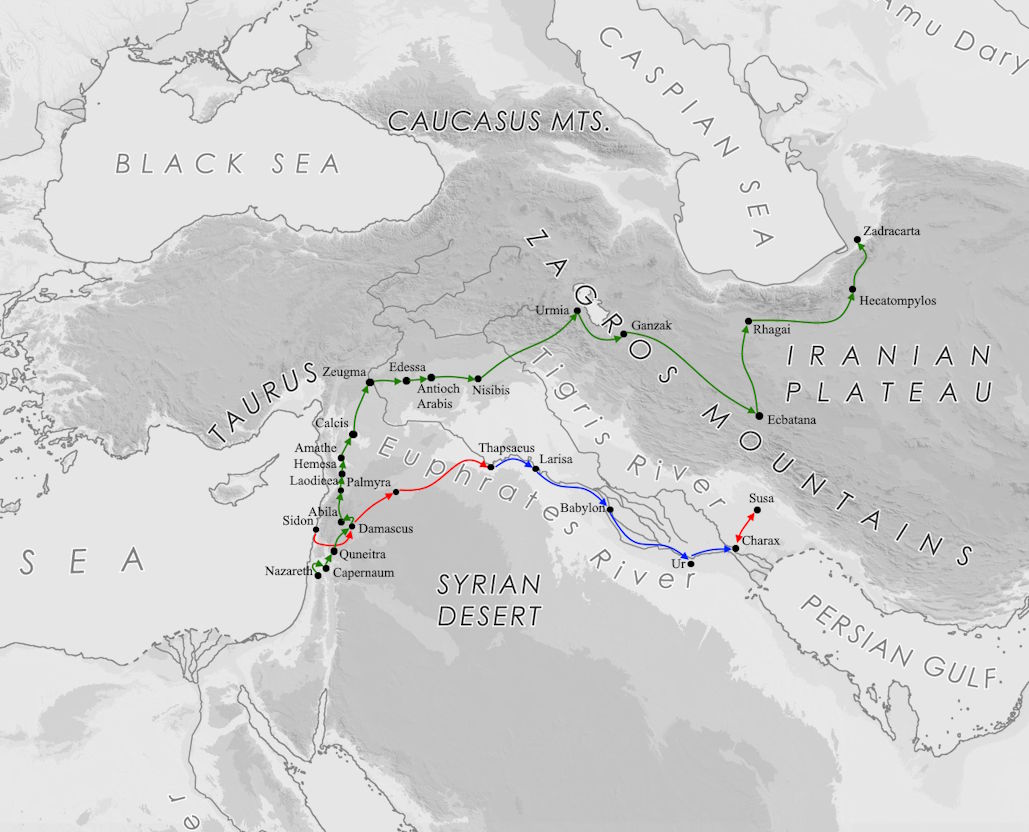
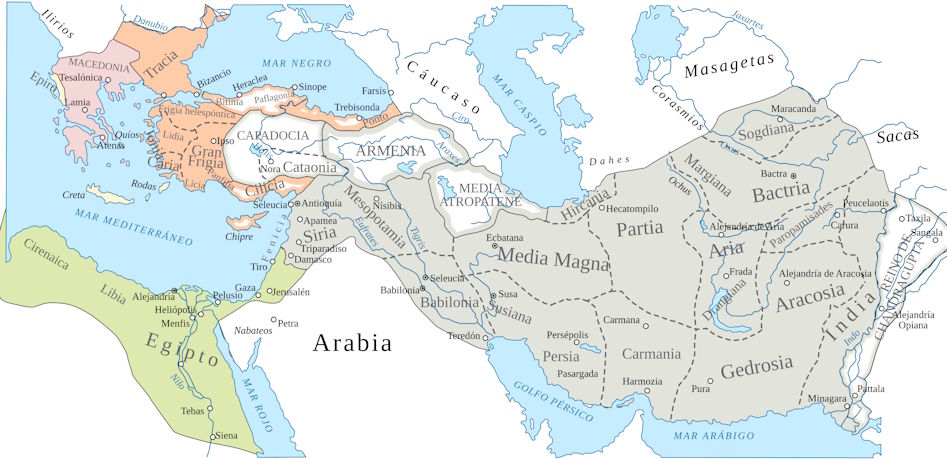
Very few details are offered in The Urantia Book about the possible route Jesus followed and the many experiences this caravan journey must have represented for him. We can speculate on an itinerary [20] and chronology, based on the data we have, as follows:
- From Nazareth to Capernaum: On his return journey from his previous trip, Jesus passed through Capernaum before continuing on to Nazareth (UB 134:1.1), to greet his family and the sons of Zebedee. Therefore, it is logical to think that before departing with the caravan, he also made a stop here of at least one day.
- From Capernaum to Quneitra: At a certain point north of Capernaum, the Jordan is crossed at a ford, entering the tetrarchy of Herod Philip. It takes about two days to get there.
- From Quneitra to Damascus: Crossing the foothills of Mount Hermon, over rocky and elevated terrain, the oasis of Damascus was reached in about three days, with the camels able to refresh themselves in the waters of the Barada River.
- From Damascus via Abila Lysanou to Heliopolis: Leaving Damascus, the capital of the province of Syria, they would travel through the Barada Valley towards Abila Lysanou (capital of the tetrarchy of Lysanias), along a route hemmed in by limestone cliffs. In Heliopolis (Baalbek), they entered the Beqaa Valley. There, Jesus and the travelers could admire the colossal works of the Temple of Jupiter, with its gigantic stones. This would take them about three days.
- From Heliopolis to Laodicea in Lebanon: Following the Orontes River north, Laodicea is reached in two days, over flatter and easier terrain.
- From Laodicea to Hemesa: The next day they would cover the distance to Hemesa (Homs). Here the culture changes, and the people worship other gods, such as the sun god El-Gabal.
- From Hemesa to Amathe: Amathe (Hama) was famous for its fertile lands. It probably took them two days, stopping at Arethusa (Al-Rastan) on the Orontes River.
- From Amathe to “Chalcis ad Belum”: Chalcis had a drier landscape, far from major rivers. It was a long journey of at least four days.
- From Chalcis to Zeugma via Beroia: Beroia was an important market located at a crossroads. Several routes led from here to reach the Euphrates, some more direct than others. Zeugma (meaning “The Bridge”) was a dual city (Seleucia and Apamea joined by a floating bridge of boats). Here the legions guarded the crossing of the Euphrates, collecting the highest tolls of the entire journey. It was another long stretch of about three days.
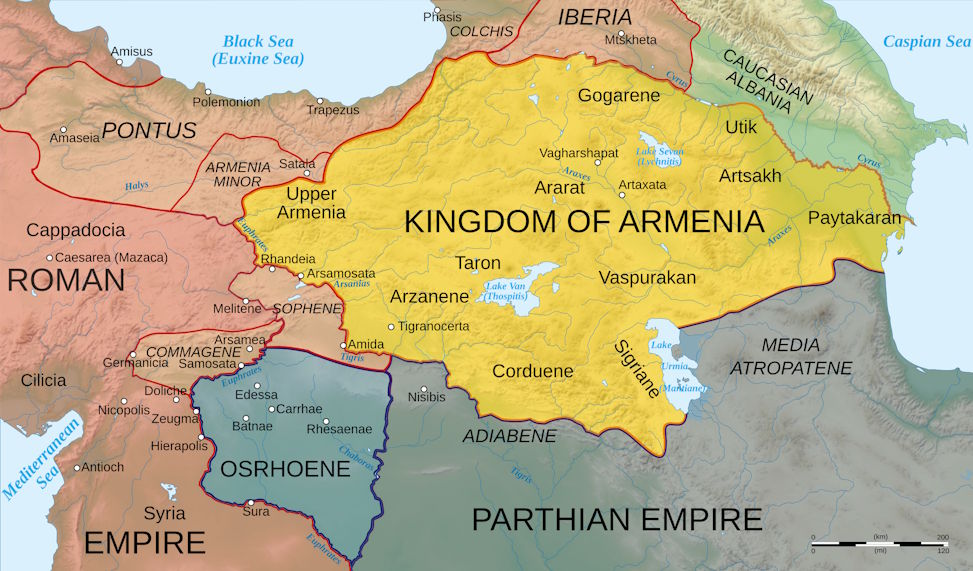
- From Zeugma to Edessa: here Jesus and his companions would meet on the “Persian Royal Road,” which Strabo called the Koine Hodos or “Common Road,” the most ancient route for caravans heading to the East. Edessa (Urfa) was the capital of the kingdom of Osroene (Wikipedia), a vassal kingdom of Rome, whose king, Abgar V, maintained very good relations with Tiberius, as the two were close friends [21]. The journey must have taken three days.
- From Edessa to Arabian Antioch (Tella / Viranshehir): here they arrived after crossing a long plain, with a flat horizon and scorching heat, considering they would arrive there at the beginning of summer. It’s a journey of about three days.
- From Antioch to Nisibis via Ammodios: Nisibis was a commercial gem, the meeting point in those times for caravans coming from India and China (via Parthia) with those from the Mediterranean. It was a walled city of bricks where the markets never slept. Reaching Nisibis must have taken four days.
- From Nisibis to Urmia: From Nisibis, the caravan must have headed east towards the Tigris River (near present-day Cizre). After crossing it, they faced the imposing Zagros Mountains. The best pass was Rowanduz. Upon leaving the mountains, the caravan would have turned north to the city of Urmia, on the western shore of Lake Urmia (Lake Spauta/Matianus). This region was the territory of the kingdom of Atropatene (Wikipedia), a vassal of the Parthians, which was ruled from its capital, Gandzak, by King Artabanus II of Parthia (Wikipedia). This long journey must have taken between 12 and 14 days.
- From Urmia to Gandzak: Following the southern shore of Lake Urmia, one enters the Iranian plateau, where the route connected with the Silk Road, eventually reaching Gandzak, the summer capital of Atropatene, famous for its fire temple (this was Zoroastrian territory).
- From Gandzak to Ecbatana (Hamadan, Wikipedia): This was the ancient capital of the Medes and the summer residence of the Parthian kings. It was a mandatory stop for resupply. It was an immense city with seven colored walls (according to the legend recounted by Herodotus).
- From Ecbatana to Rhagai (present-day Ray, in Tehran): This was one of the oldest and most sacred cities in the Zoroastrian world. It was a vital commercial center where routes from India and the Far East converged. In total, the journey from Urmia to Rhagai must have taken 22 to 25 days.
- From Rhagai to the Caspian coast (the Alborz crossing), passing through Hecatompylos (modern-day Qumis, Wikipedia): this route was the most complicated, necessary to enter the magnificent kingdom of Hyrcania. To reach the sea, one had to cross massive mountains, and the best pass was the famous “Caspian Gates” (Pylae Caspiae, Wikipedia), although their exact location is unclear today. It was a narrow and strategic defile that separated the Iranian plateau from the Caspian lowlands. For a camel caravan, this pass represented a crucial point. Once across the pass, the landscape changed dramatically: from dry desert to humid subtropical forests. The final destination is not revealed in The Urantia Book, but it was surely Zadracarta (near modern-day Sari or Gorgan), the capital of the satrapy of Hyrcania, on the southeastern coast of the Caspian Sea. In total, this journey must have taken 15 to 18 days.

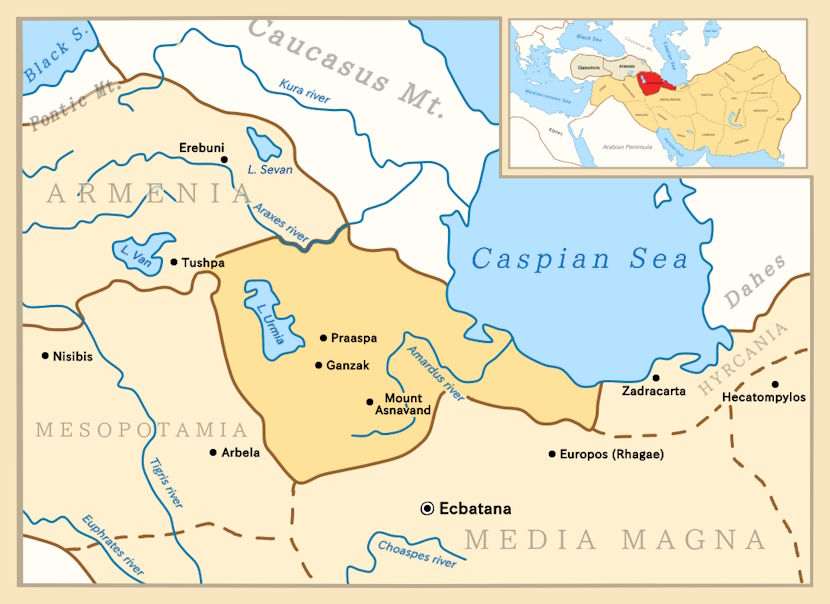

It should be noted that on this journey Jesus assumed the role of guide of the caravan. This type of position would include some of these duties:
- Security: Beyond Zeugma, the risk of small raids by Arab nomads increased, and it was advisable to hire an escort, usually of local sagittarii (archers). It should not surprise us that Jesus performed these kinds of tasks. Although he was a person who systematically refused to carry weapons or commit acts of violence, he was not unaware of the needs of his time. Furthermore, beyond Nisibis, the Roman Empire ended, and therefore its roads. It was unwise to provoke these people with condescending remarks. The roads were not in good condition and there was a greater degree of insecurity on them.
- Water: The stretch between Beroia and Zeugma, as well as others, required planning. It was necessary to know where the wells were and to keep in mind that in some places the water was brackish.
- Coins: It was necessary to carry a certain amount of money for the necessary bribes. Roman officials usually required an extra payment for their services in the form of silver denarii, and at the crossings through Mesopotamia, one had to loosen a few silver drachmas or bronze coins.
Jesus’ return journey, like his outward journey, is not indicated in The Urantia Book, but it must surely have followed the same route Jesus used on the outward journey. We know that he stayed in Urmia for “a little over two weeks” (UB 134:2.5) to give twenty-four lectures at a school [22] located there (UB 134:3.5), but we have no further information.

¶ The trip to Syria
This was the third long journey Jesus made during his life. He left Nazareth in mid-April 25 (UB 134:7.1), stayed “more than two months in Antioch” (UB 134:7.3) and returned afterwards, probably towards the end of June 25.
On this journey and the subsequent one through Palestine, Jesus no longer used routes unfamiliar to him. He had already traveled many of the roads he covered in the past. This is the point at which Jesus focuses his movements on the region of Palestine, where he will concentrate his activity during his public ministry. On the outward journey to Antioch, he passed through Tyre and Sidon, and on the return journey, he went to Caesarea and Joppa. However, tracing the itinerary of these two journeys presents a problem, as we shall see below (UB 134:7.4).
This journey and Jesus’ subsequent one through Palestine have a significant chronological problem. The time frame in which they occurred was only four months. If Jesus made these journeys on foot and stopped in some places on the days indicated by The Urantia Book, it is completely impossible that Jesus had enough time to complete these routes.
Let us compile all the time references given:
- Jesus left Nazareth in mid-April of the year 25 (UB 134:7.1).
- In Sidon he stayed “a few days” (UB 134:7.1).
- In Antioch he lived “more than two months” (UB 134:7.3).
- In Caesarea he stayed “a few weeks” (two or three?, UB 134:7.4).
- In Beersheba he stayed “a week” (UB 134:7.4).
- In mid-August of the year 25 Jesus set up camp on the slopes of Mount Hermon (UB 134:8.1).
From mid-April to mid-August there are four months. The stays mentioned amount to approximately: 3 days (Sidon) + 70 days (Antioch) + 14 days (Caesarea) + 7 days (Beersheba) = 94 days. This is approximately three months and four days, leaving Jesus with roughly three weeks to travel. However, the journey on foot from Nazareth to Antioch takes 19 days, from Antioch to Beersheba 23 to 26 days, and from Beersheba to Caesarea Philippi 11 to 13 days. Therefore, on foot, these journeys would have taken Jesus 53 to 58 days. In total, the entire journey from Nazareth to Caesarea Philippi would have taken 147 to 152 days, which is five months.
It is obvious that Jesus made part of this journey without walking, and it is very likely that this was the coastal route, where he probably took a boat on the outward journey and another on the return. It is worth noting that he had already traveled this coastal route in a caravan with Gonod and Ganid, and therefore many of the places held no particular interest for Jesus. The Urantia Book tells us only that Jesus, on his outward journey, was in Tyre and Sidon, and then adds, “but his destination was Antioch” (UB 134:7.1), which seems to indicate that from Sidon he went directly to Antioch by boat.
The same can be deduced from his return journey. We are told that he traveled south along the coast to Caesarea (UB 134:7.4), and then again along the coast to Joppa, but then it clearly states that he “traveled inland.” A careful reading seems to indicate that the journey from Antioch to Caesarea was by sea, as was the journey from Caesarea to Joppa, but then he traveled inland along the roads, continuing on foot.
This would allow us to reconcile the chronological start and end times given in The Urantia Book for this journey. With this in mind, let’s develop an itinerary that takes these conclusions into account:
- From Nazareth, Jesus must have departed for Sepphoris, which is very close, just a few kilometers away, so he probably didn’t linger there long and continued on to Ptolomais (Ptolemais, Acre), on the coast. This was the first time Jesus had visited this town, as he had not passed through it on his journey with Gonod and Ganid. This port was one of the most vibrant and vital in the Roman Empire, and the coastal road, called the Via Maris, as well as the inland branch, was one of the safest, traveled daily by dozens of caravans. The journey to Acre must have taken Jesus a day, and he likely stayed a few more days in this city (as seems to be implied by UB 134:7.3, which states that he “remained some time in other places,” in the plural).
- From Acre he went to Tyre. To get there, one had to cross the famous “Ladder of Tyre” (Scala Tyriorum, Wikipedia), a perilous passage carved into the white limestone cliffs at the edge of the coast. Tyre was another city that Jesus was unable to visit on his journey with Gonod and Ganid, and it was famous for its purple dye extracted from murex snails. A two-day journey to Tyre was possible.
- From Tyre, he went to Sidon, in the heart of Phoenicia, a place he had already passed through with Gonod and Ganid. He likely spent the night in Sarepta first, and the next day reached Sidon. Jesus stayed in Sidon for “a few days,” possibly three.
- From Sidon to Seleucia Pieria, Jesus took a boat. At that time of year, sailing was challenging due to the Etesian winds (which blow from the north), so the boat sometimes had to sail close-hauled or wait for favorable breezes. It was a four- to five-day journey with stops in Beirut, Tripoli, Aradus (Antarado), and Laodicea ad Mare, towns where Jesus had already stopped during his caravan journey with Gonod and Ganid.
In total, the journey from Nazareth to Antioch took about ten days, including the stops in Acre, Tyre, and Sidon, where Jesus likely wanted to linger for a while. If we add to that the more than two months he spent living in Antioch, this gives us a total of approximately two and a half months for the entire journey, and therefore, he must have left Antioch at the end of June 25.
¶ The Journey Through Palestine
This was the fourth and final major journey that Jesus made during his life. He left Antioch of Syria at a time that is not specified, probably at the end of June 25, and arrived at the beginning of August 25 in Caesarea Philippi, since we are told in The Urantia Book that he “remained some time in the vicinity of Caesarea” and that “a little before the middle of August of the year 25” he established a camp in the hills of Mount Hermon (UB 134:8.1).
The Urantia Book details the itinerary quite well (UB 134:7.4-5):
From Antioch Jesus journeyed south along the coast to Caesarea, where he tarried for a few weeks, continuing down the coast to Joppa. From Joppa he traveled inland to Jamnia, Ashdod, and Gaza. From Gaza he took the inland trail to Beersheba, where he remained for a week.
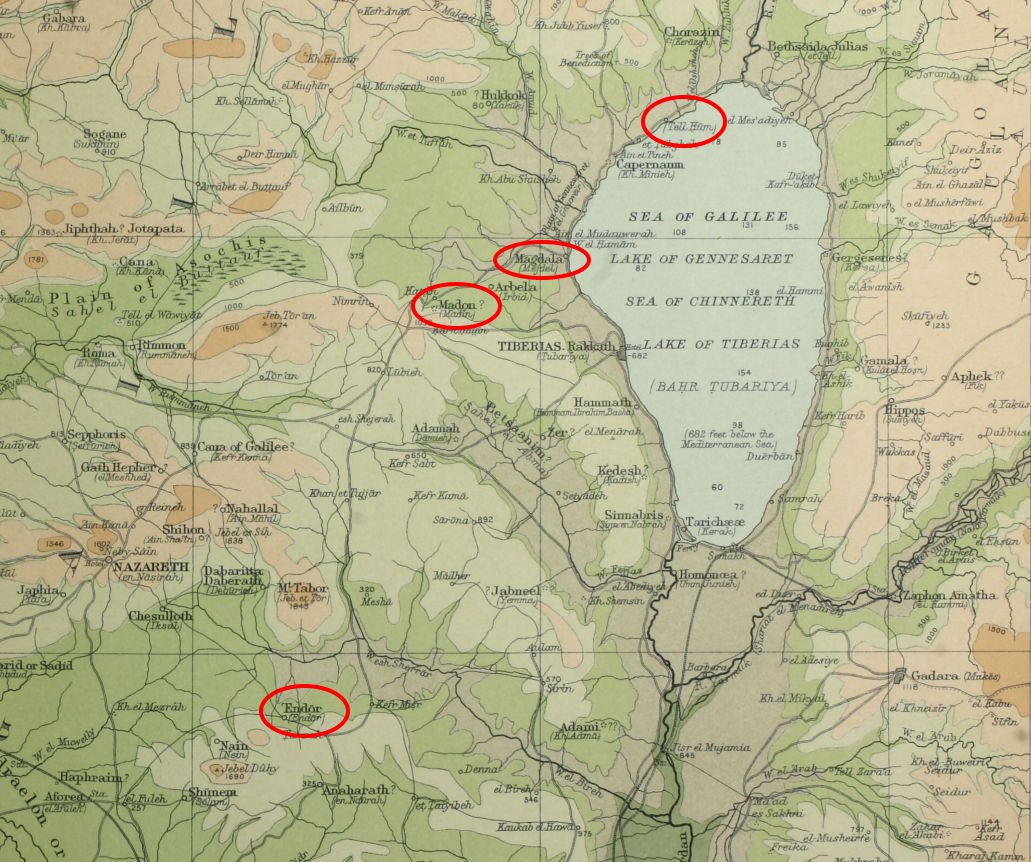
Jesus then started on his final tour, as a private individual, through the heart of Palestine, going from Beersheba in the south to Dan in the north. On this journey northward he stopped at Hebron, Bethlehem (where he saw his birthplace), Jerusalem (he did not visit Bethany), Beeroth, Lebonah, Sychar, Shechem, Samaria, Geba, En-Gannim, Endor, Madon; passing through Magdala and Capernaum, he journeyed on north; and passing east of the Waters of Merom, he went by Karahta to Dan, or Caesarea-Philippi.
On this journey, as we have already mentioned, Jesus did not use any unfamiliar routes. The boat trip from Antioch to Sidon was the same one he had taken on the outward journey. Caesarea and Joppa had already been among his stops during his trip to Rome with Gonod and Ganid. Furthermore, in the year 17, Jesus had already traveled along that coastal area with his brother Simon, following the causeway by the sea. The route he took between Jerusalem and Shechem was the same one Jesus had taken in the year 12 with his brother James. Regarding the journey between Capernaum and Caesarea Philippi, Jesus had already taken that road on his way to Damascus when he lived there for four months in the year 17.
Even so, this journey must have been full of interesting anecdotes, as it expanded the extent of the territory of Palestine that he managed to visit. Unfortunately, none of these experiences of Jesus are recounted in The Urantia Book, which glosses over this period with remarkable brevity.
Based on the available information, the possible chronology of this journey could have been as follows:
- He departed from Antioch in Syria towards Seleucia Pieria, traveling along the causeway beside the Orontes River in a one-day journey.
- From the port of Seleucia, he boarded a ship that took him to Caesarea. This leg of the journey must have been faster than the outward journey, as the prevailing north and northwest winds facilitated the descent along the Levantine coast. It must have taken Jesus six days with these stops:
- Day 1: Seleucia → Laodicea. This was a quick descent, taking advantage of the following wind as they rounded Mount Cassius.
- Day 2: Laodicea → Aradus. They followed the coastline, and the sailing here was calm with good visibility.
- Day 3: Aradus → Beirut. This involved a day of continuous sailing. If the wind was strong, the captain could certainly bypass Tripoli to save time.
- Day 4: Beirut → Tyre. Passing Sidon, they arrived at the great metropolis of Tyre. It was a mandatory stop: large ships often unloaded or loaded valuable purple-dyed fabrics here.
- Day 5: Tyre → Ptolemais (Acre). They crossed the “Step of Tyre,” but now by sea. Ptolemais was the last major port before entering the waters under the direct jurisdiction of Judea.
- Day 6: Ptolemais → Caesarea Maritima. The arrival was spectacular. Jesus could admire the colossal breakwater of the port of Sebastos and the Temple of Augustus and Rome gleaming in white marble on the coast. He must also have been able to see the lighthouse of Caesarea (called Drusion in honor of Tiberius’s brother), which guided ships to the harbor entrance.
- In Caesarea we are told that Jesus stayed “for a few weeks” (UB 134:7.4), which given the chronological times could only have been two weeks at most.
- From Caesarea he went to Joppa, a one-day boat trip. That he traveled by boat seems to be inferred from The Urantia Book, which states that Jesus “continued along the coast,” in contrast to the next stage, in which he “traveled inland.”
- From Joppa he went to Jamnia, a city separated from the sea, with another coastal city called Jamnia Paralios. It was reached by a causeway that ran parallel to the coast, but at a distance. Jesus likely spent the night here and continued his journey the next day.
- From Jamnia he went to Ashdod. Ashdod (Wikipedia), along with Jamnia, Azotus, and Phasaelis, was an independent toparchy that had been ruled by Salome I, sister of King Herod the Great, but which, after her death a few years earlier, had come under the direct jurisdiction of the prefect of Judea. Ashdod also had a port called “Azotos Paralios” (Azotos was the Greek name for the city). Jesus likely spent the night there and continued the next day.
- From Ashdod to Gaza. Gaza (Wikipedia) was one of the southernmost Jewish settlements on the Mediterranean coast. To reach it by road, a journey that could be made in a day, Jesus must have passed near Ashkelon and Anthedon, two nearby towns along the way. The port of Gaza was called Maiuma (Wikipedia), although it was formerly known as Anthedon.
- From Gaza to Beersheba (Wikipedia). This route is long and likely required Jesus to stop at some point along the way. Beersheba was an ancient city steeped in the history of the patriarchs. It was a crossroads of two roads: one leading from Gaza to the southern Dead Sea, and the other traversing the mountainous spine of Judea and Samaria, connecting Haluza (Elusa) with Jerusalem, and Jerusalem with Shechem (later Neapolis). Jesus stayed in Beersheba for a week. It seems that Jesus was always drawn to places with a long history, as he also spent some time in Ur of Chaldea, interested in the story of Abraham.
- From Beersheba to Hebron (Wikipedia). This involves a steep climb of about 700 meters to the Judean mountains, following the road that runs parallel to the Hebron nahal (the wadi al-Khalil and al-Samen). Surely a Jesus in good physical shape could have covered this distance in a single day.
- From Hebron to Bethlehem and Jerusalem. Following the upper part of the mountain, the road became easier, passing through Beth-Sur and easily reaching Jerusalem in a day. About 5 km before reaching Jerusalem, the road had another branch leading towards the Dead Sea, to En-Gedi. This is the road that Jesus likely took to make a brief detour to Bethlehem and see his birthplace for the first time, before continuing on to Jerusalem. We are told that Jesus did not pass through Bethany, which would have been the appropriate place to spend the night, so it is probable that he simply passed through Jerusalem to spend the night in Beeroth. In this part of the journey, he seems to have been in a hurry to reach his destination. This is inferred from the fact that his inner spirit prompted him to travel to a secluded place, Mount Hermon (UB 134:7.6).
- From Jerusalem to Beeroth (Wikipedia). The exact location of this town is unknown. One of the possible locations is al-Birah[23] (Wikipedia). It is likely that Jesus spent the night here after the long journey from Hebron.
- From Beeroth to Shechem. This route is gently downhill, although it passes through a series of hills in a seemingly endless series of ascents and descents. The Urantia Book tells us that he passed through two towns, Lebona and Sychar[24].
- Shechem to Madon. In the itinerary that Jesus follows for this leg of his journey, it is clear that he is trying to avoid Scythopolis, and therefore the Decapolis. The shortest route to the Sea of Galilee and Capernaum is to continue along the main road north to the Greek city, and from there to Taricheae on the southern shore. Jesus avoids this road and heads to Samaria (renamed Sebaste by Herod, Wikipedia). He then detours again, passing through Geba, En-Ganim, Endor, and Madon.[25]
- From Madon to Caesarea. Jesus could have spent the night in Endor or Madon. We have already mentioned that he was in a hurry, which is why The Urantia Book mentions that he passed through Magdala and Capernaum. This suggests that he likely continued along the main road without stopping to greet the families, in order to save time. The road from Capernaum to Paneas (Caesarea Philippi) is very flat, following a fertile valley (Hula Valley). The two intermediate places mentioned in The Urantia Book at this stage of the journey are the Waters of Merom[26] and Karatha[27].
¶ The Ascent to Mount Hermon
Jesus made the journey from Paneas (Caesarea Philippi) to Mount Hermon in mid-August of the year 25 (UB 134:8.1). He remained there for six weeks (UB 134:7.7), the last three weeks of August and the first three of September (UB 134:8.4). In his itinerary to reach the place where he would reside for those weeks, we are told that he passed through “a town once known as Beith Jenn”[28] (UB 134:8.1).
The place where he established his camp is said to have been situated at 2,000 m, making it one of the foothills of Mount Hermon, which reaches a much higher altitude of 2,814 m. From the peaks of Mount Hermon to Beit Jenn, two streams flow down the slopes, joining together shortly before reaching the town. The northernmost branch, now traversed by a road and containing several nature parks, may well have been the one Jesus traveled with the child named Tiglath. This stream had its source at a small peak with an elevation of 2,224 m, which is more than sufficient for Jesus’ purposes of “forsake the dwelling places of men” (UB 134:7.6).
¶ The Return to Capernaum and the Visit to Jerusalem
Jesus returned to Capernaum sometime during the fourth week of September 25. From the indications in The Urantia Book it appears that Jesus said goodbye to Tiglath, the boy who had helped him by bringing him provisions during those weeks, continued his journey without interruption through Dan (also called Dan instead of Paneas or Caesarea Philippi), and arrived in Capernaum perhaps in a single day (UB 134:8.10).
We do not know the exact day Jesus arrived, but since we are told that he was on Mount Hermon for six weeks, including the first three weeks of September (UB 134:8.4), it seems clear that Jesus returned in the fourth week of September (not counting the 1st and 2nd of that month, which were actually part of the last week of August). This means between September 24 and 30. Since we are also told that on the Sabbath of that week Jesus had a family gathering (UB 134:9.1), he must have arrived before that Sabbath. He probably returned on Thursday, September 27, with enough time to visit his family and Zebedee’s family.
On the Sunday after the family gathering, Jesus left with John Zebedee for Jerusalem to spend the Feast of Atonement there. On this journey to Jerusalem with John Zebedee, Jesus traveled along the eastern shore of the lake and through Kheresa (UB 134:9.1). Here, The Urantia Book appears to have a clear error [29]. They must have spent the night somewhere along the way, probably in Pella. On the second day, Monday, they may have spent the night in Jericho, arriving in Bethany on Tuesday. This is a route Jesus had taken on other occasions when traveling to Jerusalem. They spent Tuesday with Lazarus’s family, and on Wednesday they entered Jerusalem, “spending almost three weeks in and around the city” (UB 134:9.2).
Jesus spent part of the Feast of Tabernacles with John. “In the middle of this week” (UB 134:9.5), Jesus withdrew to the hills near Bethany for a week. John returned to Capernaum on his own, and Jesus continued alone for a few more days.
He returned to Capernaum probably toward the end of October 25. He traveled north toward Samaria, following the same route he had used on his solo journey through Palestine. He may have passed through Beeroth and Sychar, spending the night there. The next day he continued on toward the slopes of Mount Gilboa (Wikipedia). He could have traveled along the causeway between Shechem and Scythopolis, likely stopping near a town called Gilboa (Jalbun, Jelbun, or Gelbus, Wikipedia); or he could have taken the road to Samaria (Sebaste), then Ginae, Jezreel, and the valley of Nahal Harod. The second option represents the same route he had already taken on his journey during July of that same year. In The Urantia Book the place where he withdrew alone is not specified, only that it was “near the place where King Saul had taken his own life” (UB 134:9.5), but this place, where a battle was fought between Israelites and Philistines, is not known (see King Saul in Wikipedia).
The next day he must have continued on to Capernaum, possibly arriving there on a Thursday. Jesus had to have arrived in Capernaum during the week, for we are told that “the next morning” after arriving he immediately went to work in Zebedee’s shipyard (UB 134:9.6). He could not have arrived on a Friday or a Saturday, and the three-day return journey could not have included a Saturday, which would have prevented him from traveling on that day.
¶ The Baptism at Pella and the Retreat in the Hills
Jesus traveled from Capernaum to Pella [30] on Sunday, January 13, 26 (UB 135:8.2) for the purpose of being baptized by John. He went there with his brothers James and Judah. They spent the night at the ford of the Jordan. We are not told whether they went by the western or eastern route across the lake, but it is possible they went by the western route to avoid the toll when crossing the Galilean border, and surely also to give Judah an opportunity to tell his wife (in Magdala) where he would be staying for the next few days.
They arrived opposite Pella at noon the following day (UB 135:8.4), Monday, January 14, right where John had his encampment, and there Jesus and his brothers were baptized. Then, immediately, the Master left the encampment, going to the hills east of Pella to spend a few weeks in seclusion. One possible location for where Jesus stayed during these forty days is east of a village called Beit Adis (also Beit Edis or Beit Idis, UB 136:4.14). In that area of the Gilead hills, gullies form on the slopes, and in one of them may have been the precipice where Jesus meditated on one occasion (UB 136:7.1). [31]
Jesus returned to Pella, to John’s camp, on Saturday, February 23, 26 (UB 137:0.1). At the camp, Jesus and his first apostle, Andrew, took charge of an injured boy and brought him to their home in Pella, where Jesus spent the night.
The next day, Sunday, February 24, 1926 (UB 137:2.1), Jesus, now with his first four disciples (Andrew, Peter, James, and John), began the return journey, traveling first toward Nazareth. Along the way, upon reaching the ford of the Jordan, two new members, Philip and Nathanael, joined the group of apostles. The seven crossed the river into Galilee by way of Nain (UB 137:2.3, UB 137:2.8). The Urantia Book mentions a road from Nain, but it is unclear which road it refers to, since on all maps (including Adam Smith’s Atlas) Nain does not appear as a major town with a road passing through it, much less in the direction of Nazareth [32]. It likely refers to the road from Jezreel, which then ascends in the direction of Nain.
They arrived in Nazareth on Sunday afternoon, spent the night there in Jesus’s former home, and the next day Jesus returned to Capernaum, stopping in Magdala, while sending his apostles to Cana [33] (UB 137:3.1). Jesus arrived in Capernaum on Monday night and slept in the house of the Zebedee family. (UB 137:3.4).
¶ The Wedding at Cana
Jesus traveled with his family to Cana from Capernaum on Tuesday, February 26, 26 (UB 137:3.6). The location of Cana remains unclear to this day [34], but the place that best fits Jesus’ itinerary is Kefar Kenna, a few kilometers northeast of Nazareth, on the Via Maris. The wedding at Cana took place on Wednesday, with the extraordinary events already known, and the next day, Thursday, Jesus and his apostles hurried back to Capernaum.
Once there, the Master decided to spend a long time in Capernaum, until June 26, preparing his apostles for their future preaching.
¶ First Personal Sermon
On Sunday, June 23, 1926, Jesus sent out the first six apostles in pairs. “James and John, son of Zebedee, went to Kheresa, Andrew and Peter remained in Capernaum, while Philip and Nathanael went to Taricheae” (UB 138:1.1). As you can see, these were three lakeside towns. They stayed in these towns for two weeks while Jesus traveled to Nazareth to visit his family, many of whom he had abruptly left during the wedding at Cana. (UB 138:1.4).
They most likely met again on a Friday, July 5, 26, to avoid having to travel on Saturday. The “whole day that Jesus spent with the six” (UB 138:2.10) in which the apostles related their experiences to Jesus was most likely Saturday, July 6. The next day Jesus was at Matthew’s house, admitting Matthew and Simon the Zealot as apostles. On Monday, Jesus and his eight apostles traveled by boat to Kheresa, where the twins Alphaeus were admitted to the apostolic body. On Tuesday, they all traveled by boat together to Taricheae, where Jesus admitted Thomas and Judas. They spent Wednesday together, and on Thursday, July 11, they returned to Capernaum in their boat.
¶ First Preaching of the Twelve
Once they arrived in Capernaum, they stayed there for a while preparing for their future preaching work. In mid-August of 138 AD, they began their first preaching effort. Every two weeks they went fishing in Capernaum, and when they had earned enough, they spent the next two weeks preaching. They went in pairs according to the order in which they had entered the apostleship, and every two weeks Jesus accompanied one pair (UB 138:8.1).
A possible chronology of the six preaching trips could be as follows:
- Jesus’ first trip, with Andrew and Peter: from August 4 (Sunday) to August 17 (Saturday).
- Jesus’ second trip, with James and John Zebedee: from September 1 (Sunday) to September 14 (Saturday).
- Jesus’ third trip, with Philip and Nathanael: from September 29 (Sunday) to October 12 (Saturday).
- Jesus’ fourth journey, with Matthew and Simon the Zealot: from October 27 (Sunday) to November 9 (Saturday).
- Jesus’ fifth journey, with the twins Alphaeus: from December 1 (Monday, after Hanukkah) to December 7 (Saturday).
- Jesus’ sixth journey, with Thomas and Judas: from December 22, 26 (Sunday) to January 4, 27 (Saturday).
This period of preaching concluded in early January, for on January 12, 27, a Sunday, Jesus gathered the twelve, leading them to a mountain north of Capernaum to formally ordain them as apostles (UB 140:0.1-2).
The Urantia Book does not detail the itineraries of these fortnightly journeys of Jesus and his apostles. It offers only a list of prominent towns they visited: “Capernaum, Bethsaida-Julias, Chorazin, Kheresa [34:1], Hippos, Magdala, Cana, Bethlehem of Galilee, Jotapatha, Ramah, Safed, Giscala, Gadara, and Abila” (UB 138:9.3). We are also told that in addition to these cities, they worked in many towns. This seems to indicate that the list only mentions important towns, and that less important towns are not included.
However, it doesn’t take much effort to find out a good number of the towns that Jesus and his apostles surely passed through. To do this, simply place the towns on a map, trace the most logical route starting from Capernaum, and then list the intermediate places you find.
Capernaum, Bethsaida-Julias, and Chorazin don’t represent a journey in themselves, since Bethsaida-Julias is only a few kilometers east of Capernaum, across the Jordan River, and Chorazin is the next town a short distance north of Capernaum. We have already mentioned that Jesus and his apostles were in Kheresa when he chose the twins Alphaeus. Therefore, the following cities remain:
- Hippos: This is one of the cities of the Decapolis [35], the closest to the Sea of Galilee, located on a hill on the eastern shore of the lake. There are several nearby towns that they could have visited: Ein Gofra, a fishing village located between Kheresa and the port of Hippos; The port of Hippos itself; Afeq, a village east of Hippos; and Iyyon, a village situated in the high ground slightly south of Hippos. It should be noted that The Urantia Book does not mention Gamala (Wikipedia) in this list. Archaeologists believed (at the time the book was written) that Gamala was located near where Ein Gofra is today, but the city of Gamala was discovered in 1968 10 km northeast of the Sea of Galilee.
- Magdala (Wikipedia): It was located precisely where archaeology initially believed it to be (5 km north of Tiberias), but it is now believed that this Magdala was Taricheae. The Urantia Book clearly distinguishes between these two locations and places Taricheae at the mouth of the lake [36].
- Cana: This was already visited by Jesus and his apostles during the wedding, and we have already mentioned that the location suggested by The Urantia Book seems to be Kefar Kenna, northeast of Nazareth. Therefore, the usual route to Cana was the same as to Nazareth, the Via Maris. Some villages located along this route were Kefar Nimra and Turan. In the vicinity of Cana were three towns called Nahallal, Shihon, and Geth Hefer.
- Bethlehem of Galilee: It is somewhat unusual for this town to appear on the list because its location is usually placed far west of Galilee, well beyond Sepphoris. The usual route to reach it would have been a road connecting the Sea of Galilee with Sepphoris, passing through towns such as Arbela, Madon, Kefar Nimra, Turan, and Rimmon.
- Jotapata: It was located to the west, on some hills north of the plain of Asochis. To get there, one had to use the road towards Sepphoris and then turn off for a stretch to the north at Rimon.
- Ramah: It was located northwest of the Sea of Galilee [37], in the foothills of Upper Galilee, midway along the road that connected the Sea of Galilee with Ptolemais. In the vicinity of Ramah were a number of nearby villages: Kefar Hananiah, Parod, Beersheba, and Selamen.
- Safed: Safed was also located northwest of the Sea of Galilee [38], rising towards a hill not far from Capernaum and Chorazin. Some nearby towns are Acchabaron, Biri, Kephar Nevraia, Meroth, and Kishon. All were situated on a northern road that traversed Upper Galilee.
- Giscala: Giscala [39] was located on the same route that led to Safed, a little further northwest.
- Gadara: This is another of the cities of the Decapolis [35:1], located southeast of the Sea of Galilee. Since one passage mentions that Thomas worked for a time in Gadara (UB 138:2.5), and Gadara is not far from Taricheae, Thomas’s homeland, it is easy to assume that this city and its surroundings were the site of the several weeks of preaching by Thomas and Judas.
- Abila: This is another of the Decapolitan cities [35:2], located east of Gadara, on a road that also connected with Capitolias (also called Dion, which should not be confused with Dium). There must have been a number of villages near Gadara, Abila, and Capitolias, but unfortunately, it is very difficult to obtain locations of settlements from Jesus’s time in the Jordan region. We only know that Zaphon was near Gadara, and between Gadara and Capitolias there was a city called Lidebir. This territory, called Gilead in ancient times, has always been shown on maps as sparsely populated and with few prominent locations, something that surely was not the case given the great importance of the Decapolis.
¶ Jesus’ First Great Journey with the Apostles
The first journey that Jesus made to Jerusalem with his apostles took place on January 19, 27, a Sunday (UB 140:0.1). This journey actually became a long preaching tour that spanned the entire year 27 until they returned to Capernaum. They spent time in the Jordan Valley, then in Jerusalem, then in southern Judea, and finally continued through Samaria and part of the Decapolis. This itinerary is given in considerable detail in The Urantia Book.
On January 19 they arrived at Taricheae, and on January 20 they traveled to near Pella, where John the Baptist had previously camped (UB 141:1.2). They stayed there “more than two weeks” preaching to people from all over. Probably around Wednesday, February 5, they left Pella and arrived at Amatus, farther south, where they stayed “almost three weeks” (UB 141:3.1). On February 26, they departed from Amatus for Bethabara, also called “Bethany of Perea” and “Bethany beyond the Jordan” (UB 141:7.1, UB 141:8.1), where they remained for “four weeks.” Except for a short retreat Jesus made with Peter, James, and John in the western hills south of Jericho, the rest of their time was spent at this famous ford of the Jordan, which is precisely where John had begun to baptize (John was now in prison).
On Monday, March 31, 27, Jesus and the twelve set out for Jerusalem, staying at the house of Lazarus in Bethany (UB 141:9.1). On Sunday, April 6, they went to Jerusalem together for the first time (UB 141:9.1). They remained in the vicinity of Jerusalem throughout April. Passover was a few days later, and they likely celebrated it together at Lazarus’s house. Toward the end of April, tensions with the Jewish leaders became so dangerous that Jesus and the twelve left Jerusalem and traveled south to Bethlehem and Hebron (UB 142:8.1), where they spent the entire month of May doing personal rather than public work. We are also told that Jesus and Abner, the leader of John the Baptist’s disciples, traveled together to En-Gedi, a city on the west shore of the Dead Sea. Jesus and the twelve returned to Jerusalem in “early June” but did not enter the city. They stayed in a garden called Gethsemane on the Mount of Olives, doing private work. They spent the entire month of June without incident, but at the end, because a Sanhedrin member embraced Jesus’ cause, a situation became so acute that Jesus decided to leave (UB 142:8.3-5).
Jesus now took the route through Samaria. They left at the end of June, arriving “on a Sabbath” at Bethel, probably on June 28 (UB 143:0.1). They stayed there for two days, and people from Gofna and Ephraim came to them. They spent more than two weeks preaching also in the region of Arimathea and Tamna [40]. During the last week of July, the group departed for the cities of Phasaelis and Archelais [41], near the Jordan (UB 143:0.2), where they remained for the first half of August 27. They made a three-day escape to the top of Mount Sartaba (probably near where the fortress of Alexandrion stood, UB 143:3.1).
On a Monday morning in the middle of the month, probably August 18, they departed from their camp west of Mount Sartaba on the road to Samaria, heading for Sychar, near Jacob’s well (UB 143:3.8). There was a road that connected Jericho and Scythopolis along the west bank of the Jordan, passing through Magdalsenna, Arquelais, Phasaelis, the eastern slope of Mount Sartaba, and then continuing north. At Phasaelis, another road branched off, skirting Mount Sartaba to the west and joining the main road that crossed Samaria from west to east. Following this second route, they arrived at Jacob’s Well, near Sychar, around six in the evening, where Jesus had the famous encounter with a Samaritan woman (UB 143:5.1). They spent the night at Jacob’s Well (where a large crowd gathered) and then went to Sychar (where they preached for two days, UB 143:6.2) before finally ascending nearby Mount Gerizim and setting up camp there. They remained at this location from August 21 (interestingly, the date of Jesus’ birth) until the end of August 27 (UB 143:6.6). From there, Jesus and the twelve visited several unspecified cities in Samaria. Two key cities they likely visited were Shechem (later called Neapolis, “New Shechem”) and Sebaste (formerly called Samaria). Shechem and Sebaste were west of Sychar on the road to Caesarea Maritima. A road leading from Shechem to Scythopolis passed near several towns: Thebes, Asher, and Bezek. It is quite possible that they followed this road because in the months of September and October Jesus and the twelve established a new encampment on the slopes of Mount Gilboa, not far from Scythopolis, “on the border of Samaria and the Decapolis,” where they remained alone (UB 144:0.1-2).
In early October, the apostle Philip and others were in a nearby town (probably Araba) and met with the twelve apostles of John the Baptist, recently appointed (UB 144:6.1). The 24 apostles remained together for the first three weeks of October. The Gilboa encampment was broken up on November 2, 27 CE (UB 144:6.13).
“Throughout the months of November and December, Jesus and the twenty-four worked quietly in the Greek cities of the Decapolis, chiefly in Scythopolis, Gerasa, Abila, and Gadara”[42] (UB 144:7.1). At the end of December, they all moved near the Jordan River, in the vicinity of Pella (UB 144:8.1). John the Baptist was executed on January 10, 28. His disciples buried him in Sebaste, Samaria. They brought the news to Jesus on Monday, January 12, and Jesus announced: “The hour has come to proclaim the kingdom openly and with power.” This marked the beginning of Jesus’ public ministry. On Tuesday, January 13, 28, Jesus, the twelve, and 25 other disciples went to Capernaum and stayed at the house of Zebedee (UB 144:9.2).
¶ First Public Preaching Tour of Galilee
From Tuesday, January 13, to Saturday, January 17, Jesus and his disciples remained in Capernaum preparing (UB 145:0.1). On Friday and Saturday, several remarkable events occurred that hastened Jesus’ departure on Sunday, heading for Rimmon (a town located on a branch of the Via Maris that connected Capernaum with Ptolemais via Sepphoris, UB 145:5.9).
“The first public preaching tour of Galilee began on Sunday, January 18, A.D. 28, and continued for about two months, ending with the return to Capernaum on March 17. On this tour Jesus and the twelve apostles, assisted by the former apostles of John, preached the gospel and baptized believers in Rimmon, Jotapata, Ramah, Zebulun, Iron, Gischala, Chorazin, Madon, Cana, Nain, and Endor. In these cities they tarried and taught, while in many other smaller towns they proclaimed the gospel of the kingdom as they passed through.” (UB 146:0.1)
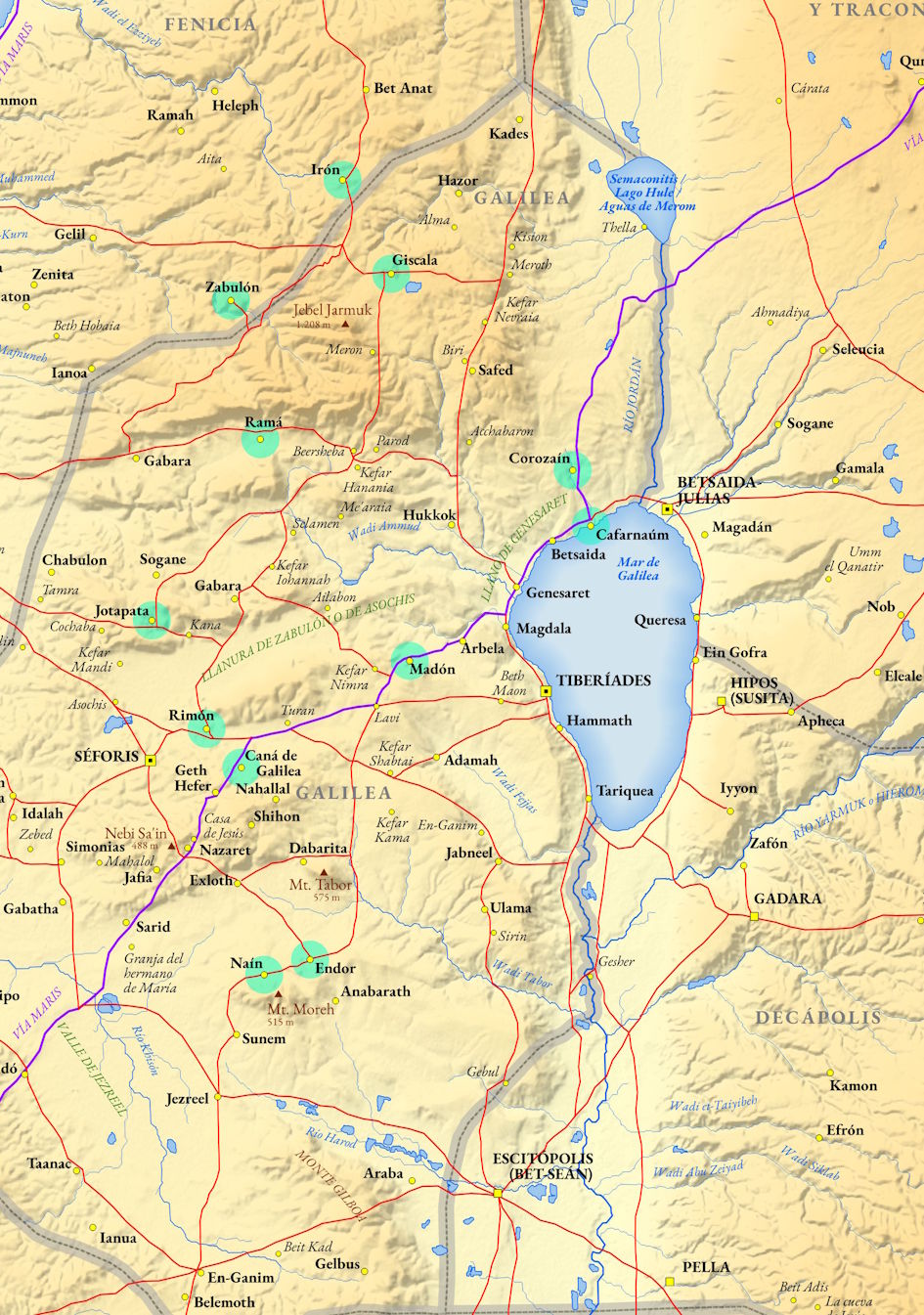
By listing the principal cities (of that time), The Urantia Book seems to imply that Jesus and the twenty-four disciples followed a route, and the towns they passed through are listed. First, they went to Rimmon, passing through Magdala, Arbela, and Madon, as well as Turan, all towns on the same road, the Via Maris. Then they went north to Jotapata, and from there also north to Ramah. Further north they found Zebulun and Iron, the latter on the border with Phoenicia. From Iron they went down to Giscala in the southeast, and then to Chorazin, likely passing through Safed. Once in Chorazin, they went down to Capernaum and passed through Madon and Cana, going through Nazareth and arriving at Nain and Endor in the southernmost part of Galilee. It is somewhat doubtful that this was the itinerary because, right at the beginning, to get to Rimmon, they had to pass through Madon and very close to Cana, which seem relegated to the end of the route.
The enumeration of the cities is indeed presented as an itinerary. In fact, we are told that “from Iron they went to Gischala, spending two days proclaiming the gospel, and then departed for Chorazin, where they spent almost a week, then passing quietly through Capernaum, they went on to the village of Madon” (UB 146:4.6), which they supposedly already passed through on their way to Rimmon (or not?). From there they went to Cana (quite strange, since after passing through Rimmon they should have passed near Cana [43]). From Cana, we are told that they went to Nain, a route that makes sense if Cana is located near Nazareth, although all these locations seem a bit forced here. Could it be that Madon and Cana were not in the places that archaeologists have suggested for them to date? [44]. The day after arriving in Nain, Jesus had to leave for Endor, a short distance to the east, because a supposed miracle had stirred up the crowds (UB 146:6.4). They stayed two days in Endor and returned to Capernaum the next day, Wednesday, March 17, 28 (UB 147:0.1).
¶ Second Visit to Jerusalem with the Twelve
Jesus and the twelve stayed two weeks in Bethsaida. Except for two secret visits to Tiberias, Jesus spent much of his time alone in seclusion (UB 147:0.1). On March 29, 28, the healing of the servant of the Roman captain of Capernaum occurred (UB 147:1.1-4).
Jesus and the twenty-four apostles departed for Jerusalem early in the morning on Tuesday, March 30, 28. They took the road through the Jordan Valley, arriving in Bethany on the afternoon of Friday, April 2, after stopping briefly in Jericho that day (UB 147:2.1). Because the people were pressing in on Jesus in Bethany, they set up a private, unknown encampment in a garden called Gethsemane. They stayed there for three weeks (UB 147:2.2).
Jesus and the twelve returned to Capernaum on Tuesday, April 27, 28, retracing their steps (UB 147:6.1). John’s twelve apostles remained in Jerusalem, and both groups made their progress separately (UB 147:2.4). On April 27, they passed through Jericho and reached the ford of the Jordan. On Wednesday, April 28, they traveled to Amatus (UB 147:6.3). They stayed there for three days (April 28, 29, and 30), and on Saturday, May 1, they began their journey, but only partially, so as not to upset the spies of the Sanhedrin who had joined them (UB 147:6.4). On Sunday, May 2, they traveled to Taricheae, on the southern shore of the Sea of Galilee, and on Monday they arrived at Bethsaida, traveling across the lake by boat, arriving around noon (UB 147:7.1).
From May 3 to October 3, 28 CE, Jesus and the twelve remained in Bethsaida, where a large tent encampment was set up to accommodate all the curious who came to hear the new preaching (UB 148:0.1).
¶ Second Public Preaching Tour of Galilee
“The second public preaching tour of Galilee began on Sunday, October 3, A.D. 28, and continued for almost three months, ending on December 30. Participating in this effort were Jesus and his twelve apostles, assisted by the newly recruited corps of 117 evangelists and by numerous other interested persons. On this tour they visited Gadara, Ptolemais, Japhia, Dabaritta, Megiddo, Jezreel, Scythopolis, Tarichea, Hippos, Gamala, Bethsaida-Julias, and many other cities and villages.” (UB 149:0.1).
On this preaching tour, the organization differed from other tours. Jesus traveled accompanied only by James and John Zebedee, visiting the workplaces of the other apostles. Jesus made numerous journeys during those three months, often visiting even two cities in a single day (UB 149:0.3). The other ten apostles, for their part, each took charge of twelve evangelists, replicating the way in which Jesus had taken charge of the twelve.
The list of locations provided by The Urantia Book is somewhat striking. First, a good number of the towns mentioned (Gadara, Ptolemais, Scythopolis, Hippos, Gamala, and Bethsaida-Julias) were not located in Galilee. The only Galilean towns mentioned are Japhia, Dabarita, Megiddo, Jezreel, and Taricheae, all in southern Galilee and near or within the Jezreel Valley. None of them, presumably, were considered cities. Taricheae, in fact, is described in The Urantia Book as a “little village” (UB 139:8.2). However, the non-Galilean towns were indeed important cities. Gadara, Hippos, and Scythopolis were significant urban centers within the territory of the Decapolis. Bethsaida-Julias and Gamala, for their part, were located in the territory of Gaulanitis, the tetrarchy under the rule of Herod Philip. Ptolemais (modern-day Acre, Wikipedia) was in Phoenicia, on the coast. It could almost be said that this was a tour of Galilee and surrounding territories.
The order in which the towns are listed seems to follow a certain itinerary were it not for Gadara, which would make more sense to place between Scythopolis and Taricheae. If we listed it there, we could imagine this route taken by Jesus, James, and John:
- First, a journey from Capernaum to Ptolemais, on the Phoenician coast, following the road that connected the Sea of Galilee with this important port city on the Mediterranean. The journey was likely along a northern route that passes through Ramah, visiting the cities north of Galilee.
- From Ptolemais to Japhia[45], near Nazareth, to the southwest. It is logical to think that they did not use the route of the previous stage but one that headed further south and passed through Sepphoris.
- From Japhia to Dabarita, east of Nazareth, at the foot of Mount Tabor.
- From Dabarita to Megiddo, on the road towards Caesarea Maritima, although it is somewhat strange to do this stage because it retraces some of the steps of the previous stage.
- From Megiddo to Jezreel, in the Jezreel Valley, next to the Harod River.
- Following the Harod River, one then goes to Scythopolis, already in the territory of the Decapolis.
- Then heading north, one would pass through Gadara, then Taricheae, and then following the eastern coast of the Sea of Galilee through Hippos, finally arriving at Bethsaida-Julias.
- As for Gamala, which should appear last if the list truly represented an itinerary, it was located a few kilometers east of Betsaida-Julias.
It is also worth considering that a list of eleven towns is given, and that this possibly represented the list of towns, excluding Bethsaida-Julias (which is almost next to Capernaum), where each preaching group, consisting of one apostle and twelve evangelists, established its center of operations. We know that there were 117 evangelists (UB 149:0.1), which means that there were nine groups consisting of one apostle and twelve evangelists, and one group of one apostle with nine evangelists (9 * 12 + 9 = 117). We also know that the group of the apostle Philip was in Gamala (UB 149:6.1). It is not unreasonable to think that each of the towns (except Bethsaida-Julias) was actually one of the outposts from which the apostles then launched a preaching mission throughout the surrounding area, sending pairs of evangelists to nearby towns and villages, and operating in a manner very similar to how Jesus had done with the twelve apostles on their previous preaching tours.
¶ Third Public Preaching Tour of Galilee
After spending a few days resting in Bethsaida, Jesus, the twelve apostles, and a group of 75 evangelists who had remained as such after the previous tour, held a three-day conference, from January 16 to 18, with Abner and the apostles of John (UB 150:0.1).
On January 18, 29, the third preaching tour of Galilee began. The novelty of this tour was that all the groups worked together: Jesus, the twenty-four apostles, and the seventy-five evangelists (UB 150:0.3). Fifteen groups of five evangelists each were formed (15 * 5 = 75). These groups were supported by Abner and his eleven associates. Jesus also traveled to support these groups, going out with the twelve apostles and touring the region. “They visited Magdala, Tiberias, Nazareth, and all the principal cities and villages of central and southern Galilee, all the places previously visited and many others” (UB 150:0.4).
Another notable and different feature of this tour was that Jesus chose a group of ten women evangelists to work side by side with the men on these preaching missions. On this tour there were ten, but later Jesus added two more women. These women accompanied Jesus and the twelve, traveling in the rear, and later doing invaluable work in many villages and towns. It was truly remarkable in this era that a religious teacher would allow women to perform these preaching duties (UB 150:1.3).
We do not know the day of departure, but from Bethsaida Jesus, the twelve, and the ten women set out for Magdala, nearby. There Jesus had his brother Judah living, and in fact one of the ten women was Rachel, Judah’s sister-in-law (UB 150:1.1). It was there, too, that the women carried out their first work with great success (UB 150:2.2). In this work, an extraordinary woman, Mary Magdalene, was converted to the gospel, and four weeks later, in Jotapata (which we must understand to have been another of the towns on the tour), she was admitted along with Rebecca as part of the group of twelve evangelist women (UB 150:2.3).
From Magdala they continued along the western shore of the Sea of Galilee to Tiberias, where they spent a Sabbath (UB 150:3.1). The next day, Sunday, Jesus sent out his twelve apostles two by two (Andrew and Peter, James and John Zebedee, Philip and Nathanael, Thomas and Matthew, James and Judas Alphaeus, Simon the Zealot and Judas Iscariot) throughout the region. He remained with the ten women and the twelve apostles of John, who had joined them in Tiberias. From there, in the following days, Jesus traveled throughout the region with this group (UB 150:4.1).
Jesus’s itinerary is unknown to us, but we do know that he was first in Jotapata, as we have already described, since it is there that the group of women increased from ten to twelve (UB 150:2.3). Then he was in Shunem (a city south of Nazareth, in the Jezreel Valley). There, twelve women are mentioned (UB 150:5.1). It is there that a group of two evangelists were under the care of a certain Jacob. This character is somewhat strange, since his name is presented as if we already knew him, but no Jacob appears anywhere as one of the evangelists or apostles of John. Is The Urantia Book perhaps referring to James son of Alphaeus? This is not possible because we are told that his apostles had been sent out two by two, and that John’s apostles had returned to Hebron. This James, therefore, must have been a prominent member of the evangelists.[46]
The tour ended on Friday, March 4, 29, in Nazareth, where Jesus had requested through messengers that all the scattered groups of evangelists and apostles should come together (UB 150:6.3). The following Saturday, Jesus spoke in the synagogue in Nazareth, and a very strange riot broke out against him, where some quarrelsome men were about to kill him if Jesus had not prevented it. And with this disturbing event, this tour ended, Jesus and his followers returning to Capernaum.
¶ Escapes across the Sea of Galilee
They arrived in Capernaum on March 10, 29. On Sunday, March 13, Jesus began a new kind of preaching with the people who came to see him: from that time on, he used parables to teach. On Sunday, March 20, when the crowds that gathered in Capernaum to hear him began to grow too large, Jesus decided to travel in the afternoon with the twelve toward Kheresa (which appears in the English translation as Jeresa). They traveled by boat from Bethsaida, and in the middle of the crossing, they were surprised by a storm, which the twelve believed Jesus calmed through his supernatural powers (UB 151:5.5). They returned to Capernaum on the morning of Tuesday, March 22, because in Kheresa another supposed miracle occurred with a man who suffered from what is now known as bipolar disorder with psychotic features[47]. However, Jesus could not find rest in Capernaum either, for several events occurred that his fellow countrymen did not hesitate to call miraculous. On Sunday, March 27, he again tried to leave the crowd by boat, sailing to Magadan,[48] a park or recreation area south of Bethsaida-Julias (UB 152:2.1). Despite this, the crowd located the Master again and flocked once more to this recreation area on the eastern shore of the lake. On Wednesday, March 30, that crowd witnessed the first real miracle performed by Jesus during his earthly ministry (UB 152:2.10): feeding five thousand people with almost no food available. The preceding supernatural events that had taken place up to that point had not been performed directly by Jesus but by various heavenly agencies located on Earth at that time, and in many cases, independently of the Master’s will.
The wondrous miracle of the feeding had a turbulent effect on the crowd. They wanted to proclaim him king right then and there, but Jesus dashed all those expectations of the multitude, shattering the apostles’ illusions. In view of this situation, he sent the twelve back to Bethsaida in the boat, while he withdrew with the young John Mark and went to Bethsaida on foot (UB 152:5.1). There, Jesus decided to withdraw for a few days to the region of Gennesaret, where they traveled by boat. Gennesaret was a town located just a few miles beyond Bethsaida on the western shore of the Sea of Galilee, before reaching Magdala. Opposite this town lay a flat area, the only one before the great escarpments that usually border that side of the lake.
¶ Third visit to Jerusalem with the twelve
“Sunday, April 3, Jesus, accompanied only by the twelve apostles, started from Bethsaida on the journey to Jerusalem. To avoid the multitudes and to attract as little attention as possible, they journeyed by way of Gerasa and Philadelphia. He forbade them to do any public teaching on this trip; neither did he permit them to teach or preach while sojourning in Jerusalem. They arrived at Bethany, near Jerusalem, late on Wednesday evening, April 6. For this one night they stopped at the home of Lazarus, Martha, and Mary, but the next day they separated. Jesus, with John, stayed at the home of a believer named Simon, near the house of Lazarus in Bethany. Judas Iscariot and Simon Zelotes stopped with friends in Jerusalem, while the rest of the apostles sojourned, two and two, in different homes.” (UB 152:7.1)
“On Sunday, April 24, Jesus and the apostles left Jerusalem for Bethsaida, going by way of the coast cities of Joppa, Caesarea, and Ptolemais. Thence, overland they went by Ramah and Chorazin to Bethsaida, arriving on Friday, April 29.” (UB 152:7.3)
As can be seen, this second visit of Jesus to Jerusalem (where he only entered the city once) shows that feelings toward Jesus were changing at that time. The dispersal of the crowd after the miracle of the feeding of the dead triggered a drastic reduction in the number of believers in Jesus, many of whom were simply looking for a powerful leader to solve their material problems. This explains why the round trip to Jerusalem was so long and far from the usual routes. Jesus knew that it was becoming necessary to avoid the common roads, where his group could face serious dangers from the Jewish authorities (UB 152:6.5).
¶ The Flight to Phoenicia
On Saturday, April 30, 29 CE, Jesus led the teaching in the synagogue at Capernaum before an expectant audience of many followers and a delegation from the Sanhedrin of Jerusalem (UB 153:1.1). During this meeting, Jesus’ words caused such a stir that anti-Jesus sentiment reached its peak, and many former believers deserted (UB 153:5.1). On Friday, May 6, the leaders of the Capernaum synagogue, with the exception of Jairus, officially closed the doors to Jesus and his followers (UB 154:1.2). That week the members of the Sanhedrin tried to involve Herod Antipas in the arrest of Jesus, but they were unsuccessful (UB 154:0.1). On Sunday, May 8, the Sanhedrin passed a decree closing the doors of all synagogues in Palestine to Jesus and his followers (UB 154:2.1). On May 16, the Sanhedrin members tried again with Herod Antipas at another meeting in Tiberias. They did not obtain his authorization to arrest him, but in view of their persistence, on May 18 he granted them permission, if Pontius Pilate so agreed, for him to be arrested and brought before the Sanhedrin in Jerusalem (UB 154:3.1). The messengers ran swiftly, and on the night of May 21, the agreement for Jesus’ arrest was reached (UB 154:3.2). The news reached Bethsaida on Sunday, May 22. Jesus, accompanied only by his twelve apostles and a select group of twelve evangelists, “fled before his captors, taking the oars of a large boat and rowing toward the eastern shore of the Sea of Galilee” (UB 154:7.1).
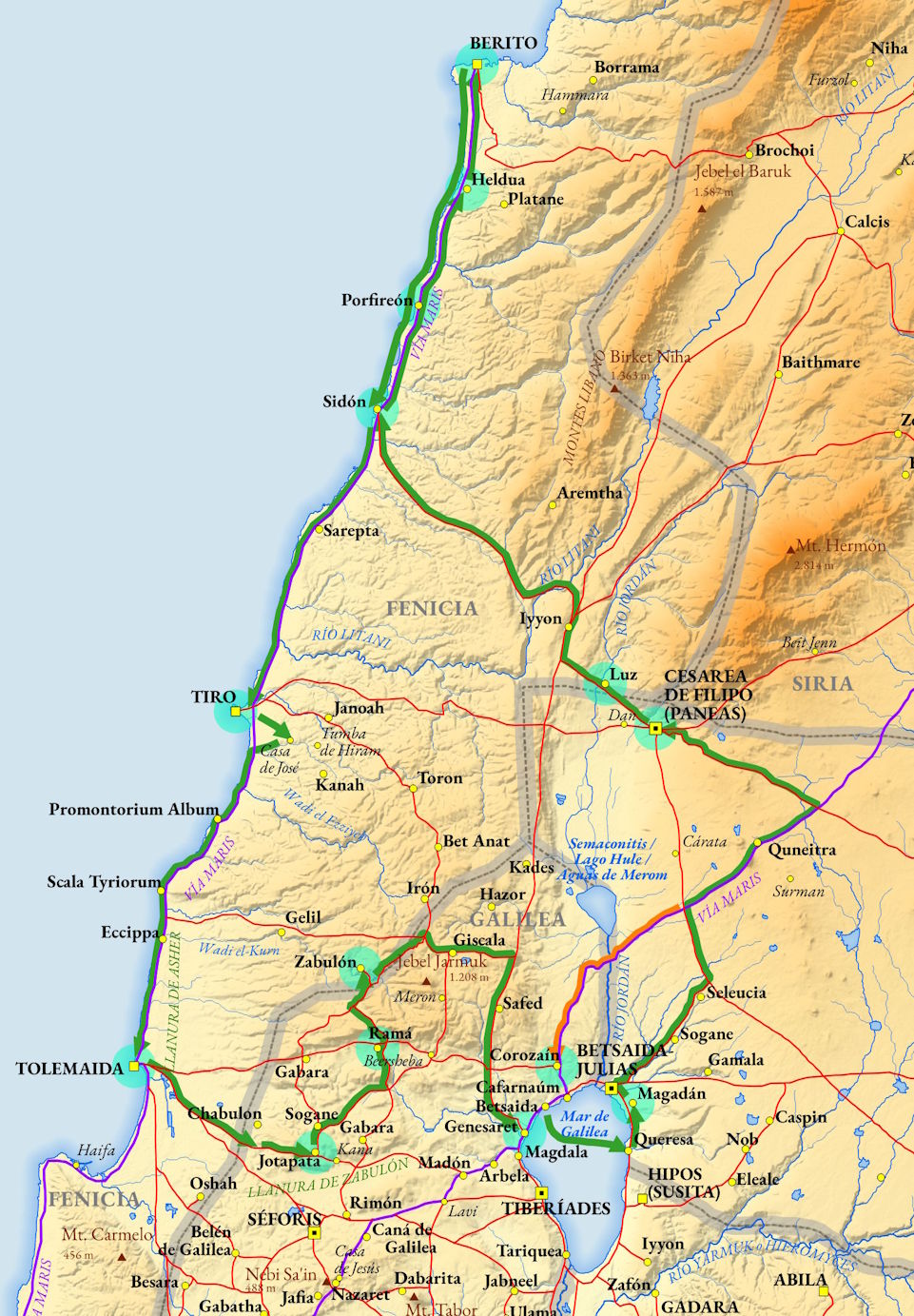
They arrived at Kheresa (the Spanish translation calls it Jeresa). On Sunday they camped in a park south of Bethsaida-Julias. There they planned their journey to Phoenicia, passing through Batanea and northern Galilee (UB 155:0.1). “For a time they remained in the domains of Philip, going from Kheresa up to Caesarea-Philippi, thence making their way over to the coast of Phoenicia.” (UB 154:7.3).
“On Monday morning, May 23, Jesus directed Peter to go over to Chorazin with the twelve evangelists while he, with the eleven, departed for Caesarea-Philippi, going by way of the Jordan to the Damascus-Capernaum road, thence northeast to the junction with the road to Caesarea-Philippi, and then on into that city, where they tarried and taught for two weeks. They arrived during the afternoon of Tuesday, May 24.” (UB 155:2.1) Peter and the evangelists had no success in Chorazin, and they departed from there on Tuesday, June 7, joining Jesus and the apostles at Caesarea Philippi on Tuesday, June 7, 29 (UB 155:2.3).
On Thursday, June 9, after two weeks in Caesarea Philippi, “they begin their journey to the Phoenician coast. They passed around the marsh country, by way of Luz, to the point of junction with the Magdala-Mount Lebanon trail road, thence to the crossing with the road leading to Sidon, arriving there Friday afternoon.” (UB 155:4.1) This journey, completed in two days, indicates that they made good progress, as the terrain was quite rugged. Near Sidon, they stayed at the home of Karuska, a wealthy woman who was a believer in Jesus. They spent almost two and a half weeks in Sidon (UB 156:0.1-2). There, Jesus stayed at the home of two women, Justa and her mother Berenice, a house located north of the city.
“On Tuesday, June 28, the Master and his associates left Sidon, going up the coast to Porphyreon and Heldua.” It is worth noting that throughout Jesus’ journey through Phoenicia, his teachings were very well received, much more so than they ever were in his own land. “The apostles preached in Porphyreon and the evangelists taught in Heldua. While the twenty-four were thus engaged in their work, Jesus left them for a period of three or four days, paying a visit to the coast city of Beirut, where he visited with a Syrian named Malach, who was a believer, and who had been at Bethsaida the year before.” (UB 156:3.1)
“On Wednesday, July 6, they all returned to Sidon and tarried at the home of Justa until Sunday morning, when they departed for Tyre, going south along the coast by way of Sarepta, arriving at Tyre on Monday, July 11.” (UB 156:3.2) From July 11 to 24 they taught in Tyre. During that time Jesus stayed at the house of a Jew named Joseph, who lived about 5 km south of Tyre (UB 156:4.1).
On Saturday, July 23, Jesus sent the twelve evangelists back to Galilee by a different route than his own. The two groups of twelve disciples would never work together again (UB 156:5.23). For their part, Jesus and the twelve apostles, taking extra precautions, set out on Sunday, July 24, at noon, leaving Joseph’s house and traveling down the coast to Ptolemais, where they stopped and preached on the 25th. “On Tuesday they left Ptolemais, going east inland to near Jotapata by way of the Tiberias road. Wednesday they stopped at Jotapata and instructed the believers further in the things of the kingdom. Thursday they left Jotapata, going north on the Nazareth-Mount Lebanon trail to the village of Zebulun, by way of Ramah. They held meetings at Ramah on Friday and remained over the Sabbath. They reached Zebulun on Sunday, the 31st, holding a meeting that evening and departing the next morning.” (UB 156:6.2).
“Leaving Zebulun, they journeyed over to the junction with the Magdala-Sidon road near Gischala, and thence they made their way to Gennesaret on the western shores of the lake of Galilee, south of Capernaum, where they had appointed to meet with David Zebedee” (UB 156:6.3). From there they went by boat that same night to Kheresa and then to the park of Magadan, where they usually pitched their tent camp south of Bethsaida-Julias.
¶ A New Visit to Caesarea Philippi and a Second Ascent of Hermon
On Tuesday, August 9, 29, early in the morning, Jesus and the twelve set out for the second time for Caesarea Philippi from Magadan (UB 157:3.1). They passed south of the Waters of Merom [26:1], arriving at Caesarea in the evening and staying at the house of a certain Celsus, an unknown person about whom The Urantia Book gives no further information anywhere[49] (UB 157:3.7).
On Friday, August 12, Jesus instructed the apostles to prepare to ascend Mount Hermon (UB 157:7.5). They arrived there in the afternoon, following the same path he used with Tiglath when Jesus withdrew for several weeks (UB 158:0.1). On Monday, August 15, Jesus climbed the final stretch, halfway to the summit, accompanied only by Peter and the two Zebedee brothers (UB 158:0.1). That evening, the three apostles witnessed a vision of two heavenly beings communicating with Jesus. Afterward, they descended, and Jesus’ three friends were astounded by what they had just witnessed. On their return, there was a bit of a commotion in the apostles’ camp because a man had come seeking healing for his son. There, in the sight of many who had followed the Master, Jesus performed another royal miracle by healing the boy (UB 158:4.1-8). Then they returned toward Caesarea Philippi. On Wednesday, August 17, they left Caesarea Philippi. “As they journeyed south, just beyond the Waters of Merom they came to the Damascus road, and desiring to avoid the scribes and others whom Jesus knew would presently be coming along after them, he directed that they go on to Capernaum by the Damascus road which passes through Galilee. And he did this because he knew that those who followed after him would go on down over the east Jordan road since they reckoned that Jesus and the apostles would fear to pass through the territory of Herod Antipas[50].” (UB 158:7.1)
They arrived in Capernaum in the evening and ate dinner at Peter’s house in secret. Then they traveled by boat across the lake to Magadan (UB 158:8.1-2).
¶ The Decapolis Tour
This was actually the third time that Jesus and the twelve traveled through the Decapolis region. The first time was during a long journey in which they traveled through the Jordan Valley, Jerusalem, southern Judea, Samaria, and part of the Decapolis. The second time was during the second public preaching tour of Galilee. However, this was the first systematic tour in which they preached in the Decapolis.[35:3]
The tour began on Thursday, August 18, 1529, and lasted four weeks, until Friday, September 16. Each of the twelve apostles partnered with one of the twelve evangelists, and each pair led a small group of other evangelists, dividing among themselves the towns to be visited. During that month, the twelve groups worked in Gerasa, Gamala, Hippos, Zaphon, Gadara, Abila, Edrei, Philadelphia, Heshbon, Dium, Scythopolis, and many other cities (UB 159:0.2). Jesus made trips to visit each of the groups and stay with them for a few days before returning to Magadan or going elsewhere. We know that John Zebedee carried out a preaching work in Gamala that even took him as far as Ashtaroth, a very eastern town in the region of Batanea (UB 159:2.1). Thomas worked in Edrei (UB 159:3.1). Nathanael worked in Abila (UB 159:4.4). James Zebedee worked in Philadelphia (UB 159:5.1).
On Friday the 16th, as agreed, all the groups returned to Magadan, where Jesus and the rest of the followers were waiting for them (UB 160:0.1).
¶ Fourth Visit to Jerusalem with the Twelve
Despite the Sanhedrin’s arrest warrant, Jesus surprised everyone by deciding to visit Jerusalem for the Feast of Tabernacles, accompanied only by the twelve (UB 161:0.1). They departed on Sunday, September 25, 29. He ultimately made the journey with only ten apostles, without Nathanael and Thomas, who stayed behind to continue teaching Rodan, an Alexandrian philosopher. They went along the eastern shore of the lake and then entered Samaria through Scythopolis (UB 162:0.1). They sought lodging in a village at the foot of Mount Gilboa (perhaps one called Rehov or Tel Rehov) but were driven out with stones and had to continue on to a “little village by the Jordan ford” (UB 162:0.2). This town was probably Salem or Salim (mentioned in John 3:23), located near Ainon, Aenon, or Enon, a place of springs and a well-known ford of the Jordan River, the very place where John baptized when he arrived near Pella.
Jesus and the ten stopped to spend the night in the town near the ford of the Jordan. The next day they crossed the river and continued their journey to Jerusalem along the road east of the Jordan, arriving in Bethany late in the afternoon of Wednesday, September 28. Thomas and Nathanael arrived on Friday, September 30 (UB 162:0.3).
Jesus and the twelve entered Jerusalem only a few times, and remained in the vicinity for four and a half weeks, that is, the entire month of October. Jesus traveled to Bethlehem, where he met Abner and the apostles of John, and spent a good part of that time there (UB 162:0.4).
“In the latter part of October Jesus and the twelve withdrew from the immediate vicinity of Jerusalem. On Sunday, October 30, Jesus and his associates left the city of Ephraim, where he had been resting in seclusion for a few days, and, going by the west Jordan highway directly to Magadan Park, arrived late on the afternoon of Wednesday, November 2.” (UB 162:9.6)
¶ The First Tour of the Seventy, Through Galilee, Samaria, and Judea
The next preaching tour was undertaken by a group of seventy disciples whom Jesus organized in Magadan. This group included Abner as its prominent leader, ten apostles of John, fifty-one veteran evangelists, and eight more disciples (UB 163:1.1). After a period of preparation, they were ordained as messengers of the gospel on Saturday, November 19, 1529, in Magadan. The next day Jesus sent them out in pairs through Galilee, Samaria, and Judea for six weeks, and they rejoined Jesus and the twelve on Friday, December 30, near Pella in Perea (UB 163:1.6).
Once this group had been sent out on a preaching tour, the first in which Jesus no longer actively participated, he and the twelve moved their encampment to the vicinity of Pella, to the same place where John had baptized in the past. They departed from Magadan on Tuesday, December 6, and arrived at this location near Pella that evening (UB 163:5.1). Jesus remained in Pella all that time, except for a few outings with Peter and the sons of Zebedee in the nearby hills (UB 163:6.1).
¶ Fifth visit to Jerusalem, with Nathanael and Thomas
Once the group of seventy messengers of the gospel returned, Jesus decided to embark on a tour of Perea. But first, he performed one last act in Jerusalem. The Urantia Book does not specify the dates but indicates that Jesus traveled from Pella to Jerusalem to attend the Feast of Anointing, a festival that usually falls around December. On this journey, he was accompanied only by Nathanael and Thomas. He said nothing to anyone, not even his companions, about the purpose of his journey, for he knew that fear would grip his followers (UB 164:0.1). The Sanhedrin was still trying to capture him, and his stay in Gaulanitis, the Decapolis, and Perea was not by chance. In those territories, the tetrarchs had not authorized the Sanhedrin to arrest him.
On their way there and back they passed through Jericho, and Jesus stayed those days with the two apostles on the Mount of Olives, most likely in the private garden of Gethsemane (UB 164:2.3), occasionally visiting his friends in Bethany. During this stay in Jerusalem, Jesus performed one of his most remarkable and real miracles on the Sabbath, restoring sight to a blind man, an event that caused a definitive and complete break between him and the Sanhedrin leaders (UB 164:3.1). This was Jesus’ last attempt to make these prejudiced leaders reconsider, but they refused even to question him because they feared him and because a good portion of the Sanhedrin was beginning to sympathize with Jesus (UB 164:4.2).
¶ The Second Tour of the Seventy, Through Perea
After Jesus returned with his two apostles to Pella, the first preaching tour of Perea began, which was the second tour for the group of seventy evangelists. Abner was in charge of organizing it. This tour began on Tuesday, January 3, in the year 30. In it, the seventy messengers of the gospel were sent to “the following cities and towns and some fifty additional villages: Zaphon, Gadara, Macad, Arbela, Ramath, Edrei, Bosora, Caspin, Mispeh, Gerasa, Ragaba, Succoth, Amathus, Adam, Penuel, Capitolias, Dion, Hatita, Gadda, Philadelphia, Jogbehah, Gilead, Beth-Nimrah, Tyrus, Elealah, Livias, Heshbon, Callirrhoe, Beth-Peor, Shittim, Sibmah, Medeba, Beth-Meon, Areopolis, and Aroer” (UB 165:0.1).
The group of twelve women evangelists, which had been augmented by an additional group of fifty women “caregivers of the sick,” also participated in this tour (UB 165:0.2). During all this time, Jesus remained in Pella, and from February 11 to 20, he and the twelve toured the cities and towns where the seventy and the women were working (UB 166:0.1). [From here on, we will refer to them as “the twelve,” but in reality, Jesus was accompanied by only ten of the apostles; two of them took turns tending to the camp in Pella (UB 167:0.1).] On Saturday, February 18, Jesus was in Ragaba, a town a short distance east of Zaphon and Amatus, two towns along the main road that Jesus and the twelve undoubtedly had to pass through before reaching Ragaba, all of which are mentioned as preaching locations of the seventy (UB 166:1.1). On Sunday, February 19, Jesus was with the twelve in Amatus. Near this town, Jesus performed the only miracle of this entire tour, healing ten lepers (UB 166:2.1). Days later, we do not know exactly when, Jesus was in Gerasa (UB 166:3.1). From Gerasa, Jesus and the twelve apparently traveled south to Philadelphia (UB 166:5.1), arriving there on Wednesday, February 22 (UB 167:0.3). They remained there until Sunday, February 26, and their plan was to return to Pella on Monday, but then news arrived of Lazarus’s death (UB 167:4.1). However, Jesus refused to go immediately to Bethany. They departed on Wednesday, March 1, spending the night in Jericho. They arrived in Bethany on Thursday, March 2, and Jesus performed the supreme miracle of raising Lazarus back to life, the only time in all human history that such a thing has happened (UB 168:1.9; UB 168:2.8). This event shocked the entire region and particularly the Sanhedrin in Jerusalem (UB 168:3.5). Jesus remained in Bethphage on the following Friday and Saturday, and on Sunday, March 5, Jesus and the twelve departed from Bethany, beginning their return to the camp at Pella, likely passing through Jericho and ascending north along the eastern Jordan road (UB 168:3.7). “Late on Monday evening, March 6, Jesus and the ten apostles arrived at the Pella camp. This was the last week of Jesus’ sojourn there, and he was very active in teaching the multitude and instructing the apostles.” (UB 169:0.1) “On Saturday afternoon, March 11, Jesus preached his last sermon at Pella.” (UB 170:0.1). This marked the end of the tour through Perea.
Regarding the list of towns offered in The Urantia Book for this tour, this is a description of their possible locations[51]:
- Zaphon: Adam Smith identifies it as Zaphon Amatha, at a site called el-Hammi, next to the Yarmuk River, a few kilometers east of Taricheae and the Sea of Galilee.
- Gadara: Gadara was a short distance south of Zaphon, and was one of the towns of the Decapolis and therefore not in Perea.
- Macad: In Adam Smith’s Atlas, no Macad appears near Gadara, but a town called Ma’ad is mentioned, located on the road between Gadara and Pella, not far south of Gadara.
- Arbela: A town south of Capitolias (or Dion), present-day Irbid.
- Ramat: According to Adam Smith, it was located east of Arbela, at a crossroads where the main road passed through Perea from north to south, then through Gerasa and Philadelphia. It is likely the present-day Ar-Ramtha.
- Edrei: Adam Smith places it several kilometers east of Ramat, on the same road that then leads to Bosora, a city in the foothills of Mount Hauran.
- Bosora: Also called Bozrah and Bosra, Adam Smith places it far to the east, a city in the foothills of Mount Hauran.
- Caspin: Adam Smith identifies it with a settlement northwest of Edrei, on the main north-south road coming from Ramat. This location makes more sense than another I have found on other maps that identifies it with a settlement called Khisfin, east of Kheresa on the Sea of Galilee. This settlement could not be the Caspin mentioned in The Urantia Book, as it was clearly outside Perea and far to the north.
- Mizpeh: Adam Smith calls it Mizpeh and places it northwest of Gerasa, in the Wadi ed-Deir, identifying it with a settlement called Suf, not far from the highest point of Mount Ajlun.
- Gerasa: This was an independent settlement of the Decapolis and was not part of Perea. It was located southeast of Pella, present-day Jerash in Jordan.
- Ragaba: Several kilometers east of Amatus, also in the Wadi Rajib.
- Succoth: A short distance south of Amatus, near the Yabbok River. Adam Smith identifies it with present-day Deir Alla or Dayr Allah.
- Amatus: It was located on the eastern Jordan road, in the Wadi Rajib. Adam Smith refers to it as Ammatha.
- Adam: Also called Adán, it is a town on the eastern road of the Jordan and very close to the river, further south of Succoth, on the other side of the slopes of Mount Sartaba.
- Penuel: It was located east of Succoth, next to the Yabbok River (Wikipedia), in some hills called Tulul al-Dhahab. Adam Smith erroneously places Penuel (although with question marks) on top of Mount Gilead, far southeast of Succoth.
- Capitolias: Adam Smith identifies it with the present-day village of Beit Ras, north of Arbel (modern-day Irbid). It was one of the cities of the Decapolis, not in Perea, although that would increase the number of Decapolis cities to over ten.
- Dion: This addition of this settlement in The Urantia Book is striking because Adam Smith’s Atlas does not include a settlement near those mentioned called Dion or Dium, which was known from ancient times but whose location was unknown. The current site where this city is believed to have been located is marked by Adam Smith as Tell Ashary, but this geographer was unable to identify this site as Dion.
- Hatita: Adam Smith places it northeast of Philadelphia, along the easternmost road of the Decapolis, which later became the Hajj Road. This road connected Ramat in the north with Philadelphia in the south, passing through Hatita and Gadda. Hatita is also referred to as Aditha.
- Gadda: Adam Smith calls it Gadda and places it on the same road that connected to Philadelphia.
- Philadelphia: This was an independent settlement of the Decapolis and was not part of Perea, located far south of Gerasa, present-day Amman, Jordan.
- Jogbeha: A settlement a few kilometers northwest of Philadelphia, in a high area known as Jubeihat.
- Gilead: Adam Smith calls it Gilead and places it midway between Jogbeha and Succoth, in a settlement called Jelaad, north of present-day Allan. The Urantia Book mentions the balms from this town, which must have been famous (UB 152:4.2).
- Beth-Nimra: This is the town on the eastern Jordan road beyond Adam. Adam Smith calls it Beth-Nimrah and identifies it with Tell Nimrin in Wadi Nimrin. Beyond this town on the same road were Shittim and then Livias.
- Tyre: This town has nothing to do with the coastal town of Phoenicia. Adam Smith actually designates it as Tyrus and identifies it with modern-day Iraq Al Amir.
- Eleale: Adam Smith places it on a road that ran through the eastern region of the Dead Sea, passing through Heshbon, Medeba, Beth-Meon, Lemba, Dion, Areopolis, Kir of Moab, and Thorma. It is the present-day village of Al-Al (or el-Al, as Adam Smith calls it).
- Livias: This settlement is linked to Shittim and is located a short distance away in the Shittim Valley. The current archaeological site is called Tell er-Rameh, and it very likely corresponds to the ancient Beth-Haram, as Adam Smith correctly identified. See Wikipedia.
- Heshbon: Adam Smith places it south of Eleale, the first settlement on that road. It is the present-day Hisban.
- Callirhue: Callirhue (or Callirrhoe or Baths of Herod, as Adam Smith calls it) is a settlement near the eastern shore of the Dead Sea, located in the Zarqa Ma’in wadi. South of Callirhue was the fortress of Machaerus, where John the Baptist was imprisoned and executed.
- Beth-Peor: Adam Smith places this west of Eleale, in the Heshban wadi.
- Shittim: Adam Smith actually identifies it with Abel-Shittim, although the name is usually shortened. He places it, seemingly correctly, west of Eleale, on the main road that runs near the Jordan River, in a broad plain called the Shittim Valley. Flavius Josephus later referred to this location as Abila, linking it with nearby Livias. The archaeological site is now called Khirbet el-Kafrayn.
- Sibma: Adam Smith places it west of Eleale, between Bet-Peor and Eleale, also in the Wadi Heshban.
- Medeba: also known in ancient times and today as Madaba, it is a town south of Heshbon, with Mount Nebo to the west. Mabada is famous for a Byzantine mosaic map that still depicts much of Palestine.
- Beth-Meon: Adam Smith calls it Beth-Meon or Baal-Meon and identifies it with the village of Ma’in, southwest of present-day Madaba. It was not on the main road but was a short distance from it.
- Areopolis: The Urantia Book omits several settlements located south of Madaba, one of them Lemba (present-day Libb) and another Dibon or Daibon (present-day Dhiban), but it does mention this Areopolis, in Moabite territory. Adam Smith also calls it Rabboth Moab and identifies it with present-day Rabba.
- Aroer: This is a settlement that Adam Smith places southeast of Dibon, in an area he calls el-Arair, near the present-day Almujab or Mujib Dam, which later becomes the Arnon River, the most important tributary on the eastern shore of the Dead Sea.
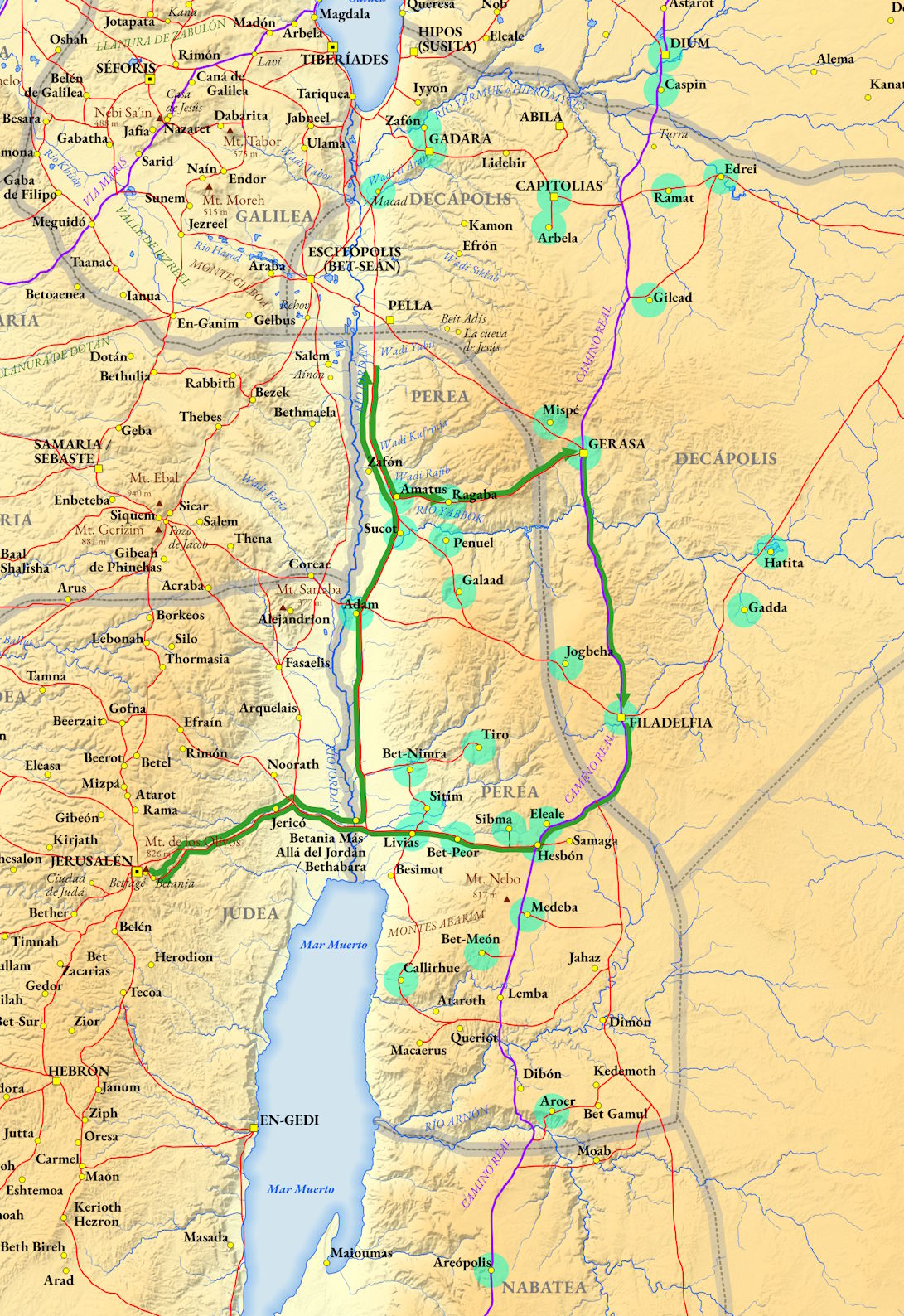
¶ The Last Visit to Jerusalem
On Sunday, March 12, Jesus “announced that he would depart for Jerusalem with the twelve to attend the Passover in Jerusalem, visiting on the way many cities south of Perea.” (UB 171:0.1).
“On the forenoon of Monday, March 13, Jesus and his twelve apostles took final leave of the Pella encampment, starting south on their tour of the cities of southern Perea, where Abner’s associates were at work. They spent more than two weeks visiting among the seventy and then went directly to Jerusalem for the Passover.” (UB 171:1.1)
When they reached the ford of the Jordan (Bethany on the Jordan or Bethabara), half of those who followed Jesus and the twelve separated and went up toward Jerusalem, while Jesus continued on to Heshbon (UB 171:1.2), where they met Abner. “For more than two weeks, Jesus and the twelve, followed by a crowd of several hundred disciples, traveled through southern Perea, visiting all the towns where the seventy were working.” (UB 171:3.1)
“On Wednesday evening, March 29, Jesus and his followers encamped at Livias on their way to Jerusalem, after having completed their tour of the cities of southern Perea.” (UB 171:4.1) Livias, as we have seen before, was a town a short distance east of Bethabara. From there they crossed the ford and went to Jericho (UB 171:4.8) where they arrived on Thursday, March 30, at sunset (UB 171:5.1). The next day, the 31st, they went along “the highway of robbers” toward Bethany, on the way to Jerusalem (UB 171:6.4). This was the last journey Jesus made on Earth (UB 171:8.15). Jesus and the twelve “arrived at Bethany shortly after four o’clock in the afternoon on Friday, March 31, in the year 30” (UB 172:0.1).
On Saturday, April 1, Jesus spent the day in Bethany (UB 172:1.2); he did the same on Sunday (UB 172:2.1), but at noon he entered Jerusalem with the twelve (UB 172:3.1). On Monday, Jesus entered Jerusalem and spent the night in Bethany (UB 172:5.1; UB 173:0.1; UB 174:0.1). On Tuesday, he went to Jerusalem but spent the night in the private garden of Gethsemane (which was known only to Jesus, the twelve, and a few followers, UB 174:0.3). On Wednesday, April 5, as was their custom, they took a day of rest. Jesus spent the entire day alone in the nearby hills with only John Mark, a young man from a family that followed Jesus, for company (UB 177:0.4). On Thursday, April 6, the last day of Jesus’ life, he spent it in Gethsemane with a small group of his followers. After instructing his apostles to prepare a room for the celebration of the Passover that day (although it was the day before it was to be celebrated), the Master led the twelve along the path that led to the road to Bethany, and from there to Jerusalem. “This was the last journey he made with the twelve.” (UB 178:2.12)
After dinner in Jerusalem they returned to Gethsemane (UB 181:2.31; UB 182:0.1). There Jesus led them to a slightly higher place on the Olivet, where he prayed with them (UB 182:1.2). Then they returned to the camp and went to sleep (UB 182:2.1), except Jesus, who took three apostles to pray in a nearby hollow (UB 182:3.1). Later they returned to the others, and realizing the danger that surrounded him, Jesus went down to the winepress to await the arrival of the Roman detachment, which arrested him (UB 183:0.5). First, they took him to the palace of Annas, which was located nearby on the Mount of Olives itself (UB 183:5.1; UB 184:0.3). From there, Jesus was taken before Caiaphas and a group of Sanhedrin members gathered at Caiaphas’s palace in Jerusalem (UB 184:3.2). After suffering a completely unjust trial there, he was taken to the praetorium before Pilate at six o’clock in the morning of the new day, Friday, April 7 (UB 184:5.11). The praetorium was a building attached to the Antonia Fortress, where Pilate had his residence when he was in Jerusalem (UB 185:0.2). Pilate initially wanted to release Jesus, but then, to get rid of the problem, he sent Jesus to Herod Antipas, whose residence was in the former Maccabean palace of Herod the Great (UB 185:4.1). Herod Antipas removed Jesus’s usual robe and dressed him in an old purple one[52] (a color reserved only for royalty) in order to mock him (UB 185:4.3). Then Herod sent him back to Pilate, who, under pressure from the Sanhedrin, decided to execute him (UB 185:8.2). Jesus had already been flogged inside the Praetorium by Pilate during his interrogation, so when the order was given to execute him, they took him back inside, but they did not flog him again. Instead, they removed the purple robe, dressed him in his own, and mocked him for a while (UB 186:4.1). He was led with two other prisoners to Golgotha. The prisoners carried only the horizontal crossbeam; the vertical ones were carried separately, contrary to how Jesus is usually depicted (UB 187:1.1). A long route was usually taken to reach Golgotha, but in this case, the short one was used, heading north to the Damascus Gate (UB 187:1.4). Golgotha was a rocky outcrop located on the northern road. Beyond it were the villas of the wealthy of Jerusalem, and on the other side of the road,their graves. Around three o’clock in the afternoon of that fateful April 7, Jesus breathed his last (UB 187:5.5).
¶ The Appearances of Jesus
The body of Jesus was given by Pilate to Joseph of Arimathea and Nicodemus, who buried it in a new family tomb owned by Joseph, located a short distance north of Golgotha, across the road leading to Samaria (UB 188:1.2).
The appearances of Jesus cannot be considered journeys in the proper sense, since Jesus was not restricted by material laws to travel. At least we can indicate the locations of these apparitions:
- The first apparition was on Sunday, April 9, at about 3:30 a.m.[53], at Joseph’s tomb, to a group of women: Mary Magdalene, Mary the mother of the twins Alphaeus, Salome the mother of the brothers Zebedee, Joanna the wife of Chuza, and Susanna the daughter of Ezra of Alexandria (UB 189:4.4-5).
- The second apparition was a little later in the same place only before Mary Magdalene (UB 189:5.4).
- Jesus’ third appearance was at noon on Sunday, April 9, in Bethany, before his brother James (UB 190:2.3).
- The fourth appearance was before 2:00 p.m. that Sunday in Bethany when he appeared to his family and friends, twenty people in all (UB 190:2.6).
- The fifth appearance was about 4:15 p.m. on Sunday, at the house of Joseph of Arimathea, before twenty-five women (UB 190:3.1).
- The sixth appearance was at 4:30 on Sunday, at the house of Flavius in Jerusalem, before about 40 Greek believers (UB 190:4.1).
- The seventh appearance, at 5:00 p.m. on Sunday, occurred 5 km from Jerusalem on the road to Emmaus, before two disciples named Cleopas and James (UB 190:5.1).
- The eighth appearance took place at 8:30 on Sunday before Simon Peter in the garden of Mark’s house, where ten of the apostles had taken refuge (UB 191:1.1).
- The ninth appearance was before the ten apostles in Mark’s house, shortly after nine o’clock (UB 191:2.1).
- The tenth appearance occurred on Tuesday, April 11, shortly after eight o’clock, in Philadelphia, before Abner, Lazarus, and about 150 companions (UB 191:4.1).
- The eleventh appearance was before the eleven apostles (including Thomas) in Mark’s house in Jerusalem, on Saturday, April 15, at about six in the evening, while they were having supper (UB 191:5.2).
- The twelfth appearance occurred in Alexandria on Tuesday, April 18, at about 8:30 p.m., before Rodan and about 80 believers (UB 191:6.1).
- The thirteenth appearance occurred at the Sea of Galilee, near the usual landing place at Bethsaida, on Friday, April 21, at about 6:00 a.m., before the ten apostles (Simon the Zealot was absent) and John Mark (UB 192:1.3).
- The fourteenth appearance occurred on the hill north of Capernaum where Jesus had ordained the apostles. It was on Saturday, April 22, at noon, and before all eleven apostles (UB 192:3.1).
- The fifteenth appearance took place on Saturday, April 29, at three in the afternoon, on the shore at Bethsaida, before 500 believers (UB 192:4.2).
- The sixteenth appearance was on Friday, May 5, at about nine o’clock at night, in the courtyard of Nicodemus in Jerusalem. Jesus appeared to the eleven apostles, the body of women and their associates, and about fifty other principal disciples (UB 193:0.1).
- The seventeenth appearance was on Saturday, May 13, about four in the afternoon, to Nalda and about seventy-five Samaritan believers near Jacob’s well at Sychar (UB 193:1.1).
- The eighteenth appearance took place in Tyre, on Tuesday, May 16, shortly before nine at night, to a group of believers (UB 193:2.1).
- The last appearance took place early on the morning of Thursday, May 18, at the home of Mary Mark (unfortunately, Elias Mark had died a few days earlier). It was before the eleven apostles. Surprisingly, they all went out into the street, and Jesus led them to the Mount of Olives. It is understood that no one recognized the Master on this journey. There, he took leave of them, disappeared from their sight, and was never seen again (UB 193:3.1). This occurred at 7:45 a.m. that morning of May 18 (UB 193:5.5).
¶ In conclusion
We now conclude this long journey through all the places and routes Jesus took during his life, which were numerous and filled with remarkable events.
it is worth noting that if a traveler today, in the 21st century, wished to emulate Jesus and undertake the same journeys he made, they would face serious difficulties. The journey across the Mediterranean might not present a great difficulty, but the other journeys would not. As these lines are being written (April 2026), a war is raging throughout the Middle East. The journey Jesus made through Palestine would be impossible to replicate. The Gaza Strip, through which Jesus passed, is now an area of terrible conflict; Israel is under attack; Lebanon, the Phoenicia where Jesus toured, is devastated by bombs. Jesus’s very long journey from Damascus to the shores of the Persian Gulf would be impossible to undertake, as all of Iran and that region are now at war. Finally, the journey to the Caspian Sea, in which he crossed present-day countries such as Syria, Iraq, and Iran, would represent an unimaginable danger.
What a remarkable lesson in humility to observe these facts! It gives one pause for thought: is the world today, two thousand years after the coming of Jesus, a better place for travel and cultural exchange, or have we actually regressed over these centuries? An interesting question I leave here for reflection.
¶ Notes
Many historians question the story Luke tells (Lk 2:1-7) about the census of Quirinius and the journey of Joseph and Mary to Bethlehem to register. For example, Emil Schürer, History of the Jewish People in the Time of Jesus, Volume I, pp. 515-550, Ediciones Cristiandad, 1985. ↩︎
The time Jesus spent in Alexandria is key to making the dates of the entire journey consistent with the periods when the Mediterranean is most navigable, which were the months of March through November. In fact, the Roman administration set dates between which navigation was officially considered open, to minimize shipwrecks and to limit insurance payouts (which already existed in Roman times). See From Rome to China, Jean-Noël Robert, Ed. Herder, p. 144.
This means that if they departed from Caesarea in May of 23, they must have arrived in Rome around the middle of the sailing period, perhaps September. Then they spent six months there, as we know, which allowed them to spend the winter, returning to sea around March of 24.
Another reason for the long stay in Alexandria is that Jesus’ family always considered that he had remained in this city for the entire time of this journey, something that Jesus never denied, and to some extent because it was so, since it was one of the places where he stayed for the most days (UB 134:1.2). ↩︎The Lasea (in English Lasaea or Lasaia, Wikipedia) mentioned by The Urantia Book must be a southern city of Crete near the “Good Harbors” (Kaloi Limenes, Wikipedia) mentioned in "Acts of the Apostles” (Acts 27:8). ↩︎
The Phoenix (in English Phoenix or Phoinix) mentioned in The Urantia Book must be “Phoenix of the Lampeans,” a Greek city mentioned by Strabo and Luke (Acts 27, Wikipedia). It was located on the southern coast of Crete, west of Lasea, about 100 km away, which is a journey of at least 2-3 days on the back of a donkey or a horse. Since we are later told that they were in some mountains from which Jesus sought the way back to Phoenix with the help of a young man named Fortunatus, it is quite possible that the mountain they climbed was Mount Leuka, also called Lefka Ori, Leuca Ori, or Madares, “the white mountains” (Wikipedia). The highest peak, Pachnes Peak, is 2,453 m. This area, of extraordinary beauty, is now the “Samaria National Park,” a protected area since 1969. Given that even climbing the nearest slopes of Mount Leuka from Phoenix would have taken several days, it is unlikely that they traveled overland from Lasea to Phoenix. The Urantia Book tells us that Jesus, Gonod, and Ganid were “rested” when they resumed their journey (UB 130:6.6). They probably traveled by boat from Lasea, or Fair Havens, two locations very close to each other, to Phoenix. From there, they made an excursion on donkeys up the southern slopes of Mount Leuka and then returned to Phoenix, from where they likely sailed for Cyrene. Thus, their stay in Crete could have been about a week, and no more. ↩︎
Actually, the port where they disembarked was called Apollonia (Wikipedia), the coastal city of Cyrene, which was located further inland on a rise. From Cyrene to Carthage is a very long sea voyage that they probably did in one go. They probably stopped at Leptis Magna (Wikipedia), the second most important city on the African coast after Carthage, and today one of the most outstanding archaeological sites of the entire Roman empire. ↩︎
Originally, Messina was called Zancle by the ancient Sicel natives. Later it became known as Mesana or Messina (Wikipedia). ↩︎
The causeway of the Appian Way (Wikipedia) headed towards the coast from Capua to Sinuessa (Wikipedia). From there it skirted near the coast to Minturnae (Wikipedia), then Tarracina, and then in an eternal straight line, passing near the Lepino and Alban mountains, it continued to Tres Tabernas (Wikipedia) and Ariccia (Wikipedia). In this last section the Pontine swamps were crossed, stagnant waters that an attempt was made to bridge with the road but with little success. The entire journey was about 200 km, a journey that, since they were traveling with pack animals (UB 130:8.6), must have taken them no less than a week. It is unlikely that Gonod, being a wealthy man, would have allowed them to make such a journey on foot, and the travelers surely had mounts, whether donkeys, mules, or horses, but The Urantia Book tells us that at least on their return journey they walked (UB 133:0.2). If they lingered at each stop, the journey from Capua to Rome probably took them two weeks. ↩︎
Tiberius likely received them on the Palatine Hill, in what is known as the Domus Tiberiana, the palace where Tiberius resided (Wikipedia). This palace was located in the northwestern corner of the hill, near the temple of Castor and Pollux, raised on imposing porticoes that supported it. This residence of Tiberius is also mentioned in The Urantia Book (UB 132:0.2). ↩︎
Two other routes that Jesus, Gonod, and Ganid could have taken to go to Switzerland could have been these:
— To the west (Helvetia - Geneva / Avenches): from Brescia to Mediolanum (Milan), then northwest to Augusta Praetoria (Aosta), finally crossing the “Great St. Bernard Pass” (Summus Poeninus). Augustus had established a temple to Jupiter and a paved road there. Descending, they would have entered the Valais and reached Lacus Lemanus (Lake Geneva).
— To the east (Retai - Grisones / Lake Constance) heading north up the Adige River valley towards Tridentum (Trent), using the Via Claudia Augusta. This route would have taken them through the “Resia Pass” to the present-day Graubünden region and eventually to Lacus Brigantinus (Lake Constance).
The advantage of these other two routes is that they had paved roads in much better condition. The problem is that both represented a much longer journey for someone already visiting the northern lakes, and who had already been traveling for several days, perhaps several weeks. ↩︎A probable route could have been the following, indicating the places where they spent the night: day 1 - Aricia; day 2 - Forum Appii; day 3 - taking a barge to cross the Pontine Marshes at night, pulled by mules, to arrive at Terracina at dawn; day 4 - Formiae; days 5-6 - crossing the Volturno River, arriving at Capua; days 7-8 - Caudium; day 9 - Beneventum; days 10-11 - Aeclanum; days 11-12 - Venusia; days 14-17 - Silvium; days 18-21 - Tarentum. The calculation was made using 16-18 Roman miles per day at a brisk pace (iter iustum) as a reference. ↩︎
The Troas mentioned in The Urantia Book must be “Alexandria Troas” (in English, “Alexandria Troas,” Wikipedia). Its ruins are located on the northwestern coast of Turkey, near a town now called Dalyan, opposite the island of Tenedos (Bozcaada in Turkish). Among these ruins, baths, an odeon, a theater, a gymnasium, and a stadium have been discovered. According to Strabo, the place was first called “Sygia,” but Antigonus renamed it “Antigonia Troas,” and then Lysimachus renamed it “Alexandria Troas.” The few ruins that remain today can be somewhat deceiving, but in Roman times it was the most important port in the area and a prosperous city. The Acts of the Apostles mentions an event that occurred with Paul in this place (Acts 20:5-12). ↩︎
This journey on foot by Jesus, Gonod, and Ganid from Troades to Ephesus is very strange. To begin with, the return journey from Tarentum had been primarily by boat, making the obligatory stops in Nicopolis, Corinth, and Athens. Traveling by boat to Troades only to then have to walk 300 km to Ephesus, as they were carrying so many things, would have made no sense. Furthermore, if they did make this journey, it must have been full of anecdotes, yet The Urantia Book makes no mention of any (UB 133:6.1). One possibility is that when The Urantia Book refers to their going to Ephesus “by way of the Troas,” it means they were on the same route that later led to the Troas, not that they disembarked there. In any case, if they did indeed make this journey, the itinerary they could have followed would be as follows:
— From Troas to Pergamum (days 1 to 6), circling Mount Ida and following the coast, they would have passed through Assos and Adramyttium. Pergamum was a major cultural center at that time, and the “Great Altar of Zeus” on the Acropolis and the library were famous.
— From Pergamon to Smyrna (days 7 to 11), passing through Elaea and Cyme. Smyrna (modern-day Izmir) was known as “The Crown of Asia,” famous for its paved streets and sea breeze. In the time of Tiberius, Smyrna competed with Ephesus to be the leading city in Asia.
— From Smyrna to Ephesus (days 12 to 15), passing through Metropolis (modern-day Yeniköy, Wikipedia), a city at the height of its commercial boom. ↩︎At that time, navigation was mostly coastal (skimming the shore) to allow for regular resupply and to take advantage of the winds. Therefore, the voyage from Ephesus to Paphos must also have included stops in Rhodes, the most important port in that area (where the Colossus could no longer be admired as it was no longer standing); in Patara, the capital of Lycia (with a famous lighthouse); in Myra (port of Andriake), the port for merchants laden with grain; in Side, the commercial port of Pamphylia; and finally in Anemurium, on Cape Anamur, the closest point to Cyprus. ↩︎
Since we are told that upon landing at Paphos they gathered some animals with provisions to go to the mountains (UB 133:7.2), it is clear that the mountains they traversed during that period were the Troodos Mountains (Wikipedia), the most extensive mountain system in Cyprus, whose highest peak is Mount Olympus, at 1952 meters. Since we are also told that at the time Ganid fell ill they were “far from any human dwelling” (UB 133:7.3), it is reasonable to assume that they ventured into the mountains from Paphos, without using the Roman roads that skirted the island along the coast. At that time, no road existed that traversed the mountains, so it is reasonable to imagine that they followed some kind of route known to the locals that led from Paphos to Tamasos (Wikipedia), in the center of the island. Ganid’s illness likely caught them by surprise while they were skirting Mount Olympus to the south, somewhere far from an inn or shelter. Once they arrived safely at Tamasos, the path was shorter, traveling along the Roman road to Nicosia (called in ancient times Lidir, Ledra, Ledri or Ledroi, Wikipedia), then to Quitri (Chythroi, Wikipedia), Leukos Oikos and finally Salamis. ↩︎
In reality they landed in Seleucia Pieria (Wikipedia), the seaport of Antioch, since the latter was about 25 km inland, following the bed of the Orontes River. ↩︎
It is striking that they used a “camel caravan” to reach Sidon, since their intention is said to be to go to Damascus. If they went to Sidon and then from there to Damascus, they would have had to cross Mount Lebanon and then Mount Hermon. This statement in The Urantia Book would be more understandable if, instead of the port of Sidon, they had descended to Heliopolis (Baalbek) by a road that passed through Apamea, Amat (Hama), Emesa (Homs), and Laodicea in Lebanon; or if they had sailed down to Beirut (Berytos) and from there, by a road that passed through Abila of Lysanias, reached Damascus.
However, it is true that a road connecting Sidon with Damascus existed in Jesus’ time. It followed the course of the Al-Awali River (known to the Romans as the Bostrenus River). The road was called the Bisri Way, and the remains of a bridge over the river can still be seen. But it was a difficult route, along a poorly paved road, and Jesus, Gonod, and Ganid are assumed to have traveled with a camel caravan, laden with numerous objects they had collected along their journey. The route suggested by The Urantia Book is quite strange, unless they shipped their belongings in a caravan to Damascus traveling inland, as they had done on their journey from Rome to Tarentum, while they themselves walked comfortably along the coast, or unless they traveled from Sidon to Tyre, from there to Paneas (Caesarea Philippi), and from there to Damascus. See vici.org.
This last option seems the most plausible. Gonod likely wished to travel along the coast, where the most commercially important port cities of the region were located (Laodicea, Aradus or modern-day Arwad, Tripolis, Byblos or Gebal, and Berytus or Beirut). Perhaps The Urantia Book doesn’t mention their descent to Sarepta and Tyre because the causeway veers off before reaching Tyre, heading towards Paneas. But this is clearly the most logical route for a merchant like Gonod, who was also traveling with a camel caravan.
Therefore, the complete route could have been: Antioch - Seleucia Pieria - Laodicea - Aradus (they passed close by, on the coast, as it is an island) - Tripolis - Byblos - Berytus - Sarepta - near Tyre but without reaching it - Paneas - Damascus.
Some considerations regarding this journey:
— The road from Antioch to Seleucia Pieria was very pleasant. One had to descend slightly following the banks of the Orontes River, a journey that could be made in a day. Seleucia Pieria was the military and commercial port of Antioch.
— Laodicea ad Mare (Latakia, Wikipedia) was a prosperous city, famous for its wine, with its own lighthouse in the harbor, and many of the monumental buildings typical of a polis liberated by the Romans. Reaching it took about two days, with a likely stop in Balanea (Leukas). To get there, one first had to cross the Orontes River, then skirt the eastern side of Mount Casius (Mons Casius, present-day Jebel al-Aqra, a sacred mountain since time immemorial, reaching 1700 m and rising practically from the seashore), and then cross the northern foothills of the Alaouite Range (Bargylus Mons). This was a journey of no less than two days.
— Aradus was an island off the coast. Jesus, Gonod, and Ganid likely stopped at Antarado, the coastal port opposite the island.
— Tripoli (Tripolis) was so named because it was a confederation of three districts (Tyre, Sidon, and Arados).
— Beirut (Berytos) was the Colonia Iulia Augusta Felix Berytus, a deeply Roman city populated by veterans of the legions and the center of Roman culture in the region; Latin was spoken there, and temples in a purely imperial style could be admired. ↩︎Thapsacus (Wikipedia) was an ancient city located on the western bank of the Euphrates, but its exact location is still unknown. One possibility is a site near Carchemish (known in Jesus’ time as Europus, Wikipedia), whose nearest modern city is Jarubulus. Another suggested identification is “Seleucia at Zeugma” (Wikipedia), which is believed to have been the new name adopted by the settlement, but the exact location of this Seleucia is unknown. Some have proposed that it was the village now called Killik, west of the Atatürk Dam on the Euphrates. Another possible identification is Jebel Khalid (Wikipedia), a recently excavated archaeological site located a few kilometers south of the Tishrin Dam. Another identification is Dibsi Faraj (Wikipedia), west of Raqqa, although this possibility has received little support from scholars. It is possible that none of these locations is the correct Tapsacos, as explained in the following note. ↩︎
Larissa, the next city mentioned in The Urantia Book as being on the road to Babylon, should not be confused with other Larisas. There is one in Greece, another in Syria (Shaizar), and another in the Assyrian city of Calhu (the biblical Nimrud). The latter is located on the eastern bank of the Tigris River, a little south of modern-day Mosul, Iraq. The journey that The Urantia Book seems to indicate as the likely route of Jesus, Gonod, and Ganid from Damascus to Babylon would not make sense if it went far north, beyond Palmyra. The logical route at that time was to cover the distance between Damascus and Palmyra (the strategic enclave in the desert) by caravan, and then continue in that caravan from Palmyra to Tapsacus, on the banks of the Euphrates. This implies that Tapsacos was most likely located very close to Palmyra, near the great river, making the desert route as short as possible. Tapsacos, therefore, cannot be placed at any of the locations that have been considered to date, since all of them, as can be easily seen on a map (see image 6), are many kilometers north of Palmyra. It made no sense to take that route unless one was going to travel along the Roman roads to the north, towards the Caspian Sea (a route that, incidentally, we will see Jesus did take on another of his journeys). It is important to consider that reaching the Euphrates River quickly represented a double advantage at that time: firstly, because it avoided passing through an arid and dangerous area controlled in the 1st century by nomadic tribes (the Scenitae) who levied exorbitant taxes or raided caravans; Secondly, the Euphrates was navigable, and when large quantities of goods needed to be transported, they could be loaded onto boats, making the journey to Babylon much safer, faster, and more relaxed. It is possible that since Gonod and Ganid had purchased many goods on their journey and were traveling with several laden camels, they preferred to load their cargo onto a boat to travel more quickly up the Euphrates.
Regarding the location of Larissa, there was a “Larissa on the Euphrates” in Jesus’ time, mentioned in Roman sources such as Pliny the Elder (Natural History, Book VI), and specifically situated on the Euphrates road after Tapsacus and before reaching the regions of Lower Mesopotamia. It is believed that this Larissa might have been located near the confluence of the Khabur and Euphrates rivers, as is the case with Circesium Wikipedia. Pliny mentions a city called Sura and another Philiscum on the same route, whose location is also unknown. ↩︎Charax, or better yet Charax Spasinou Wikipedia, was probably located south of present-day Basra and was an important trading center during the Parthian period and later. Its most illustrious son was the geographer Isidore of Charax, a contemporary of Jesus, whose work “The Parthian Seasons” lists the various locations along the main route from Syria, through northern Mesopotamia, to Central Asia (Wikipedia). Charax appears to have been located on an artificial elevation between the Tigris and the Choaspes (the Karkheh River) at their confluence near the Persian Gulf, in what is now called the Jabal Khujabir. It was likely founded by Alexander the Great as Alexandria-Antioch. Later, it was restored by Hispaosines, the son of a local Arab sheikh, hence its name Spasinou. From that time onward, it was the capital of the kingdom of Caracene, a vassal of the Parthian Empire. It used to be on the Gulf coast and had a port, but over time sedimentation meant that by Jesus’ time the coast was 70 km away! ↩︎
In this account, The Urantia Book tells us only that Jesus traveled south of the Caspian Sea and then returned, passing by Lake Urmia, and that the starting point was Damascus. No other point on the itinerary is provided. To cover this distance, there were several possible trade routes in Jesus’s time. One of them passed through Palmyra, and then, instead of taking the shortest route to the Euphrates, it went north to Europos and Edessa, on the Persian King’s Road, the main road to the Caspian. Another route took a more direct route to Zeugma (on the Euphrates, north of Europos), which was also part of the Persian King’s Road. Considering the destination of this journey, and Jesus’s intentions for these trips, the second of these options is the most logical. Jesus likely offered to accompany this caravan because the journey it was about to take represented a trip through lands that Jesus had never traveled before. With Gonod and Ganid, Jesus had visited the Mediterranean coast, traveling down the eastern shore from Antioch in Syria to Damascus, and had crossed the desert in a caravan to Tapsacus, a point far south on the Euphrates particularly suitable for travelers heading toward Babylon and the shores of the Persian Gulf.
The purpose of these journeys of Jesus is recounted in The Urantia Book. It was always to meet as many diverse people as possible throughout the known world (UB 129:3.8). Bearing this in mind, it is logical to think that on his journeys Jesus always sought to travel a new route each time. Therefore, since with Gonod and Ganid he had already used the caravan route that passed through Palmyra, Tapsacus, and Babylon, it is quite likely that on this journey to the Caspian Sea the route was different. ↩︎There is a legend about Edessa according to which Abgar V was one of the first Christian kings, converted to the new faith by a disciple of Jesus. There are even very ancient writings that claim to be correspondence between the king and Jesus himself (Wikipedia). It is curious that in The Urantia Book we are told many anecdotes of Jesus encountering various people during his travels around the Mediterranean who later became acquaintances of the apostle Paul (Stephen in Jerusalem; Aquila and Priscilla in Rome; Jerami in Nicopolis; Crispus, Justus, Martha, and Gaius in Corinth), but there is no indication of a possible encounter between Jesus and King Abgar, which would have fit very well with these anecdotes of Jesus’s “key encounters.” It should also be considered that The Urantia Book contains only a portion of the information about these journeys, as the writers are subject to limitations in their revelations (UB 129:3.1). This very brief account of Jesus’s long journeys, which he allowed to be revealed, is known as “The Mission of Joshua the Educator” (UB 133:9.6). Could the Master have met Abgar V, and could this encounter have been another “key moment” for future Christian educators who ventured into the kingdom of Osroene? It is unlikely. When The Urantia Book tells us the story of Jesus’s appearance before Emperor Tiberius (UB 132:0.1), the explanation is that he was accompanying Gonod, an ambassador of a king of India. On the journey to the Caspian, Jesus is simply a caravan guide and is not acting as an interpreter for any important man. ↩︎
This school of philosophy and religion is described in The Urantia Book as being “a great amphitheater” and situated on “the largest island in a small archipelago located a short distance from the coast of Urmia” (UB 134:3.1). Unfortunately, Lake Urmia has recently suffered one of the most dramatic environmental problems in its history. It has currently lost 90% of its water mass and is believed to be drying up completely within a few years, with the consequent disaster for many ecosystems (Wikipedia). An archipelago of islands still exists in the southern part of the lake (Kaboodan, Arezo, and Ashk Islands), but they are far from the western shore. However, if the water level in Roman times had been higher than it is today, some rather high hills located a few kilometers northeast of present-day Urmia would have formed an archipelago of islands very similar to the one described in The Urantia Book. The largest island would have been formed by the highest elevation, which reaches 2,000 m, while Urmia is at 1,300 m. Unfortunately, no remains of any amphitheater or ancient structure have been discovered on these hills, nor any remains that would indicate a Roman settlement. ↩︎
It is currently believed that Beeroth was located somewhere near Beit Iksa, a few kilometers west of the main road that connected Jerusalem and Shechem. If this were the correct location of this town, the itinerary offered by The Urantia Book would not make much sense. It would mean that Jesus detoured several kilometers to pass through this town and then returned to the main road, a long and unnecessary detour. It is more logical to think that ancient Beeroth was where the first archaeologists thought it was: in el Birah, a crossroads where the main road to Samaria branched off from the one that took the “road to the sea” passing through Lydda towards Joppa. ↩︎
Lebonah is easy to locate. It was located on the main road of Samaria, halfway between Jerusalem and Shechem, west of Shiloh, in what is known today as Al-Lubban ash-Sharquiya (Wikipedia). As for Sychar, its location is not very certain. Sychar is only mentioned in the Gospel of John in connection with Jesus’ encounter there with Nalda, a Samaritan woman. Based on the indications, it seems that Sychar must have been a village predating Shechem, located a short distance from Jacob’s Well (Wikipedia). Since Shechem itself was already situated by the road a few meters from the well, Sychar must have been very close to Shechem, perhaps as a southern neighborhood of this town. However, some scholars believe that the village was located to the north, on the slopes of Mount Ebal. If this were the case, the itinerary listed in The Urantia Book would not make sense, since it mentions Sychar first and then Shechem. In fact, it would be even more illogical because after Shechem, Jesus travels to Samaria (Sebaste), a prominent Samaritan city located to the northwest along another road that branched off from Shechem. See Wikipedia. ↩︎
These settlements are not located on major Roman roads and are difficult to locate:
Geba may be a Gaba located on the secondary road that connected Sebaste with Ginae.
Ginae (Jenin, Wikipedia) has been commonly identified with En-Ganim.
Endor is not easy to locate (Wikipedia). It is known to have been situated between Mount Moreh and Mount Tabor in the Jezreel Valley. The location most commonly considered is one called Khirbet Safsafeh, about 6 km south of Mount Tabor.
Madon (Jewish Virtual Library) is a complete mystery. There is some biblical reference to this settlement, but no site has ever been found that fully fits the criteria, except for a place called Khirbat Madin, south of the horns of Hattin. This location is the one shown on a map in George Adam Smith’s Atlas of the Historical Geography of the Holy Land (1915). Given that Jesus deviated completely from the main roads for this stage of his journey, and considering that after Madon the next town mentioned is Magdala, it could be assumed that Madon was located somewhere between Endor and Magdala. Two towns that fit this description are Kafr Kama (later Helenoupolis, Wikipedia) and Beth Maon or Bethmaus (Tell Ma’un, Wikipedia), the latter with a very similar name, but these towns have never been identified as such. The location offered by George Adam Smith, near the Horns of Hattin, although it has not received much consideration, curiously fits very well with The Urantia Book. Smith traces on his map a route connecting Endor, Lubieh, Madon, Arbela, and Magdala, precisely the route mentioned for Jesus.
It is worth making special mention here of the famous Atlas of George Adam Smith. Many of the sites mentioned in The Urantia Book almost always have a location in this atlas, even in places whose location is doubtful and debated today by biblical scholars. The famous Scottish theologian (Wikipedia) resolved many of the locations in the life of Jesus at a time when archaeological findings were still in their infancy. It is noteworthy that when he attempted to resolve some sites, he offered locations that would later be confirmed by The Urantia Book, but which archaeology has subsequently contradicted. For example, he placed Taricheae south of the Sea of Galilee, as The Urantia Book does, but modern science places it in the area of present-day Magdala. He placed Cana of Galilee on the plain of Asochis and also in a village near Nazareth, the latter location being the one that seems to be used in The Urantia Book. Other examples could be given, but the most striking thing is that even for settlements for which there is no archaeological evidence as to their location, Smith offered a site that later fits with the mentions in The Urantia Book. Nor should one draw an erroneous conclusion here. In other cases, The Urantia Book offers locations for places that Smith did not consider in the same way. For example, it placed Capernaum much further south than its present site, and it located Bethsaida Julias on a mound that has long been considered its correct site, but which The Urantia Book seems to place further south along the coast. Furthermore, it ignored the dual location of two Bethsaidas, one south of Capernaum and the other on the eastern coast, which The Urantia Book clearly favored. ↩︎“Waters of Merom” (Wikipedia) is a biblical location mentioned in the book of Joshua, where an important battle took place, but its location is unknown. It was usually identified with Lake Hula (called Lake Semaconitis by the Romans, Wikipedia), a lake now extinct due to the overexploitation of the area for agriculture by the Israeli government. Since we are told that Jesus passed “east of the Waters of Merom” (UB 134:7.5), and Lake Hula was located just west of the causeway, a possible location for this place could be ancient Thella (Wikipedia), a settlement on the lake’s shores. There is a settlement to the west called Meroth, and “Waters of Merom” could be a way of saying “the Meroth situated by the waters,” that is, by Lake Hula. Thella is the settlement that would best fit this description. ↩︎ ↩︎
Karatha, in English, is a complete mystery. This town is not mentioned in the Bible. One place where it can be found is on a map in George Adam Smith’s Atlas of the Historical Geography of the Holy Land (1915). It appears as a village a few kilometers northeast of Lake Hule, west of the town now called Quneitra (Wikipedia). It seems that there was a crossroads here: one road ran through Quneitra towards Damascus (the Via Maris), and another road came from the Decapolis and went up through Karatha towards Paneas. ↩︎
It is strange that The Urantia Book says “once upon a time,” since there is currently a town called Beit Jinn (Wikipedia). Perhaps the writers emphasize this distinction in the name because it hasn’t exactly preserved the vowels, but it’s somewhat superfluous, since the vowel sounds of words have practically not been maintained in any of the towns mentioned in the Bible. There is also a town called “Mazraat Beit Jenn” in the valley, but this town is clearly more modern and probably didn’t exist in Jesus’ time, meaning there was only one town with that exact name. On this topic, see this other article: Mount Hermon. But, where was Jesus?. ↩︎
The Urantia Book, UB 134:9.1, says in its English version: “going to the east of the lake and by Gerasa and on down the Jordan valley.” The Spanish version reads: “heading east of the lake and through Gerasa, and going down the Jordan Valley.” If Jesus and John went through the Jordan Valley, it is impossible that the town they passed through was Gerasa. This was the name given to a town in the Decapolis, in present-day Jordan, a Greek city of which spectacular ruins have survived (modern-day Jerash, Wikipedia). This city was not at all in the Jordan Valley, and it is highly improbable that the two travelers would have deviated so much to reach Jerusalem. It makes more sense to think that there was a typo in The Urantia Book, which even the latest standard edition did not correct at the time (Corrections), and that it should read Kheresa instead of Gerasa. Queresa was east of the lake and was also called Kursi or Chorsia, which is mentioned several times as the homeland of the twins Alpheus (UB 138:4.1). In the Spanish version, the translation is not very accurate, as it appears as Jeresa, when its name, Chorsia, is more similar if translated as Queresa, which is how it is used here.
This is not the only time the two towns are confused in The Urantia Book: in UB 138:9.3 Gerasa is mentioned as part of a list of cities clearly in Galilee and the area around the Sea of Tiberias, and it should be Kheresa.
Regarding this town, see this other article: Kheresa. ↩︎See the article Pella and The Decapolis. ↩︎
See the article The Cave of the Forty Days. ↩︎
At that time there were several fords to cross the Jordan from the north. One of these fords was located near where John pitched his camp before Pella, and it was the ford formed by the causeway that connected Scythopolis with Pella (a place some archaeologists mistakenly called Bethabara, but which The Urantia Book does not confuse, placing Bethabara south of the Jordan). Another was located further north, between Pella and the Sea of Galilee, following the causeway that connected Scythopolis with Gadara. Finally, there was another ford, right at the mouth of the sea, near Taricheae. Once across the Jordan to the western bank, no road seems to have led to Nain. The main roads followed the valleys, such as the causeway that connected Scythopolis with Ptolemais, which ran through the Jezreel Valley; or the causeway that ran parallel to Wadi Tabor (Wadi el-Bireh), which passed near Endor, Exloth, and Nazareth before ending at Sepphoris. Since this latter road is not far from Nain, it may have been known as the Nain Road in Jesus’ time. It is possible that Nain was an important town in Jesus’ time, and that is why it was used as the name of this road. ↩︎
It is curious that the location for Cana that seems to be deduced from The Urantia Book is northeast of Nazareth. If this is the case, how can we understand that Jesus sent his apostles to Cana while he went to Capernaum? This location of Cana is right on the road that Jesus would also use to go to Capernaum. It would have made more sense for it to say that the seven went to Cana, but that Jesus left them there and went to Capernaum. Is this perhaps what seems to be suggested in UB 139:5.1? For a long time, two places have vied for the title of the Gospel Cana: one located in the plain of Asochis, present-day Khirbet Kanah; and another Cana located northeast of Nazareth or Kefar Kenna. The Urantia Book seems to favor the latter. See the article Where was Cana of Galilee?. ↩︎
It has already been mentioned that the inclusion in this list of Gerasa, a city south of the Decapolis, must be a misprint in The Urantia Book, and that it should read Kheresa. ↩︎ ↩︎
See the article The Decapolis. ↩︎ ↩︎ ↩︎ ↩︎
The location of Bethel is still not definitively established. Archaeology originally considered it to be Beitin; others have considered el-Bireh, the original site of Beeroth. Gofna was a short distance west of the road beyond Bethel, and Ephraim a similar distance west, both on the road connecting Jericho with Antipatris (Afeq). Tamna and Arimathea are located on the same road toward Antipatris. See the article South of Samaria. ↩︎
Phasaelis and Achelous were two cities recently founded by Herod the Great and his son Archelaus, respectively. See the article South of Samaria. ↩︎
We have already indicated that The Urantia Book sometimes confuses Kheresa with Gerasa. The inclusion of Gerasa in this list is also somewhat strange, since, if one looks closely, Scythopolis, Gadara, and Abila are connected by a road and are relatively close to each other, but Gerasa is much farther south. It is odd that Capitolias (Dion) or Hippos (Susita), cities of the Decapolis that were much closer, are not mentioned, and yet Gerasa, which involved a journey much further south, is included. Perhaps we should assume that the preaching work in the Decapolis included not just a few cities near Scythopolis but the entire Decapolitan territory. ↩︎
The passage in The Urantia Book that discusses Jesus’ stay in Cana UB 146:5.2 shows that Cana was not near Jotapata. The nobleman from Capernaum who asks Jesus to heal his daughter begs the Master to “come quickly to Capernaum.” The journey between Capernaum and Khirbet Kanah (the ruins near Jotapata) is quite long, a day’s walk. How can this nobleman ask Jesus to retrace such a long journey immediately after arriving? It makes more sense for Cana to be located at Kefar Kenna, closer to the Sea of Galilee, and it would make even more sense if it were somewhere closer to Madon and Arbela. See the article Where was Cana of Galilee?. ↩︎
One possible solution would be to relocate the towns of Madon and Cana. Neither has yet been definitively located by archaeologists. One possibility is that Madon was not on the main road to Rimmon (on the Via Maris) but on a secondary road further south that branched off from Tiberias, passing through Beth Maon in a westward direction. Cana could even be located at a site identified with Kfar Kama (Wikipedia), which is believed to have later become Helenoupolis (Wikipedia), founded in honor of Queen Helena, mother of Constantine. This site is roughly halfway between a Madon located as described above and Nain. In this way, the two towns on the route that seem inconsistent with The Urantia Book would now form a much more coherent itinerary. Furthermore, this location for Cana maintains the same relative distances, even closer to Capernaum than the location at Jotapata. However, these assumptions would not fit with other statements in The Urantia Book. ↩︎
There was a Jafia or Japha about 3 km southwest of Nazareth, which Flavius Josephus described as the “largest village in Galilee” (Bible Walks). It makes more sense that Jesus and his followers visited this town and not Jafia or Khaifa (modern-day Haifa, Wikipedia) located on the Phoenician coast at the foot of Mount Carmel, since at that time it was probably just a small coastal town also called Hefa or Haifa. However, the fact that Jafia is mentioned after Ptolemais is suspicious. ↩︎
Regarding the group of evangelists, we have almost no information in The Urantia Book, which contrasts sharply with the extensive information it provides about the twelve apostles. We know that their leader was named Joab (UB 153:5.2). We know that two of the younger evangelists were named Nahor and Joab (UB 150:9.3; UB 152:2.5). But we don’t know a single other name of the rest of them. Two possible candidates from the group could have been Matthias and Justus, who participated in the election of Judas’ successor, which fell to Matthias (UB 193:6.2). An evangelist mentioned without being named is the son of Titus, a nobleman from Capernaum (UB 146:5.1; UB 148:1.4). ↩︎
This man, named Amos, is known as the “demon-possessed man of Kheresa,” but as The Urantia Book indicates, he was not afflicted by any demonic possession (UB 151:6.3-4). The book states that his disorder was a “periodic form of insanity that caused him to have considerably long periods of lucidity alternating with stormy phases in which he screamed wildly.” It adds: “His disturbances were primarily emotional—his brain was not seriously diseased.” These symptoms could correspond either to bipolar I disorder (with cycles of psychotic mania and depression) or to affective schizophrenia, that is, a schizoaffective disorder. However, the indication that his condition was emotional rather than biological seems to make it more plausible that it was a bipolar disorder of an affective or emotional nature. These disorders are classified in psychiatry as mood disorders. The brain itself does not necessarily exhibit structural or organic degeneration, and outside of crisis periods, a person with bipolar disorder usually maintains their mental faculties intact. However, in schizoaffective disorder, a hybrid between bipolar disorder and schizophrenia, a deeper disturbance of thought structure and perception is usually involved, which persists even when mood is stable. ↩︎
Magadan appears in Mt 15:39 but has traditionally been understood as Magdala and thus appears erroneously in many translations. Adam Smith does not offer any location by this name in his Atlas. The Urantia Book makes it very clear that this location existed under that name and was not related to Magdala (which is situated on the western shore of the Sea of Galilee) but to Bethsaida-Julias, as a park or recreation area south of this city. ↩︎
Tiglath, the young man whom Jesus hired for his first ascent of Mount Hermon (UB 134:8.1), and Veronica, the woman who was healed through her faith (UB 152:0.3), were also from Caesarea Philippi. Of course, Herod Philip, the tetrarch, whose capital was Caesarea, was also there, and he had gained some esteem from Jesus (UB 156:6.6). However, none of these individuals appear in the account of Jesus’ visit to Caesarea; only this Celsus is mentioned. ↩︎
The Urantia Book’s mention of this pair of roads seems to closely follow George Adam Smith’s Atlas of the Historical Geography of the Holy Land, which we have already mentioned. It is known that there was a causeway on the east side of the Jordan, passing by the “Waters of Merom” (which Adam Smith identifies with Lake Hule) and connecting Caesarea Philippi with the Sea of Galilee at the river’s confluence. Smith’s Atlas also depicts a transverse road that likewise originated in Damascus, but instead of heading to Caesarea, it crossed the Gaulanitis, passing through Quneitra, reaching the Jordan River south of the “Waters of Merom,” crossing by a bridge or ford into Galilee, and continuing along a road far from any settlement until it reached what Adam Smith considered Capernaum, but which was probably Gennesaret (the ruins of Capernaum were later discovered at a site known as Tell Hum). This road is also referred to in this Atlas as the “road to the sea,” the ancient Via Maris. The final section where the road forks into two branches, one on the eastern side of the Jordan and the other on the western, seems somewhat odd. The eastern branch makes some sense, as it leads to Bethsaida-Julias, but the western branch follows a long stretch that does not connect with any significant settlement. It runs between Safed and Chorazin without approaching them and seems unlikely to have been a regular route for camel caravans carrying cargo. Furthermore, we know that there was such a caravan stop at Capernaum, and Capernaum was on the coast only a few miles south of Chorazin (UB 129:1.7). It is more plausible to think that The Urantia Book is correcting the errors of this Atlas here. The road, once the Jordan was forded, headed directly south along the right bank, a short distance from the water, passing through Chorazin and reaching Capernaum. ↩︎
All these locations can be obtained from George Adam Smith’s Atlas of the Historical Geography of the Holy Land, which, as we have already said, The Urantia Book follows fairly faithfully with certain exceptions. ↩︎
Many depictions of Jesus wearing a white or purple (or deep red) robe, or even sky blue, are entirely incorrect. The usual color of the linen from which these robes were normally made was straw-colored or pale yellow. If it was dyed that color, which was very uncommon for a poor person, common and inexpensive colors were used, such as brown and gray (obtained from walnut shells or soot), or yellows (obtained from pomegranate peels or saffron). Colors like purple (obtained from murex snails), crimson (from the kermes insect), royal blue (tekhelet), or pure white (produced by costly bleaching processes) sometimes cost more than their weight in gold and were prohibitively expensive. Moreover, such colors sometimes represented an indication of social status reserved only for certain classes. The most common color Jesus wore must have been a more or less dark brown, either plain or alternating in dark and light stripes, which is the universal color of the cloak worn by ordinary people at that time. ↩︎
It is very strange that The Urantia Book insists on several occasions (UB 189:4.3; UB 189:4.6; UB 189:4.10) that this hour, half past three in the morning, was the hour of dawn. It says: “A little before three o’clock this Sunday morning, when the first signs of dawn began to appear toward the east” and also “At this hour there was sufficient light for a new day.” Then he repeats: “in the early hours of dawn of this new day.” In Jerusalem, it’s impossible for the sun to begin rising in April at that time. The first real light of dawn (astronomical twilight) occurred around 4:40 a.m. on those dates, and the sun rose over the horizon at 5:50 a.m. ↩︎